Individual Poster
Tesla Organization Change
Introduction
Tesla Inc., founded in 2003, has quickly
become an EV and renewable energy leader.
The company's growth and global perception
of electric cars have been driven by Elon
Musk. The company has grown, especially
recently. Tesla's direct-to-consumer sales
model, autonomous driving features, and
unique manufacturing approach have made it
a global automotive industry leader.
SWOT analysis
Corporate Social
Responsibility
Strategic
Tesla's Leadership
Styles and Changes
Elon Musk's transformational leadership
style defines Tesla. Musk's vision, risk-
taking, and innovation have shaped
Tesla's strategy. He inspires employees,
customers, and investors with his
sustainable future vision. Musk's
volatile leadership has caused
Tesla uncertainty and risk. Thus,
Tesla must balance Musk's bold
leadership with operational
stability and efficiency.
References
• Henderson, R.M. and Clark, K.B., 1990.
Architectural innovation: The reconfiguration of
existing product technologies and the failure of
established firms. Administrative science
quarterly, pp.9-30.
• Heaton, S., Linden, G. and Teece, D., 2014.
Business model innovation and organizational
design: a dynamic capabilities perspective.
• Bass, B.M. and Riggio, R.E., 2006.
Transformational leadership.
• Gupta, A., 2013. Environment & PEST analysis: an
approach to external business
environment. International Journal of Modern
Social Sciences, 2(1), pp.34-43.
• Hersey, P. and Blanchard, K.H., 1969.
Management of organizational behavior: Utilizing
human resources.
• Porter, M.E., 2008. The five competitive forces
that shape strategy. Harvard business
review, 86(1), p.78.
Conclusion
The previous analyses examined Tesla's strategic management,
leadership, and global business conditions. Tesla's success has been driven by
Elon Musk's visionary leadership and a strong strategic focus on innovation and
technology. The report critically examined Tesla's ethics, sustainability,
and CSR. Tesla's focus on electric vehicles supports environmental
sustainability, but labour relations and corporate governance need
improvement .
Stakeholder
Key stakeholders in Tesla include
shareholders, employees,
customers, suppliers, and
regulatory authorities.
Shareholders' expectations of
profitability influence Tesla's
strategic decisions, such as
investing in new products or
markets. Employee interests relate
to fair compensation, safe working
conditions, and opportunities for
development.

tesla.pdf

  • 1.
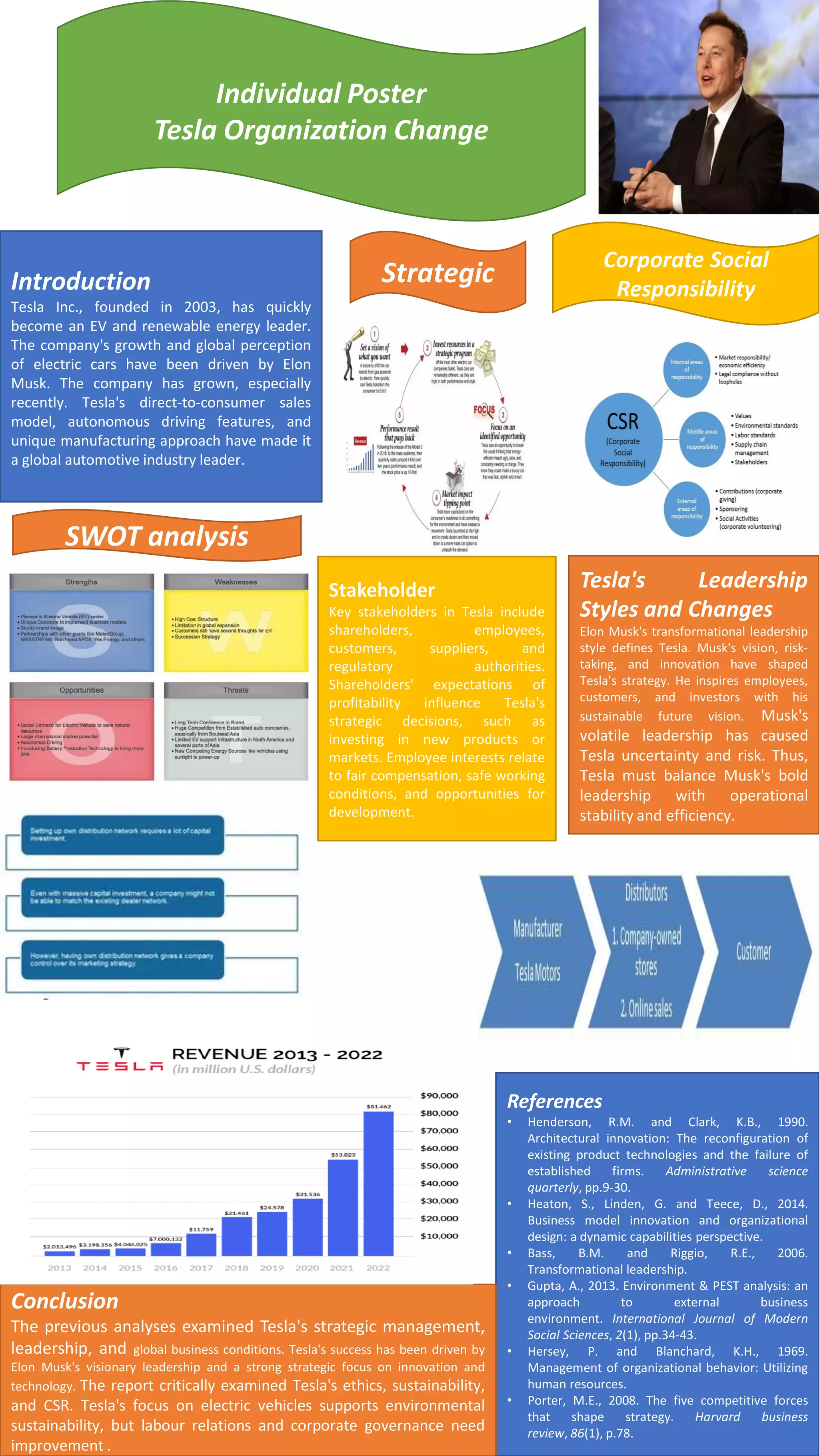
    Individual Poster Tesla OrganizationChange Introduction Tesla Inc., founded in 2003, has quickly become an EV and renewable energy leader. The company's growth and global perception of electric cars have been driven by Elon Musk. The company has grown, especially recently. Tesla's direct-to-consumer sales model, autonomous driving features, and unique manufacturing approach have made it a global automotive industry leader. SWOT analysis Corporate Social Responsibility Strategic Tesla's Leadership Styles and Changes Elon Musk's transformational leadership style defines Tesla. Musk's vision, risk- taking, and innovation have shaped Tesla's strategy. He inspires employees, customers, and investors with his sustainable future vision. Musk's volatile leadership has caused Tesla uncertainty and risk. Thus, Tesla must balance Musk's bold leadership with operational stability and efficiency. References • Henderson, R.M. and Clark, K.B., 1990. Architectural innovation: The reconfiguration of existing product technologies and the failure of established firms. Administrative science quarterly, pp.9-30. • Heaton, S., Linden, G. and Teece, D., 2014. Business model innovation and organizational design: a dynamic capabilities perspective. • Bass, B.M. and Riggio, R.E., 2006. Transformational leadership. • Gupta, A., 2013. Environment & PEST analysis: an approach to external business environment. International Journal of Modern Social Sciences, 2(1), pp.34-43. • Hersey, P. and Blanchard, K.H., 1969. Management of organizational behavior: Utilizing human resources. • Porter, M.E., 2008. The five competitive forces that shape strategy. Harvard business review, 86(1), p.78. Conclusion The previous analyses examined Tesla's strategic management, leadership, and global business conditions. Tesla's success has been driven by Elon Musk's visionary leadership and a strong strategic focus on innovation and technology. The report critically examined Tesla's ethics, sustainability, and CSR. Tesla's focus on electric vehicles supports environmental sustainability, but labour relations and corporate governance need improvement . Stakeholder Key stakeholders in Tesla include shareholders, employees, customers, suppliers, and regulatory authorities. Shareholders' expectations of profitability influence Tesla's strategic decisions, such as investing in new products or markets. Employee interests relate to fair compensation, safe working conditions, and opportunities for development.