This video will walk you through the benefits of
this framework. Paid members, please log in for
a better viewing experience.
Watch explainer
You Exec provides business resources that move your career
forward. Access our full library of presentations,
spreadsheet models, and business book summaries. We do
the work, you take the credit.
Errors & Omissions Liability (E&O): You Exec makes no
guarantee that the statements, analysis, projections,
estimates, graphs, reports, numbers, and any derivatives
sourced from this presentation are free of errors and
omissions. You Exec assumes no liability for erroneous
outcomes derived from this presentation.
For a commercial or group license, please visit Unlimited
and schedule a demo.
Stop Low Business Value
Project
Reduce Apps
Maintenance
Manage Apps Portfolio Reduce Service Level
MANAGE DEMAND
SHIFT TO VARIABLE
COST
Financial Engineering
Manage Apps Spec.
(Mandatory, Useful, Nice
to have)
Manage Technology
Portfolio
Lean IT
REDUCE LABOR COST
REDUCE TECHNOLOGY
COST
Grouped Maintenance Reduce Project Length
Retire non-use
Code/Module in Apps
Adopt Layered Model
CHANGE IT
OPERATING MODEL
IMPROVE IT BUSINESS
PRACTICES
Fiscal Optimization
Improve IT Financial
Knowledge
Increase Span of Control
in IT Org.
IT COST
CONTAINMENT
DEMAND
SUPPLY
CONTROL
OPPORTUNITY
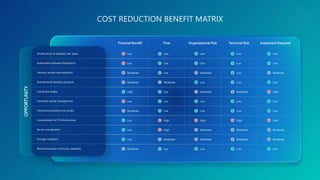
Stratification of desktop user types
Automated software distribution
Desktop printer rationalization
Standardized desktop products
Cell phone audits
Centralize portal management
Telecommunications line audits
Consolidation of IT infrastructure
Server virtualization
Storage migration
Reduce business continuity capability
Low
Moderate
Moderate
High
Low
Moderate
Low
Low
Low
Moderate
Low
Low
Moderate
Low
Low
Low
High
High
Moderate
Low
Low
Moderate
Low
Moderate
Low
Low
High
Moderate
Moderate
Low
Low
Low
Low
Moderate
Low
Low
High
Moderate
Moderate
Low
Low
Moderate
Low
High
Low
Low
High
Moderate
Moderate
Low
Time
Financial Benefit Organizational Risk Technical Risk Investment Required
Low Low Low Low Low
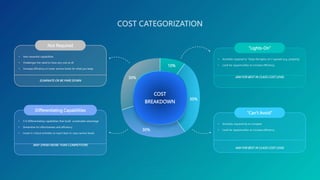
10%
30%
30%
30%
COST
BREAKDOWN
• Activities required to “Keep the lights on”/ operate (e.g. property)
• Look for opportunities to increase efficiency.
AIM FOR BEST IN CLASS COST LEVEL
• Activities required by to compete
• Look for opportunities to increase efficiency.
AIM FOR BEST IN CLASS COST LEVEL
• Non-essential capabilities
• Challenges the need to have any cost at all
• Increase efficiency or lower service levels for what you keep
ELIMINATE OR BE PARE DOWN
• 3-6 Differentiating capabilities that build sustainable advantage
• Streamline for effectiveness and efficiency
• Invest in critical activities to reach best-in-class service levels
MAY SPEND MORE THAN COMPETITORS
“Lights-On”
“Can’t Avoid”
Not Required
Differentiating Capabilities
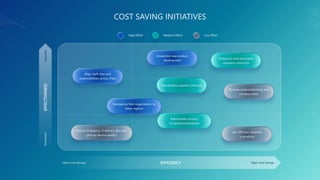
EFFECTIVENESS
Improved
Diminished
EFFICIENCY Major Cost Savings
Minor Cost Savings
Streamline new product
development
Align staff roles and
responsibilities across chain
Reorganize field organization to
fewer regions
Standardize supplier contracts
Outsource selected quality
assurance functions
Reformulate product
components/hardware
Remove underperforming and
complex items
Use 30% less materials
in products
Reduce frequency of delivery (But also
give up service quality)
High Effort Medium Effort Low Effort
Initiative A Initiative B Initiative C
EFFECTIVENESS BUILDS TOP OF THE CURVE EFFECTIVENESS DECLINE
Clear Wins
Initiatives that should be pursued under any
scenario, as they improve both effectiveness
and efficiency
Example:
Create online self-service portals that
eliminate the need for call centers
Worth the Trade-off
Initiatives that should likely be pursued,
given an acceptable trade-off of
effectiveness for efficiency gains
Example:
Streamline marginally effective training
and events
Last Resort
Initiatives that may be pursued, given
strategic business objectives, but they come
at the expense of effectiveness
Example:
Reduce product or service quality
INCREASED
EFFECTIVENESS
INCREASED EFFICIENCY (Operating Expense Saving)
B
A
C
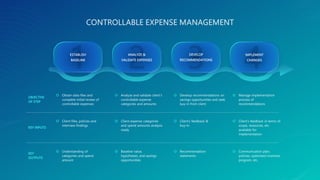
 Obtain data files and
complete initial review of
controllable expenses
 Analyze and validate client’s
controllable expense
categories and amounts
 Develop recommendations on
savings opportunities and seek
buy-in from client
 Manage implementation
process of
recommendations
 Client files, policies and
interview findings
 Client expense categories
and spend amounts analysis
ready
 Client’s feedback &
buy-in
 Client’s feedback in terms of
scope, resources, etc.
available for
implementation
 Understanding of
categories and spend
amount
 Baseline value,
hypotheses, and savings
opportunities
 Recommendation
statements
 Communication plan,
policies, optimized incentive
program, etc.
OBJECTIVE
OF STEP
KEY INPUTS
KEY
OUTPUTS
ESTABLISH
BASELINE
ANALYZE &
VALIDATE EXPENSES
DEVELOP
RECOMMENDATIONS
IMPLEMENT
CHANGES
Controllable Expense Categories Low
($ millions)
High
($ millions)
Transportation 2.0 3.0
Facilities 1.0 2.0
Outsourcing services 1.0 3.0
Travel 0.5 1.5
Entertainment 0.5 1.5
Fringe benefits 0.5 1.5
Training 0.5 1.5
Total 6.0 14.0
Get the full version of this framework
and access our library of hundreds of
other business resources.
Join You Exec Plus today and take your career to
new heights. Receive premium business resources in
your inbox every week.
Start today
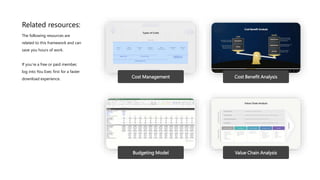
Related resources:
Cost Management Cost Benefit Analysis
Budgeting Model Value Chain Analysis
The following resources are
related to this framework and can
save you hours of work.
If you’re a free or paid member,
log into You Exec first for a faster
download experience.

cost.pptx

  • 1.
    This video willwalk you through the benefits of this framework. Paid members, please log in for a better viewing experience. Watch explainer You Exec provides business resources that move your career forward. Access our full library of presentations, spreadsheet models, and business book summaries. We do the work, you take the credit. Errors & Omissions Liability (E&O): You Exec makes no guarantee that the statements, analysis, projections, estimates, graphs, reports, numbers, and any derivatives sourced from this presentation are free of errors and omissions. You Exec assumes no liability for erroneous outcomes derived from this presentation. For a commercial or group license, please visit Unlimited and schedule a demo.
  • 2.
    Stop Low BusinessValue Project Reduce Apps Maintenance Manage Apps Portfolio Reduce Service Level MANAGE DEMAND SHIFT TO VARIABLE COST Financial Engineering Manage Apps Spec. (Mandatory, Useful, Nice to have) Manage Technology Portfolio Lean IT REDUCE LABOR COST REDUCE TECHNOLOGY COST Grouped Maintenance Reduce Project Length Retire non-use Code/Module in Apps Adopt Layered Model CHANGE IT OPERATING MODEL IMPROVE IT BUSINESS PRACTICES Fiscal Optimization Improve IT Financial Knowledge Increase Span of Control in IT Org. IT COST CONTAINMENT DEMAND SUPPLY CONTROL
  • 3.
    OPPORTUNITY Stratification of desktopuser types Automated software distribution Desktop printer rationalization Standardized desktop products Cell phone audits Centralize portal management Telecommunications line audits Consolidation of IT infrastructure Server virtualization Storage migration Reduce business continuity capability Low Moderate Moderate High Low Moderate Low Low Low Moderate Low Low Moderate Low Low Low High High Moderate Low Low Moderate Low Moderate Low Low High Moderate Moderate Low Low Low Low Moderate Low Low High Moderate Moderate Low Low Moderate Low High Low Low High Moderate Moderate Low Time Financial Benefit Organizational Risk Technical Risk Investment Required Low Low Low Low Low
  • 4.
    10% 30% 30% 30% COST BREAKDOWN • Activities requiredto “Keep the lights on”/ operate (e.g. property) • Look for opportunities to increase efficiency. AIM FOR BEST IN CLASS COST LEVEL • Activities required by to compete • Look for opportunities to increase efficiency. AIM FOR BEST IN CLASS COST LEVEL • Non-essential capabilities • Challenges the need to have any cost at all • Increase efficiency or lower service levels for what you keep ELIMINATE OR BE PARE DOWN • 3-6 Differentiating capabilities that build sustainable advantage • Streamline for effectiveness and efficiency • Invest in critical activities to reach best-in-class service levels MAY SPEND MORE THAN COMPETITORS “Lights-On” “Can’t Avoid” Not Required Differentiating Capabilities
  • 5.
    EFFECTIVENESS Improved Diminished EFFICIENCY Major CostSavings Minor Cost Savings Streamline new product development Align staff roles and responsibilities across chain Reorganize field organization to fewer regions Standardize supplier contracts Outsource selected quality assurance functions Reformulate product components/hardware Remove underperforming and complex items Use 30% less materials in products Reduce frequency of delivery (But also give up service quality) High Effort Medium Effort Low Effort
  • 6.
    Initiative A InitiativeB Initiative C EFFECTIVENESS BUILDS TOP OF THE CURVE EFFECTIVENESS DECLINE Clear Wins Initiatives that should be pursued under any scenario, as they improve both effectiveness and efficiency Example: Create online self-service portals that eliminate the need for call centers Worth the Trade-off Initiatives that should likely be pursued, given an acceptable trade-off of effectiveness for efficiency gains Example: Streamline marginally effective training and events Last Resort Initiatives that may be pursued, given strategic business objectives, but they come at the expense of effectiveness Example: Reduce product or service quality INCREASED EFFECTIVENESS INCREASED EFFICIENCY (Operating Expense Saving) B A C
  • 7.
     Obtain datafiles and complete initial review of controllable expenses  Analyze and validate client’s controllable expense categories and amounts  Develop recommendations on savings opportunities and seek buy-in from client  Manage implementation process of recommendations  Client files, policies and interview findings  Client expense categories and spend amounts analysis ready  Client’s feedback & buy-in  Client’s feedback in terms of scope, resources, etc. available for implementation  Understanding of categories and spend amount  Baseline value, hypotheses, and savings opportunities  Recommendation statements  Communication plan, policies, optimized incentive program, etc. OBJECTIVE OF STEP KEY INPUTS KEY OUTPUTS ESTABLISH BASELINE ANALYZE & VALIDATE EXPENSES DEVELOP RECOMMENDATIONS IMPLEMENT CHANGES
  • 8.
    Controllable Expense CategoriesLow ($ millions) High ($ millions) Transportation 2.0 3.0 Facilities 1.0 2.0 Outsourcing services 1.0 3.0 Travel 0.5 1.5 Entertainment 0.5 1.5 Fringe benefits 0.5 1.5 Training 0.5 1.5 Total 6.0 14.0
  • 9.
    Get the fullversion of this framework and access our library of hundreds of other business resources. Join You Exec Plus today and take your career to new heights. Receive premium business resources in your inbox every week. Start today
  • 10.
    Related resources: Cost ManagementCost Benefit Analysis Budgeting Model Value Chain Analysis The following resources are related to this framework and can save you hours of work. If you’re a free or paid member, log into You Exec first for a faster download experience.