Have you ever wondered how architects and engineers use
circles?
How important are circles in the field of transportation,
industries, sports, navigation, carpentry, and in your daily
life?
The Provincial Disaster and Risk Reduction Management Committee (PDRRMC)
advised the residents living within the 14-km radius critical area to evacuate due to
eminent eruption of a volcano. If the map is drawn on a coordinate plane, the
coordinates corresponding to the location of the volcano is (4, 5).
CIRCLES
A circle is the set of all points in a plane
that are equidistant from a given point
in the plane known as the center of the
circle.
A radius (plural, radii) is a segment from the
center of the circle to a point on the circle.
A chord is a segment whose endpoints lie on a
circle.
A diameter is a chord that contains the center
of the circle.
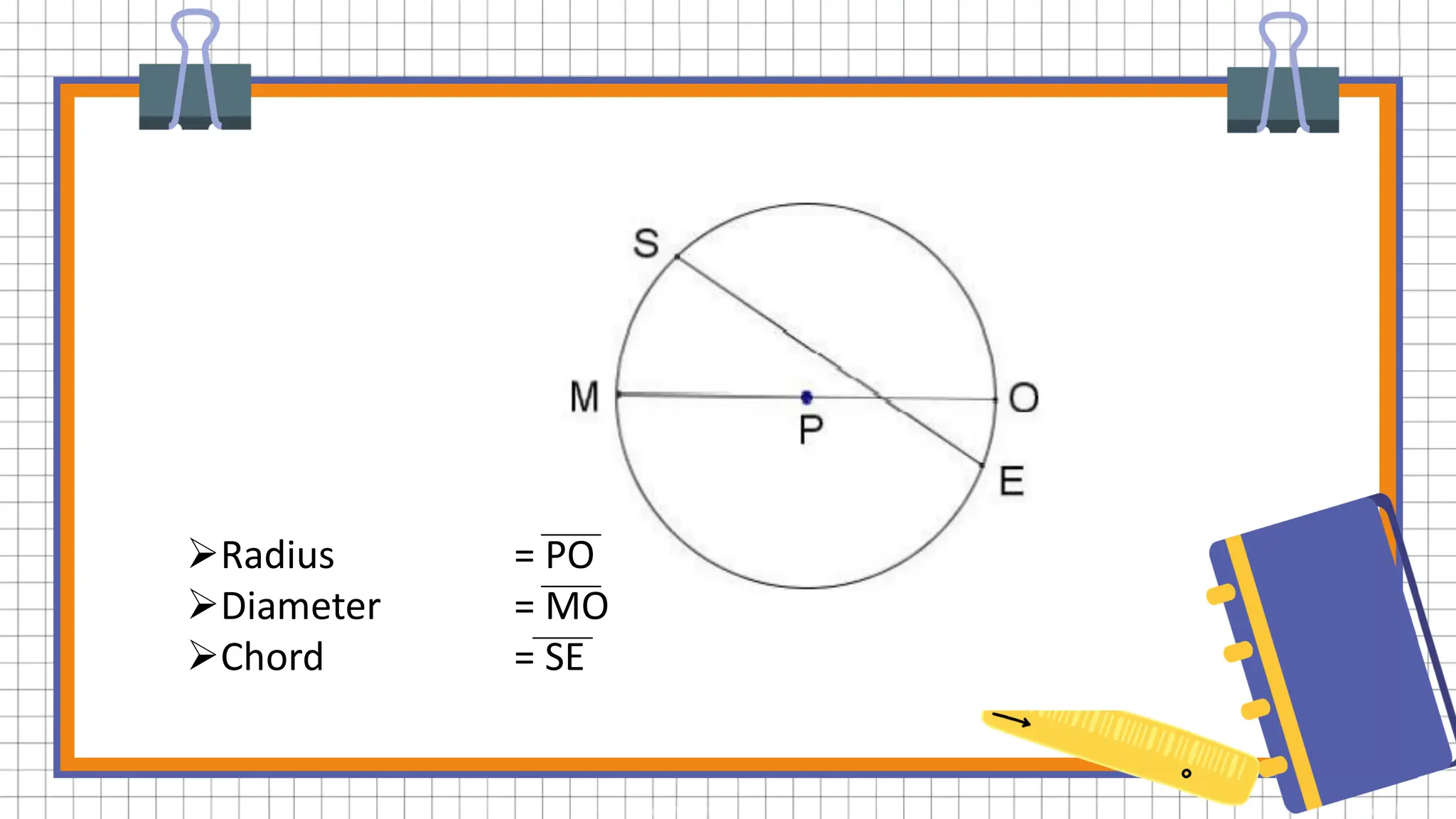
Radius = PO
Diameter = MO
Chord = SE
An arc is an unbroken part of a circle.
Any two distinct points on a circle divide
the circle into two arcs. The points are
called the endpoints of the circle.
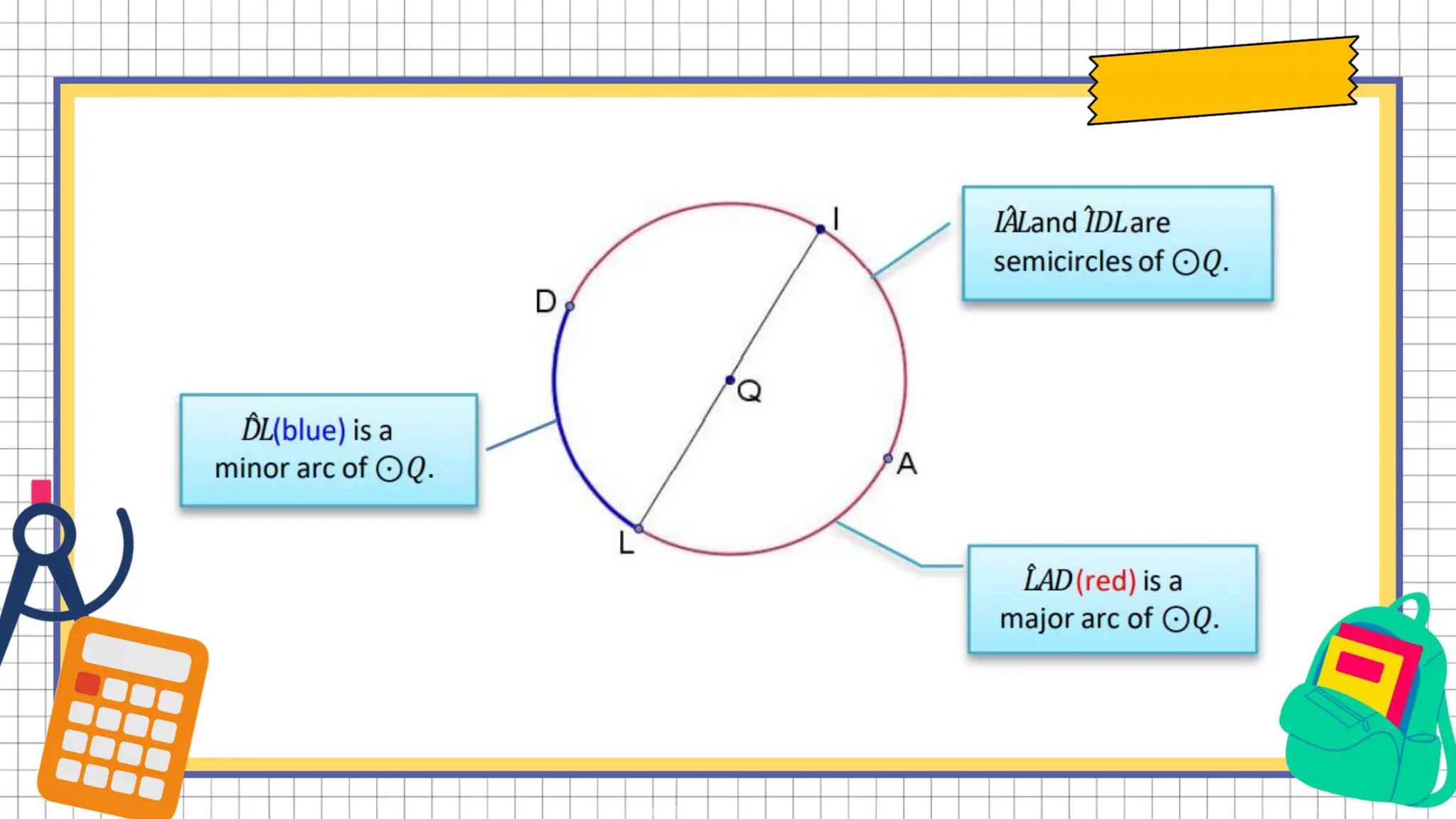
Arcs
 A semicircle is an arc whose endpoints are endpoints of a
diameter. A semicircle is informally called a half-circle. A
semicircle is named by its endpoints and another point that lies
on the arc.
 A minor arc of a circle is an arc that is shorter than a semicircle
of that circle.
 A major arc is named by its endpoints. A major arc of a circle is
an arc that is longer than a semicircle of that circle. A major arc
is named by its endpoints and another point that lies on the
arc.
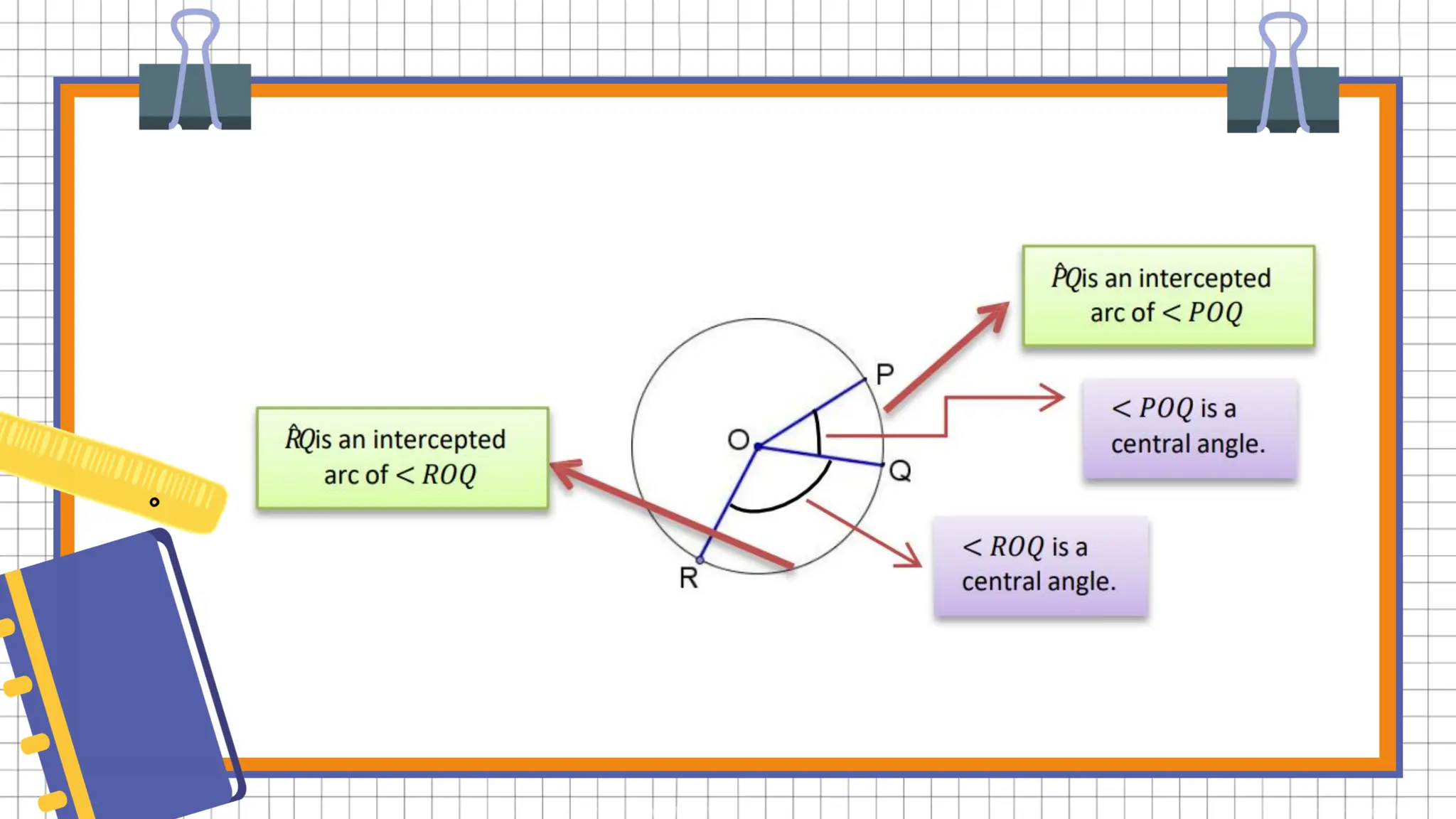
Central Angle
A central angle is an angle in the plane of a
circle whose vertex is the center of the circle.
An arc whose endpoints lie on the sides of the
angle and whose other points lie in the interior
of the angle is the intercepted arc of the
central angle.
Learning Target:
I can derive inductively the relations among center,
radius, chord, and diameter of a circle.
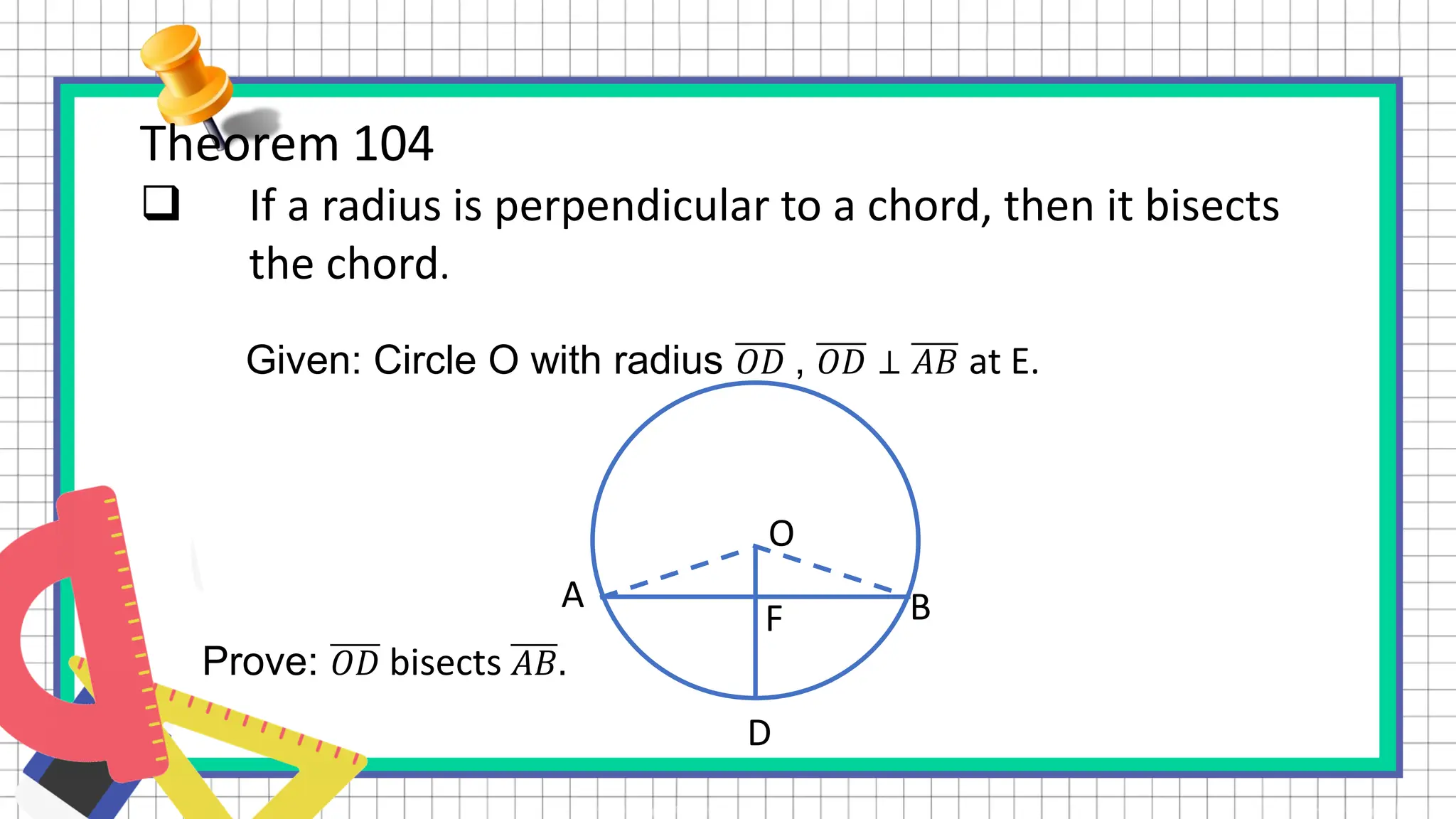
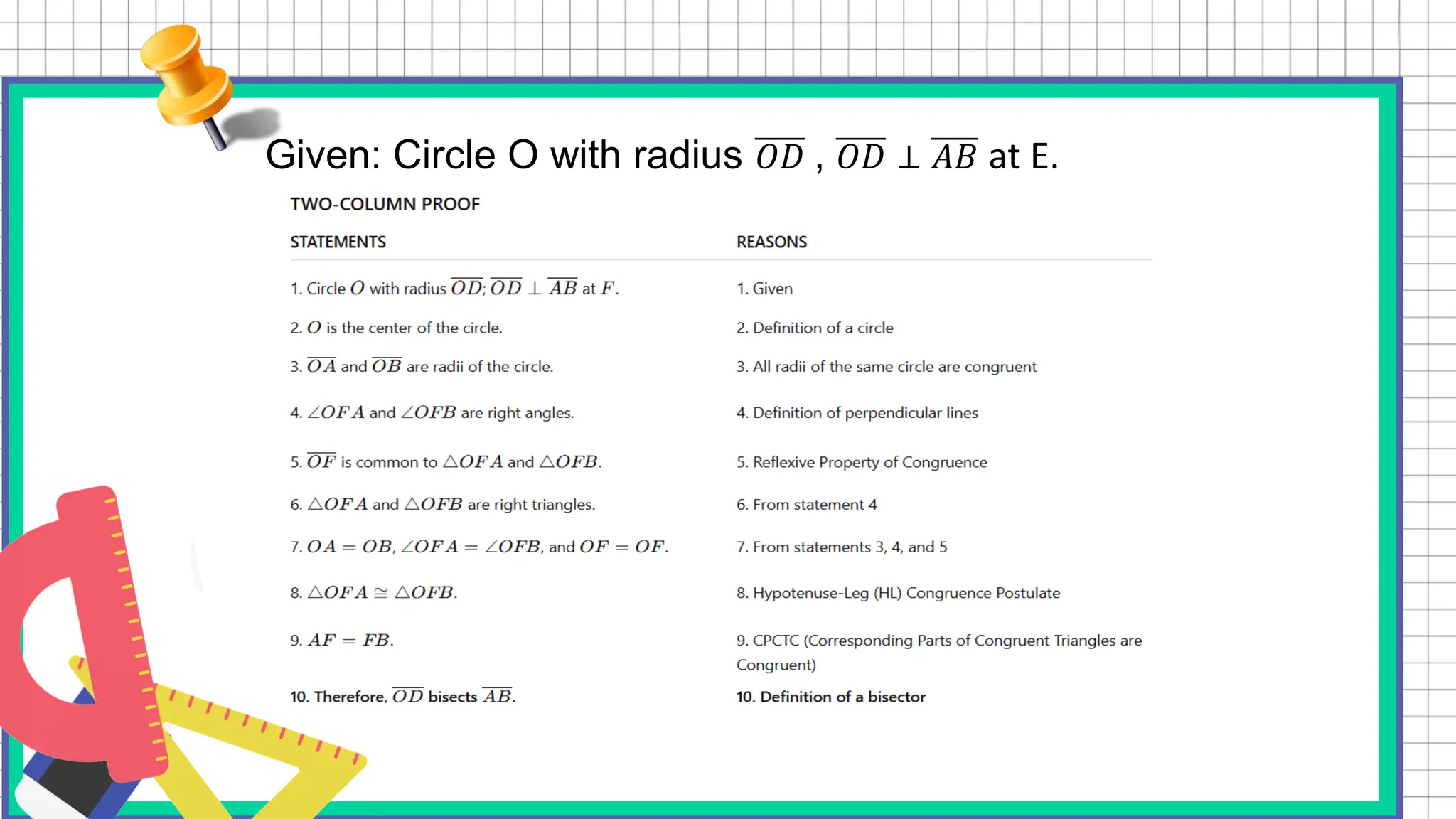
Theorem 104
 If a radius is perpendicular to a chord, then it bisects
the chord.
Given: Circle O with radius 𝑂𝐷 , 𝑂𝐷 ⊥ 𝐴𝐵 at E.
Prove: 𝑂𝐷 bisects 𝐴𝐵.
O
A
F B
D
Given: Circle O with radius 𝑂𝐷 , 𝑂𝐷 ⊥ 𝐴𝐵 at E.
Theorem 105
 If the radius of a circle bisects a chord that is not a
diameter, then it is perpendicular to the chord.
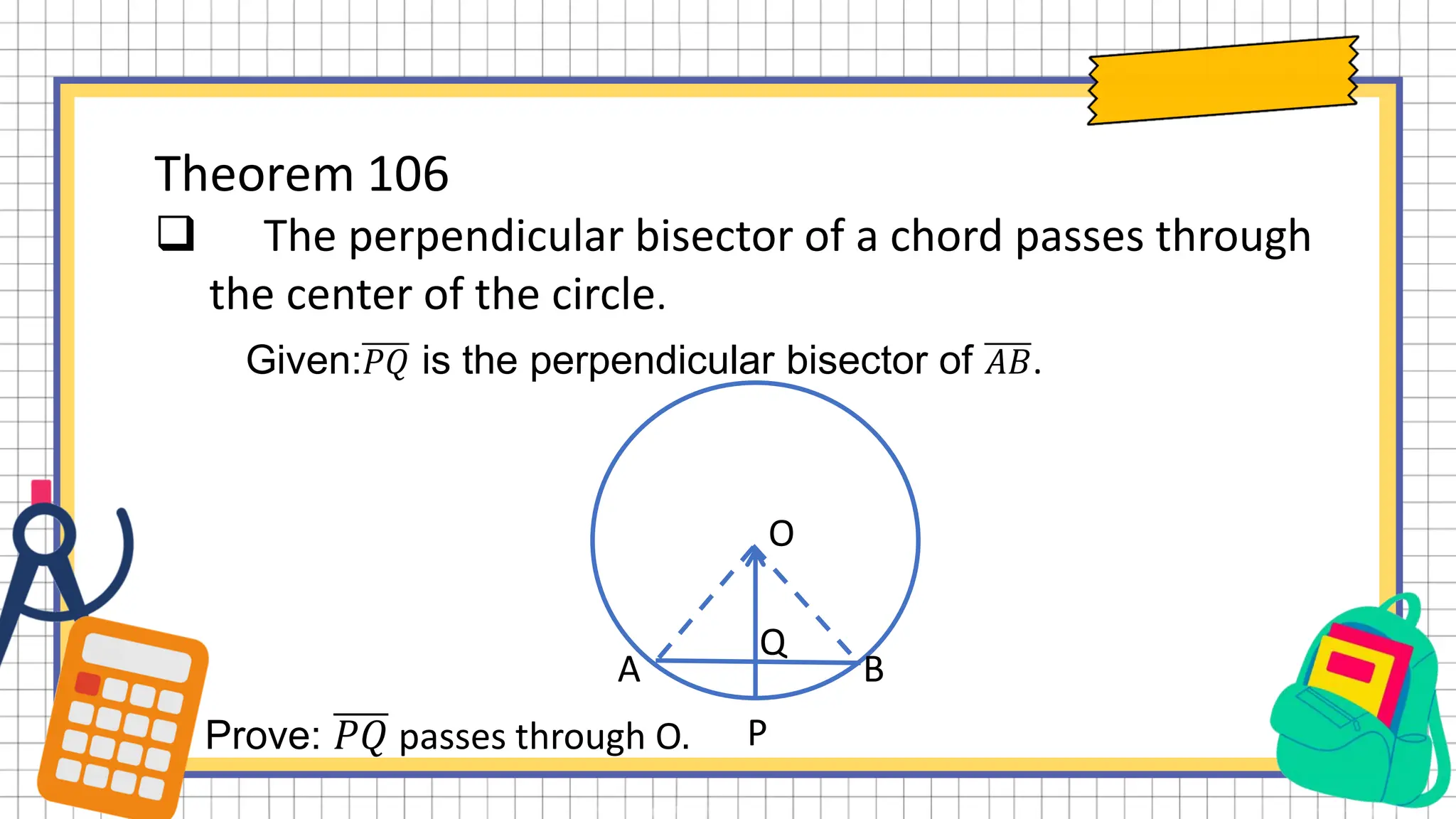
Theorem 106
 The perpendicular bisector of a chord passes through
the center of the circle.
Given:𝑃𝑄 is the perpendicular bisector of 𝐴𝐵.
O
A
Q
B
P
Prove: 𝑃𝑄 passes through O.
O
A
Q
B
P
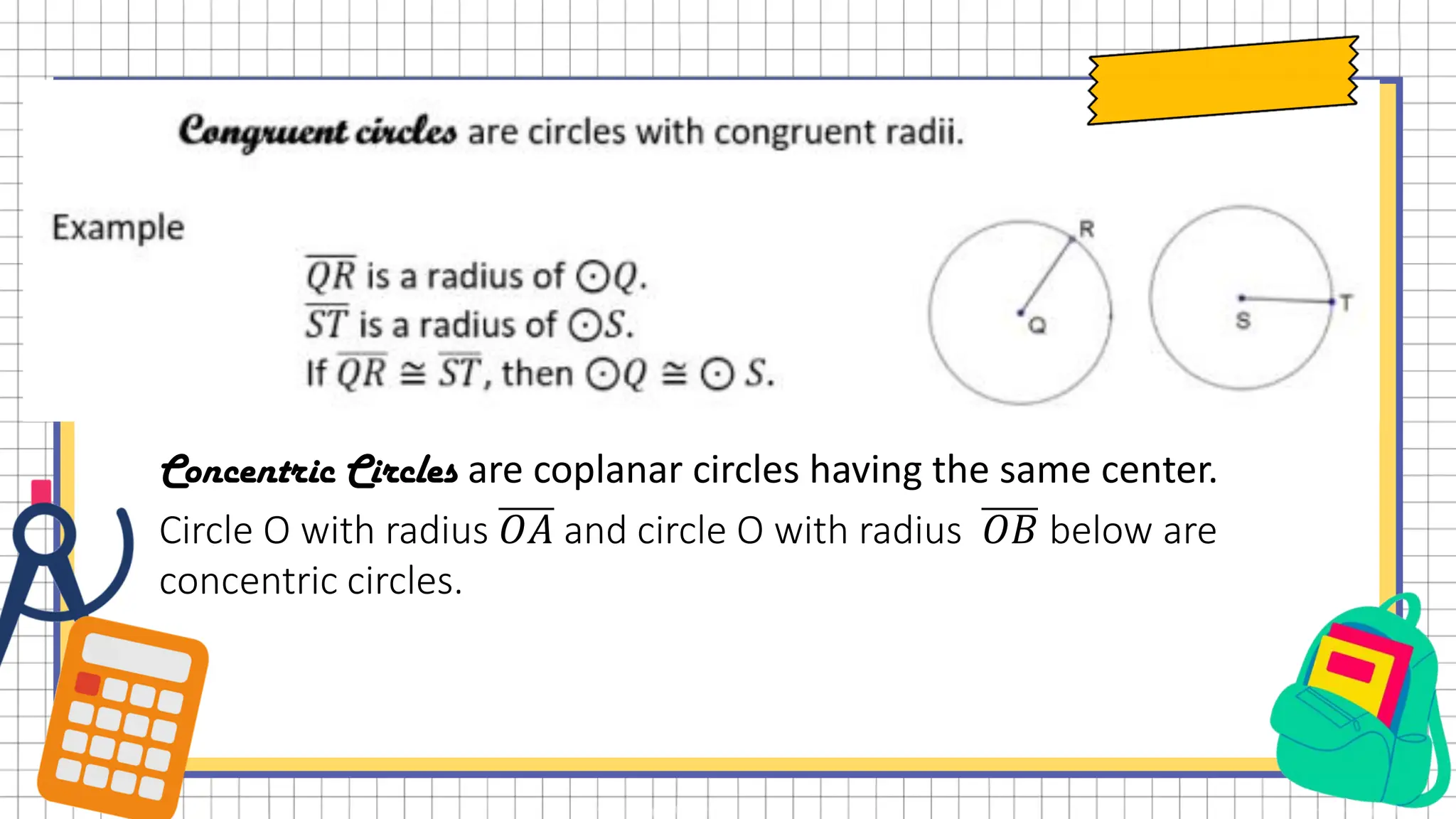
Concentric Circles are coplanar circles having the same center.
Circle O with radius 𝑂𝐴 and circle O with radius 𝑂𝐵 below are
concentric circles.
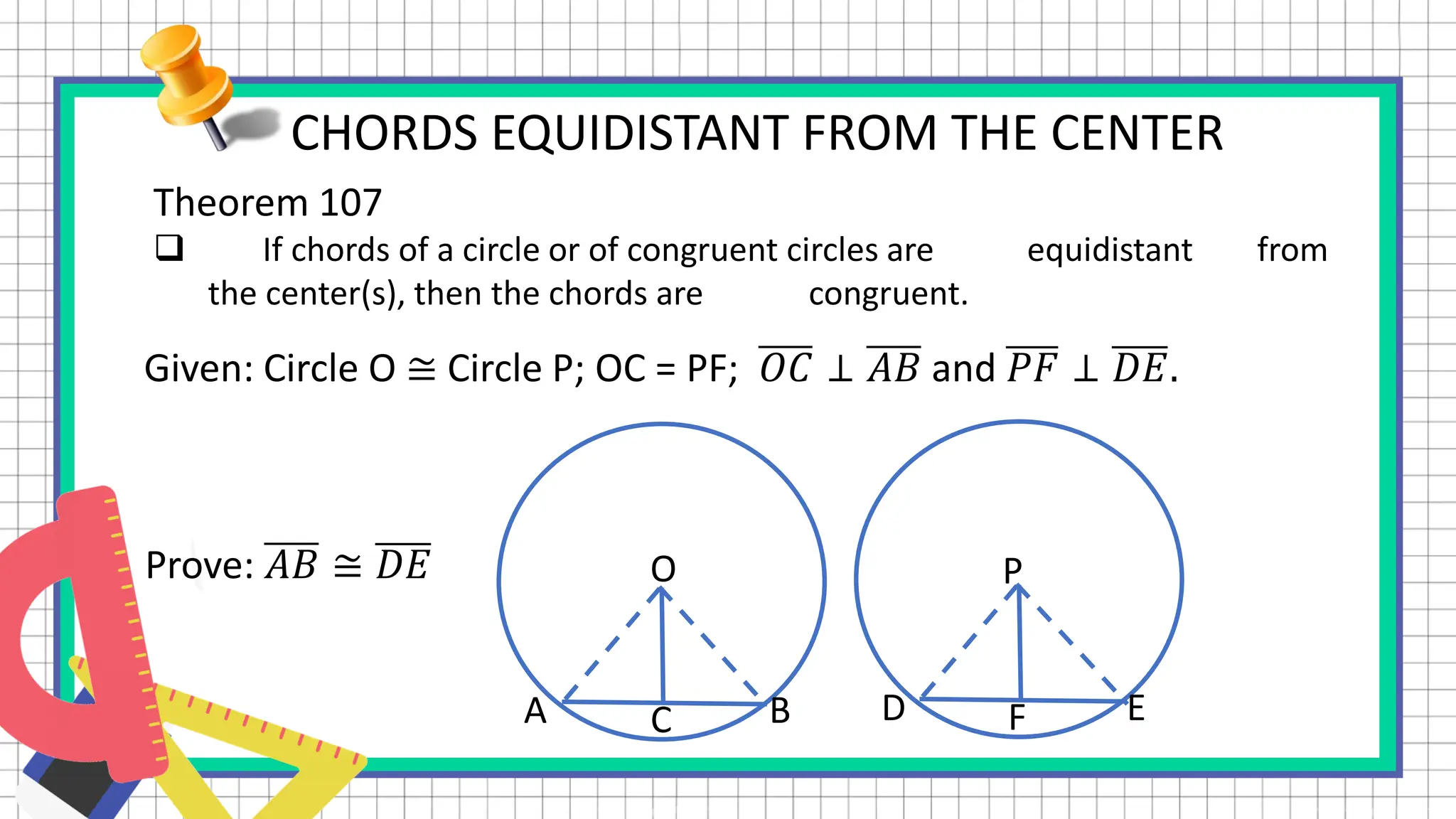
Theorem 107
 If chords of a circle or of congruent circles are equidistant from
the center(s), then the chords are congruent.
CHORDS EQUIDISTANT FROM THE CENTER
O
A C B
P
D F E
Given: Circle O ≅ Circle P; OC = PF; 𝑂𝐶 ⊥ 𝐴𝐵 and 𝑃𝐹 ⊥ 𝐷𝐸.
Prove: 𝐴𝐵 ≅ 𝐷𝐸
Theorem 108
 If chords of a circle or of congruent circles are
congruent, then they are equidistant from the centers
of the circles.
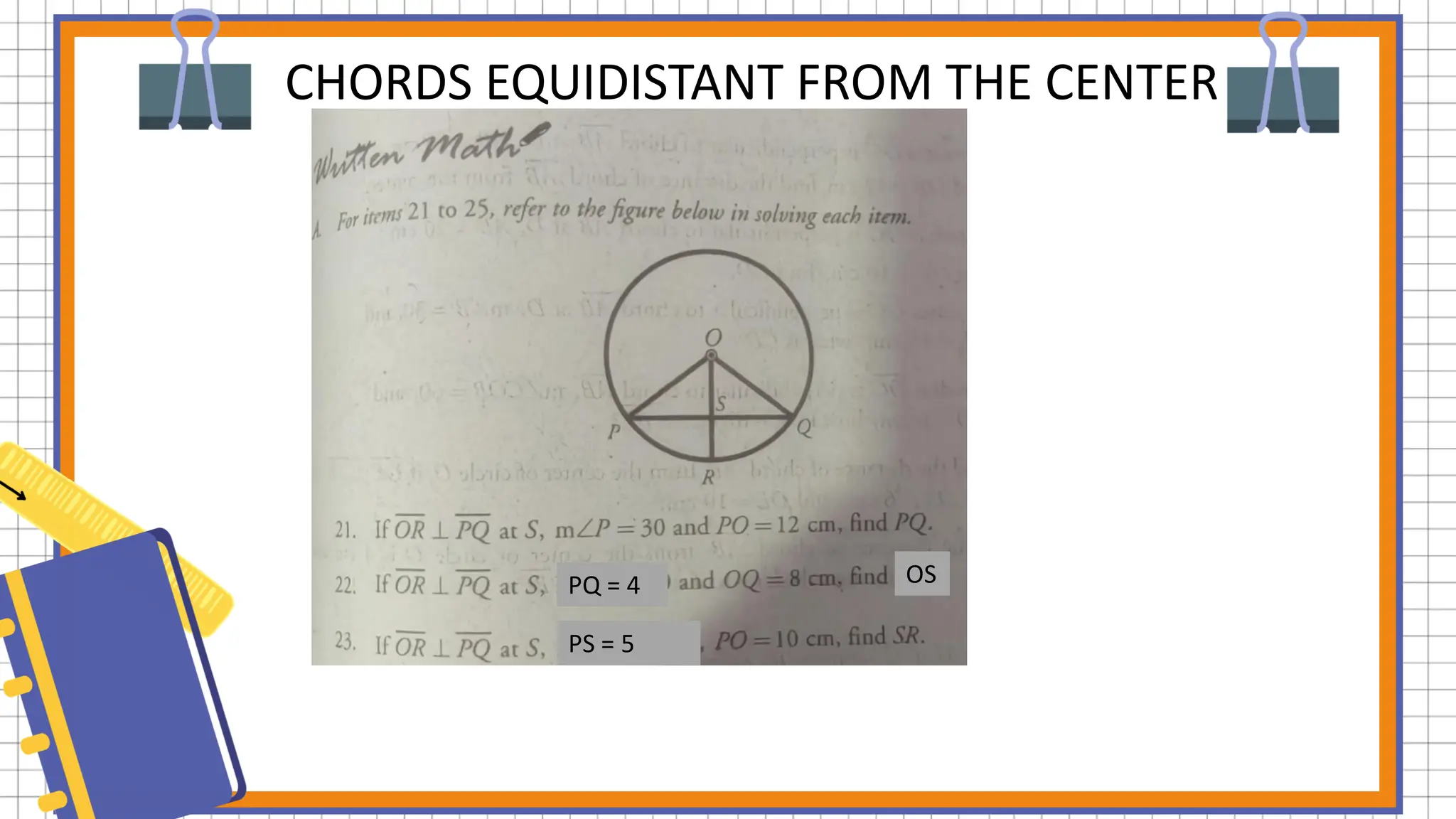
CHORDS EQUIDISTANT FROM THE CENTER
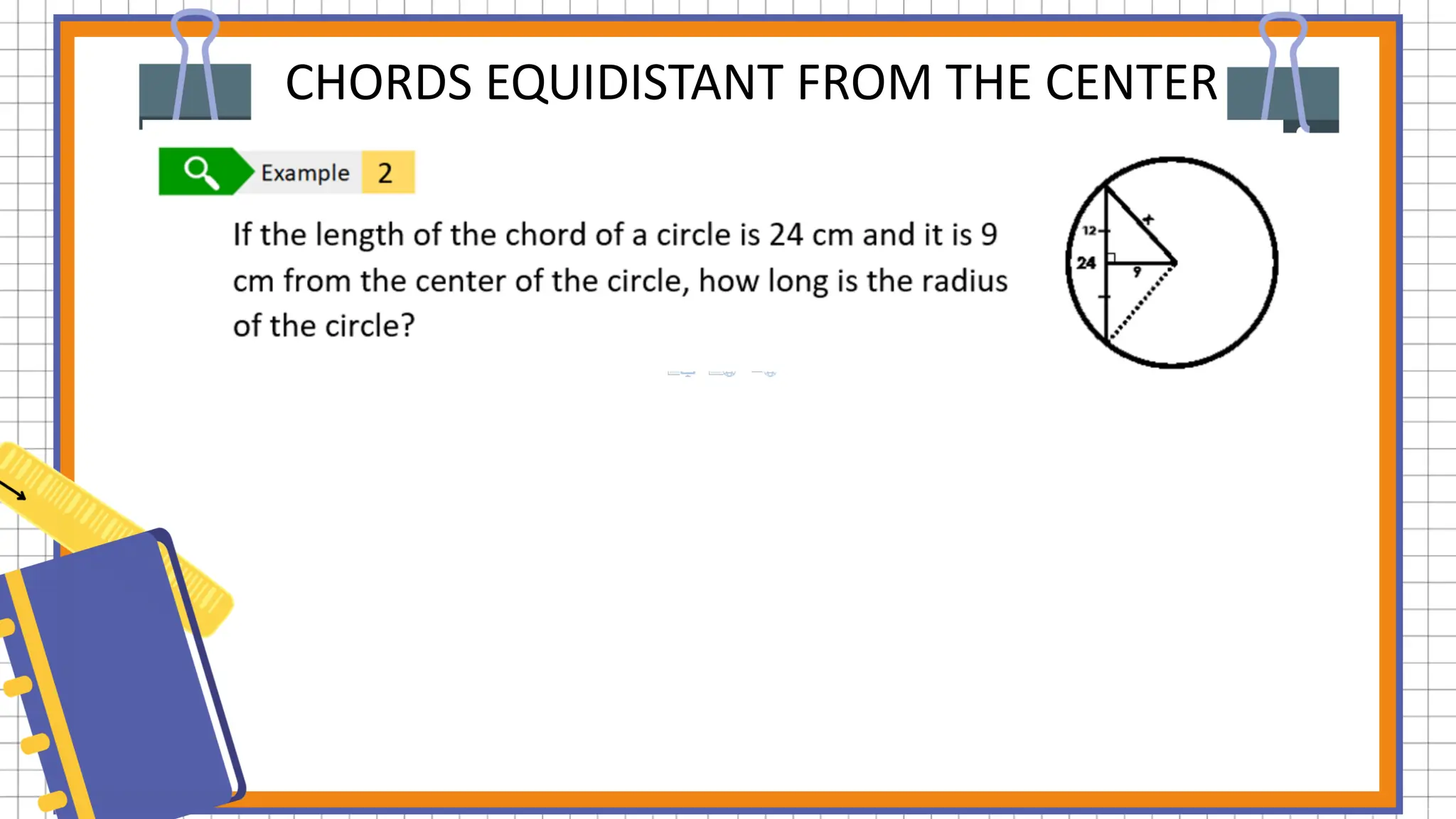
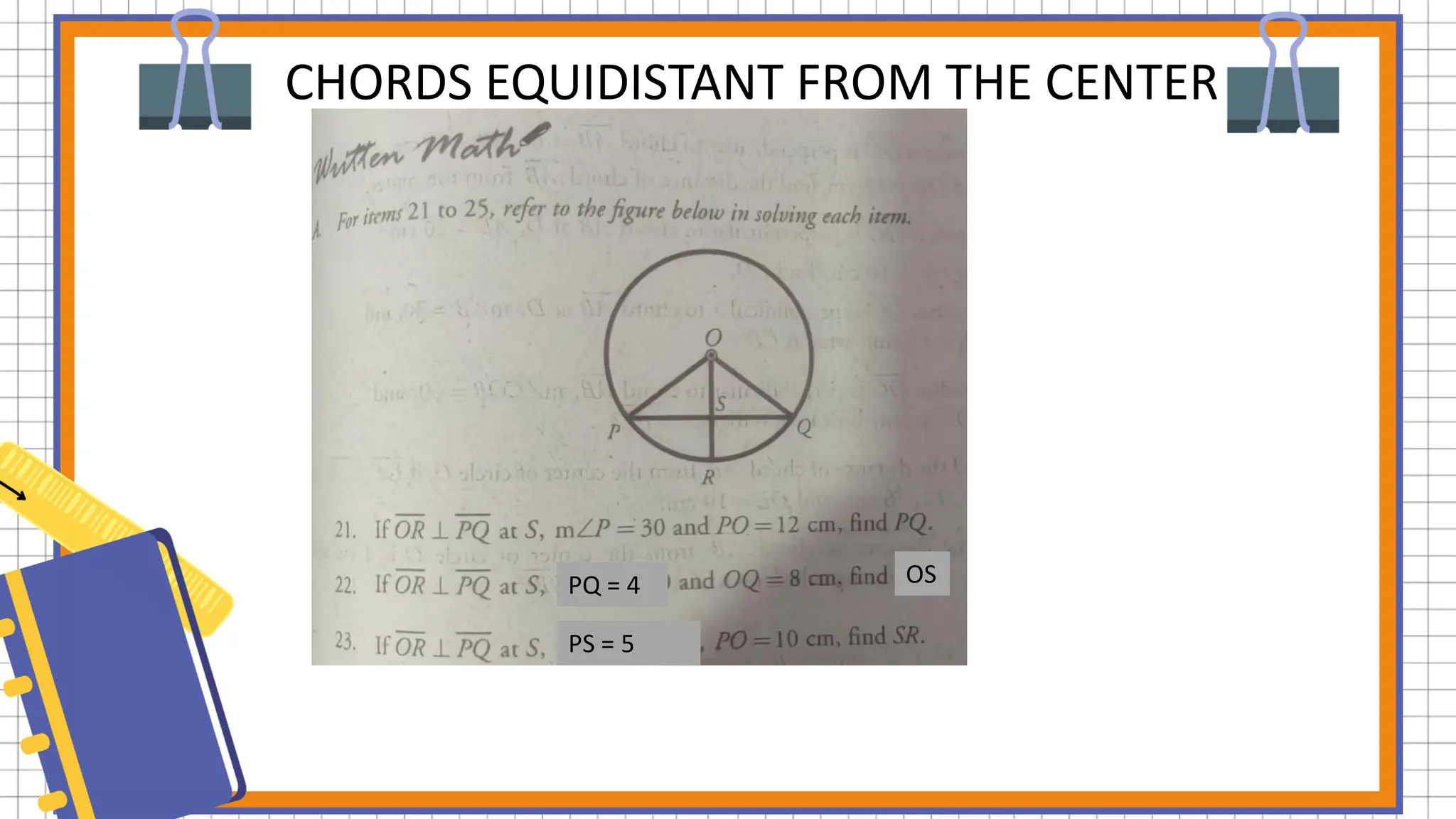
PQ = 4 OS
PS = 5
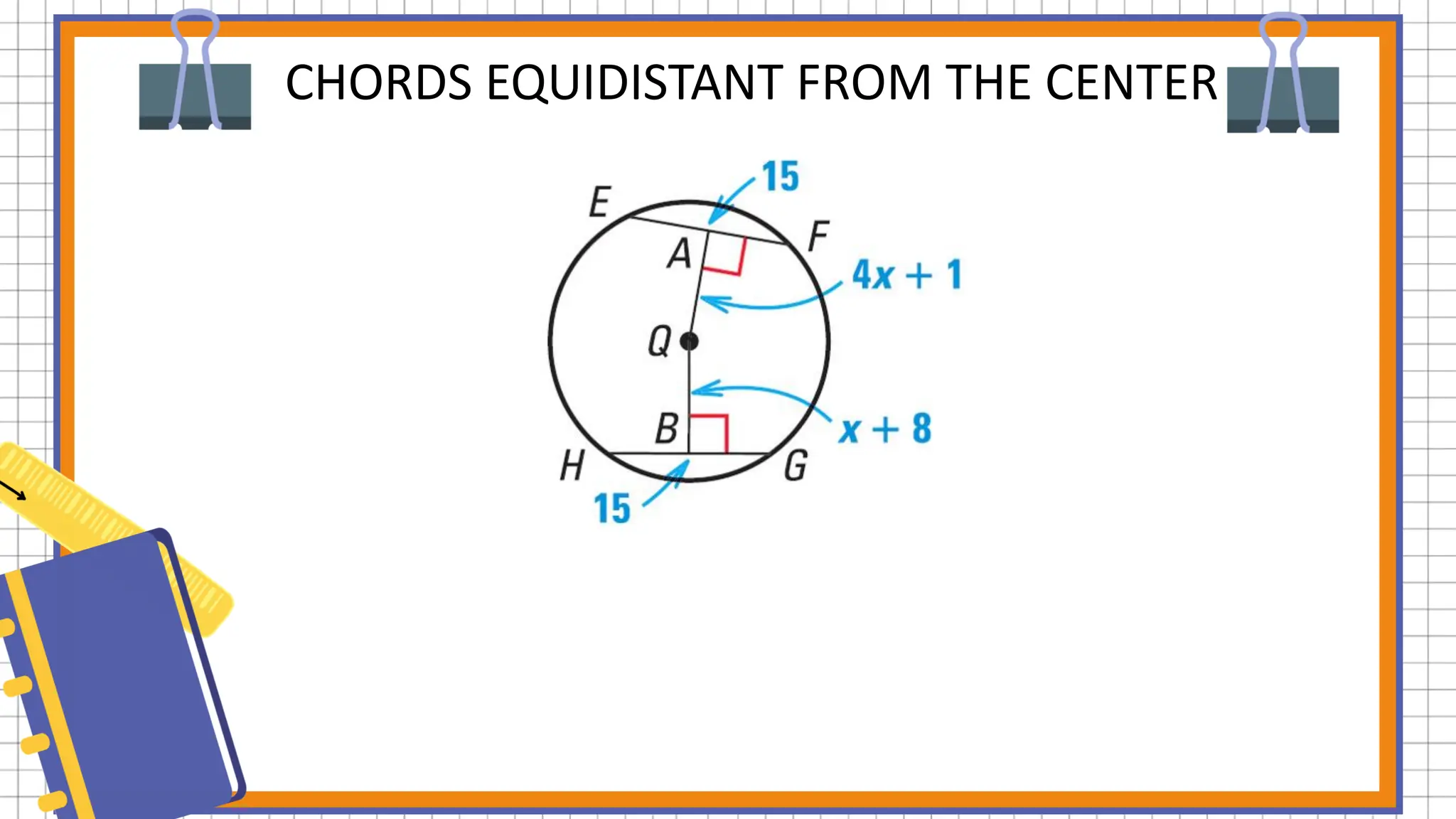
CHORDS EQUIDISTANT FROM THE CENTER
PQ = 4 OS
PS = 5
CHORDS EQUIDISTANT FROM THE CENTER
PQ = 4 OS
PS = 5
Theorem 106
 The perpendicular bisector of a chord passes through
the center of the circle.

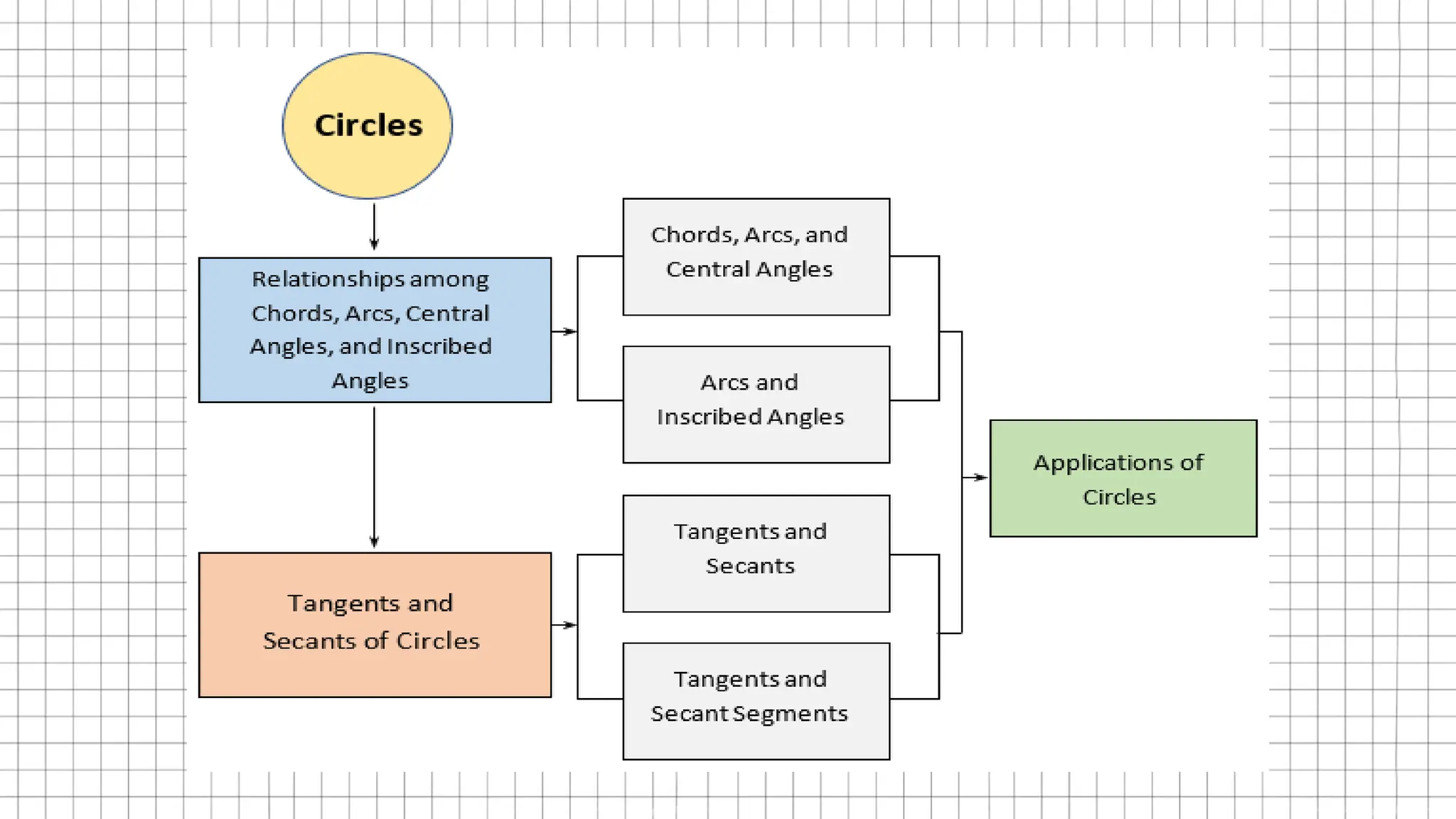
Terms and theorems related to CIRCLES theorem 104-108

  • 2.
    Have you everwondered how architects and engineers use circles? How important are circles in the field of transportation, industries, sports, navigation, carpentry, and in your daily life?
  • 3.
    The Provincial Disasterand Risk Reduction Management Committee (PDRRMC) advised the residents living within the 14-km radius critical area to evacuate due to eminent eruption of a volcano. If the map is drawn on a coordinate plane, the coordinates corresponding to the location of the volcano is (4, 5).
  • 4.
    CIRCLES A circle isthe set of all points in a plane that are equidistant from a given point in the plane known as the center of the circle.
  • 5.
    A radius (plural,radii) is a segment from the center of the circle to a point on the circle. A chord is a segment whose endpoints lie on a circle. A diameter is a chord that contains the center of the circle.
  • 6.
    Radius = PO Diameter= MO Chord = SE
  • 7.
    An arc isan unbroken part of a circle. Any two distinct points on a circle divide the circle into two arcs. The points are called the endpoints of the circle.
  • 9.
    Arcs  A semicircleis an arc whose endpoints are endpoints of a diameter. A semicircle is informally called a half-circle. A semicircle is named by its endpoints and another point that lies on the arc.  A minor arc of a circle is an arc that is shorter than a semicircle of that circle.  A major arc is named by its endpoints. A major arc of a circle is an arc that is longer than a semicircle of that circle. A major arc is named by its endpoints and another point that lies on the arc.
  • 10.
    Central Angle A centralangle is an angle in the plane of a circle whose vertex is the center of the circle. An arc whose endpoints lie on the sides of the angle and whose other points lie in the interior of the angle is the intercepted arc of the central angle.
  • 18.
    Learning Target: I canderive inductively the relations among center, radius, chord, and diameter of a circle.
  • 19.
    Theorem 104  Ifa radius is perpendicular to a chord, then it bisects the chord. Given: Circle O with radius 𝑂𝐷 , 𝑂𝐷 ⊥ 𝐴𝐵 at E. Prove: 𝑂𝐷 bisects 𝐴𝐵. O A F B D
  • 20.
    Given: Circle Owith radius 𝑂𝐷 , 𝑂𝐷 ⊥ 𝐴𝐵 at E.
  • 21.
    Theorem 105  Ifthe radius of a circle bisects a chord that is not a diameter, then it is perpendicular to the chord.
  • 22.
    Theorem 106  Theperpendicular bisector of a chord passes through the center of the circle. Given:𝑃𝑄 is the perpendicular bisector of 𝐴𝐵. O A Q B P Prove: 𝑃𝑄 passes through O.
  • 23.
  • 24.
    Concentric Circles arecoplanar circles having the same center. Circle O with radius 𝑂𝐴 and circle O with radius 𝑂𝐵 below are concentric circles.
  • 25.
    Theorem 107  Ifchords of a circle or of congruent circles are equidistant from the center(s), then the chords are congruent. CHORDS EQUIDISTANT FROM THE CENTER O A C B P D F E Given: Circle O ≅ Circle P; OC = PF; 𝑂𝐶 ⊥ 𝐴𝐵 and 𝑃𝐹 ⊥ 𝐷𝐸. Prove: 𝐴𝐵 ≅ 𝐷𝐸
  • 26.
    Theorem 108  Ifchords of a circle or of congruent circles are congruent, then they are equidistant from the centers of the circles. CHORDS EQUIDISTANT FROM THE CENTER
  • 27.
  • 28.
  • 29.
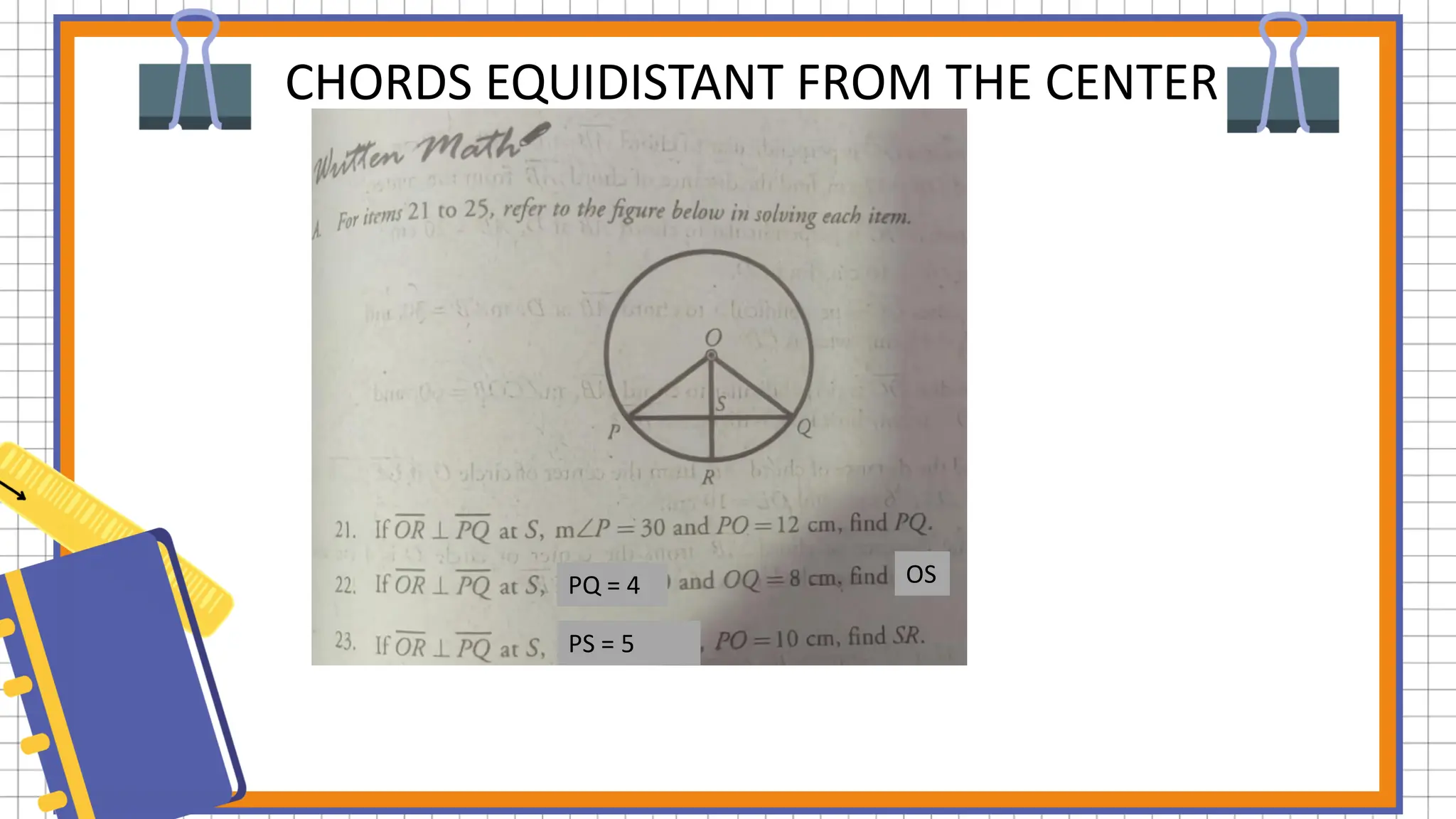
    CHORDS EQUIDISTANT FROMTHE CENTER PQ = 4 OS PS = 5
  • 30.
    CHORDS EQUIDISTANT FROMTHE CENTER PQ = 4 OS PS = 5
  • 31.
    CHORDS EQUIDISTANT FROMTHE CENTER PQ = 4 OS PS = 5
  • 32.
    Theorem 106  Theperpendicular bisector of a chord passes through the center of the circle.