TERM PAPER
Time Management Training for Students
P R E S E N T S
SUBMITTED TO :
Mohammad Atiqul Basher
BRAC Business School
BRAC University, Bangladesh
SUBMITTED BY :
Salman Bin Firoz
MGT 423: TRAINING AND DEVELOPMENT
Spring 2018, Sec:01
Topic: Time Management Training for Students
02
1st August, 2018.
Mohammad Atiqul Basher
BRAC Business School
BRAC University, Bangladesh
Sir,
We are submitting herewith our term paper entitled ‘Time Management Training for Students’.
The main purpose of this paper is to develop their soft skills and make them prepared for
corporate life.
We are very grateful to you for giving us the opportunity to work on this term paper. We had a
very good experience and also gained a vast knowledge while working on this term paper
which will surely help us in our future.
Respectfully yours,
Salman Bin Firoz
Letter of Transmittal
03
We the students of MGT423 Training and Development course Section 01,would like to
take the opportunity to thank them who helped us at the time of preparing this report. We
are very grateful to our course instructor Mr. Mohammad Atiqul Basher for his
continuous guidance henceforth. His guidance has been of extreme help to us. We are
also gratified for all the times we seek advice from him and he answered with the
paramount patience and perseverance. In addition to this, his requirements for the term
paper made it mandatory for us to seek contacts external to the classroom, which proved
to be very worthwhile.
Secondly we would like to thank the students of BRAC University for giving feedback on
our survey, for their precious time and valuable opinions. They have helped as a lot for
this report.
We would like to thank BRAC University for the working environment of the lab; where
we spent hours together to prepare this report. We are really indebt to all the people who
helped us in preparing this report.
Finally, all the group members related to this term paper worked a lot and worked very
hard to make this report successful. Without everyone’s active participation it would be
very difficult for us to complete this task in time. A special thanks to all the group members
who worked very hard to make this report.
Acknowledgement
04
This term paper focuses on Training and Development and one of the common soft
skills which is Time management . We tried to analyze the reasons why this soft skill is
needed to be improved. We have surveyed and found it common to all. Therefore, we
have planned a training program for developing this soft skill among students. This will
benefit all ages of the society too.
We have gathered some interesting facts on how people spends most of their time on
corporate world and personal productivity and how they can improve their time
management. Doing something quicker is not time management, it’s more than that.
This paper contains many important issues like importance of Time management,
importance of Time management in corporates, Time management facts and events,
who needs this training means training needs analysis (TNA), our training idea, its
features and benefits, Development of the training program according to the 9 steps of
Gagne’s Model, Time management matrix, our limitations and proposed
recommendation.
Executive Summary
05
SL Contents Page no.
01 Introduction 07
02 Overview: Time Management 08
03 Time management facts 09
04 Training Need Analysis 10
05 Time Management Training 13
06 Development training program of 9
steps of Gagne’s model
15
07 Time management matrix 16
08 Recommendation 18
09 Reference 19
TABLE OF CONTENTS
06
07
1. Introduction
1.1 Origin of the Term Paper
This paper is the work of seven undergraduates, under the supervision of Mr. Mohammad
Atiqul Basher , BRAC Business School, BRAC University, Bangladesh. We are assigned with
a plan that will look into a soft skill which is needed to be improved and we have found Time
Management skill very important.
1.2 Objectives
Our prime objective is to provide a training model for the students . This paper contains many
important issues like importance of Time management, importance of Time management in
corporates, Time management facts and events, who needs this training means training needs
analysis (TNA), our training idea, its features and benefits, Development of the training program
according to the 9 steps of Gagne’s Model, Time management matrix, our limitations and
proposed recommendation.
1.3 Sources and Methodology
The data required for and presented in the report are collected mostly from the primary sources.
Primary sources:
 Interviews of the students
 Meeting with the employees
Secondary sources:
 Surveys
 Different publications
 Internet research
 Social medias
1.4 Limitations
Collecting information for our term paper was not easy. We faced difficulties to collect the data
as all the information not available on Internet. Besides that, all the information that are
available on internet is not reliable. Most of our information are collected from secondary
sources that is why we did not experience the real scenario of the employees, but if we could
manage the information from the primary sources it will gave us real life experience as an
employee.
2. A brief overview of Time Management
2.1 Time Management
Time Management refers to making the best possible use of time and doing the right thing at
the right time. Managing time well plays a pivotal role in finishing off tasks within the stipulated
time frame and also increases productivity of an individual.
Employees must learn to manage time well at the workplace to achieve targets ahead of
deadline and make a mark of their own. One who understands the value of time is never
overburdened and enjoys each and every moment to the fullest.
2.2 Why Time Management is Important in Corporates?
Every organization works on deadlines: Time Management helps individuals to finish work
within the assigned time and stay stress free and relaxed throughout the day. Time
Management helps us plan specific time slots for all our day to day tasks at workplace.
Time Management helps an individual to prioritize things. It is important for an employee to
understand what is important and urgent at the moment. Staying overburdened at work leads to
frustration and eventually one loses interest in work. We can’t do anything and everything. We
have to pick up which is important and urgent
Effective Time Management makes an employee a favorite amongst your superiors,
clients as well as fellow workers. We should not keep work pending from our end. We have
to finish the tasks and if found critical by discussing with our coworkers or immediate reporting
boss and find out a solution.
Managing time well helps an employee to plan his career path effectively. Doing things on
time helps us to reach the top of our career within the shortest possible time frame. Employees
who just work for the sake of doing work and do not pay attention to deadlines are never taken
seriously at the workplace. They are the ones who always complain of excessive work load.
Time Management makes an individual disciplined and punctual. One gets in the habit of
reaching work on time as a result of effective time management.
08
3. Time Management Facts
We also have some interesting fact on how people spends most of their time on corporate
world and personal productivity and how they can improve their time management. Doing
something quicker is not time management, it’s more than that. These facts are discussed
briefly below:
Management: One hour of planning will spare 10 long periods of doing and 80% of
"emergency administration" occasions are preventable. Also good time managers do not
allocate their time to those who "demand" it, but rather to those who "deserve" it. The most
intense word in our Time Management vocabulary is "no."
Management: One hour of planning will spare 10 long periods of doing and 80% of
"emergency administration" occasions are preventable. Also good time managers do not
allocate their time to those who "demand" it, but rather to those who "deserve" it. The most
intense word in our Time Management vocabulary is "no."
Meetings: 9 out of 10 people daydream in meetings. On the other hand 60% of meeting
attendees take notes to appear as if they are listening. When somebody is requesting our
chance for a gathering, 80% of the time there is a substitute date and time that will be
acceptable.
Work: The average person gets one interruption every eight minutes, or approximately seven
an hour, or 50-60 per day creating approximately three hours of wasted time per day. The
normal intrusion takes five minutes, totaling around four hours, or half of the normal workday.
80% of those interferences are ordinarily appraised as "little value" or "no value" creating
approximately three hours of wasted time per day. Moreover It almost always takes twice as
long to complete a task as what we originally thought it would take .Other than that an individual
today receives more information on a daily basis, than the average person used to receive in
his whole lifetime in 1900.
Self-improvement: By taking one hour for each day for independent study, seven hours for
every week, 365 hours in a year, one can learn at the rate of a full-time student. In three to five
years, the normal individual can turn into a specialist in their preferred point, by spending just a
09
single hour for each day. On the other hand Taking five minutes for every day, five days for
each week to enhance one's activity will make 1,200 little changes to an occupation over a five-
year time period.
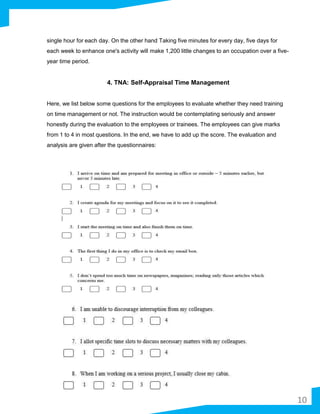
4. TNA: Self-Appraisal Time Management
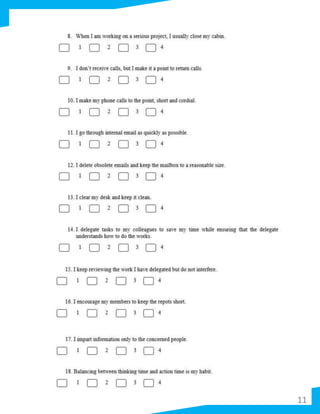
Here, we list below some questions for the employees to evaluate whether they need training
on time management or not. The instruction would be contemplating seriously and answer
honestly during the evaluation to the employees or trainees. The employees can give marks
from 1 to 4 in most questions. In the end, we have to add up the score. The evaluation and
analysis are given after the questionnaires:
10
11
12
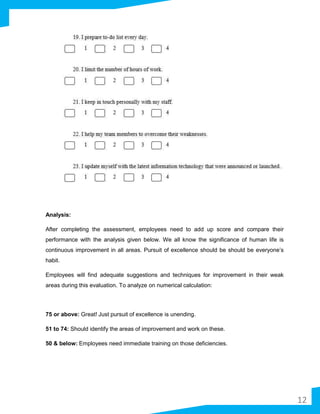
Analysis:
After completing the assessment, employees need to add up score and compare their
performance with the analysis given below. We all know the significance of human life is
continuous improvement in all areas. Pursuit of excellence should be should be everyone’s
habit.
Employees will find adequate suggestions and techniques for improvement in their weak
areas during this evaluation. To analyze on numerical calculation:
75 or above: Great! Just pursuit of excellence is unending.
51 to 74: Should identify the areas of improvement and work on these.
50 & below: Employees need immediate training on those deficiencies.
5. Time Management through a Game
Time management can be learned or trained through a game called “Habitica”. For training
program this method can be used as it is easy to use and also entertaining. It is basically an
application or game for self-improvement with game mechanics overlaid to help the player keep
track of and remain motivated to achieve their goals. This game consists of three parts.
Rewards are achieved through maintaining real-life goals.
Parts of Habitica:
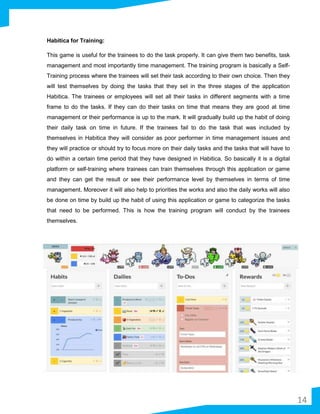
Habits:
In Habitica, Habits are long-term goals which are utilized to change a person's habits these
habits can be set to either 'positive' or 'negative', or both. If a user completes a positive Habit
often, it will turn green. This indicates that they are doing a good job and going for their desire
Habit. On the other hand, if a user practice a negative Habit most of the time, it will start to turn
red and the damage of their health increases over time.
Dailies:
Habitica uses Dailies to track tasks that the user wants to complete in a scheduled and
repeatable time. Dailies are completed by ticking a check box: the user sets their Daily tasks in
advance, and checks off what they have completed during their day. Completed Dailies user
increase or get more experience and gold. Failed to complete dailies result in a loss of health at
the end of the day.
To-Dos:
To- Dos are one-time tasks that can be added or deleted. When a user completes a To-Do,
they gain experience. Unlike Habits and Dailies, To-Dos will never cause the user to lose
health.
13
Habitica for Training:
This game is useful for the trainees to do the task properly. It can give them two benefits, task
management and most importantly time management. The training program is basically a Self-
Training process where the trainees will set their task according to their own choice. Then they
will test themselves by doing the tasks that they set in the three stages of the application
Habitica. The trainees or employees will set all their tasks in different segments with a time
frame to do the tasks. If they can do their tasks on time that means they are good at time
management or their performance is up to the mark. It will gradually build up the habit of doing
their daily task on time in future. If the trainees fail to do the task that was included by
themselves in Habitica they will consider as poor performer in time management issues and
they will practice or should try to focus more on their daily tasks and the tasks that will have to
do within a certain time period that they have designed in Habitica. So basically it is a digital
platform or self-training where trainees can train themselves through this application or game
and they can get the result or see their performance level by themselves in terms of time
management. Moreover it will also help to priorities the works and also the daily works will also
be done on time by build up the habit of using this application or game to categorize the tasks
that need to be performed. This is how the training program will conduct by the trainees
themselves.
14
6. Development of the training program according to the 9 steps of Gagne’s Model
At the beginning of the training program we will get the attention of the trainees through giving
them the idea about the digital training program where they can train themselves and also
evaluate their performance by themselves through self-training.
After that, the trainees will get to know about the objective of the training program which is the
time management skills in workplace or in corporate. Time management is a very important
element to become successful in the corporate world. The training program will help them to get
a brief idea about how to segment all their tasks and do it on time.
As the training program is self-oriented so we will ask them whether they have any previous
experience of attaining any sort of training program which is actually a Self-training program. It
will give an idea about the trainee’s level of knowledge regarding the digital or self-training
program.
Then we will announce the training program which is actually a Game through which the
trainees can test their time management skill by themselves.
After announcing the training method we will briefly explain about the Game of self-training
“The Habitica”. Each of the parts of the game will describe in this step and will provide guidance
about how to play or use this game for developing the time management skill of the trainees.
As Habitica is a self-training program, the trainees will use this application by set up their task
on Habits, Dailies or To-Dos list by themselves and test their skills of doing tasks on time or
their time management skill.
After that, the feedback they will get depends on their performance. If they can do all the tasks
set by them previously in Habitica they are good performer or they have an excellent skill in
time management. On the other hand, if they cannot do so, their performance is not up to the
mark or they are not good in managing time for their tasks.
In this step, the trainees will compare their performance of time management with the objective
that was on the objective of the training program. It will give them an idea whether the need to
practice more for further development or not.
15
Then on last stage, the trainees will use the application or the game in their real work place to
see the effectiveness and efficiency of their time management skill.
7. Time management matrix
In our life we have got an endless list of to dos. But hardly, we get done with all our works that
we plan to do in a single day. End of the day we keep thinking, 24 hours are too short for a day
to do all our things. Yet there are many people who are achieving so much with the same 24
hours. The answer lies in time management skill.
Time management matrix is such a technique that helps us prioritize our work. In reality it’s not
possible to get done with all work in a single day. All we can do is, we can choose to do things
which is more important to us.
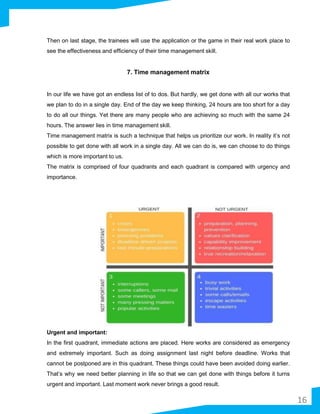
The matrix is comprised of four quadrants and each quadrant is compared with urgency and
importance.
Urgent and important:
In the first quadrant, immediate actions are placed. Here works are considered as emergency
and extremely important. Such as doing assignment last night before deadline. Works that
cannot be postponed are in this quadrant. These things could have been avoided doing earlier.
That’s why we need better planning in life so that we can get done with things before it turns
urgent and important. Last moment work never brings a good result.
16
Not urgent but important:
Works found in quadrant two are important for the future but not that urgent at present. Putting
these works down will bring us to quadrant one where we will be in hurry to get things done.
But here in quadrant two people do their work in advance so that they don’t get in trouble in
near future. May be at present the work is not important but in future this can be a very
important work. So, it’s good to get done with all works beforehand.
Preparing, training, planning is few examples of this quadrant.
Urgent but not important:
This third quadrant comprises of actions that has urgency but not so important currently. This
sort of work mostly ego driven but not adding any value. These actions work like a barrier
between you and your desired goal. We should try to let these things go. Regular meeting and
phone calls are such example.
Not urgent and not important:
The fourth quadrant summarizes actions that doesn’t add value in our life. These are all
worthless things which doesn’t bring anything good in our life. We need to avoid such things as
much as possible. These things are distracting us from achieving our goal. Browsing online for
no reason, watching tv for hours are few examples of this quadrant.
17
8. Recommendations
There are some recommendations which will help the employees to improve their time
management-
Schedule yourself: The importance of daily goal setting, daily scheduling of your tasks will keep
you on track and improve your time management practices.
Prioritize tasks: Build up the habit of prioritizing tasks help employees to be more organized in the
workplace.
Stress free: Stress in the workplace hampers the employees work. So, employees should always
try to be stress free in their workplace.
Have courage to say NO: Most of the employees don’t have courage to say no while they are
assigned works beyond their capacity or limit. And they eventually land up in taking high stress,
when they are unable to complete the tasks in time. Hence, a smart way is to say “No” politely to
further tasks being assigned to you, when you are already overloaded with work. Don’t make false
commitment.
Limit multi-tasking: Many of us multi-task and believe we’re effective when we do so; but evidence
suggests that we can’t effectively focus on more than one thing at a time. So, employees need to do
one work at a time to do it effectively.
18
9. References
 Habitica - Gamify Your Life. Retrieved from https://habitica.com/static/home
 Habitica for Training – Acrobolix. Retrieved from http://acrobolix.com/habitrpg-for-training/
 Toompuu, L. (2014). Survey: Time Management Habits And Work Attitudes. Retrieved from
https://toggl.com/blog/survey-time-management-habits-work-attitudes/
 Wetmore, D. (2003). Time Management Facts and Figures. Retrieved from
https://www.masoncontractors.org/2003/12/19/time-management-facts-and-figures/
 Prioritizing and Time Management in the Laboratory: Streamline Tasks with an ELN. (2017).
Retrieved from http://3dsbiovia.com/blog/index.php/2014/06/17/improve-time-management-skills-
laboratory/
 Anupkumar, S. Easy Tips to Create Time Management Matrix on PowerPoint. Retrieved from
https://www.24point0.com/powerpoint-business-templates/sample-use-stephen-covey-time-
management-matrix/
 Self-appraisal Time Management; Answer 26 Questions. (2017). Retrieved from
https://satishkakri.wordpress.com/2017/01/20/self-appraisal-time-management-answer-26-
questions/
 Habitica - Gamify Your Life. Retrieved from https://habitica.com/static/features
 Anda, K. (2015). Improve Your Time Management With Effective Tips and Strategies. Retrieved
from http://www.pepworldwide.com.au/blog/reducing-stress/improve-your-time-management-
with-effective-tips-and-strategies
19

Term paper on time management training

  • 1.
    TERM PAPER Time ManagementTraining for Students P R E S E N T S
  • 2.
    SUBMITTED TO : MohammadAtiqul Basher BRAC Business School BRAC University, Bangladesh SUBMITTED BY : Salman Bin Firoz MGT 423: TRAINING AND DEVELOPMENT Spring 2018, Sec:01 Topic: Time Management Training for Students 02
  • 3.
    1st August, 2018. MohammadAtiqul Basher BRAC Business School BRAC University, Bangladesh Sir, We are submitting herewith our term paper entitled ‘Time Management Training for Students’. The main purpose of this paper is to develop their soft skills and make them prepared for corporate life. We are very grateful to you for giving us the opportunity to work on this term paper. We had a very good experience and also gained a vast knowledge while working on this term paper which will surely help us in our future. Respectfully yours, Salman Bin Firoz Letter of Transmittal 03
  • 4.
    We the studentsof MGT423 Training and Development course Section 01,would like to take the opportunity to thank them who helped us at the time of preparing this report. We are very grateful to our course instructor Mr. Mohammad Atiqul Basher for his continuous guidance henceforth. His guidance has been of extreme help to us. We are also gratified for all the times we seek advice from him and he answered with the paramount patience and perseverance. In addition to this, his requirements for the term paper made it mandatory for us to seek contacts external to the classroom, which proved to be very worthwhile. Secondly we would like to thank the students of BRAC University for giving feedback on our survey, for their precious time and valuable opinions. They have helped as a lot for this report. We would like to thank BRAC University for the working environment of the lab; where we spent hours together to prepare this report. We are really indebt to all the people who helped us in preparing this report. Finally, all the group members related to this term paper worked a lot and worked very hard to make this report successful. Without everyone’s active participation it would be very difficult for us to complete this task in time. A special thanks to all the group members who worked very hard to make this report. Acknowledgement 04
  • 5.
    This term paperfocuses on Training and Development and one of the common soft skills which is Time management . We tried to analyze the reasons why this soft skill is needed to be improved. We have surveyed and found it common to all. Therefore, we have planned a training program for developing this soft skill among students. This will benefit all ages of the society too. We have gathered some interesting facts on how people spends most of their time on corporate world and personal productivity and how they can improve their time management. Doing something quicker is not time management, it’s more than that. This paper contains many important issues like importance of Time management, importance of Time management in corporates, Time management facts and events, who needs this training means training needs analysis (TNA), our training idea, its features and benefits, Development of the training program according to the 9 steps of Gagne’s Model, Time management matrix, our limitations and proposed recommendation. Executive Summary 05
  • 6.
    SL Contents Pageno. 01 Introduction 07 02 Overview: Time Management 08 03 Time management facts 09 04 Training Need Analysis 10 05 Time Management Training 13 06 Development training program of 9 steps of Gagne’s model 15 07 Time management matrix 16 08 Recommendation 18 09 Reference 19 TABLE OF CONTENTS 06
  • 7.
    07 1. Introduction 1.1 Originof the Term Paper This paper is the work of seven undergraduates, under the supervision of Mr. Mohammad Atiqul Basher , BRAC Business School, BRAC University, Bangladesh. We are assigned with a plan that will look into a soft skill which is needed to be improved and we have found Time Management skill very important. 1.2 Objectives Our prime objective is to provide a training model for the students . This paper contains many important issues like importance of Time management, importance of Time management in corporates, Time management facts and events, who needs this training means training needs analysis (TNA), our training idea, its features and benefits, Development of the training program according to the 9 steps of Gagne’s Model, Time management matrix, our limitations and proposed recommendation. 1.3 Sources and Methodology The data required for and presented in the report are collected mostly from the primary sources. Primary sources:  Interviews of the students  Meeting with the employees Secondary sources:  Surveys  Different publications  Internet research  Social medias 1.4 Limitations Collecting information for our term paper was not easy. We faced difficulties to collect the data as all the information not available on Internet. Besides that, all the information that are available on internet is not reliable. Most of our information are collected from secondary sources that is why we did not experience the real scenario of the employees, but if we could manage the information from the primary sources it will gave us real life experience as an employee.
  • 8.
    2. A briefoverview of Time Management 2.1 Time Management Time Management refers to making the best possible use of time and doing the right thing at the right time. Managing time well plays a pivotal role in finishing off tasks within the stipulated time frame and also increases productivity of an individual. Employees must learn to manage time well at the workplace to achieve targets ahead of deadline and make a mark of their own. One who understands the value of time is never overburdened and enjoys each and every moment to the fullest. 2.2 Why Time Management is Important in Corporates? Every organization works on deadlines: Time Management helps individuals to finish work within the assigned time and stay stress free and relaxed throughout the day. Time Management helps us plan specific time slots for all our day to day tasks at workplace. Time Management helps an individual to prioritize things. It is important for an employee to understand what is important and urgent at the moment. Staying overburdened at work leads to frustration and eventually one loses interest in work. We can’t do anything and everything. We have to pick up which is important and urgent Effective Time Management makes an employee a favorite amongst your superiors, clients as well as fellow workers. We should not keep work pending from our end. We have to finish the tasks and if found critical by discussing with our coworkers or immediate reporting boss and find out a solution. Managing time well helps an employee to plan his career path effectively. Doing things on time helps us to reach the top of our career within the shortest possible time frame. Employees who just work for the sake of doing work and do not pay attention to deadlines are never taken seriously at the workplace. They are the ones who always complain of excessive work load. Time Management makes an individual disciplined and punctual. One gets in the habit of reaching work on time as a result of effective time management. 08
  • 9.
    3. Time ManagementFacts We also have some interesting fact on how people spends most of their time on corporate world and personal productivity and how they can improve their time management. Doing something quicker is not time management, it’s more than that. These facts are discussed briefly below: Management: One hour of planning will spare 10 long periods of doing and 80% of "emergency administration" occasions are preventable. Also good time managers do not allocate their time to those who "demand" it, but rather to those who "deserve" it. The most intense word in our Time Management vocabulary is "no." Management: One hour of planning will spare 10 long periods of doing and 80% of "emergency administration" occasions are preventable. Also good time managers do not allocate their time to those who "demand" it, but rather to those who "deserve" it. The most intense word in our Time Management vocabulary is "no." Meetings: 9 out of 10 people daydream in meetings. On the other hand 60% of meeting attendees take notes to appear as if they are listening. When somebody is requesting our chance for a gathering, 80% of the time there is a substitute date and time that will be acceptable. Work: The average person gets one interruption every eight minutes, or approximately seven an hour, or 50-60 per day creating approximately three hours of wasted time per day. The normal intrusion takes five minutes, totaling around four hours, or half of the normal workday. 80% of those interferences are ordinarily appraised as "little value" or "no value" creating approximately three hours of wasted time per day. Moreover It almost always takes twice as long to complete a task as what we originally thought it would take .Other than that an individual today receives more information on a daily basis, than the average person used to receive in his whole lifetime in 1900. Self-improvement: By taking one hour for each day for independent study, seven hours for every week, 365 hours in a year, one can learn at the rate of a full-time student. In three to five years, the normal individual can turn into a specialist in their preferred point, by spending just a 09
  • 10.
    single hour foreach day. On the other hand Taking five minutes for every day, five days for each week to enhance one's activity will make 1,200 little changes to an occupation over a five- year time period. 4. TNA: Self-Appraisal Time Management Here, we list below some questions for the employees to evaluate whether they need training on time management or not. The instruction would be contemplating seriously and answer honestly during the evaluation to the employees or trainees. The employees can give marks from 1 to 4 in most questions. In the end, we have to add up the score. The evaluation and analysis are given after the questionnaires: 10
  • 11.
  • 12.
    12 Analysis: After completing theassessment, employees need to add up score and compare their performance with the analysis given below. We all know the significance of human life is continuous improvement in all areas. Pursuit of excellence should be should be everyone’s habit. Employees will find adequate suggestions and techniques for improvement in their weak areas during this evaluation. To analyze on numerical calculation: 75 or above: Great! Just pursuit of excellence is unending. 51 to 74: Should identify the areas of improvement and work on these. 50 & below: Employees need immediate training on those deficiencies.
  • 13.
    5. Time Managementthrough a Game Time management can be learned or trained through a game called “Habitica”. For training program this method can be used as it is easy to use and also entertaining. It is basically an application or game for self-improvement with game mechanics overlaid to help the player keep track of and remain motivated to achieve their goals. This game consists of three parts. Rewards are achieved through maintaining real-life goals. Parts of Habitica: Habits: In Habitica, Habits are long-term goals which are utilized to change a person's habits these habits can be set to either 'positive' or 'negative', or both. If a user completes a positive Habit often, it will turn green. This indicates that they are doing a good job and going for their desire Habit. On the other hand, if a user practice a negative Habit most of the time, it will start to turn red and the damage of their health increases over time. Dailies: Habitica uses Dailies to track tasks that the user wants to complete in a scheduled and repeatable time. Dailies are completed by ticking a check box: the user sets their Daily tasks in advance, and checks off what they have completed during their day. Completed Dailies user increase or get more experience and gold. Failed to complete dailies result in a loss of health at the end of the day. To-Dos: To- Dos are one-time tasks that can be added or deleted. When a user completes a To-Do, they gain experience. Unlike Habits and Dailies, To-Dos will never cause the user to lose health. 13
  • 14.
    Habitica for Training: Thisgame is useful for the trainees to do the task properly. It can give them two benefits, task management and most importantly time management. The training program is basically a Self- Training process where the trainees will set their task according to their own choice. Then they will test themselves by doing the tasks that they set in the three stages of the application Habitica. The trainees or employees will set all their tasks in different segments with a time frame to do the tasks. If they can do their tasks on time that means they are good at time management or their performance is up to the mark. It will gradually build up the habit of doing their daily task on time in future. If the trainees fail to do the task that was included by themselves in Habitica they will consider as poor performer in time management issues and they will practice or should try to focus more on their daily tasks and the tasks that will have to do within a certain time period that they have designed in Habitica. So basically it is a digital platform or self-training where trainees can train themselves through this application or game and they can get the result or see their performance level by themselves in terms of time management. Moreover it will also help to priorities the works and also the daily works will also be done on time by build up the habit of using this application or game to categorize the tasks that need to be performed. This is how the training program will conduct by the trainees themselves. 14
  • 15.
    6. Development ofthe training program according to the 9 steps of Gagne’s Model At the beginning of the training program we will get the attention of the trainees through giving them the idea about the digital training program where they can train themselves and also evaluate their performance by themselves through self-training. After that, the trainees will get to know about the objective of the training program which is the time management skills in workplace or in corporate. Time management is a very important element to become successful in the corporate world. The training program will help them to get a brief idea about how to segment all their tasks and do it on time. As the training program is self-oriented so we will ask them whether they have any previous experience of attaining any sort of training program which is actually a Self-training program. It will give an idea about the trainee’s level of knowledge regarding the digital or self-training program. Then we will announce the training program which is actually a Game through which the trainees can test their time management skill by themselves. After announcing the training method we will briefly explain about the Game of self-training “The Habitica”. Each of the parts of the game will describe in this step and will provide guidance about how to play or use this game for developing the time management skill of the trainees. As Habitica is a self-training program, the trainees will use this application by set up their task on Habits, Dailies or To-Dos list by themselves and test their skills of doing tasks on time or their time management skill. After that, the feedback they will get depends on their performance. If they can do all the tasks set by them previously in Habitica they are good performer or they have an excellent skill in time management. On the other hand, if they cannot do so, their performance is not up to the mark or they are not good in managing time for their tasks. In this step, the trainees will compare their performance of time management with the objective that was on the objective of the training program. It will give them an idea whether the need to practice more for further development or not. 15
  • 16.
    Then on laststage, the trainees will use the application or the game in their real work place to see the effectiveness and efficiency of their time management skill. 7. Time management matrix In our life we have got an endless list of to dos. But hardly, we get done with all our works that we plan to do in a single day. End of the day we keep thinking, 24 hours are too short for a day to do all our things. Yet there are many people who are achieving so much with the same 24 hours. The answer lies in time management skill. Time management matrix is such a technique that helps us prioritize our work. In reality it’s not possible to get done with all work in a single day. All we can do is, we can choose to do things which is more important to us. The matrix is comprised of four quadrants and each quadrant is compared with urgency and importance. Urgent and important: In the first quadrant, immediate actions are placed. Here works are considered as emergency and extremely important. Such as doing assignment last night before deadline. Works that cannot be postponed are in this quadrant. These things could have been avoided doing earlier. That’s why we need better planning in life so that we can get done with things before it turns urgent and important. Last moment work never brings a good result. 16
  • 17.
    Not urgent butimportant: Works found in quadrant two are important for the future but not that urgent at present. Putting these works down will bring us to quadrant one where we will be in hurry to get things done. But here in quadrant two people do their work in advance so that they don’t get in trouble in near future. May be at present the work is not important but in future this can be a very important work. So, it’s good to get done with all works beforehand. Preparing, training, planning is few examples of this quadrant. Urgent but not important: This third quadrant comprises of actions that has urgency but not so important currently. This sort of work mostly ego driven but not adding any value. These actions work like a barrier between you and your desired goal. We should try to let these things go. Regular meeting and phone calls are such example. Not urgent and not important: The fourth quadrant summarizes actions that doesn’t add value in our life. These are all worthless things which doesn’t bring anything good in our life. We need to avoid such things as much as possible. These things are distracting us from achieving our goal. Browsing online for no reason, watching tv for hours are few examples of this quadrant. 17
  • 18.
    8. Recommendations There aresome recommendations which will help the employees to improve their time management- Schedule yourself: The importance of daily goal setting, daily scheduling of your tasks will keep you on track and improve your time management practices. Prioritize tasks: Build up the habit of prioritizing tasks help employees to be more organized in the workplace. Stress free: Stress in the workplace hampers the employees work. So, employees should always try to be stress free in their workplace. Have courage to say NO: Most of the employees don’t have courage to say no while they are assigned works beyond their capacity or limit. And they eventually land up in taking high stress, when they are unable to complete the tasks in time. Hence, a smart way is to say “No” politely to further tasks being assigned to you, when you are already overloaded with work. Don’t make false commitment. Limit multi-tasking: Many of us multi-task and believe we’re effective when we do so; but evidence suggests that we can’t effectively focus on more than one thing at a time. So, employees need to do one work at a time to do it effectively. 18
  • 19.
    9. References  Habitica- Gamify Your Life. Retrieved from https://habitica.com/static/home  Habitica for Training – Acrobolix. Retrieved from http://acrobolix.com/habitrpg-for-training/  Toompuu, L. (2014). Survey: Time Management Habits And Work Attitudes. Retrieved from https://toggl.com/blog/survey-time-management-habits-work-attitudes/  Wetmore, D. (2003). Time Management Facts and Figures. Retrieved from https://www.masoncontractors.org/2003/12/19/time-management-facts-and-figures/  Prioritizing and Time Management in the Laboratory: Streamline Tasks with an ELN. (2017). Retrieved from http://3dsbiovia.com/blog/index.php/2014/06/17/improve-time-management-skills- laboratory/  Anupkumar, S. Easy Tips to Create Time Management Matrix on PowerPoint. Retrieved from https://www.24point0.com/powerpoint-business-templates/sample-use-stephen-covey-time- management-matrix/  Self-appraisal Time Management; Answer 26 Questions. (2017). Retrieved from https://satishkakri.wordpress.com/2017/01/20/self-appraisal-time-management-answer-26- questions/  Habitica - Gamify Your Life. Retrieved from https://habitica.com/static/features  Anda, K. (2015). Improve Your Time Management With Effective Tips and Strategies. Retrieved from http://www.pepworldwide.com.au/blog/reducing-stress/improve-your-time-management- with-effective-tips-and-strategies 19