MEMO
Date: March 3, 2015
To: Melinda Weaver Manager of Production Department at DepoTexas
Located in the Houston office
From: Caramel Velez Lead Case Specialist of business units: COR-DT, COR-SB, AUS-DT,
AUS-SB
Working in the Production Department at DepoTexas
Subject: Proposal for new onboarding/ cross training program
Purpose
The purpose of this proposal is to request authorization to create an onboarding program
built up of a team of four that will help train new hires as well as lead bi-monthly office
training meetings to relieve interpersonal/external office tensions occurring at DepoTexas in
our production department.
Summary
Since November 2013, Mike Cellper, CEO of DepoTexas, has announced two large mergers
and two acquisitions of local court reporting companies. The first merger was with a
smaller firm Sunbelt Reporting and Litigation Services. This is the first merger in the history
of this company Mr. Cellper believed that union would triple our workload and make us the
largest court reporting firm in Texas. The second merger allowed us to merge with a court
reporting firm in Louisiana, which has increased our territory to outside the state of Texas.
With the increase of product demand, we have had an influx of new hires along with
employees that came from the other companies we acquired. Currently we do not have any
training program in place for new hires. Our production lead Cale McCabe is the only
person training each new hire. This can create problems since the training process take up
to a week and he trains them all individually. Mr. McCabe’s training duties also take him
away from his regular job leaving his case specialist teama man short.
With very little time to train each individual member and amount of knowledge they have
to learn in such a short time I feel like the new employees are lacking the adequate
knowledge to do there jobs. When I fist started at DepoTexas when it was a smaller
company each new team member was cross-trained in every department. This was done so
when one departments workload was heavier than another department each employee
could fill in where needed. This also created more office cohesiveness because each
individual new the in an outs of each department they would be more inclined to rely on
each when there was a heavy load.
Since the merger time constraints have lead the new hires to only be trained on there
individual jobs. Which in the past couple of months have proved not to work in a
department that is based on working as a unit. I find that when an individual doesn’t know
the deadlines of other departments they tend to hold grudges when things aren’t done
right.
I propose to create a team of four people from each department to start an
onboarding/training
program by which we can help new hires acclimate and cross/train. I estimate that this
requires
a total of 4 weeks to get a team together and put a training program in place along with
packets and hand outs.
Proposed Tasks
Task 1: Establish an onboarding program for new hires
I feel we need to have a set orientation program. Currently it is up to the individual’s
discretion to show new hires around and sometimes that does not happen. New hires of
the company need a better understanding of what working for our company is really
like. Every company has a different work environment, or culture, that they are
conveying to each new employee. There are many cool things about DepoTexas, which
new hires do not know about. When I was hired, I was fortunate enough to know one of
the employees currently working at DepoTexas. That individual showed me the
benefits: birthdays and holidays off, vacation days. In addition, many new hires are not
from around this area. It would be nice to have someone show you where to eat and
tell you while informing you about DepoTexas. That is why I feel a four person training
team should be put into place – to have one set people show new hires around and to
go to lunch with. I feel this type of orientation would really make them feel part of a
team.
Currently we do not have a written-down, structured training program in place. The
company has been stressing consistency. Now that we have a training guide, we are
heading in the right direction. I feel my training as a scanner was unstructured and as a
result, I missed a few things such as deadlines and quality control procedures. I feel the
onboarding team should have a trainer from each department. Each trainer should be
following the same training guidelines to insure constancy in everyone's work. The
orientation program I suggested above should be part of this program. Cross-training is
a good idea since we all help each other. A variable basic knowledge of each department
will help with frustrations that can arise. For example, a case specialist needs exhibits
scanned as a rush. If the scanner knows this last minute request did not start with the
case specialist, but instead with the attorney, she will realize the importance of the
request and not agitated by untimely fashion of the request.
Task 1: Establish better interpersonal office communication with bi-monthly meetings
and incentives
We currently have do not have a set dates for meetings. We need to establish a
schedule where we have we have bi-monthly departmental meetings including
department heads; there we can help discuss the issues that occur day to day. When
people feel like they are being heard, it helps boost team moral. The meetings would be
run by the onboarding/ training team since it is there job to alleviate departmental
angst. As well as airing out grievances, we can have training sessions of any new
techniques that have come up on the case specialist side as well as in production. This
cross training will allow each department to understand everyone’s workload and allow
for more patience between departments. After the training session, I propose having
the employees take a quarterly survey made up of a few poignant questions about the
production department and the bi-monthly meetings. This is great because it provides a
way to have anonymous feedback from employees, and help to streamline the
department by tracking the department’s progress and that way we can know what to
discuss in the following training session.
Not everything has to be all work awards and incentives are a good way to provide
cohesion between employees and boost moral. We could have an employee
appreciation day. This is a way to promote team building and community. Employees
can nominate their co-workers for awards. For example: ‘the above and beyond award’
or ‘great team player’. Awards can be handed out with small gifts. It is a fun way to
show recognition for the work everyone does.
Proposal for creating new On-barding training program at DepoTexas
Submitted to: Robert Jarrett, Professor
Prepared by: Caramel Velez, Student
Date: April 13, 2014
IV
TABLE OF CONTENTS
EXECUTIVE SUMMARY ....................................................................................................... 1
INTRODUCTION .................................................................................................................. 2
RESEARCH METHOD........................................................................................................... 5
TASK 1: RESEARCH PRODUCTION DEPARTMENT & ACQUIRE BASIC KNOWLEDGE OF ONBOARDING .......... 5
TASK 2: RESEARCH EMPLOYEE ATTITUDES TOWARDS CURRENT TRAINING PROGRAM........................... 6
RESULTS .............................................................................................................................. 7
TASK 1: ACQUIRE BASIC KNOWLEDGE ON HOW TO CREATE ONBOARDING PROGRAM ........................... 7
Onboarding................................................................................................................... 7
First Impressions “Buddy System”................................................................................ 8
Begin the process early................................................................................................. 8
Clarification and Retention........................................................................................... 8
TASK 2: SURVEY RESULTS OF CURRENT AND NEW EMPLOYEES........................................................... 10
CONCLUSION .................................................................................................................... 11
REASONS FORHAVING AN ONBOARDINGPROGRAM.................................................................... 11
HOW ONBOARDING WILL POSITIVELY EFFECT DEPOTEXAS ............................................................. 12
RECOMENDATIONS .......................................................................................................... 10
REFERENCES...................................................................................................................... 14
APPEDIX A: CURRENT EMPLOYEE SURVEY...................................................................... 15
1
Executive Summary
November 2013, Mike Cellper, CEO of DepoTexas, announced two large mergers and two
acquisitions of local court reporting companies. The acquisition of these companies is
guaranteed to triple our workload. The influx of new business will require our company to hire
new employees a well as train some of the new people who will remain with the company after
the merger.
Currently DepoTexas has one person Cale Mcabe, training all new hires that come into the
company. Unfortunately, because jobs are so extensive he is only able to train one individual at
a time. With the influx of new employees, this current method of training is not feasible for all
the new employees coming into the company. While we have recently created a training book,
we have no established onboarding program to not only train people but also give the idea of
the culture, and the company that is DepoTexas.
Many of the positions being filled at DepoTexas are entry-level that require on the job training.
In this situation, many new hires come in with very little knowledge of the positions they are
filling. This requires a lot of indepth, detailed training. Our training books are a good start but
since most of what we deal in is law, an in-depth knowledge of Texas state rules is necessary.
With only one person providing all the training, he has very little time to go into all the details
of every position. His ability is also limited because of the time constraints. He is also unable to
act as a guide getting people acclimated to our company culture.
When I first started at DepoTexas I was lucky enough to know one of the individuals who
already worked at DepoTexas. She showed me around the office, informed me of what my
position entailed the benefits of my job, as well as took me to lunch around the area. We need
an established program that will provide in-depth information to a large quantity of individuals
with out removing the personal touch.
I performed research by sending surveys to current and new employees that had just started at
DepoTexas and asked them to analyze the current training program. I also researched current
onboarding programs at large thriving companies such as google and Amazon. After that, I
weighed the cost versus the benefit this new program would have on employee job satisfaction
and low job termination.
I found that in every department employees are receptive to a new on-boarding program. If
this program is adopted it will increase employee job satisfaction and decrease new employee
job errors increasing our clients satisfaction. With the information provided by larger
company’s onboarding programs, it is my hope that this training format will continue to be
relevant as the company continues to expand.
On the basis of these conclusion, I recommend that DepoTexas proceed with establishing a new
onboarding program for the production department.
2
Introduction
Summary
November 20 2013, Mike Cellper, CEO of DepoTexas, announced two large mergers and
two acquisitions of local court reporting companies. The current one-man training program
established is not feasible for the influx of employees that are about to be hired. Due to
this, I advise that we create a new onboarding program so new employees can learn
company culture and job training quick and efficiently.
Introduction to the Background of the Study
Currently the training program in place for new hires is based on a smaller business model.
Our production lead Cale McCabe is the only person training each new hire. This can create
problems since the training process take up to a week and he trains them all individually.
Mr. McCabe’s training duties also take him away from his regular job leaving his case
specialist teama man short. Initially this training model worked for the smaller business
that we once had. Unfortunately, with the merger the business has grown increasing
product demand, and causing us to have an influx of new hires along with employees
grandfathered in by the companies we acquired. With very little time to train each
individual member and amount of knowledge they have to learn in such a short time, I feel
like the new employees are lacking time the adequate knowledge to do their jobs. This is
why I hope to allocate a bit of DepoTexas resources to create a new Onboarding training
program. With the knowledge acquired by surveys giving to current and new employees. I
should be able to narrow down how to formulate a great on boarding program for our
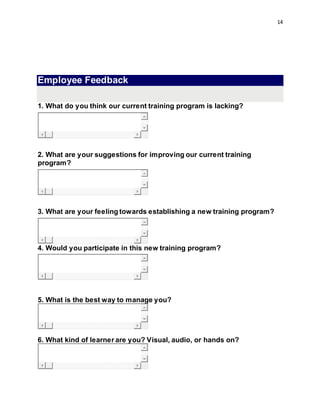
company. The surveys for the current employees will encompass the following questions.
1. What do you think that the current training program is lacking?
2. What are your suggestions for its improvement?
3. What are your feelings towards establishing an onboarding program for new hires?
4. Would you participate in this new training program?
5. What is the best way to manage you?
6. What is your learning style? Video, Audio, or Hands on learner?
3
The Relationship the Work and the Study
An understanding of how the current employee’s feel about the current training
program will be used to create a better model for the new onboarding program allowing
for a model that can work for anyone. Also using questions that are more pointed to
individualistic training will help the new program feel like it has a more personal
approach. We need to understand if by creating a new onboarding program we will
decrease the amount of time it takes to train several people as well as helps with
information retention of the new skills applied to their new job position. By recognizing
the flaws in the current systemhopefully, we can establish a program that is a better fit
for the new company DepoTexas is becoming. The data acquired from the surveys along
with research found from onboarding programs used in larger thriving companies such
as google should help to create a successful onboarding program that will continue to
be relevant as the company expands.
Formal Statement
For these reasons, I feel that the company should allocate a small amount of resources
to the research and implication of a new onboarding training program. Strike while the
iron is hot now is the time to better our business. I guarantee that this new program will
help shape the company that we are growing in to.
The Method
First, I needed to learn the basics in creating a good onboarding program for any large
company. This was done by researching business models for large companies like google,
Zapatos, and Amazon. Next, I wrote survey questions that I would to gather information
about the flaws in our current training program. Once the surveys are created, I then sent
an e-mail out to each employee requesting them to follow the link and answer the
questions honestly. Making sure to stress that all answers are anonymous. Lastly, I
collected that and analyzed the feedback received and then started creating the new
program.
Acknowledgements
I would like two managers Melinda Weaver, head of the Production Department and
Joanna Trammel Case Specialist Lead for taking the time to reviewing my proposal and
giving me suggestions for a new program.
Principle Findings (percent’s subject to change in final report)
I found that the current employees as well as new hires were responsive to the surveys.
In addition to that, the production manager was open to the idea of creating a new
onboarding training program. In addition I found that nearly all (90 percent) of the
employees were interested in participating in onboarding program. Where as few (10
percent) believed that the current program was working.
4
The current environment of the new merger is the best time to test out a new
onboarding program. Based on human resource models followed by larger companies
we will be able to decrease training time while increase job skills retention and increase
employee job satisfaction in the long run.
Recommendation
Based on my finding I recommend that DepoTexas proceed with the creation of the new
onboarding training program.
5
Research Method
To evaluate if establishing a new onboarding program with help with interpersonal office
relations by increasing productivity in production department
Task 1. Research the production department and acquire basic knowledge on how to create
an onboarding program suited DepoTexas
Many established companies such as Google and Apple already have successful onboarding
programs. So I did some research looking through a myriad of sources about onboarding
programs used for large companies such as the ones listed above. Through my research, I found
that the most successful onboarding programs contain these two aspects
 Branding is a very important aspect of onboarding and should be done as soon as
possible. The image that you portray to a new hire is important to rooting out
individuals who do not fit the company model. This helps increase employee job
satisfaction and works as a successful advertisement tool for the company. No body
wants to work with a cooperation whose has their employees quitting all the time. That
is why places like google have so many applications for new hires every year. Most good
onboarding programs begin employee branding before the employee’s first day. It can
be daunting and overwhelming to fill out information and learn the company culture on
your first day of work. That is why orientation should start before the first hiring date
and as soon as new employee is formally hired. Information about the company culture
as well as employee handbook and access to a multi-media video presentation should
be given to new employee as soon as an offer is made.
 Establish a buddy systema new hire should have a training manager or partner to help
them through the day. There are a million simple things that new hires will not know
that will slow down the training process. So make sure you set new employees up for
success. Before they arrive, tell them basic things such as.
o Where to park
o Where the bathrooms are
o Where the lobby is located and who to ask for when you arrive
o Where to get their office key and parking badge
o What they need to bring such as photo id
Establishing a “buddy” that helps to show new hires around will create long-term
connection inside the company. Fostering good interdepartmental office relations as
well as helps with training retention. By allowing new hires to learn and ask as many
questions about their new job in a safe friendly environment.
6
Most of the research acquired contains a lot of information that regards human
resources in office relations. As well as little bit of statistical data for overall employee
satisfaction and production improvement.
Task 2. Research current employee’s attitudes about current training program and how they
would feel about establishing an onboarding program for new hires as well as question new
hires to help Taylor training process to the individual allowing better long term results.
Make up a survey on survey monkey and e-mail it to all the departments in production
requiring them to be filled out at the end of business day. Create and additional survey to be
taken by new hires at the end of their first day. The following questions will be listed on the
survey for current production staff: What do you think that the current training program is
lacking? What are your suggestions for its improvement? What are your feelings towards
establishing an onboarding program for new hires? The following questions will be listed on
survey for new hires: What is the best way to manage you? What is your learning style? Are you
a visual, audio or hands on learner? What are your personal goals in life and in this company?
 Read feedback from current staff and use suggestions towards creating a better
onboarding program.
 Read through feedback given by new employee and tailor their second day of training.
Which will be a heavier day to their custom learning style.
Based on our finding we will see if we should proceed with creating this program and if it will
improve the production department in the end. The information gleaned both surveys will help
provide a well rounded program tailored to any new employee as well as give a personal
approach to every new member.
7
Results
In this section, I will present the results of the research performed. The most important findings
of my research are listed below.
Task 1. Acquire basic knowledge on how to create an onboarding program suited DepoTexas.
Research the production department.
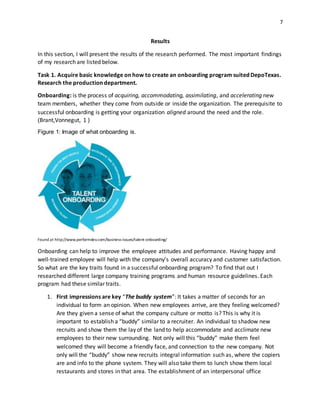
Onboarding: is the process of acquiring, accommodating, assimilating, and accelerating new
team members, whether they come from outside or inside the organization. The prerequisite to
successful onboarding is getting your organization aligned around the need and the role.
(Brant,Vonnegut, 1 )
Figure 1: Image of what onboarding is.
Found at http://www.performdev.com/business-issues/talent-onboarding/
Onboarding can help to improve the employee attitudes and performance. Having happy and
well-trained employee will help with the company’s overall accuracy and customer satisfaction.
So what are the key traits found in a successful onboarding program? To find that out I
researched different large company training programs and human resource guidelines. Each
program had these similar traits.
1. First impressions are key “The buddy system”: It takes a matter of seconds for an
individual to form an opinion. When new employees arrive, are they feeling welcomed?
Are they given a sense of what the company culture or motto is? This is why it is
important to establish a “buddy” similar to a recruiter. An individual to shadow new
recruits and show them the lay of the land to help accommodate and acclimate new
employees to their new surrounding. Not only will this “buddy” make them feel
welcomed they will become a friendly face, and connection to the new company. Not
only will the “buddy” show new recruits integral information such as, where the copiers
are and info to the phone system. They will also take them to lunch show them local
restaurants and stores in that area. The establishment of an interpersonal office
8
relationship will help make a happy employees which will intern become positive
advertisement for the company.
a. Branding: We have to start thinking of the company as a brand. When no one
likes or is interesting in that Brand your stock plummets. Branding begins with
good advertisement what better person to advertise for a company then the
people who already work there. A large online shoe company called Zappos
believes “That how its employees feel about the company is the best advertising
it can share with the world. It holds a five-week course on company values, and
invites anyone who does not feel they belong $2,000 to quit—and, reportedly,
only 1% of new hires actually take them up on this offer.” 1 percent of a
company that houses over 15 thousand employees is not bad at all. (Miller)
2. Begin the process early: Training should not begin on the new employee’s day but it
should begin during the interview process. The first day can be overwhelming you
receive a lot of information all at once. To help increase retention as well as not
overloading your new employees it is best to begin training as soon as possible. Once
you have decided on a candidate, give them information about the company. This will
keep the new hire interested throughout the hiring and onboarding process. "The
engagement process starts at the very beginning of the recruitment process. It is a
strong part of attraction and needs to build through the process at every point”(Brown)
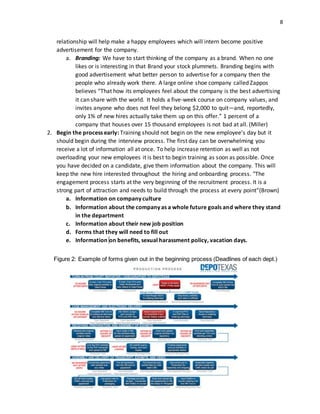
a. Information on company culture
b. Information about the company as a whole future goals and where they stand
in the department
c. Information about their new job position
d. Forms that they will need to fill out
e. Information on benefits, sexual harassment policy, vacation days.
Figure 2: Example of forms given out in the beginning process (Deadlines of each dept.)
9
3. Clarification and Retention:“United States and United Kingdom found that businesses
lose an estimated $37 billion each year as a result of employees not understanding their
jobs.” (Bauer,5)In the training process, new employees can often be afraid to step out of
the box and ask for help. Clarification of new job duties as well as their place within the
company can help lower the margin of errors that occur while the new employee
acclimates. “The introduction of the “buddy” to help shadow new employees creates a
safe environment for the new employee to ask question.
a. Cross training: “Cross-training is an optimum solution for someone who is
reasonably good at something and who wants to continue excelling at it and
then to move into the higher ranks in any given activity or sport.” (Zenger,et
al.,ch.4)Allowing new employees to cross train in different sections of the
production department will help them better understand their position in the
whole scheme of things. As well a squelch and tensions that may arise in
different departments. Knowledge is power so we should give our new recruits
every opportunity to succeed.
b. Quizzes and Surveys: At the end of every training day their will be and quiz built
up of multiple choice and fill in the blank answers over what they learned that
day. This will help with retention as well as give the trainer and idea of what the
new employee needs more training on. Two surveys should be provided one
after the end of the first training day and another 3-4 weeks after their start
date.
i. The First survey: The questions will be regarding how their experience
was for the first day. How training was going and if it was not going well
how would they liked to be trained for future sessions? This will help
tailor the current training program to the individual by giving the trainer
more info on the employees learning style and pace.
ii. The Second Survey: This will be done in 3-4 weeks this is the best amount
of time for the new employee to get a feel for their new position. This is
also a good amount of time to see how well the training process is
progressing. “According to “‘best practices,’” it is typically at about this
time that the employee can give you some honest feedback as to how he
feels he is managing” (Sims, Ch. 5)
c. Check in: 3-4 weeks after hiring date their should be a meeting with the new
employee and trainer and management to asses the new employee’s progress.
This will give the new employee and avenue to discuss what they are learning
what they need more in-depth training on and give management an idea of how
much longer they need to be trained. Another meeting should be held after the
60-day trail period of the new employee before hiring them on full time.
10
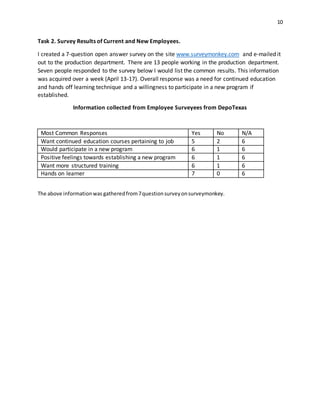
Task 2. Survey Results of Current and New Employees.
I created a 7-question open answer survey on the site www.surveymonkey.com and e-mailed it
out to the production department. There are 13 people working in the production department.
Seven people responded to the survey below I would list the common results. This information
was acquired over a week (April 13-17). Overall response was a need for continued education
and hands off learning technique and a willingness to participate in a new program if
established.
Information collected from Employee Surveyees from DepoTexas
Most Common Responses Yes No N/A
Want continued education courses pertaining to job 5 2 6
Would participate in a new program 6 1 6
Positive feelings towards establishing a new program 6 1 6
Want more structured training 6 1 6
Hands on learner 7 0 6
The above informationwas gatheredfrom7questionsurveyonsurveymonkey.
11
Conclusions
12
Recommendation
13
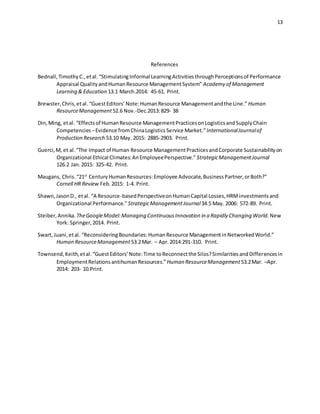
References
Bednall,TimothyC.,etal.“StimulatingInformal LearningActivitiesthroughPerceptionsof Performance
Appraisal QualityandHumanResource ManagementSystem” Academy of Management
Learning & Education 13.1 March.2014: 45-61. Print.
Brewster,Chris,etal.“GuestEditors’Note:HumanResource Managementandthe Line.” Human
ResourceManagement 52.6 Nov.-Dec.2013:829- 38
Din,Ming, etal. “Effectsof HumanResource ManagementPracticesonLogisticsandSupplyChain
Competencies –Evidence fromChinaLogisticsService Market.”InternationalJournalof
Production Research 53.10 May. 2015: 2885-2903. Print.
Guerci,M, et al.“The Impact of Human Resource ManagementPracticesandCorporate Sustainabilityon
Organizational Ethical Climates:AnEmployeePerspective.” StrategicManagementJournal
126.2 Jan.2015: 325-42. Print.
Maugans, Chris.“21st
CenturyHumanResources:Employee Advocate,BusinessPartner,orBoth?”
Cornell HR Review Feb.2015: 1-4. Print.
Shawn,JasonD., etal. “A Resource-basedPerspectiveonHumanCapital Losses,HRMinvestmentsand
Organizational Performance.”StrategicManagementJournal34.5 May. 2006: 572-89. Print.
Steiber,Annika. TheGoogleModel:Managing Continuous Innovation in a Rapidly Changing World.New
York: Springer,2014. Print.
Swart,Juani,etal. “ReconsideringBoundaries:HumanResource ManagementinNetworkedWorld.”
Human ResourceManagement 53.2Mar. – Apr.2014:291-310. Print.
Townsend,Keith,etal.“GuestEditors’Note:Time toReconnectthe Silos?SimilaritiesandDifferencesin
EmploymentRelationsantihumanResources.” Human ResourceManagement 53.2Mar. –Apr.
2014: 203- 10.Print.
14
Employee Feedback
1. What do you think our current training program is lacking?
2. What are your suggestions for improving our current training
program?
3. What are your feeling towards establishing a new training program?
4. Would you participate in this new training program?
5. What is the best way to manage you?
6. What kind of learner are you? Visual, audio, or hands on?

Proposal

  • 1.
    MEMO Date: March 3,2015 To: Melinda Weaver Manager of Production Department at DepoTexas Located in the Houston office From: Caramel Velez Lead Case Specialist of business units: COR-DT, COR-SB, AUS-DT, AUS-SB Working in the Production Department at DepoTexas Subject: Proposal for new onboarding/ cross training program Purpose The purpose of this proposal is to request authorization to create an onboarding program built up of a team of four that will help train new hires as well as lead bi-monthly office training meetings to relieve interpersonal/external office tensions occurring at DepoTexas in our production department. Summary Since November 2013, Mike Cellper, CEO of DepoTexas, has announced two large mergers and two acquisitions of local court reporting companies. The first merger was with a smaller firm Sunbelt Reporting and Litigation Services. This is the first merger in the history of this company Mr. Cellper believed that union would triple our workload and make us the largest court reporting firm in Texas. The second merger allowed us to merge with a court reporting firm in Louisiana, which has increased our territory to outside the state of Texas. With the increase of product demand, we have had an influx of new hires along with employees that came from the other companies we acquired. Currently we do not have any training program in place for new hires. Our production lead Cale McCabe is the only person training each new hire. This can create problems since the training process take up to a week and he trains them all individually. Mr. McCabe’s training duties also take him away from his regular job leaving his case specialist teama man short. With very little time to train each individual member and amount of knowledge they have to learn in such a short time I feel like the new employees are lacking the adequate knowledge to do there jobs. When I fist started at DepoTexas when it was a smaller company each new team member was cross-trained in every department. This was done so when one departments workload was heavier than another department each employee could fill in where needed. This also created more office cohesiveness because each individual new the in an outs of each department they would be more inclined to rely on each when there was a heavy load. Since the merger time constraints have lead the new hires to only be trained on there individual jobs. Which in the past couple of months have proved not to work in a department that is based on working as a unit. I find that when an individual doesn’t know
  • 2.
    the deadlines ofother departments they tend to hold grudges when things aren’t done right. I propose to create a team of four people from each department to start an onboarding/training program by which we can help new hires acclimate and cross/train. I estimate that this requires a total of 4 weeks to get a team together and put a training program in place along with packets and hand outs. Proposed Tasks Task 1: Establish an onboarding program for new hires I feel we need to have a set orientation program. Currently it is up to the individual’s discretion to show new hires around and sometimes that does not happen. New hires of the company need a better understanding of what working for our company is really like. Every company has a different work environment, or culture, that they are conveying to each new employee. There are many cool things about DepoTexas, which new hires do not know about. When I was hired, I was fortunate enough to know one of the employees currently working at DepoTexas. That individual showed me the benefits: birthdays and holidays off, vacation days. In addition, many new hires are not from around this area. It would be nice to have someone show you where to eat and tell you while informing you about DepoTexas. That is why I feel a four person training team should be put into place – to have one set people show new hires around and to go to lunch with. I feel this type of orientation would really make them feel part of a team. Currently we do not have a written-down, structured training program in place. The company has been stressing consistency. Now that we have a training guide, we are heading in the right direction. I feel my training as a scanner was unstructured and as a result, I missed a few things such as deadlines and quality control procedures. I feel the onboarding team should have a trainer from each department. Each trainer should be following the same training guidelines to insure constancy in everyone's work. The orientation program I suggested above should be part of this program. Cross-training is a good idea since we all help each other. A variable basic knowledge of each department will help with frustrations that can arise. For example, a case specialist needs exhibits scanned as a rush. If the scanner knows this last minute request did not start with the case specialist, but instead with the attorney, she will realize the importance of the request and not agitated by untimely fashion of the request.
  • 3.
    Task 1: Establishbetter interpersonal office communication with bi-monthly meetings and incentives We currently have do not have a set dates for meetings. We need to establish a schedule where we have we have bi-monthly departmental meetings including department heads; there we can help discuss the issues that occur day to day. When people feel like they are being heard, it helps boost team moral. The meetings would be run by the onboarding/ training team since it is there job to alleviate departmental angst. As well as airing out grievances, we can have training sessions of any new techniques that have come up on the case specialist side as well as in production. This cross training will allow each department to understand everyone’s workload and allow for more patience between departments. After the training session, I propose having the employees take a quarterly survey made up of a few poignant questions about the production department and the bi-monthly meetings. This is great because it provides a way to have anonymous feedback from employees, and help to streamline the department by tracking the department’s progress and that way we can know what to discuss in the following training session. Not everything has to be all work awards and incentives are a good way to provide cohesion between employees and boost moral. We could have an employee appreciation day. This is a way to promote team building and community. Employees can nominate their co-workers for awards. For example: ‘the above and beyond award’ or ‘great team player’. Awards can be handed out with small gifts. It is a fun way to show recognition for the work everyone does.
  • 4.
    Proposal for creatingnew On-barding training program at DepoTexas Submitted to: Robert Jarrett, Professor Prepared by: Caramel Velez, Student Date: April 13, 2014
  • 5.
    IV TABLE OF CONTENTS EXECUTIVESUMMARY ....................................................................................................... 1 INTRODUCTION .................................................................................................................. 2 RESEARCH METHOD........................................................................................................... 5 TASK 1: RESEARCH PRODUCTION DEPARTMENT & ACQUIRE BASIC KNOWLEDGE OF ONBOARDING .......... 5 TASK 2: RESEARCH EMPLOYEE ATTITUDES TOWARDS CURRENT TRAINING PROGRAM........................... 6 RESULTS .............................................................................................................................. 7 TASK 1: ACQUIRE BASIC KNOWLEDGE ON HOW TO CREATE ONBOARDING PROGRAM ........................... 7 Onboarding................................................................................................................... 7 First Impressions “Buddy System”................................................................................ 8 Begin the process early................................................................................................. 8 Clarification and Retention........................................................................................... 8 TASK 2: SURVEY RESULTS OF CURRENT AND NEW EMPLOYEES........................................................... 10 CONCLUSION .................................................................................................................... 11 REASONS FORHAVING AN ONBOARDINGPROGRAM.................................................................... 11 HOW ONBOARDING WILL POSITIVELY EFFECT DEPOTEXAS ............................................................. 12 RECOMENDATIONS .......................................................................................................... 10 REFERENCES...................................................................................................................... 14 APPEDIX A: CURRENT EMPLOYEE SURVEY...................................................................... 15
  • 6.
    1 Executive Summary November 2013,Mike Cellper, CEO of DepoTexas, announced two large mergers and two acquisitions of local court reporting companies. The acquisition of these companies is guaranteed to triple our workload. The influx of new business will require our company to hire new employees a well as train some of the new people who will remain with the company after the merger. Currently DepoTexas has one person Cale Mcabe, training all new hires that come into the company. Unfortunately, because jobs are so extensive he is only able to train one individual at a time. With the influx of new employees, this current method of training is not feasible for all the new employees coming into the company. While we have recently created a training book, we have no established onboarding program to not only train people but also give the idea of the culture, and the company that is DepoTexas. Many of the positions being filled at DepoTexas are entry-level that require on the job training. In this situation, many new hires come in with very little knowledge of the positions they are filling. This requires a lot of indepth, detailed training. Our training books are a good start but since most of what we deal in is law, an in-depth knowledge of Texas state rules is necessary. With only one person providing all the training, he has very little time to go into all the details of every position. His ability is also limited because of the time constraints. He is also unable to act as a guide getting people acclimated to our company culture. When I first started at DepoTexas I was lucky enough to know one of the individuals who already worked at DepoTexas. She showed me around the office, informed me of what my position entailed the benefits of my job, as well as took me to lunch around the area. We need an established program that will provide in-depth information to a large quantity of individuals with out removing the personal touch. I performed research by sending surveys to current and new employees that had just started at DepoTexas and asked them to analyze the current training program. I also researched current onboarding programs at large thriving companies such as google and Amazon. After that, I weighed the cost versus the benefit this new program would have on employee job satisfaction and low job termination. I found that in every department employees are receptive to a new on-boarding program. If this program is adopted it will increase employee job satisfaction and decrease new employee job errors increasing our clients satisfaction. With the information provided by larger company’s onboarding programs, it is my hope that this training format will continue to be relevant as the company continues to expand. On the basis of these conclusion, I recommend that DepoTexas proceed with establishing a new onboarding program for the production department.
  • 7.
    2 Introduction Summary November 20 2013,Mike Cellper, CEO of DepoTexas, announced two large mergers and two acquisitions of local court reporting companies. The current one-man training program established is not feasible for the influx of employees that are about to be hired. Due to this, I advise that we create a new onboarding program so new employees can learn company culture and job training quick and efficiently. Introduction to the Background of the Study Currently the training program in place for new hires is based on a smaller business model. Our production lead Cale McCabe is the only person training each new hire. This can create problems since the training process take up to a week and he trains them all individually. Mr. McCabe’s training duties also take him away from his regular job leaving his case specialist teama man short. Initially this training model worked for the smaller business that we once had. Unfortunately, with the merger the business has grown increasing product demand, and causing us to have an influx of new hires along with employees grandfathered in by the companies we acquired. With very little time to train each individual member and amount of knowledge they have to learn in such a short time, I feel like the new employees are lacking time the adequate knowledge to do their jobs. This is why I hope to allocate a bit of DepoTexas resources to create a new Onboarding training program. With the knowledge acquired by surveys giving to current and new employees. I should be able to narrow down how to formulate a great on boarding program for our company. The surveys for the current employees will encompass the following questions. 1. What do you think that the current training program is lacking? 2. What are your suggestions for its improvement? 3. What are your feelings towards establishing an onboarding program for new hires? 4. Would you participate in this new training program? 5. What is the best way to manage you? 6. What is your learning style? Video, Audio, or Hands on learner?
  • 8.
    3 The Relationship theWork and the Study An understanding of how the current employee’s feel about the current training program will be used to create a better model for the new onboarding program allowing for a model that can work for anyone. Also using questions that are more pointed to individualistic training will help the new program feel like it has a more personal approach. We need to understand if by creating a new onboarding program we will decrease the amount of time it takes to train several people as well as helps with information retention of the new skills applied to their new job position. By recognizing the flaws in the current systemhopefully, we can establish a program that is a better fit for the new company DepoTexas is becoming. The data acquired from the surveys along with research found from onboarding programs used in larger thriving companies such as google should help to create a successful onboarding program that will continue to be relevant as the company expands. Formal Statement For these reasons, I feel that the company should allocate a small amount of resources to the research and implication of a new onboarding training program. Strike while the iron is hot now is the time to better our business. I guarantee that this new program will help shape the company that we are growing in to. The Method First, I needed to learn the basics in creating a good onboarding program for any large company. This was done by researching business models for large companies like google, Zapatos, and Amazon. Next, I wrote survey questions that I would to gather information about the flaws in our current training program. Once the surveys are created, I then sent an e-mail out to each employee requesting them to follow the link and answer the questions honestly. Making sure to stress that all answers are anonymous. Lastly, I collected that and analyzed the feedback received and then started creating the new program. Acknowledgements I would like two managers Melinda Weaver, head of the Production Department and Joanna Trammel Case Specialist Lead for taking the time to reviewing my proposal and giving me suggestions for a new program. Principle Findings (percent’s subject to change in final report) I found that the current employees as well as new hires were responsive to the surveys. In addition to that, the production manager was open to the idea of creating a new onboarding training program. In addition I found that nearly all (90 percent) of the employees were interested in participating in onboarding program. Where as few (10 percent) believed that the current program was working.
  • 9.
    4 The current environmentof the new merger is the best time to test out a new onboarding program. Based on human resource models followed by larger companies we will be able to decrease training time while increase job skills retention and increase employee job satisfaction in the long run. Recommendation Based on my finding I recommend that DepoTexas proceed with the creation of the new onboarding training program.
  • 10.
    5 Research Method To evaluateif establishing a new onboarding program with help with interpersonal office relations by increasing productivity in production department Task 1. Research the production department and acquire basic knowledge on how to create an onboarding program suited DepoTexas Many established companies such as Google and Apple already have successful onboarding programs. So I did some research looking through a myriad of sources about onboarding programs used for large companies such as the ones listed above. Through my research, I found that the most successful onboarding programs contain these two aspects  Branding is a very important aspect of onboarding and should be done as soon as possible. The image that you portray to a new hire is important to rooting out individuals who do not fit the company model. This helps increase employee job satisfaction and works as a successful advertisement tool for the company. No body wants to work with a cooperation whose has their employees quitting all the time. That is why places like google have so many applications for new hires every year. Most good onboarding programs begin employee branding before the employee’s first day. It can be daunting and overwhelming to fill out information and learn the company culture on your first day of work. That is why orientation should start before the first hiring date and as soon as new employee is formally hired. Information about the company culture as well as employee handbook and access to a multi-media video presentation should be given to new employee as soon as an offer is made.  Establish a buddy systema new hire should have a training manager or partner to help them through the day. There are a million simple things that new hires will not know that will slow down the training process. So make sure you set new employees up for success. Before they arrive, tell them basic things such as. o Where to park o Where the bathrooms are o Where the lobby is located and who to ask for when you arrive o Where to get their office key and parking badge o What they need to bring such as photo id Establishing a “buddy” that helps to show new hires around will create long-term connection inside the company. Fostering good interdepartmental office relations as well as helps with training retention. By allowing new hires to learn and ask as many questions about their new job in a safe friendly environment.
  • 11.
    6 Most of theresearch acquired contains a lot of information that regards human resources in office relations. As well as little bit of statistical data for overall employee satisfaction and production improvement. Task 2. Research current employee’s attitudes about current training program and how they would feel about establishing an onboarding program for new hires as well as question new hires to help Taylor training process to the individual allowing better long term results. Make up a survey on survey monkey and e-mail it to all the departments in production requiring them to be filled out at the end of business day. Create and additional survey to be taken by new hires at the end of their first day. The following questions will be listed on the survey for current production staff: What do you think that the current training program is lacking? What are your suggestions for its improvement? What are your feelings towards establishing an onboarding program for new hires? The following questions will be listed on survey for new hires: What is the best way to manage you? What is your learning style? Are you a visual, audio or hands on learner? What are your personal goals in life and in this company?  Read feedback from current staff and use suggestions towards creating a better onboarding program.  Read through feedback given by new employee and tailor their second day of training. Which will be a heavier day to their custom learning style. Based on our finding we will see if we should proceed with creating this program and if it will improve the production department in the end. The information gleaned both surveys will help provide a well rounded program tailored to any new employee as well as give a personal approach to every new member.
  • 12.
    7 Results In this section,I will present the results of the research performed. The most important findings of my research are listed below. Task 1. Acquire basic knowledge on how to create an onboarding program suited DepoTexas. Research the production department. Onboarding: is the process of acquiring, accommodating, assimilating, and accelerating new team members, whether they come from outside or inside the organization. The prerequisite to successful onboarding is getting your organization aligned around the need and the role. (Brant,Vonnegut, 1 ) Figure 1: Image of what onboarding is. Found at http://www.performdev.com/business-issues/talent-onboarding/ Onboarding can help to improve the employee attitudes and performance. Having happy and well-trained employee will help with the company’s overall accuracy and customer satisfaction. So what are the key traits found in a successful onboarding program? To find that out I researched different large company training programs and human resource guidelines. Each program had these similar traits. 1. First impressions are key “The buddy system”: It takes a matter of seconds for an individual to form an opinion. When new employees arrive, are they feeling welcomed? Are they given a sense of what the company culture or motto is? This is why it is important to establish a “buddy” similar to a recruiter. An individual to shadow new recruits and show them the lay of the land to help accommodate and acclimate new employees to their new surrounding. Not only will this “buddy” make them feel welcomed they will become a friendly face, and connection to the new company. Not only will the “buddy” show new recruits integral information such as, where the copiers are and info to the phone system. They will also take them to lunch show them local restaurants and stores in that area. The establishment of an interpersonal office
  • 13.
    8 relationship will helpmake a happy employees which will intern become positive advertisement for the company. a. Branding: We have to start thinking of the company as a brand. When no one likes or is interesting in that Brand your stock plummets. Branding begins with good advertisement what better person to advertise for a company then the people who already work there. A large online shoe company called Zappos believes “That how its employees feel about the company is the best advertising it can share with the world. It holds a five-week course on company values, and invites anyone who does not feel they belong $2,000 to quit—and, reportedly, only 1% of new hires actually take them up on this offer.” 1 percent of a company that houses over 15 thousand employees is not bad at all. (Miller) 2. Begin the process early: Training should not begin on the new employee’s day but it should begin during the interview process. The first day can be overwhelming you receive a lot of information all at once. To help increase retention as well as not overloading your new employees it is best to begin training as soon as possible. Once you have decided on a candidate, give them information about the company. This will keep the new hire interested throughout the hiring and onboarding process. "The engagement process starts at the very beginning of the recruitment process. It is a strong part of attraction and needs to build through the process at every point”(Brown) a. Information on company culture b. Information about the company as a whole future goals and where they stand in the department c. Information about their new job position d. Forms that they will need to fill out e. Information on benefits, sexual harassment policy, vacation days. Figure 2: Example of forms given out in the beginning process (Deadlines of each dept.)
  • 14.
    9 3. Clarification andRetention:“United States and United Kingdom found that businesses lose an estimated $37 billion each year as a result of employees not understanding their jobs.” (Bauer,5)In the training process, new employees can often be afraid to step out of the box and ask for help. Clarification of new job duties as well as their place within the company can help lower the margin of errors that occur while the new employee acclimates. “The introduction of the “buddy” to help shadow new employees creates a safe environment for the new employee to ask question. a. Cross training: “Cross-training is an optimum solution for someone who is reasonably good at something and who wants to continue excelling at it and then to move into the higher ranks in any given activity or sport.” (Zenger,et al.,ch.4)Allowing new employees to cross train in different sections of the production department will help them better understand their position in the whole scheme of things. As well a squelch and tensions that may arise in different departments. Knowledge is power so we should give our new recruits every opportunity to succeed. b. Quizzes and Surveys: At the end of every training day their will be and quiz built up of multiple choice and fill in the blank answers over what they learned that day. This will help with retention as well as give the trainer and idea of what the new employee needs more training on. Two surveys should be provided one after the end of the first training day and another 3-4 weeks after their start date. i. The First survey: The questions will be regarding how their experience was for the first day. How training was going and if it was not going well how would they liked to be trained for future sessions? This will help tailor the current training program to the individual by giving the trainer more info on the employees learning style and pace. ii. The Second Survey: This will be done in 3-4 weeks this is the best amount of time for the new employee to get a feel for their new position. This is also a good amount of time to see how well the training process is progressing. “According to “‘best practices,’” it is typically at about this time that the employee can give you some honest feedback as to how he feels he is managing” (Sims, Ch. 5) c. Check in: 3-4 weeks after hiring date their should be a meeting with the new employee and trainer and management to asses the new employee’s progress. This will give the new employee and avenue to discuss what they are learning what they need more in-depth training on and give management an idea of how much longer they need to be trained. Another meeting should be held after the 60-day trail period of the new employee before hiring them on full time.
  • 15.
    10 Task 2. SurveyResults of Current and New Employees. I created a 7-question open answer survey on the site www.surveymonkey.com and e-mailed it out to the production department. There are 13 people working in the production department. Seven people responded to the survey below I would list the common results. This information was acquired over a week (April 13-17). Overall response was a need for continued education and hands off learning technique and a willingness to participate in a new program if established. Information collected from Employee Surveyees from DepoTexas Most Common Responses Yes No N/A Want continued education courses pertaining to job 5 2 6 Would participate in a new program 6 1 6 Positive feelings towards establishing a new program 6 1 6 Want more structured training 6 1 6 Hands on learner 7 0 6 The above informationwas gatheredfrom7questionsurveyonsurveymonkey.
  • 16.
  • 17.
  • 18.
    13 References Bednall,TimothyC.,etal.“StimulatingInformal LearningActivitiesthroughPerceptionsof Performance AppraisalQualityandHumanResource ManagementSystem” Academy of Management Learning & Education 13.1 March.2014: 45-61. Print. Brewster,Chris,etal.“GuestEditors’Note:HumanResource Managementandthe Line.” Human ResourceManagement 52.6 Nov.-Dec.2013:829- 38 Din,Ming, etal. “Effectsof HumanResource ManagementPracticesonLogisticsandSupplyChain Competencies –Evidence fromChinaLogisticsService Market.”InternationalJournalof Production Research 53.10 May. 2015: 2885-2903. Print. Guerci,M, et al.“The Impact of Human Resource ManagementPracticesandCorporate Sustainabilityon Organizational Ethical Climates:AnEmployeePerspective.” StrategicManagementJournal 126.2 Jan.2015: 325-42. Print. Maugans, Chris.“21st CenturyHumanResources:Employee Advocate,BusinessPartner,orBoth?” Cornell HR Review Feb.2015: 1-4. Print. Shawn,JasonD., etal. “A Resource-basedPerspectiveonHumanCapital Losses,HRMinvestmentsand Organizational Performance.”StrategicManagementJournal34.5 May. 2006: 572-89. Print. Steiber,Annika. TheGoogleModel:Managing Continuous Innovation in a Rapidly Changing World.New York: Springer,2014. Print. Swart,Juani,etal. “ReconsideringBoundaries:HumanResource ManagementinNetworkedWorld.” Human ResourceManagement 53.2Mar. – Apr.2014:291-310. Print. Townsend,Keith,etal.“GuestEditors’Note:Time toReconnectthe Silos?SimilaritiesandDifferencesin EmploymentRelationsantihumanResources.” Human ResourceManagement 53.2Mar. –Apr. 2014: 203- 10.Print.
  • 19.
    14 Employee Feedback 1. Whatdo you think our current training program is lacking? 2. What are your suggestions for improving our current training program? 3. What are your feeling towards establishing a new training program? 4. Would you participate in this new training program? 5. What is the best way to manage you? 6. What kind of learner are you? Visual, audio, or hands on?