<Insert Picture Here>
Java SE Update
Steve Elliott – Oracle UK
steve.elliott@oracle.com
November 2010
2
The following is intended to outline our general
product direction. It is intended for information
purposes only, and may not be incorporated into any
contract. It is not a commitment to deliver any
material, code, or functionality, and should not be
relied upon in making purchasing decisions.
The development, release, and timing of any features
or functionality described for Oracle’s products
remains at the sole discretion of Oracle.
3
4
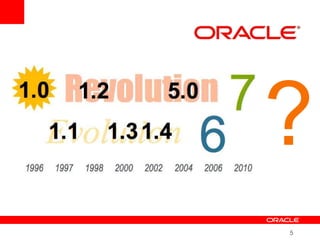
5
?
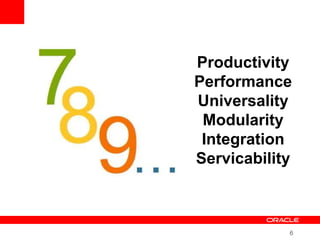
6
Productivity
Performance
Universality
Modularity
Integration
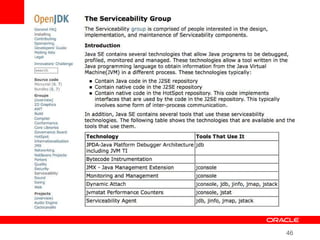
Servicability
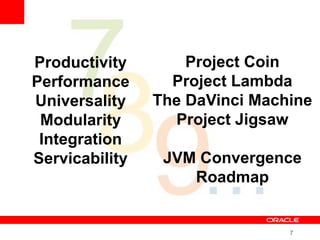
7
Project Coin
Project Lambda
The DaVinci Machine
Project Jigsaw
JVM Convergence
Roadmap
Productivity
Performance
Universality
Modularity
Integration
Servicability
8
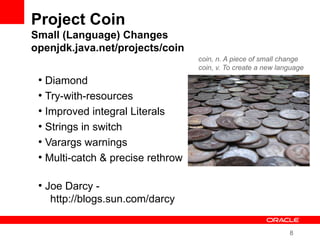
Project Coin
Small (Language) Changes
openjdk.java.net/projects/coin
●
Diamond
●
Try-with-resources
●
Improved integral Literals
●
Strings in switch
●
Varargs warnings
●
Multi-catch & precise rethrow
●
Joe Darcy -
http://blogs.sun.com/darcy
coin, n. A piece of small change
coin, v. To create a new language
9
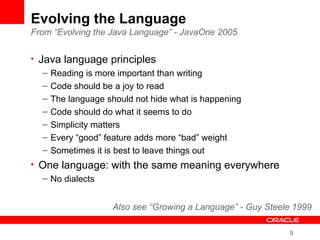
Evolving the Language
From “Evolving the Java Language” - JavaOne 2005
• Java language principles
– Reading is more important than writing
– Code should be a joy to read
– The language should not hide what is happening
– Code should do what it seems to do
– Simplicity matters
– Every “good” feature adds more “bad” weight
– Sometimes it is best to leave things out
• One language: with the same meaning everywhere
– No dialects
Also see “Growing a Language” - Guy Steele 1999
10
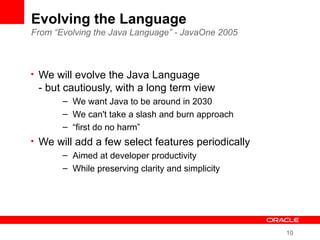
Evolving the Language
From “Evolving the Java Language” - JavaOne 2005
• We will evolve the Java Language
- but cautiously, with a long term view
– We want Java to be around in 2030
– We can't take a slash and burn approach
– “first do no harm”
• We will add a few select features periodically
– Aimed at developer productivity
– While preserving clarity and simplicity
11
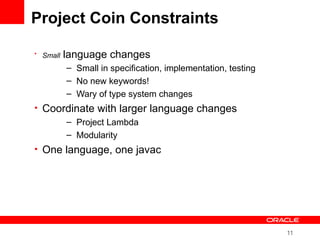
Project Coin Constraints
• Small language changes
– Small in specification, implementation, testing
– No new keywords!
– Wary of type system changes
• Coordinate with larger language changes
– Project Lambda
– Modularity
• One language, one javac
12
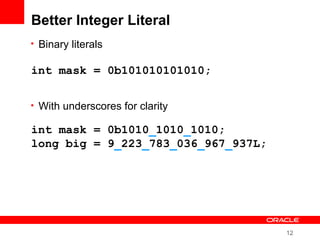
Better Integer Literal
• Binary literals
• With underscores for clarity
int mask = 0b101010101010;
int mask = 0b1010_1010_1010;
long big = 9_223_783_036_967_937L;
13
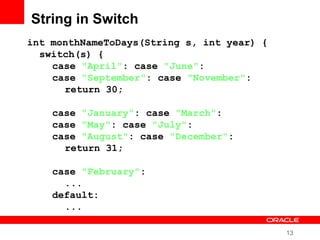
String in Switch
int monthNameToDays(String s, int year) {
switch(s) {
case "April": case "June":
case "September": case "November":
return 30;
case "January": case "March":
case "May": case "July":
case "August": case "December":
return 31;
case "February":
...
default:
...
14
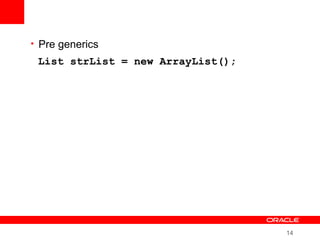
• Pre generics
List strList = new ArrayList();
15
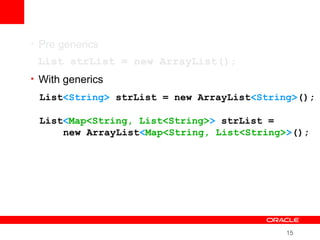
• Pre generics
• With generics
List strList = new ArrayList();
List<String> strList = new ArrayList<String>();
List<Map<String, List<String>> strList =
new ArrayList<Map<String, List<String>>();
16
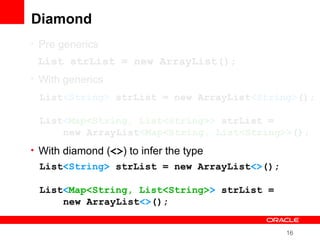
Diamond
• Pre generics
• With generics
• With diamond (<>) to infer the type
List strList = new ArrayList();
List<String> strList = new ArrayList<String>();
List<Map<String, List<String>> strList =
new ArrayList<Map<String, List<String>>();
List<String> strList = new ArrayList<>();
List<Map<String, List<String>> strList =
new ArrayList<>();
17
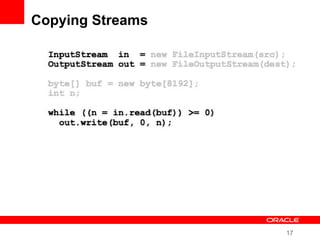
Copying Streams
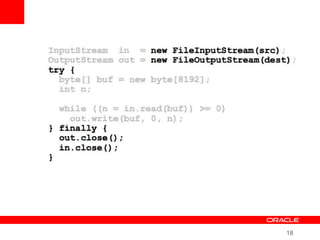
18
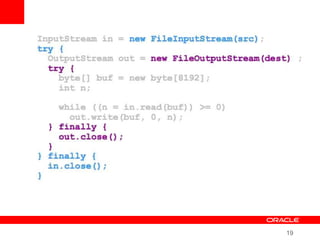
19
20
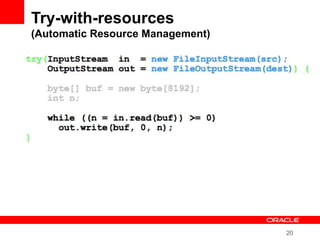
Try-with-resources
(Automatic Resource Management)
21
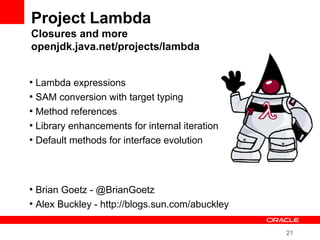
Project Lambda
Closures and more
openjdk.java.net/projects/lambda
●
Lambda expressions
●
SAM conversion with target typing
●
Method references
●
Library enhancements for internal iteration
●
Default methods for interface evolution
●
Brian Goetz - @BrianGoetz
●
Alex Buckley - http://blogs.sun.com/abuckley
22
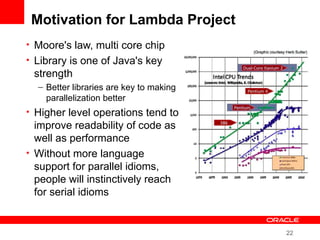
Motivation for Lambda Project
• Moore's law, multi core chip
• Library is one of Java's key
strength
– Better libraries are key to making
parallelization better
• Higher level operations tend to
improve readability of code as
well as performance
• Without more language
support for parallel idioms,
people will instinctively reach
for serial idioms
23
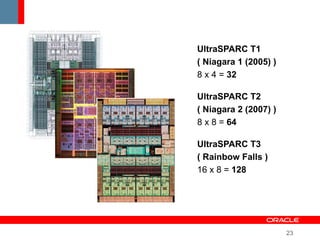
UltraSPARC T1
( Niagara 1 (2005) )
8 x 4 = 32
UltraSPARC T2
( Niagara 2 (2007) )
8 x 8 = 64
UltraSPARC T3
( Rainbow Falls )
16 x 8 = 128
24
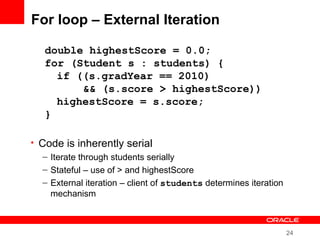
For loop – External Iteration
• Code is inherently serial
– Iterate through students serially
– Stateful – use of > and highestScore
– External iteration – client of students determines iteration
mechanism
double highestScore = 0.0;
for (Student s : students) {
if ((s.gradYear == 2010)
&& (s.score > highestScore))
highestScore = s.score;
}
25
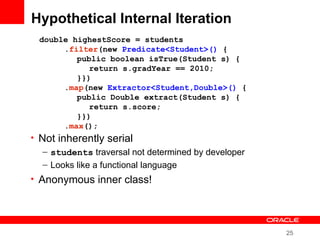
Hypothetical Internal Iteration
• Not inherently serial
– students traversal not determined by developer
– Looks like a functional language
• Anonymous inner class!
double highestScore = students
.filter(new Predicate<Student>() {
public boolean isTrue(Student s) {
return s.gradYear == 2010;
}})
.map(new Extractor<Student,Double>() {
public Double extract(Student s) {
return s.score;
}})
.max();
26
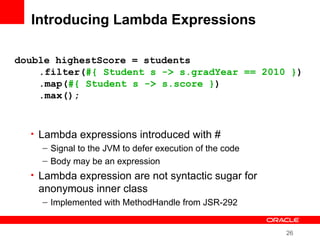
Introducing Lambda Expressions
• Lambda expressions introduced with #
– Signal to the JVM to defer execution of the code
– Body may be an expression
• Lambda expression are not syntactic sugar for
anonymous inner class
– Implemented with MethodHandle from JSR-292
double highestScore = students
.filter(#{ Student s -> s.gradYear == 2010 })
.map(#{ Student s -> s.score })
.max();
27
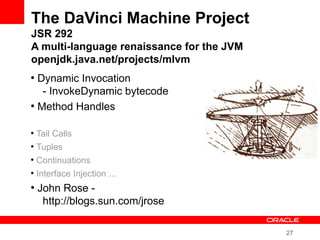
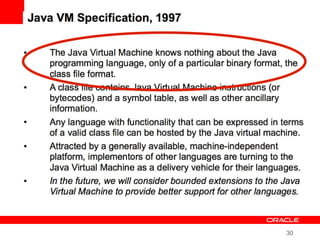
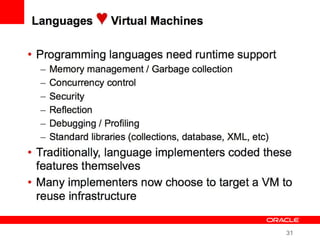
The DaVinci Machine Project
JSR 292
A multi-language renaissance for the JVM
openjdk.java.net/projects/mlvm
●
Dynamic Invocation
- InvokeDynamic bytecode
●
Method Handles
●
Tail Calls
●
Tuples
●
Continuations
●
Interface Injection ...
●
John Rose -
http://blogs.sun.com/jrose
28
29
30
31
32
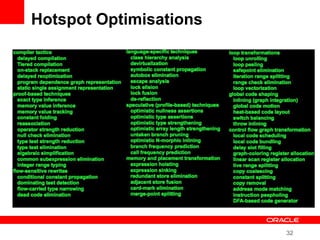
Hotspot Optimisations
33
Project Jigsaw
Modularity in the Java platform
openjdk.java.net/projects/jigsaw
●
Module System for JDK
●
Mark Reinhold
http://blogs.sun.com/mr
●
Alex Buckley
http://blogs.sun.com/abuckley
34
Problems
• Application construction, packaging and publication
– “JAR Hell”
• Performance
– Download time
– Startup time
• Platform scalability
– Down to small devices
35
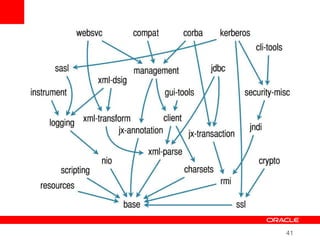
Solution – The Modular Java Platform
• Enables escape from “JAR Hell”
– Eliminates class path
– Package modules for automatic download & install
– Generate native packages – deb, rpm, ips, etc
• Enables significant performance improvements
– Incremental download → fast classloading
– Optimise module content during installation
• Platform scalability – down to small devices
– Well-specified SE subsets can fit into small devices
36
Modularity
• Grouping
• Dependencies
• Versioning
• Encapsulation
• Optional modules
• Virtual modules
37
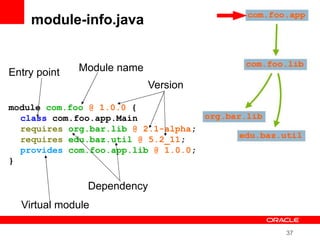
module-info.java
module com.foo @ 1.0.0 {
class com.foo.app.Main
requires org.bar.lib @ 2.1-alpha;
requires edu.baz.util @ 5.2_11;
provides com.foo.app.lib @ 1.0.0;
}
Module name
Version
Entry point
Dependency
Virtual module
38
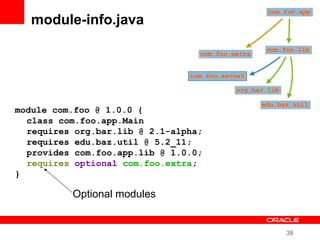
module-info.java
Optional modules
module com.foo @ 1.0.0 {
class com.foo.app.Main
requires org.bar.lib @ 2.1-alpha;
requires edu.baz.util @ 5.2_11;
provides com.foo.app.lib @ 1.0.0;
requires optional com.foo.extra;
}
39
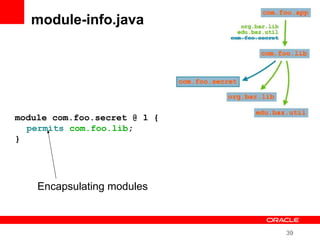
module-info.java
module com.foo.secret @ 1 {
permits com.foo.lib;
}
Encapsulating modules
40
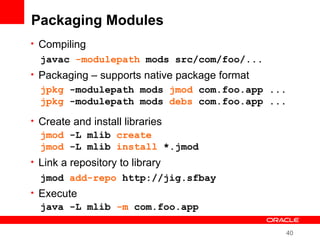
Packaging Modules
• Compiling
• Packaging – supports native package format
• Create and install libraries
• Link a repository to library
• Execute
javac -modulepath mods src/com/foo/...
jpkg -modulepath mods jmod com.foo.app ...
jpkg -modulepath mods debs com.foo.app ...
jmod -L mlib create
jmod -L mlib install *.jmod
java -L mlib -m com.foo.app
jmod add-repo http://jig.sfbay
41
42
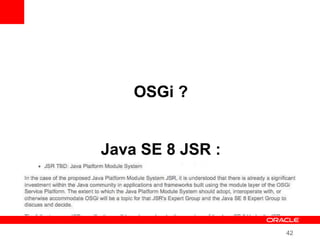
OSGi ?
Java SE 8 JSR :
43
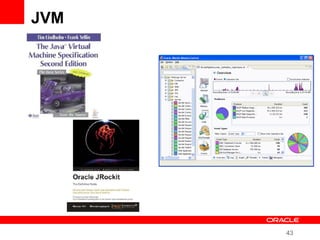
JVM
44
JVM Convergence
●
Two mainstream JVMs
●
HotSpot
●
Versatile (client and server), market share leader, high
quality and performance
●
JRockit
●
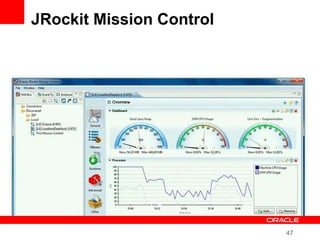
Specialized for the Oracle server stack, basis of value-adds
like Mission Control, Virtual Edition and Soft Real-Time
●
Wasteful to continue development on both, so
●
Goal: Single JVM incorporating best features
45
JVM Convergence
●
More engineers working on HotSpot so..
●
Converged JVM based on HotSpot
with all goodness from JRockit
●
Open-sourced via OpenJDK
●
Some value-add such as Mission Control will remain proprietary
●
Free binary download includes closed source goodies
●
Same use license as before
●
Oracle committed to continued investment
●
JVM teams have been merged, working on feature transfer
●
And moving forward on new projects
●
Will be a multi-year process
46
47
JRockit Mission Control
48
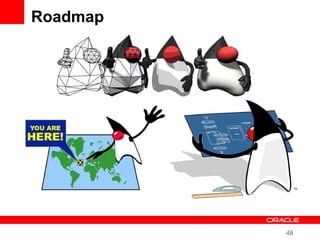
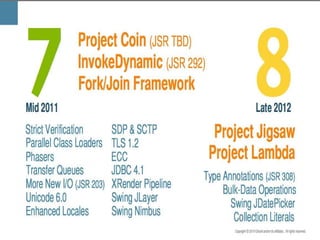
Roadmap
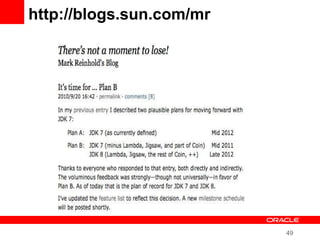
49
http://blogs.sun.com/mr
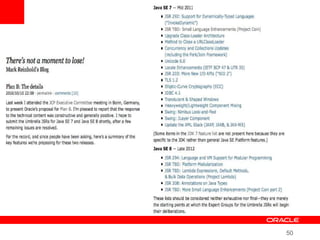
50
51
52
GPLv2+ Classpath Exception
53
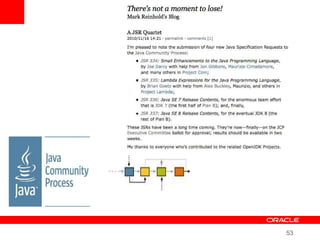
54
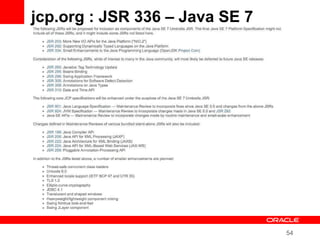
jcp.org : JSR 336 – Java SE 7
55
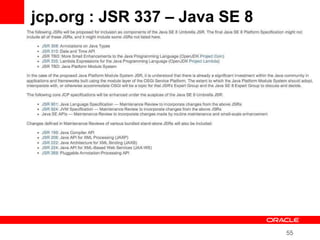
jcp.org : JSR 337 – Java SE 8
56
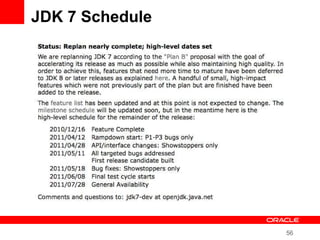
JDK 7 Schedule
57
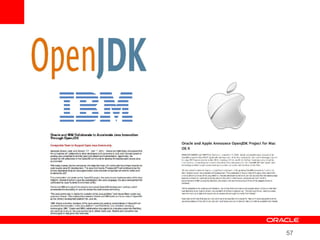
58
openjdk.java.net/projects/jdk
7download.java.net/jdk7
59
(Some) More...
Mark Reinhold
http://blogs.sun.com/mr ( @mreinhold )
Henrik Stahl
http://blogs.oracle.com/henrik
Dalobor Topic
http://robilad.livejournal.com ( @robilad )
Open JDK
http://openjdk.java.net ( /projects/jdk7 ) ( @openjdk )
OTN
http://www.oracle.com/technetwork/java ( @oracletechnet )
JavaOne 2010
http://www.oracle.com/us/javaonedevelop
60
Thank You!
Q&A

Java jdk-update-nov10-sde-v3m

  • 1.
    <Insert Picture Here> JavaSE Update Steve Elliott – Oracle UK steve.elliott@oracle.com November 2010
  • 2.
    2 The following isintended to outline our general product direction. It is intended for information purposes only, and may not be incorporated into any contract. It is not a commitment to deliver any material, code, or functionality, and should not be relied upon in making purchasing decisions. The development, release, and timing of any features or functionality described for Oracle’s products remains at the sole discretion of Oracle.
  • 3.
  • 4.
  • 5.
  • 6.
  • 7.
    7 Project Coin Project Lambda TheDaVinci Machine Project Jigsaw JVM Convergence Roadmap Productivity Performance Universality Modularity Integration Servicability
  • 8.
    8 Project Coin Small (Language)Changes openjdk.java.net/projects/coin ● Diamond ● Try-with-resources ● Improved integral Literals ● Strings in switch ● Varargs warnings ● Multi-catch & precise rethrow ● Joe Darcy - http://blogs.sun.com/darcy coin, n. A piece of small change coin, v. To create a new language
  • 9.
    9 Evolving the Language From“Evolving the Java Language” - JavaOne 2005 • Java language principles – Reading is more important than writing – Code should be a joy to read – The language should not hide what is happening – Code should do what it seems to do – Simplicity matters – Every “good” feature adds more “bad” weight – Sometimes it is best to leave things out • One language: with the same meaning everywhere – No dialects Also see “Growing a Language” - Guy Steele 1999
  • 10.
    10 Evolving the Language From“Evolving the Java Language” - JavaOne 2005 • We will evolve the Java Language - but cautiously, with a long term view – We want Java to be around in 2030 – We can't take a slash and burn approach – “first do no harm” • We will add a few select features periodically – Aimed at developer productivity – While preserving clarity and simplicity
  • 11.
    11 Project Coin Constraints •Small language changes – Small in specification, implementation, testing – No new keywords! – Wary of type system changes • Coordinate with larger language changes – Project Lambda – Modularity • One language, one javac
  • 12.
    12 Better Integer Literal •Binary literals • With underscores for clarity int mask = 0b101010101010; int mask = 0b1010_1010_1010; long big = 9_223_783_036_967_937L;
  • 13.
    13 String in Switch intmonthNameToDays(String s, int year) { switch(s) { case "April": case "June": case "September": case "November": return 30; case "January": case "March": case "May": case "July": case "August": case "December": return 31; case "February": ... default: ...
  • 14.
    14 • Pre generics ListstrList = new ArrayList();
  • 15.
    15 • Pre generics •With generics List strList = new ArrayList(); List<String> strList = new ArrayList<String>(); List<Map<String, List<String>> strList = new ArrayList<Map<String, List<String>>();
  • 16.
    16 Diamond • Pre generics •With generics • With diamond (<>) to infer the type List strList = new ArrayList(); List<String> strList = new ArrayList<String>(); List<Map<String, List<String>> strList = new ArrayList<Map<String, List<String>>(); List<String> strList = new ArrayList<>(); List<Map<String, List<String>> strList = new ArrayList<>();
  • 17.
  • 18.
  • 19.
  • 20.
  • 21.
    21 Project Lambda Closures andmore openjdk.java.net/projects/lambda ● Lambda expressions ● SAM conversion with target typing ● Method references ● Library enhancements for internal iteration ● Default methods for interface evolution ● Brian Goetz - @BrianGoetz ● Alex Buckley - http://blogs.sun.com/abuckley
  • 22.
    22 Motivation for LambdaProject • Moore's law, multi core chip • Library is one of Java's key strength – Better libraries are key to making parallelization better • Higher level operations tend to improve readability of code as well as performance • Without more language support for parallel idioms, people will instinctively reach for serial idioms
  • 23.
    23 UltraSPARC T1 ( Niagara1 (2005) ) 8 x 4 = 32 UltraSPARC T2 ( Niagara 2 (2007) ) 8 x 8 = 64 UltraSPARC T3 ( Rainbow Falls ) 16 x 8 = 128
  • 24.
    24 For loop –External Iteration • Code is inherently serial – Iterate through students serially – Stateful – use of > and highestScore – External iteration – client of students determines iteration mechanism double highestScore = 0.0; for (Student s : students) { if ((s.gradYear == 2010) && (s.score > highestScore)) highestScore = s.score; }
  • 25.
    25 Hypothetical Internal Iteration •Not inherently serial – students traversal not determined by developer – Looks like a functional language • Anonymous inner class! double highestScore = students .filter(new Predicate<Student>() { public boolean isTrue(Student s) { return s.gradYear == 2010; }}) .map(new Extractor<Student,Double>() { public Double extract(Student s) { return s.score; }}) .max();
  • 26.
    26 Introducing Lambda Expressions •Lambda expressions introduced with # – Signal to the JVM to defer execution of the code – Body may be an expression • Lambda expression are not syntactic sugar for anonymous inner class – Implemented with MethodHandle from JSR-292 double highestScore = students .filter(#{ Student s -> s.gradYear == 2010 }) .map(#{ Student s -> s.score }) .max();
  • 27.
    27 The DaVinci MachineProject JSR 292 A multi-language renaissance for the JVM openjdk.java.net/projects/mlvm ● Dynamic Invocation - InvokeDynamic bytecode ● Method Handles ● Tail Calls ● Tuples ● Continuations ● Interface Injection ... ● John Rose - http://blogs.sun.com/jrose
  • 28.
  • 29.
  • 30.
  • 31.
  • 32.
  • 33.
    33 Project Jigsaw Modularity inthe Java platform openjdk.java.net/projects/jigsaw ● Module System for JDK ● Mark Reinhold http://blogs.sun.com/mr ● Alex Buckley http://blogs.sun.com/abuckley
  • 34.
    34 Problems • Application construction,packaging and publication – “JAR Hell” • Performance – Download time – Startup time • Platform scalability – Down to small devices
  • 35.
    35 Solution – TheModular Java Platform • Enables escape from “JAR Hell” – Eliminates class path – Package modules for automatic download & install – Generate native packages – deb, rpm, ips, etc • Enables significant performance improvements – Incremental download → fast classloading – Optimise module content during installation • Platform scalability – down to small devices – Well-specified SE subsets can fit into small devices
  • 36.
    36 Modularity • Grouping • Dependencies •Versioning • Encapsulation • Optional modules • Virtual modules
  • 37.
    37 module-info.java module com.foo @1.0.0 { class com.foo.app.Main requires org.bar.lib @ 2.1-alpha; requires edu.baz.util @ 5.2_11; provides com.foo.app.lib @ 1.0.0; } Module name Version Entry point Dependency Virtual module
  • 38.
    38 module-info.java Optional modules module com.foo@ 1.0.0 { class com.foo.app.Main requires org.bar.lib @ 2.1-alpha; requires edu.baz.util @ 5.2_11; provides com.foo.app.lib @ 1.0.0; requires optional com.foo.extra; }
  • 39.
    39 module-info.java module com.foo.secret @1 { permits com.foo.lib; } Encapsulating modules
  • 40.
    40 Packaging Modules • Compiling •Packaging – supports native package format • Create and install libraries • Link a repository to library • Execute javac -modulepath mods src/com/foo/... jpkg -modulepath mods jmod com.foo.app ... jpkg -modulepath mods debs com.foo.app ... jmod -L mlib create jmod -L mlib install *.jmod java -L mlib -m com.foo.app jmod add-repo http://jig.sfbay
  • 41.
  • 42.
  • 43.
  • 44.
    44 JVM Convergence ● Two mainstreamJVMs ● HotSpot ● Versatile (client and server), market share leader, high quality and performance ● JRockit ● Specialized for the Oracle server stack, basis of value-adds like Mission Control, Virtual Edition and Soft Real-Time ● Wasteful to continue development on both, so ● Goal: Single JVM incorporating best features
  • 45.
    45 JVM Convergence ● More engineersworking on HotSpot so.. ● Converged JVM based on HotSpot with all goodness from JRockit ● Open-sourced via OpenJDK ● Some value-add such as Mission Control will remain proprietary ● Free binary download includes closed source goodies ● Same use license as before ● Oracle committed to continued investment ● JVM teams have been merged, working on feature transfer ● And moving forward on new projects ● Will be a multi-year process
  • 46.
  • 47.
  • 48.
  • 49.
  • 50.
  • 51.
  • 52.
  • 53.
  • 54.
    54 jcp.org : JSR336 – Java SE 7
  • 55.
    55 jcp.org : JSR337 – Java SE 8
  • 56.
  • 57.
  • 58.
  • 59.
    59 (Some) More... Mark Reinhold http://blogs.sun.com/mr( @mreinhold ) Henrik Stahl http://blogs.oracle.com/henrik Dalobor Topic http://robilad.livejournal.com ( @robilad ) Open JDK http://openjdk.java.net ( /projects/jdk7 ) ( @openjdk ) OTN http://www.oracle.com/technetwork/java ( @oracletechnet ) JavaOne 2010 http://www.oracle.com/us/javaonedevelop
  • 60.