ECONOMIC COMMISSION
FOR AFRICA
ECONOMIC COMMISSION
FOR EUROPE
ECONOMIC AND SOCIAL
COMMISSION FOR ASIA
AND THE PACIFIC
ECONOMIC COMMISSION
FOR LATIN AMERICA
AND THE CARIBBEAN
ECONOMIC AND SOCIAL
COMMISSION FOR
WESTERN ASIA
Global Trade Facilitation Conference 2011
Connecting International Trade:
Single Windows and Supply Chains in the Next Decade
TEN YEARS OF SINGLE WINDOW IMPLEMENTATION: 
LESSONS LEARNED FOR THE FUTURE 
Discussion paper
Author: Jonathan Koh Tat Tsen
Disclaimer
The views and the opinions expressed in this document are those of the author and do
not necessarily reflect the views of the United Nations or other organizations that have
contributed to this document.
Contents
1. Overview of Single Window development and automation and
regional trends in the last 10 years......................................................................4
1.1 What was the initial idea behind the Single Window concept?...................4
1.2 Has this initial Single Window idea undergoneany change
in the meantime?...............................................................................................5
2. Different forms of Single Window ...............................................................7
2.1 Customs Automation..........................................................................................8
2.2 Trade Points Portals...........................................................................................9
2.3 Trade Electronic Data Interchange / Value Added Network ........................9
2.4 Limited forms of the Single Window..............................................................10
2.5 National Single Windows ................................................................................12
2.6 Regional / Global Single Windows ................................................................15
3. Trends in the use of ICT for Single Windows.........................................15
4. Trends in national “Single Window” developments.............................18
4.1 Common Goals / Objectives for the Single Window project......................19
4.2 Regional trends in the development of Single Windows............................20
4.3 Trends in African Single Window projects....................................................20
4.4 Trends in Asia / Oceania Single Window projects ......................................21
4.5 Trends in Middle East Single Window projects ...........................................21
4.6 Trends in Latin America / Caribbean Single Window projects ..................21
4.7 Funding models used in Single Window development ..............................22
5. Conclusions and Lessons learned............................................................23
5.1 Recommendations ...........................................................................................25
Annex ........................................................................................................................26
Figure 1 Staged approach to developing a Single Window 7
Figure 2 Good practices for trade across borders 8
Figure 3 Evolution of Single Window development 8
Figure 4 Single Window Tenders / Request for Proposals 19
Figure 5 Asian Single Window implementations 21
Figure 6 Funding and Charging modes 22
Ten years of Single Window Implementation: Lessons learned for the future 2
Abstract
This paper examines the Single Window concept and its developments in practice over the
last 10 years and provides an analysis of its development over time. An overview of the
emerging information technology that would impact its future development is also
presented. The paper also examines regional trends in Single Window implementation,
based on a survey of tenders documents issued by various countries in the recent years.
Finally, it offers an outlook on its future development and provides a number of
recommendations.
Ten years of Single Window Implementation: Lessons learned for the future 3
1. Overview of Single Window development and automation and regional trends in
the last 10 years
1.1 What was the initial idea behind the Single Window concept?
Global trade expanded rapidly during the 1980s and 1990s. The resulting complexity and
speed of the modern supply chain and the number of parties involved greatly increased the
requirements for information controlling the flow of goods. But despite the breakneck
developments in information and communications technologies (ICT) and trade data-
exchange standards during the same time, trade documentation exchanges remained mostly
paper-based. However, in the modern trade environment such paper-based exchanges
cannot satisfy the need for efficiency and security.
One “omnibus” means of addressing this problem that has gained considerable momentum
over the past 10 years is the so-called “ Single Window”. In Recommendation No. 33,
UNECE defines the Single Window as a “facility that allows parties involved in trade and
transport to lodge standardized trade-related information and/or documents to be submitted
once at a single entry point to fulfil all import, export, and transit-related regulatory
requirements1
.
The Recommendation identifies three basic models for the Single Window:
A. A Single Authority that receives information, and disseminates this information
to all relevant governmental authorities, and coordinates controls in the
logistical chain.
B. A Single Automated System for the collection, dissemination and integration of
information and data related to trade that crosses the border. There are various
possibilities:
i. Integrated System: Data is processed through the system
ii. Interfaced System (decentralized): Data is sent to the agency for processing
iii. Combination of (i) and (ii)
C. An automated Information Transaction System through which a trader can
submit electronic trade declarations to the various authorities for processing and
approval in a single application. In this approach, approvals are transmitted
electronically from governmental authorities to the trader’s computer.
1
In 2004, UNECE published “Recommendation 33 - Guidelines on Establishing a Single Window”
developed by its Centre for Trade Facilitation and electronic Business (UN/CEFACT). It recommended
that governments and those engaged in the international trade and movement of goods should actively
consider implementing a “Single Window facility” in their country. The Recommendation and Guidelines
were formally approved by UN/CEFACT in 2004.
Ten years of Single Window Implementation: Lessons learned for the future 4
Many countries have seen that a Single Window facility can greatly improve the
implementation of standards, techniques and tools for simplifying and expediting
information flows between traders and government. It can also simplify processes,
harmonize data and improve the sharing of relevant information across governmental
systems. The improved efficiency and effectiveness of controls, and the reduction in costs
both for governments and for traders, due to a better use of resources are expected to bring
significant gains to all parties involved in cross-border trade.
1.2 Has this initial Single Window idea undergone any change in the meantime?
Since the initial idea, three important developments have evolved that are critical to the
evolution and development of the Single Window.
Firstly, that a “Single Window” doesn't necessarily imply using high-tech information and
communication technology (ICT), although it is usually better if governments do adopt ICT
technologies for a Single Window”. But in our digital and Internet-fuelled age, all
implementations of the “Single Window” have invariably been coupled with the use of ICT
to help automate and create a paperless trading environment. For practical purposes, the
establishment of “Single Window” today can only be done through the use of ICT and the
Internet.
Secondly, the idea of a “Single Window” at the national level has challenged the
conventional “compartmentalized” approach to regulatory control of the movement of
goods. For example Recommendation 33 states that “a Single Window should represent a
close cooperation between all involved governmental authorities and agencies, and the
trading community”.
However, most of us understand the challenge of involving all the relevant governmental
authorities and agencies as well as the trading community. Many different government
departments and agencies hold legislative powers and control and manage various levels of
regulation—e.g. health, plant and animal quarantine, sanitary and phyto-sanitary, food and
drug safety, and defence. Agencies other than Customs that are involved in the regulation
of cross-border trade are termed “Other Government Agencies” (OGAs). There are often
between 20 and 40 of these involved, but the number varies among countries.
It's rare to find a Single Window facility covering all OGAs. Many implementers have
found that the challenge of coordinating these different agencies (and their procedural and
data requirements) into coherent and simplified procedures that could be automated is often
more political than technical. A recurrent challenge is to convince the OGAs to agree to use
the Harmonized System Codes (HS Code) as the commodity classification for the Single
Window.
Indeed, not all players in the government and/or trade community welcome the
implementation of a Single Window. Opposition to the establishment of the Single Window
can also come from within Customs. The anecdote below, which is drawn from the case
study on Madagascar’s trade reforms, provides some insights.
Ten years of Single Window Implementation: Lessons learned for the future 5
Opposition to the reforms was widespread and came from many quarters. The
private sector - resigned to the inefficiency and corruption in Customs - was
reluctant to start paying the additional fees that the project would require and
sceptical that such an ambitious and advanced solution would work in the Malagasy
context. The 1,400-strong Customs service itself was also reluctant to change its
ways. Wedded to the old way of doing things, many customs agents also had a
vested interest in existing arrangements, which brought steady revenues under the
table.
Source: Kjartan Fjeldsted, 2009. Case study on trade reform in Madagascar, World
Bank Publications
Thirdly, the initial concept according to which the trading community can submit
information and documents to government authorities in compliance with regulatory
requirements implies a national or countrywide facility for all trade transactions.
However, Single Window implementation on a countrywide scale is an extremely complex
and costly undertaking. Creating a national Single Window requires tremendous efforts,
cost, changes of mindset and more importantly, strong political will. Therefore, most
governments choose an incremental step-by-step rather than a “big bang” approach to their
Single Window projects.
Some start with a limited form of the Single Window, for example to cover either a specific
procedure such as export declarations or a specific area such as the port — “Port Single
Window” or “Port Community System” — while others focus on exports only.
Many national Single Windows were introduced in a phased approach, with each stage
covering a selected group of OGAs. The selection of the initial group is usually based on
their readiness for change and willingness to simplify cross-border trade processes.2
Over
time, all OGAs can gradually be incorporated into the Single Window system.
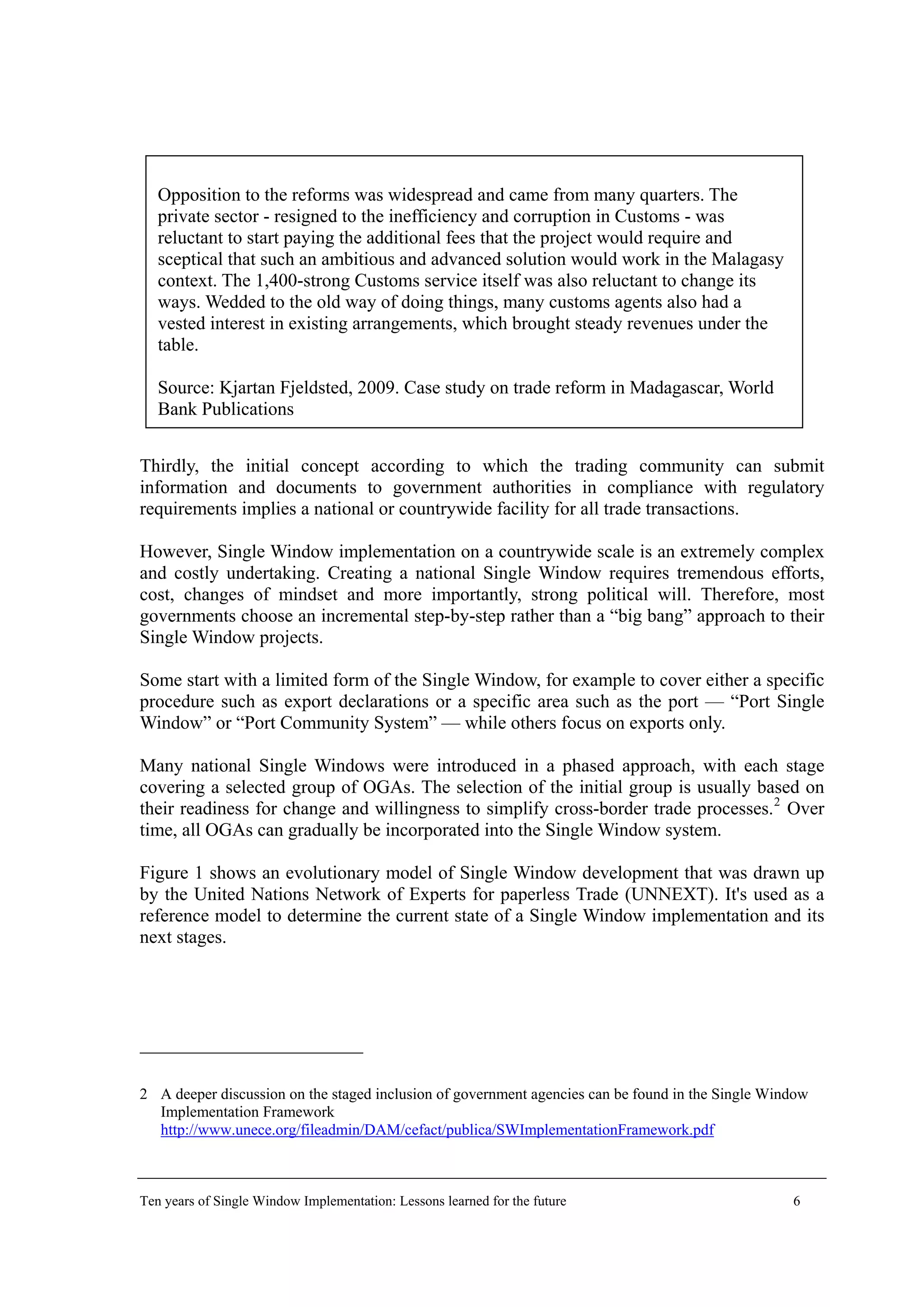
Figure 1 shows an evolutionary model of Single Window development that was drawn up
by the United Nations Network of Experts for paperless Trade (UNNEXT). It's used as a
reference model to determine the current state of a Single Window implementation and its
next stages.
2 A deeper discussion on the staged inclusion of government agencies can be found in the Single Window
Implementation Framework
http://www.unece.org/fileadmin/DAM/cefact/publica/SWImplementationFramework.pdf
Ten years of Single Window Implementation: Lessons learned for the future 6
Figure 1 Staged approach to developing a Single Window
2. Different forms of Single Window
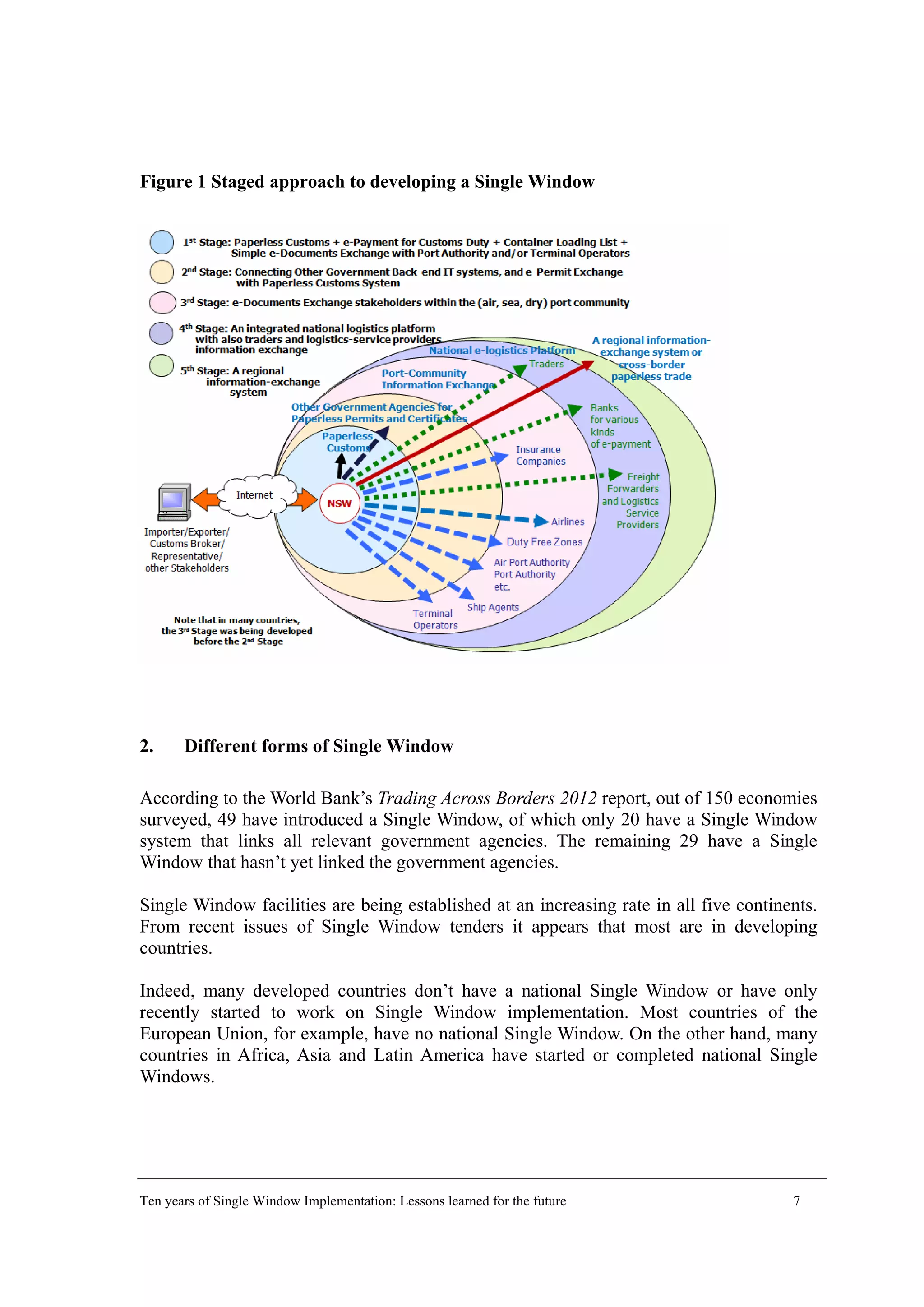
According to the World Bank’s Trading Across Borders 2012 report, out of 150 economies
surveyed, 49 have introduced a Single Window, of which only 20 have a Single Window
system that links all relevant government agencies. The remaining 29 have a Single
Window that hasn’t yet linked the government agencies.
Single Window facilities are being established at an increasing rate in all five continents.
From recent issues of Single Window tenders it appears that most are in developing
countries.
Indeed, many developed countries don’t have a national Single Window or have only
recently started to work on Single Window implementation. Most countries of the
European Union, for example, have no national Single Window. On the other hand, many
countries in Africa, Asia and Latin America have started or completed national Single
Windows.
Ten years of Single Window Implementation: Lessons learned for the future 7
Figure 2 Good practices for trade across borders3
Governments have introduced a range of inter-agency collaborative systems to manage
export- and import-related procedures. These systems perform certain functions and meet
certain criteria of the Single Window, as described in UNECE Recommendation 33.
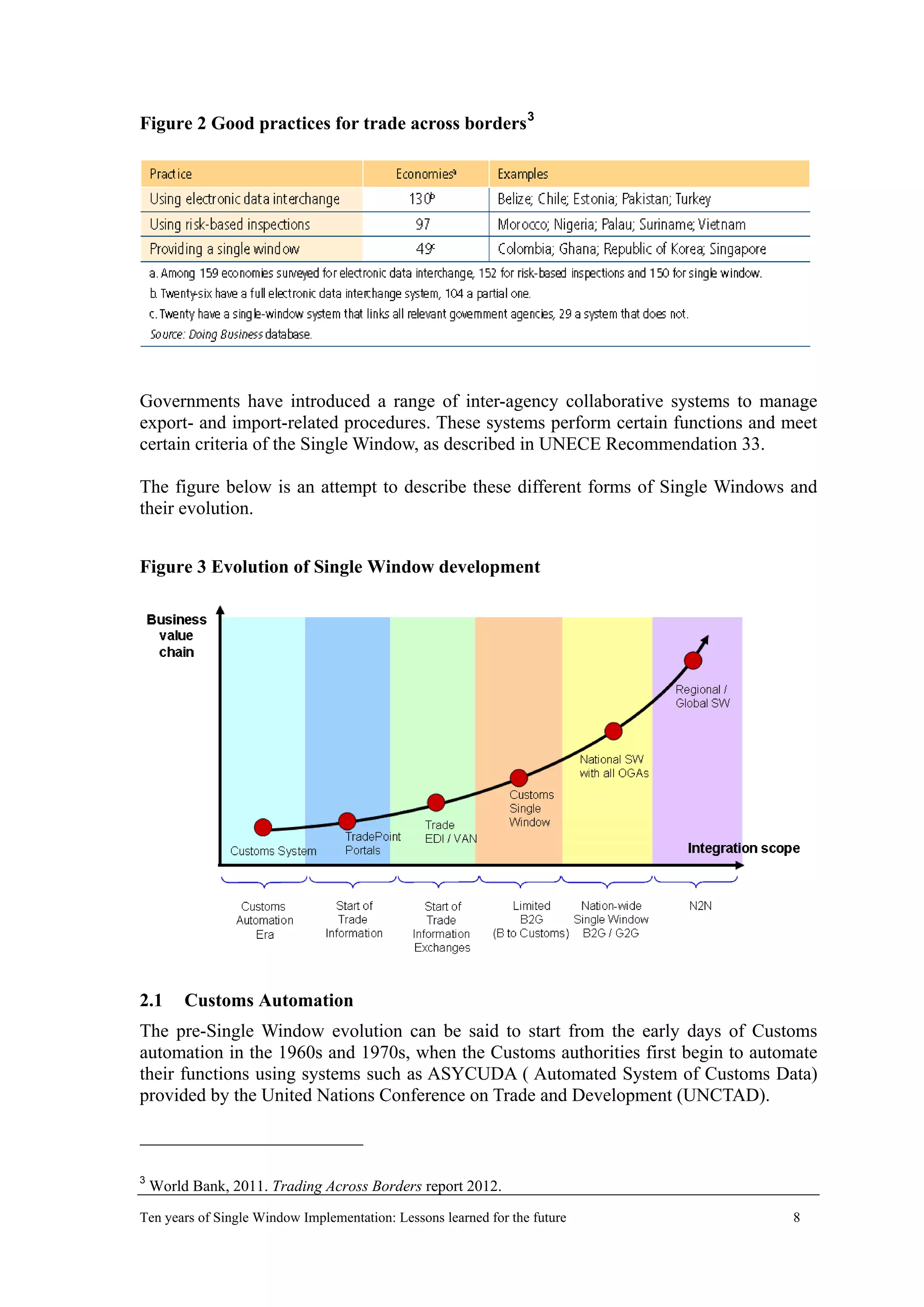
The figure below is an attempt to describe these different forms of Single Windows and
their evolution.
Figure 3 Evolution of Single Window development
2.1 Customs Automation
The pre-Single Window evolution can be said to start from the early days of Customs
automation in the 1960s and 1970s, when the Customs authorities first begin to automate
their functions using systems such as ASYCUDA ( Automated System of Customs Data)
provided by the United Nations Conference on Trade and Development (UNCTAD).
3
World Bank, 2011. Trading Across Borders report 2012.
Ten years of Single Window Implementation: Lessons learned for the future 8
2.2 Trade Points Portals
Following this was the era of the development of national “Trade Points”. These serve as
an information source for trade-related information, providing traders with data about
business and market opportunities. They also function as trade-facilitation centres, where
players in trade transactions (e.g. Customs, banks, chambers of commerce, freight
forwarders, transport and insurance companies) are grouped together under a single
physical roof or linked virtually to the Trade Point to provide all the services required for
trade transactions.
Trade Points were originally conceptualized to serve as gateways to global electronic
networks, with all national Trade Points interconnected in a worldwide electronic network.
2.3 Trade Electronic Data Interchange / Value Added Network
With the advent of Electronic Data Interchange (EDI) techniques, a popular method for
transmitting documents was the use of modems to communicate through a value added
network (VAN) provider.
VAN providers are the go-betweens in EDI transmissions. They receive EDI transactions,
examine the from and the to information and route the transaction to the final recipient.
They also provide “value-added” services such as providing a mailbox service, re-
transmitting documents, producing delivery reports, and acting as a gateway for different
transmission methods.
One of the earliest national trade EDI initiatives was the Hong Kong Trade Local and
International Network (HOTLINE) Project, started in 1984. HOTLINE was to
interconnect computers between organizations for data exchange for trade. The project
failed due to the lack of support from the trading community and the government of Hong
Kong4
.
The Tradelink project was subsequently initiated as a consortium of government and
private companies. In 1997, it was appointed as an exclusive service provider by the Hong
Kong SAR government and began operations to electronically process specific trade
documents such as trade declarations, permits and certificates of origin.
Many countries have adopted the EDI-based approach for trade documentation:
Chinese Taipei launched their EDI network for customs clearance automation
under their Ministry of Finance in the 1992.
Mauritius developed their TradeNet project in 1994 with the help of the
Singaporean TradeNet.
4
UNESCAP, 2002. Initiatives for E-Commerce Capacity-Building of Small and Medium Enterprises.
Proceedings and papers presented at the Regional Consultative Meeting on Initiatives for E-Commerce
Capacity-Building of Small and Medium Enterprises, Seoul, 13-15 November 2002
Ten years of Single Window Implementation: Lessons learned for the future 9
Japan started their nationwide “Trade and Settlement EDI System” (TEDI) in 1998
as an initiative of their Ministry of International Trade and Industry. The original
objective of the TEDI system was to reduce time and cost incurred in trade
administration and operation by standardizing and exchanging electronic trade
documents over safe and reliable networks.
Saudi Arabia initiated their SaudiEDI project in 2002. SaudiEDI incorporates an
electronic gateway linking the trade users to Customs, Ports Authority and other
government agencies for the electronic submission and processing of manifests,
declarations and delivery orders.
Today, according to the World Bank’s Trading Across Borders 2012 report5
, 82 per cent of
economies around the world allow traders to submit at least some of their export and
import declarations, manifests and other trade-related documents to Customs authorities
electronically. However, many of these systems are not linked to the Internet, and others
still require hard copies.
2.4 Limited forms of the Single Window
Customs Single Window
To circumvent the challenge of involving other government agencies (OGAs), a variation
of the limited “Single Window” has emerged: the Customs Single Window. This
essentially provides a single interface between the trading community and the Customs
Authority. Such instances of a “Single Window for Customs Clearance” don't fully cover
the permits and licensing of all of the OGAs and therefore don't cover all the regulatory
processes described in Recommendation 33.
Examples of the Customs Single Window include:
Mauritius’ TradeNet system, which has not yet extended to include all of the
OGAs.
Australian Customs and Border Protection Service Integrated Cargo System, which
is a Customs-centric Single Window initiative with a degree of interaction with
selected OGAs.
Port Single Windows and Port Community Systems
Similarly, other authorities with a substantial role in trade—such as the Port Authority—
have also established a limited, port-centric, “Single Window”, commonly referred to as
either a “Port Single Window” or a “Port Community System” (PCS).
The Port Single Window has been defined as a system which provides local level
information about the vessel to the authorities on a port level, has B2G (Business to
5
World Bank, 2012. Doing Business 2012 – Trading Across Border report.
Ten years of Single Window Implementation: Lessons learned for the future 10
Government) character; while the Port Community System (PCS) provides a tool to
exchange messages in the port environment, having a commercial and logistic nature and
B2B (Business to Business) character6
.
Examples of Port Single Windows include:
Finland’s PortNet System, which was first developed in 1993, and is owned by
Finland Customs, the Finnish Maritime Administration and 20 of the largest ports
in Finland.
France’s e-Maritime Port Single Window, which is a public-private partnership
between Le Havre Port Authority, the French Customs, and SOGET.
A Port Community System can be characterized as a “centrally operated system for
transferring data and providing other services with the help of this data, which can be used
by any party who is interested in information concerning sea-borne transport. A Port
Community System avoids bilateral data transfer”7
.
Europe has a long history of Port Community Systems, in particular Germany, the United
Kingdom, France, the Netherlands and Spain. These systems have been established in
many European ports and airports since the 1960s.
Examples include:
Felixstowe Port Community System, which was started in 1984, and subsequently
expanded to include other ports in the United Kingdom.
India's Port Community System, which is a web-based centralized Port
Community System initiative by the Indian Ports Association, intended to provide
a Single Window system for the port communities in India. Established in 2007, it
currently serves 22 of the country's major ports.
Today, the European PCS are providing services related to the Single Window and have
started to offer support for cross-border transactions. For example, DAKOSY and
Portbase, the PCS of the ports of Hamburg and Rotterdam, make it possible for their
shippers to send advance cargo declarations required under the EU Import Control System
to many EU Customs organizations.
While the landscape in Europe is characterized by a network of existing Port Community
Systems and Customs Single Windows, the challenge for Europe is to build upon these
long-established existing systems and turn them into the fuller national Single Windows
that correspond to the “single entry point” criteria. This means that they should cover all
government agencies and fulfil all import, export, and transit-related regulatory
requirements.
6
Kari Suvila, 2007, Single Window implementation in Customs Environment, National Board of
Customs, Finland.
7
Grizell, P. et al, 2001. An evaluation of Port Community Systems: What can the Port of the Netherlands
learn and use of other platforms”, NedCargo.
Ten years of Single Window Implementation: Lessons learned for the future 11
Subnational “Single Window”
While the original concept implies countrywide, in some cases of “Single Window”
implementation—especially in larger countries—it was found that the only feasible way
was to take a subnational approach, whereby the local trade community and regulatory
agencies can be grouped together at city or provincial level to establish a trade community
“Single Window” system.
An example of this is China’s massive E-Port project, which is characterized as an
“integrated clearance information platform focused on clearance management and
enforcement, extending gradually to logistics and commerce service”. It comprises three
components – data exchange, transaction processing and auxiliary support platforms. It
supports data exchange and sharing between government departments, port management
agencies and enterprises, and provides online services such as declaration and payment
through a Single Window.
The project is implemented at both central and local levels, whereby the central
government ministries and the local e-ports interconnect with each other via China’s E-
Port VPN for data exchange and sharing. It is at the local level where the subnational
implementation of the E-Port - Shanghai’s Easipass Platform - is currently the operational
Single Window for port and customs clearance in Shanghai8
.
2.5 National Single Windows
The preceding section traced the evolutionary progression of the development of the
Single Window in the national context. The limited forms of Single Window systems—
Customs-centric as well as port-centric versions—provide a valuable “learning curve” for
many countries as they progress towards fulfilling the “Single Window” vision: a
countrywide facility that provides for all parties (regulatory agencies and the trading
community) to submit standardized information only once, at a single entry point, to fulfil
all import, export and transit-related regulatory requirements.
The Association of South East Asian Nations (ASEAN) has expanded the definition of the
“National Single Window” further by introducing the concept of “submitting once at a
single entry point”:
ASEAN defines the “National Single Window” as a system which enables:
A single submission of data and information;
A single and synchronous processing of data and information;
A single decision-making for customs release and clearance;
A single decision-making shall be uniformly interpreted as a single point of
decision for the release of cargoes by the Customs on the basis of decisions, if
8
Wang Jian, 2010. China Progress Towards Single Window and Paperless Trade, Presentation at the
UNESCAP Asia Pacific Trade Facilitation Forum Oct 2010.
Ten years of Single Window Implementation: Lessons learned for the future 12
required, taken by line ministries and agencies and communicated in a timely
manner to the Customs”9
.
The development of a National Single Window also means that all other government
agencies have to be part of this system. It needs to be able to accommodate and to connect
the various agencies’ needs and requirements in order to facilitate trade.
But government agencies are traditionally organized through a variety of separate
departments, which may have limited connection with each other either technologically or
in the way their services are delivered. Those implementing the Single Window very often
found themselves to be pioneers in establishing an unprecedented “connected
government” framework!10
Few, if any, E-Government initiatives have as wide a scope and breadth as a Single
Window project that necessitates the interconnection of several government backend
systems that are mainly operated as independent “silos”. This makes Single Window
projects even more challenging. Only countries that already have a strong electronic
government foundation are able to build upon that foundation towards the “connected”
government structure.
In recent years, we have seen several attempts to establish countrywide Single Window
systems that meet this ambitious criterion.
9
ASEAN, 2005. Agreement to Establish and Implement the ASEAN Single Window.
10
The concept of “connected” government is derived from the whole-of-government approach, which is
increasingly looking towards technology as a strategic tool and as an enabler for public service
innovation and productivity growth - United Nations e-Government Survey 2008 - From e-Government
to Connected Governance.
Ten years of Single Window Implementation: Lessons learned for the future 13
Singapore’s TradeNet integrates 35 government agencies
Singapore was an early starter to develop a countrywide system. They initiated their
plan in 1986 and launched a fully automated national system for trade facilitation,
called TradeNet, in Jan 1989.
TradeNet enabled traders to have 24-hour access to services for the electronic
transmission of trade documents. It was further upgraded in January 1999 to
embrace web-based technologies. It currently connects 35 government agencies to
facilitate the processing and approvals of trade permits, reducing the processing time
per application to less than 3 minutes.
The TradeNet system requires the cooperation of multiple government agencies and
an integration of their systems. Having a strong sponsor for the project was
important but not sufficient for success.
Earlier efforts by individual government statutory boards did not offer an acceptable
solution. It took several painstaking years to achieve the full coverage of the 35
government agencies involved in the trading eco-system.
Extended National Single Windows with Business-to-Government Services
A National Single Window, by definition, caters for Business-to-Government (B2G) and
Government-to-Government (G2G) connectivity. An interesting variant of National Single
Windows provides for the extension of the services to offer Business-to-Business (B2B)
services as well, such as trade-financing instruments (letter of credit, letter of guarantee,
bill of ladings), commercial documents (purchase/sales order, order confirmation, packing
list, advanced shipment notice, commercial invoices), etc. These services hinge on the
concept of “paperless trade”11
.
So far, three Asian economies have extended their existing Single Window to cater for
B2B services; these include Hong Kong’s Digital Trade & Transportation Network
(DTTN); the Republic of Korea’s u-TradeHub, and Singapore’s TradeXchange, which
were launched between 2006 and 2007.
The extended Single Window: challenges
There are significant challenges and issues to the success of the extended Single Window.
First, the business world is still very much paper-based, especially for cross-border
transactions. Many banks and even government regulatory authorities still require paper-
based documents for verification. Although the landscape is slowly transitioning to a
paperless environment, it will still take some years to come. Secondly, unlike B2G / G2G
services, where a government mandate can guarantee the compulsory usage of the Single
11
For an in-depth analysis of “Paperless Trade”, see UNECE (2005), A Roadmap Towards Paperless
Trade.
Ten years of Single Window Implementation: Lessons learned for the future 14
Window for B2G transactions, there is no such requirement for B2B services. Businesses
have many choices and alternatives for exchanging digital documents, and cost is often the
overriding factor. Because of this, the transaction volumes of the extended Single
Windows are not at the anticipated level.
2.6 Regional / Global Single Windows
As we see more national Single Windows being created, there is considerable impetus in
regional and international fora for greater connectivity between countries, regions and
across continents. The model currently being contemplated foresees supra-national
Nation-to-Nation (N2N) exchange of trade information between National Single
Windows.
ASEAN was one of the first organizations to conceptualize a regional Single Window
project. As early as Dec 2005, it concluded the agreement to establish and implement the
ASEAN Single Window, and followed this in April 2006 with the establishment of a
protocol for that Single Window.
The ASEAN Single Window (ASW) is the first regional initiative that seeks to enhance
regional connectivity. It is defined as:
“The secured environment where National Single Windows (NSWs) integrate and operate.
The ASW constitutes a regional facility to enable a seamless, standardized and
harmonized routing and communication of trade and customs-related information and
data for customs clearance and release from and to NSWs. Trade and related customs data
and information will stay within, and belong to respective Member States.”
The implementation of the ASW is planned for 2015, although some cross-border
transactions are expected to begin as early as 2013.
Currently the European Community has two major Single Window initiatives: (a) the
Single Window Initiative of the Directorate-General Taxation and Customs Union (DG
TAXUD), aims at a community-level Single Window, and (b) the “Maritime Single
Window” of Directorate-General for Mobility and Transport (DG MOVE) aims to provide
electronic exchange between the operators of maritime transporters within the EU.
The next stage in this fascinating evolution of the Single Window lies in connecting
national Single Windows— including the existing evolutionary forms of Single Windows
such as Customs Single Windows, Port Community Systems and EDI VAN—in global
networks that will facilitate cross-border trade and the sharing of information in the supply
chain.
3. Trends in the use of ICT for Single Windows
In the 1960s, advances in information technology and computers contributed to making
electronic data interchanges pervasive. In finance, the use of Electronic Data Interchange
became widespread with the setting up of the Society for Worldwide Interbank Financial
Telecommunications (SWIFT) in 1974. The society established the SWIFT messaging
Ten years of Single Window Implementation: Lessons learned for the future 15
system in 1977 when it started operations with 230 banks from five countries. The use of
EDI for trade began more or less around the same time:
• In 1971, the Simplification of Trade Procedures Board (SITPRO) in the United
Kingdom began work on common EDI standards for Europe.
• In 1975, the United Nations began to develop terms of reference for international
EDI standardization.
• In the 1980s, UNECE contributed by laying the groundwork for the use of EDI
techniques for trade-information exchanges.
• In 1988, the United Nations chartered UN/EDIFACT (United Nations Electronic
Data Interchange for Administration, Commerce, and Transport) to develop a
worldwide and internationally approved standard structure for exchanging
information among partners.
In the pre-Internet days, Single Window systems would invariably require a front-end
client for traders to access the back-end Single Window main system. These front-end
clients, frequently referred to as thick clients, are software programs that have to be
installed at the traders’ premises. The continued support and maintenance of these front-
end clients necessitates the existence of first-tier service providers to service the ICT
needs of the trading community. Since all of these incur additional cost to the traders, this
becomes a barrier for the large number of small enterprises who cannot justify such costs
in view of their low trading volumes.
Today, with the pervasiveness of the Internet and its associated technologies, the leveraged
use of ICT for the Single Window development is imperative.
Many of the current Single Window technical requirements focus on the use of web-based
technologies for better trading-community access to the Single Window portal. The use of
browsers to access the Single Window system becomes pervasive, reducing the need for
the front-end thick client. This allows traders to come “on board” to the Single Window in
an easier and almost cost-free manner.
One of the significant technologies for the Single Window is the use of messaging and
message translation technologies to enable messages to be exchanged, processed and
analysed in a secured manner. When Singapore’s TradeNet was first developed, in the late
1980s, it used a proprietary “Information Exchange Engine” developed by IBM that
comprised 1.2 million lines of assembly code12
. Great advancements in secured messaging
handling and processing technologies have provided Single Window implementers with a
greater choice of messaging/translation engines, capable of handling increasingly massive
amounts of trade message interchanges in a scalable and secure manner. This development
has reduced the cost and overall duration of Single Window development to reasonable
levels.
12
Benn Konsynski, John King, 1990. Singapore TradeNet : A Tale of One City, July 1990 Harvard
Business Review
Ten years of Single Window Implementation: Lessons learned for the future 16
Another recent ICT innovation that significantly impacts the Single Window is the
Services-Oriented Architecture (SOA). An SOA utilizes methodologies for designing and
developing software to enable interoperability. Designing the Single Window using SOA
principles will enable a web-based Single Window environment to integrate widely
disparate systems and applications and to use multiple implementation platforms. Hence, a
Single Window using the SOA integration approach provides a flexible integration model
for online and transactional processing through a messaging architecture (such as those
previously described above).
Two significant advances in ICT development are expected to dominate the Single
Window development landscape in the coming years: cloud computing and mobile
computing.
The advent of cloud computing where applications are served with data that is stored on
the Internet “in the clouds” and can be accessed and shared by the parties involved in the
supply chain operation has evoked various degree of interest.
Some Single Window initiatives already make use of cloud technology. One recent
example is the Trans-Kalahari Corridor regional Single Window, which employs cloud
computing to automate the Customs processes and exchanges between the Customs
authorities of Botswana, Namibia and South Africa.
But cloud computing for Single Windows is still very new and there have been many
issues that may arise such as data quality, data privacy and security, misuse of information,
reliability, liability, lawful authority for data access and many others.
It is therefore unlikely that Single Window implementation would consider operating the
public “cloud” were access to the data is given to the general public. Alternatives such as
“private clouds” were data and services are restricted to authorized parties may be a
possible option.
Second, the ubiquitous mobile computing and radio frequency identification technology is
a phenomenon that will change the way trade transactions will be done in the coming
years. Soon, desk-bound computers will no longer be required for data entry and retrieval.
The combination of smart devices, tablets with scanners and wireless technology will
transform the logistics and supply chain into dynamic, highly traceable and visible
environments. Data and information shall be captured in real-time while the cargo is on
the move. All these will transform the Single Window landscape drastically.
New ways and means to interconnect the Single Window and external systems with all
these devices and appliances, will mean that the real-time flow of data and information,
disseminated at the almost the same time as they are received, will present a set of new
issues and challenges. Information management at the speed of thought would be the new
operating envelope.
Ten years of Single Window Implementation: Lessons learned for the future 17
4. Trends in national “Single Window” developments
In recent years, there has been a spate of countries who have issued tenders/requests for
proposals for their Single Window implementation. These tenders are publicly available
and reflect the current objectives and priorities of governments when implementing a form
of Single Window as described in the evolutionary model in chapter two.
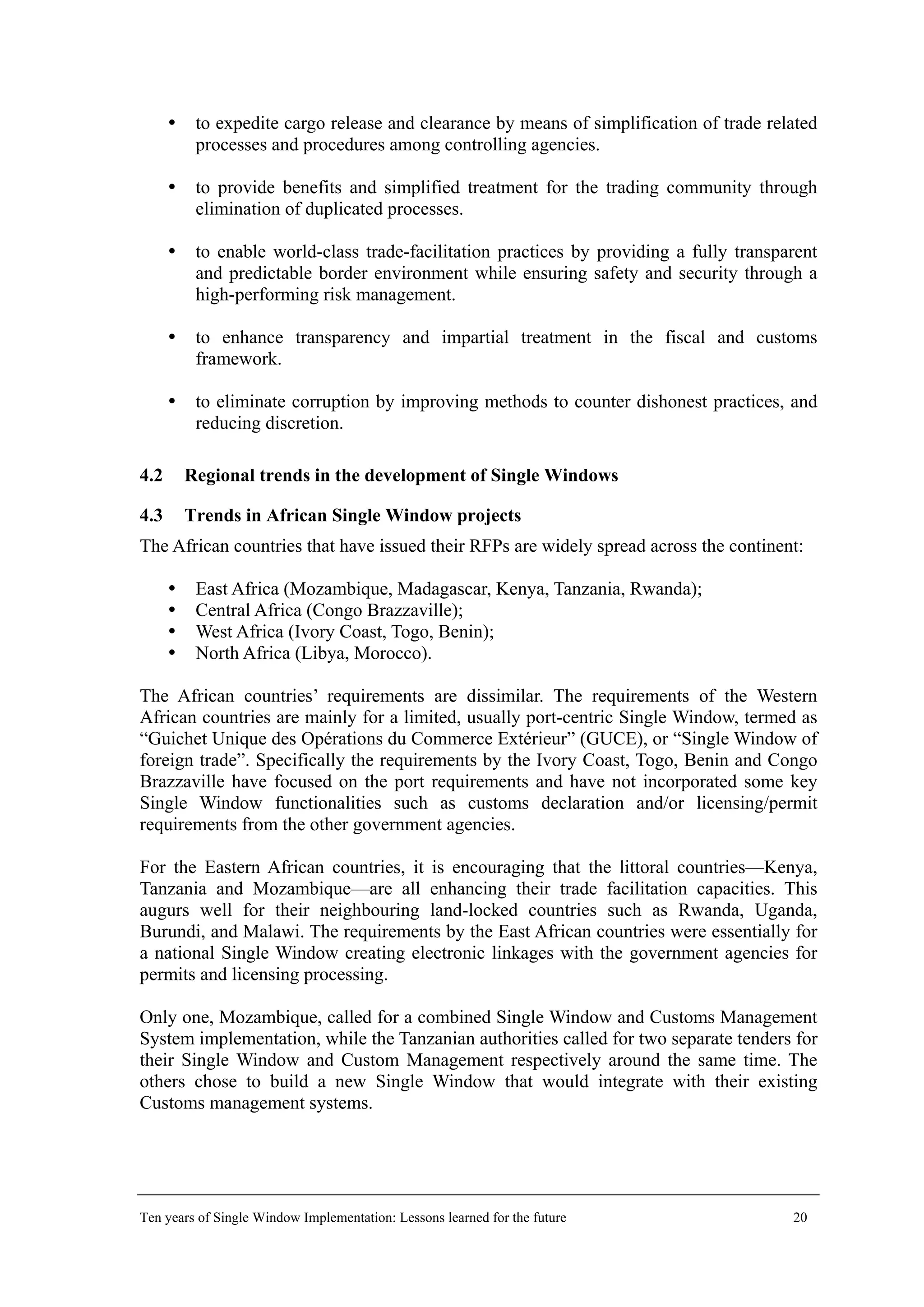
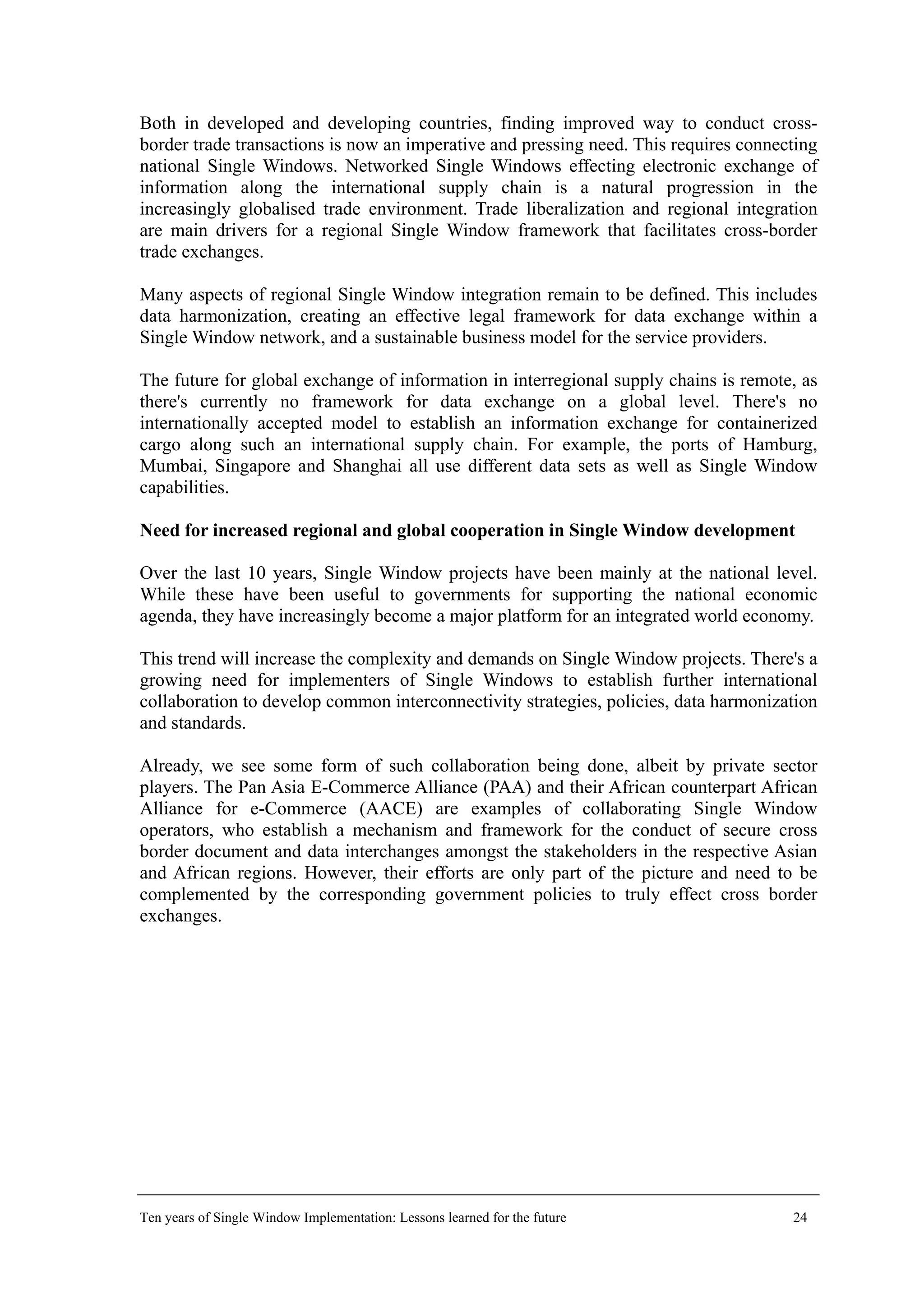
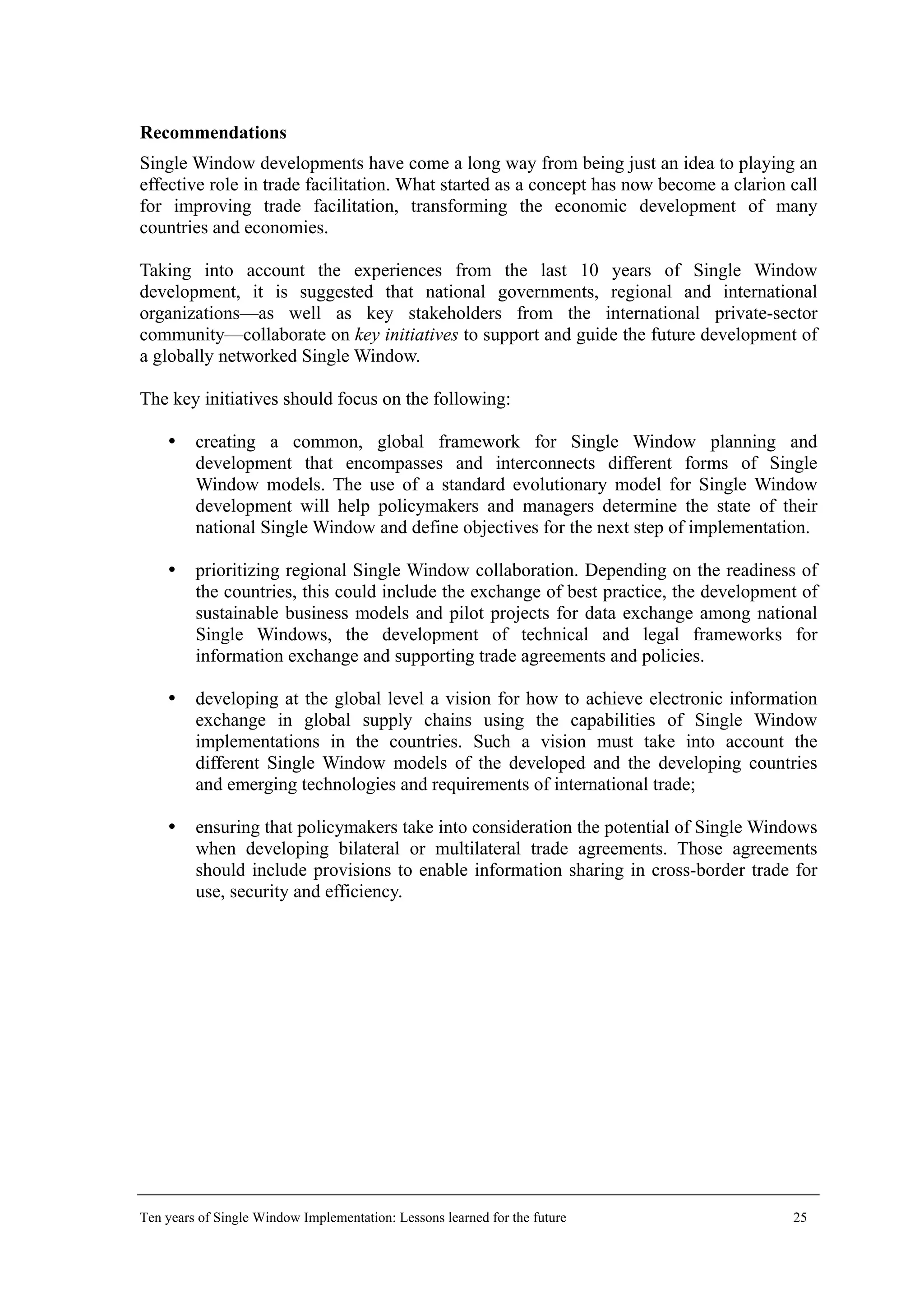
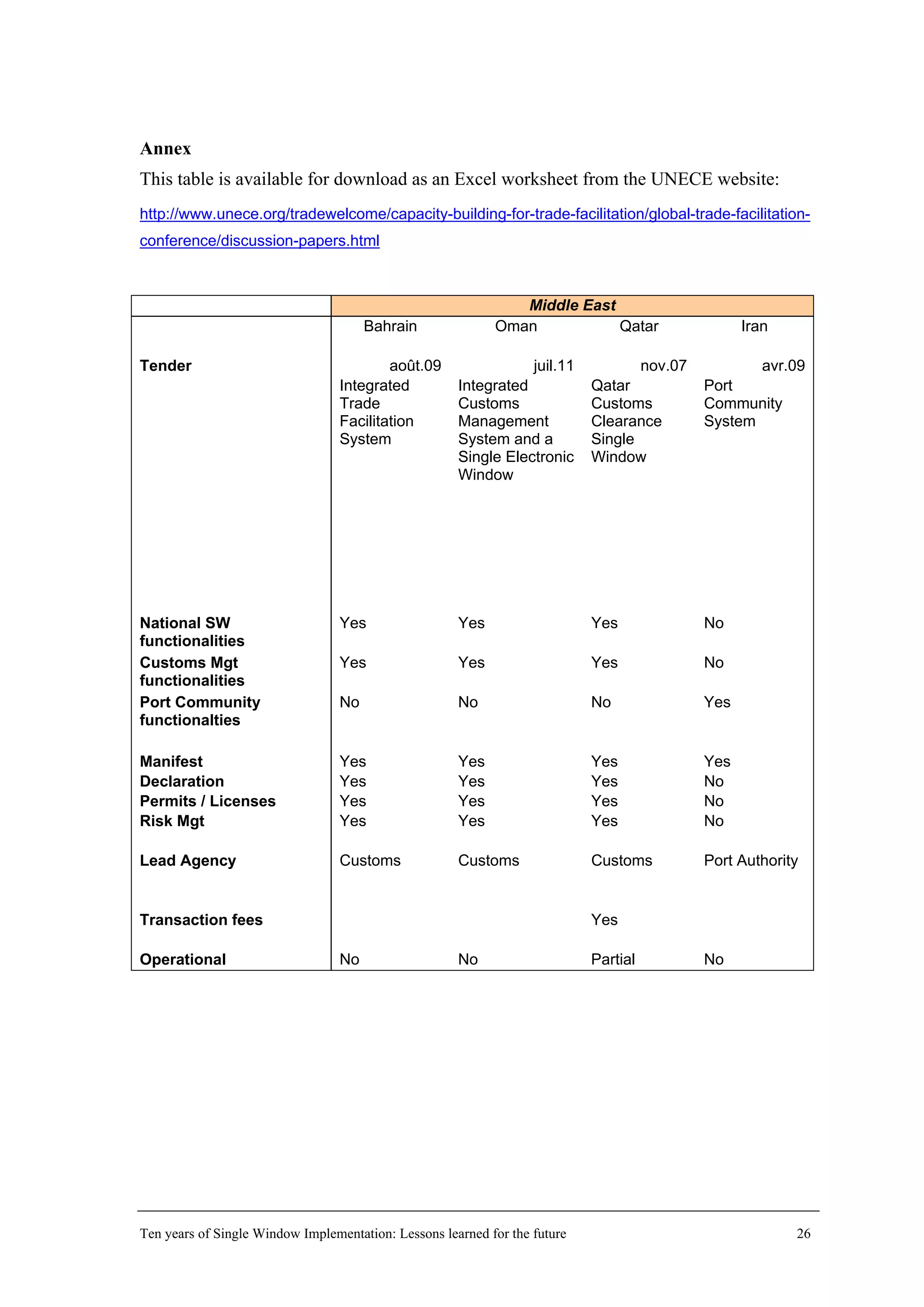
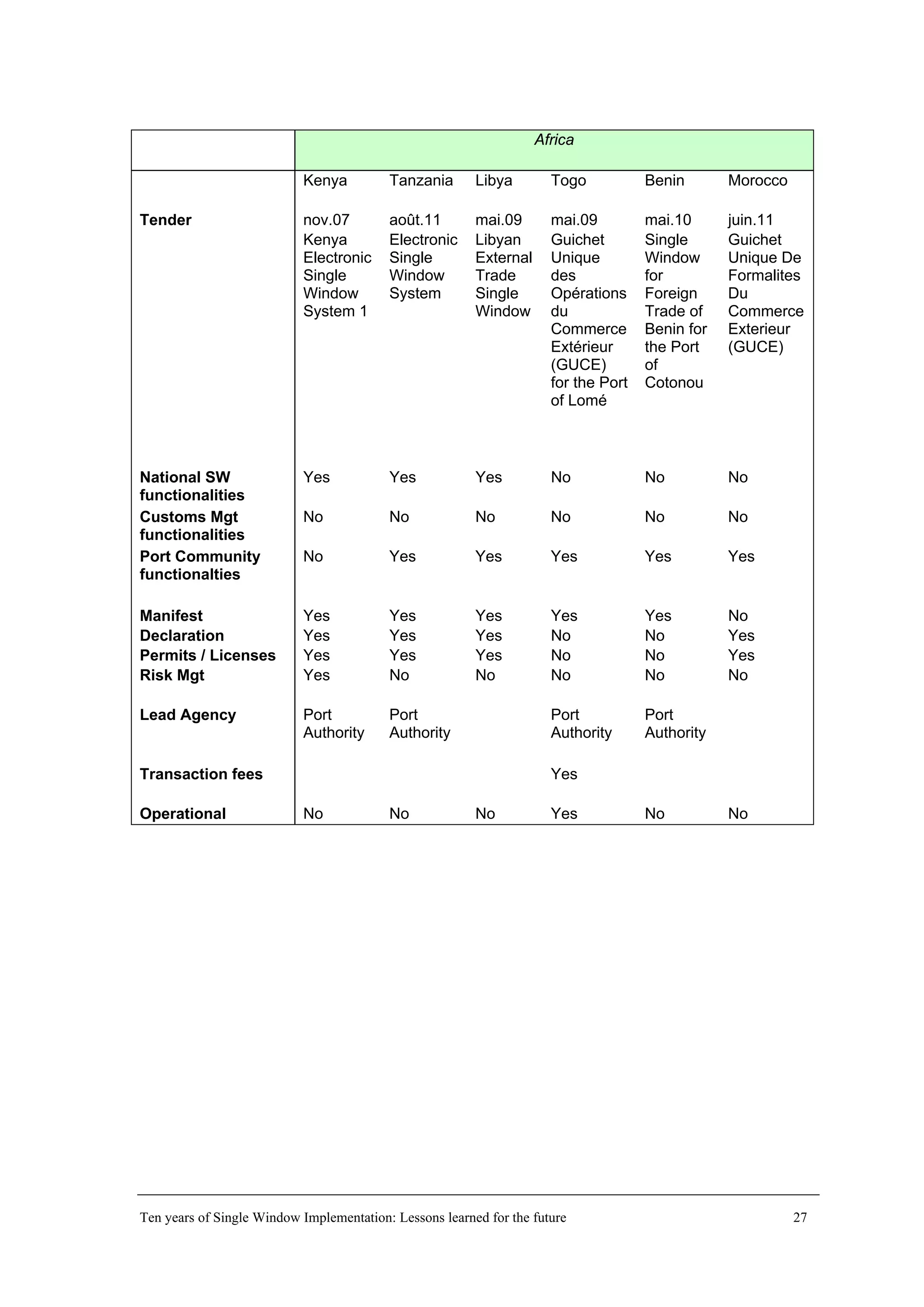
The following table surveys a list of 24 countries that have issued tenders/requests for
proposals (RFPs) for Single Windows or related initiatives from 2005 to present, and the
dates of issue of their respective tenders. The specific requirements as specified in these
tender documents were analysed to ascertain common trends as well as distinctive
specifications among them. The compilation of these tenders is appended in the Annex.
From these 24 RFPs, it is found that there is a good spread across the various regions - 11
from Africa; 5 from Asia / Oceania; 4 from Middle East, and 4 from Latin America. 18
RFPs have called for a full National Single Window (NSW) implementation, while 6 are
essentially for a Port Community System, or a port-centric Single Window. Of the 18
National Single Window RFPs, 9 include requirements for risk management
functionalities within the Single Window.
Interestingly, 6 countries called for a combined National Single Window and a Customs
Management System. These took the opportunity to refresh their existing Customs
management systems, and therefore include requirements that provides seek for a
seamless integration between the “front-end” NSW and the “back-end” Customs
Management System.
Ten years of Single Window Implementation: Lessons learned for the future 18
Figure 4 Single Window Tenders / Request for Proposals
4.1 Common Goals / Objectives for the Single Window project
It must be acknowledged that, for some, if not most, countries, it may have taken
extensive effort, strenuous justifications, and several years of “selling” for the sponsors of
the Single Window project just to reach the RFP stage. It is laudable that by reaching this
stage, these countries have taken the most perceptible step in their desire to improve and
enhance the trade facilitation condition, i.e. the development of their Single Window
facility.
It is therefore worthwhile to note that, while the goals and objectives highlighted in the
above RFPs are wide ranging, there is consensus on the following goals and objectives of
the Single Window:
to provide convenient and a “one stop” integrated services through multiple
channels.
to electronically link government agencies that are involved in the trade process.
to provide tangible cost savings for business and the Government.
Ten years of Single Window Implementation: Lessons learned for the future 19
to expedite cargo release and clearance by means of simplification of trade related
processes and procedures among controlling agencies.
to provide benefits and simplified treatment for the trading community through
elimination of duplicated processes.
to enable world-class trade-facilitation practices by providing a fully transparent
and predictable border environment while ensuring safety and security through a
high-performing risk management.
to enhance transparency and impartial treatment in the fiscal and customs
framework.
to eliminate corruption by improving methods to counter dishonest practices, and
reducing discretion.
4.2 Regional trends in the development of Single Windows
4.3 Trends in African Single Window projects
The African countries that have issued their RFPs are widely spread across the continent:
East Africa (Mozambique, Madagascar, Kenya, Tanzania, Rwanda);
Central Africa (Congo Brazzaville);
West Africa (Ivory Coast, Togo, Benin);
North Africa (Libya, Morocco).
The African countries’ requirements are dissimilar. The requirements of the Western
African countries are mainly for a limited, usually port-centric Single Window, termed as
“Guichet Unique des Opérations du Commerce Extérieur” (GUCE), or “Single Window of
foreign trade”. Specifically the requirements by the Ivory Coast, Togo, Benin and Congo
Brazzaville have focused on the port requirements and have not incorporated some key
Single Window functionalities such as customs declaration and/or licensing/permit
requirements from the other government agencies.
For the Eastern African countries, it is encouraging that the littoral countries—Kenya,
Tanzania and Mozambique—are all enhancing their trade facilitation capacities. This
augurs well for their neighbouring land-locked countries such as Rwanda, Uganda,
Burundi, and Malawi. The requirements by the East African countries were essentially for
a national Single Window creating electronic linkages with the government agencies for
permits and licensing processing.
Only one, Mozambique, called for a combined Single Window and Customs Management
System implementation, while the Tanzanian authorities called for two separate tenders for
their Single Window and Custom Management respectively around the same time. The
others chose to build a new Single Window that would integrate with their existing
Customs management systems.
Ten years of Single Window Implementation: Lessons learned for the future 20
4.4 Trends in Asia / Oceania Single Window projects
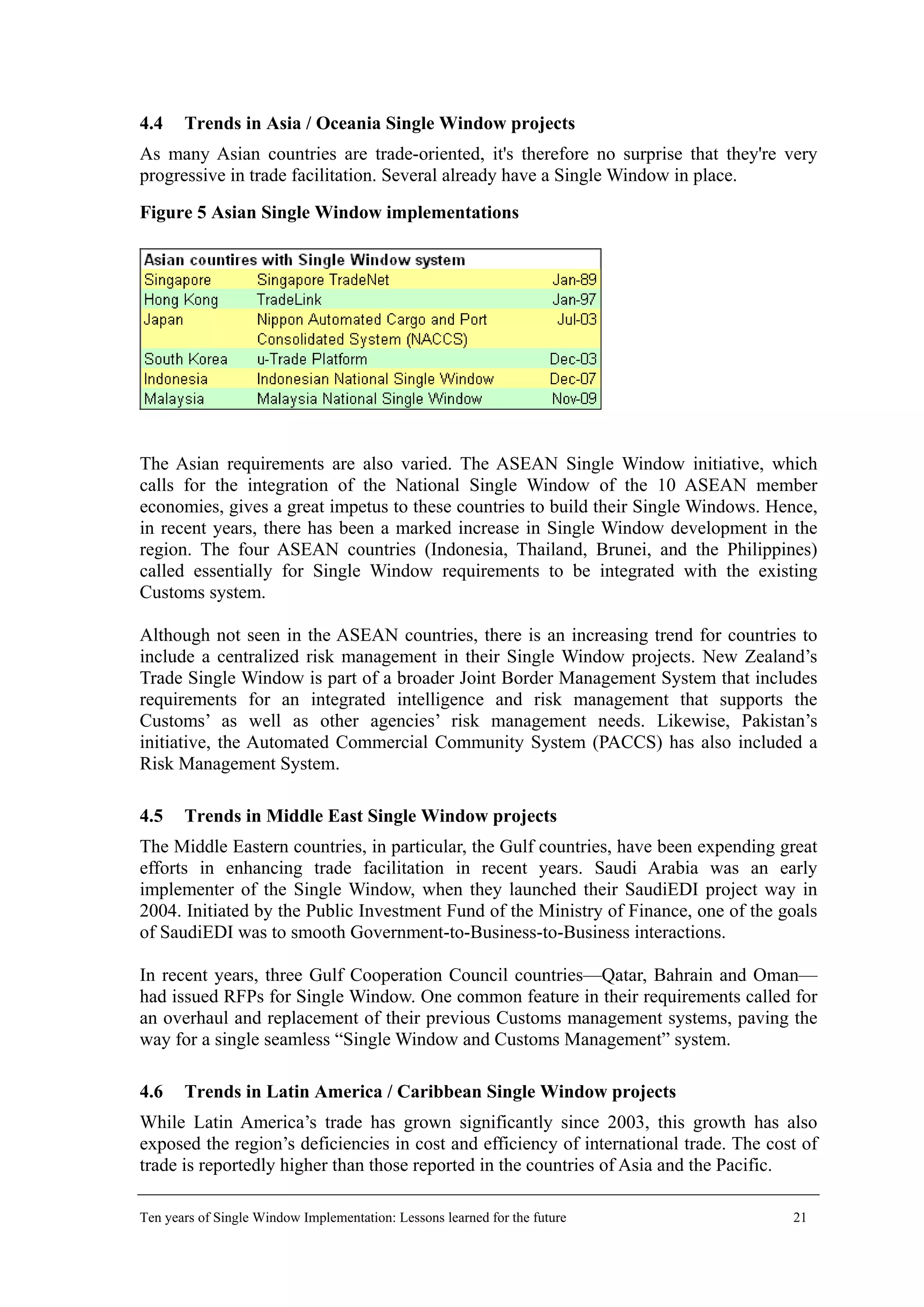
As many Asian countries are trade-oriented, it's therefore no surprise that they're very
progressive in trade facilitation. Several already have a Single Window in place.
Figure 5 Asian Single Window implementations
The Asian requirements are also varied. The ASEAN Single Window initiative, which
calls for the integration of the National Single Window of the 10 ASEAN member
economies, gives a great impetus to these countries to build their Single Windows. Hence,
in recent years, there has been a marked increase in Single Window development in the
region. The four ASEAN countries (Indonesia, Thailand, Brunei, and the Philippines)
called essentially for Single Window requirements to be integrated with the existing
Customs system.
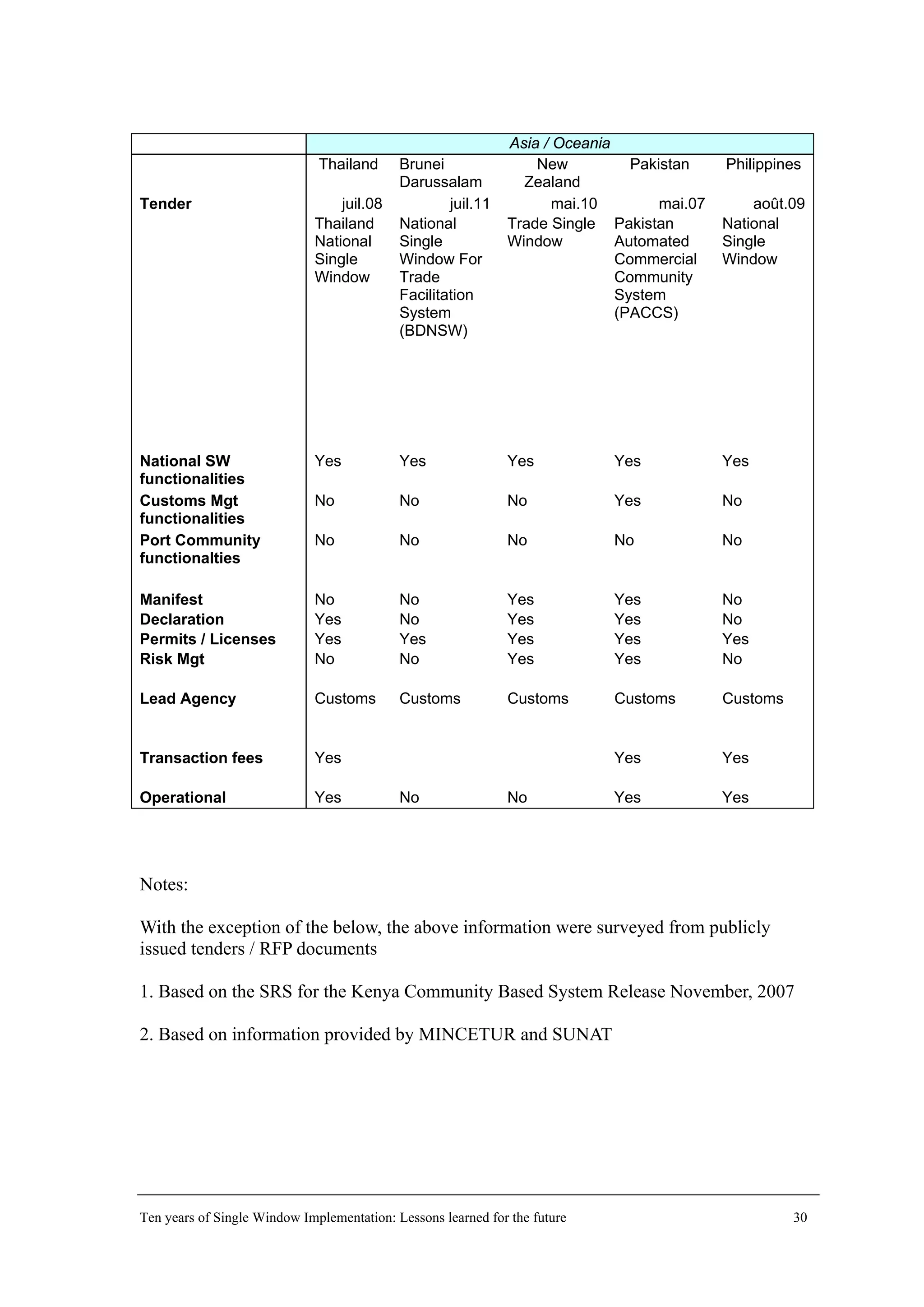
Although not seen in the ASEAN countries, there is an increasing trend for countries to
include a centralized risk management in their Single Window projects. New Zealand’s
Trade Single Window is part of a broader Joint Border Management System that includes
requirements for an integrated intelligence and risk management that supports the
Customs’ as well as other agencies’ risk management needs. Likewise, Pakistan’s
initiative, the Automated Commercial Community System (PACCS) has also included a
Risk Management System.
4.5 Trends in Middle East Single Window projects
The Middle Eastern countries, in particular, the Gulf countries, have been expending great
efforts in enhancing trade facilitation in recent years. Saudi Arabia was an early
implementer of the Single Window, when they launched their SaudiEDI project way in
2004. Initiated by the Public Investment Fund of the Ministry of Finance, one of the goals
of SaudiEDI was to smooth Government-to-Business-to-Business interactions.
In recent years, three Gulf Cooperation Council countries—Qatar, Bahrain and Oman—
had issued RFPs for Single Window. One common feature in their requirements called for
an overhaul and replacement of their previous Customs management systems, paving the
way for a single seamless “Single Window and Customs Management” system.
4.6 Trends in Latin America / Caribbean Single Window projects
While Latin America’s trade has grown significantly since 2003, this growth has also
exposed the region’s deficiencies in cost and efficiency of international trade. The cost of
trade is reportedly higher than those reported in the countries of Asia and the Pacific.
Ten years of Single Window Implementation: Lessons learned for the future 21
In recent years, we have seen a marked interest in developing Single Window systems for
foreign trade or “Ventanilla Única de Comercio Exterior” (VUCE) as it is called in
Spanish. Colombia and Perú had an early start in establishing their VUCEs around 2006.
Mexico and Chile issued their RFPs in 2010 and 2111 respectively.
A common feature of the initiatives in this region, unlike in other regions, is that the
VUCEs have most Single Window features, except risk management or Customs
Management functionalities.
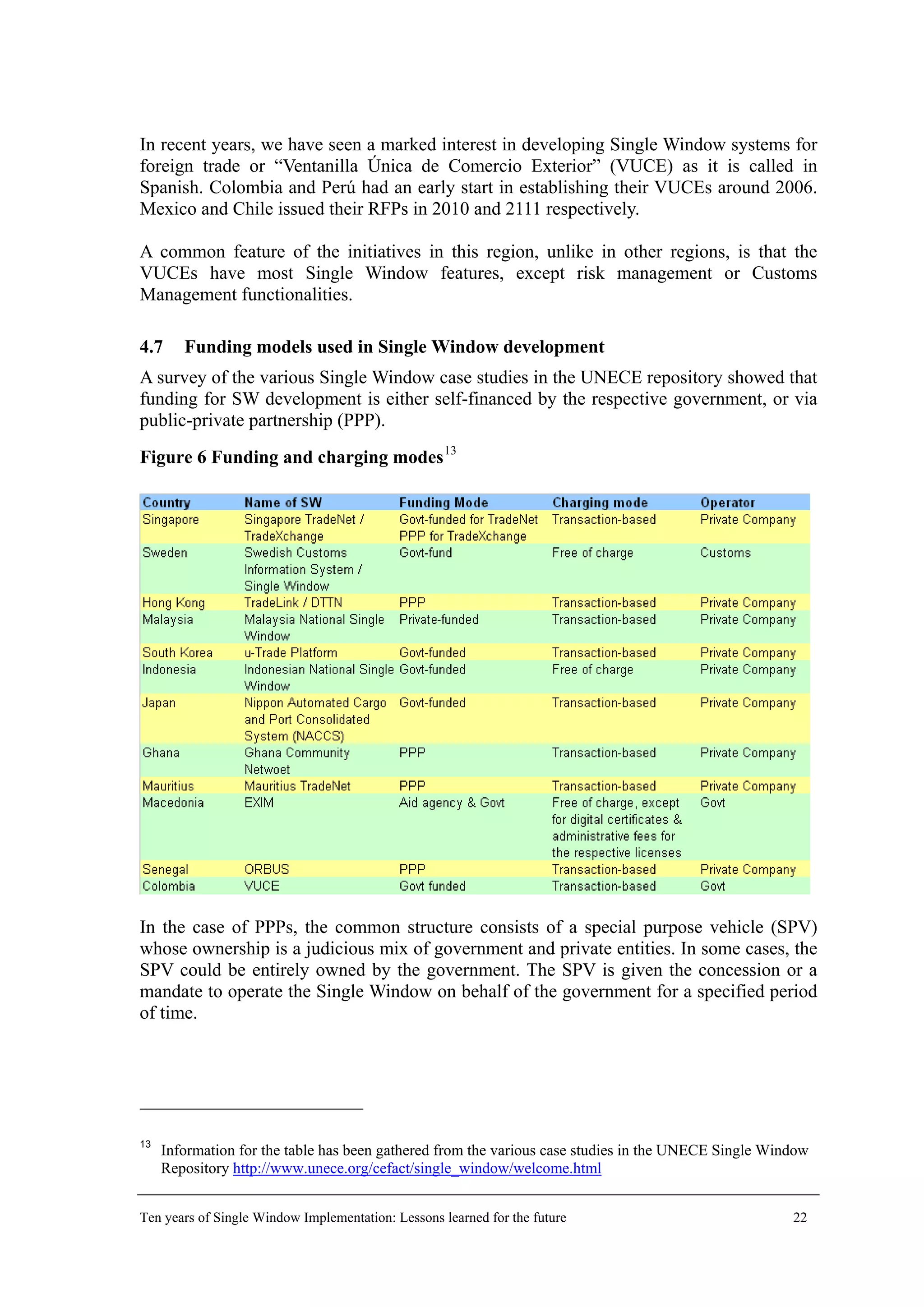
4.7 Funding models used in Single Window development
A survey of the various Single Window case studies in the UNECE repository showed that
funding for SW development is either self-financed by the respective government, or via
public-private partnership (PPP).
Figure 6 Funding and charging modes13
In the case of PPPs, the common structure consists of a special purpose vehicle (SPV)
whose ownership is a judicious mix of government and private entities. In some cases, the
SPV could be entirely owned by the government. The SPV is given the concession or a
mandate to operate the Single Window on behalf of the government for a specified period
of time.
13
Information for the table has been gathered from the various case studies in the UNECE Single Window
Repository http://www.unece.org/cefact/single_window/welcome.html
Ten years of Single Window Implementation: Lessons learned for the future 22
To meet the continuing cost of operating and sustaining the maintenance of the Single
Window, many countries charge fees based on transactions or a fixed schedule. Other
countries, notably Sweden and Indonesia, provide Single Window services free of charge.
5. Conclusions and Lessons learned
After 10 years of Single Window implementation we are now in a position to leverage the
experiences made and to draw some intermediary conclusions. This chapter is an attempt
to establish shared and accepted knowledge about Single Window planning and
management. The observations may be useful to policymakers and managers in further
developing their Single Window systems.
Different Forms of Single Windows
Depending on their readiness and priorities, countries have implemented very different
forms of Single Windows ranging from integrated Customs solutions to sophisticated Port
Community Systems and regional platforms. The Single Window concepts used do not
strictly follow the definition of the Single Window facility as set out in UNECE
Recommendation 33. The practical examples showed that Single Windows have generally
been conceived as a large interagency collaborative system that facilitate and automate
business processes and data exchange for international trade.
Evolutionary and Staged Development
To develop a Single Window is typically a massive undertaking involving interlinking and
information-sharing by Customs and all government agencies responsible for trade, and
also the trading community. It requires new ways of processing trade and necessitates
streamlined business processes. Due to the complex change management, Single Window
development typically follows a gradual evolutionary and staged pathway, usually starting
from an advanced Customs solution, and progressing to encompass advanced national and
regional trade-facilitation objectives.
Impact of Single Window in Different Forms
Particularly in developing countries and transition economies, the national Single Window
has been a success story. Single Window projects have simplified and automated business
procedures, introduced change and brought about collaboration between government
agencies and the private sector. Many of these countries have shown marked
improvements in their trade-facilitation indicators, as seen in the various surveys including
the World Bank’s Doing Business - Trading Across Borders, as well as the Logistics
Performance Index.
In many advanced trading economies, such as the EU, the US and China, the national
Single Window concept has not been implemented. Instead, other forms of Single
Windows, in particular Port Community Systems and Customs Single Windows are being
successfully used to enhance a high-performing logistics sector. However, linking these
different platforms into a national or regional network remains a challenge.
Cross-border information exchange
Ten years of Single Window Implementation: Lessons learned for the future 23
Both in developed and developing countries, finding improved way to conduct cross-
border trade transactions is now an imperative and pressing need. This requires connecting
national Single Windows. Networked Single Windows effecting electronic exchange of
information along the international supply chain is a natural progression in the
increasingly globalised trade environment. Trade liberalization and regional integration
are main drivers for a regional Single Window framework that facilitates cross-border
trade exchanges.
Many aspects of regional Single Window integration remain to be defined. This includes
data harmonization, creating an effective legal framework for data exchange within a
Single Window network, and a sustainable business model for the service providers.
The future for global exchange of information in interregional supply chains is remote, as
there's currently no framework for data exchange on a global level. There's no
internationally accepted model to establish an information exchange for containerized
cargo along such an international supply chain. For example, the ports of Hamburg,
Mumbai, Singapore and Shanghai all use different data sets as well as Single Window
capabilities.
Need for increased regional and global cooperation in Single Window development
Over the last 10 years, Single Window projects have been mainly at the national level.
While these have been useful to governments for supporting the national economic
agenda, they have increasingly become a major platform for an integrated world economy.
This trend will increase the complexity and demands on Single Window projects. There's a
growing need for implementers of Single Windows to establish further international
collaboration to develop common interconnectivity strategies, policies, data harmonization
and standards.
Already, we see some form of such collaboration being done, albeit by private sector
players. The Pan Asia E-Commerce Alliance (PAA) and their African counterpart African
Alliance for e-Commerce (AACE) are examples of collaborating Single Window
operators, who establish a mechanism and framework for the conduct of secure cross
border document and data interchanges amongst the stakeholders in the respective Asian
and African regions. However, their efforts are only part of the picture and need to be
complemented by the corresponding government policies to truly effect cross border
exchanges.
Ten years of Single Window Implementation: Lessons learned for the future 24
Recommendations
Single Window developments have come a long way from being just an idea to playing an
effective role in trade facilitation. What started as a concept has now become a clarion call
for improving trade facilitation, transforming the economic development of many
countries and economies.
Taking into account the experiences from the last 10 years of Single Window
development, it is suggested that national governments, regional and international
organizations—as well as key stakeholders from the international private-sector
community—collaborate on key initiatives to support and guide the future development of
a globally networked Single Window.
The key initiatives should focus on the following:
creating a common, global framework for Single Window planning and
development that encompasses and interconnects different forms of Single
Window models. The use of a standard evolutionary model for Single Window
development will help policymakers and managers determine the state of their
national Single Window and define objectives for the next step of implementation.
prioritizing regional Single Window collaboration. Depending on the readiness of
the countries, this could include the exchange of best practice, the development of
sustainable business models and pilot projects for data exchange among national
Single Windows, the development of technical and legal frameworks for
information exchange and supporting trade agreements and policies.
developing at the global level a vision for how to achieve electronic information
exchange in global supply chains using the capabilities of Single Window
implementations in the countries. Such a vision must take into account the
different Single Window models of the developed and the developing countries
and emerging technologies and requirements of international trade;
ensuring that policymakers take into consideration the potential of Single Windows
when developing bilateral or multilateral trade agreements. Those agreements
should include provisions to enable information sharing in cross-border trade for
use, security and efficiency.
Ten years of Single Window Implementation: Lessons learned for the future 25
Annex
This table is available for download as an Excel worksheet from the UNECE website:
http://www.unece.org/tradewelcome/capacity-building-for-trade-facilitation/global-trade-facilitation-
conference/discussion-papers.html
Middle East
Bahrain Oman Qatar Iran
Tender août.09 juil.11 nov.07 avr.09
Integrated
Trade
Facilitation
System
Integrated
Customs
Management
System and a
Single Electronic
Window
Qatar
Customs
Clearance
Single
Window
Port
Community
System
National SW
functionalities
Yes Yes Yes No
Customs Mgt
functionalities
Yes Yes Yes No
Port Community
functionalties
No No No Yes
Manifest Yes Yes Yes Yes
Declaration Yes Yes Yes No
Permits / Licenses Yes Yes Yes No
Risk Mgt Yes Yes Yes No
Lead Agency Customs Customs Customs Port Authority
Transaction fees Yes
Operational No No Partial No
Ten years of Single Window Implementation: Lessons learned for the future 26
Africa
Kenya Tanzania Libya Togo Benin Morocco
Tender nov.07 août.11 mai.09 mai.09 mai.10 juin.11
Kenya
Electronic
Single
Window
System 1
Electronic
Single
Window
System
Libyan
External
Trade
Single
Window
Guichet
Unique
des
Opérations
du
Commerce
Extérieur
(GUCE)
for the Port
of Lomé
Single
Window
for
Foreign
Trade of
Benin for
the Port
of
Cotonou
Guichet
Unique De
Formalites
Du
Commerce
Exterieur
(GUCE)
National SW
functionalities
Yes Yes Yes No No No
Customs Mgt
functionalities
No No No No No No
Port Community
functionalties
No Yes Yes Yes Yes Yes
Manifest Yes Yes Yes Yes Yes No
Declaration Yes Yes Yes No No Yes
Permits / Licenses Yes Yes Yes No No Yes
Risk Mgt Yes No No No No No
Lead Agency Port
Authority
Port
Authority
Port
Authority
Port
Authority
Transaction fees Yes
Operational No No No Yes No No
Ten years of Single Window Implementation: Lessons learned for the future 27
Africa
Ivory Coast Rwanda Congo
Brazzaville
Mozambique Madagascar
Tender août.05 févr.10 août.07 sept.09 mars.07
Abidjan Port
Community
of Côte
d'Ivoire
(Ivory
Coast) -
Abidjan Port
Synergie
Rwanda
Single
Electronic
Window
Maritime
Single
Window
(GUMAR)
Single
Electronic
Window
System for
the Customs
Clearance of
Traded
Goods
Malagasy
Community
Network
Services
National SW
functionalities
No Yes No Yes Yes
Customs Mgt
functionalities
No No No Yes No
Port Community
functionalties
Yes No Yes No No
Manifest Yes Yes Yes Yes Yes
Declaration No Yes No Yes Yes
Permits / Licenses No Yes No Yes Yes
Risk Mgt No Yes No Yes No
Lead Agency Customs Shippers
Council
Customs Customs
Transaction fees Yes Yes Yes
Operational Yes No No Yes Yes
Ten years of Single Window Implementation: Lessons learned for the future 28
Latin America / Caribbean
Mexico Chile Peru Trinidad &
Tobago
Tender juil.10 sept.11 juin.06 mai.09
Ventanilla
Única de
Comercio
Exterior de
México
(VUCEM)
Ventanilla
Única de
Comercio
Exterior
(VUCE)
Ventanilla
Única de
Comercio
Exterior
(VUCE) 2
Single
Economic
Window
(SEW)
National SW functionalities Yes Yes Yes Yes
Customs Mgt
functionalities
No No No No
Port Community
functionalties
No No No No
Manifest Yes No Yes Yes
Declaration Yes Yes No Yes
Permits / Licenses Yes Yes Yes Yes
Risk Mgt No No No No
Lead Agency Revenue
Authority
Trade Trade
Transaction fees Yes Yes
Operational No No Yes Yes
Ten years of Single Window Implementation: Lessons learned for the future 29
Asia / Oceania
Thailand Brunei
Darussalam
New
Zealand
Pakistan Philippines
Tender juil.08 juil.11 mai.10 mai.07 août.09
Thailand
National
Single
Window
National
Single
Window For
Trade
Facilitation
System
(BDNSW)
Trade Single
Window
Pakistan
Automated
Commercial
Community
System
(PACCS)
National
Single
Window
National SW
functionalities
Yes Yes Yes Yes Yes
Customs Mgt
functionalities
No No No Yes No
Port Community
functionalties
No No No No No
Manifest No No Yes Yes No
Declaration Yes No Yes Yes No
Permits / Licenses Yes Yes Yes Yes Yes
Risk Mgt No No Yes Yes No
Lead Agency Customs Customs Customs Customs Customs
Transaction fees Yes Yes Yes
Operational Yes No No Yes Yes
Notes:
With the exception of the below, the above information were surveyed from publicly
issued tenders / RFP documents
1. Based on the SRS for the Kenya Community Based System Release November, 2007
2. Based on information provided by MINCETUR and SUNAT
Ten years of Single Window Implementation: Lessons learned for the future 30

TenYearsSingleWindow

  • 1.
    ECONOMIC COMMISSION FOR AFRICA ECONOMICCOMMISSION FOR EUROPE ECONOMIC AND SOCIAL COMMISSION FOR ASIA AND THE PACIFIC ECONOMIC COMMISSION FOR LATIN AMERICA AND THE CARIBBEAN ECONOMIC AND SOCIAL COMMISSION FOR WESTERN ASIA Global Trade Facilitation Conference 2011 Connecting International Trade: Single Windows and Supply Chains in the Next Decade TEN YEARS OF SINGLE WINDOW IMPLEMENTATION:  LESSONS LEARNED FOR THE FUTURE  Discussion paper Author: Jonathan Koh Tat Tsen Disclaimer The views and the opinions expressed in this document are those of the author and do not necessarily reflect the views of the United Nations or other organizations that have contributed to this document.
  • 2.
    Contents 1. Overview ofSingle Window development and automation and regional trends in the last 10 years......................................................................4 1.1 What was the initial idea behind the Single Window concept?...................4 1.2 Has this initial Single Window idea undergoneany change in the meantime?...............................................................................................5 2. Different forms of Single Window ...............................................................7 2.1 Customs Automation..........................................................................................8 2.2 Trade Points Portals...........................................................................................9 2.3 Trade Electronic Data Interchange / Value Added Network ........................9 2.4 Limited forms of the Single Window..............................................................10 2.5 National Single Windows ................................................................................12 2.6 Regional / Global Single Windows ................................................................15 3. Trends in the use of ICT for Single Windows.........................................15 4. Trends in national “Single Window” developments.............................18 4.1 Common Goals / Objectives for the Single Window project......................19 4.2 Regional trends in the development of Single Windows............................20 4.3 Trends in African Single Window projects....................................................20 4.4 Trends in Asia / Oceania Single Window projects ......................................21 4.5 Trends in Middle East Single Window projects ...........................................21 4.6 Trends in Latin America / Caribbean Single Window projects ..................21 4.7 Funding models used in Single Window development ..............................22 5. Conclusions and Lessons learned............................................................23 5.1 Recommendations ...........................................................................................25 Annex ........................................................................................................................26 Figure 1 Staged approach to developing a Single Window 7 Figure 2 Good practices for trade across borders 8 Figure 3 Evolution of Single Window development 8 Figure 4 Single Window Tenders / Request for Proposals 19 Figure 5 Asian Single Window implementations 21 Figure 6 Funding and Charging modes 22 Ten years of Single Window Implementation: Lessons learned for the future 2
  • 3.
    Abstract This paper examinesthe Single Window concept and its developments in practice over the last 10 years and provides an analysis of its development over time. An overview of the emerging information technology that would impact its future development is also presented. The paper also examines regional trends in Single Window implementation, based on a survey of tenders documents issued by various countries in the recent years. Finally, it offers an outlook on its future development and provides a number of recommendations. Ten years of Single Window Implementation: Lessons learned for the future 3
  • 4.
    1. Overview ofSingle Window development and automation and regional trends in the last 10 years 1.1 What was the initial idea behind the Single Window concept? Global trade expanded rapidly during the 1980s and 1990s. The resulting complexity and speed of the modern supply chain and the number of parties involved greatly increased the requirements for information controlling the flow of goods. But despite the breakneck developments in information and communications technologies (ICT) and trade data- exchange standards during the same time, trade documentation exchanges remained mostly paper-based. However, in the modern trade environment such paper-based exchanges cannot satisfy the need for efficiency and security. One “omnibus” means of addressing this problem that has gained considerable momentum over the past 10 years is the so-called “ Single Window”. In Recommendation No. 33, UNECE defines the Single Window as a “facility that allows parties involved in trade and transport to lodge standardized trade-related information and/or documents to be submitted once at a single entry point to fulfil all import, export, and transit-related regulatory requirements1 . The Recommendation identifies three basic models for the Single Window: A. A Single Authority that receives information, and disseminates this information to all relevant governmental authorities, and coordinates controls in the logistical chain. B. A Single Automated System for the collection, dissemination and integration of information and data related to trade that crosses the border. There are various possibilities: i. Integrated System: Data is processed through the system ii. Interfaced System (decentralized): Data is sent to the agency for processing iii. Combination of (i) and (ii) C. An automated Information Transaction System through which a trader can submit electronic trade declarations to the various authorities for processing and approval in a single application. In this approach, approvals are transmitted electronically from governmental authorities to the trader’s computer. 1 In 2004, UNECE published “Recommendation 33 - Guidelines on Establishing a Single Window” developed by its Centre for Trade Facilitation and electronic Business (UN/CEFACT). It recommended that governments and those engaged in the international trade and movement of goods should actively consider implementing a “Single Window facility” in their country. The Recommendation and Guidelines were formally approved by UN/CEFACT in 2004. Ten years of Single Window Implementation: Lessons learned for the future 4
  • 5.
    Many countries haveseen that a Single Window facility can greatly improve the implementation of standards, techniques and tools for simplifying and expediting information flows between traders and government. It can also simplify processes, harmonize data and improve the sharing of relevant information across governmental systems. The improved efficiency and effectiveness of controls, and the reduction in costs both for governments and for traders, due to a better use of resources are expected to bring significant gains to all parties involved in cross-border trade. 1.2 Has this initial Single Window idea undergone any change in the meantime? Since the initial idea, three important developments have evolved that are critical to the evolution and development of the Single Window. Firstly, that a “Single Window” doesn't necessarily imply using high-tech information and communication technology (ICT), although it is usually better if governments do adopt ICT technologies for a Single Window”. But in our digital and Internet-fuelled age, all implementations of the “Single Window” have invariably been coupled with the use of ICT to help automate and create a paperless trading environment. For practical purposes, the establishment of “Single Window” today can only be done through the use of ICT and the Internet. Secondly, the idea of a “Single Window” at the national level has challenged the conventional “compartmentalized” approach to regulatory control of the movement of goods. For example Recommendation 33 states that “a Single Window should represent a close cooperation between all involved governmental authorities and agencies, and the trading community”. However, most of us understand the challenge of involving all the relevant governmental authorities and agencies as well as the trading community. Many different government departments and agencies hold legislative powers and control and manage various levels of regulation—e.g. health, plant and animal quarantine, sanitary and phyto-sanitary, food and drug safety, and defence. Agencies other than Customs that are involved in the regulation of cross-border trade are termed “Other Government Agencies” (OGAs). There are often between 20 and 40 of these involved, but the number varies among countries. It's rare to find a Single Window facility covering all OGAs. Many implementers have found that the challenge of coordinating these different agencies (and their procedural and data requirements) into coherent and simplified procedures that could be automated is often more political than technical. A recurrent challenge is to convince the OGAs to agree to use the Harmonized System Codes (HS Code) as the commodity classification for the Single Window. Indeed, not all players in the government and/or trade community welcome the implementation of a Single Window. Opposition to the establishment of the Single Window can also come from within Customs. The anecdote below, which is drawn from the case study on Madagascar’s trade reforms, provides some insights. Ten years of Single Window Implementation: Lessons learned for the future 5
  • 6.
    Opposition to thereforms was widespread and came from many quarters. The private sector - resigned to the inefficiency and corruption in Customs - was reluctant to start paying the additional fees that the project would require and sceptical that such an ambitious and advanced solution would work in the Malagasy context. The 1,400-strong Customs service itself was also reluctant to change its ways. Wedded to the old way of doing things, many customs agents also had a vested interest in existing arrangements, which brought steady revenues under the table. Source: Kjartan Fjeldsted, 2009. Case study on trade reform in Madagascar, World Bank Publications Thirdly, the initial concept according to which the trading community can submit information and documents to government authorities in compliance with regulatory requirements implies a national or countrywide facility for all trade transactions. However, Single Window implementation on a countrywide scale is an extremely complex and costly undertaking. Creating a national Single Window requires tremendous efforts, cost, changes of mindset and more importantly, strong political will. Therefore, most governments choose an incremental step-by-step rather than a “big bang” approach to their Single Window projects. Some start with a limited form of the Single Window, for example to cover either a specific procedure such as export declarations or a specific area such as the port — “Port Single Window” or “Port Community System” — while others focus on exports only. Many national Single Windows were introduced in a phased approach, with each stage covering a selected group of OGAs. The selection of the initial group is usually based on their readiness for change and willingness to simplify cross-border trade processes.2 Over time, all OGAs can gradually be incorporated into the Single Window system. Figure 1 shows an evolutionary model of Single Window development that was drawn up by the United Nations Network of Experts for paperless Trade (UNNEXT). It's used as a reference model to determine the current state of a Single Window implementation and its next stages. 2 A deeper discussion on the staged inclusion of government agencies can be found in the Single Window Implementation Framework http://www.unece.org/fileadmin/DAM/cefact/publica/SWImplementationFramework.pdf Ten years of Single Window Implementation: Lessons learned for the future 6
  • 7.
    Figure 1 Stagedapproach to developing a Single Window 2. Different forms of Single Window According to the World Bank’s Trading Across Borders 2012 report, out of 150 economies surveyed, 49 have introduced a Single Window, of which only 20 have a Single Window system that links all relevant government agencies. The remaining 29 have a Single Window that hasn’t yet linked the government agencies. Single Window facilities are being established at an increasing rate in all five continents. From recent issues of Single Window tenders it appears that most are in developing countries. Indeed, many developed countries don’t have a national Single Window or have only recently started to work on Single Window implementation. Most countries of the European Union, for example, have no national Single Window. On the other hand, many countries in Africa, Asia and Latin America have started or completed national Single Windows. Ten years of Single Window Implementation: Lessons learned for the future 7
  • 8.
    Figure 2 Goodpractices for trade across borders3 Governments have introduced a range of inter-agency collaborative systems to manage export- and import-related procedures. These systems perform certain functions and meet certain criteria of the Single Window, as described in UNECE Recommendation 33. The figure below is an attempt to describe these different forms of Single Windows and their evolution. Figure 3 Evolution of Single Window development 2.1 Customs Automation The pre-Single Window evolution can be said to start from the early days of Customs automation in the 1960s and 1970s, when the Customs authorities first begin to automate their functions using systems such as ASYCUDA ( Automated System of Customs Data) provided by the United Nations Conference on Trade and Development (UNCTAD). 3 World Bank, 2011. Trading Across Borders report 2012. Ten years of Single Window Implementation: Lessons learned for the future 8
  • 9.
    2.2 Trade PointsPortals Following this was the era of the development of national “Trade Points”. These serve as an information source for trade-related information, providing traders with data about business and market opportunities. They also function as trade-facilitation centres, where players in trade transactions (e.g. Customs, banks, chambers of commerce, freight forwarders, transport and insurance companies) are grouped together under a single physical roof or linked virtually to the Trade Point to provide all the services required for trade transactions. Trade Points were originally conceptualized to serve as gateways to global electronic networks, with all national Trade Points interconnected in a worldwide electronic network. 2.3 Trade Electronic Data Interchange / Value Added Network With the advent of Electronic Data Interchange (EDI) techniques, a popular method for transmitting documents was the use of modems to communicate through a value added network (VAN) provider. VAN providers are the go-betweens in EDI transmissions. They receive EDI transactions, examine the from and the to information and route the transaction to the final recipient. They also provide “value-added” services such as providing a mailbox service, re- transmitting documents, producing delivery reports, and acting as a gateway for different transmission methods. One of the earliest national trade EDI initiatives was the Hong Kong Trade Local and International Network (HOTLINE) Project, started in 1984. HOTLINE was to interconnect computers between organizations for data exchange for trade. The project failed due to the lack of support from the trading community and the government of Hong Kong4 . The Tradelink project was subsequently initiated as a consortium of government and private companies. In 1997, it was appointed as an exclusive service provider by the Hong Kong SAR government and began operations to electronically process specific trade documents such as trade declarations, permits and certificates of origin. Many countries have adopted the EDI-based approach for trade documentation: Chinese Taipei launched their EDI network for customs clearance automation under their Ministry of Finance in the 1992. Mauritius developed their TradeNet project in 1994 with the help of the Singaporean TradeNet. 4 UNESCAP, 2002. Initiatives for E-Commerce Capacity-Building of Small and Medium Enterprises. Proceedings and papers presented at the Regional Consultative Meeting on Initiatives for E-Commerce Capacity-Building of Small and Medium Enterprises, Seoul, 13-15 November 2002 Ten years of Single Window Implementation: Lessons learned for the future 9
  • 10.
    Japan started theirnationwide “Trade and Settlement EDI System” (TEDI) in 1998 as an initiative of their Ministry of International Trade and Industry. The original objective of the TEDI system was to reduce time and cost incurred in trade administration and operation by standardizing and exchanging electronic trade documents over safe and reliable networks. Saudi Arabia initiated their SaudiEDI project in 2002. SaudiEDI incorporates an electronic gateway linking the trade users to Customs, Ports Authority and other government agencies for the electronic submission and processing of manifests, declarations and delivery orders. Today, according to the World Bank’s Trading Across Borders 2012 report5 , 82 per cent of economies around the world allow traders to submit at least some of their export and import declarations, manifests and other trade-related documents to Customs authorities electronically. However, many of these systems are not linked to the Internet, and others still require hard copies. 2.4 Limited forms of the Single Window Customs Single Window To circumvent the challenge of involving other government agencies (OGAs), a variation of the limited “Single Window” has emerged: the Customs Single Window. This essentially provides a single interface between the trading community and the Customs Authority. Such instances of a “Single Window for Customs Clearance” don't fully cover the permits and licensing of all of the OGAs and therefore don't cover all the regulatory processes described in Recommendation 33. Examples of the Customs Single Window include: Mauritius’ TradeNet system, which has not yet extended to include all of the OGAs. Australian Customs and Border Protection Service Integrated Cargo System, which is a Customs-centric Single Window initiative with a degree of interaction with selected OGAs. Port Single Windows and Port Community Systems Similarly, other authorities with a substantial role in trade—such as the Port Authority— have also established a limited, port-centric, “Single Window”, commonly referred to as either a “Port Single Window” or a “Port Community System” (PCS). The Port Single Window has been defined as a system which provides local level information about the vessel to the authorities on a port level, has B2G (Business to 5 World Bank, 2012. Doing Business 2012 – Trading Across Border report. Ten years of Single Window Implementation: Lessons learned for the future 10
  • 11.
    Government) character; whilethe Port Community System (PCS) provides a tool to exchange messages in the port environment, having a commercial and logistic nature and B2B (Business to Business) character6 . Examples of Port Single Windows include: Finland’s PortNet System, which was first developed in 1993, and is owned by Finland Customs, the Finnish Maritime Administration and 20 of the largest ports in Finland. France’s e-Maritime Port Single Window, which is a public-private partnership between Le Havre Port Authority, the French Customs, and SOGET. A Port Community System can be characterized as a “centrally operated system for transferring data and providing other services with the help of this data, which can be used by any party who is interested in information concerning sea-borne transport. A Port Community System avoids bilateral data transfer”7 . Europe has a long history of Port Community Systems, in particular Germany, the United Kingdom, France, the Netherlands and Spain. These systems have been established in many European ports and airports since the 1960s. Examples include: Felixstowe Port Community System, which was started in 1984, and subsequently expanded to include other ports in the United Kingdom. India's Port Community System, which is a web-based centralized Port Community System initiative by the Indian Ports Association, intended to provide a Single Window system for the port communities in India. Established in 2007, it currently serves 22 of the country's major ports. Today, the European PCS are providing services related to the Single Window and have started to offer support for cross-border transactions. For example, DAKOSY and Portbase, the PCS of the ports of Hamburg and Rotterdam, make it possible for their shippers to send advance cargo declarations required under the EU Import Control System to many EU Customs organizations. While the landscape in Europe is characterized by a network of existing Port Community Systems and Customs Single Windows, the challenge for Europe is to build upon these long-established existing systems and turn them into the fuller national Single Windows that correspond to the “single entry point” criteria. This means that they should cover all government agencies and fulfil all import, export, and transit-related regulatory requirements. 6 Kari Suvila, 2007, Single Window implementation in Customs Environment, National Board of Customs, Finland. 7 Grizell, P. et al, 2001. An evaluation of Port Community Systems: What can the Port of the Netherlands learn and use of other platforms”, NedCargo. Ten years of Single Window Implementation: Lessons learned for the future 11
  • 12.
    Subnational “Single Window” Whilethe original concept implies countrywide, in some cases of “Single Window” implementation—especially in larger countries—it was found that the only feasible way was to take a subnational approach, whereby the local trade community and regulatory agencies can be grouped together at city or provincial level to establish a trade community “Single Window” system. An example of this is China’s massive E-Port project, which is characterized as an “integrated clearance information platform focused on clearance management and enforcement, extending gradually to logistics and commerce service”. It comprises three components – data exchange, transaction processing and auxiliary support platforms. It supports data exchange and sharing between government departments, port management agencies and enterprises, and provides online services such as declaration and payment through a Single Window. The project is implemented at both central and local levels, whereby the central government ministries and the local e-ports interconnect with each other via China’s E- Port VPN for data exchange and sharing. It is at the local level where the subnational implementation of the E-Port - Shanghai’s Easipass Platform - is currently the operational Single Window for port and customs clearance in Shanghai8 . 2.5 National Single Windows The preceding section traced the evolutionary progression of the development of the Single Window in the national context. The limited forms of Single Window systems— Customs-centric as well as port-centric versions—provide a valuable “learning curve” for many countries as they progress towards fulfilling the “Single Window” vision: a countrywide facility that provides for all parties (regulatory agencies and the trading community) to submit standardized information only once, at a single entry point, to fulfil all import, export and transit-related regulatory requirements. The Association of South East Asian Nations (ASEAN) has expanded the definition of the “National Single Window” further by introducing the concept of “submitting once at a single entry point”: ASEAN defines the “National Single Window” as a system which enables: A single submission of data and information; A single and synchronous processing of data and information; A single decision-making for customs release and clearance; A single decision-making shall be uniformly interpreted as a single point of decision for the release of cargoes by the Customs on the basis of decisions, if 8 Wang Jian, 2010. China Progress Towards Single Window and Paperless Trade, Presentation at the UNESCAP Asia Pacific Trade Facilitation Forum Oct 2010. Ten years of Single Window Implementation: Lessons learned for the future 12
  • 13.
    required, taken byline ministries and agencies and communicated in a timely manner to the Customs”9 . The development of a National Single Window also means that all other government agencies have to be part of this system. It needs to be able to accommodate and to connect the various agencies’ needs and requirements in order to facilitate trade. But government agencies are traditionally organized through a variety of separate departments, which may have limited connection with each other either technologically or in the way their services are delivered. Those implementing the Single Window very often found themselves to be pioneers in establishing an unprecedented “connected government” framework!10 Few, if any, E-Government initiatives have as wide a scope and breadth as a Single Window project that necessitates the interconnection of several government backend systems that are mainly operated as independent “silos”. This makes Single Window projects even more challenging. Only countries that already have a strong electronic government foundation are able to build upon that foundation towards the “connected” government structure. In recent years, we have seen several attempts to establish countrywide Single Window systems that meet this ambitious criterion. 9 ASEAN, 2005. Agreement to Establish and Implement the ASEAN Single Window. 10 The concept of “connected” government is derived from the whole-of-government approach, which is increasingly looking towards technology as a strategic tool and as an enabler for public service innovation and productivity growth - United Nations e-Government Survey 2008 - From e-Government to Connected Governance. Ten years of Single Window Implementation: Lessons learned for the future 13
  • 14.
    Singapore’s TradeNet integrates35 government agencies Singapore was an early starter to develop a countrywide system. They initiated their plan in 1986 and launched a fully automated national system for trade facilitation, called TradeNet, in Jan 1989. TradeNet enabled traders to have 24-hour access to services for the electronic transmission of trade documents. It was further upgraded in January 1999 to embrace web-based technologies. It currently connects 35 government agencies to facilitate the processing and approvals of trade permits, reducing the processing time per application to less than 3 minutes. The TradeNet system requires the cooperation of multiple government agencies and an integration of their systems. Having a strong sponsor for the project was important but not sufficient for success. Earlier efforts by individual government statutory boards did not offer an acceptable solution. It took several painstaking years to achieve the full coverage of the 35 government agencies involved in the trading eco-system. Extended National Single Windows with Business-to-Government Services A National Single Window, by definition, caters for Business-to-Government (B2G) and Government-to-Government (G2G) connectivity. An interesting variant of National Single Windows provides for the extension of the services to offer Business-to-Business (B2B) services as well, such as trade-financing instruments (letter of credit, letter of guarantee, bill of ladings), commercial documents (purchase/sales order, order confirmation, packing list, advanced shipment notice, commercial invoices), etc. These services hinge on the concept of “paperless trade”11 . So far, three Asian economies have extended their existing Single Window to cater for B2B services; these include Hong Kong’s Digital Trade & Transportation Network (DTTN); the Republic of Korea’s u-TradeHub, and Singapore’s TradeXchange, which were launched between 2006 and 2007. The extended Single Window: challenges There are significant challenges and issues to the success of the extended Single Window. First, the business world is still very much paper-based, especially for cross-border transactions. Many banks and even government regulatory authorities still require paper- based documents for verification. Although the landscape is slowly transitioning to a paperless environment, it will still take some years to come. Secondly, unlike B2G / G2G services, where a government mandate can guarantee the compulsory usage of the Single 11 For an in-depth analysis of “Paperless Trade”, see UNECE (2005), A Roadmap Towards Paperless Trade. Ten years of Single Window Implementation: Lessons learned for the future 14
  • 15.
    Window for B2Gtransactions, there is no such requirement for B2B services. Businesses have many choices and alternatives for exchanging digital documents, and cost is often the overriding factor. Because of this, the transaction volumes of the extended Single Windows are not at the anticipated level. 2.6 Regional / Global Single Windows As we see more national Single Windows being created, there is considerable impetus in regional and international fora for greater connectivity between countries, regions and across continents. The model currently being contemplated foresees supra-national Nation-to-Nation (N2N) exchange of trade information between National Single Windows. ASEAN was one of the first organizations to conceptualize a regional Single Window project. As early as Dec 2005, it concluded the agreement to establish and implement the ASEAN Single Window, and followed this in April 2006 with the establishment of a protocol for that Single Window. The ASEAN Single Window (ASW) is the first regional initiative that seeks to enhance regional connectivity. It is defined as: “The secured environment where National Single Windows (NSWs) integrate and operate. The ASW constitutes a regional facility to enable a seamless, standardized and harmonized routing and communication of trade and customs-related information and data for customs clearance and release from and to NSWs. Trade and related customs data and information will stay within, and belong to respective Member States.” The implementation of the ASW is planned for 2015, although some cross-border transactions are expected to begin as early as 2013. Currently the European Community has two major Single Window initiatives: (a) the Single Window Initiative of the Directorate-General Taxation and Customs Union (DG TAXUD), aims at a community-level Single Window, and (b) the “Maritime Single Window” of Directorate-General for Mobility and Transport (DG MOVE) aims to provide electronic exchange between the operators of maritime transporters within the EU. The next stage in this fascinating evolution of the Single Window lies in connecting national Single Windows— including the existing evolutionary forms of Single Windows such as Customs Single Windows, Port Community Systems and EDI VAN—in global networks that will facilitate cross-border trade and the sharing of information in the supply chain. 3. Trends in the use of ICT for Single Windows In the 1960s, advances in information technology and computers contributed to making electronic data interchanges pervasive. In finance, the use of Electronic Data Interchange became widespread with the setting up of the Society for Worldwide Interbank Financial Telecommunications (SWIFT) in 1974. The society established the SWIFT messaging Ten years of Single Window Implementation: Lessons learned for the future 15
  • 16.
    system in 1977when it started operations with 230 banks from five countries. The use of EDI for trade began more or less around the same time: • In 1971, the Simplification of Trade Procedures Board (SITPRO) in the United Kingdom began work on common EDI standards for Europe. • In 1975, the United Nations began to develop terms of reference for international EDI standardization. • In the 1980s, UNECE contributed by laying the groundwork for the use of EDI techniques for trade-information exchanges. • In 1988, the United Nations chartered UN/EDIFACT (United Nations Electronic Data Interchange for Administration, Commerce, and Transport) to develop a worldwide and internationally approved standard structure for exchanging information among partners. In the pre-Internet days, Single Window systems would invariably require a front-end client for traders to access the back-end Single Window main system. These front-end clients, frequently referred to as thick clients, are software programs that have to be installed at the traders’ premises. The continued support and maintenance of these front- end clients necessitates the existence of first-tier service providers to service the ICT needs of the trading community. Since all of these incur additional cost to the traders, this becomes a barrier for the large number of small enterprises who cannot justify such costs in view of their low trading volumes. Today, with the pervasiveness of the Internet and its associated technologies, the leveraged use of ICT for the Single Window development is imperative. Many of the current Single Window technical requirements focus on the use of web-based technologies for better trading-community access to the Single Window portal. The use of browsers to access the Single Window system becomes pervasive, reducing the need for the front-end thick client. This allows traders to come “on board” to the Single Window in an easier and almost cost-free manner. One of the significant technologies for the Single Window is the use of messaging and message translation technologies to enable messages to be exchanged, processed and analysed in a secured manner. When Singapore’s TradeNet was first developed, in the late 1980s, it used a proprietary “Information Exchange Engine” developed by IBM that comprised 1.2 million lines of assembly code12 . Great advancements in secured messaging handling and processing technologies have provided Single Window implementers with a greater choice of messaging/translation engines, capable of handling increasingly massive amounts of trade message interchanges in a scalable and secure manner. This development has reduced the cost and overall duration of Single Window development to reasonable levels. 12 Benn Konsynski, John King, 1990. Singapore TradeNet : A Tale of One City, July 1990 Harvard Business Review Ten years of Single Window Implementation: Lessons learned for the future 16
  • 17.
    Another recent ICTinnovation that significantly impacts the Single Window is the Services-Oriented Architecture (SOA). An SOA utilizes methodologies for designing and developing software to enable interoperability. Designing the Single Window using SOA principles will enable a web-based Single Window environment to integrate widely disparate systems and applications and to use multiple implementation platforms. Hence, a Single Window using the SOA integration approach provides a flexible integration model for online and transactional processing through a messaging architecture (such as those previously described above). Two significant advances in ICT development are expected to dominate the Single Window development landscape in the coming years: cloud computing and mobile computing. The advent of cloud computing where applications are served with data that is stored on the Internet “in the clouds” and can be accessed and shared by the parties involved in the supply chain operation has evoked various degree of interest. Some Single Window initiatives already make use of cloud technology. One recent example is the Trans-Kalahari Corridor regional Single Window, which employs cloud computing to automate the Customs processes and exchanges between the Customs authorities of Botswana, Namibia and South Africa. But cloud computing for Single Windows is still very new and there have been many issues that may arise such as data quality, data privacy and security, misuse of information, reliability, liability, lawful authority for data access and many others. It is therefore unlikely that Single Window implementation would consider operating the public “cloud” were access to the data is given to the general public. Alternatives such as “private clouds” were data and services are restricted to authorized parties may be a possible option. Second, the ubiquitous mobile computing and radio frequency identification technology is a phenomenon that will change the way trade transactions will be done in the coming years. Soon, desk-bound computers will no longer be required for data entry and retrieval. The combination of smart devices, tablets with scanners and wireless technology will transform the logistics and supply chain into dynamic, highly traceable and visible environments. Data and information shall be captured in real-time while the cargo is on the move. All these will transform the Single Window landscape drastically. New ways and means to interconnect the Single Window and external systems with all these devices and appliances, will mean that the real-time flow of data and information, disseminated at the almost the same time as they are received, will present a set of new issues and challenges. Information management at the speed of thought would be the new operating envelope. Ten years of Single Window Implementation: Lessons learned for the future 17
  • 18.
    4. Trends innational “Single Window” developments In recent years, there has been a spate of countries who have issued tenders/requests for proposals for their Single Window implementation. These tenders are publicly available and reflect the current objectives and priorities of governments when implementing a form of Single Window as described in the evolutionary model in chapter two. The following table surveys a list of 24 countries that have issued tenders/requests for proposals (RFPs) for Single Windows or related initiatives from 2005 to present, and the dates of issue of their respective tenders. The specific requirements as specified in these tender documents were analysed to ascertain common trends as well as distinctive specifications among them. The compilation of these tenders is appended in the Annex. From these 24 RFPs, it is found that there is a good spread across the various regions - 11 from Africa; 5 from Asia / Oceania; 4 from Middle East, and 4 from Latin America. 18 RFPs have called for a full National Single Window (NSW) implementation, while 6 are essentially for a Port Community System, or a port-centric Single Window. Of the 18 National Single Window RFPs, 9 include requirements for risk management functionalities within the Single Window. Interestingly, 6 countries called for a combined National Single Window and a Customs Management System. These took the opportunity to refresh their existing Customs management systems, and therefore include requirements that provides seek for a seamless integration between the “front-end” NSW and the “back-end” Customs Management System. Ten years of Single Window Implementation: Lessons learned for the future 18
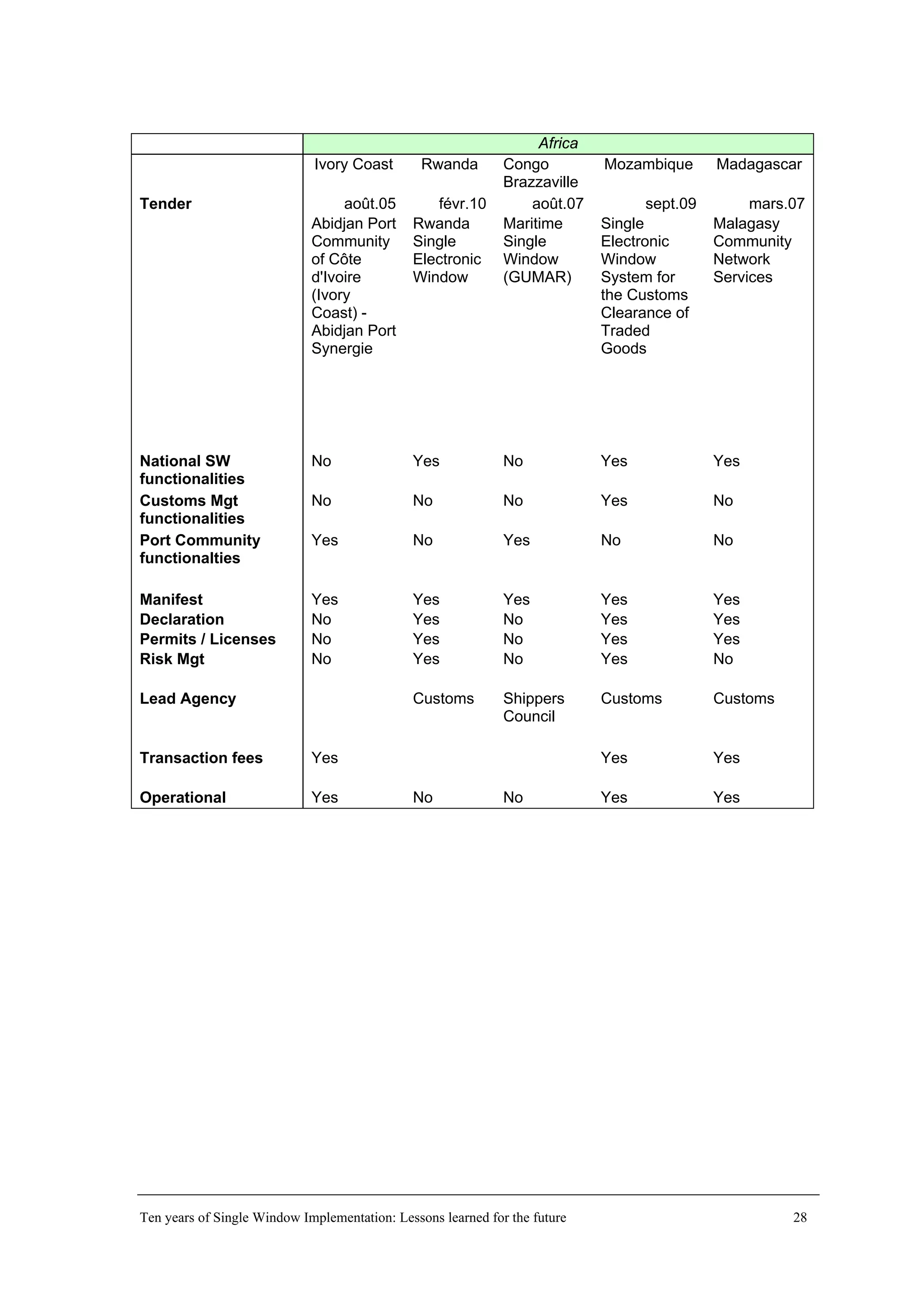
  • 19.
    Figure 4 SingleWindow Tenders / Request for Proposals 4.1 Common Goals / Objectives for the Single Window project It must be acknowledged that, for some, if not most, countries, it may have taken extensive effort, strenuous justifications, and several years of “selling” for the sponsors of the Single Window project just to reach the RFP stage. It is laudable that by reaching this stage, these countries have taken the most perceptible step in their desire to improve and enhance the trade facilitation condition, i.e. the development of their Single Window facility. It is therefore worthwhile to note that, while the goals and objectives highlighted in the above RFPs are wide ranging, there is consensus on the following goals and objectives of the Single Window: to provide convenient and a “one stop” integrated services through multiple channels. to electronically link government agencies that are involved in the trade process. to provide tangible cost savings for business and the Government. Ten years of Single Window Implementation: Lessons learned for the future 19
  • 20.
    to expedite cargorelease and clearance by means of simplification of trade related processes and procedures among controlling agencies. to provide benefits and simplified treatment for the trading community through elimination of duplicated processes. to enable world-class trade-facilitation practices by providing a fully transparent and predictable border environment while ensuring safety and security through a high-performing risk management. to enhance transparency and impartial treatment in the fiscal and customs framework. to eliminate corruption by improving methods to counter dishonest practices, and reducing discretion. 4.2 Regional trends in the development of Single Windows 4.3 Trends in African Single Window projects The African countries that have issued their RFPs are widely spread across the continent: East Africa (Mozambique, Madagascar, Kenya, Tanzania, Rwanda); Central Africa (Congo Brazzaville); West Africa (Ivory Coast, Togo, Benin); North Africa (Libya, Morocco). The African countries’ requirements are dissimilar. The requirements of the Western African countries are mainly for a limited, usually port-centric Single Window, termed as “Guichet Unique des Opérations du Commerce Extérieur” (GUCE), or “Single Window of foreign trade”. Specifically the requirements by the Ivory Coast, Togo, Benin and Congo Brazzaville have focused on the port requirements and have not incorporated some key Single Window functionalities such as customs declaration and/or licensing/permit requirements from the other government agencies. For the Eastern African countries, it is encouraging that the littoral countries—Kenya, Tanzania and Mozambique—are all enhancing their trade facilitation capacities. This augurs well for their neighbouring land-locked countries such as Rwanda, Uganda, Burundi, and Malawi. The requirements by the East African countries were essentially for a national Single Window creating electronic linkages with the government agencies for permits and licensing processing. Only one, Mozambique, called for a combined Single Window and Customs Management System implementation, while the Tanzanian authorities called for two separate tenders for their Single Window and Custom Management respectively around the same time. The others chose to build a new Single Window that would integrate with their existing Customs management systems. Ten years of Single Window Implementation: Lessons learned for the future 20
  • 21.
    4.4 Trends inAsia / Oceania Single Window projects As many Asian countries are trade-oriented, it's therefore no surprise that they're very progressive in trade facilitation. Several already have a Single Window in place. Figure 5 Asian Single Window implementations The Asian requirements are also varied. The ASEAN Single Window initiative, which calls for the integration of the National Single Window of the 10 ASEAN member economies, gives a great impetus to these countries to build their Single Windows. Hence, in recent years, there has been a marked increase in Single Window development in the region. The four ASEAN countries (Indonesia, Thailand, Brunei, and the Philippines) called essentially for Single Window requirements to be integrated with the existing Customs system. Although not seen in the ASEAN countries, there is an increasing trend for countries to include a centralized risk management in their Single Window projects. New Zealand’s Trade Single Window is part of a broader Joint Border Management System that includes requirements for an integrated intelligence and risk management that supports the Customs’ as well as other agencies’ risk management needs. Likewise, Pakistan’s initiative, the Automated Commercial Community System (PACCS) has also included a Risk Management System. 4.5 Trends in Middle East Single Window projects The Middle Eastern countries, in particular, the Gulf countries, have been expending great efforts in enhancing trade facilitation in recent years. Saudi Arabia was an early implementer of the Single Window, when they launched their SaudiEDI project way in 2004. Initiated by the Public Investment Fund of the Ministry of Finance, one of the goals of SaudiEDI was to smooth Government-to-Business-to-Business interactions. In recent years, three Gulf Cooperation Council countries—Qatar, Bahrain and Oman— had issued RFPs for Single Window. One common feature in their requirements called for an overhaul and replacement of their previous Customs management systems, paving the way for a single seamless “Single Window and Customs Management” system. 4.6 Trends in Latin America / Caribbean Single Window projects While Latin America’s trade has grown significantly since 2003, this growth has also exposed the region’s deficiencies in cost and efficiency of international trade. The cost of trade is reportedly higher than those reported in the countries of Asia and the Pacific. Ten years of Single Window Implementation: Lessons learned for the future 21
  • 22.
    In recent years,we have seen a marked interest in developing Single Window systems for foreign trade or “Ventanilla Única de Comercio Exterior” (VUCE) as it is called in Spanish. Colombia and Perú had an early start in establishing their VUCEs around 2006. Mexico and Chile issued their RFPs in 2010 and 2111 respectively. A common feature of the initiatives in this region, unlike in other regions, is that the VUCEs have most Single Window features, except risk management or Customs Management functionalities. 4.7 Funding models used in Single Window development A survey of the various Single Window case studies in the UNECE repository showed that funding for SW development is either self-financed by the respective government, or via public-private partnership (PPP). Figure 6 Funding and charging modes13 In the case of PPPs, the common structure consists of a special purpose vehicle (SPV) whose ownership is a judicious mix of government and private entities. In some cases, the SPV could be entirely owned by the government. The SPV is given the concession or a mandate to operate the Single Window on behalf of the government for a specified period of time. 13 Information for the table has been gathered from the various case studies in the UNECE Single Window Repository http://www.unece.org/cefact/single_window/welcome.html Ten years of Single Window Implementation: Lessons learned for the future 22
  • 23.
    To meet thecontinuing cost of operating and sustaining the maintenance of the Single Window, many countries charge fees based on transactions or a fixed schedule. Other countries, notably Sweden and Indonesia, provide Single Window services free of charge. 5. Conclusions and Lessons learned After 10 years of Single Window implementation we are now in a position to leverage the experiences made and to draw some intermediary conclusions. This chapter is an attempt to establish shared and accepted knowledge about Single Window planning and management. The observations may be useful to policymakers and managers in further developing their Single Window systems. Different Forms of Single Windows Depending on their readiness and priorities, countries have implemented very different forms of Single Windows ranging from integrated Customs solutions to sophisticated Port Community Systems and regional platforms. The Single Window concepts used do not strictly follow the definition of the Single Window facility as set out in UNECE Recommendation 33. The practical examples showed that Single Windows have generally been conceived as a large interagency collaborative system that facilitate and automate business processes and data exchange for international trade. Evolutionary and Staged Development To develop a Single Window is typically a massive undertaking involving interlinking and information-sharing by Customs and all government agencies responsible for trade, and also the trading community. It requires new ways of processing trade and necessitates streamlined business processes. Due to the complex change management, Single Window development typically follows a gradual evolutionary and staged pathway, usually starting from an advanced Customs solution, and progressing to encompass advanced national and regional trade-facilitation objectives. Impact of Single Window in Different Forms Particularly in developing countries and transition economies, the national Single Window has been a success story. Single Window projects have simplified and automated business procedures, introduced change and brought about collaboration between government agencies and the private sector. Many of these countries have shown marked improvements in their trade-facilitation indicators, as seen in the various surveys including the World Bank’s Doing Business - Trading Across Borders, as well as the Logistics Performance Index. In many advanced trading economies, such as the EU, the US and China, the national Single Window concept has not been implemented. Instead, other forms of Single Windows, in particular Port Community Systems and Customs Single Windows are being successfully used to enhance a high-performing logistics sector. However, linking these different platforms into a national or regional network remains a challenge. Cross-border information exchange Ten years of Single Window Implementation: Lessons learned for the future 23
  • 24.
    Both in developedand developing countries, finding improved way to conduct cross- border trade transactions is now an imperative and pressing need. This requires connecting national Single Windows. Networked Single Windows effecting electronic exchange of information along the international supply chain is a natural progression in the increasingly globalised trade environment. Trade liberalization and regional integration are main drivers for a regional Single Window framework that facilitates cross-border trade exchanges. Many aspects of regional Single Window integration remain to be defined. This includes data harmonization, creating an effective legal framework for data exchange within a Single Window network, and a sustainable business model for the service providers. The future for global exchange of information in interregional supply chains is remote, as there's currently no framework for data exchange on a global level. There's no internationally accepted model to establish an information exchange for containerized cargo along such an international supply chain. For example, the ports of Hamburg, Mumbai, Singapore and Shanghai all use different data sets as well as Single Window capabilities. Need for increased regional and global cooperation in Single Window development Over the last 10 years, Single Window projects have been mainly at the national level. While these have been useful to governments for supporting the national economic agenda, they have increasingly become a major platform for an integrated world economy. This trend will increase the complexity and demands on Single Window projects. There's a growing need for implementers of Single Windows to establish further international collaboration to develop common interconnectivity strategies, policies, data harmonization and standards. Already, we see some form of such collaboration being done, albeit by private sector players. The Pan Asia E-Commerce Alliance (PAA) and their African counterpart African Alliance for e-Commerce (AACE) are examples of collaborating Single Window operators, who establish a mechanism and framework for the conduct of secure cross border document and data interchanges amongst the stakeholders in the respective Asian and African regions. However, their efforts are only part of the picture and need to be complemented by the corresponding government policies to truly effect cross border exchanges. Ten years of Single Window Implementation: Lessons learned for the future 24
  • 25.
    Recommendations Single Window developmentshave come a long way from being just an idea to playing an effective role in trade facilitation. What started as a concept has now become a clarion call for improving trade facilitation, transforming the economic development of many countries and economies. Taking into account the experiences from the last 10 years of Single Window development, it is suggested that national governments, regional and international organizations—as well as key stakeholders from the international private-sector community—collaborate on key initiatives to support and guide the future development of a globally networked Single Window. The key initiatives should focus on the following: creating a common, global framework for Single Window planning and development that encompasses and interconnects different forms of Single Window models. The use of a standard evolutionary model for Single Window development will help policymakers and managers determine the state of their national Single Window and define objectives for the next step of implementation. prioritizing regional Single Window collaboration. Depending on the readiness of the countries, this could include the exchange of best practice, the development of sustainable business models and pilot projects for data exchange among national Single Windows, the development of technical and legal frameworks for information exchange and supporting trade agreements and policies. developing at the global level a vision for how to achieve electronic information exchange in global supply chains using the capabilities of Single Window implementations in the countries. Such a vision must take into account the different Single Window models of the developed and the developing countries and emerging technologies and requirements of international trade; ensuring that policymakers take into consideration the potential of Single Windows when developing bilateral or multilateral trade agreements. Those agreements should include provisions to enable information sharing in cross-border trade for use, security and efficiency. Ten years of Single Window Implementation: Lessons learned for the future 25
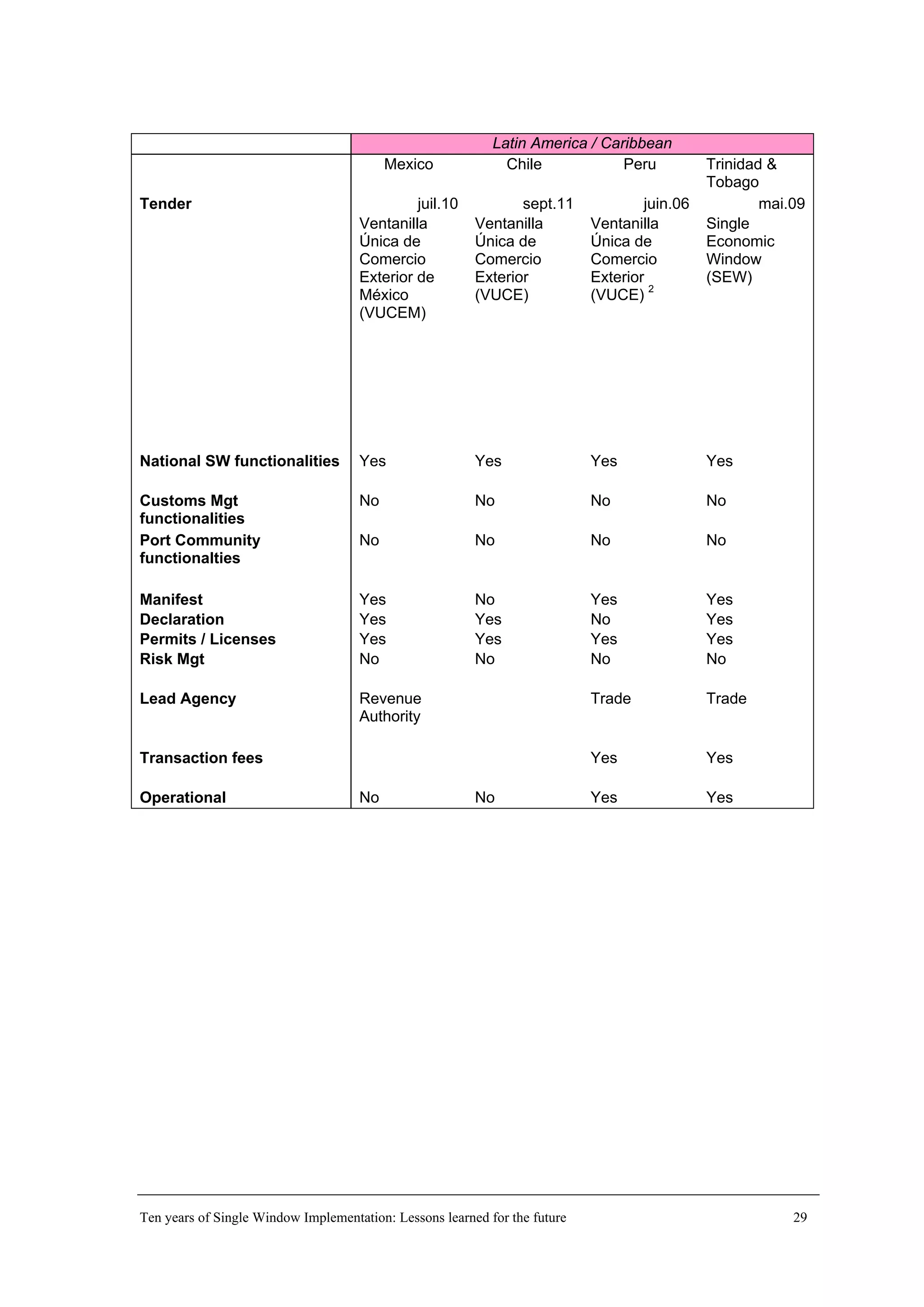
  • 26.
    Annex This table isavailable for download as an Excel worksheet from the UNECE website: http://www.unece.org/tradewelcome/capacity-building-for-trade-facilitation/global-trade-facilitation- conference/discussion-papers.html Middle East Bahrain Oman Qatar Iran Tender août.09 juil.11 nov.07 avr.09 Integrated Trade Facilitation System Integrated Customs Management System and a Single Electronic Window Qatar Customs Clearance Single Window Port Community System National SW functionalities Yes Yes Yes No Customs Mgt functionalities Yes Yes Yes No Port Community functionalties No No No Yes Manifest Yes Yes Yes Yes Declaration Yes Yes Yes No Permits / Licenses Yes Yes Yes No Risk Mgt Yes Yes Yes No Lead Agency Customs Customs Customs Port Authority Transaction fees Yes Operational No No Partial No Ten years of Single Window Implementation: Lessons learned for the future 26
  • 27.
    Africa Kenya Tanzania LibyaTogo Benin Morocco Tender nov.07 août.11 mai.09 mai.09 mai.10 juin.11 Kenya Electronic Single Window System 1 Electronic Single Window System Libyan External Trade Single Window Guichet Unique des Opérations du Commerce Extérieur (GUCE) for the Port of Lomé Single Window for Foreign Trade of Benin for the Port of Cotonou Guichet Unique De Formalites Du Commerce Exterieur (GUCE) National SW functionalities Yes Yes Yes No No No Customs Mgt functionalities No No No No No No Port Community functionalties No Yes Yes Yes Yes Yes Manifest Yes Yes Yes Yes Yes No Declaration Yes Yes Yes No No Yes Permits / Licenses Yes Yes Yes No No Yes Risk Mgt Yes No No No No No Lead Agency Port Authority Port Authority Port Authority Port Authority Transaction fees Yes Operational No No No Yes No No Ten years of Single Window Implementation: Lessons learned for the future 27
  • 28.
    Africa Ivory Coast RwandaCongo Brazzaville Mozambique Madagascar Tender août.05 févr.10 août.07 sept.09 mars.07 Abidjan Port Community of Côte d'Ivoire (Ivory Coast) - Abidjan Port Synergie Rwanda Single Electronic Window Maritime Single Window (GUMAR) Single Electronic Window System for the Customs Clearance of Traded Goods Malagasy Community Network Services National SW functionalities No Yes No Yes Yes Customs Mgt functionalities No No No Yes No Port Community functionalties Yes No Yes No No Manifest Yes Yes Yes Yes Yes Declaration No Yes No Yes Yes Permits / Licenses No Yes No Yes Yes Risk Mgt No Yes No Yes No Lead Agency Customs Shippers Council Customs Customs Transaction fees Yes Yes Yes Operational Yes No No Yes Yes Ten years of Single Window Implementation: Lessons learned for the future 28
  • 29.
    Latin America /Caribbean Mexico Chile Peru Trinidad & Tobago Tender juil.10 sept.11 juin.06 mai.09 Ventanilla Única de Comercio Exterior de México (VUCEM) Ventanilla Única de Comercio Exterior (VUCE) Ventanilla Única de Comercio Exterior (VUCE) 2 Single Economic Window (SEW) National SW functionalities Yes Yes Yes Yes Customs Mgt functionalities No No No No Port Community functionalties No No No No Manifest Yes No Yes Yes Declaration Yes Yes No Yes Permits / Licenses Yes Yes Yes Yes Risk Mgt No No No No Lead Agency Revenue Authority Trade Trade Transaction fees Yes Yes Operational No No Yes Yes Ten years of Single Window Implementation: Lessons learned for the future 29
  • 30.
    Asia / Oceania ThailandBrunei Darussalam New Zealand Pakistan Philippines Tender juil.08 juil.11 mai.10 mai.07 août.09 Thailand National Single Window National Single Window For Trade Facilitation System (BDNSW) Trade Single Window Pakistan Automated Commercial Community System (PACCS) National Single Window National SW functionalities Yes Yes Yes Yes Yes Customs Mgt functionalities No No No Yes No Port Community functionalties No No No No No Manifest No No Yes Yes No Declaration Yes No Yes Yes No Permits / Licenses Yes Yes Yes Yes Yes Risk Mgt No No Yes Yes No Lead Agency Customs Customs Customs Customs Customs Transaction fees Yes Yes Yes Operational Yes No No Yes Yes Notes: With the exception of the below, the above information were surveyed from publicly issued tenders / RFP documents 1. Based on the SRS for the Kenya Community Based System Release November, 2007 2. Based on information provided by MINCETUR and SUNAT Ten years of Single Window Implementation: Lessons learned for the future 30