• Receives all of today's satellite standards 
• Highlight is the ability to receive MIS 
• Can be used with a large variety of reception 
software 
• Extremely sensitive tuner 
• Efficient Blind Scan finds all transponders 
TBS 
QBOX 
5925 
TEST REPORT USB Receiver for MIS 
40 TELE-audiovision International — The World‘s Leading Digital TV Industry Publication — 11-12/2014 — www.TELE-audiovision.com www.TELE-audiovision.com — 11-12/2014 — TELE-audiovision International — 全球发行量最大的数字电视杂志41
TEST REPORT USB Receiver for MIS 
USB DVB-S2 Receiver 
for Multi Input Streams 
port for connection to a PC, 
an IR receiver as well as two 
status LEDs. On the other 
side there‘s the tuner input 
with looped-through output 
plus the connection for the 
external 12V power supply. 
The remote control included 
by the manufacturer is very 
practical and impressed us 
just as much as the box itself 
with its high-quality work-manship. 
The tuner in the TBS QBOX 
5925 can receive signals in 
the 950-2150 MHZ frequen-cy 
range with an input signal 
level from -69 to -23dBm. 
It can work with symbol-rates 
0.54 
TELE-audiovision first presented the new 
MIS technology in issue 12-01/2012. Read 
the full report here: 
http://www.tele-audiovision.com/ 
TELE-satellite-1201/eng/tenow-TBS6925.pdf 
11-12/2014 
■ 
www.TELE-audiovision.com/14/11/tenow 
It wasn‘t too long ago 
when we introduced to you 
here in TELE-audiovision a 
solution for the reception 
of MIS (Multi Input Stream) 
frequencies in the form of a 
PCI card from Tenow for a 
PC (see TELE-satellite issue 
12-01/2012). Now Tenow has 
developed another device 
that can be used to receive 
MIS: the TBS QBOX 5925 is 
the first USB compatible MIS 
box. 
The QBOX is about the size 
of a pack of cigarettes and 
is enclosed in a high-quality 
metal housing. On one side 
of the box you‘ll find the USB 
42 TELE-audiovision International — The World‘s Leading Digital TV Industry Publication — 11-12/2014 — www.TELE-audiovision.com 
from 0.2 to 45 Ms/s 
in both DVB-S and DVB-S2 
modes and also supports all 
the popular demodulation 
modes, namely 8PSK, QPSK, 
16APSK and 32 APSK. The 
TBS QBOX does not place 
any extreme requirements 
on the PC it will be connect-ed 
to; for DVB-S reception a 
1 GHz Pentium III CPU with 
256 MB of memory is good 
enough. For DVB-S2 recep-tion 
a machine with a 3 GHz 
Pentium IV CPU and 1GB of 
memory is recommended. A 
free USB port is also neces-sary 
and shouldn‘t present 
TBS QBOX 5925 
Best suited 
for real satellite enthusiasts
1 
2 
3 
4 
5 
6 
7 
9 
8 
10 
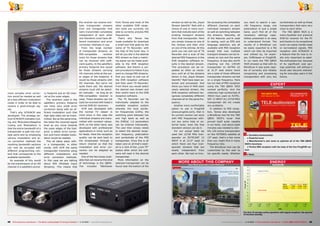
MIS Reception 
1. The user can select the desired MIS stream with the help of the 
TS Recorder 
2. Storing an MIS stream 
3. Scan of an MIS frequency with TBSViewer 
4. Reception of channels on an MIS frequency with TBSViewer 
5. Scan of an MIS frequency with TBSViewer 
6. Reception of channels on an MIS frequency with TBSViewer 
7. Scan of an MIS frequency with ProgDVB 
8. Reception of channels on an MIS frequency with ProgDVB 
9. Scan of an MIS frequency with ProgDVB 
10. Reception of channels on an MIS frequency with ProgDVB 
any problems. As far as the 
PCs operating system, all 
Windows versions starting 
with XP as well as Linux are 
supported. 
We found it interesting 
that, although Tenow has 
their own DVB reception tool 
that goes by the name of TB-SViewer, 
they freely suggest 
alternative software solu-tions. 
In particular, there‘s 
DVBDream, DVBViewer, 
DVBLogic, DVBControl, Me-diaPortal, 
TVheadend, Prog- 
DVB, MuMuDVB or DVBLast. 
In this way you can use your 
favorite software. If you‘re 
not sure which program 
you should use, nearly all 
of them offer free trial ver-sions 
that you can download 
from the Internet so you can 
test them out. In any case 
though, they all offer a much 
wider range of functions 
compared to the rather rudi-mentary 
TBSViewer. 
Because of this we won‘t 
be talking about the every-day 
use of the TBS QBOX 
5925 in this test report; all of 
the available DVB reception 
tools are too different from 
each other in their capabili-ties 
and their expandability. 
We are much more interest-ed 
in a special feature of the 
TBS QBOX 5925 that makes 
it stand out above all the 
other USB DVB-S2 recep-tion 
solutions on the market: 
namely the ability to receive 
VCM/ACM signals as well as 
MIS signals. What do these 
terms mean and what are 
they all about? 
There are several ways to 
transmit the data of a tran-sponder 
via satellite. The 
standard that has been used 
thus far and the technol-ogy 
that is used by all the 
other standard receivers is 
called CCM (Constant Coding 
and Modulation). With this 
44 TELE-audiovision International — The World‘s Leading Digital TV Industry Publication — 11-12/2014 — www.TELE-audiovision.com www.TELE-audiovision.com — 11-12/2014 — TELE-audiovision International — 全球发行量最大的数字电视杂志45
11 12 
13 14 
standard a satellite channel 
is transmitted with a fixed 
modulation mode and er-ror 
correction code. In other 
words, all of the receivers 
wherever they may be in 
the footprint of the satellite 
receive the same signal and 
process it identically. 
At first glance this technol-ogy 
appears to be logical and 
correct but if you look again 
you‘ll recognize the disad-vantage: 
since they are all 
Blindscan 
11. Blindscan Tool for the TBS QBOX 5925 
12. The BlindScan tool can recognize transponders with very low 
as well as very high symbolrates. Even MIS transponders were 
instantly recognized. 
13. TS Recorder can store the selected transponder stream in a TS 
file on the hard drive of a PC. 
14. Results of a BlindScan of HOTBIRD at 13° east. A total of 120 
active transponders were found. 
receiving the same signal, 
the receivers cannot react 
the same way to especially 
strong signals in a satellite‘s 
primary footprint as they 
can with especially weaker 
signals in the outer edges 
46 TELE-audiovision International — The World‘s Leading Digital TV Industry Publication — 11-12/2014 — www.TELE-audiovision.com 
of the same satellite‘s foot-print. 
With stronger signals 
a smaller error correction 
is required and a more effi-cient 
modulation would suf-fice 
but with weaker signals 
it‘s the other way around: a
you want to search a spe-cific 
frequency range, one 
polarization or just a single 
band, you‘ll find all of the 
necessary settings capa-bilities 
presented in an easy 
to understand format. The 
results of a BlindScan can 
be easily exported to a file 
which can then be imported 
and utilized by, for exam-ple, 
DVBViewer or ProgDVB. 
In our tests the TBS QBOX 
5925 showed us that with its 
BlindScan it was quite capa-ble 
of correctly and reliably 
recognizing and processing 
transponders with very low 
symbolrates as well as those 
transponders that were very 
close to each other. 
The TBS QBOX 5925 is a 
many-facetted and practical 
DVB-S2 receiver for the PC 
and thanks to its exceptional 
tuner can easily handle weak 
or narrowband signals. MIS 
reception with VCM/ACM is 
a feature that for now is re-ally 
only important to satel-lite 
enthusiasts but, because 
of its significant cost sav-ings 
potential, will without a 
doubt also become interest-ing 
for everyday users in the 
future. 
expert 
● Excellent workmanship 
● Powerful tuner 
● Manufacturer‘s own tools to optimize all of the TBS QBOX 
5925‘s functions 
● Perfect MIS reception with the help of the free ProgDVB ver-sion 
ENERGY 
DIAGRAM 
Apparent Power 
Active Power 
Mode Apparent Active Factor 
Active 12 W 6.5 W 0.54 
StandBy 9.5 W 4.5 W 0.47 
OPINION 
+ 
– 
RECOMMENDED 
PRODUCT BY 
Thomas Haring 
Test Center 
Austria 
TBS QBOX 5925 
USB Receiver for MIS 
window as well as the „Input 
Stream Identify“ field with a 
choice of one or more num-bers 
that indicate each of the 
existing transport streams 
from that transponder. Here 
you simply choose on one of 
the choices and then click 
on one of the entries. At this 
point you can exit out of TS 
Recorder and a scan of the 
desired MIS frequency in the 
DVB reception software re-sults 
in the desired stream. 
This procedure can be re-peated 
as often as neces-sary 
until all of the streams 
shown in the „Input Stream 
Identify“ field have been se-lected 
and processed. And 
there you have it! With each 
newly selected stream, the 
DVB reception software rec-ognizes 
completely different 
channels all on the same fre-quency. 
Another more comfortable 
option to use is ProgDVB 
(www.progdvb.com), that in 
its current version can work 
with MIS frequencies with-out 
any extra help or ex-ternal 
tools; even the free 
standard version can do it. 
For our actual tests we 
used the 12718 MHz tran-sponder 
on EUTELSAT 12 
WEST A at 12.5° west on 
which there are four tran-sponder 
streams that are 
totally independent from 
each other. We had no trou-ble 
accessing the completely 
different channels on each 
individual transport stream 
as well as switching between 
the streams. Naturally, all 
of the features you‘re used 
to seeing, such as EPG and 
language selection, are all 
available with MIS reception 
except that now multiple 
transport streams can be re-ceived 
on one and the same 
frequency. It was also worth 
checking out the 11914H 
transponder on ASTRA 1G 
at 31.5° east where there 
are a total of three different 
transponder streams carried 
on a single frequency. Here 
too our test of MIS reception 
using the TBS QBOX 5925 
worked perfectly. And the 
relatively high symbolrate of 
35610 Ks/s used on EUTEL-SAT 
12 WEST A‘s 12718 MHZ 
transponder did not create 
any problems. 
In addition to MIS recep-tion, 
Tenow also developed 
a BlindScan tool for the TBS 
QBOX 5925‘s tuner that 
proved itself quite capable 
in our tests. Just about eight 
minutes was needed to iden-tify 
120 active transponders 
on the HOTBIRD satellite at 
13° east; that‘s a few more 
than you might find in many 
frequency lists. 
The BlindScan tool can be 
customized by the user to 
his specific needs. Whether 
More abo ut this comp any 
www.TELE-audiovision.com/11/03/tenow 
more complex error correc-tion 
would be needed as well 
as a less efficient modulation 
mode in order to be able to 
receive a good-enough sig-nal. 
That‘s why VCM/ACM was 
developed. The strategy be-hind 
VCM/ACM (Variable Cod-ing 
and Modulation/Adaptive 
Coding and Modulation) is 
that the entire bandwidth of a 
transponder is split into mul-tiple 
parts and by employing 
various modulation and er-ror 
correction methods the 
resulting bandwidth sections 
can now be occupied with 
different programming con-tent 
that corresponds to the 
available bandwidth. 
An example of this would 
be the transmission of an HD 
channel in a satellite‘s prima-ry 
footprint and an SD chan-nel 
at the outer edges. 
The receivers used in the 
satellite‘s primary footprint 
can have very small error 
correction along with an ef-ficient 
modulation such that 
high data rates can be trans-mitted. 
But at the same time, 
the lower the received signal 
level as you move towards 
the outer edges of the foot-print, 
a better error correc-tion 
and more reliable modu-lation 
would be needed. 
This all takes place with-in 
a transponder, in other 
words, with VCM the same 
transponder transmits using 
different modulations and 
error correction methods. 
In this case we are talking 
about MIS (Multiple Input 
Streams). This means that 
● None 
The first 15 minutes active operation with signal reception, the second 
15 minutes standby 
the receiver can receive mul-tiple 
transponder streams 
from one transponder that 
were transmitted completely 
independent of each other 
and therefore could have dif-ferent 
modulation and error 
correction methods in use. 
From the large number 
of transponder streams, an 
MIS-compatible receiver 
looks for those streams that 
can be received with suffi-cient 
quality. In the satellite‘s 
primary footprint this would 
be those streams carrying 
HD channels while at the out-er 
edges of the footprint, it 
would be those streams with 
SD channels. But we‘re not 
quite there yet; the desired 
streams must still be select-ed 
manually - as long as an 
MIS-compatible receiver is 
used. These streams can not 
(yet) be received with today‘s 
normal DVB-S2 receivers. 
VCM was developed with 
the normal TV viewer in 
mind since in this case the 
individual streams are trans-mitted 
with constant values. 
ACM, on the other hand, was 
developed with professional 
applications in mind, such as 
for feeds. Here the reception 
quality can be sent back to 
the broadcaster through a 
return channel so that the 
modulation and error cor-rection 
can be adapted as 
needed. 
One of the few boxes avail-able 
that can receive this kind 
of technology is the QBOX. 
The included TBSViewer 
from Tenow and most of the 
other available DVB recep-tion 
tools are currently not 
able to correctly process MIS 
frequencies. 
That‘s why Tenow has 
made available for download 
a small tool that goes by the 
name of TS Recorder; with 
the help of the tuner box, it 
will let you dial in the desired 
MIS stream so that a match-ing 
signal can be made avail-able 
to the DVB reception 
software. But there‘s a cer-tain 
procedure to follow if you 
want to change MIS streams: 
first you have to exit out of 
the DVB reception software 
and then start TS Recorder. 
From there you would select 
the desired new stream and 
then switch back to the DVB 
reception software. 
The TS Recorder can be 
individually adapted to the 
available reception system 
whereby the local oscilla-tor 
frequencies (LOFs), the 
switching point between low 
and high band as well as 
the DiSEqC 1.0 parameters 
can be entered individually. 
The user then simply needs 
to select the desired recep-tion 
frequency, polarization 
and symbolrate of the MIS 
transponder. Once this is all 
taken care of, all that‘s need-ed 
is a click of the „Lock TP“ 
button after which the soft-ware 
will read in the desired 
transponder. 
More information on the 
selected transponder can be 
found near the bottom of the 
48 TELE-audiovision International — The World‘s Leading Digital TV Industry Publication — 11-12/2014 — www.TELE-audiovision.com www.TELE-audiovision.com — 11-12/2014 — TELE-audiovision International — 全球发行量最大的数字电视杂志49

Tenow

  • 1.
    • Receives allof today's satellite standards • Highlight is the ability to receive MIS • Can be used with a large variety of reception software • Extremely sensitive tuner • Efficient Blind Scan finds all transponders TBS QBOX 5925 TEST REPORT USB Receiver for MIS 40 TELE-audiovision International — The World‘s Leading Digital TV Industry Publication — 11-12/2014 — www.TELE-audiovision.com www.TELE-audiovision.com — 11-12/2014 — TELE-audiovision International — 全球发行量最大的数字电视杂志41
  • 2.
    TEST REPORT USBReceiver for MIS USB DVB-S2 Receiver for Multi Input Streams port for connection to a PC, an IR receiver as well as two status LEDs. On the other side there‘s the tuner input with looped-through output plus the connection for the external 12V power supply. The remote control included by the manufacturer is very practical and impressed us just as much as the box itself with its high-quality work-manship. The tuner in the TBS QBOX 5925 can receive signals in the 950-2150 MHZ frequen-cy range with an input signal level from -69 to -23dBm. It can work with symbol-rates 0.54 TELE-audiovision first presented the new MIS technology in issue 12-01/2012. Read the full report here: http://www.tele-audiovision.com/ TELE-satellite-1201/eng/tenow-TBS6925.pdf 11-12/2014 ■ www.TELE-audiovision.com/14/11/tenow It wasn‘t too long ago when we introduced to you here in TELE-audiovision a solution for the reception of MIS (Multi Input Stream) frequencies in the form of a PCI card from Tenow for a PC (see TELE-satellite issue 12-01/2012). Now Tenow has developed another device that can be used to receive MIS: the TBS QBOX 5925 is the first USB compatible MIS box. The QBOX is about the size of a pack of cigarettes and is enclosed in a high-quality metal housing. On one side of the box you‘ll find the USB 42 TELE-audiovision International — The World‘s Leading Digital TV Industry Publication — 11-12/2014 — www.TELE-audiovision.com from 0.2 to 45 Ms/s in both DVB-S and DVB-S2 modes and also supports all the popular demodulation modes, namely 8PSK, QPSK, 16APSK and 32 APSK. The TBS QBOX does not place any extreme requirements on the PC it will be connect-ed to; for DVB-S reception a 1 GHz Pentium III CPU with 256 MB of memory is good enough. For DVB-S2 recep-tion a machine with a 3 GHz Pentium IV CPU and 1GB of memory is recommended. A free USB port is also neces-sary and shouldn‘t present TBS QBOX 5925 Best suited for real satellite enthusiasts
  • 3.
    1 2 3 4 5 6 7 9 8 10 MIS Reception 1. The user can select the desired MIS stream with the help of the TS Recorder 2. Storing an MIS stream 3. Scan of an MIS frequency with TBSViewer 4. Reception of channels on an MIS frequency with TBSViewer 5. Scan of an MIS frequency with TBSViewer 6. Reception of channels on an MIS frequency with TBSViewer 7. Scan of an MIS frequency with ProgDVB 8. Reception of channels on an MIS frequency with ProgDVB 9. Scan of an MIS frequency with ProgDVB 10. Reception of channels on an MIS frequency with ProgDVB any problems. As far as the PCs operating system, all Windows versions starting with XP as well as Linux are supported. We found it interesting that, although Tenow has their own DVB reception tool that goes by the name of TB-SViewer, they freely suggest alternative software solu-tions. In particular, there‘s DVBDream, DVBViewer, DVBLogic, DVBControl, Me-diaPortal, TVheadend, Prog- DVB, MuMuDVB or DVBLast. In this way you can use your favorite software. If you‘re not sure which program you should use, nearly all of them offer free trial ver-sions that you can download from the Internet so you can test them out. In any case though, they all offer a much wider range of functions compared to the rather rudi-mentary TBSViewer. Because of this we won‘t be talking about the every-day use of the TBS QBOX 5925 in this test report; all of the available DVB reception tools are too different from each other in their capabili-ties and their expandability. We are much more interest-ed in a special feature of the TBS QBOX 5925 that makes it stand out above all the other USB DVB-S2 recep-tion solutions on the market: namely the ability to receive VCM/ACM signals as well as MIS signals. What do these terms mean and what are they all about? There are several ways to transmit the data of a tran-sponder via satellite. The standard that has been used thus far and the technol-ogy that is used by all the other standard receivers is called CCM (Constant Coding and Modulation). With this 44 TELE-audiovision International — The World‘s Leading Digital TV Industry Publication — 11-12/2014 — www.TELE-audiovision.com www.TELE-audiovision.com — 11-12/2014 — TELE-audiovision International — 全球发行量最大的数字电视杂志45
  • 4.
    11 12 1314 standard a satellite channel is transmitted with a fixed modulation mode and er-ror correction code. In other words, all of the receivers wherever they may be in the footprint of the satellite receive the same signal and process it identically. At first glance this technol-ogy appears to be logical and correct but if you look again you‘ll recognize the disad-vantage: since they are all Blindscan 11. Blindscan Tool for the TBS QBOX 5925 12. The BlindScan tool can recognize transponders with very low as well as very high symbolrates. Even MIS transponders were instantly recognized. 13. TS Recorder can store the selected transponder stream in a TS file on the hard drive of a PC. 14. Results of a BlindScan of HOTBIRD at 13° east. A total of 120 active transponders were found. receiving the same signal, the receivers cannot react the same way to especially strong signals in a satellite‘s primary footprint as they can with especially weaker signals in the outer edges 46 TELE-audiovision International — The World‘s Leading Digital TV Industry Publication — 11-12/2014 — www.TELE-audiovision.com of the same satellite‘s foot-print. With stronger signals a smaller error correction is required and a more effi-cient modulation would suf-fice but with weaker signals it‘s the other way around: a
  • 5.
    you want tosearch a spe-cific frequency range, one polarization or just a single band, you‘ll find all of the necessary settings capa-bilities presented in an easy to understand format. The results of a BlindScan can be easily exported to a file which can then be imported and utilized by, for exam-ple, DVBViewer or ProgDVB. In our tests the TBS QBOX 5925 showed us that with its BlindScan it was quite capa-ble of correctly and reliably recognizing and processing transponders with very low symbolrates as well as those transponders that were very close to each other. The TBS QBOX 5925 is a many-facetted and practical DVB-S2 receiver for the PC and thanks to its exceptional tuner can easily handle weak or narrowband signals. MIS reception with VCM/ACM is a feature that for now is re-ally only important to satel-lite enthusiasts but, because of its significant cost sav-ings potential, will without a doubt also become interest-ing for everyday users in the future. expert ● Excellent workmanship ● Powerful tuner ● Manufacturer‘s own tools to optimize all of the TBS QBOX 5925‘s functions ● Perfect MIS reception with the help of the free ProgDVB ver-sion ENERGY DIAGRAM Apparent Power Active Power Mode Apparent Active Factor Active 12 W 6.5 W 0.54 StandBy 9.5 W 4.5 W 0.47 OPINION + – RECOMMENDED PRODUCT BY Thomas Haring Test Center Austria TBS QBOX 5925 USB Receiver for MIS window as well as the „Input Stream Identify“ field with a choice of one or more num-bers that indicate each of the existing transport streams from that transponder. Here you simply choose on one of the choices and then click on one of the entries. At this point you can exit out of TS Recorder and a scan of the desired MIS frequency in the DVB reception software re-sults in the desired stream. This procedure can be re-peated as often as neces-sary until all of the streams shown in the „Input Stream Identify“ field have been se-lected and processed. And there you have it! With each newly selected stream, the DVB reception software rec-ognizes completely different channels all on the same fre-quency. Another more comfortable option to use is ProgDVB (www.progdvb.com), that in its current version can work with MIS frequencies with-out any extra help or ex-ternal tools; even the free standard version can do it. For our actual tests we used the 12718 MHz tran-sponder on EUTELSAT 12 WEST A at 12.5° west on which there are four tran-sponder streams that are totally independent from each other. We had no trou-ble accessing the completely different channels on each individual transport stream as well as switching between the streams. Naturally, all of the features you‘re used to seeing, such as EPG and language selection, are all available with MIS reception except that now multiple transport streams can be re-ceived on one and the same frequency. It was also worth checking out the 11914H transponder on ASTRA 1G at 31.5° east where there are a total of three different transponder streams carried on a single frequency. Here too our test of MIS reception using the TBS QBOX 5925 worked perfectly. And the relatively high symbolrate of 35610 Ks/s used on EUTEL-SAT 12 WEST A‘s 12718 MHZ transponder did not create any problems. In addition to MIS recep-tion, Tenow also developed a BlindScan tool for the TBS QBOX 5925‘s tuner that proved itself quite capable in our tests. Just about eight minutes was needed to iden-tify 120 active transponders on the HOTBIRD satellite at 13° east; that‘s a few more than you might find in many frequency lists. The BlindScan tool can be customized by the user to his specific needs. Whether More abo ut this comp any www.TELE-audiovision.com/11/03/tenow more complex error correc-tion would be needed as well as a less efficient modulation mode in order to be able to receive a good-enough sig-nal. That‘s why VCM/ACM was developed. The strategy be-hind VCM/ACM (Variable Cod-ing and Modulation/Adaptive Coding and Modulation) is that the entire bandwidth of a transponder is split into mul-tiple parts and by employing various modulation and er-ror correction methods the resulting bandwidth sections can now be occupied with different programming con-tent that corresponds to the available bandwidth. An example of this would be the transmission of an HD channel in a satellite‘s prima-ry footprint and an SD chan-nel at the outer edges. The receivers used in the satellite‘s primary footprint can have very small error correction along with an ef-ficient modulation such that high data rates can be trans-mitted. But at the same time, the lower the received signal level as you move towards the outer edges of the foot-print, a better error correc-tion and more reliable modu-lation would be needed. This all takes place with-in a transponder, in other words, with VCM the same transponder transmits using different modulations and error correction methods. In this case we are talking about MIS (Multiple Input Streams). This means that ● None The first 15 minutes active operation with signal reception, the second 15 minutes standby the receiver can receive mul-tiple transponder streams from one transponder that were transmitted completely independent of each other and therefore could have dif-ferent modulation and error correction methods in use. From the large number of transponder streams, an MIS-compatible receiver looks for those streams that can be received with suffi-cient quality. In the satellite‘s primary footprint this would be those streams carrying HD channels while at the out-er edges of the footprint, it would be those streams with SD channels. But we‘re not quite there yet; the desired streams must still be select-ed manually - as long as an MIS-compatible receiver is used. These streams can not (yet) be received with today‘s normal DVB-S2 receivers. VCM was developed with the normal TV viewer in mind since in this case the individual streams are trans-mitted with constant values. ACM, on the other hand, was developed with professional applications in mind, such as for feeds. Here the reception quality can be sent back to the broadcaster through a return channel so that the modulation and error cor-rection can be adapted as needed. One of the few boxes avail-able that can receive this kind of technology is the QBOX. The included TBSViewer from Tenow and most of the other available DVB recep-tion tools are currently not able to correctly process MIS frequencies. That‘s why Tenow has made available for download a small tool that goes by the name of TS Recorder; with the help of the tuner box, it will let you dial in the desired MIS stream so that a match-ing signal can be made avail-able to the DVB reception software. But there‘s a cer-tain procedure to follow if you want to change MIS streams: first you have to exit out of the DVB reception software and then start TS Recorder. From there you would select the desired new stream and then switch back to the DVB reception software. The TS Recorder can be individually adapted to the available reception system whereby the local oscilla-tor frequencies (LOFs), the switching point between low and high band as well as the DiSEqC 1.0 parameters can be entered individually. The user then simply needs to select the desired recep-tion frequency, polarization and symbolrate of the MIS transponder. Once this is all taken care of, all that‘s need-ed is a click of the „Lock TP“ button after which the soft-ware will read in the desired transponder. More information on the selected transponder can be found near the bottom of the 48 TELE-audiovision International — The World‘s Leading Digital TV Industry Publication — 11-12/2014 — www.TELE-audiovision.com www.TELE-audiovision.com — 11-12/2014 — TELE-audiovision International — 全球发行量最大的数字电视杂志49