Tennessee 
State Nutrition, Physical Activity, and 
Obesity Profile 
Obesity has important consequences on our nation’s health and economy. It is linked 
to a number of chronic diseases, including coronary heart disease, stroke, diabetes, 
and some cancers (NIH Clinical Guidelines, 1998). Among adults, the medical costs 
associated with obesity are estimated at 147 billion dollars (Finkelstein, 2009). Many 
American communities are characterized by unhealthy options when it comes to diet 
and physical activity. We need public health approaches that make healthy options 
available, accessible, and affordable for all Americans.
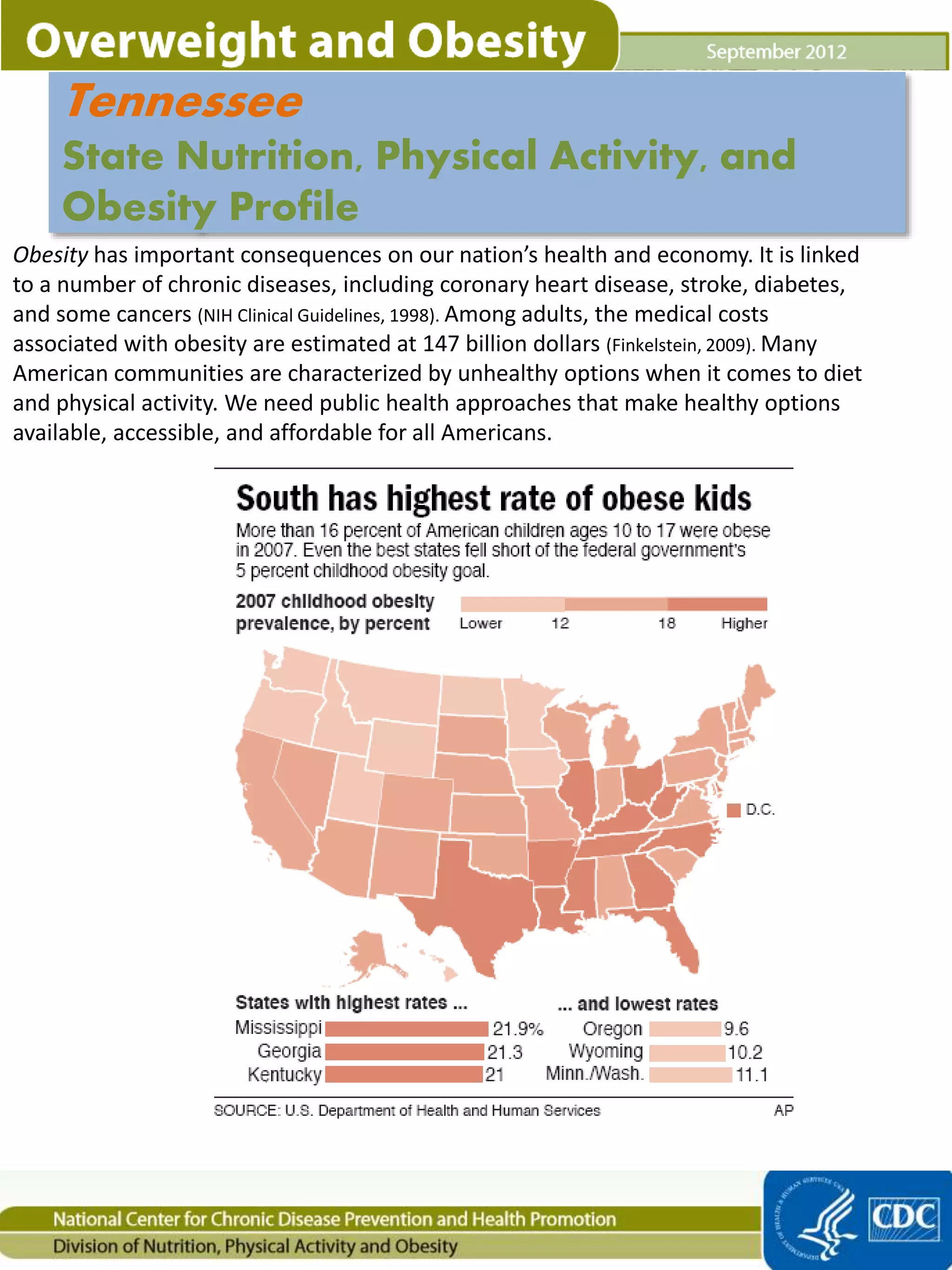
Childhood obesity rates drop nationally, rise 
in Tennessee 
CDC’s Division of Nutrition and Physical, and 
Obesity (DNPAO) supports the nation’s capacity 
to address public health in all policies and 
establish successful and sustainable interventions 
to support healthy eating and active living. The 
Division provides support (i.e., implementation 
and evaluation guidance, technical assistance, 
training, surveillance and applied research, 
translation and dissemination, and partnership 
development) to states, communities and national 
partners to implement policy, system, and 
environmental strategies. The goal is to improve 
dietary quality, increase physical activity and 
reduce obesity across multiple settings—such 
as child care facilities, workplaces, hospitals and 
medical care facilities, schools, and communities. 
State Population of Tennessee 
• Estimated Total Population 2010 
(1)= 6,346,105 
• Adults age 18 and over 
(2) = 76.4% of the total population in 2010 
• Youth under 18 years of age 
(1) = 23.6% of the total population in 2010 
(1) U.S. Census Bureau. State and County 
QuickFacts. 2011. 
Available online at 
http://quickfacts.census.gov/qfd/index.html 
(2) Calculated estimated = 100% minus percent of 
the total population under 18 years old, using State 
and County QuickFacts, 2010 data from the U.S. 
Census. 
Adult Overweight and Obesity 
Overweight and Obesity (3) 
• 67.2% were overweight, with a Body Mass 
Index of 25 or greater. 
• 30.8% were obese, with a Body Mass Index 
of 30 or greater. Dietary Behaviors (4) 
• 26.4% of adults reported having consumed 
fruits at the recommended level of 2 or more times 
per day. 
• 33% of adults reported having consumed 
vegetables at the recommended level of 3 
or more times per day 
Physical Activity 
• 29.8% of adults achieved at least 300 minutes a 
week of moderate-intensity aerobic physical activity 
or 150 minutes a week of vigorous-intensity aerobic 
activity (or an equivalent combination). 
• 31.0% of Tennessee’s adults reported that during 
the past month, they had not participated in any 
physical activity. 
Source of Adult Obesity Data: 
(3) CDC. Behavioral Risk Factor Surveillance System: 
Prevalence and Trend Data–Overweight and Obesity, 
U.S. Obesity Trends, Trends by State 2010. Available 
online at http://nccd.cdc.gov/NPAO_DTM/ 
Source of Adult Fruit and Vegetable Data: (4) CDC. 
MMWR 
September 2010 State–Specific Trends in Fruit 
and Vegetable Consumption Among Adults United 
States, 2000–2009. Available online at 
http://www.cdc.gov/mmwr/ 
pdf/wk/mm5935.pdf 
Source of Adult Physical Activity Data: (5) 
CDC. BRFSS Behavioral Risk Factor Surveillance 
System: Prevalence and Trend Data–Physical 
Activity, U.S. Physical Activity Trends by State 2009– 
2010. Available online at 
http://nccd.cdc.gov/NPAO_DTM/ 
Physical Activity 
• Achieved recommended level of activity: 
Only 24.2% were physically active 
* for a total of at least 60 minutes per day on each 
of the 7 days prior to the survey. 
• Participated in daily physical education: 
22.9% of adolescents attended daily 
physical education classes in an average 
week (when they were in school)
Physical Inactivity 
• No activity: 17.7% did not participate in at least 60 
minutes of physical activity on any day during the 7 
days prior to the survey. 
• Television viewing time: 37.7% watched television 
3 or more hours per day on an average school day. 
The 2010 Tennessee School Health Profiles assessed 
the school environment, indicating that among 
high schools(7) 
• 61.4% did not sell less nutritious foods and 
beverages anywhere outside the school food service 
program. 
• 9.9% always offered fruits or non-fried vegetables 
in vending machines and school stores, canteens, or 
snack bars, and during celebrations whenever foods 
and beverages were offered. 
• 41.5% prohibited all forms of advertising and 
promotion of candy, fast food restaurants, or soft 
drinks in all locations. 
All school-related locations were defined as in 
school buildings; on school grounds, including on 
the outside of the school building, on playing fields, 
or other areas of the campus; on school buses or 
other vehicles used to transport students; and in 
school publications. 
Sources of Adolescent Obesity, Fruit and Vegetable, 
Sugar-sweetened Beverages, and Physical Activity 
Data: 
*Physical activity defined as “any kind of physical activity 
that increases your heart rate and makes you breathe hard 
some of the time.” 
(6) 
CDC, Division of Adolescent and School Health. The 2009 
Youth Risk Behavior Survey. Available online at 
http://www.cdc.gov/HealthyYouth/yrbs/index.htm 
(7) 
CDC, Division of Adolescent and School Health. The 2010 
School Health Profiles. Available online at 
http://www.cdc.gov/healthyyouth/profiles/index.htm 
Child Overweight and Obesity 
Breastfeeding 
(8) 
Increasing breastfeeding initiation, duration, 
and exclusivity is a priority strategy in CDC’s 
efforts to decrease the rate of childhood obesity 
throughout the United States. 
• 65.6% of infants were Ever Breastfed. 
• 35.5% of infants were Breastfed for at least 6 
months. 
Body Mass Index 
(9)*Among Tennessee’s children aged 2 years to less 
than 5 years * 
• 15.2% were overweight (85th to < 95th percentile BMI-for- 
Age). 
• 14.5% were obese (≥ 95th percentile BMI-for-Age). 
Sources of Breastfeeding Data: (8) CDC. Division of 
Nutrition, Physical Activity, and Obesity Breastfeeding 
Report Card 2011. Centers for Disease Control and 
Prevention National Immunization Survey, Provisional 
Data, 2008births. Available online at 
http://www.cdc.gov/breastfeeding/data/reportcard2.htm 
Sources of Child Obesity Data:(9) CDC. Division of Nutrition, 
Physical Activity, and Obesity. 2010 
Pediatric Nutrition Surveillance System, Table 6 (PedNSS). 
http://www.cdc.gov/pednss/pednss_tables/tables_health_ 
indicators.htm 
*BMI data only includes low-income children from the 
PedNSS sample and do not represent all children. 
*BMI data is based on 2000 CDC growth chart percentiles 
for BMI-for-age for children 2 years of age and older. 
Tennessee’s Response to Obesity 
Obesity Mini-Grants 
In cooperation with the Tennessee Obesity 
Taskforce (TOT), the Tennessee Department 
of Health is supporting local communities 
implementing one or more of the objectives 
from the state nutrition, physical activity, and 
obesity plan. The plan, entitled “Eat Well, Play 
More Tennessee,” was created by members of 
TOT and serves as a statewide call to action. The 
TOT taskforce has successfully linked scientists, 
clinicians, city planners, school officials, state 
agencies, policymakers, transportation experts, 
nutritionists, and parents in addressing the needs 
of vulnerable populations in Tennessee.
Healthy Vending 
In 2010, Tennessee Governor Phil Bredesen signed 
Executive Order No. 69 promoting healthy options 
for food and beverages sold through vending 
facilities on properties within the executive branch 
of state government. The order applies to all 
vending machines on public properties within the 
executive branch of state government under the 
authority of the Department of Human Services. 
Tennessee Health and Human Services has 
developed and published the nutritional guidelines 
and incorporated them into the state’s minimum 
standards. The Department of Health also plans to 
publish recommendations for nutritional food and 
beverages provided to state employees at breaks, 
meetings, conferences and other work-related 
events held on public property. 
Gold Sneaker Initiative 
Two hundred and forty two Child Care Centers 
throughout the Tennessee have been designated 
thus far as Gold Sneaker facilities for their having 
successfully implemented nutrition and physical 
activity-related policy interventions. The program’s 
website (http://health.state.tn.us/goldsneaker.htm 
) provides instructions, training materials, and all 
forms that child care centers need to adopt policies 
that promote age-appropriate physical activities, 
limit television and screen viewing time, and 
promote a healthy eating environment 
Join Nashville on the Move! 
Held the first Friday of every month, Nashville on 
the Move is a free lunchtime walking event 
designed to encourage employees to be more active 
during their workday. The walks are organized by 
the YMCA of Middle Tennessee in partnership with 
Metro Public Health and several local employers. 
Connect With Tennessee Campaign 
With an abundance of 749 trails and greenways, 
the state’s “Connect with Tennessee” campaign 
encourages use of these resources. The website 
www.connectwithtn.com offers news about 
upcoming park events and provides helpful guidance 
concerning the many ways individuals and families 
can enjoy parks, trails and greenways throughout 
Tennessee. 
Contacts 
Rick Canada, MS 
Director; Nutrition, Physical Activity and Obesity 
Tennessee Department of Health Bureau of Health Svcs. 
Cordell Hull Building, 5th Floor 
425 5th Ave North 
Nashville, TN 37243 
Phone: 615-253-8729 
E-mail: Richard.Canada@tn.gov 
References 
NIH. Clinical Guidelines Clinical Guidelines on the 
Identification, Evaluation, and Treatment of 
Overweight and Obesity in Adults: The Evidence 
Report. 1998. Available online at 
http://www.nhlbi.nih.gov/guidelines/obesity/ob_gdl 
ns.htm 
Finkelstein, EA, Trogdon, JG, Cohen, JW, and Dietz, W. 
Annual medical spending attributable to obesity: Payer-and 
service-specific estimates. Health Affairs 2009; 28(5): 
w822-w831

Tennessee Overweight and Obesity

  • 1.
    Tennessee State Nutrition,Physical Activity, and Obesity Profile Obesity has important consequences on our nation’s health and economy. It is linked to a number of chronic diseases, including coronary heart disease, stroke, diabetes, and some cancers (NIH Clinical Guidelines, 1998). Among adults, the medical costs associated with obesity are estimated at 147 billion dollars (Finkelstein, 2009). Many American communities are characterized by unhealthy options when it comes to diet and physical activity. We need public health approaches that make healthy options available, accessible, and affordable for all Americans.
  • 2.
    Childhood obesity ratesdrop nationally, rise in Tennessee CDC’s Division of Nutrition and Physical, and Obesity (DNPAO) supports the nation’s capacity to address public health in all policies and establish successful and sustainable interventions to support healthy eating and active living. The Division provides support (i.e., implementation and evaluation guidance, technical assistance, training, surveillance and applied research, translation and dissemination, and partnership development) to states, communities and national partners to implement policy, system, and environmental strategies. The goal is to improve dietary quality, increase physical activity and reduce obesity across multiple settings—such as child care facilities, workplaces, hospitals and medical care facilities, schools, and communities. State Population of Tennessee • Estimated Total Population 2010 (1)= 6,346,105 • Adults age 18 and over (2) = 76.4% of the total population in 2010 • Youth under 18 years of age (1) = 23.6% of the total population in 2010 (1) U.S. Census Bureau. State and County QuickFacts. 2011. Available online at http://quickfacts.census.gov/qfd/index.html (2) Calculated estimated = 100% minus percent of the total population under 18 years old, using State and County QuickFacts, 2010 data from the U.S. Census. Adult Overweight and Obesity Overweight and Obesity (3) • 67.2% were overweight, with a Body Mass Index of 25 or greater. • 30.8% were obese, with a Body Mass Index of 30 or greater. Dietary Behaviors (4) • 26.4% of adults reported having consumed fruits at the recommended level of 2 or more times per day. • 33% of adults reported having consumed vegetables at the recommended level of 3 or more times per day Physical Activity • 29.8% of adults achieved at least 300 minutes a week of moderate-intensity aerobic physical activity or 150 minutes a week of vigorous-intensity aerobic activity (or an equivalent combination). • 31.0% of Tennessee’s adults reported that during the past month, they had not participated in any physical activity. Source of Adult Obesity Data: (3) CDC. Behavioral Risk Factor Surveillance System: Prevalence and Trend Data–Overweight and Obesity, U.S. Obesity Trends, Trends by State 2010. Available online at http://nccd.cdc.gov/NPAO_DTM/ Source of Adult Fruit and Vegetable Data: (4) CDC. MMWR September 2010 State–Specific Trends in Fruit and Vegetable Consumption Among Adults United States, 2000–2009. Available online at http://www.cdc.gov/mmwr/ pdf/wk/mm5935.pdf Source of Adult Physical Activity Data: (5) CDC. BRFSS Behavioral Risk Factor Surveillance System: Prevalence and Trend Data–Physical Activity, U.S. Physical Activity Trends by State 2009– 2010. Available online at http://nccd.cdc.gov/NPAO_DTM/ Physical Activity • Achieved recommended level of activity: Only 24.2% were physically active * for a total of at least 60 minutes per day on each of the 7 days prior to the survey. • Participated in daily physical education: 22.9% of adolescents attended daily physical education classes in an average week (when they were in school)
  • 3.
    Physical Inactivity •No activity: 17.7% did not participate in at least 60 minutes of physical activity on any day during the 7 days prior to the survey. • Television viewing time: 37.7% watched television 3 or more hours per day on an average school day. The 2010 Tennessee School Health Profiles assessed the school environment, indicating that among high schools(7) • 61.4% did not sell less nutritious foods and beverages anywhere outside the school food service program. • 9.9% always offered fruits or non-fried vegetables in vending machines and school stores, canteens, or snack bars, and during celebrations whenever foods and beverages were offered. • 41.5% prohibited all forms of advertising and promotion of candy, fast food restaurants, or soft drinks in all locations. All school-related locations were defined as in school buildings; on school grounds, including on the outside of the school building, on playing fields, or other areas of the campus; on school buses or other vehicles used to transport students; and in school publications. Sources of Adolescent Obesity, Fruit and Vegetable, Sugar-sweetened Beverages, and Physical Activity Data: *Physical activity defined as “any kind of physical activity that increases your heart rate and makes you breathe hard some of the time.” (6) CDC, Division of Adolescent and School Health. The 2009 Youth Risk Behavior Survey. Available online at http://www.cdc.gov/HealthyYouth/yrbs/index.htm (7) CDC, Division of Adolescent and School Health. The 2010 School Health Profiles. Available online at http://www.cdc.gov/healthyyouth/profiles/index.htm Child Overweight and Obesity Breastfeeding (8) Increasing breastfeeding initiation, duration, and exclusivity is a priority strategy in CDC’s efforts to decrease the rate of childhood obesity throughout the United States. • 65.6% of infants were Ever Breastfed. • 35.5% of infants were Breastfed for at least 6 months. Body Mass Index (9)*Among Tennessee’s children aged 2 years to less than 5 years * • 15.2% were overweight (85th to < 95th percentile BMI-for- Age). • 14.5% were obese (≥ 95th percentile BMI-for-Age). Sources of Breastfeeding Data: (8) CDC. Division of Nutrition, Physical Activity, and Obesity Breastfeeding Report Card 2011. Centers for Disease Control and Prevention National Immunization Survey, Provisional Data, 2008births. Available online at http://www.cdc.gov/breastfeeding/data/reportcard2.htm Sources of Child Obesity Data:(9) CDC. Division of Nutrition, Physical Activity, and Obesity. 2010 Pediatric Nutrition Surveillance System, Table 6 (PedNSS). http://www.cdc.gov/pednss/pednss_tables/tables_health_ indicators.htm *BMI data only includes low-income children from the PedNSS sample and do not represent all children. *BMI data is based on 2000 CDC growth chart percentiles for BMI-for-age for children 2 years of age and older. Tennessee’s Response to Obesity Obesity Mini-Grants In cooperation with the Tennessee Obesity Taskforce (TOT), the Tennessee Department of Health is supporting local communities implementing one or more of the objectives from the state nutrition, physical activity, and obesity plan. The plan, entitled “Eat Well, Play More Tennessee,” was created by members of TOT and serves as a statewide call to action. The TOT taskforce has successfully linked scientists, clinicians, city planners, school officials, state agencies, policymakers, transportation experts, nutritionists, and parents in addressing the needs of vulnerable populations in Tennessee.
  • 4.
    Healthy Vending In2010, Tennessee Governor Phil Bredesen signed Executive Order No. 69 promoting healthy options for food and beverages sold through vending facilities on properties within the executive branch of state government. The order applies to all vending machines on public properties within the executive branch of state government under the authority of the Department of Human Services. Tennessee Health and Human Services has developed and published the nutritional guidelines and incorporated them into the state’s minimum standards. The Department of Health also plans to publish recommendations for nutritional food and beverages provided to state employees at breaks, meetings, conferences and other work-related events held on public property. Gold Sneaker Initiative Two hundred and forty two Child Care Centers throughout the Tennessee have been designated thus far as Gold Sneaker facilities for their having successfully implemented nutrition and physical activity-related policy interventions. The program’s website (http://health.state.tn.us/goldsneaker.htm ) provides instructions, training materials, and all forms that child care centers need to adopt policies that promote age-appropriate physical activities, limit television and screen viewing time, and promote a healthy eating environment Join Nashville on the Move! Held the first Friday of every month, Nashville on the Move is a free lunchtime walking event designed to encourage employees to be more active during their workday. The walks are organized by the YMCA of Middle Tennessee in partnership with Metro Public Health and several local employers. Connect With Tennessee Campaign With an abundance of 749 trails and greenways, the state’s “Connect with Tennessee” campaign encourages use of these resources. The website www.connectwithtn.com offers news about upcoming park events and provides helpful guidance concerning the many ways individuals and families can enjoy parks, trails and greenways throughout Tennessee. Contacts Rick Canada, MS Director; Nutrition, Physical Activity and Obesity Tennessee Department of Health Bureau of Health Svcs. Cordell Hull Building, 5th Floor 425 5th Ave North Nashville, TN 37243 Phone: 615-253-8729 E-mail: Richard.Canada@tn.gov References NIH. Clinical Guidelines Clinical Guidelines on the Identification, Evaluation, and Treatment of Overweight and Obesity in Adults: The Evidence Report. 1998. Available online at http://www.nhlbi.nih.gov/guidelines/obesity/ob_gdl ns.htm Finkelstein, EA, Trogdon, JG, Cohen, JW, and Dietz, W. Annual medical spending attributable to obesity: Payer-and service-specific estimates. Health Affairs 2009; 28(5): w822-w831