Applying
Primary Prevention Principles to
Obesity Prevention
Primary Prevention Initiative: Nutrition Module
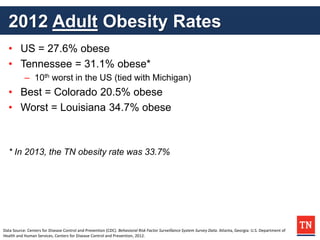
2012 Adult Obesity Rates
• US = 27.6% obese
• Tennessee = 31.1% obese*
– 10th worst in the US (tied with Michigan)
• Best = Colorado 20.5% obese
• Worst = Louisiana 34.7% obese
* In 2013, the TN obesity rate was 33.7%
Data Source: Centers for Disease Control and Prevention (CDC). Behavioral Risk Factor Surveillance System Survey Data. Atlanta, Georgia: U.S. Department of
Health and Human Services, Centers for Disease Control and Prevention, 2012.
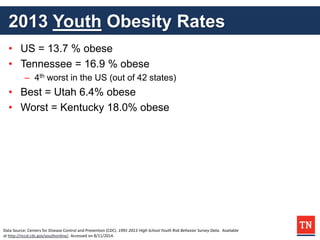
2013 Youth Obesity Rates
• US = 13.7 % obese
• Tennessee = 16.9 % obese
– 4th worst in the US (out of 42 states)
• Best = Utah 6.4% obese
• Worst = Kentucky 18.0% obese
Data Source: Centers for Disease Control and Prevention (CDC). 1991-2013 High School Youth Risk Behavior Survey Data. Available
at http://nccd.cdc.gov/youthonline/. Accessed on 8/11/2014.
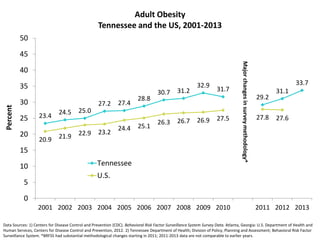
Data Sources: 1) Centers for Disease Control and Prevention (CDC). Behavioral Risk Factor Surveillance System Survey Data. Atlanta, Georgia: U.S. Department of Health and
Human Services, Centers for Disease Control and Prevention, 2012. 2) Tennessee Department of Health; Division of Policy, Planning and Assessment; Behavioral Risk Factor
Surveillance System. *BRFSS had substantial methodological changes starting in 2011; 2011-2013 data are not comparable to earlier years.
23.4 24.5 25.0
27.2 27.4
28.8
30.7 31.2
32.9
31.7
29.2
31.1
33.7
20.9 21.9 22.9 23.2
24.4 25.1
26.3 26.7 26.9 27.5 27.8 27.6
0
5
10
15
20
25
30
35
40
45
50
2001 2002 2003 2004 2005 2006 2007 2008 2009 2010 2011 2012 2013
Percent
Adult Obesity
Tennessee and the US, 2001-2013
Tennessee
U.S.
Major
changes
in
survey
methodology*
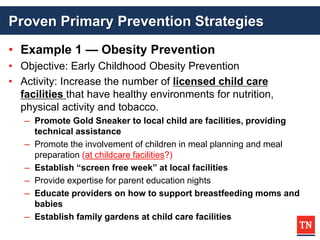
Proven Primary Prevention Strategies
• Example 1 — Obesity Prevention
• Objective: Early Childhood Obesity Prevention
• Activity: Increase the number of licensed child care
facilities that have healthy environments for nutrition,
physical activity and tobacco.
– Promote Gold Sneaker to local child are facilities, providing
technical assistance
– Promote the involvement of children in meal planning and meal
preparation (at childcare facilities?)
– Establish “screen free week” at local facilities
– Provide expertise for parent education nights
– Educate providers on how to support breastfeeding moms and
babies
– Establish family gardens at child care facilities
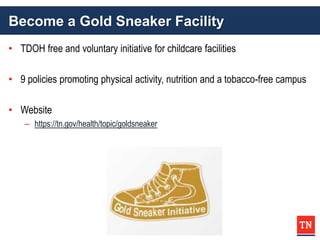
Become a Gold Sneaker Facility
• TDOH free and voluntary initiative for childcare facilities
• 9 policies promoting physical activity, nutrition and a tobacco-free campus
• Website
– https://tn.gov/health/topic/goldsneaker
Gold Sneaker
• Technical Assistance
– Yvette Mack, Phd, MSPH, MCHES
yvette.mack@tn.gov
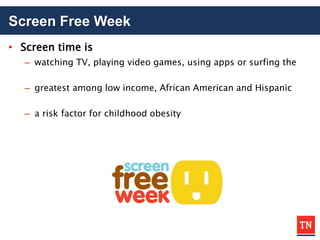
Screen Free Week
• Screen time is
– watching TV, playing video games, using apps or surfing the
– greatest among low income, African American and Hispanic
– a risk factor for childhood obesity
Screen Free Week
• Website (flyers, pledge cards, activity logs…)
– http://www.screenfree.org/
• Toolkit
– http://www.screenfree.org/wp-
Proven Primary Prevention Strategies
• Example 2 — Obesity Prevention
• Objective: Promote Breastfeeding
• Activities: Create a community supportive of
breastfeeding
– Encourage businesses to take the “Breastfeeding
Welcomed Here” pledge
– Promote existing laws that support breastfeeding
– Publicize and enforce employer compliance with existing law to
accommodate breastfeeding mothers at work
– Build breastfeeding support groups for prenatal and
breastfeeding mothers and their families
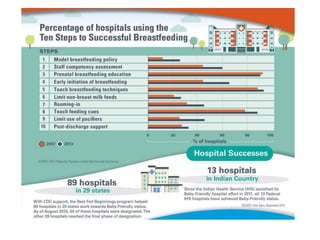
– Encourage hospitals to have a breastfeeding policy that
supports the 10 Steps to Successful Breastfeeding
Breastfeeding Welcomed Here
• Tennessee law allows breastfeeding in any public or private space
• Businesses show support by taking a pledge and displaying a decal
• Supports women breastfeeding their babies with community support
Breastfeeding Welcomed Here
• Website
– https://www.tn.gov/health/article/breastfeeding-
Breastfeeding Welcomed Here
Adolescent Breastfeeding
• Only 19% of mothers ≤ 20 years of age breastfeed infants at 3 months
compared to 36% of women aged 20-29 and 45% of women aged > 30
years old.
• 71% of adolescent moms receive a gift pack containing infant formula from
the hospital
• In 2011 Tennessee ranked 10th for teen pregnancy (aged 15-19) (rank of 1
as highest pregnancy rate)
http://www.hhs.gov/ash/oah/adolescent-health-topics/reproductive-health/states/tn.html
http://www.cdc.gov/mmwr/volumes/65/wr/mm6502a1.htm
Resources for Adolescent Breastfeeding
Promotion
• LaLeche League
– http://www.llli.org/llleaderweb/lv/lvjunjul03p58.html
– http://www.llli.org/llleaderweb/lv/lvmarapr90p19.html
• Articles
– http://internationalbreastfeedingjournal.biomedcentral.com/articles/10.1186/
– http://www.unicef.org.uk/BabyFriendly/News-and-
breastfeeding/Telephone-peer-support-for-improves-breastfeeding-
Resources for Adolescent Breastfeeding
Promotion
Employee Breastfeeding Support
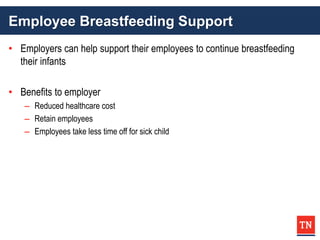
• Employers can help support their employees to continue breastfeeding
their infants
• Benefits to employer
– Reduced healthcare cost
– Retain employees
– Employees take less time off for sick child
Employee Breastfeeding Support
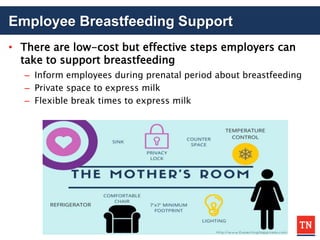
• There are low-cost but effective steps employers can
take to support breastfeeding
– Inform employees during prenatal period about breastfeeding
– Private space to express milk
– Flexible break times to express milk
Employee Breastfeeding Support
• Toolkit
– https://www.colorado.gov/pacific/sites/default/files/Tool%20K
%20Building%20a%20Lactation%20Support%20Program.pdf
• Resources
– http://mchb.hrsa.gov/pregnancyandbeyond/breastfeeding/
– https://www.tn.gov/health/article/breastfeeding-business
10 Steps to Successful Breastfeeding
1. Have a written breastfeeding policy that is routinely
communicated to all health care staff.
2. Train all health care staff in skills necessary to implement this
policy.
3. Inform all pregnant women about the benefits and
management of breastfeeding.
4. Help mothers initiate breastfeeding within half an hour of birth
5. Show mothers how to breastfeed, and how to maintain
lactation even if they should be separated from their infants.
10 Steps to Successful Breastfeeding
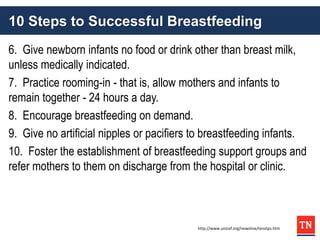
6. Give newborn infants no food or drink other than breast milk,
unless medically indicated.
7. Practice rooming-in - that is, allow mothers and infants to
remain together - 24 hours a day.
8. Encourage breastfeeding on demand.
9. Give no artificial nipples or pacifiers to breastfeeding infants.
10. Foster the establishment of breastfeeding support groups and
refer mothers to them on discharge from the hospital or clinic.
http://www.unicef.org/newsline/tenstps.htm
10 Steps Resources
• Baby Friendly USA
– http://www.babyfriendlyusa.org/about-
initiative/the-ten-steps/
• 10 steps frequently asked ?’s
– file:///C:/Users/dc60ku9/Downloads/Ten_Steps
13.pdf
• CDC
– http://www.cdc.gov/vitalsigns/breastfeeding201
Alternative Baby Gift Bags
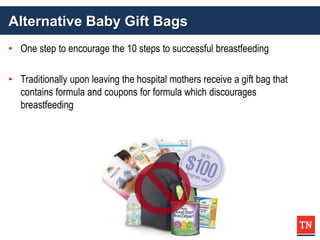
• One step to encourage the 10 steps to successful breastfeeding
• Traditionally upon leaving the hospital mothers receive a gift bag that
contains formula and coupons for formula which discourages
breastfeeding
Alternative Baby Gift Bags
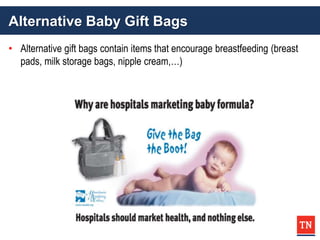
• Alternative gift bags contain items that encourage breastfeeding (breast
pads, milk storage bags, nipple cream,…)
Alternative Baby Gift Bags
• Partner with local breastfeeding coalitions and lactation consultants
• Ban the Bags Toolkit
– http://banthebags.org/wp-content/uploads/2012/09/ToolKit-revision-10-11-12.pdf
• Case studies of communities that were able to ban formula gift bags
– http://www.citizen.org/documents/report-successful-initiatives-formula-marketing.pdf
Other Resources
Link to TN hospitals that ban gift bags or baby friendly hospitals
• http://www.citizen.org/documents/Best-Hospitals-End-Infant-Formula-
Marketing-to-Support-Breastfeeding-Report.pdf
Proven Primary Prevention Strategies
• Example 3 — Promoting Nutritious Choices
• Objective: Increase availability of nutritious food in the
community
• Activity: Ensure nutritious choices are available for
people away from home
– Adopt healthy meeting policies for worksites
– Enable local park and recreation facilities adopt healthier menus for
concessions
– Revamp vending choices to make healthier options available at
local worksites
– Ban the sale of sugar sweetened sodas in public places
– Work to establish local farmers markets and improved distribution
of local produce
– Establish community gardens
– Promote Food Service Guidelines in school cafeterias
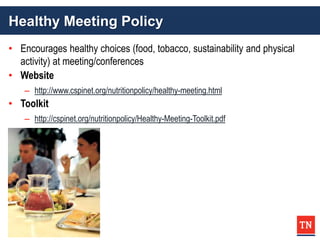
Healthy Meeting Policy
• Encourages healthy choices (food, tobacco, sustainability and physical
activity) at meeting/conferences
• Website
– http://www.cspinet.org/nutritionpolicy/healthy-meeting.html
• Toolkit
– http://cspinet.org/nutritionpolicy/Healthy-Meeting-Toolkit.pdf
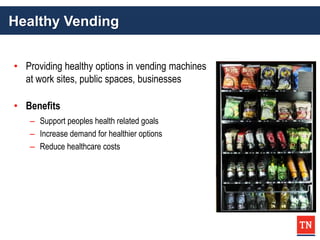
Healthy Vending
• Providing healthy options in vending machines
at work sites, public spaces, businesses
• Benefits
– Support peoples health related goals
– Increase demand for healthier options
– Reduce healthcare costs
Vending worksites
• Healthy Vending Toolkit
– http://www.kingcounty.gov/healthservices/health/nutritio
health/documents/nutrition/HealthyVendingToolkit.ashx
• Multiple Resources on Healthy Vending
– http://www.cspinet.org/nutritionpolicy/foodstandards.ht
32
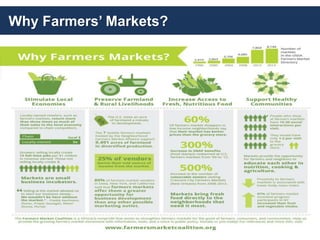
Why Farmers’ Markets?
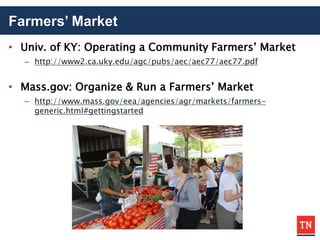
Farmers’ Market
• Univ. of KY: Operating a Community Farmers’ Market
– http://www2.ca.uky.edu/agc/pubs/aec/aec77/aec77.pdf
• Mass.gov: Organize & Run a Farmers’ Market
– http://www.mass.gov/eea/agencies/agr/markets/farmers-
generic.html#gettingstarted
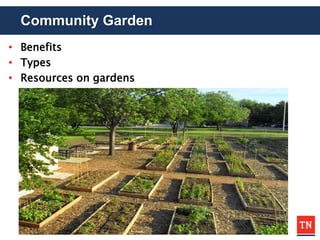
Community Garden
• Benefits
• Types
• Resources on gardens
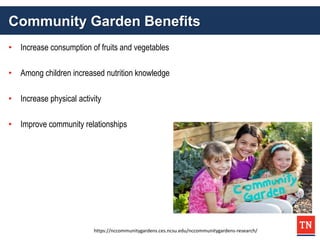
Community Garden Benefits
• Increase consumption of fruits and vegetables
• Among children increased nutrition knowledge
• Increase physical activity
• Improve community relationships
https://nccommunitygardens.ces.ncsu.edu/nccommunitygardens-research/
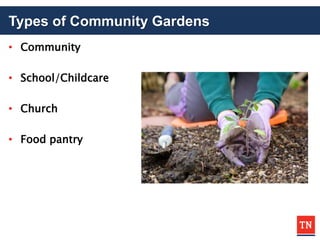
Types of Community Gardens
• Community
• School/Childcare
• Church
• Food pantry
Garden Checklist
• Community Garden
– http://www.letsmove.gov/sites/letsmove.gov/files/p
ty%20Garden%20Checklist.pdf
• School Garden
– http://www.letsmove.gov/sites/letsmove.gov/files/p
20Garden%20Checklist_0.pdf
Garden Resources
• CDC website (white papers, case studies…)
– http://www.cdc.gov/healthyplaces/healthtopics/healthyfood/commu
• Wisconsin DOH youth gardening toolkit (some info. is
specific to WI)
– https://www.dhs.wisconsin.gov/publications/p4/p40112.pdf
• USDA
– http://www.usda.gov/wps/portal/usda/usdahome?navid=GARDEN_R
S_GARDEN&navtype=RT
– http://www.usda.gov/wps/portal/usda/usdahome?navid=GARDEN_R
S_GARDEN&navtype=RT
– http://healthymeals.nal.usda.gov/resource-library/school-and-
garden-resources (multiple resources)
Proven Primary Prevention Strategies
• Example 4 — Promoting Physical Activity
• Objective: Increase opportunities for residents to be
more active
• Activity: Ensure physical activity opportunities are
available
– Establish Joint Use Agreements with local schools
– Establish natural surface walking trails on public land
– Establish walking groups and walking clubs for community
participation
– Promote before and after school exercise, run and/or walk clubs
– Create walking school bus routes to enable children to walk to
school
– Promote daily physical activity within schools
CDC Strategies & Guidelines Links
• Strategies to Increase the Consumption of Fruits and
Vegetables
– http://www.cdc.gov/obesity/downloads/fandv_2011_web_tag5
• Breastfeeding
– http://www.cdc.gov/breastfeeding/resources/guide.htm
Bright Spot: Gibson County
• Objective:
– increase the proportion of exclusively breastfed infants
• Activity:
– PPI team educated local businesses on the Breastfeeding
Bright Spot: Gibson County
• Outcome of Breastfeeding Welcomed Here PPI
– Oct.2014: pledges increased from 21 to 58
– Nov.2014: total of 93 businesses learned about initiative
Bright Spot: Hickman County
• Objective
– Increase the intake of healthy foods
• PPI team partnered with local farmers’ market director,
local health council
• Activity: Community focus group assessment and in-
house health department survey:
– Few home gardens, lack of transportation
– Lack of awareness of farmers’ market, inconvenient hours
Bright Spot: Hickman County
• Promotion through banners, water bottles, T-shirts…
• Offered on-site nutrition education, cooking tips at twice weekly market
• Weekly walking program adjacent to farmers’ market
• Produced a monthly newsletter
• Link to word.doc
Additional Resources
• Behavioral Risk Factor Surveillance System
– http://www.cdc.gov/brfss/
• County Health Rankings
– http://www.countyhealthrankings.org/#app/
• American Public Health Association
– http://www.apha.org/programs/resources/obesity/
• Center for Disease Control and Prevention
– http://www.cdc.gov/obesity/resource/
Technical Assistance Resources
• Beth Allen: elizabeth.allen@tn.gov
– CDC 1305 Chronic Disease & School Health Grant
– Nutritionist
– 615-253-8729
• Joan Cook: joan.cook@tn.gov
– Project Diabetes & Gold Sneaker Initiative
– Nutritionist
– 615-253-8745
• Dare Bible: dare.bible@tn.gov
– Project Diabetes
– Public Health Educator
– 615-253-0005

ObesityPreventionModule(mattupdate).pptx

  • 1.
    Applying Primary Prevention Principlesto Obesity Prevention Primary Prevention Initiative: Nutrition Module
  • 2.
    2012 Adult ObesityRates • US = 27.6% obese • Tennessee = 31.1% obese* – 10th worst in the US (tied with Michigan) • Best = Colorado 20.5% obese • Worst = Louisiana 34.7% obese * In 2013, the TN obesity rate was 33.7% Data Source: Centers for Disease Control and Prevention (CDC). Behavioral Risk Factor Surveillance System Survey Data. Atlanta, Georgia: U.S. Department of Health and Human Services, Centers for Disease Control and Prevention, 2012.
  • 3.
    2013 Youth ObesityRates • US = 13.7 % obese • Tennessee = 16.9 % obese – 4th worst in the US (out of 42 states) • Best = Utah 6.4% obese • Worst = Kentucky 18.0% obese Data Source: Centers for Disease Control and Prevention (CDC). 1991-2013 High School Youth Risk Behavior Survey Data. Available at http://nccd.cdc.gov/youthonline/. Accessed on 8/11/2014.
  • 4.
    Data Sources: 1)Centers for Disease Control and Prevention (CDC). Behavioral Risk Factor Surveillance System Survey Data. Atlanta, Georgia: U.S. Department of Health and Human Services, Centers for Disease Control and Prevention, 2012. 2) Tennessee Department of Health; Division of Policy, Planning and Assessment; Behavioral Risk Factor Surveillance System. *BRFSS had substantial methodological changes starting in 2011; 2011-2013 data are not comparable to earlier years. 23.4 24.5 25.0 27.2 27.4 28.8 30.7 31.2 32.9 31.7 29.2 31.1 33.7 20.9 21.9 22.9 23.2 24.4 25.1 26.3 26.7 26.9 27.5 27.8 27.6 0 5 10 15 20 25 30 35 40 45 50 2001 2002 2003 2004 2005 2006 2007 2008 2009 2010 2011 2012 2013 Percent Adult Obesity Tennessee and the US, 2001-2013 Tennessee U.S. Major changes in survey methodology*
  • 5.
    Proven Primary PreventionStrategies • Example 1 — Obesity Prevention • Objective: Early Childhood Obesity Prevention • Activity: Increase the number of licensed child care facilities that have healthy environments for nutrition, physical activity and tobacco. – Promote Gold Sneaker to local child are facilities, providing technical assistance – Promote the involvement of children in meal planning and meal preparation (at childcare facilities?) – Establish “screen free week” at local facilities – Provide expertise for parent education nights – Educate providers on how to support breastfeeding moms and babies – Establish family gardens at child care facilities
  • 6.
    Become a GoldSneaker Facility • TDOH free and voluntary initiative for childcare facilities • 9 policies promoting physical activity, nutrition and a tobacco-free campus • Website – https://tn.gov/health/topic/goldsneaker
  • 7.
    Gold Sneaker • TechnicalAssistance – Yvette Mack, Phd, MSPH, MCHES yvette.mack@tn.gov
  • 8.
    Screen Free Week •Screen time is – watching TV, playing video games, using apps or surfing the – greatest among low income, African American and Hispanic – a risk factor for childhood obesity
  • 9.
    Screen Free Week •Website (flyers, pledge cards, activity logs…) – http://www.screenfree.org/ • Toolkit – http://www.screenfree.org/wp-
  • 10.
    Proven Primary PreventionStrategies • Example 2 — Obesity Prevention • Objective: Promote Breastfeeding • Activities: Create a community supportive of breastfeeding – Encourage businesses to take the “Breastfeeding Welcomed Here” pledge – Promote existing laws that support breastfeeding – Publicize and enforce employer compliance with existing law to accommodate breastfeeding mothers at work – Build breastfeeding support groups for prenatal and breastfeeding mothers and their families – Encourage hospitals to have a breastfeeding policy that supports the 10 Steps to Successful Breastfeeding
  • 11.
    Breastfeeding Welcomed Here •Tennessee law allows breastfeeding in any public or private space • Businesses show support by taking a pledge and displaying a decal • Supports women breastfeeding their babies with community support
  • 12.
    Breastfeeding Welcomed Here •Website – https://www.tn.gov/health/article/breastfeeding-
  • 13.
  • 14.
    Adolescent Breastfeeding • Only19% of mothers ≤ 20 years of age breastfeed infants at 3 months compared to 36% of women aged 20-29 and 45% of women aged > 30 years old. • 71% of adolescent moms receive a gift pack containing infant formula from the hospital • In 2011 Tennessee ranked 10th for teen pregnancy (aged 15-19) (rank of 1 as highest pregnancy rate) http://www.hhs.gov/ash/oah/adolescent-health-topics/reproductive-health/states/tn.html http://www.cdc.gov/mmwr/volumes/65/wr/mm6502a1.htm
  • 15.
    Resources for AdolescentBreastfeeding Promotion • LaLeche League – http://www.llli.org/llleaderweb/lv/lvjunjul03p58.html – http://www.llli.org/llleaderweb/lv/lvmarapr90p19.html • Articles – http://internationalbreastfeedingjournal.biomedcentral.com/articles/10.1186/ – http://www.unicef.org.uk/BabyFriendly/News-and- breastfeeding/Telephone-peer-support-for-improves-breastfeeding-
  • 16.
    Resources for AdolescentBreastfeeding Promotion
  • 17.
    Employee Breastfeeding Support •Employers can help support their employees to continue breastfeeding their infants • Benefits to employer – Reduced healthcare cost – Retain employees – Employees take less time off for sick child
  • 18.
    Employee Breastfeeding Support •There are low-cost but effective steps employers can take to support breastfeeding – Inform employees during prenatal period about breastfeeding – Private space to express milk – Flexible break times to express milk
  • 19.
    Employee Breastfeeding Support •Toolkit – https://www.colorado.gov/pacific/sites/default/files/Tool%20K %20Building%20a%20Lactation%20Support%20Program.pdf • Resources – http://mchb.hrsa.gov/pregnancyandbeyond/breastfeeding/ – https://www.tn.gov/health/article/breastfeeding-business
  • 20.
    10 Steps toSuccessful Breastfeeding 1. Have a written breastfeeding policy that is routinely communicated to all health care staff. 2. Train all health care staff in skills necessary to implement this policy. 3. Inform all pregnant women about the benefits and management of breastfeeding. 4. Help mothers initiate breastfeeding within half an hour of birth 5. Show mothers how to breastfeed, and how to maintain lactation even if they should be separated from their infants.
  • 21.
    10 Steps toSuccessful Breastfeeding 6. Give newborn infants no food or drink other than breast milk, unless medically indicated. 7. Practice rooming-in - that is, allow mothers and infants to remain together - 24 hours a day. 8. Encourage breastfeeding on demand. 9. Give no artificial nipples or pacifiers to breastfeeding infants. 10. Foster the establishment of breastfeeding support groups and refer mothers to them on discharge from the hospital or clinic. http://www.unicef.org/newsline/tenstps.htm
  • 23.
    10 Steps Resources •Baby Friendly USA – http://www.babyfriendlyusa.org/about- initiative/the-ten-steps/ • 10 steps frequently asked ?’s – file:///C:/Users/dc60ku9/Downloads/Ten_Steps 13.pdf • CDC – http://www.cdc.gov/vitalsigns/breastfeeding201
  • 24.
    Alternative Baby GiftBags • One step to encourage the 10 steps to successful breastfeeding • Traditionally upon leaving the hospital mothers receive a gift bag that contains formula and coupons for formula which discourages breastfeeding
  • 25.
    Alternative Baby GiftBags • Alternative gift bags contain items that encourage breastfeeding (breast pads, milk storage bags, nipple cream,…)
  • 26.
    Alternative Baby GiftBags • Partner with local breastfeeding coalitions and lactation consultants • Ban the Bags Toolkit – http://banthebags.org/wp-content/uploads/2012/09/ToolKit-revision-10-11-12.pdf • Case studies of communities that were able to ban formula gift bags – http://www.citizen.org/documents/report-successful-initiatives-formula-marketing.pdf
  • 27.
    Other Resources Link toTN hospitals that ban gift bags or baby friendly hospitals • http://www.citizen.org/documents/Best-Hospitals-End-Infant-Formula- Marketing-to-Support-Breastfeeding-Report.pdf
  • 28.
    Proven Primary PreventionStrategies • Example 3 — Promoting Nutritious Choices • Objective: Increase availability of nutritious food in the community • Activity: Ensure nutritious choices are available for people away from home – Adopt healthy meeting policies for worksites – Enable local park and recreation facilities adopt healthier menus for concessions – Revamp vending choices to make healthier options available at local worksites – Ban the sale of sugar sweetened sodas in public places – Work to establish local farmers markets and improved distribution of local produce – Establish community gardens – Promote Food Service Guidelines in school cafeterias
  • 29.
    Healthy Meeting Policy •Encourages healthy choices (food, tobacco, sustainability and physical activity) at meeting/conferences • Website – http://www.cspinet.org/nutritionpolicy/healthy-meeting.html • Toolkit – http://cspinet.org/nutritionpolicy/Healthy-Meeting-Toolkit.pdf
  • 30.
    Healthy Vending • Providinghealthy options in vending machines at work sites, public spaces, businesses • Benefits – Support peoples health related goals – Increase demand for healthier options – Reduce healthcare costs
  • 31.
    Vending worksites • HealthyVending Toolkit – http://www.kingcounty.gov/healthservices/health/nutritio health/documents/nutrition/HealthyVendingToolkit.ashx • Multiple Resources on Healthy Vending – http://www.cspinet.org/nutritionpolicy/foodstandards.ht
  • 32.
  • 33.
    Farmers’ Market • Univ.of KY: Operating a Community Farmers’ Market – http://www2.ca.uky.edu/agc/pubs/aec/aec77/aec77.pdf • Mass.gov: Organize & Run a Farmers’ Market – http://www.mass.gov/eea/agencies/agr/markets/farmers- generic.html#gettingstarted
  • 34.
    Community Garden • Benefits •Types • Resources on gardens
  • 35.
    Community Garden Benefits •Increase consumption of fruits and vegetables • Among children increased nutrition knowledge • Increase physical activity • Improve community relationships https://nccommunitygardens.ces.ncsu.edu/nccommunitygardens-research/
  • 36.
    Types of CommunityGardens • Community • School/Childcare • Church • Food pantry
  • 37.
    Garden Checklist • CommunityGarden – http://www.letsmove.gov/sites/letsmove.gov/files/p ty%20Garden%20Checklist.pdf • School Garden – http://www.letsmove.gov/sites/letsmove.gov/files/p 20Garden%20Checklist_0.pdf
  • 38.
    Garden Resources • CDCwebsite (white papers, case studies…) – http://www.cdc.gov/healthyplaces/healthtopics/healthyfood/commu • Wisconsin DOH youth gardening toolkit (some info. is specific to WI) – https://www.dhs.wisconsin.gov/publications/p4/p40112.pdf • USDA – http://www.usda.gov/wps/portal/usda/usdahome?navid=GARDEN_R S_GARDEN&navtype=RT – http://www.usda.gov/wps/portal/usda/usdahome?navid=GARDEN_R S_GARDEN&navtype=RT – http://healthymeals.nal.usda.gov/resource-library/school-and- garden-resources (multiple resources)
  • 39.
    Proven Primary PreventionStrategies • Example 4 — Promoting Physical Activity • Objective: Increase opportunities for residents to be more active • Activity: Ensure physical activity opportunities are available – Establish Joint Use Agreements with local schools – Establish natural surface walking trails on public land – Establish walking groups and walking clubs for community participation – Promote before and after school exercise, run and/or walk clubs – Create walking school bus routes to enable children to walk to school – Promote daily physical activity within schools
  • 40.
    CDC Strategies &Guidelines Links • Strategies to Increase the Consumption of Fruits and Vegetables – http://www.cdc.gov/obesity/downloads/fandv_2011_web_tag5 • Breastfeeding – http://www.cdc.gov/breastfeeding/resources/guide.htm
  • 41.
    Bright Spot: GibsonCounty • Objective: – increase the proportion of exclusively breastfed infants • Activity: – PPI team educated local businesses on the Breastfeeding
  • 42.
    Bright Spot: GibsonCounty • Outcome of Breastfeeding Welcomed Here PPI – Oct.2014: pledges increased from 21 to 58 – Nov.2014: total of 93 businesses learned about initiative
  • 43.
    Bright Spot: HickmanCounty • Objective – Increase the intake of healthy foods • PPI team partnered with local farmers’ market director, local health council • Activity: Community focus group assessment and in- house health department survey: – Few home gardens, lack of transportation – Lack of awareness of farmers’ market, inconvenient hours
  • 44.
    Bright Spot: HickmanCounty • Promotion through banners, water bottles, T-shirts… • Offered on-site nutrition education, cooking tips at twice weekly market • Weekly walking program adjacent to farmers’ market • Produced a monthly newsletter • Link to word.doc
  • 45.
    Additional Resources • BehavioralRisk Factor Surveillance System – http://www.cdc.gov/brfss/ • County Health Rankings – http://www.countyhealthrankings.org/#app/ • American Public Health Association – http://www.apha.org/programs/resources/obesity/ • Center for Disease Control and Prevention – http://www.cdc.gov/obesity/resource/
  • 46.
    Technical Assistance Resources •Beth Allen: elizabeth.allen@tn.gov – CDC 1305 Chronic Disease & School Health Grant – Nutritionist – 615-253-8729 • Joan Cook: joan.cook@tn.gov – Project Diabetes & Gold Sneaker Initiative – Nutritionist – 615-253-8745 • Dare Bible: dare.bible@tn.gov – Project Diabetes – Public Health Educator – 615-253-0005

Editor's Notes

  • #11 Is this a realistic PPI when only 3 hospitals have done the 10 steps. Should it be to adopt 1 of the policies or assess where local hospital stand.
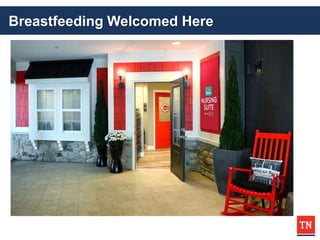
  • #14 Here is an example of a public nursing area at the Cincinnati Red’s Great American Ballpark….This provides a comfortable area for nursing mothers to come and nurse their child.
  • #15 Tenn pregnancy reference- http://www.hhs.gov/ash/oah/adolescent-health-topics/reproductive-health/states/tn.html Adolescent breastfeeding reference- http://www.cdc.gov/mmwr/volumes/65/wr/mm6502a1.htm
  • #22 Removal of gift pack with infant formula on discharge (has this already been done in TN hospitals?) Baby Friendly designation only 1 hospital in TN?? Could removal of gift pack be a PPI?
  • #27 Link to TN hospitals that allow gift bags. Cottonwood-kids.com (alternative gift bags$2.19/bag)
  • #40 Link to Physical Activity PPI
  • #46 Keep or remove?
  • #47 Keep or remove?