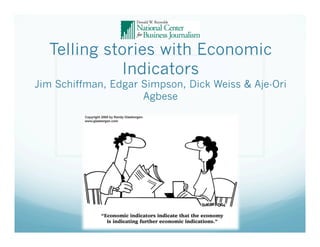
Telling stories with Economic
Indicators

Jim Schiffman, Edgar Simpson, Dick Weiss & Aje-Ori
Agbese
What is An Economic Indicator?
—  Data and economic trends that tell consumers, the
government, organizations, and investors what is
happening, has happened and will happen

—  There are 3 types of indicators
—  Leading indicators happen before a change in the

economy and allow us to predict what’s coming
—  Coincident indicators measure economic changes as
they happen and tell us the current situation
—  Lagging indicators follow economic changes and tell
us where the economy has been
Common Indicators
—  Employment statistics
—  Gross Domestic Product
—  Retail and food sales
—  Inflation
—  Consumer Confidence Survey
—  S&P 500 Stock Index
—  Manufacturing and Trade Inventories and Sales
—  Consumer spending
—  New houses
—  Labor market
Why Use Them in Journalism?
—  When we report news based on economic

indicators, we help people understand the state of
the economy and how it affects them

—  Journalists can help people know and understand
why the government creates certain policies

—  People can make decisions once they have the data
broken down for them

—  Economic indicators can make for interactive

journalism, which help people visualize what is
happening, has happened or will happen
But There Are Quirky Indicators
Exercise
—  Your Mission: Define an indicator that offers some insight into the health and

direction of the campus economy. An indicator is meant to provide guidance on
what is happening in the economy and/or what could be happening in the near
future. Your indicator will be combined with two others: student loan debt and gas
prices. Keep in mind the following parameters:

—  An indicator is a snapshot in time. That means you must define the timeframe you
are seeking to measure. Data for most national economic indicators are gathered
on a monthly basis. But, some are gathered quarterly or evenly annually.

—  An indicator must be factually sound. In other words, hearing something or feeling
something is not the same thing as being able to prove something.

—  An indicator must be methodologically sound. Let’s say, for instance, you decide a

good economic indicator would be the five most-consumed brands of beer by your
fellow college students. How are you going to gather and then analyze the data?

—  An indicator must be repeatable. That means something that only happens once a
semester or once a year likely would have little value in gauging current economic
conditions (i.e. the price of textbooks may be a great story, but would not work as
a monthly indicator since most students tend to buy books only twice in a school
year).

Business Journalism Professors 2014: Lesson Plan - Telling Stories with Economic Indicators

  • 1.
    Telling stories withEconomic Indicators Jim Schiffman, Edgar Simpson, Dick Weiss & Aje-Ori Agbese
  • 2.
    What is AnEconomic Indicator? —  Data and economic trends that tell consumers, the government, organizations, and investors what is happening, has happened and will happen —  There are 3 types of indicators —  Leading indicators happen before a change in the economy and allow us to predict what’s coming —  Coincident indicators measure economic changes as they happen and tell us the current situation —  Lagging indicators follow economic changes and tell us where the economy has been
  • 3.
    Common Indicators —  Employmentstatistics —  Gross Domestic Product —  Retail and food sales —  Inflation —  Consumer Confidence Survey —  S&P 500 Stock Index —  Manufacturing and Trade Inventories and Sales —  Consumer spending —  New houses —  Labor market
  • 4.
    Why Use Themin Journalism? —  When we report news based on economic indicators, we help people understand the state of the economy and how it affects them —  Journalists can help people know and understand why the government creates certain policies —  People can make decisions once they have the data broken down for them —  Economic indicators can make for interactive journalism, which help people visualize what is happening, has happened or will happen
  • 5.
    But There AreQuirky Indicators
  • 6.
    Exercise —  Your Mission:Define an indicator that offers some insight into the health and direction of the campus economy. An indicator is meant to provide guidance on what is happening in the economy and/or what could be happening in the near future. Your indicator will be combined with two others: student loan debt and gas prices. Keep in mind the following parameters: —  An indicator is a snapshot in time. That means you must define the timeframe you are seeking to measure. Data for most national economic indicators are gathered on a monthly basis. But, some are gathered quarterly or evenly annually. —  An indicator must be factually sound. In other words, hearing something or feeling something is not the same thing as being able to prove something. —  An indicator must be methodologically sound. Let’s say, for instance, you decide a good economic indicator would be the five most-consumed brands of beer by your fellow college students. How are you going to gather and then analyze the data? —  An indicator must be repeatable. That means something that only happens once a semester or once a year likely would have little value in gauging current economic conditions (i.e. the price of textbooks may be a great story, but would not work as a monthly indicator since most students tend to buy books only twice in a school year).