SECTION 1. Identification of the substance/mixture and of the
company/undertaking
Revision nr. 4
Dated 02/07/2018
Printed on 02/07/2018
Page n. 1/11
Safety Data Sheet
According to Annex II to REACH - Regulation 2015/830
1.1. Product identifier
Code: TEK 1960
Product name TEK 1960
1.2. Relevant identified uses of the substance or mixture and uses advised against
Intended use Security cleaner for high viscosity resin on DLP. LCD and SLA.
1.3. Details of the supplier of the safety data sheet
Name Keytech srl
Full address Via M. Resistenza, 63
District and Country 60125 Ancona (AN)
Italia
Tel. +39 071 9157015
e-mail address of the competent person
responsible for the Safety Data Sheet s.corinaldesi@gmail.com
1.4. Emergency telephone number
For urgent inquiries refer to +39 071 9157015 (Orario di ufficio 8.30/12.30 - 14.00/18.00)
SECTION 2. Hazards identification
2.1. Classification of the substance or mixture
The product is classified as hazardous pursuant to the provisions set forth in (EC) Regulation 1272/2008 (CLP) (and subsequent amendments and
supplements). The product thus requires a safety datasheet that complies with the provisions of (EU) Regulation 2015/830.
Any additional information concerning the risks for health and/or the environment are given in sections 11 and 12 of this sheet.
Hazard classification and indication:
2.2. Label elements
Hazard labelling pursuant to EC Regulation 1272/2008 (CLP) and subsequent amendments and supplements.
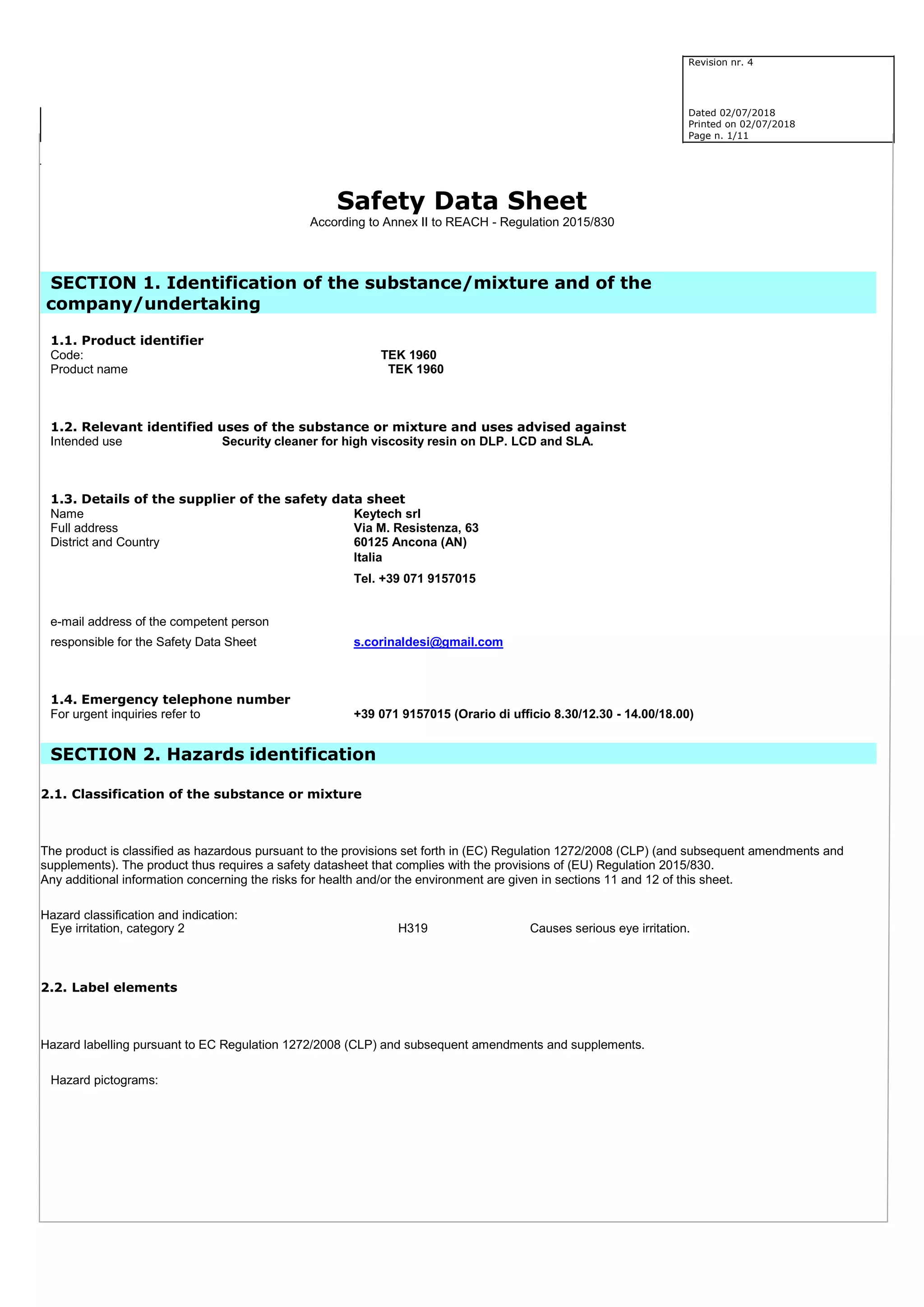
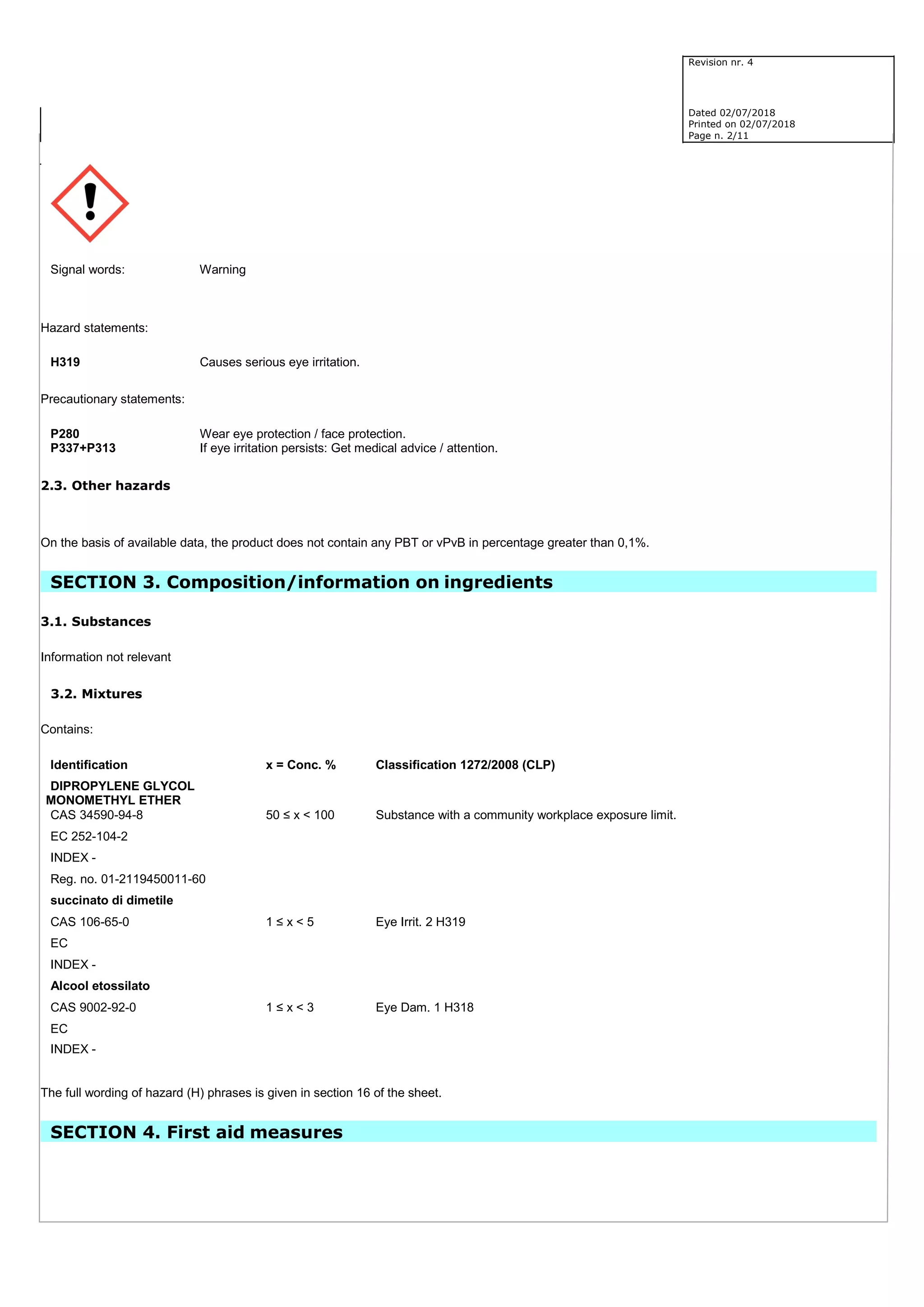
Hazard pictograms:
Eye irritation, category 2 H319 Causes serious eye irritation.
Revision nr. 4
Dated 02/07/2018
Printed on 02/07/2018
Page n. 2/11
Signal words: Warning
Hazard statements:
H319 Causes serious eye irritation.
Precautionary statements:
P280 Wear eye protection / face protection.
P337+P313 If eye irritation persists: Get medical advice / attention.
2.3. Other hazards
On the basis of available data, the product does not contain any PBT or vPvB in percentage greater than 0,1%.
SECTION 3. Composition/information on ingredients
3.1. Substances
Information not relevant
3.2. Mixtures
Contains:
Identification x = Conc. % Classification 1272/2008 (CLP)
DIPROPYLENE GLYCOL
MONOMETHYL ETHER
CAS 34590-94-8 50 ≤ x < 100 Substance with a community workplace exposure limit.
EC 252-104-2
INDEX -
Reg. no. 01-2119450011-60
succinato di dimetile
CAS 106-65-0 1 ≤ x < 5 Eye Irrit. 2 H319
EC
INDEX -
Alcool etossilato
CAS 9002-92-0 1 ≤ x < 3 Eye Dam. 1 H318
EC
INDEX -
The full wording of hazard (H) phrases is given in section 16 of the sheet.
SECTION 4. First aid measures
Revision nr. 4
Dated 02/07/2018
Printed on 02/07/2018
Page n. 3/11
4.1. Description of first aid measures
Not specifically necessary. Observance of good industrial hygiene is recommended.
4.2. Most important symptoms and effects, both acute and delayed
Specific information on symptoms and effects caused by the product are unknown.
4.3. Indication of any immediate medical attention and special treatment needed
Information not available
SECTION 5. Firefighting measures
5.1. Extinguishing media
SUITABLE EXTINGUISHING EQUIPMENT
The extinguishing equipment should be of the conventional kind: carbon dioxide, foam, powder and water spray.
UNSUITABLE EXTINGUISHING EQUIPMENT
None in particular.
5.2. Special hazards arising from the substance or mixture
HAZARDS CAUSED BY EXPOSURE IN THE EVENT OF FIRE
Do not breathe combustion products.
5.3. Advice for firefighters
GENERAL INFORMATION
Use jets of water to cool the containers to prevent product decomposition and the development of substances potentially hazardous for health. Always
wear full fire prevention gear. Collect extinguishing water to prevent it from draining into the sewer system. Dispose of contaminated water used for
extinction and the remains of the fire according to applicable regulations.
SPECIAL PROTECTIVE EQUIPMENT FOR FIRE-FIGHTERS
Normal fire fighting clothing i.e. fire kit (BS EN 469), gloves (BS EN 659) and boots (HO specification A29 and A30) in combination with self-contained
open circuit positive pressure compressed air breathing apparatus (BS EN 137).
SECTION 6. Accidental release measures
6.1. Personal precautions, protective equipment and emergency procedures
Use breathing equipment if fumes or powders are released into the air. These indications apply for both processing staff and those involved in emergency
procedures.
6.2. Environmental precautions
The product must not penetrate into the sewer system or come into contact with surface water or ground water.
6.3. Methods and material for containment and cleaning up
Confine using earth or inert material. Collect as much material as possible and eliminate the rest using jets of water. Contaminated material should be
disposed of in compliance with the provisions set forth in point 13.
Revision nr. 4
Dated 02/07/2018
Printed on 02/07/2018
Page n. 4/11
6.4. Reference to other sections
Any information on personal protection and disposal is given in sections 8 and 13.
SECTION 7. Handling and storage
7.1. Precautions for safe handling
Before handling the product, consult all the other sections of this material safety data sheet. Avoid leakage of the product into the environment. Do not
eat, drink or smoke during use.
7.2. Conditions for safe storage, including any incompatibilities
Keep the product in clearly labelled containers. Keep containers away from any incompatible materials, see section 10 for details.
7.3. Specific end use(s)
Information not available
SECTION 8. Exposure controls/personal protection
8.1. Control parameters
Regulatory References:
DEU Deutschland TRGS 900 (Fassung 31.1.2018 ber.) - Liste der Arbeitsplatzgrenzwerte und Kurzzeitwerte
GBR United Kingdom EH40/2005 Workplace exposure limits
ITA Italia Decreto Legislativo 9 Aprile 2008, n.81
EU OEL EU Directive (EU) 2017/2398; Directive (EU) 2017/164; Directive 2009/161/EU; Directive 2006/15/EC; Directive
2004/37/EC; Directive 2000/39/EC; Directive 91/322/EEC.
TLV-ACGIH ACGIH 2017
DIPROPYLENE GLYCOL MONOMETHYL ETHER
Threshold Limit Value
Type Country TWA/8h STEL/15min
mg/m3 ppm mg/m3 ppm
MAK DEU 310 50 310 50
WEL GBR 308 50 SKIN
VLEP ITA 308 50 SKIN
OEL EU 308 50 SKIN
TLV-ACGIH 606 100 909 150 SKIN
Legend:
(C) = CEILING ; INHAL = Inhalable Fraction ; RESP = Respirable Fraction ; THORA = Thoracic Fraction.
8.2. Exposure controls
As the use of adequate technical equipment must always take priority over personal protective equipment, make sure that the workplace is well aired
through effective local aspiration.
When choosing personal protective equipment, ask your chemical substance supplier for advice.
Personal protective equipment must be CE marked, showing that it complies with applicable standards.
Revision nr. 4
Dated 02/07/2018
Printed on 02/07/2018
Page n. 5/11
Provide an emergency shower with face and eye wash station.
HAND PROTECTION
Protect hands with category III work gloves (see standard EN 374).
The following should be considered when choosing work glove material: compatibility, degradation, failure time and permeability.
The work gloves' resistance to chemical agents should be checked before use, as it can be unpredictable. The gloves' wear time depends on the duration
and type of use.
SKIN PROTECTION
Wear category I professional long-sleeved overalls and safety footwear (see Directive 89/686/EEC and standard EN ISO 20344). Wash body with soap
and water after removing protective clothing.
EYE PROTECTION
Wear airtight protective goggles (see standard EN 166).
RESPIRATORY PROTECTION
If the threshold value (e.g. TLV-TWA) is exceeded for the substance or one of the substances present in the product, use a mask with a type A filter
whose class (1, 2 or 3) must be chosen according to the limit of use concentration. (see standard EN 14387). In the presence of gases or vapours of
various kinds and/or gases or vapours containing particulate (aerosol sprays, fumes, mists, etc.) combined filters are required.
Respiratory protection devices must be used if the technical measures adopted are not suitable for restricting the worker's exposure to the threshold
values considered. The protection provided by masks is in any case limited.
If the substance considered is odourless or its olfactory threshold is higher than the corresponding TLV-TWA and in the case of an emergency, wear
open-circuit compressed air breathing apparatus (in compliance with standard EN 137) or external air-intake breathing apparatus (in compliance with
standard EN 138). For a correct choice of respiratory protection device, see standard EN 529.
ENVIRONMENTAL EXPOSURE CONTROLS
The emissions generated by manufacturing processes, including those generated by ventilation equipment, should be checked to ensure compliance with
environmental standards.
SECTION 9. Physical and chemical properties
9.1. Information on basic physical and chemical properties
Appearance liquid
Colour colourless
Odour mild
Odour threshold Not available
pH Not available
Melting point / freezing point Not available
Initial boiling point 189 °C
Boiling range Not available
Flash point > 60 °C
Evaporation Rate Not available
Flammability of solids and gases not flammable
Lower inflammability limit Not available
Upper inflammability limit Not available
Lower explosive limit Not available
Upper explosive limit Not available
Vapour pressure 0,052 KPa
Vapour density Not available
Relative density 0,96
Solubility partially soluble in water
Partition coefficient: n-octanol/water Not available
Auto-ignition temperature Not available
Decomposition temperature Not available
Viscosity Not available
Explosive properties Not available
Oxidising properties Not available
9.2. Other information
Revision nr. 4
Dated 02/07/2018
Printed on 02/07/2018
Page n. 6/11
VOC (Directive 2010/75/EC) : 100,00 % - 7,00 g/litre
VOC (volatile carbon) : 84,00 % - 803,51 g/litre
SECTION 10. Stability and reactivity
10.1. Reactivity
There are no particular risks of reaction with other substances in normal conditions of use.
DIPROPYLENE GLYCOL MONOMETHYL ETHER
May react with: oxidising substances.When heated to decomposition releases: harsh fumes,zinc alloys.
10.2. Chemical stability
The product is stable in normal conditions of use and storage.
10.3. Possibility of hazardous reactions
No hazardous reactions are foreseeable in normal conditions of use and storage.
10.4. Conditions to avoid
None in particular. However the usual precautions used for chemical products should be respected.
10.5. Incompatible materials
Information not available
10.6. Hazardous decomposition products
Information not available
SECTION 11. Toxicological information
In the absence of experimental data for the product itself, health hazards are evaluated according to the properties of the substances it contains, using
the criteria specified in the applicable regulation for classification.
It is therefore necessary to take into account the concentration of the individual hazardous substances indicated in section 3, to evaluate the toxicological
effects of exposure to the product.
11.1. Information on toxicological effects
Metabolism, toxicokinetics, mechanism of action and other information
Information not available Information
on likely routes of exposure
Information not available
Delayed and immediate effects as well as chronic effects from short and long-term exposure
Information not available
Revision nr. 4
Dated 02/07/2018
Printed on 02/07/2018
Page n. 7/11
Interactive effects
Information not available
ACUTE TOXICITY
LC50 (Inhalation) of the mixture:
Not classified (no significant component)
LD50 (Oral) of the mixture:
Not classified (no significant component)
LD50 (Dermal) of the mixture:
Not classified (no significant component)
SKIN CORROSION / IRRITATION
Does not meet the classification criteria for this hazard class
SERIOUS EYE DAMAGE / IRRITATION
Causes serious eye irritation
RESPIRATORY OR SKIN SENSITISATION
Does not meet the classification criteria for this hazard class
GERM CELL MUTAGENICITY
Does not meet the classification criteria for this hazard class
CARCINOGENICITY
Does not meet the classification criteria for this hazard class
REPRODUCTIVE TOXICITY
Does not meet the classification criteria for this hazard class
STOT - SINGLE EXPOSURE
Does not meet the classification criteria for this hazard class
STOT - REPEATED EXPOSURE
Does not meet the classification criteria for this hazard class
ASPIRATION HAZARD
Does not meet the classification criteria for this hazard class
SECTION 12. Ecological information
Use this product according to good working practices. Avoid littering. Inform the competent authorities, should the product reach waterways or
Revision nr. 4
Dated 02/07/2018
Printed on 02/07/2018
Page n. 8/11
contaminate soil or vegetation.
12.1. Toxicity
Information not available
12.2. Persistence and degradability
DIPROPYLENE GLYCOL MONOMETHYL
ETHER
Solubility in water 1000 - 10000 mg/l
Rapidly degradable
12.3. Bioaccumulative potential
DIPROPYLENE GLYCOL MONOMETHYL
ETHER
Partition coefficient: n-octanol/water 0,0043
12.4. Mobility in soil
Information not available
12.5. Results of PBT and vPvB assessment
On the basis of available data, the product does not contain any PBT or vPvB in percentage greater than 0,1%.
12.6. Other adverse effects
Information not available
SECTION 13. Disposal considerations
13.1. Waste treatment methods
Reuse, when possible. Product residues should be considered special hazardous waste. The hazard level of waste containing this product should be
evaluated according to applicable regulations.
Disposal must be performed through an authorised waste management firm, in compliance with national and local regulations.
CONTAMINATED PACKAGING
Contaminated packaging must be recovered or disposed of in compliance with national waste management regulations.
SECTION 14. Transport information
The product is not dangerous under current provisions of the Code of International Carriage of Dangerous Goods by Road (ADR) and by Rail (RID), of
the International Maritime Dangerous Goods Code (IMDG), and of the International Air Transport Association (IATA) regulations.
14.1. UN number
Revision nr. 4
Dated 02/07/2018
Printed on 02/07/2018
Page n. 9/11
Not applicable
14.2. UN proper shipping name
Not applicable
14.3. Transport hazard class(es)
Not applicable
14.4. Packing group
Not applicable
14.5. Environmental hazards
Not applicable
14.6. Special precautions for user
Not applicable
14.7. Transport in bulk according to Annex II of Marpol and the IBC Code
Information not relevant
SECTION 15. Regulatory information
15.1. Safety, health and environmental regulations/legislation specific for the substance or mixture
Seveso Category - Directive 2012/18/EC: None
Restrictions relating to the product or contained substances pursuant to Annex XVII to EC Regulation 1907/2006
Product
Point 3
Substances in Candidate List (Art. 59 REACH)
On the basis of available data, the product does not contain any SVHC in percentage greater than 0,1%.
Revision nr. 4
Dated 02/07/2018
Printed on 02/07/2018
Page n. 10/11
Substances subject to authorisarion (Annex XIV REACH)
None
Substances subject to exportation reporting pursuant to (EC) Reg. 649/2012:
None
Substances subject to the Rotterdam Convention:
None
Substances subject to the Stockholm Convention:
None
Healthcare controls
Workers exposed to this chemical agent must not undergo health checks, provided that available risk-assessment data prove that the risks related to the
workers' health and safety are modest and that the 98/24/EC directive is respected.
15.2. Chemical safety assessment
No chemical safety assessment has been processed for the mixture and the substances it contains.
SECTION 16. Other information
Text of hazard (H) indications mentioned in section 2-3 of the sheet:
Eye Dam. 1 Serious eye damage, category 1
Eye Irrit. 2 Eye irritation, category 2
H318 Causes serious eye damage.
H319 Causes serious eye irritation.
LEGEND:
- ADR: European Agreement concerning the carriage of Dangerous goods by Road
- CAS NUMBER: Chemical Abstract Service Number
- CE50: Effective concentration (required to induce a 50% effect)
- CE NUMBER: Identifier in ESIS (European archive of existing substances)
- CLP: EC Regulation 1272/2008
- DNEL: Derived No Effect Level
- EmS: Emergency Schedule
- GHS: Globally Harmonized System of classification and labeling of chemicals
- IATA DGR: International Air Transport Association Dangerous Goods Regulation
- IC50: Immobilization Concentration 50%
- IMDG: International Maritime Code for dangerous goods
- IMO: International Maritime Organization
- INDEX NUMBER: Identifier in Annex VI of CLP
- LC50: Lethal Concentration 50%
- LD50: Lethal dose 50%
- OEL: Occupational Exposure Level
- PBT: Persistent bioaccumulative and toxic as REACH Regulation
- PEC: Predicted environmental Concentration
- PEL: Predicted exposure level
- PNEC: Predicted no effect concentration
Revision nr. 4
Dated 02/07/2018
Printed on 02/07/2018
Page n. 11/11
- REACH: EC Regulation 1907/2006
- RID: Regulation concerning the international transport of dangerous goods by train
- TLV: Threshold Limit Value
- TLV CEILING: Concentration that should not be exceeded during any time of occupational exposure.
- TWA STEL: Short-term exposure limit
- TWA: Time-weighted average exposure limit
- VOC: Volatile organic Compounds
- vPvB: Very Persistent and very Bioaccumulative as for REACH Regulation
- WGK: Water hazard classes (German).
GENERAL BIBLIOGRAPHY
1. Regulation (EC) 1907/2006 (REACH) of the European Parliament
2. Regulation (EC) 1272/2008 (CLP) of the European Parliament
3. Regulation (EU) 790/2009 (I Atp. CLP) of the European Parliament
4. Regulation (EU) 2015/830 of the European Parliament
5. Regulation (EU) 286/2011 (II Atp. CLP) of the European Parliament
6. Regulation (EU) 618/2012 (III Atp. CLP) of the European Parliament
7. Regulation (EU) 487/2013 (IV Atp. CLP) of the EuropeanParliament
8. Regulation (EU) 944/2013 (V Atp. CLP) of the European Parliament
9. Regulation (EU) 605/2014 (VI Atp. CLP) of the European Parliament
10. Regulation (EU) 2015/1221 (VII Atp. CLP) of the European Parliament
11. Regulation (EU) 2016/918 (VIII Atp. CLP) of the European Parliament
12. Regulation (EU) 2016/1179 (IX Atp. CLP)
13. Regulation (EU) 2017/776 (X Atp. CLP)
- The Merck Index. - 10th Edition
- Handling Chemical Safety
- INRS - Fiche Toxicologique (toxicological sheet)
- Patty - Industrial Hygiene and Toxicology
- N.I. Sax - Dangerous properties of Industrial Materials-7, 1989 Edition
- IFA GESTIS website
- ECHA website
- Database of SDS models for chemicals - Ministry of Health and ISS (Istituto Superiore di Sanità) - Italy
Note for users:
The information contained in the present sheet are based on our own knowledge on the date of the last version. Users must verify the suitability and
thoroughness of provided information according to each specific use of the product.
This document must not be regarded as a guarantee on any specific product property.
The use of this product is not subject to our direct control; therefore, users must, under their own responsibility, comply with the current health and safety
laws and regulations. The producer is relieved from any liability arising from improper uses.
Provide appointed staff with adequate training on how to use chemical products.
Changes to previous review:
The following sections were modified:
01 / 02 / 03 / 04 / 08 / 09 / 10 / 11 / 12 / 13 / 14 / 15 / 16.

TEK 1960 MSDS EN

  • 1.
    SECTION 1. Identificationof the substance/mixture and of the company/undertaking Revision nr. 4 Dated 02/07/2018 Printed on 02/07/2018 Page n. 1/11 Safety Data Sheet According to Annex II to REACH - Regulation 2015/830 1.1. Product identifier Code: TEK 1960 Product name TEK 1960 1.2. Relevant identified uses of the substance or mixture and uses advised against Intended use Security cleaner for high viscosity resin on DLP. LCD and SLA. 1.3. Details of the supplier of the safety data sheet Name Keytech srl Full address Via M. Resistenza, 63 District and Country 60125 Ancona (AN) Italia Tel. +39 071 9157015 e-mail address of the competent person responsible for the Safety Data Sheet s.corinaldesi@gmail.com 1.4. Emergency telephone number For urgent inquiries refer to +39 071 9157015 (Orario di ufficio 8.30/12.30 - 14.00/18.00) SECTION 2. Hazards identification 2.1. Classification of the substance or mixture The product is classified as hazardous pursuant to the provisions set forth in (EC) Regulation 1272/2008 (CLP) (and subsequent amendments and supplements). The product thus requires a safety datasheet that complies with the provisions of (EU) Regulation 2015/830. Any additional information concerning the risks for health and/or the environment are given in sections 11 and 12 of this sheet. Hazard classification and indication: 2.2. Label elements Hazard labelling pursuant to EC Regulation 1272/2008 (CLP) and subsequent amendments and supplements. Hazard pictograms: Eye irritation, category 2 H319 Causes serious eye irritation.
  • 2.
    Revision nr. 4 Dated02/07/2018 Printed on 02/07/2018 Page n. 2/11 Signal words: Warning Hazard statements: H319 Causes serious eye irritation. Precautionary statements: P280 Wear eye protection / face protection. P337+P313 If eye irritation persists: Get medical advice / attention. 2.3. Other hazards On the basis of available data, the product does not contain any PBT or vPvB in percentage greater than 0,1%. SECTION 3. Composition/information on ingredients 3.1. Substances Information not relevant 3.2. Mixtures Contains: Identification x = Conc. % Classification 1272/2008 (CLP) DIPROPYLENE GLYCOL MONOMETHYL ETHER CAS 34590-94-8 50 ≤ x < 100 Substance with a community workplace exposure limit. EC 252-104-2 INDEX - Reg. no. 01-2119450011-60 succinato di dimetile CAS 106-65-0 1 ≤ x < 5 Eye Irrit. 2 H319 EC INDEX - Alcool etossilato CAS 9002-92-0 1 ≤ x < 3 Eye Dam. 1 H318 EC INDEX - The full wording of hazard (H) phrases is given in section 16 of the sheet. SECTION 4. First aid measures
  • 3.
    Revision nr. 4 Dated02/07/2018 Printed on 02/07/2018 Page n. 3/11 4.1. Description of first aid measures Not specifically necessary. Observance of good industrial hygiene is recommended. 4.2. Most important symptoms and effects, both acute and delayed Specific information on symptoms and effects caused by the product are unknown. 4.3. Indication of any immediate medical attention and special treatment needed Information not available SECTION 5. Firefighting measures 5.1. Extinguishing media SUITABLE EXTINGUISHING EQUIPMENT The extinguishing equipment should be of the conventional kind: carbon dioxide, foam, powder and water spray. UNSUITABLE EXTINGUISHING EQUIPMENT None in particular. 5.2. Special hazards arising from the substance or mixture HAZARDS CAUSED BY EXPOSURE IN THE EVENT OF FIRE Do not breathe combustion products. 5.3. Advice for firefighters GENERAL INFORMATION Use jets of water to cool the containers to prevent product decomposition and the development of substances potentially hazardous for health. Always wear full fire prevention gear. Collect extinguishing water to prevent it from draining into the sewer system. Dispose of contaminated water used for extinction and the remains of the fire according to applicable regulations. SPECIAL PROTECTIVE EQUIPMENT FOR FIRE-FIGHTERS Normal fire fighting clothing i.e. fire kit (BS EN 469), gloves (BS EN 659) and boots (HO specification A29 and A30) in combination with self-contained open circuit positive pressure compressed air breathing apparatus (BS EN 137). SECTION 6. Accidental release measures 6.1. Personal precautions, protective equipment and emergency procedures Use breathing equipment if fumes or powders are released into the air. These indications apply for both processing staff and those involved in emergency procedures. 6.2. Environmental precautions The product must not penetrate into the sewer system or come into contact with surface water or ground water. 6.3. Methods and material for containment and cleaning up Confine using earth or inert material. Collect as much material as possible and eliminate the rest using jets of water. Contaminated material should be disposed of in compliance with the provisions set forth in point 13.
  • 4.
    Revision nr. 4 Dated02/07/2018 Printed on 02/07/2018 Page n. 4/11 6.4. Reference to other sections Any information on personal protection and disposal is given in sections 8 and 13. SECTION 7. Handling and storage 7.1. Precautions for safe handling Before handling the product, consult all the other sections of this material safety data sheet. Avoid leakage of the product into the environment. Do not eat, drink or smoke during use. 7.2. Conditions for safe storage, including any incompatibilities Keep the product in clearly labelled containers. Keep containers away from any incompatible materials, see section 10 for details. 7.3. Specific end use(s) Information not available SECTION 8. Exposure controls/personal protection 8.1. Control parameters Regulatory References: DEU Deutschland TRGS 900 (Fassung 31.1.2018 ber.) - Liste der Arbeitsplatzgrenzwerte und Kurzzeitwerte GBR United Kingdom EH40/2005 Workplace exposure limits ITA Italia Decreto Legislativo 9 Aprile 2008, n.81 EU OEL EU Directive (EU) 2017/2398; Directive (EU) 2017/164; Directive 2009/161/EU; Directive 2006/15/EC; Directive 2004/37/EC; Directive 2000/39/EC; Directive 91/322/EEC. TLV-ACGIH ACGIH 2017 DIPROPYLENE GLYCOL MONOMETHYL ETHER Threshold Limit Value Type Country TWA/8h STEL/15min mg/m3 ppm mg/m3 ppm MAK DEU 310 50 310 50 WEL GBR 308 50 SKIN VLEP ITA 308 50 SKIN OEL EU 308 50 SKIN TLV-ACGIH 606 100 909 150 SKIN Legend: (C) = CEILING ; INHAL = Inhalable Fraction ; RESP = Respirable Fraction ; THORA = Thoracic Fraction. 8.2. Exposure controls As the use of adequate technical equipment must always take priority over personal protective equipment, make sure that the workplace is well aired through effective local aspiration. When choosing personal protective equipment, ask your chemical substance supplier for advice. Personal protective equipment must be CE marked, showing that it complies with applicable standards.
  • 5.
    Revision nr. 4 Dated02/07/2018 Printed on 02/07/2018 Page n. 5/11 Provide an emergency shower with face and eye wash station. HAND PROTECTION Protect hands with category III work gloves (see standard EN 374). The following should be considered when choosing work glove material: compatibility, degradation, failure time and permeability. The work gloves' resistance to chemical agents should be checked before use, as it can be unpredictable. The gloves' wear time depends on the duration and type of use. SKIN PROTECTION Wear category I professional long-sleeved overalls and safety footwear (see Directive 89/686/EEC and standard EN ISO 20344). Wash body with soap and water after removing protective clothing. EYE PROTECTION Wear airtight protective goggles (see standard EN 166). RESPIRATORY PROTECTION If the threshold value (e.g. TLV-TWA) is exceeded for the substance or one of the substances present in the product, use a mask with a type A filter whose class (1, 2 or 3) must be chosen according to the limit of use concentration. (see standard EN 14387). In the presence of gases or vapours of various kinds and/or gases or vapours containing particulate (aerosol sprays, fumes, mists, etc.) combined filters are required. Respiratory protection devices must be used if the technical measures adopted are not suitable for restricting the worker's exposure to the threshold values considered. The protection provided by masks is in any case limited. If the substance considered is odourless or its olfactory threshold is higher than the corresponding TLV-TWA and in the case of an emergency, wear open-circuit compressed air breathing apparatus (in compliance with standard EN 137) or external air-intake breathing apparatus (in compliance with standard EN 138). For a correct choice of respiratory protection device, see standard EN 529. ENVIRONMENTAL EXPOSURE CONTROLS The emissions generated by manufacturing processes, including those generated by ventilation equipment, should be checked to ensure compliance with environmental standards. SECTION 9. Physical and chemical properties 9.1. Information on basic physical and chemical properties Appearance liquid Colour colourless Odour mild Odour threshold Not available pH Not available Melting point / freezing point Not available Initial boiling point 189 °C Boiling range Not available Flash point > 60 °C Evaporation Rate Not available Flammability of solids and gases not flammable Lower inflammability limit Not available Upper inflammability limit Not available Lower explosive limit Not available Upper explosive limit Not available Vapour pressure 0,052 KPa Vapour density Not available Relative density 0,96 Solubility partially soluble in water Partition coefficient: n-octanol/water Not available Auto-ignition temperature Not available Decomposition temperature Not available Viscosity Not available Explosive properties Not available Oxidising properties Not available 9.2. Other information
  • 6.
    Revision nr. 4 Dated02/07/2018 Printed on 02/07/2018 Page n. 6/11 VOC (Directive 2010/75/EC) : 100,00 % - 7,00 g/litre VOC (volatile carbon) : 84,00 % - 803,51 g/litre SECTION 10. Stability and reactivity 10.1. Reactivity There are no particular risks of reaction with other substances in normal conditions of use. DIPROPYLENE GLYCOL MONOMETHYL ETHER May react with: oxidising substances.When heated to decomposition releases: harsh fumes,zinc alloys. 10.2. Chemical stability The product is stable in normal conditions of use and storage. 10.3. Possibility of hazardous reactions No hazardous reactions are foreseeable in normal conditions of use and storage. 10.4. Conditions to avoid None in particular. However the usual precautions used for chemical products should be respected. 10.5. Incompatible materials Information not available 10.6. Hazardous decomposition products Information not available SECTION 11. Toxicological information In the absence of experimental data for the product itself, health hazards are evaluated according to the properties of the substances it contains, using the criteria specified in the applicable regulation for classification. It is therefore necessary to take into account the concentration of the individual hazardous substances indicated in section 3, to evaluate the toxicological effects of exposure to the product. 11.1. Information on toxicological effects Metabolism, toxicokinetics, mechanism of action and other information Information not available Information on likely routes of exposure Information not available Delayed and immediate effects as well as chronic effects from short and long-term exposure Information not available
  • 7.
    Revision nr. 4 Dated02/07/2018 Printed on 02/07/2018 Page n. 7/11 Interactive effects Information not available ACUTE TOXICITY LC50 (Inhalation) of the mixture: Not classified (no significant component) LD50 (Oral) of the mixture: Not classified (no significant component) LD50 (Dermal) of the mixture: Not classified (no significant component) SKIN CORROSION / IRRITATION Does not meet the classification criteria for this hazard class SERIOUS EYE DAMAGE / IRRITATION Causes serious eye irritation RESPIRATORY OR SKIN SENSITISATION Does not meet the classification criteria for this hazard class GERM CELL MUTAGENICITY Does not meet the classification criteria for this hazard class CARCINOGENICITY Does not meet the classification criteria for this hazard class REPRODUCTIVE TOXICITY Does not meet the classification criteria for this hazard class STOT - SINGLE EXPOSURE Does not meet the classification criteria for this hazard class STOT - REPEATED EXPOSURE Does not meet the classification criteria for this hazard class ASPIRATION HAZARD Does not meet the classification criteria for this hazard class SECTION 12. Ecological information Use this product according to good working practices. Avoid littering. Inform the competent authorities, should the product reach waterways or
  • 8.
    Revision nr. 4 Dated02/07/2018 Printed on 02/07/2018 Page n. 8/11 contaminate soil or vegetation. 12.1. Toxicity Information not available 12.2. Persistence and degradability DIPROPYLENE GLYCOL MONOMETHYL ETHER Solubility in water 1000 - 10000 mg/l Rapidly degradable 12.3. Bioaccumulative potential DIPROPYLENE GLYCOL MONOMETHYL ETHER Partition coefficient: n-octanol/water 0,0043 12.4. Mobility in soil Information not available 12.5. Results of PBT and vPvB assessment On the basis of available data, the product does not contain any PBT or vPvB in percentage greater than 0,1%. 12.6. Other adverse effects Information not available SECTION 13. Disposal considerations 13.1. Waste treatment methods Reuse, when possible. Product residues should be considered special hazardous waste. The hazard level of waste containing this product should be evaluated according to applicable regulations. Disposal must be performed through an authorised waste management firm, in compliance with national and local regulations. CONTAMINATED PACKAGING Contaminated packaging must be recovered or disposed of in compliance with national waste management regulations. SECTION 14. Transport information The product is not dangerous under current provisions of the Code of International Carriage of Dangerous Goods by Road (ADR) and by Rail (RID), of the International Maritime Dangerous Goods Code (IMDG), and of the International Air Transport Association (IATA) regulations. 14.1. UN number
  • 9.
    Revision nr. 4 Dated02/07/2018 Printed on 02/07/2018 Page n. 9/11 Not applicable 14.2. UN proper shipping name Not applicable 14.3. Transport hazard class(es) Not applicable 14.4. Packing group Not applicable 14.5. Environmental hazards Not applicable 14.6. Special precautions for user Not applicable 14.7. Transport in bulk according to Annex II of Marpol and the IBC Code Information not relevant SECTION 15. Regulatory information 15.1. Safety, health and environmental regulations/legislation specific for the substance or mixture Seveso Category - Directive 2012/18/EC: None Restrictions relating to the product or contained substances pursuant to Annex XVII to EC Regulation 1907/2006 Product Point 3 Substances in Candidate List (Art. 59 REACH) On the basis of available data, the product does not contain any SVHC in percentage greater than 0,1%.
  • 10.
    Revision nr. 4 Dated02/07/2018 Printed on 02/07/2018 Page n. 10/11 Substances subject to authorisarion (Annex XIV REACH) None Substances subject to exportation reporting pursuant to (EC) Reg. 649/2012: None Substances subject to the Rotterdam Convention: None Substances subject to the Stockholm Convention: None Healthcare controls Workers exposed to this chemical agent must not undergo health checks, provided that available risk-assessment data prove that the risks related to the workers' health and safety are modest and that the 98/24/EC directive is respected. 15.2. Chemical safety assessment No chemical safety assessment has been processed for the mixture and the substances it contains. SECTION 16. Other information Text of hazard (H) indications mentioned in section 2-3 of the sheet: Eye Dam. 1 Serious eye damage, category 1 Eye Irrit. 2 Eye irritation, category 2 H318 Causes serious eye damage. H319 Causes serious eye irritation. LEGEND: - ADR: European Agreement concerning the carriage of Dangerous goods by Road - CAS NUMBER: Chemical Abstract Service Number - CE50: Effective concentration (required to induce a 50% effect) - CE NUMBER: Identifier in ESIS (European archive of existing substances) - CLP: EC Regulation 1272/2008 - DNEL: Derived No Effect Level - EmS: Emergency Schedule - GHS: Globally Harmonized System of classification and labeling of chemicals - IATA DGR: International Air Transport Association Dangerous Goods Regulation - IC50: Immobilization Concentration 50% - IMDG: International Maritime Code for dangerous goods - IMO: International Maritime Organization - INDEX NUMBER: Identifier in Annex VI of CLP - LC50: Lethal Concentration 50% - LD50: Lethal dose 50% - OEL: Occupational Exposure Level - PBT: Persistent bioaccumulative and toxic as REACH Regulation - PEC: Predicted environmental Concentration - PEL: Predicted exposure level - PNEC: Predicted no effect concentration
  • 11.
    Revision nr. 4 Dated02/07/2018 Printed on 02/07/2018 Page n. 11/11 - REACH: EC Regulation 1907/2006 - RID: Regulation concerning the international transport of dangerous goods by train - TLV: Threshold Limit Value - TLV CEILING: Concentration that should not be exceeded during any time of occupational exposure. - TWA STEL: Short-term exposure limit - TWA: Time-weighted average exposure limit - VOC: Volatile organic Compounds - vPvB: Very Persistent and very Bioaccumulative as for REACH Regulation - WGK: Water hazard classes (German). GENERAL BIBLIOGRAPHY 1. Regulation (EC) 1907/2006 (REACH) of the European Parliament 2. Regulation (EC) 1272/2008 (CLP) of the European Parliament 3. Regulation (EU) 790/2009 (I Atp. CLP) of the European Parliament 4. Regulation (EU) 2015/830 of the European Parliament 5. Regulation (EU) 286/2011 (II Atp. CLP) of the European Parliament 6. Regulation (EU) 618/2012 (III Atp. CLP) of the European Parliament 7. Regulation (EU) 487/2013 (IV Atp. CLP) of the EuropeanParliament 8. Regulation (EU) 944/2013 (V Atp. CLP) of the European Parliament 9. Regulation (EU) 605/2014 (VI Atp. CLP) of the European Parliament 10. Regulation (EU) 2015/1221 (VII Atp. CLP) of the European Parliament 11. Regulation (EU) 2016/918 (VIII Atp. CLP) of the European Parliament 12. Regulation (EU) 2016/1179 (IX Atp. CLP) 13. Regulation (EU) 2017/776 (X Atp. CLP) - The Merck Index. - 10th Edition - Handling Chemical Safety - INRS - Fiche Toxicologique (toxicological sheet) - Patty - Industrial Hygiene and Toxicology - N.I. Sax - Dangerous properties of Industrial Materials-7, 1989 Edition - IFA GESTIS website - ECHA website - Database of SDS models for chemicals - Ministry of Health and ISS (Istituto Superiore di Sanità) - Italy Note for users: The information contained in the present sheet are based on our own knowledge on the date of the last version. Users must verify the suitability and thoroughness of provided information according to each specific use of the product. This document must not be regarded as a guarantee on any specific product property. The use of this product is not subject to our direct control; therefore, users must, under their own responsibility, comply with the current health and safety laws and regulations. The producer is relieved from any liability arising from improper uses. Provide appointed staff with adequate training on how to use chemical products. Changes to previous review: The following sections were modified: 01 / 02 / 03 / 04 / 08 / 09 / 10 / 11 / 12 / 13 / 14 / 15 / 16.