Material Safety Data Sheet
Pigment Orange 64
SECTION 1: Identification of the substance/mixture and of the company/undertaking
1.1. Product identifier
Cromophtal® Orange K 2960
1.2. Relevant identified uses of the substance or mixture and uses advised against
Relevant identified uses: colouring component
1.3. Details of the supplier of the safety data sheet
Dongguan Baoxu Chemical Technology.,ltd.
Caijin Business Bldg DongGuan CN 523071
+86 0769 22821082 Fax 86 0769 22821083
www.additivesforpolymer.com
info@additivesforpolymer.com
SECTION 2: Hazards Identification
2.1. Classification of the substance or mixture
According to Regulation (EC) No 1272/2008 [CLP]
No need for classification according to GHS criteria for this product.
2.2. Label elements
Globally Harmonized System, EU (GHS)
The product does not require a hazard warning label in accordance with GHS criteria.
2.3. Other hazards
According to Regulation (EC) No 1272/2008 [CLP]
The product is under certain conditions capable of dust explosion.
SECTION 3: Composition/Information on Ingredients
3.1. Substances
Not applicable
3.2. Mixtures
Chemical nature
Preparation based on: azo pigment Pigment Orange 64
Hazardous ingredients (GHS)
according to Regulation (EC) No. 1272/2008
No particular hazards known.
SECTION 4: First-Aid Measures
4.1. Description of first aid measures
Remove contaminated clothing.
If inhaled:
| If difficulties occur after dust has been inhaled, remove to fresh air and seek medical
attention. On skin contact:
Wash thoroughly with soap and water.
On contact with eyes:
Wash affected eyes for at least 15 minutes under running water with eyelids held open.
On ingestion:
Rinse mouth and then drink plenty of water.
4.2. Most important symptoms and effects, both acute and delayed
4.3. Indication of any immediate medical attention and special treatment needed
Treatment: Treat according to symptoms (decontamination, vital functions), no known specific
antidote.
SECTION 5: Fire-Fighting Measures
5.1. Extinguishing media
Suitable extinguishing media: dry powder, foam
Unsuitable extinguishing media for safety reasons: carbon dioxide
Additional information:
Avoid whirling up the material/product because of the danger of dust explosion.
5.2. Special hazards arising from the substance or mixture
harmful vapours
Evolution of fumes/fog. The substances/groups of substances mentioned can be released in
case of fire.
5.3. Advice for fire-fighters
Special protective equipment:
Wear a self-contained breathing apparatus.
Further information:
The degree of risk is governed by the burning substance and the fire conditions.
Contaminated extinguishing water must be disposed of in accordance with official
regulations.
SECTION 6: Accidental Release Measures
6.1. Personal precautions, protective equipment and emergency procedures
Avoid dust formation. Use personal protective clothing.
6.2. Environmental precautions
Contain contaminated water/firefighting water. Do not discharge into drains/surface
waters/groundwater.
6.3. Methods and material for containment and cleaning up
For small amounts: Pick up with suitable appliance and dispose of.
For large amounts: Contain with dust binding material and dispose of.
Avoid raising dust.
6.4. Reference to other sections
Information regarding exposure controls/personal protection and disposal considerations can
be found in section 8 and 13.
SECTION 7: Handling and Storage
7.1. Precautions for safe handling
Breathing must be protected when large quantities are decanted without local exhaust ventilation.
7.2. Conditions for safe storage, including any incompatibilities
Further information on storage conditions: Keep container tightly closed and dry; store in a
cool place. Keep only in the original container.
7.3. Specific end use(s)
For the relevant identified use(s) listed in Section 1 the advice mentioned in this section 7 is
to be observed.
SECTION 8: Exposure Controls/Personal Protection
8.1. Control parameters
Components with occupational exposure limits
Does not contain components with substance specific occupational exposure limits.
I Particles, not otherwise specified, inhalable Particles, not otherwise specified, respirable
8.2. Exposure controls
Personal protective equipment Respiratory protection:
I Suitable respiratory protection for lower concentrations or short-term effect: Particle filter
with
medium efficiency for solid and liquid particles (e.g. EN 143 or 149, Type P2 or FFP2)
Hand protection:
Chemical resistant protective gloves (EN 374)
Suitable materials also with prolonged, direct contact (Recommended: Protective index 6,
corresponding > 480 minutes of permeation time according to EN 374):
e.g. nitrile rubber (0.4 mm), chloroprene rubber (0.5 mm), polyvinylchloride (0.7 mm) and
other
Supplementary note: The specifications are based on tests, literature data and information of
glove
manufacturers or are derived from similar substances by analogy. Due to many conditions
(e.g.
temperature) it must be considered, that the practical usage of a chemical-protective glove in
practice may be much shorter than the permeation time determined through testing.
Manufacturer's directions for use should be observed because of great diversity of types.
Eye protection:
Safety glasses with side-shields (frame goggles) (e.g. EN 166)
General safety and hygiene measures
Handle in accordance with good industrial hygiene and safety practice. Due to the
colouring properties of the product closed work clothes should be used, to avoid stains
during manipulation.
Environmental exposure controls
For information regarding environmental exposure controls, see Section 6.
SECTION 9: Physical and Chemical Properties
9.1. Information on basic physical and chemical properties
Form:
Colour:
Odour:
Odour threshold:
pH value:
Melting point:
Boiling point:
Flash point:
Evaporation rate:
Flammability:
Lower explosion
limit:
Upper explosion
limit:Ignition
temperature:
Vapour pressure:
Density:
Relative density:
Solubility in water:
Partitioning
coefficient
Self ignition:
powder
orange
odourless
No applicable information available.
5.5 - 8.5
(as suspension)
> 300 °C
not applicable
not applicable
The product is a non-volatile solid.
not highly flammable
For solids not relevant for
classification and labelling.
For solids not relevant for
classification and labelling.
530 °C
not applicable, solid with a melting
temperature over 300 °C 1.62 g/cm3
(20 °C) approx. 1.62 (20 °C)
insoluble -octanol/water (log Kow):
Study scientifically not justified. not
self-igniting
Temperature: 229 °C
(other)
(BAM)
Test type: Spontaneous self-
ignition at room-temperature.
Test type: Self-ignition at high
temperatures.
(Method: VDI 2263, sheet 1,
1.4.1)
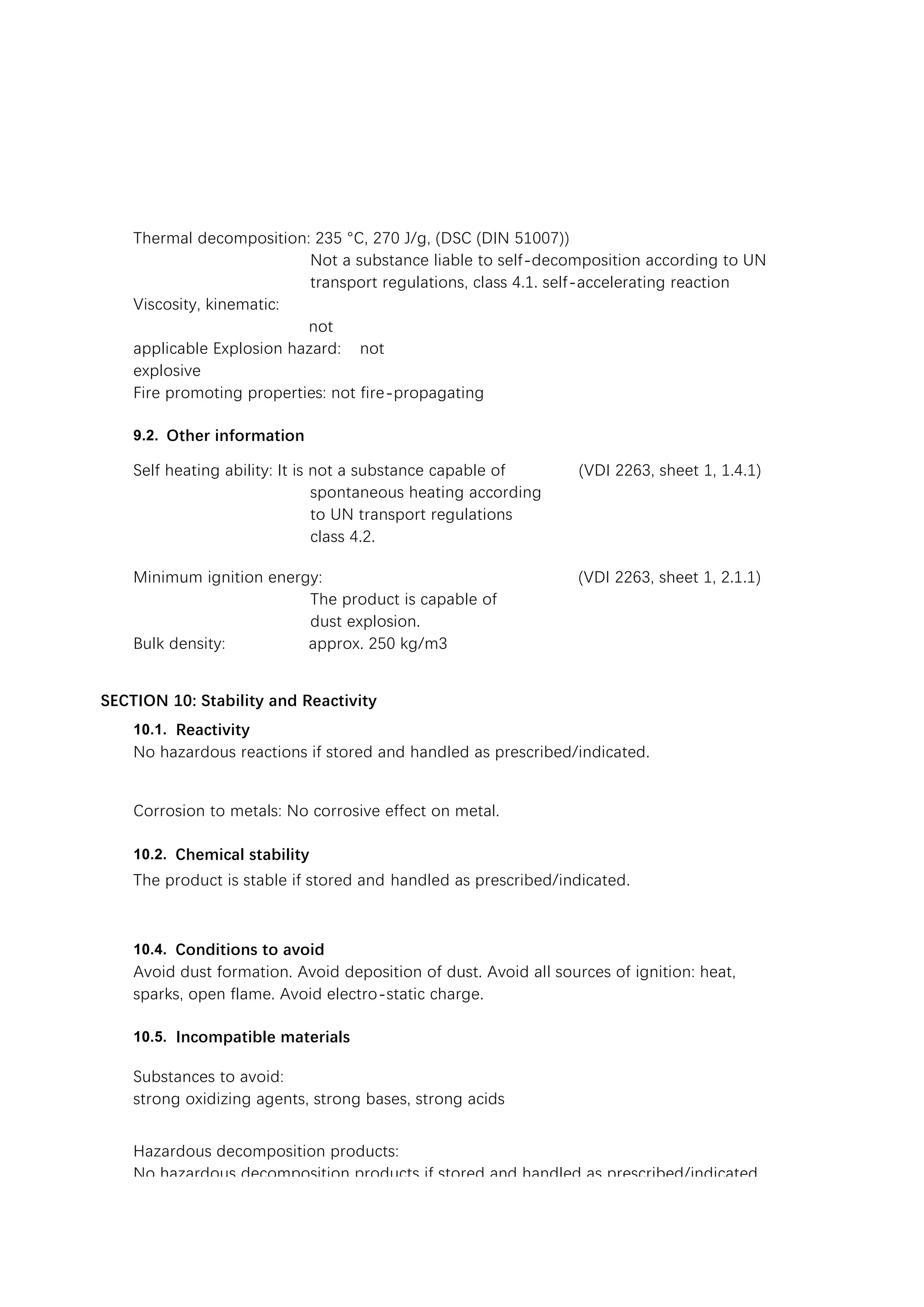
Thermal decomposition: 235 °C, 270 J/g, (DSC (DIN 51007))
Not a substance liable to self-decomposition according to UN
transport regulations, class 4.1. self-accelerating reaction
Viscosity, kinematic:
not
applicable Explosion hazard: not
explosive
Fire promoting properties: not fire-propagating
9.2. Other information
Self heating ability: It is not a substance capable of (VDI 2263, sheet 1, 1.4.1)
spontaneous heating according
to UN transport regulations
class 4.2.
Minimum ignition energy: (VDI 2263, sheet 1, 2.1.1)
The product is capable of
dust explosion.
Bulk density: approx. 250 kg/m3
SECTION 10: Stability and Reactivity
10.1. Reactivity
No hazardous reactions if stored and handled as prescribed/indicated.
Corrosion to metals: No corrosive effect on metal.
10.2. Chemical stability
The product is stable if stored and handled as prescribed/indicated.
10.3. Possibility of hazardous reactions
Dust explosion hazard.10.4. Conditions to avoid
Avoid dust formation. Avoid deposition of dust. Avoid all sources of ignition: heat,
sparks, open flame. Avoid electro-static charge.
10.5. Incompatible materials
Substances to avoid:
strong oxidizing agents, strong bases, strong acids
10.6. Hazardous decomposition products
Hazardous decomposition products:
No hazardous decomposition products if stored and handled as prescribed/indicated.
SECTION 11: Toxicological Information
11.1. Information on toxicological effects
Acute toxicity
Experimental/calculated data:
LD50 rat (oral): > 5,000 mg/kg
The product has not been tested. The statement has been derived from
substances/products of a similar structure or composition.
LC50 rat (by inhalation): > 2,000 mg/m3
The product has not been tested. The statement has been derived from
substances/products of a similar structure or composition.
Irritation
Experimental/calculated data:
Skin corrosion/irritation rabbit: non-irritant
The product has not been tested. The statement has been derived from
substances/products of a similar structure or composition.
Serious eye damage/irritation rabbit: non-irritant
The product has not been tested. The statement has been derived from
substances/products of a similar structure or composition.
Respiratory/Skin sensitization
Experimental/calculated data:
Buehler test guinea pig: Non-sensitizing.
Tested as a preparation.
Germ cell mutagenicity
Assessment of mutagenicity:
Mutagenicity tests revealed no genotoxic potential.
Carcinogenicity
Assessment of carcinogenicity:
The whole of the information assessable provides no indication of a carcinogenic effect.
Reproductive toxicity
Assessment of reproduction toxicity:
The chemical structure does not suggest a specific alert for such an effect.
Specific target organ toxicity (single exposure)
No data available.
Repeated dose toxicity and Specific target organ toxicity (repeated exposure)
No data available.
Aspiration hazard No data available.
Other relevant toxicity information
The product has not been tested. The statements on toxicology have been derived
from the properties of the individual components.
SECTION 12: Ecological Information
12.1. Toxicity
Assessment of aquatic toxicity:
There is a high probability that the product is not acutely harmful to aquatic organisms.
Toxicity to fish:
LC50 (96 h) > 100 mg/l, Leuciscus idus
The product has not been tested. The statement has been derived from the
properties of the individual components.
Aquatic invertebrates:
LC50 (48 h), Daphnia magna
No toxic effects occur within the range of solubility. The product has not been fully
tested. The statements have been derived in parts from products of a similar
structure or composition.
Aquatic plants:
EC50 (72 h) > 100 mg/l (growth rate), Selenastrum capricornutum
The product has not been tested. The statement has been derived from the
properties of the individual components.
Microorganisms/Effect on activated sludge:
EC50 (0.5 h) > 100 mg/l, activated sludge
The product has not been fully tested. The statements have been derived in parts from
products of a similar structure or composition.
12.2. Persistence and degradability
Assessment biodegradation and elimination (H2O):
The colourant is insoluble in water and can thus be separated from water mechanically in
suitable effluent treatment plant
12.3. Bioaccumulative potential
Assessment bioaccumulation potential:
product will not be readily bioavailable due to its consistency and insolubility in water.
12.4. Mobility in soil
Assessment transport between environmental compartments:
Volatility: The substance will not evaporate into the atmosphere from the water surface.
12.5. Results of PBT and vPvB assessment
According to AnnexXIII of Regulation (EC) No.1907/2006 concerning the Registration,
Evaluation, Authorisation and Restriction of Chemicals (REACH): The product does not
contain a substance fulfilling the PBT (persistent/bioaccumulative/toxic) criteria or the
vPvB (very persistent/very bioaccumulative) criteria.
12.6. Other adverse effects
The product does not contain substances that are listed in Regulation (EC) 1005/2009 on
substances that deplete the ozone layer.
12.7. Additional information
Other ecotoxicological advice:
Do not discharge product into the environment without control.
The product has not been tested. The statement has been derived from
substances/products of a similar structure or composition. The material has no harmful
effect on the environment.
SECTION 13: Disposal Considerations
13.1. Waste treatment methods
Must be disposed of or incinerated in accordance with local regulations.
Contaminated packaging:
Uncontaminated packaging can be re-used.
Packs that cannot be cleaned should be disposed of in the same manner as the contents.
SECTION 14: Transport Information
Land transport
ADR
Not classified as a dangerous good under transport
regulations UN number: Not applicable
UN proper shipping name: Not applicable
Transport hazard class(es):
Packing group:
Environmental hazards:
Special precautions for
user
Not
applicable
Not
applicable
Not
applicable
None
known
RID
UN number:
UN proper shipping
name: Transport hazard
class(es): Packing group:
Environmental hazards:
Special precautions for
user
Not classified as a dangerous good under transport
regulations
Not applicable
Not applicable
Not applicable
Not applicable
Not applicable
None known
Inland waterway transport
ADN
UN number:
UN proper shipping
name: Transport hazard
class(es): Packing group:
Environmental hazards:
Special precautions for
user:
Not classified as a dangerous good under transport
regulations
Not applicable
Not applicable
Not applicable
Not applicable
Not applicable
None known
Transport in inland waterway vessel Not evaluated
Sea transport
IMDG
UN number:
UN proper shipping
name: Transport hazard
class(es): Packing group:
Environmental hazards:
Special precautions for
user
Not classified as a dangerous good under transport
regulations
Not applicable
Not applicable
Not applicable
Not applicable
Not applicable
None known
Air transport
IATA/ICAO
UN number:
UN proper shipping name:
Transport hazard class(es):
Packing group:
Environmental hazards:
Special precautions for user
Not classified as a dangerous good under transport
regulations
Not applicable
Not applicable
Not applicable
Not applicable
Not applicable
None known
14.1. UN number
See corresponding entries for “UN number” for the respective regulations in the tables above.
14.2. UN proper shipping name
See corresponding entries for “UN proper shipping name” for the respective regulations in
the tables above.
14.3. Transport hazard class(es)
See corresponding entries for “Transport hazard class(es)” for the respective regulations in
the tables above.
14.4. Packing group
See corresponding entries for “Packing group” for the respective regulations in the tables
above.
14.5. Environmental hazards
See corresponding entries for “Environmental hazards” for the respective regulations in the
tables above.
14.6. Special precautions for user
See corresponding entries for “Special precautions for user” for the respective regulations
in the tables above.
14.7. Transport in bulk according to Annex II of MARPOL and the IBC Code
Regulation: Not evaluated
Shipment approved: Not evaluated
Pollution name: Not evaluated
Pollution category: Not evaluated
Ship Type: Not evaluated
SECTION 15: Regulatory Information
15.1. Safety, health and environmental regulations/legislation specific for the substance
or mixture
15.2. Chemical Safety Assessment
SECTION 16: Other Information

Pigment orange 64 gp cas 72102 84-2 material safety data sheet msds sds baoxu chemical

  • 1.
    Material Safety DataSheet Pigment Orange 64 SECTION 1: Identification of the substance/mixture and of the company/undertaking 1.1. Product identifier Cromophtal® Orange K 2960 1.2. Relevant identified uses of the substance or mixture and uses advised against Relevant identified uses: colouring component 1.3. Details of the supplier of the safety data sheet Dongguan Baoxu Chemical Technology.,ltd. Caijin Business Bldg DongGuan CN 523071 +86 0769 22821082 Fax 86 0769 22821083 www.additivesforpolymer.com info@additivesforpolymer.com SECTION 2: Hazards Identification 2.1. Classification of the substance or mixture According to Regulation (EC) No 1272/2008 [CLP] No need for classification according to GHS criteria for this product. 2.2. Label elements
  • 2.
    Globally Harmonized System,EU (GHS) The product does not require a hazard warning label in accordance with GHS criteria. 2.3. Other hazards According to Regulation (EC) No 1272/2008 [CLP] The product is under certain conditions capable of dust explosion. SECTION 3: Composition/Information on Ingredients 3.1. Substances Not applicable 3.2. Mixtures Chemical nature Preparation based on: azo pigment Pigment Orange 64 Hazardous ingredients (GHS) according to Regulation (EC) No. 1272/2008 No particular hazards known. SECTION 4: First-Aid Measures 4.1. Description of first aid measures Remove contaminated clothing. If inhaled: | If difficulties occur after dust has been inhaled, remove to fresh air and seek medical attention. On skin contact: Wash thoroughly with soap and water. On contact with eyes: Wash affected eyes for at least 15 minutes under running water with eyelids held open. On ingestion: Rinse mouth and then drink plenty of water. 4.2. Most important symptoms and effects, both acute and delayed
  • 3.
    4.3. Indication ofany immediate medical attention and special treatment needed Treatment: Treat according to symptoms (decontamination, vital functions), no known specific antidote. SECTION 5: Fire-Fighting Measures 5.1. Extinguishing media Suitable extinguishing media: dry powder, foam Unsuitable extinguishing media for safety reasons: carbon dioxide Additional information: Avoid whirling up the material/product because of the danger of dust explosion. 5.2. Special hazards arising from the substance or mixture harmful vapours Evolution of fumes/fog. The substances/groups of substances mentioned can be released in case of fire. 5.3. Advice for fire-fighters Special protective equipment: Wear a self-contained breathing apparatus. Further information: The degree of risk is governed by the burning substance and the fire conditions. Contaminated extinguishing water must be disposed of in accordance with official regulations. SECTION 6: Accidental Release Measures 6.1. Personal precautions, protective equipment and emergency procedures Avoid dust formation. Use personal protective clothing. 6.2. Environmental precautions Contain contaminated water/firefighting water. Do not discharge into drains/surface waters/groundwater. 6.3. Methods and material for containment and cleaning up For small amounts: Pick up with suitable appliance and dispose of. For large amounts: Contain with dust binding material and dispose of. Avoid raising dust. 6.4. Reference to other sections
  • 4.
    Information regarding exposurecontrols/personal protection and disposal considerations can be found in section 8 and 13. SECTION 7: Handling and Storage 7.1. Precautions for safe handling Breathing must be protected when large quantities are decanted without local exhaust ventilation. 7.2. Conditions for safe storage, including any incompatibilities Further information on storage conditions: Keep container tightly closed and dry; store in a cool place. Keep only in the original container. 7.3. Specific end use(s) For the relevant identified use(s) listed in Section 1 the advice mentioned in this section 7 is to be observed. SECTION 8: Exposure Controls/Personal Protection 8.1. Control parameters Components with occupational exposure limits Does not contain components with substance specific occupational exposure limits. I Particles, not otherwise specified, inhalable Particles, not otherwise specified, respirable 8.2. Exposure controls Personal protective equipment Respiratory protection: I Suitable respiratory protection for lower concentrations or short-term effect: Particle filter with medium efficiency for solid and liquid particles (e.g. EN 143 or 149, Type P2 or FFP2) Hand protection: Chemical resistant protective gloves (EN 374) Suitable materials also with prolonged, direct contact (Recommended: Protective index 6, corresponding > 480 minutes of permeation time according to EN 374): e.g. nitrile rubber (0.4 mm), chloroprene rubber (0.5 mm), polyvinylchloride (0.7 mm) and other Supplementary note: The specifications are based on tests, literature data and information of glove manufacturers or are derived from similar substances by analogy. Due to many conditions (e.g. temperature) it must be considered, that the practical usage of a chemical-protective glove in practice may be much shorter than the permeation time determined through testing. Manufacturer's directions for use should be observed because of great diversity of types. Eye protection: Safety glasses with side-shields (frame goggles) (e.g. EN 166)
  • 5.
    General safety andhygiene measures Handle in accordance with good industrial hygiene and safety practice. Due to the colouring properties of the product closed work clothes should be used, to avoid stains during manipulation. Environmental exposure controls For information regarding environmental exposure controls, see Section 6. SECTION 9: Physical and Chemical Properties 9.1. Information on basic physical and chemical properties Form: Colour: Odour: Odour threshold: pH value: Melting point: Boiling point: Flash point: Evaporation rate: Flammability: Lower explosion limit: Upper explosion limit:Ignition temperature: Vapour pressure: Density: Relative density: Solubility in water: Partitioning coefficient Self ignition: powder orange odourless No applicable information available. 5.5 - 8.5 (as suspension) > 300 °C not applicable not applicable The product is a non-volatile solid. not highly flammable For solids not relevant for classification and labelling. For solids not relevant for classification and labelling. 530 °C not applicable, solid with a melting temperature over 300 °C 1.62 g/cm3 (20 °C) approx. 1.62 (20 °C) insoluble -octanol/water (log Kow): Study scientifically not justified. not self-igniting Temperature: 229 °C (other) (BAM) Test type: Spontaneous self- ignition at room-temperature. Test type: Self-ignition at high temperatures. (Method: VDI 2263, sheet 1, 1.4.1)
  • 6.
    Thermal decomposition: 235°C, 270 J/g, (DSC (DIN 51007)) Not a substance liable to self-decomposition according to UN transport regulations, class 4.1. self-accelerating reaction Viscosity, kinematic: not applicable Explosion hazard: not explosive Fire promoting properties: not fire-propagating 9.2. Other information Self heating ability: It is not a substance capable of (VDI 2263, sheet 1, 1.4.1) spontaneous heating according to UN transport regulations class 4.2. Minimum ignition energy: (VDI 2263, sheet 1, 2.1.1) The product is capable of dust explosion. Bulk density: approx. 250 kg/m3 SECTION 10: Stability and Reactivity 10.1. Reactivity No hazardous reactions if stored and handled as prescribed/indicated. Corrosion to metals: No corrosive effect on metal. 10.2. Chemical stability The product is stable if stored and handled as prescribed/indicated. 10.3. Possibility of hazardous reactions Dust explosion hazard.10.4. Conditions to avoid Avoid dust formation. Avoid deposition of dust. Avoid all sources of ignition: heat, sparks, open flame. Avoid electro-static charge. 10.5. Incompatible materials Substances to avoid: strong oxidizing agents, strong bases, strong acids 10.6. Hazardous decomposition products Hazardous decomposition products: No hazardous decomposition products if stored and handled as prescribed/indicated.
  • 7.
    SECTION 11: ToxicologicalInformation 11.1. Information on toxicological effects Acute toxicity Experimental/calculated data: LD50 rat (oral): > 5,000 mg/kg The product has not been tested. The statement has been derived from substances/products of a similar structure or composition. LC50 rat (by inhalation): > 2,000 mg/m3 The product has not been tested. The statement has been derived from substances/products of a similar structure or composition. Irritation Experimental/calculated data: Skin corrosion/irritation rabbit: non-irritant The product has not been tested. The statement has been derived from substances/products of a similar structure or composition. Serious eye damage/irritation rabbit: non-irritant The product has not been tested. The statement has been derived from substances/products of a similar structure or composition. Respiratory/Skin sensitization Experimental/calculated data: Buehler test guinea pig: Non-sensitizing. Tested as a preparation. Germ cell mutagenicity Assessment of mutagenicity: Mutagenicity tests revealed no genotoxic potential. Carcinogenicity Assessment of carcinogenicity: The whole of the information assessable provides no indication of a carcinogenic effect. Reproductive toxicity Assessment of reproduction toxicity: The chemical structure does not suggest a specific alert for such an effect. Specific target organ toxicity (single exposure) No data available.
  • 8.
    Repeated dose toxicityand Specific target organ toxicity (repeated exposure) No data available. Aspiration hazard No data available. Other relevant toxicity information The product has not been tested. The statements on toxicology have been derived from the properties of the individual components. SECTION 12: Ecological Information 12.1. Toxicity Assessment of aquatic toxicity: There is a high probability that the product is not acutely harmful to aquatic organisms. Toxicity to fish: LC50 (96 h) > 100 mg/l, Leuciscus idus The product has not been tested. The statement has been derived from the properties of the individual components. Aquatic invertebrates: LC50 (48 h), Daphnia magna No toxic effects occur within the range of solubility. The product has not been fully tested. The statements have been derived in parts from products of a similar structure or composition. Aquatic plants: EC50 (72 h) > 100 mg/l (growth rate), Selenastrum capricornutum The product has not been tested. The statement has been derived from the properties of the individual components. Microorganisms/Effect on activated sludge: EC50 (0.5 h) > 100 mg/l, activated sludge The product has not been fully tested. The statements have been derived in parts from products of a similar structure or composition. 12.2. Persistence and degradability Assessment biodegradation and elimination (H2O): The colourant is insoluble in water and can thus be separated from water mechanically in suitable effluent treatment plant 12.3. Bioaccumulative potential Assessment bioaccumulation potential:
  • 9.
    product will notbe readily bioavailable due to its consistency and insolubility in water. 12.4. Mobility in soil Assessment transport between environmental compartments: Volatility: The substance will not evaporate into the atmosphere from the water surface. 12.5. Results of PBT and vPvB assessment According to AnnexXIII of Regulation (EC) No.1907/2006 concerning the Registration, Evaluation, Authorisation and Restriction of Chemicals (REACH): The product does not contain a substance fulfilling the PBT (persistent/bioaccumulative/toxic) criteria or the vPvB (very persistent/very bioaccumulative) criteria. 12.6. Other adverse effects The product does not contain substances that are listed in Regulation (EC) 1005/2009 on substances that deplete the ozone layer. 12.7. Additional information Other ecotoxicological advice: Do not discharge product into the environment without control. The product has not been tested. The statement has been derived from substances/products of a similar structure or composition. The material has no harmful effect on the environment. SECTION 13: Disposal Considerations 13.1. Waste treatment methods Must be disposed of or incinerated in accordance with local regulations. Contaminated packaging: Uncontaminated packaging can be re-used. Packs that cannot be cleaned should be disposed of in the same manner as the contents. SECTION 14: Transport Information Land transport ADR Not classified as a dangerous good under transport regulations UN number: Not applicable UN proper shipping name: Not applicable
  • 10.
    Transport hazard class(es): Packinggroup: Environmental hazards: Special precautions for user Not applicable Not applicable Not applicable None known RID UN number: UN proper shipping name: Transport hazard class(es): Packing group: Environmental hazards: Special precautions for user Not classified as a dangerous good under transport regulations Not applicable Not applicable Not applicable Not applicable Not applicable None known Inland waterway transport ADN UN number: UN proper shipping name: Transport hazard class(es): Packing group: Environmental hazards: Special precautions for user: Not classified as a dangerous good under transport regulations Not applicable Not applicable Not applicable Not applicable Not applicable None known Transport in inland waterway vessel Not evaluated Sea transport IMDG UN number: UN proper shipping name: Transport hazard class(es): Packing group: Environmental hazards: Special precautions for user Not classified as a dangerous good under transport regulations Not applicable Not applicable Not applicable Not applicable Not applicable None known Air transport
  • 11.
    IATA/ICAO UN number: UN propershipping name: Transport hazard class(es): Packing group: Environmental hazards: Special precautions for user Not classified as a dangerous good under transport regulations Not applicable Not applicable Not applicable Not applicable Not applicable None known 14.1. UN number See corresponding entries for “UN number” for the respective regulations in the tables above. 14.2. UN proper shipping name See corresponding entries for “UN proper shipping name” for the respective regulations in the tables above. 14.3. Transport hazard class(es) See corresponding entries for “Transport hazard class(es)” for the respective regulations in the tables above. 14.4. Packing group See corresponding entries for “Packing group” for the respective regulations in the tables above. 14.5. Environmental hazards See corresponding entries for “Environmental hazards” for the respective regulations in the tables above. 14.6. Special precautions for user See corresponding entries for “Special precautions for user” for the respective regulations in the tables above. 14.7. Transport in bulk according to Annex II of MARPOL and the IBC Code Regulation: Not evaluated Shipment approved: Not evaluated Pollution name: Not evaluated Pollution category: Not evaluated Ship Type: Not evaluated SECTION 15: Regulatory Information 15.1. Safety, health and environmental regulations/legislation specific for the substance or mixture 15.2. Chemical Safety Assessment
  • 12.
    SECTION 16: OtherInformation