ETHIOPIAN DEVELOPMENT
RESEARCH INSTITUTE
Using evidence in unraveling food supply
chains in Ethiopia:
The case of teff from major production areas
to Addis Ababa
Bart Minten, Seneshaw Tamiru, Ermias Engeda,
and Tadesse Kuma
IFPRI ESSP-II EDRI
Ethiopian Economic Association Conference
July 19, 2013
Addis Ababa
1
2
1. Introduction
• Importance of cities rapidly growing world-wide: In 1950:
30% living in cities; In 2010: 50%
• In Africa: projected to have 60% in cities in 2050
• Rapidly growing rural-urban agricultural market flows, with
important implications on urban and rural food security
• Increasing dependence of African cities on imported
food, blamed on uncompetitive local value chains
• However, few scientific studies that look rural-urban food
value chains;
• This leads often to a badly informed debate
3
Three conventional wisdoms on food value
chains
• Perception 1: “Farmers obtain small share of final retail
price” (The Economist: “… too few subsistence farmers get
a chance to sell their produce (and usually get less than
20% of the market price)” March 2nd-8th, 2013, p.9, in
Leaders)
• Perception 2: “Value chains are long and there are many
layers, causing inefficiency”
• Perception 3: “Sales are driven by distress immediately
after harvest when prices are low”
4
Contribution of our research:
Test validity of these perceptions
• Large surveys at each level of the value chain
• Study major staple in Ethiopia, i.e. teff; by value the most
important crop in the country (1.6 billion USD in
2011/2012); the second most important cash crop in the
country (after coffee)
• Look at:
a/ structure of the value chain
b/ average marketing margins
c/ margins over space and season
d/ distress sales and seasonality in sales
• Purpose of the study is to understand major value chains
from rural producers in major production zones to
Addis, the major city in the country.
• Surveys with producers and communities upstream; rural
and urban wholesalers and truckers midstream; cereal
shops, mills, and cooperative retail downstream
2. Data
• Procurement/sales by rural traders
3. Structure of the value chain
Rural traders
% bought % sold
from to
Farmers 84.9
Farmer-traders or rural assemblers 13.3
Traders in wholesale
markets/wholesalers 1.3 8.1
Cooperative unions 0.3 0.0
Brokers 76.3
Mills/cereal shops 13.2
Others 0.2 2.4
Total 100.0 100.0
Percentage sold to:
Addis 92.8
Rural zone where trader was interviewed 4.6
Other zone 2.4
• Procurement/sales by urban traders/brokers
3. Structure of the value chain
% bought % sold
from to
Farmers 4.5
Farmer-traders or rural assemblers 2.5
Traders in wholesale markets/wholesalers 5.8
Cooperative unions 0.0 1.3
Traders located outside Addis 83.2
Traders in Addis 9.8
Enjera sellers 7.1
Institutions 1.8
Restaurants 1.4
Mills 69.8
Cereal shops 6.8
Consumers 5.7
Others 0.0 0.4
Total 100.0 100.0
• Procurement/sales by urban retailers
3. Structure of the value chain
% bought % sold
from to
Farmers 9.8
Farmer-traders or rural assemblers 4.3
Cooperative unions 0.1
Traders/brokers in Addis 68.3
Traders located outside Addis 17.6
Enjera wholesalers 1.3
Enjera wholesale companies 0.0
Enjera retailers with fixed shops 4.8
Enjera retailers without fixed shops 5.2
Institutions/restaurants 2.3
Consumers 85.7
Supermarkets 0.4
Others 0.0 0.4
Total 100.0 100.0
• Most common value chain is one with three
intermediaries between producer and consumer:
Producer
Regional trader Urban broker/trader Urban retailer
Consumer
- Sometimes shorter, e.g. 32% of teff sold by urban retailers
directly obtained in rural areas
- Sometime longer, e.g. 13% of procurement of rural traders
from rural assemblers or farmer-traders
4. Structure of the value chain
• Farmers asked teff price at the time of the survey
(October- November 2012) for their most common place
of sale
• All value chain participants asked prices for the different
teff qualities at the time of the survey (rural traders:
October-November; urban traders and retailers:
December)
• Consistent price collection on urban wholesale markets;
price dropped in period 2; assumed retail, milling, and
cleaning margin stayed similar for comparison
• Use all these prices to get at average price composition
4. Price formation
4. Price formation in value chain
(October 2012)
0.0
200.0
400.0
600.0
800.0
1000.0
1200.0
1400.0
1600.0
1800.0
Magna White Mix Red
Birr/quintal
Milling and
cleaning
Urban retail
Urban wholesale
Rural market/town
Farmgate
• Farmers obtain between 78% (red) to 86% (magna) of the
final urban retail grain price
• Average composition of margin between producer and
consumers:
1/ Farmgate – rural markets: 15%
2/ Rural market – urban wholesale: 54%
3/ Urban wholesale – urban retail: 19%
4/ Milling and cleaning: 13%
• Gives us average picture at time of survey; in rest of
presentation look at spatial and temporal variation
4. Price formation in the value chain
a. Understanding the transport sector
- Survey was implemented with truck drivers that
transported teff to Addis
- Questions on themselves, the owner, type of truck, and
characteristics of the last trip
b. Understanding the impact on farmers
- Heterogeneity of farmers by transportation costs to Addis
- Link teff prices and transport costs to Addis
- Information on sales to whom by transport costs to Addis
5. Variation over space
Teff transport sector:
• Average distance covered in last transaction is 228 kms
• On average, transported for 2 sellers; sold to 3 buyers
• Transport charges: 18 Birr/quintal for 100 kms or 10
USD/ton for 100 km
• Regression of costs on size truck, road quality, number of
buyers and sellers
• Distance only significant variable
• For extra 100 kms travelled, transport charges go up by 13
Birr/quintal
5. Variation over space
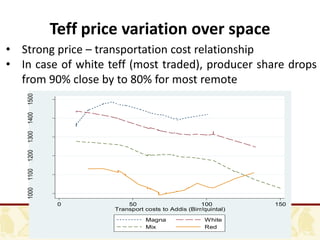
• Strong price – transportation cost relationship
• In case of white teff (most traded), producer share drops
from 90% close by to 80% for most remote
Teff price variation over space100011001200130014001500
0 50 100 150
Transport costs to Addis (Birr/quintal)
Magna White
Mix Red
• Regression analysis: for the 4 qualities: 1/ Use reported
prices at time of survey; 2/ Use transaction price in last 12
months
• Independent variables: 1/ place of sales (farmgate or not);
2/ quantity sold; 3/ month of sales; 4/ transportation
costs to Addis
• In none of the 8 specifications can hypothesis be rejected
that producer price declines in line with transportation
costs
Producer price variation over space
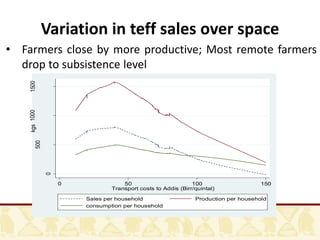
• Farmers close by more productive; Most remote farmers
drop to subsistence level
Variation in teff sales over space
0
500
10001500kgs
0 50 100 150
Transport costs to Addis (Birr/quintal)
Sales per household Production per household
consumption per household
• Produce of close by farmers goes to Addis; more remote
farmers sell elsewhere or do not sell at all
Variation in teff sales over space
0
100200300400500
0 50 100 150
Transport costs to Addis (Birr/quintal)
• Storage: release smooth over the year
6. Temporal variation
0
100
200
300
400
500
600
700
800
900
N-D D-J J-F F-M M-A A-M M-J J-J J-A A-S S-O O-N
kg
storage
• Two measures of distress sales:
1. “Would you have sold the teff at this time if the price
would have been 10% lower?”: 19% of transactions
(“distress”)
2. “Would you have sold the teff at this time if the price
would have been 50% lower?”: 10% of transactions
(“extreme distress”)
• In 71% of the cases, farmers would not have accepted
lower price
6. Temporal variation in sales
• Multinomal model (0=normal; 1=distress; 2=extreme
distress):
1. Strong effect of the month of sales: More distress sales in
months immediately after harvest
2. Extreme distress sales characterized by smaller quantities
sold (seemingly only done to cover immediate needs)
3. Off-farm income leads to less distress and extreme distress
sales
4. More remote households have more distress sales (poorer
in general and play less the market)
Associates of distress sales
22
7. Conclusions
1. We find most common value chain to be rather
short, with on average 3 intermediaries between farmers
and consumers
2. The share of the farmer in final retail price is about 80
%, using different methodologies (price at time of survey;
price from transactions and taking seasonality of sales into
consideration); share drops when farmers live further
3. Distress sales: 19% of transactions; Extreme distress: 10%
of transactions; smooth storage release
These are seemingly all signs of well-functioning markets
23
7. Conclusions
Why in contradiction with perceptions?
1. Few surveys; mostly case studies; problems of
representativity;
2. Important changes (roads; communication) have
happened that people are not aware of
3. Teff unsophisticated value chain (little value addition by
value chain agents)
4. Results different for perishable crops; root crops; or thin
markets
5. Teff high price; e.g. maize different
6. Traders easy to blame; their importance overstated
24
8. Implications
1. As market assessment hard (and often wrong), careful at
benefits and costs before interventions (such as
cooperative marketing, modern commodity exchanges;
warehouse receipt systems; price controls)
2. Lower transportation costs lead to higher prices for
producers
3. Better qualities have higher producer share
4. If objective of policy makers is to reduce consumer
prices, focus on costs at the farm level (i.e. improved
technologies); there is seemingly very little potential at
the market level

Teff value chain_eea_pptx

  • 1.
    ETHIOPIAN DEVELOPMENT RESEARCH INSTITUTE Usingevidence in unraveling food supply chains in Ethiopia: The case of teff from major production areas to Addis Ababa Bart Minten, Seneshaw Tamiru, Ermias Engeda, and Tadesse Kuma IFPRI ESSP-II EDRI Ethiopian Economic Association Conference July 19, 2013 Addis Ababa 1
  • 2.
    2 1. Introduction • Importanceof cities rapidly growing world-wide: In 1950: 30% living in cities; In 2010: 50% • In Africa: projected to have 60% in cities in 2050 • Rapidly growing rural-urban agricultural market flows, with important implications on urban and rural food security • Increasing dependence of African cities on imported food, blamed on uncompetitive local value chains • However, few scientific studies that look rural-urban food value chains; • This leads often to a badly informed debate
  • 3.
    3 Three conventional wisdomson food value chains • Perception 1: “Farmers obtain small share of final retail price” (The Economist: “… too few subsistence farmers get a chance to sell their produce (and usually get less than 20% of the market price)” March 2nd-8th, 2013, p.9, in Leaders) • Perception 2: “Value chains are long and there are many layers, causing inefficiency” • Perception 3: “Sales are driven by distress immediately after harvest when prices are low”
  • 4.
    4 Contribution of ourresearch: Test validity of these perceptions • Large surveys at each level of the value chain • Study major staple in Ethiopia, i.e. teff; by value the most important crop in the country (1.6 billion USD in 2011/2012); the second most important cash crop in the country (after coffee) • Look at: a/ structure of the value chain b/ average marketing margins c/ margins over space and season d/ distress sales and seasonality in sales
  • 5.
    • Purpose ofthe study is to understand major value chains from rural producers in major production zones to Addis, the major city in the country. • Surveys with producers and communities upstream; rural and urban wholesalers and truckers midstream; cereal shops, mills, and cooperative retail downstream 2. Data
  • 6.
    • Procurement/sales byrural traders 3. Structure of the value chain Rural traders % bought % sold from to Farmers 84.9 Farmer-traders or rural assemblers 13.3 Traders in wholesale markets/wholesalers 1.3 8.1 Cooperative unions 0.3 0.0 Brokers 76.3 Mills/cereal shops 13.2 Others 0.2 2.4 Total 100.0 100.0 Percentage sold to: Addis 92.8 Rural zone where trader was interviewed 4.6 Other zone 2.4
  • 7.
    • Procurement/sales byurban traders/brokers 3. Structure of the value chain % bought % sold from to Farmers 4.5 Farmer-traders or rural assemblers 2.5 Traders in wholesale markets/wholesalers 5.8 Cooperative unions 0.0 1.3 Traders located outside Addis 83.2 Traders in Addis 9.8 Enjera sellers 7.1 Institutions 1.8 Restaurants 1.4 Mills 69.8 Cereal shops 6.8 Consumers 5.7 Others 0.0 0.4 Total 100.0 100.0
  • 8.
    • Procurement/sales byurban retailers 3. Structure of the value chain % bought % sold from to Farmers 9.8 Farmer-traders or rural assemblers 4.3 Cooperative unions 0.1 Traders/brokers in Addis 68.3 Traders located outside Addis 17.6 Enjera wholesalers 1.3 Enjera wholesale companies 0.0 Enjera retailers with fixed shops 4.8 Enjera retailers without fixed shops 5.2 Institutions/restaurants 2.3 Consumers 85.7 Supermarkets 0.4 Others 0.0 0.4 Total 100.0 100.0
  • 9.
    • Most commonvalue chain is one with three intermediaries between producer and consumer: Producer Regional trader Urban broker/trader Urban retailer Consumer - Sometimes shorter, e.g. 32% of teff sold by urban retailers directly obtained in rural areas - Sometime longer, e.g. 13% of procurement of rural traders from rural assemblers or farmer-traders 4. Structure of the value chain
  • 10.
    • Farmers askedteff price at the time of the survey (October- November 2012) for their most common place of sale • All value chain participants asked prices for the different teff qualities at the time of the survey (rural traders: October-November; urban traders and retailers: December) • Consistent price collection on urban wholesale markets; price dropped in period 2; assumed retail, milling, and cleaning margin stayed similar for comparison • Use all these prices to get at average price composition 4. Price formation
  • 11.
    4. Price formationin value chain (October 2012) 0.0 200.0 400.0 600.0 800.0 1000.0 1200.0 1400.0 1600.0 1800.0 Magna White Mix Red Birr/quintal Milling and cleaning Urban retail Urban wholesale Rural market/town Farmgate
  • 12.
    • Farmers obtainbetween 78% (red) to 86% (magna) of the final urban retail grain price • Average composition of margin between producer and consumers: 1/ Farmgate – rural markets: 15% 2/ Rural market – urban wholesale: 54% 3/ Urban wholesale – urban retail: 19% 4/ Milling and cleaning: 13% • Gives us average picture at time of survey; in rest of presentation look at spatial and temporal variation 4. Price formation in the value chain
  • 13.
    a. Understanding thetransport sector - Survey was implemented with truck drivers that transported teff to Addis - Questions on themselves, the owner, type of truck, and characteristics of the last trip b. Understanding the impact on farmers - Heterogeneity of farmers by transportation costs to Addis - Link teff prices and transport costs to Addis - Information on sales to whom by transport costs to Addis 5. Variation over space
  • 14.
    Teff transport sector: •Average distance covered in last transaction is 228 kms • On average, transported for 2 sellers; sold to 3 buyers • Transport charges: 18 Birr/quintal for 100 kms or 10 USD/ton for 100 km • Regression of costs on size truck, road quality, number of buyers and sellers • Distance only significant variable • For extra 100 kms travelled, transport charges go up by 13 Birr/quintal 5. Variation over space
  • 15.
    • Strong price– transportation cost relationship • In case of white teff (most traded), producer share drops from 90% close by to 80% for most remote Teff price variation over space100011001200130014001500 0 50 100 150 Transport costs to Addis (Birr/quintal) Magna White Mix Red
  • 16.
    • Regression analysis:for the 4 qualities: 1/ Use reported prices at time of survey; 2/ Use transaction price in last 12 months • Independent variables: 1/ place of sales (farmgate or not); 2/ quantity sold; 3/ month of sales; 4/ transportation costs to Addis • In none of the 8 specifications can hypothesis be rejected that producer price declines in line with transportation costs Producer price variation over space
  • 17.
    • Farmers closeby more productive; Most remote farmers drop to subsistence level Variation in teff sales over space 0 500 10001500kgs 0 50 100 150 Transport costs to Addis (Birr/quintal) Sales per household Production per household consumption per household
  • 18.
    • Produce ofclose by farmers goes to Addis; more remote farmers sell elsewhere or do not sell at all Variation in teff sales over space 0 100200300400500 0 50 100 150 Transport costs to Addis (Birr/quintal)
  • 19.
    • Storage: releasesmooth over the year 6. Temporal variation 0 100 200 300 400 500 600 700 800 900 N-D D-J J-F F-M M-A A-M M-J J-J J-A A-S S-O O-N kg storage
  • 20.
    • Two measuresof distress sales: 1. “Would you have sold the teff at this time if the price would have been 10% lower?”: 19% of transactions (“distress”) 2. “Would you have sold the teff at this time if the price would have been 50% lower?”: 10% of transactions (“extreme distress”) • In 71% of the cases, farmers would not have accepted lower price 6. Temporal variation in sales
  • 21.
    • Multinomal model(0=normal; 1=distress; 2=extreme distress): 1. Strong effect of the month of sales: More distress sales in months immediately after harvest 2. Extreme distress sales characterized by smaller quantities sold (seemingly only done to cover immediate needs) 3. Off-farm income leads to less distress and extreme distress sales 4. More remote households have more distress sales (poorer in general and play less the market) Associates of distress sales
  • 22.
    22 7. Conclusions 1. Wefind most common value chain to be rather short, with on average 3 intermediaries between farmers and consumers 2. The share of the farmer in final retail price is about 80 %, using different methodologies (price at time of survey; price from transactions and taking seasonality of sales into consideration); share drops when farmers live further 3. Distress sales: 19% of transactions; Extreme distress: 10% of transactions; smooth storage release These are seemingly all signs of well-functioning markets
  • 23.
    23 7. Conclusions Why incontradiction with perceptions? 1. Few surveys; mostly case studies; problems of representativity; 2. Important changes (roads; communication) have happened that people are not aware of 3. Teff unsophisticated value chain (little value addition by value chain agents) 4. Results different for perishable crops; root crops; or thin markets 5. Teff high price; e.g. maize different 6. Traders easy to blame; their importance overstated
  • 24.
    24 8. Implications 1. Asmarket assessment hard (and often wrong), careful at benefits and costs before interventions (such as cooperative marketing, modern commodity exchanges; warehouse receipt systems; price controls) 2. Lower transportation costs lead to higher prices for producers 3. Better qualities have higher producer share 4. If objective of policy makers is to reduce consumer prices, focus on costs at the farm level (i.e. improved technologies); there is seemingly very little potential at the market level