E n t r e - N e w
M a g a z i ne
Spring 2002
In the year of 1998, a geophysical technician in the City of Calgary
journeyed out to Staples in search of a handheld scanner. Walking up
and down the aisles of the office supplies mecca was a refreshing
change of scenery from the chaos he had left behind, late
afternoon. The technician carried on his search with snippets of office
banter going through his mind. It was plain to see that the status quo
wasn’t cutting it at the archives start-up, as the culture started to take
on a dark cloud of pessimism. It was a time of much needed change
in the company as most, if not all employees were losing their faith.
The technician wasn’t entirely sure if the $30 scanner would be the
answer to the company’s long standing issue, however, one thing he
did know was that he couldn’t believe experimenting on the 9-5 was
considered as work.
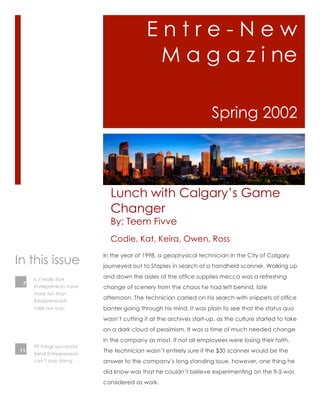
Lunch with Calgary’s Game
Changer
By: Teem Fivve
Codie, Kat, Keira, Owen, Ross
Is it really true
Entrepreneurs have
more fun than
Intrapreneurs?
Take our quiz.
In this issue
99 things successful
Serial Entrepreneurs
can’t stop doing.
7
11
1
What was the problem you
were dealing with that ignited
industry wide change?
“Our company was known for
using innovative technologies
which provided archiving
services that modernized the
storage and delivery of seismic
data for the oil and gas
industry.”
It sounds complicated.
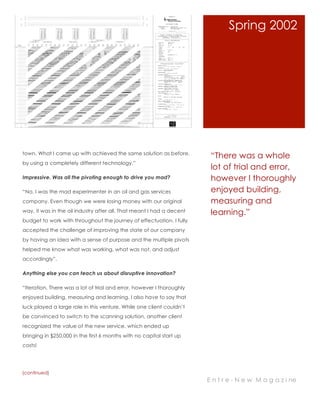
“It was! Essentially, one process
was to re-type information from
large format seismic displays
into text files, implemented as a
way to digitally replace the
displays. This procedure ran
alongside with another data
related process, creating two
files that were to be archived
together. The Client was sold on
the idea of the text file format
becoming the new industry
standard, however, the data
entry process was applied
without proper testing or
validation. This was very
problematic for us in an
environment that was
production-heavy. The service
was dysfunctional and the
company was losing a
substantial amount of money. “
How did Management react to
this?
2
“Having conceived the
solution, management
believed the process was more
than satisfactory and blamed
staff for not working hard and
smart enough. Our lead
technician was aggravated but
the lack of necessary skills and
motivation to tackle the
glitches encountered by our
small team. Our company had
plateaued; management
requested that I investigate the
team and its issues.”
Where did you start?
“My goal was to get the project
back on track. I conducted a
series of observations, interviews
with staff and management,
capturing metrics, and
determining actual costs and a
detailed understanding of the
project. The analysis revealed
the project was losing money
on each unit of production
because of the data entry
process. The service was a one
problem process; garbage in,
garbage out.”
3
You are a geophysical
technician. Did you ever see
yourself working on the inside
of the industry as an
intrapreneuer, implementing
major change?
“No. My work was always fairly
average and predictable. It’s
not often you’ll hear of many
intrapreneurial types in our
corporate setting, however,
with our company’s growing
concern, it was time to put my
pivot hat on. I had to work
beyond limitations, creating
something from nothing. I was
given the opportunity to think
and do as an entrepreneur
inside of our company.”
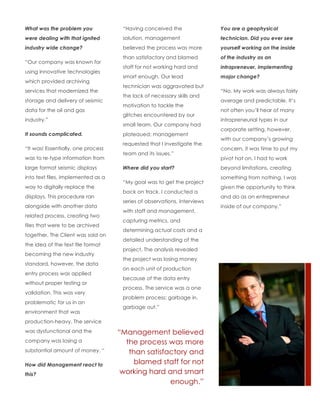
“Management believed
the process was more
than satisfactory and
blamed staff for not
working hard and smart
enough.”
“Bricolage”
“I had to work beyond limitations,
creating something from nothing and
I was given the opportunity to think
and do as an entrepreneur inside of
our company.”
1
That sounds like “Bricolage.”
“Yes! Bricolage, the act of
making do with what is at
hand! The first attempt at a
solution was to try to improve
the data entry process using
technology already in use in
other areas of the company ”
What types of Pivots did you
come across?
“In this case, I would say that it
was a series of technological
pivots. Purchasing the
handheld scanner from Staples
was my first effort to eliminate
the data entry by scanning
label information, which was
then converted with OCR
software. I came across the
OCR software online from a
Russian company created by
ex-KGB scientists. A lady by the
name of Tatiana from Moscow
was my sales rep and after a
few emails, I ordered the
2
software for $1500. The $30
scanner investment actually
picked up the label information
on the mylar but the
inconsistent nature of the text
generated inadequate results
and a few headaches for staff.
I vividly recall asking myself
“What is the best way to
digitally replace the displays?” I
had to keep it going as money
was flying out the window and
the overall turbulence within
the office wasn’t improving. The
images captured from the
staples scanner led to the
exploration of scanning the
entire document. I found and
sourced a large format scanner
on a 4-week demo, which
helped me define production
metrics, costs and designing a
workflow that fit into an existing
process. Eventually, this led to
outsourcing the scanning to a
3rd party service provider in
E n t r e - N e w M a g a z i ne
“There was a whole
lot of trial and error,
however I thoroughly
enjoyed building,
measuring and
learning.”
town. What I came up with achieved the same solution as before,
by using a completely different technology.”
Impressive. Was all the pivoting enough to drive you mad?
“No, I was the mad experimenter in an oil and gas services
company. Even though we were losing money with our original
way, it was in the oil industry after all. That meant I had a decent
budget to work with throughout the journey of effectuation. I fully
accepted the challenge of improving the state of our company
by having an idea with a sense of purpose and the multiple pivots
helped me know what was working, what was not, and adjust
accordingly”.
Anything else you can teach us about disruptive innovation?
“Iteration. There was a lot of trial and error, however I thoroughly
enjoyed building, measuring and learning. I also have to say that
luck played a large role in this venture. While one client couldn’t
be convinced to switch to the scanning solution, another client
recognized the value of the new service, which ended up
bringing in $250,000 in the first 6 months with no capital start up
costs!
Spring 2002
(continued)
E n t r e - N e w M a g a z i ne
“You are golden when you
have a major client who
shares your vision.”
1
Secondary imaging services to
produce striped and online
versions of the displays for
marketing purposes generated
additional revenue on top of
ongoing plotting service
revenue. The complete
capture and quick access to
this information allowed
procedural changes to be
easily incorporated into the
client’s sales process, reducing
the time to complete sales. All I
can say is that you are golden
when you have a major client
who shares your vision.”
It’s been an honor to have met
the person behind such an
innovation in the oil and gas
industry.
“My pleasure, thank you Entre-
New for having me.
2
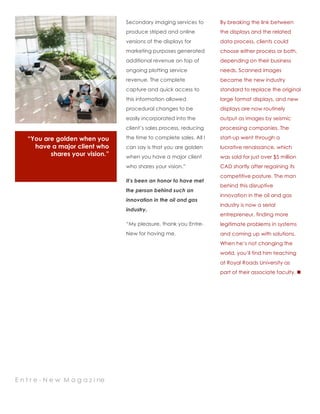
By breaking the link between
the displays and the related
data process, clients could
choose either process or both,
depending on their business
needs. Scanned images
became the new industry
standard to replace the original
large format displays, and new
displays are now routinely
output as images by seismic
processing companies. The
start-up went through a
lucrative renaissance, which
was sold for just over $5 million
CAD shortly after regaining its
competitive posture. The man
behind this disruptive
innovation in the oil and gas
industry is now a serial
entrepreneur, finding more
legitimate problems in systems
and coming up with solutions.
When he’s not changing the
world, you’ll find him teaching
at Royal Roads University as
part of their associate faculty. !
E n t r e - N e w M a g a z i ne

Teem Fivve ver 4.0

  • 1.
    E n tr e - N e w M a g a z i ne Spring 2002 In the year of 1998, a geophysical technician in the City of Calgary journeyed out to Staples in search of a handheld scanner. Walking up and down the aisles of the office supplies mecca was a refreshing change of scenery from the chaos he had left behind, late afternoon. The technician carried on his search with snippets of office banter going through his mind. It was plain to see that the status quo wasn’t cutting it at the archives start-up, as the culture started to take on a dark cloud of pessimism. It was a time of much needed change in the company as most, if not all employees were losing their faith. The technician wasn’t entirely sure if the $30 scanner would be the answer to the company’s long standing issue, however, one thing he did know was that he couldn’t believe experimenting on the 9-5 was considered as work. Lunch with Calgary’s Game Changer By: Teem Fivve Codie, Kat, Keira, Owen, Ross Is it really true Entrepreneurs have more fun than Intrapreneurs? Take our quiz. In this issue 99 things successful Serial Entrepreneurs can’t stop doing. 7 11
  • 2.
    1 What was theproblem you were dealing with that ignited industry wide change? “Our company was known for using innovative technologies which provided archiving services that modernized the storage and delivery of seismic data for the oil and gas industry.” It sounds complicated. “It was! Essentially, one process was to re-type information from large format seismic displays into text files, implemented as a way to digitally replace the displays. This procedure ran alongside with another data related process, creating two files that were to be archived together. The Client was sold on the idea of the text file format becoming the new industry standard, however, the data entry process was applied without proper testing or validation. This was very problematic for us in an environment that was production-heavy. The service was dysfunctional and the company was losing a substantial amount of money. “ How did Management react to this? 2 “Having conceived the solution, management believed the process was more than satisfactory and blamed staff for not working hard and smart enough. Our lead technician was aggravated but the lack of necessary skills and motivation to tackle the glitches encountered by our small team. Our company had plateaued; management requested that I investigate the team and its issues.” Where did you start? “My goal was to get the project back on track. I conducted a series of observations, interviews with staff and management, capturing metrics, and determining actual costs and a detailed understanding of the project. The analysis revealed the project was losing money on each unit of production because of the data entry process. The service was a one problem process; garbage in, garbage out.” 3 You are a geophysical technician. Did you ever see yourself working on the inside of the industry as an intrapreneuer, implementing major change? “No. My work was always fairly average and predictable. It’s not often you’ll hear of many intrapreneurial types in our corporate setting, however, with our company’s growing concern, it was time to put my pivot hat on. I had to work beyond limitations, creating something from nothing. I was given the opportunity to think and do as an entrepreneur inside of our company.” “Management believed the process was more than satisfactory and blamed staff for not working hard and smart enough.”
  • 3.
    “Bricolage” “I had towork beyond limitations, creating something from nothing and I was given the opportunity to think and do as an entrepreneur inside of our company.” 1 That sounds like “Bricolage.” “Yes! Bricolage, the act of making do with what is at hand! The first attempt at a solution was to try to improve the data entry process using technology already in use in other areas of the company ” What types of Pivots did you come across? “In this case, I would say that it was a series of technological pivots. Purchasing the handheld scanner from Staples was my first effort to eliminate the data entry by scanning label information, which was then converted with OCR software. I came across the OCR software online from a Russian company created by ex-KGB scientists. A lady by the name of Tatiana from Moscow was my sales rep and after a few emails, I ordered the 2 software for $1500. The $30 scanner investment actually picked up the label information on the mylar but the inconsistent nature of the text generated inadequate results and a few headaches for staff. I vividly recall asking myself “What is the best way to digitally replace the displays?” I had to keep it going as money was flying out the window and the overall turbulence within the office wasn’t improving. The images captured from the staples scanner led to the exploration of scanning the entire document. I found and sourced a large format scanner on a 4-week demo, which helped me define production metrics, costs and designing a workflow that fit into an existing process. Eventually, this led to outsourcing the scanning to a 3rd party service provider in E n t r e - N e w M a g a z i ne
  • 4.
    “There was awhole lot of trial and error, however I thoroughly enjoyed building, measuring and learning.” town. What I came up with achieved the same solution as before, by using a completely different technology.” Impressive. Was all the pivoting enough to drive you mad? “No, I was the mad experimenter in an oil and gas services company. Even though we were losing money with our original way, it was in the oil industry after all. That meant I had a decent budget to work with throughout the journey of effectuation. I fully accepted the challenge of improving the state of our company by having an idea with a sense of purpose and the multiple pivots helped me know what was working, what was not, and adjust accordingly”. Anything else you can teach us about disruptive innovation? “Iteration. There was a lot of trial and error, however I thoroughly enjoyed building, measuring and learning. I also have to say that luck played a large role in this venture. While one client couldn’t be convinced to switch to the scanning solution, another client recognized the value of the new service, which ended up bringing in $250,000 in the first 6 months with no capital start up costs! Spring 2002 (continued) E n t r e - N e w M a g a z i ne
  • 5.
    “You are goldenwhen you have a major client who shares your vision.” 1 Secondary imaging services to produce striped and online versions of the displays for marketing purposes generated additional revenue on top of ongoing plotting service revenue. The complete capture and quick access to this information allowed procedural changes to be easily incorporated into the client’s sales process, reducing the time to complete sales. All I can say is that you are golden when you have a major client who shares your vision.” It’s been an honor to have met the person behind such an innovation in the oil and gas industry. “My pleasure, thank you Entre- New for having me. 2 By breaking the link between the displays and the related data process, clients could choose either process or both, depending on their business needs. Scanned images became the new industry standard to replace the original large format displays, and new displays are now routinely output as images by seismic processing companies. The start-up went through a lucrative renaissance, which was sold for just over $5 million CAD shortly after regaining its competitive posture. The man behind this disruptive innovation in the oil and gas industry is now a serial entrepreneur, finding more legitimate problems in systems and coming up with solutions. When he’s not changing the world, you’ll find him teaching at Royal Roads University as part of their associate faculty. ! E n t r e - N e w M a g a z i ne