TEACHING LEARNING
PRACTICES
Dr.P.ASHA
Professor and Head, Department of Civil Engineering,
Jerusalem College of Engineering
TeachingLearningPractices, Dr.P.Asha
PROFESSIONS AND SKILLS
TeachingLearningPractices, Dr.P.Asha
TAILOR
• sewing skills and knowledge of tailoring techniques.
• knowledge of a range of sewing equipment.
• understanding of garment construction, and pattern-making skills.
• knowledge of human body shapes.
• clothing design skills.
• knowledge of different fashions.
• knowledge of fabric types, colours and fabric care.
TeachingLearningPractices, Dr.P.Asha
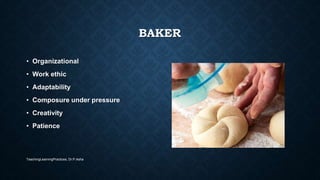
BAKER
• Organizational
• Work ethic
• Adaptability
• Composure under pressure
• Creativity
• Patience
TeachingLearningPractices, Dr.P.Asha
DRIVER
• Excellent driving record. ...
• Ability to navigate different routes. ...
• Proficiency in maintaining the vehicle. ...
• Physical strength and fitness. ...
• Time management. ...
• Detail-oriented. ...
• Concentration. ...
• Knowledge of traffic rules and regulations.
TeachingLearningPractices, Dr.P.Asha
DOMAINS OF LEARNING BENJAMIN BLOOM
1956
• Cognitive: It corresponds to the mental abilities of a person. It is divided into six
learning objectives which are explained below in this article in detail.
• Affective: It involves emotional areas and growth in feelings. Like cognitive domain, this
level comprises of five categories. These five categories are receiving, responding,
valuing, organization and characterization.
• Psychomotor: Psychomotor domain encompasses physical or manual skills which
require practice. These skills are measured against factors such as speed, precision,
distance, procedures, or techniques in execution.
TeachingLearningPractices, Dr.P.Asha
BLOOM’S TAXONOMY
TeachingLearningPractices, Dr.P.Asha
1. REMEMBER (KNOWLEDGE)
• By the end of this lesson, students will be able to define acceleration.
• By the end of this lesson, students will be able to outline various stages of design
thinking.
• By the end of this lesson, students will be able to label different parts of the human
brain.
• By the end of this lesson, students will be able to list various kinds of loops in javascript.
• By the end of this lesson, students will be able to name different parts of nervous
system
TeachingLearningPractices, Dr.P.Asha
2. UNDERSTAND (COMPREHENSION)
• By the end of this lesson, students will be able to explain how sensory receptors in our brain
detect stimuli.
• By the end of this lesson, students will be able to recognize different types of number
sequences.
• By the end of this lesson, students will be able to explain how the heart pumps blood
throughout our body.
• By the end of this lesson, students will be able to distinguish between mass and weight.
• By the end of this lesson, students will be able to discuss the factors that affect the solubility
of a liquid.
TeachingLearningPractices, Dr.P.Asha
3. APPLY
• By the end of this lesson, students will be able to compute their annual pocket money using
this mathematical formula.
• By the end of this lesson, students will be able to use this accounting software for their
annual family budget.
• By the end of this lesson, students will be able to forecast the annual revenue of any
company using its past data.
• By the end of this lesson, students will be able to demonstrate how work in a diverse
culture.
• By the end of this lesson, students will be able to show how to demonstrate emotional
intelligence during an interview.
TeachingLearningPractices, Dr.P.Asha
4. ANALYZE
• By the end of this lesson, students will be able to differentiate between differential and
inferential statistics.
• By the end of this lesson, students will be able to compare and contrast prokaryotic and
eukaryotic cells.
• By the end of this lesson, students will be able to illustrate how DNA code translates into
RNA code.
• By the end of this lesson, students will be able to analyze information in the marketing
research.
• By the end of this lesson, students will be able to analyze how leaves change colors during
the fall season.
TeachingLearningPractices, Dr.P.Asha
5. EVALUATE
• By the end of this lesson, students will be able to explain which kind of medicine is
better for leukemia and why?
• By the end of this lesson, students will be able to defend their proposed hypotheses.
• By the end of this lesson, students will be able to assess the environmental impact of
coal mining.
• By the end of this lesson, students will be able to measure the effectiveness of project-
based learning.
• By the end of this lesson, students will be able to appraise the practice of social media
advertising in business.
TeachingLearningPractices, Dr.P.Asha
6. CREATE
• By the end of this lesson, students will be able to develop an application for the Google play
store.
• By the end of this lesson, students will be able to create financial statements in MS Excel.
• By the end of this lesson, students will be able to compose the scientific name of an
organism.
• By the end of this lesson, students will be able to come up with the innovative ideas to
tackle climate change.
• By the end of this lesson, students will be able to make their own battery charger.
•
TeachingLearningPractices, Dr.P.Asha
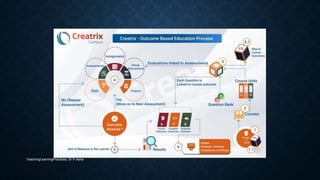
OBE PROCESS
• Constructive alignment – John Biggs ,1999
• The word 'constructive' refers - construct meaning through relevant
learning activities.
• The 'alignment' aspect - what the teacher does - especially the teaching
methods used and the assessment tasks are aligned to the learning
activities assumed in the intended outcomes.
TeachingLearningPractices, Dr.P.Asha
OBE PROCESS
Defining
Curriculum
Objective and
Intended
Learning
Outcomes
Designing
assessment
tasks
Selecting
Teaching and
Learning
Activities
TeachingLearningPractices, Dr.P.Asha
DEFINING CURRICULUM OBJECTIVE AND
INTENDED LEARNING OUTCOMES
• A learning outcome is what a student CAN DO as a result of a learning
experience. It describes a specific task that he/she is able to perform at a
given level of competence under a certain situation.
• The three broad types of learning outcomes are:
• Disciplinary knowledge and skills
• Generic skills
• Attitudes and values
TeachingLearningPractices, Dr.P.Asha
GUIDELINES FOR PRODUCING EFFECTIVE
PO STATEMENTS
• There must be a performer – the student, not the teacher
• There must be something performable (thus demonstrable or assessable)
to perform
• The focus is on the performance, not the activity or task to be performed
TeachingLearningPractices, Dr.P.Asha
SAMPLE PO
• On successful completion of the programme, a (name of program) graduate will be able
to [action verb] + [activity].
• Example 1: A graduate of this program will be able to effectively evaluate research
designs, methods, and conclusions.
• Example 2: Graduates of this program will be able to assess their own strengths,
weaknesses, and omissions and be able to adjust future performance in light of their
self-assessments.
• Example 3: Graduates of this program will be able to effectively communicate both
formally and informally through speaking, writing, and listening.
TeachingLearningPractices, Dr.P.Asha
DESIGNING ASSESSMENT TASKS
• Outcome-based assessment (OBA) asks us to first identify what it is we
expect students to be able to do once they have completed a course or
program. It then asks us to provide evidence that they are able to do so.
• In other words,
• how will each learning outcome be assessed?
• What evidence of student learning is most relevant for each learning
outcome and
• what standard or criteria will be used to evaluate that evidence?
• Assessment is therefore a key part of outcome-based education and
used to determine whether or not a qualification has been achieved.
Teaching Learning Practices, Dr.P.Asha
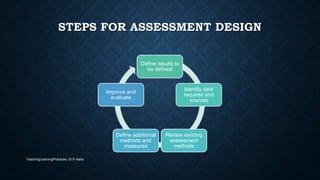
STEPS FOR ASSESSMENT DESIGN
Define results to
be defined
Identify data
required and
sources
Review existing
assessment
methods
Define additional
methods and
measures
Improve and
evaluate
TeachingLearningPractices, Dr.P.Asha
TYPES OF ASSESSMENT TOOLS AND METHODS
• Formative assessment
• Summative assessment
• Criterion-referenced assessment
• Alternative assessments
• Authentic assessments
• Performance assessments
TeachingLearningPractices, Dr.P.Asha
FORMATIVE ASSESSMENT
• The collection of information about student learning during the
progression of a course or program in order to improve
students learning.
• Example: reading the first lab reports of a class to assess
whether some or all students in the group need a lesson on
how to make them succinct and informative.
TeachingLearningPractices, Dr.P.Asha
SUMMATIVE ASSESSMENT
• The gathering of information at the conclusion of a course, program, or
undergraduate career to improve learning or to meet accountability
demands.
• When used for improvement, impacts the next cohort of students taking
the course or program.
• Examples: examining student final exams in a course to see if certain
specific areas of the curriculum were understood less well than others;
analyzing senior projects for the ability to integrate across disciplines.
TeachingLearningPractices, Dr.P.Asha
CRITERION-REFERENCED ASSESSMENT
• A score that compares a student's performance to specific standards. The student is
assessed in reference to some student outcome that can be expected as a result of an
education experience (i.e., a degree of mastery of identified criteria.
• Criteria are qualities that can provide evidence of achievement of goals or outcomes,
such as comprehension of concepts introduced or reinforced, a kind of inquiry behavior
encouraged, or a technique practiced for its potential contribution to the skill of the
artist/student or the meaning/communication of the art work.
• It makes sense to assess in terms of what a teacher believes was taught.
TeachingLearningPractices, Dr.P.Asha
ALTERNATIVE ASSESSMENTS
• A catch all term for assessments that depart from the traditional multiple choice, norm-
referenced tests such as coding live art criticism discussions , portfolio reviews, rating
performances or art products on criteria established by teachers and students, journals,
authentic task assessment and direct observation of student performance.
TeachingLearningPractices, Dr.P.Asha
AUTHENTIC ASSESSMENTS
• Assessment that fits meaningful, real-life learning experiences.
• It includes recording evidence of the learning process, applications in products and
performances, perception of visual and audio relationships, integrations of new
knowledge, reflecting profitably on one's own progress, and interpreting meaning in
consideration of contextual facts.
TeachingLearningPractices, Dr.P.Asha
PERFORMANCE ASSESSMENTS
• An observation of the process of creating an answer or product that demonstrates a
student's knowledge and/or skills. Directly observable, student- generated evidence of
learning
TeachingLearningPractices, Dr.P.Asha
RUBRICS
• A rubric is a set of criteria for assessing student work or performance. Rubrics are
particularly suited to learning outcomes that are complex or not easily quantifiable, for which
there are no clear "right" or "wrong" answers, or which are not evaluated with standardized
tests or surveys. Assessment of writing, oral communication, critical thinking, or information
literacy often requires rubrics.
• Rubrics have two dimensions: they identify the various characteristics of the outcome, and
they specify various levels of achievement in each characteristic. Thus, a well-designed
rubric consists of:
• clear definitions of each characteristic to be assessed for a given learning outcome, and
• clear descriptions of the different levels of achievement for each characteristic.
TeachingLearningPractices, Dr.P.Asha
COMPONENTS OF RUBRICS
• A rubric is a scoring guide used to evaluate performance, a product, or a project. It has
three parts:
• 1) performance criteria;
• 2) rating scale; and
• 3) indicators.
TeachingLearningPractices, Dr.P.Asha
BOOK RUBRIC
Criteria Exemplar (5) Developed (4) Limited (3)
Appearance/
Neatness
The text and the illustrations
are visually appealing, clear,
and colorful. The book is free
from smudges and stray
marks.
The text and the illustrations
are clear and colorful. No
more than a few smudges or
stray marks are visible.
The text and the illustrations
are adequate and clear. More
than three smudges or stray
marks are visible.
Content
Knowledge
Exceptional idea development
with supporting details written
in the author’s own words, or
correctly credited if quoted.
Satisfactory idea development
with some supporting details
written mainly in the author’s
own words, or correctly
credited if quoted.
Unclear, incorrect, or limited
idea development with lack of
details. Author’s own words
are not used, or quotes are not
correctly credited.
Image
Communication
Images are highly engaging for
content and audience.
Images are appropriate to
content and audience.
Images detract from or are
inappropriate for content and
audience.
Mechanics
The book contains only minor
mechanical errors.
The book contains some
mechanical errors, but does
not distract the reader.
Mechanical errors distract the
reader.
Factual
Information
(A-Z)
All letters are represented with
accurate information,
interesting information, and
relevant illustrations.
All letters are represented with
minor errors in information,
undeveloped information, or
irrelevant illustrations.
Letters are missing from the
book, or information is largely
incorrect, or illustrations are
not accurate.
TeachingLearningPractices, Dr.P.Asha
RUBRICS
• Because rubrics establish criteria, they can help make assessment more transparent,
consistent, and objective.
• Faculty members and evaluators can use rubrics to communicate to students and each
other what they see as excellent work, while students gain an understanding of what is
expected and how their performance will be assessed.
• Rubrics are also useful when there is more than one evaluator; rubrics can serve as
standardized scoring guides that assist different evaluators to determine the quality of
student work in a consistent manner.
TeachingLearningPractices, Dr.P.Asha
SELECTING TEACHING AND LEARNING
ACTIVITIES (TLAS)
• Selecting teaching and learning activities aims to help students to attain the intended
learning outcomes and engage them in these learning activities through the teaching
process.
• A student-centered approach is the emphasis in OBE as its success is largely
dependent on the extent to which students take responsibility for their own learning and
whether or not co-operative learning is used; this is because one of the long-term
outcomes of OBE is usually related to generic skills and attitudes such as teamwork and
co-operation. Therefore, programs and courses should also provide experiences that
students are going to encounter in the real world. These activities can be teacher-
managed, peer-managed or self-managed.
TeachingLearningPractices, Dr.P.Asha
BIGGS SUGGESTIONS FOR PLANNING
TEACHING STRATEGIES
• Sound knowledge is based on interconnections – connecting new learning with old.
Encourage students to create conceptual structures which integrate their new and old
learning.
• Develop meta-cognitive skills by being explicit about learning and maximising students’
awareness of their own knowledge construction through structured reflection
• Plan learning activities that actively involve students. Activity heightens arousal and makes
performance more efficient
• Incorporate explicitly stated study skills into learning, and if necessary, provide support for
developing skills, for example in teamwork
• Consider how information technology can support learning and teaching.
TeachingLearningPractices, Dr.P.Asha
https://ctl.hsu.edu.hk/outcomes-based-education-vs-outcomes-based-teaching-and-learning/
TeachingLearningPractices, Dr.P.Asha
BLOOMS TAXONOMY
TeachingLearningPractices, Dr.P.Asha
ACTIVITY BASED LEARNING
TeachingLearningPractices, Dr.P.Asha
ACTIVE LEARNING TECHNIQUES FOR
EFFICIENT AND EFFECTIVE TEACHING
TeachingLearningPractices, Dr.P.Asha
THINK PAIR SHARE OR 90 SECONDS
• Pose a specific question for discussion. For example: ▪ “Look at your lecture notes from
the last X minutes. If there is anything confusing, turn to a neighbor and ask for
clarification…” ▪
• “90 sec. from now I’m going to pick on one of you to answer the following question [state
question here].
• But first, turn to a neighbor to discuss possible answers…” ▪ “What do you think would
be the effect if we changed…”
• • Ask students to turn to a neighbor to discuss. Monitor students to make sure they are
discussing and to hear what they are saying!
• • After 90-sec., reconvene, and ask for volunteers, or call upon students, for
answers/discussion
TeachingLearningPractices, Dr.P.Asha
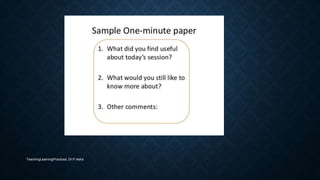
ONE MINUTE PAPER:
• Stop the lecture with 1-2 min. to go and ask the students to write: ▪ Define X [some
concept] in your own words
• ▪ Write one or two questions about what we covered today… ▪ What are the main points
of today’s lecture?
• ▪ What are the muddiest points from today’s lecture?
• • Review the submitted papers to feel-out student understanding and identify clarity
needed in future classes
TeachingLearningPractices, Dr.P.Asha
JIGSAW
TeachingLearningPractices, Dr.P.Asha
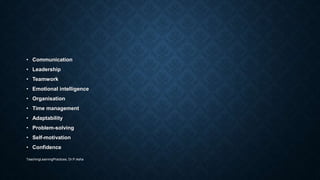
PROFESSIONAL SKILLS
• Soft skills that can help professionals become better leaders, solve
problems at work, resolve conflicts and enable the team and personal
growth.
• While technical skills help professionals perform their responsibilities and
duties, these skills help them build interpersonal relationships, appear
confident, adapt to situations and represent their organisation well
TeachingLearningPractices, Dr.P.Asha
• Communication
• Leadership
• Teamwork
• Emotional intelligence
• Organisation
• Time management
• Adaptability
• Problem-solving
• Self-motivation
• Confidence
TeachingLearningPractices, Dr.P.Asha
REFERENCES
• http://cei.hkust.edu.hk/teaching-resources/outcome-based-education/institutional-
resources/obe-principles-and-process
• https://aissmsiom.org/advanced-teaching-learning-methods-under-outcome-based-
education/
• https://www.nbaind.org/files/obe-and-nba-accreditation.pdf
• https://www.ln.edu.hk/tlc/support-for-staff/outcomes-based-approaches-to-teaching-and-
learning
• https://www.igi-global.com/chapter/implementation-of-outcome-based-education-
through-activity-based-teaching-learning-system/222519
TeachingLearningPractices, Dr.P.Asha
• https://ctl.hsu.edu.hk/outcomes-based-education-vs-outcomes-based-teaching-and-
learning/
• https://www.myklassroom.com/blog/sample-calculation-to-implement-outcome-based-
education-obe-model-at-your-institution/
• https://in.indeed.com/career-advice/career-development/professional-skills
TeachingLearningPractices, Dr.P.Asha
REFERENCES
• https://www.prodigygame.com/main-en/blog/teaching-strategies/
• https://www.internationaljournalssrg.org/IJHSS/2019/Volume6-Issue1/IJHSS-
V6I1P101.pdf
• https://www.creatrixcampus.com/blog/20-step-guide-implementing-outcome-based-
education
• https://ir.upsi.edu.my/files/docs/2020/2053_2053.pdf
• https://www.educationise.com/post/30-bloom-s-taxonomy-examples-of-learning-
objectives-for-teachers
TeachingLearningPractices, Dr.P.Asha

TeeachingPractices29.12.2022.pptx

  • 1.
    TEACHING LEARNING PRACTICES Dr.P.ASHA Professor andHead, Department of Civil Engineering, Jerusalem College of Engineering TeachingLearningPractices, Dr.P.Asha
  • 2.
  • 3.
    TAILOR • sewing skillsand knowledge of tailoring techniques. • knowledge of a range of sewing equipment. • understanding of garment construction, and pattern-making skills. • knowledge of human body shapes. • clothing design skills. • knowledge of different fashions. • knowledge of fabric types, colours and fabric care. TeachingLearningPractices, Dr.P.Asha
  • 4.
    BAKER • Organizational • Workethic • Adaptability • Composure under pressure • Creativity • Patience TeachingLearningPractices, Dr.P.Asha
  • 5.
    DRIVER • Excellent drivingrecord. ... • Ability to navigate different routes. ... • Proficiency in maintaining the vehicle. ... • Physical strength and fitness. ... • Time management. ... • Detail-oriented. ... • Concentration. ... • Knowledge of traffic rules and regulations. TeachingLearningPractices, Dr.P.Asha
  • 6.
    DOMAINS OF LEARNINGBENJAMIN BLOOM 1956 • Cognitive: It corresponds to the mental abilities of a person. It is divided into six learning objectives which are explained below in this article in detail. • Affective: It involves emotional areas and growth in feelings. Like cognitive domain, this level comprises of five categories. These five categories are receiving, responding, valuing, organization and characterization. • Psychomotor: Psychomotor domain encompasses physical or manual skills which require practice. These skills are measured against factors such as speed, precision, distance, procedures, or techniques in execution. TeachingLearningPractices, Dr.P.Asha
  • 7.
  • 8.
    1. REMEMBER (KNOWLEDGE) •By the end of this lesson, students will be able to define acceleration. • By the end of this lesson, students will be able to outline various stages of design thinking. • By the end of this lesson, students will be able to label different parts of the human brain. • By the end of this lesson, students will be able to list various kinds of loops in javascript. • By the end of this lesson, students will be able to name different parts of nervous system TeachingLearningPractices, Dr.P.Asha
  • 9.
    2. UNDERSTAND (COMPREHENSION) •By the end of this lesson, students will be able to explain how sensory receptors in our brain detect stimuli. • By the end of this lesson, students will be able to recognize different types of number sequences. • By the end of this lesson, students will be able to explain how the heart pumps blood throughout our body. • By the end of this lesson, students will be able to distinguish between mass and weight. • By the end of this lesson, students will be able to discuss the factors that affect the solubility of a liquid. TeachingLearningPractices, Dr.P.Asha
  • 10.
    3. APPLY • Bythe end of this lesson, students will be able to compute their annual pocket money using this mathematical formula. • By the end of this lesson, students will be able to use this accounting software for their annual family budget. • By the end of this lesson, students will be able to forecast the annual revenue of any company using its past data. • By the end of this lesson, students will be able to demonstrate how work in a diverse culture. • By the end of this lesson, students will be able to show how to demonstrate emotional intelligence during an interview. TeachingLearningPractices, Dr.P.Asha
  • 11.
    4. ANALYZE • Bythe end of this lesson, students will be able to differentiate between differential and inferential statistics. • By the end of this lesson, students will be able to compare and contrast prokaryotic and eukaryotic cells. • By the end of this lesson, students will be able to illustrate how DNA code translates into RNA code. • By the end of this lesson, students will be able to analyze information in the marketing research. • By the end of this lesson, students will be able to analyze how leaves change colors during the fall season. TeachingLearningPractices, Dr.P.Asha
  • 12.
    5. EVALUATE • Bythe end of this lesson, students will be able to explain which kind of medicine is better for leukemia and why? • By the end of this lesson, students will be able to defend their proposed hypotheses. • By the end of this lesson, students will be able to assess the environmental impact of coal mining. • By the end of this lesson, students will be able to measure the effectiveness of project- based learning. • By the end of this lesson, students will be able to appraise the practice of social media advertising in business. TeachingLearningPractices, Dr.P.Asha
  • 13.
    6. CREATE • Bythe end of this lesson, students will be able to develop an application for the Google play store. • By the end of this lesson, students will be able to create financial statements in MS Excel. • By the end of this lesson, students will be able to compose the scientific name of an organism. • By the end of this lesson, students will be able to come up with the innovative ideas to tackle climate change. • By the end of this lesson, students will be able to make their own battery charger. • TeachingLearningPractices, Dr.P.Asha
  • 14.
    OBE PROCESS • Constructivealignment – John Biggs ,1999 • The word 'constructive' refers - construct meaning through relevant learning activities. • The 'alignment' aspect - what the teacher does - especially the teaching methods used and the assessment tasks are aligned to the learning activities assumed in the intended outcomes. TeachingLearningPractices, Dr.P.Asha
  • 15.
  • 16.
    DEFINING CURRICULUM OBJECTIVEAND INTENDED LEARNING OUTCOMES • A learning outcome is what a student CAN DO as a result of a learning experience. It describes a specific task that he/she is able to perform at a given level of competence under a certain situation. • The three broad types of learning outcomes are: • Disciplinary knowledge and skills • Generic skills • Attitudes and values TeachingLearningPractices, Dr.P.Asha
  • 17.
    GUIDELINES FOR PRODUCINGEFFECTIVE PO STATEMENTS • There must be a performer – the student, not the teacher • There must be something performable (thus demonstrable or assessable) to perform • The focus is on the performance, not the activity or task to be performed TeachingLearningPractices, Dr.P.Asha
  • 18.
    SAMPLE PO • Onsuccessful completion of the programme, a (name of program) graduate will be able to [action verb] + [activity]. • Example 1: A graduate of this program will be able to effectively evaluate research designs, methods, and conclusions. • Example 2: Graduates of this program will be able to assess their own strengths, weaknesses, and omissions and be able to adjust future performance in light of their self-assessments. • Example 3: Graduates of this program will be able to effectively communicate both formally and informally through speaking, writing, and listening. TeachingLearningPractices, Dr.P.Asha
  • 19.
    DESIGNING ASSESSMENT TASKS •Outcome-based assessment (OBA) asks us to first identify what it is we expect students to be able to do once they have completed a course or program. It then asks us to provide evidence that they are able to do so. • In other words, • how will each learning outcome be assessed? • What evidence of student learning is most relevant for each learning outcome and • what standard or criteria will be used to evaluate that evidence? • Assessment is therefore a key part of outcome-based education and used to determine whether or not a qualification has been achieved. Teaching Learning Practices, Dr.P.Asha
  • 20.
    STEPS FOR ASSESSMENTDESIGN Define results to be defined Identify data required and sources Review existing assessment methods Define additional methods and measures Improve and evaluate TeachingLearningPractices, Dr.P.Asha
  • 21.
    TYPES OF ASSESSMENTTOOLS AND METHODS • Formative assessment • Summative assessment • Criterion-referenced assessment • Alternative assessments • Authentic assessments • Performance assessments TeachingLearningPractices, Dr.P.Asha
  • 22.
    FORMATIVE ASSESSMENT • Thecollection of information about student learning during the progression of a course or program in order to improve students learning. • Example: reading the first lab reports of a class to assess whether some or all students in the group need a lesson on how to make them succinct and informative. TeachingLearningPractices, Dr.P.Asha
  • 23.
    SUMMATIVE ASSESSMENT • Thegathering of information at the conclusion of a course, program, or undergraduate career to improve learning or to meet accountability demands. • When used for improvement, impacts the next cohort of students taking the course or program. • Examples: examining student final exams in a course to see if certain specific areas of the curriculum were understood less well than others; analyzing senior projects for the ability to integrate across disciplines. TeachingLearningPractices, Dr.P.Asha
  • 24.
    CRITERION-REFERENCED ASSESSMENT • Ascore that compares a student's performance to specific standards. The student is assessed in reference to some student outcome that can be expected as a result of an education experience (i.e., a degree of mastery of identified criteria. • Criteria are qualities that can provide evidence of achievement of goals or outcomes, such as comprehension of concepts introduced or reinforced, a kind of inquiry behavior encouraged, or a technique practiced for its potential contribution to the skill of the artist/student or the meaning/communication of the art work. • It makes sense to assess in terms of what a teacher believes was taught. TeachingLearningPractices, Dr.P.Asha
  • 25.
    ALTERNATIVE ASSESSMENTS • Acatch all term for assessments that depart from the traditional multiple choice, norm- referenced tests such as coding live art criticism discussions , portfolio reviews, rating performances or art products on criteria established by teachers and students, journals, authentic task assessment and direct observation of student performance. TeachingLearningPractices, Dr.P.Asha
  • 26.
    AUTHENTIC ASSESSMENTS • Assessmentthat fits meaningful, real-life learning experiences. • It includes recording evidence of the learning process, applications in products and performances, perception of visual and audio relationships, integrations of new knowledge, reflecting profitably on one's own progress, and interpreting meaning in consideration of contextual facts. TeachingLearningPractices, Dr.P.Asha
  • 27.
    PERFORMANCE ASSESSMENTS • Anobservation of the process of creating an answer or product that demonstrates a student's knowledge and/or skills. Directly observable, student- generated evidence of learning TeachingLearningPractices, Dr.P.Asha
  • 28.
    RUBRICS • A rubricis a set of criteria for assessing student work or performance. Rubrics are particularly suited to learning outcomes that are complex or not easily quantifiable, for which there are no clear "right" or "wrong" answers, or which are not evaluated with standardized tests or surveys. Assessment of writing, oral communication, critical thinking, or information literacy often requires rubrics. • Rubrics have two dimensions: they identify the various characteristics of the outcome, and they specify various levels of achievement in each characteristic. Thus, a well-designed rubric consists of: • clear definitions of each characteristic to be assessed for a given learning outcome, and • clear descriptions of the different levels of achievement for each characteristic. TeachingLearningPractices, Dr.P.Asha
  • 29.
    COMPONENTS OF RUBRICS •A rubric is a scoring guide used to evaluate performance, a product, or a project. It has three parts: • 1) performance criteria; • 2) rating scale; and • 3) indicators. TeachingLearningPractices, Dr.P.Asha
  • 30.
    BOOK RUBRIC Criteria Exemplar(5) Developed (4) Limited (3) Appearance/ Neatness The text and the illustrations are visually appealing, clear, and colorful. The book is free from smudges and stray marks. The text and the illustrations are clear and colorful. No more than a few smudges or stray marks are visible. The text and the illustrations are adequate and clear. More than three smudges or stray marks are visible. Content Knowledge Exceptional idea development with supporting details written in the author’s own words, or correctly credited if quoted. Satisfactory idea development with some supporting details written mainly in the author’s own words, or correctly credited if quoted. Unclear, incorrect, or limited idea development with lack of details. Author’s own words are not used, or quotes are not correctly credited. Image Communication Images are highly engaging for content and audience. Images are appropriate to content and audience. Images detract from or are inappropriate for content and audience. Mechanics The book contains only minor mechanical errors. The book contains some mechanical errors, but does not distract the reader. Mechanical errors distract the reader. Factual Information (A-Z) All letters are represented with accurate information, interesting information, and relevant illustrations. All letters are represented with minor errors in information, undeveloped information, or irrelevant illustrations. Letters are missing from the book, or information is largely incorrect, or illustrations are not accurate. TeachingLearningPractices, Dr.P.Asha
  • 31.
    RUBRICS • Because rubricsestablish criteria, they can help make assessment more transparent, consistent, and objective. • Faculty members and evaluators can use rubrics to communicate to students and each other what they see as excellent work, while students gain an understanding of what is expected and how their performance will be assessed. • Rubrics are also useful when there is more than one evaluator; rubrics can serve as standardized scoring guides that assist different evaluators to determine the quality of student work in a consistent manner. TeachingLearningPractices, Dr.P.Asha
  • 32.
    SELECTING TEACHING ANDLEARNING ACTIVITIES (TLAS) • Selecting teaching and learning activities aims to help students to attain the intended learning outcomes and engage them in these learning activities through the teaching process. • A student-centered approach is the emphasis in OBE as its success is largely dependent on the extent to which students take responsibility for their own learning and whether or not co-operative learning is used; this is because one of the long-term outcomes of OBE is usually related to generic skills and attitudes such as teamwork and co-operation. Therefore, programs and courses should also provide experiences that students are going to encounter in the real world. These activities can be teacher- managed, peer-managed or self-managed. TeachingLearningPractices, Dr.P.Asha
  • 33.
    BIGGS SUGGESTIONS FORPLANNING TEACHING STRATEGIES • Sound knowledge is based on interconnections – connecting new learning with old. Encourage students to create conceptual structures which integrate their new and old learning. • Develop meta-cognitive skills by being explicit about learning and maximising students’ awareness of their own knowledge construction through structured reflection • Plan learning activities that actively involve students. Activity heightens arousal and makes performance more efficient • Incorporate explicitly stated study skills into learning, and if necessary, provide support for developing skills, for example in teamwork • Consider how information technology can support learning and teaching. TeachingLearningPractices, Dr.P.Asha
  • 34.
  • 35.
  • 36.
  • 37.
  • 38.
    ACTIVE LEARNING TECHNIQUESFOR EFFICIENT AND EFFECTIVE TEACHING TeachingLearningPractices, Dr.P.Asha
  • 39.
    THINK PAIR SHAREOR 90 SECONDS • Pose a specific question for discussion. For example: ▪ “Look at your lecture notes from the last X minutes. If there is anything confusing, turn to a neighbor and ask for clarification…” ▪ • “90 sec. from now I’m going to pick on one of you to answer the following question [state question here]. • But first, turn to a neighbor to discuss possible answers…” ▪ “What do you think would be the effect if we changed…” • • Ask students to turn to a neighbor to discuss. Monitor students to make sure they are discussing and to hear what they are saying! • • After 90-sec., reconvene, and ask for volunteers, or call upon students, for answers/discussion TeachingLearningPractices, Dr.P.Asha
  • 40.
  • 41.
    ONE MINUTE PAPER: •Stop the lecture with 1-2 min. to go and ask the students to write: ▪ Define X [some concept] in your own words • ▪ Write one or two questions about what we covered today… ▪ What are the main points of today’s lecture? • ▪ What are the muddiest points from today’s lecture? • • Review the submitted papers to feel-out student understanding and identify clarity needed in future classes TeachingLearningPractices, Dr.P.Asha
  • 42.
  • 43.
  • 44.
    PROFESSIONAL SKILLS • Softskills that can help professionals become better leaders, solve problems at work, resolve conflicts and enable the team and personal growth. • While technical skills help professionals perform their responsibilities and duties, these skills help them build interpersonal relationships, appear confident, adapt to situations and represent their organisation well TeachingLearningPractices, Dr.P.Asha
  • 45.
    • Communication • Leadership •Teamwork • Emotional intelligence • Organisation • Time management • Adaptability • Problem-solving • Self-motivation • Confidence TeachingLearningPractices, Dr.P.Asha
  • 46.
    REFERENCES • http://cei.hkust.edu.hk/teaching-resources/outcome-based-education/institutional- resources/obe-principles-and-process • https://aissmsiom.org/advanced-teaching-learning-methods-under-outcome-based- education/ •https://www.nbaind.org/files/obe-and-nba-accreditation.pdf • https://www.ln.edu.hk/tlc/support-for-staff/outcomes-based-approaches-to-teaching-and- learning • https://www.igi-global.com/chapter/implementation-of-outcome-based-education- through-activity-based-teaching-learning-system/222519 TeachingLearningPractices, Dr.P.Asha
  • 47.
  • 48.
    REFERENCES • https://www.prodigygame.com/main-en/blog/teaching-strategies/ • https://www.internationaljournalssrg.org/IJHSS/2019/Volume6-Issue1/IJHSS- V6I1P101.pdf •https://www.creatrixcampus.com/blog/20-step-guide-implementing-outcome-based- education • https://ir.upsi.edu.my/files/docs/2020/2053_2053.pdf • https://www.educationise.com/post/30-bloom-s-taxonomy-examples-of-learning- objectives-for-teachers TeachingLearningPractices, Dr.P.Asha
  • 49.