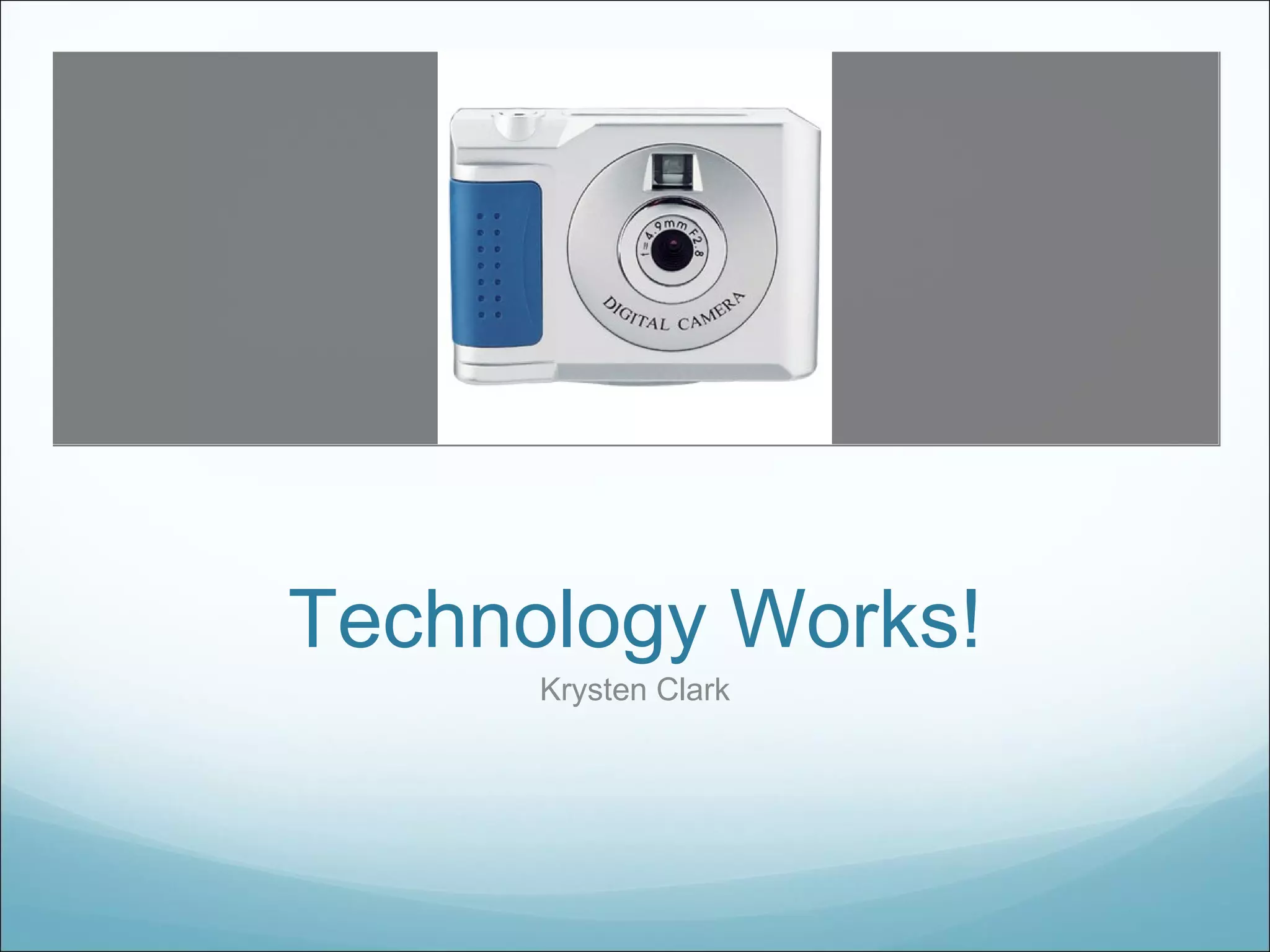
Technology Works! Krysten Clark
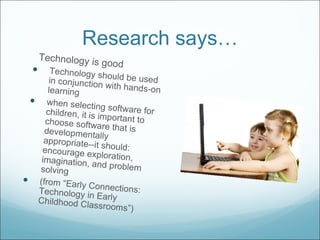
Research says… Technology is good Technology should be used in conjunction with hands-on learning when selecting software for children, it is important to choose software that is developmentally appropriate--it should: encourage exploration, imagination, and problem solving (from “Early Connections: Technology in Early Childhood Classrooms”)
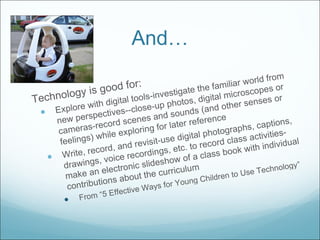
And… Technology is good for: Explore with digital tools-investigate the familiar world from new perspectives--close-up photos, digital microscopes or cameras-record scenes and sounds (and other senses or feelings) while exploring for later reference Write, record, and revisit-use digital photographs, captions, drawings, voice recordings, etc. to record class activities-make an electronic slideshow of a class book with individual contributions about the curriculum  From “5 Effective Ways for Young Children to Use Technology”
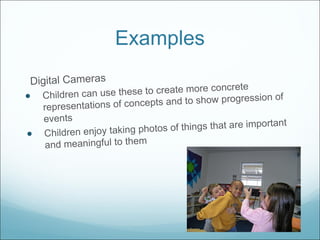
Examples Digital Cameras Children can use these to create more concrete representations of concepts and to show progression of events Children enjoy taking photos of things that are important and meaningful to them
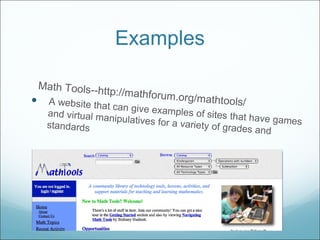
Examples Math Tools--http://mathforum.org/mathtools/ A website that can give examples of sites that have games and virtual manipulatives for a variety of grades and standards
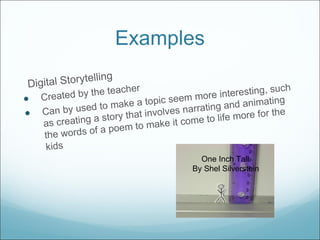
Examples Digital Storytelling Created by the teacher Can by used to make a topic seem more interesting, such as creating a story that involves narrating and animating the words of a poem to make it come to life more for the kids One Inch Tall By Shel Silverstein
Resources Digital Camera photo: http://www.lakewoodconferences.com/direct/dbimage/50197602/Digital_Camera.jpg Children on computer photo: http://joyerickson.files.wordpress.com/2008/06/kids-on-the-computer1.jpg Kids using digital camera photo: http://farm1.static.flickr.com/126/405061246_5ed2028a85.jpg Geek Squad baby photo: http://smithwinchester.files.wordpress.com/2007/05/koanbabygeek.gif

Technology Presentation

  • 1.
  • 2.
    Research says… Technologyis good Technology should be used in conjunction with hands-on learning when selecting software for children, it is important to choose software that is developmentally appropriate--it should: encourage exploration, imagination, and problem solving (from “Early Connections: Technology in Early Childhood Classrooms”)
  • 3.
    And… Technology isgood for: Explore with digital tools-investigate the familiar world from new perspectives--close-up photos, digital microscopes or cameras-record scenes and sounds (and other senses or feelings) while exploring for later reference Write, record, and revisit-use digital photographs, captions, drawings, voice recordings, etc. to record class activities-make an electronic slideshow of a class book with individual contributions about the curriculum From “5 Effective Ways for Young Children to Use Technology”
  • 4.
    Examples Digital CamerasChildren can use these to create more concrete representations of concepts and to show progression of events Children enjoy taking photos of things that are important and meaningful to them
  • 5.
    Examples Math Tools--http://mathforum.org/mathtools/A website that can give examples of sites that have games and virtual manipulatives for a variety of grades and standards
  • 6.
    Examples Digital StorytellingCreated by the teacher Can by used to make a topic seem more interesting, such as creating a story that involves narrating and animating the words of a poem to make it come to life more for the kids One Inch Tall By Shel Silverstein
  • 7.
    Resources Digital Cameraphoto: http://www.lakewoodconferences.com/direct/dbimage/50197602/Digital_Camera.jpg Children on computer photo: http://joyerickson.files.wordpress.com/2008/06/kids-on-the-computer1.jpg Kids using digital camera photo: http://farm1.static.flickr.com/126/405061246_5ed2028a85.jpg Geek Squad baby photo: http://smithwinchester.files.wordpress.com/2007/05/koanbabygeek.gif

Editor's Notes

  • #2 Hi, my name is Krysten Clark and today I will be talking about how technology can be a useful working tool in our early childhood classrooms.