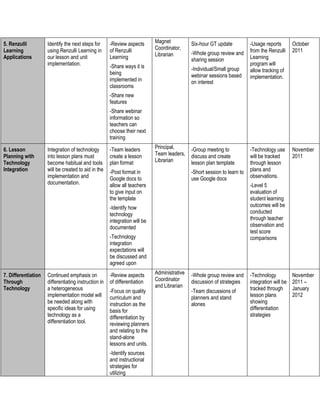
Technology Action Plan<br />River Oaks Elementary School has a fundamental belief in 21st century learning.  As a campus, we will continue to improve the utilization of technology as a data analysis tool and as an integral instructional and assessment tool.   Through the efforts that have resulted from the district’s needs assessment, we now have district-wide systems in place for communication and information-sharing.   Customer service has been improved through the creation of better websites for both the district and the campus, making information readily available and moving toward a more interactive web-based environment, which were areas in need of improvement at both levels.  <br />In this data driven educational environment, it is imperative to utilize all aspects of data-gathering available to determine instructional needs.  Our AEIS data allows us to disaggregate the scores to determine areas where more work is needed.  Our STaR chart data shows that quality professional development is a priority. <br />Differentiating instruction is the foundation of all curriculum and instruction at River Oaks Elementary.  Technology should play a huge role in creating the learning opportunities that allow teachers to meet the needs of all students.  Through wikis and class blogs, teachers can find ways to include their students in the learning process 24/7, and encourage learning to continue outside the confines of the brick and mortar building.  Renzulli Learning has been purchased for all students by the district as part of their differentiating instruction initiative and provides a web-based social networking site where students can receive differentiated lessons based on their unique learning profiles.<br />Houston ISD’s Technology Plan lists instruction and achievement as primary goals for technology use. Technology is utilized for communication in a number of ways that direct affect instruction.  Teachers communicate with students’ parents to ensure transfer of learning from school to the home.  Instructional support is sought and provided through electronic means both inside the building and from other sources.  Teachers use email as a collaboration tool and often are able to reach consensus and make decisions regarding instructional matters without having a face-to-face meeting.<br />One-size fits-all instruction is no longer considered best practice, and the methods used at River Oaks and continuing to be developed connect to the needs assessed in the Texas State Technology Plan.<br />The campus technology plan, working in consort with the district required Individual Professional Development Plan, states that our teachers will move from sit-and-get, one-size-fits-all professional development to individualized and differentiated job-embedded opportunities.  <br />Goal:  To utilize data gathered from local, state, and national sources for technology advancement that will  enhance curriculum and instruction based on students’ needs to improve achievement.<br />StepsRationaleActionsResponsible PartyStaff DevelopmentEvaluationTimeline1.Review Data Reviewing reports, plans, and documents will provide the foundation for understanding where we are and where we need to go.  The needs assessment and research done on our campus revealed that much technology is present and many interesting applications of technology are being used.  This exercise will help put those pieces into focus and help teachers develop an individual and team/school plan for our next steps.- Faculty and Staff must spend time with the following documents:-AEIS Report-Campus STaR Chart Report-Campus Improvement Plan-Texas Long Range Plan for Technology-HISD Long Range Strategic Plan for Technology-Teachers will discuss and come to understanding and consensus about each of these documents and how they relate to our curriculumAdministrative Team, Technology Specialist, Librarian-A series of in-house sessions will be planned to review and evaluate the contents of each of the documents. -Teachers will prepare a chart of the specifics of each as they relate to our work with students.-Planning assessment to determine what teachers know about the documents before the review-Level 2 evaluation of teachers’ learning after the reviewsSummer PD days, August 20112. Gather Background Knowledge on New Technology ApplicationsFaculty and Staff will explore the current trends and issues of technology use in education.  Web 2.0 tools will be utilized for this step to model administrative use.-As a staff, explore the following questions :-Why should we integrate digital technology into our curriculum?-What is Web 2.0 and what tools are available?-What tools are we currently using and who is using them?-As the staff works together to answer these questions, interests and expertise will emerge.-Create wikis for the areas of interest and expertise that were identified.  -Distribute articles on the identified topics to start the research and conversations.-Schedule Lunch Bunch sessions to share information and ideas on technology topics.Technology Specialist and Librarian will lead the discussions and set up and monitor the wikis based on interests for research.Teachers with expertise with technology will monitor wikis to share ideas and instructional strategies.-A whole group, in-house session based on the three questions will be held to start the process.-One session on wiki development and participation will be held in-house on a Wednesday afternoon.-Lunch Bunch sessions on various Web 2.0 devices will be held by the Technology Specialist and Librarian, along with other staff members with expertise who are willing.-Collaborative learning through wikis will take place so that teachers can research and participate in sessions of their choice.-Planning self-assessment to determine understanding and use of Web 2.0 tools-Follow up Level 4 assessment one month later to determine which tools teachers have implemented-Observational dataSeptember 20113. Individual Goal Setting and Professional Development PlanningFaculty and Staff will synthesize the data presented, the plans for which we are responsible, and the trends and issues to determine their levels of proficiency and set personal goals for technology growth-Teachers will identify two technology innovations they are not currently using that they will integrate into their curriculum.  -Their Individual Professional Development Plan will be created based on these two innovations.Principal and Administrative Coordinator (who are the campus appraisers)-Informational sessions on the district expectations for the IPDP, implementation, and evaluation.-Written IPDP will be used to evaluate where teachers are and where they feel growth is needed.-Observational data from appraisers-Self-assessment in the spring will show growth as a result of the IPDP.September 2011-April 20124. Website Blog CreationRiver Oaks has a new website with blogging capability for each teacher and/or team.  It is the expectation that blogs are created as a communication tool with stakeholders..-Overview of the new website-Exploration of the blogging features of the site-Staff set-up of initial site-Summary of expectations for individual blogsSchool Webmaster, Technology Specialist-Whole group session to view the website features-Hands-on, work session to set up blog-Level 3 evaluation of teachers’ perceptions of organizational support for this implementation and change. -Informal observational data from stakeholdersOctober 20115. Renzulli Learning ApplicationsIdentify the next steps for using Renzulli Learning in our lesson and unit implementation.-Review aspects of Renzulli Learning-Share ways it is being implemented in classrooms-Share new features-Share webinar information so teachers can choose their next trainingMagnet Coordinator, LibrarianSix-hour GT update-Whole group review and sharing session-Individual/Small group webinar sessions based on interest-Usage reports from the Renzulli Learning program will allow tracking of implementation.October 20116. Lesson Planning with Technology IntegrationIntegration of technology into lesson plans must become habitual and tools will be created to aid in the implementation and documentation.-Team leaders create a lesson plan format-Post format in Google docs to allow all teachers to give input on the template-Identify how technology integration will be documented-Technology integration expectations will be discussed and agreed uponPrincipal, Team leaders, Librarian-Group meeting to discuss and create lesson plan template-Short session to learn to use Google docs-Technology use will be tracked through lesson plans and observations.-Level 5 evaluation of student learning outcomes will be conducted through teacher observation and test score comparisonsNovember 20117. Differentiation Through TechnologyContinued emphasis on differentiating instruction in a heterogeneous implementation model will be needed along with specific ideas for using technology as a differentiation tool.-Review aspects of differentiation-Focus on quality curriculum and instruction as the basis for differentiation by reviewing planners and relating to the stand-alone lessons and units.-Identify sources and instructional strategies for utilizing technology as a differentiation tool.-Start a blog for sharing differentiation strategiesAdministrative Coordinator and Librarian-Whole group review and discussion of strategies-Team discussions of planners and stand alones-Technology integration will be tracked through lesson plans showing differentiation strategiesNovember 2011 – January 2012<br />
Technology plan
Technology plan
Technology plan
Technology plan

Technology plan

  • 1.
    Technology Action Plan<br/>River Oaks Elementary School has a fundamental belief in 21st century learning. As a campus, we will continue to improve the utilization of technology as a data analysis tool and as an integral instructional and assessment tool. Through the efforts that have resulted from the district’s needs assessment, we now have district-wide systems in place for communication and information-sharing. Customer service has been improved through the creation of better websites for both the district and the campus, making information readily available and moving toward a more interactive web-based environment, which were areas in need of improvement at both levels. <br />In this data driven educational environment, it is imperative to utilize all aspects of data-gathering available to determine instructional needs. Our AEIS data allows us to disaggregate the scores to determine areas where more work is needed. Our STaR chart data shows that quality professional development is a priority. <br />Differentiating instruction is the foundation of all curriculum and instruction at River Oaks Elementary. Technology should play a huge role in creating the learning opportunities that allow teachers to meet the needs of all students. Through wikis and class blogs, teachers can find ways to include their students in the learning process 24/7, and encourage learning to continue outside the confines of the brick and mortar building. Renzulli Learning has been purchased for all students by the district as part of their differentiating instruction initiative and provides a web-based social networking site where students can receive differentiated lessons based on their unique learning profiles.<br />Houston ISD’s Technology Plan lists instruction and achievement as primary goals for technology use. Technology is utilized for communication in a number of ways that direct affect instruction. Teachers communicate with students’ parents to ensure transfer of learning from school to the home. Instructional support is sought and provided through electronic means both inside the building and from other sources. Teachers use email as a collaboration tool and often are able to reach consensus and make decisions regarding instructional matters without having a face-to-face meeting.<br />One-size fits-all instruction is no longer considered best practice, and the methods used at River Oaks and continuing to be developed connect to the needs assessed in the Texas State Technology Plan.<br />The campus technology plan, working in consort with the district required Individual Professional Development Plan, states that our teachers will move from sit-and-get, one-size-fits-all professional development to individualized and differentiated job-embedded opportunities. <br />Goal: To utilize data gathered from local, state, and national sources for technology advancement that will enhance curriculum and instruction based on students’ needs to improve achievement.<br />StepsRationaleActionsResponsible PartyStaff DevelopmentEvaluationTimeline1.Review Data Reviewing reports, plans, and documents will provide the foundation for understanding where we are and where we need to go. The needs assessment and research done on our campus revealed that much technology is present and many interesting applications of technology are being used. This exercise will help put those pieces into focus and help teachers develop an individual and team/school plan for our next steps.- Faculty and Staff must spend time with the following documents:-AEIS Report-Campus STaR Chart Report-Campus Improvement Plan-Texas Long Range Plan for Technology-HISD Long Range Strategic Plan for Technology-Teachers will discuss and come to understanding and consensus about each of these documents and how they relate to our curriculumAdministrative Team, Technology Specialist, Librarian-A series of in-house sessions will be planned to review and evaluate the contents of each of the documents. -Teachers will prepare a chart of the specifics of each as they relate to our work with students.-Planning assessment to determine what teachers know about the documents before the review-Level 2 evaluation of teachers’ learning after the reviewsSummer PD days, August 20112. Gather Background Knowledge on New Technology ApplicationsFaculty and Staff will explore the current trends and issues of technology use in education. Web 2.0 tools will be utilized for this step to model administrative use.-As a staff, explore the following questions :-Why should we integrate digital technology into our curriculum?-What is Web 2.0 and what tools are available?-What tools are we currently using and who is using them?-As the staff works together to answer these questions, interests and expertise will emerge.-Create wikis for the areas of interest and expertise that were identified. -Distribute articles on the identified topics to start the research and conversations.-Schedule Lunch Bunch sessions to share information and ideas on technology topics.Technology Specialist and Librarian will lead the discussions and set up and monitor the wikis based on interests for research.Teachers with expertise with technology will monitor wikis to share ideas and instructional strategies.-A whole group, in-house session based on the three questions will be held to start the process.-One session on wiki development and participation will be held in-house on a Wednesday afternoon.-Lunch Bunch sessions on various Web 2.0 devices will be held by the Technology Specialist and Librarian, along with other staff members with expertise who are willing.-Collaborative learning through wikis will take place so that teachers can research and participate in sessions of their choice.-Planning self-assessment to determine understanding and use of Web 2.0 tools-Follow up Level 4 assessment one month later to determine which tools teachers have implemented-Observational dataSeptember 20113. Individual Goal Setting and Professional Development PlanningFaculty and Staff will synthesize the data presented, the plans for which we are responsible, and the trends and issues to determine their levels of proficiency and set personal goals for technology growth-Teachers will identify two technology innovations they are not currently using that they will integrate into their curriculum. -Their Individual Professional Development Plan will be created based on these two innovations.Principal and Administrative Coordinator (who are the campus appraisers)-Informational sessions on the district expectations for the IPDP, implementation, and evaluation.-Written IPDP will be used to evaluate where teachers are and where they feel growth is needed.-Observational data from appraisers-Self-assessment in the spring will show growth as a result of the IPDP.September 2011-April 20124. Website Blog CreationRiver Oaks has a new website with blogging capability for each teacher and/or team. It is the expectation that blogs are created as a communication tool with stakeholders..-Overview of the new website-Exploration of the blogging features of the site-Staff set-up of initial site-Summary of expectations for individual blogsSchool Webmaster, Technology Specialist-Whole group session to view the website features-Hands-on, work session to set up blog-Level 3 evaluation of teachers’ perceptions of organizational support for this implementation and change. -Informal observational data from stakeholdersOctober 20115. Renzulli Learning ApplicationsIdentify the next steps for using Renzulli Learning in our lesson and unit implementation.-Review aspects of Renzulli Learning-Share ways it is being implemented in classrooms-Share new features-Share webinar information so teachers can choose their next trainingMagnet Coordinator, LibrarianSix-hour GT update-Whole group review and sharing session-Individual/Small group webinar sessions based on interest-Usage reports from the Renzulli Learning program will allow tracking of implementation.October 20116. Lesson Planning with Technology IntegrationIntegration of technology into lesson plans must become habitual and tools will be created to aid in the implementation and documentation.-Team leaders create a lesson plan format-Post format in Google docs to allow all teachers to give input on the template-Identify how technology integration will be documented-Technology integration expectations will be discussed and agreed uponPrincipal, Team leaders, Librarian-Group meeting to discuss and create lesson plan template-Short session to learn to use Google docs-Technology use will be tracked through lesson plans and observations.-Level 5 evaluation of student learning outcomes will be conducted through teacher observation and test score comparisonsNovember 20117. Differentiation Through TechnologyContinued emphasis on differentiating instruction in a heterogeneous implementation model will be needed along with specific ideas for using technology as a differentiation tool.-Review aspects of differentiation-Focus on quality curriculum and instruction as the basis for differentiation by reviewing planners and relating to the stand-alone lessons and units.-Identify sources and instructional strategies for utilizing technology as a differentiation tool.-Start a blog for sharing differentiation strategiesAdministrative Coordinator and Librarian-Whole group review and discussion of strategies-Team discussions of planners and stand alones-Technology integration will be tracked through lesson plans showing differentiation strategiesNovember 2011 – January 2012<br />