







Technology Integration To
Meet The Needs Of The
CCSS
Andrew Miller @betamiller
Go
aboutme
questions
How does the
Common Core call
for technology
integration?
What do you already
know about
Technology
integration and the
CCSS?
ccsssays
“To be ready for college, workforce
training, and life in a technological society,
students need the ability to gather,
comprehend, evaluate, synthesize, and
report on information and ideas, to conduct
original research in order to answer
questions or solve problems, and to
analyze and nonprint texts to create a high
volume and extensive range of print and in
media forms old and new.”
ccsssays
"New technologies have broadened and
expanded the role that speaking and
listening play in acquiring and sharing
knowledge and have tightened their link to
other forms of communication. The Internet
has accelerated the speed at which
connections between speaking, listening,
reading, and writing can be made,
requiring that students be ready to use
these modalities nearly simultaneously.”
ccsssays
"Students who are college and career
ready employ technology thoughtfully to
enhance their reading, writing, speaking,
listening, and language use. They tailor
their searches online to acquire useful
information efficiently, and they integrate
what they learn using technology with what
they learn offline
ccsssays
When making mathematical models, they
know that technology can enable them to
visualize the results of varying
assumptions, explore consequences, and
compare predictions with data…They are
able to use technological tools to explore
and deepen their understanding of
concepts.
unpack
W.3.8
Recall information from experiences or
gather information from print and digital
sources; take brief notes on sources and
sort evidence into provided categories.
M 5.G.2
Represent real world and mathematical
problems by graphing points in the first
quadrant of the coordinate plane, and
interpret coordinate values of points in the
context of the situation.
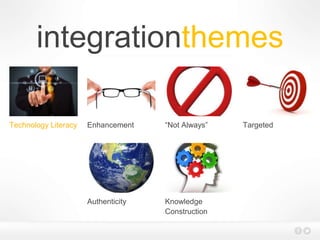
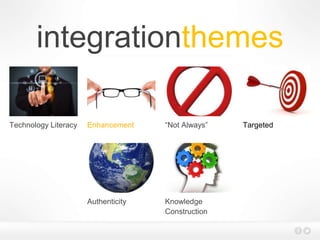
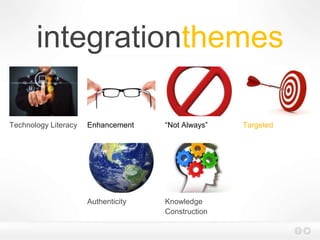
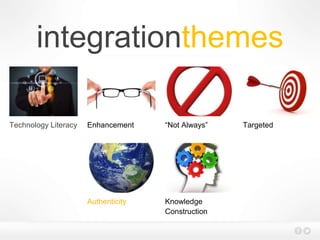
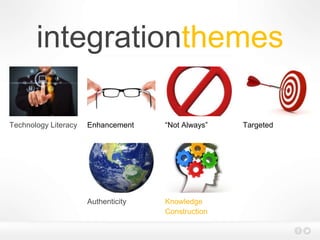
integrationthemes
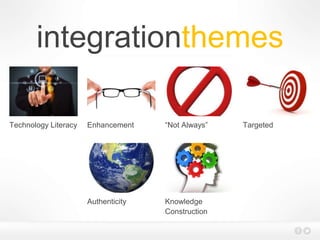
Technology Literacy Enhancement “Not Always” Targeted
Authenticity Knowledge
Construction
integrationthemes
Technology Literacy Enhancement “Not Always” Targeted
Authenticity Knowledge
Construction
edleadershipsays
“A whole host of fundamental literacy
implications, as well as global implications,
come naturally from a simple yet profound
focus on reading texts deeply, writing for
digital environments collaboratively, and
reading and writing nonfiction texts. It's a
hopeful sign that our first widely adopted
national standards, the Common Core
State Standards, support and even
encourage the teaching of these important
tasks.”
- William Kist, New Literacies and the
Common Core
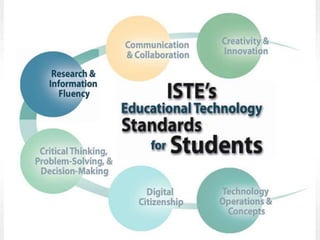
istenetssay
Research and information fluency
1.Students apply digital tools to gather, evaluate,
and use information.
2.Plan strategies to guide inquiry
3.Locate, organize, analyze, evaluate,
synthesize, and ethically use information from
a variety of sources and media
4.Evaluate and select information sources and
digital tools based on the appropriateness to
specific tasks
5.Process data and report results
istenetssay
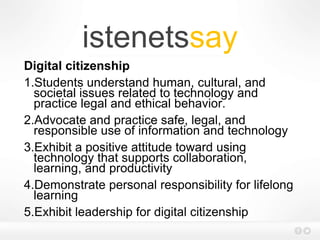
Digital citizenship
1.Students understand human, cultural, and
societal issues related to technology and
practice legal and ethical behavior.
2.Advocate and practice safe, legal, and
responsible use of information and technology
3.Exhibit a positive attitude toward using
technology that supports collaboration,
learning, and productivity
4.Demonstrate personal responsibility for lifelong
learning
5.Exhibit leadership for digital citizenship
integrationthemes
Technology Literacy Enhancement “Not Always” Targeted
Authenticity Knowledge
Construction
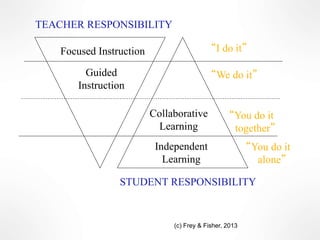
TEACHER RESPONSIBILITY
STUDENT RESPONSIBILITY
Focused Instruction
Guided
Instruction
“I do it”
“We do it”
“You do it
together”
Collaborative
Learning
Independent
Learning
“You do it
alone”
(c) Frey & Fisher, 2013
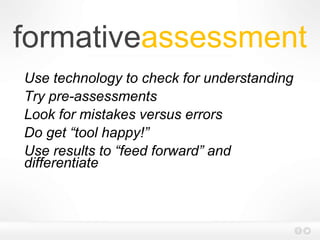
formativeassessment
Use technology to check for understanding
Try pre-assessments
Look for mistakes versus errors
Do get “tool happy!”
Use results to “feed forward” and
differentiate
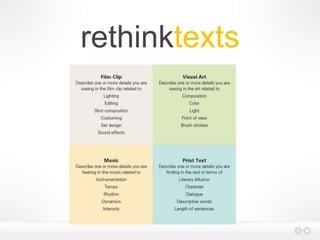
rethinktexts
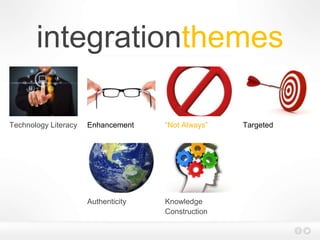
integrationthemes
Technology Literacy Enhancement “Not Always” Targeted
Authenticity Knowledge
Construction
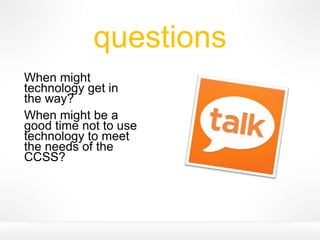
questions
When might
technology get in
the way?
When might be a
good time not to use
technology to meet
the needs of the
CCSS?
ccssstandard
1.M F-IF.7 Graph functions expressed symbolically and
show key features of the graph, by hand in simple
cases and using technology for more complicated
cases.
integrationthemes
Technology Literacy Enhancement “Not Always” Targeted
Authenticity Knowledge
Construction
ccssstandard
1.SL.9-10.5. Grade 9-10 students:
Make strategic use of digital media (e.g., textual,
graphical, audio, visual, and interactive elements) in
presentations to enhance unstinting of findings,
reasoning, and evidence and to add interest.
ccssstandard
1.RI.8.7. Grade 8 students:
Evaluate the advantages of using different mediums
(e.g., print or digital text, video, multimedia) to present a
particular topic or idea.
integrationthemes
Technology Literacy Enhancement “Not Always” Targeted
Authenticity Knowledge
Construction
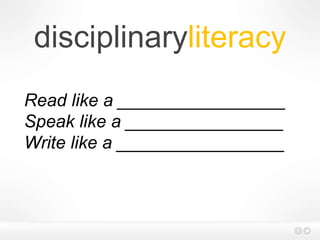
disciplinaryliteracy
Read like a _________________
Speak like a ________________
Write like a _________________
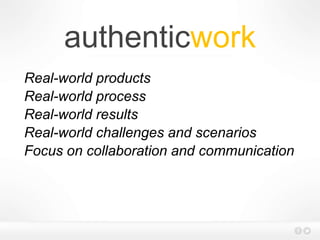
authenticwork
Real-world products
Real-world process
Real-world results
Real-world challenges and scenarios
Focus on collaboration and communication
integrationthemes
Technology Literacy Enhancement “Not Always” Targeted
Authenticity Knowledge
Construction
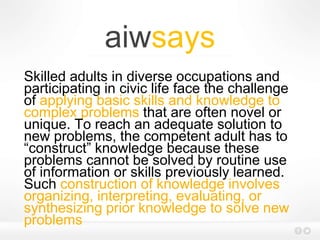
aiwsays
Skilled adults in diverse occupations and
participating in civic life face the challenge
of applying basic skills and knowledge to
complex problems that are often novel or
unique. To reach an adequate solution to
new problems, the competent adult has to
“construct” knowledge because these
problems cannot be solved by routine use
of information or skills previously learned.
Such construction of knowledge involves
organizing, interpreting, evaluating, or
synthesizing prior knowledge to solve new
problems
summativeassessment
Allow for voice and choice
Focus on powerful verbs
Pair with quality rubrics
Do get “tool happy!”
Use the right tool
Consider Models that call for knowledge
construction (PBL, UbD, etc)
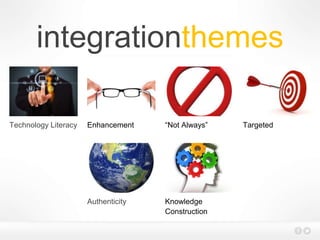
integrationthemes
Technology Literacy Enhancement “Not Always” Targeted
Authenticity Knowledge
Construction
Get in touch
contactme
Website
www.andrewkmiller.com
Twitter
@betamiller
Thankyou!

Technology Integration and the Common Core

  • 1.
    Technology Integration To MeetThe Needs Of The CCSS Andrew Miller @betamiller Go
  • 2.
  • 3.
    questions How does the CommonCore call for technology integration? What do you already know about Technology integration and the CCSS?
  • 4.
    ccsssays “To be readyfor college, workforce training, and life in a technological society, students need the ability to gather, comprehend, evaluate, synthesize, and report on information and ideas, to conduct original research in order to answer questions or solve problems, and to analyze and nonprint texts to create a high volume and extensive range of print and in media forms old and new.”
  • 5.
    ccsssays "New technologies havebroadened and expanded the role that speaking and listening play in acquiring and sharing knowledge and have tightened their link to other forms of communication. The Internet has accelerated the speed at which connections between speaking, listening, reading, and writing can be made, requiring that students be ready to use these modalities nearly simultaneously.”
  • 6.
    ccsssays "Students who arecollege and career ready employ technology thoughtfully to enhance their reading, writing, speaking, listening, and language use. They tailor their searches online to acquire useful information efficiently, and they integrate what they learn using technology with what they learn offline
  • 7.
    ccsssays When making mathematicalmodels, they know that technology can enable them to visualize the results of varying assumptions, explore consequences, and compare predictions with data…They are able to use technological tools to explore and deepen their understanding of concepts.
  • 9.
    unpack W.3.8 Recall information fromexperiences or gather information from print and digital sources; take brief notes on sources and sort evidence into provided categories. M 5.G.2 Represent real world and mathematical problems by graphing points in the first quadrant of the coordinate plane, and interpret coordinate values of points in the context of the situation.
  • 11.
    integrationthemes Technology Literacy Enhancement“Not Always” Targeted Authenticity Knowledge Construction
  • 12.
    integrationthemes Technology Literacy Enhancement“Not Always” Targeted Authenticity Knowledge Construction
  • 13.
    edleadershipsays “A whole hostof fundamental literacy implications, as well as global implications, come naturally from a simple yet profound focus on reading texts deeply, writing for digital environments collaboratively, and reading and writing nonfiction texts. It's a hopeful sign that our first widely adopted national standards, the Common Core State Standards, support and even encourage the teaching of these important tasks.” - William Kist, New Literacies and the Common Core
  • 15.
    istenetssay Research and informationfluency 1.Students apply digital tools to gather, evaluate, and use information. 2.Plan strategies to guide inquiry 3.Locate, organize, analyze, evaluate, synthesize, and ethically use information from a variety of sources and media 4.Evaluate and select information sources and digital tools based on the appropriateness to specific tasks 5.Process data and report results
  • 16.
    istenetssay Digital citizenship 1.Students understandhuman, cultural, and societal issues related to technology and practice legal and ethical behavior. 2.Advocate and practice safe, legal, and responsible use of information and technology 3.Exhibit a positive attitude toward using technology that supports collaboration, learning, and productivity 4.Demonstrate personal responsibility for lifelong learning 5.Exhibit leadership for digital citizenship
  • 18.
    integrationthemes Technology Literacy Enhancement“Not Always” Targeted Authenticity Knowledge Construction
  • 19.
    TEACHER RESPONSIBILITY STUDENT RESPONSIBILITY FocusedInstruction Guided Instruction “I do it” “We do it” “You do it together” Collaborative Learning Independent Learning “You do it alone” (c) Frey & Fisher, 2013
  • 20.
    formativeassessment Use technology tocheck for understanding Try pre-assessments Look for mistakes versus errors Do get “tool happy!” Use results to “feed forward” and differentiate
  • 21.
  • 22.
    integrationthemes Technology Literacy Enhancement“Not Always” Targeted Authenticity Knowledge Construction
  • 23.
    questions When might technology getin the way? When might be a good time not to use technology to meet the needs of the CCSS?
  • 24.
    ccssstandard 1.M F-IF.7 Graphfunctions expressed symbolically and show key features of the graph, by hand in simple cases and using technology for more complicated cases.
  • 26.
    integrationthemes Technology Literacy Enhancement“Not Always” Targeted Authenticity Knowledge Construction
  • 29.
    ccssstandard 1.SL.9-10.5. Grade 9-10students: Make strategic use of digital media (e.g., textual, graphical, audio, visual, and interactive elements) in presentations to enhance unstinting of findings, reasoning, and evidence and to add interest.
  • 30.
    ccssstandard 1.RI.8.7. Grade 8students: Evaluate the advantages of using different mediums (e.g., print or digital text, video, multimedia) to present a particular topic or idea.
  • 31.
    integrationthemes Technology Literacy Enhancement“Not Always” Targeted Authenticity Knowledge Construction
  • 33.
    disciplinaryliteracy Read like a_________________ Speak like a ________________ Write like a _________________
  • 34.
    authenticwork Real-world products Real-world process Real-worldresults Real-world challenges and scenarios Focus on collaboration and communication
  • 35.
    integrationthemes Technology Literacy Enhancement“Not Always” Targeted Authenticity Knowledge Construction
  • 36.
    aiwsays Skilled adults indiverse occupations and participating in civic life face the challenge of applying basic skills and knowledge to complex problems that are often novel or unique. To reach an adequate solution to new problems, the competent adult has to “construct” knowledge because these problems cannot be solved by routine use of information or skills previously learned. Such construction of knowledge involves organizing, interpreting, evaluating, or synthesizing prior knowledge to solve new problems
  • 37.
    summativeassessment Allow for voiceand choice Focus on powerful verbs Pair with quality rubrics Do get “tool happy!” Use the right tool Consider Models that call for knowledge construction (PBL, UbD, etc)
  • 38.
    integrationthemes Technology Literacy Enhancement“Not Always” Targeted Authenticity Knowledge Construction
  • 40.
  • 41.