Chowdary Kodali Chowdary Kodali
Dept of Education Chowdary Kodali
About me Training Specialist @ Kenexa Technologies Specializes in e-Learning Training & Development Holds a degree in e-learning Technologies www.koda.li www.twitter.com/chowkodali [email_address] Chowdary Kodali
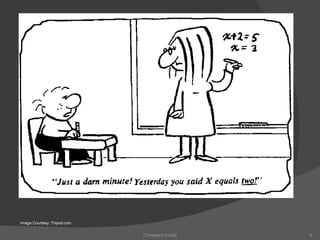
Chowdary Kodali Image Courtesy: Tripod.com
Agenda Current learning/teaching styles in Indian education system Why Technology? How can it help? Different kinds of techs for Education Benefits and drawbacks Wrap Up Chowdary Kodali
Some insight The world’s first university was established in Takshila in 700 BC. More than 10,300 studied more than 60 subjects.  The literacy ratio of India is 65.38% In nearly 60% of schools, there are less than two teachers to teach Classes I to V. Only 20% of habitation has a secondary school and 53% has a Primary School. Chowdary Kodali
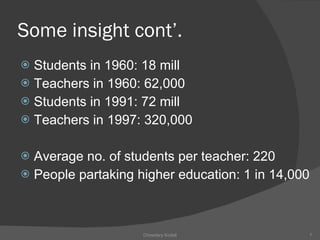
Some insight cont’. Students in 1960: 18 mill Teachers in 1960: 62,000 Students in 1991: 72 mill Teachers in 1997: 320,000 Average no. of students per teacher: 220 People partaking higher education: 1 in 14,000 Chowdary Kodali
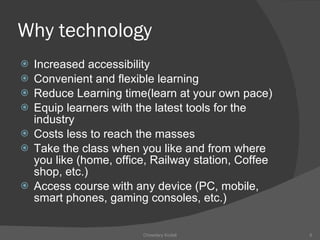
Why technology Increased accessibility Convenient and flexible learning Reduce Learning time(learn at your own pace) Equip learners with the latest tools for the industry Costs less to reach the masses Take the class when you like and from where you like (home, office, Railway station, Coffee shop, etc.) Access course with any device (PC, mobile, smart phones, gaming consoles, etc.) Chowdary Kodali
WEB 2.0 WEB 2.0 tools are used in e-learning for: content creation authoring Publishing Hosting Collaborating  Sharing and lot more…… Chowdary Kodali Image Courtesy: grizzlymedia
A Vision of students today Chowdary Kodali Direct link:  http://www.youtube.com/watch?v=dGCJ46vyR9o
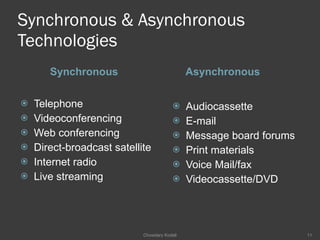
Synchronous & Asynchronous Technologies Synchronous Asynchronous Telephone Videoconferencing Web conferencing Direct-broadcast satellite Internet radio Live streaming Audiocassette E-mail Message board forums Print materials Voice Mail/fax Videocassette/DVD Chowdary Kodali
Different Technologies Classroom Computers, Websites, blogs, wikis, Discussion boards, face book, Orkut, Twitter etc.. Mobile, Smart phones, Gaming Consoles Interactive games, Multimedia, animations Ubiquitous tools Chowdary Kodali
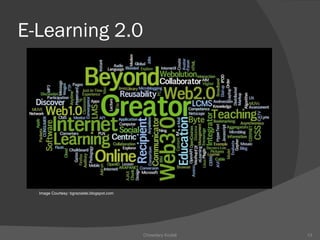
E-Learning 2.0 Image Courtesy: bgraziadei.blogspot.com Chowdary Kodali
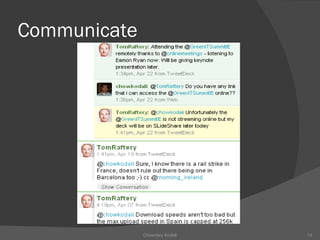
Communicate Chowdary Kodali
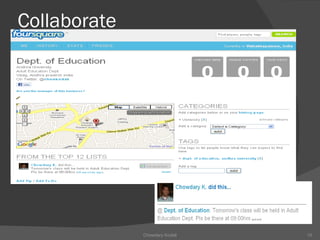
Collaborate Chowdary Kodali
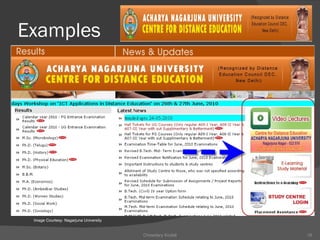
Examples Chowdary Kodali Image Courtesy: Nagarjuna University
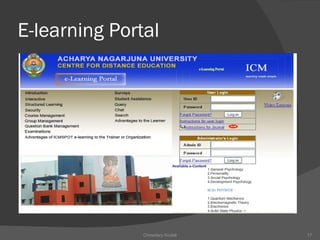
E-learning Portal Chowdary Kodali
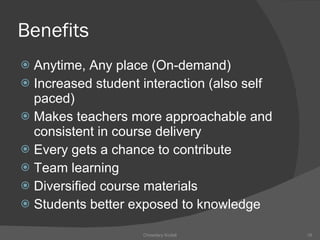
Benefits Anytime, Any place (On-demand) Increased student interaction (also self paced) Makes teachers more approachable and consistent in course delivery Every gets a chance to contribute Team learning Diversified course materials Students better exposed to knowledge Chowdary Kodali
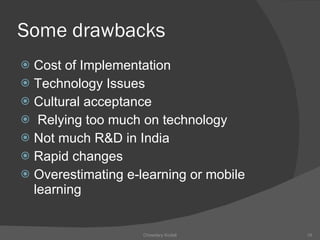
Some drawbacks Cost of Implementation Technology Issues Cultural acceptance Relying too much on technology Not much R&D in India Rapid changes Overestimating e-learning or mobile learning Chowdary Kodali
Conclusion For Successful implementation of Technology in education: Plan (Set goals and have vision) Align (get support from senior personnel) Integrate (classroom, online, satellite, telephone) Motivate ( think how to motivate learners) Market ( Tell users how it can help them) Evaluate and refine (get feedback and improve) Chowdary Kodali
Questions ?? Chowdary Kodali
Chowdary Kodali

Technology In Education

  • 1.
  • 2.
    Dept of EducationChowdary Kodali
  • 3.
    About me TrainingSpecialist @ Kenexa Technologies Specializes in e-Learning Training & Development Holds a degree in e-learning Technologies www.koda.li www.twitter.com/chowkodali [email_address] Chowdary Kodali
  • 4.
    Chowdary Kodali ImageCourtesy: Tripod.com
  • 5.
    Agenda Current learning/teachingstyles in Indian education system Why Technology? How can it help? Different kinds of techs for Education Benefits and drawbacks Wrap Up Chowdary Kodali
  • 6.
    Some insight Theworld’s first university was established in Takshila in 700 BC. More than 10,300 studied more than 60 subjects. The literacy ratio of India is 65.38% In nearly 60% of schools, there are less than two teachers to teach Classes I to V. Only 20% of habitation has a secondary school and 53% has a Primary School. Chowdary Kodali
  • 7.
    Some insight cont’.Students in 1960: 18 mill Teachers in 1960: 62,000 Students in 1991: 72 mill Teachers in 1997: 320,000 Average no. of students per teacher: 220 People partaking higher education: 1 in 14,000 Chowdary Kodali
  • 8.
    Why technology Increasedaccessibility Convenient and flexible learning Reduce Learning time(learn at your own pace) Equip learners with the latest tools for the industry Costs less to reach the masses Take the class when you like and from where you like (home, office, Railway station, Coffee shop, etc.) Access course with any device (PC, mobile, smart phones, gaming consoles, etc.) Chowdary Kodali
  • 9.
    WEB 2.0 WEB2.0 tools are used in e-learning for: content creation authoring Publishing Hosting Collaborating Sharing and lot more…… Chowdary Kodali Image Courtesy: grizzlymedia
  • 10.
    A Vision ofstudents today Chowdary Kodali Direct link: http://www.youtube.com/watch?v=dGCJ46vyR9o
  • 11.
    Synchronous & AsynchronousTechnologies Synchronous Asynchronous Telephone Videoconferencing Web conferencing Direct-broadcast satellite Internet radio Live streaming Audiocassette E-mail Message board forums Print materials Voice Mail/fax Videocassette/DVD Chowdary Kodali
  • 12.
    Different Technologies ClassroomComputers, Websites, blogs, wikis, Discussion boards, face book, Orkut, Twitter etc.. Mobile, Smart phones, Gaming Consoles Interactive games, Multimedia, animations Ubiquitous tools Chowdary Kodali
  • 13.
    E-Learning 2.0 ImageCourtesy: bgraziadei.blogspot.com Chowdary Kodali
  • 14.
  • 15.
  • 16.
    Examples Chowdary KodaliImage Courtesy: Nagarjuna University
  • 17.
  • 18.
    Benefits Anytime, Anyplace (On-demand) Increased student interaction (also self paced) Makes teachers more approachable and consistent in course delivery Every gets a chance to contribute Team learning Diversified course materials Students better exposed to knowledge Chowdary Kodali
  • 19.
    Some drawbacks Costof Implementation Technology Issues Cultural acceptance Relying too much on technology Not much R&D in India Rapid changes Overestimating e-learning or mobile learning Chowdary Kodali
  • 20.
    Conclusion For Successfulimplementation of Technology in education: Plan (Set goals and have vision) Align (get support from senior personnel) Integrate (classroom, online, satellite, telephone) Motivate ( think how to motivate learners) Market ( Tell users how it can help them) Evaluate and refine (get feedback and improve) Chowdary Kodali
  • 21.
  • 22.

Editor's Notes

  • #2 Chowdary Kodali