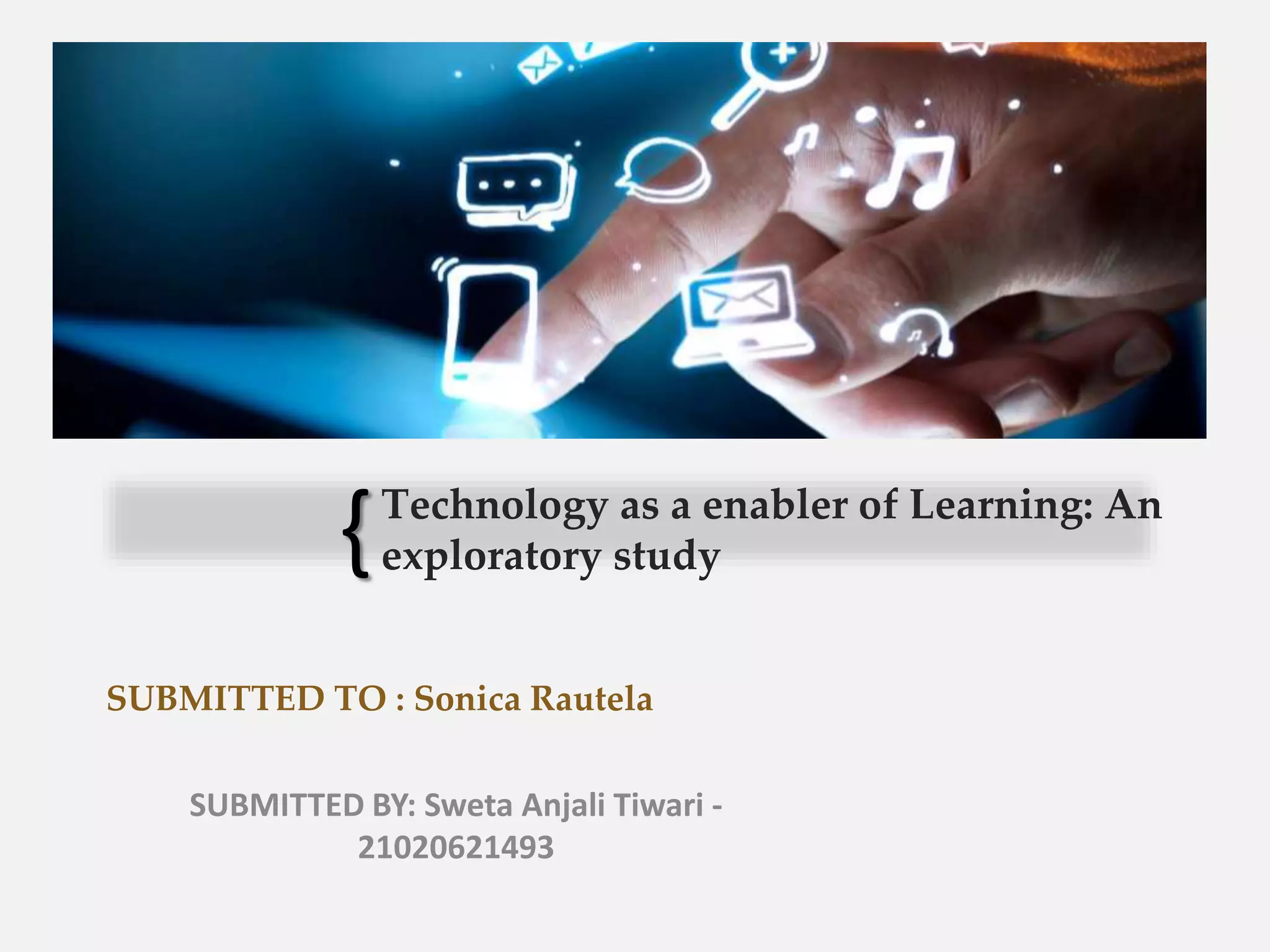
{Technology as a enabler of Learning: An
exploratory study
SUBMITTED TO : Sonica Rautela
SUBMITTED BY: Sweta Anjali Tiwari -
21020621493
Research Objective
1. To explore the factors affecting acceptance of technology in education
2. To identify the relationship among different technology variables
Research methodology
The research methodolgy used in my research paper was mostly the qualitative data
that are collected by other authors who have written Thier research on the similar
topics and have found the effect of technology on education and its advantages and
disadvantages along with the future predictions that how technology will influence
the education system.

 Introduction
 Educational Technology
 Technological devices used in Education
 Impact of Technological devices in Education
 Positive findings
 Negative findings
 Conclusion
Content
 As we all know that, the era of 21st century is often regarded as an
era of technology. Technology, today, plays a very important role
in our life. It is seen as a basis of growth of an economy.
 An economy which is poor in technology can never grow in
today’s scenario. This is because technology makes our work much
easier and less time consuming.
 The impact of technology can be felt in every possible field one
such field is EDUCATION.
Introduction

 The application of scientific laws and principles for the purpose
of making life easy and comfortable is technology.
 Educational technology is that science of strategies and
techniques which leads us to the educational goals.
 By using educational technology students learn, what they
want to learn.
 This is applicable through all stages of human knowledge. i.e.
Preservation, transmission, advancement of knowledge.
 Preservation of knowledge: printed book, tape-recorders, CDs,
pen-drive,etc.
 Transition of knowl. : teacher , T.V, internet, etc.
 We said Advancement of knowledge, when knowledge reaches
through machines.
Educational Technology

 Computer
 Internet
 E-books
 Virtual class
 Audio-books
Technological devices used in Education

Impact of Technology in
Education
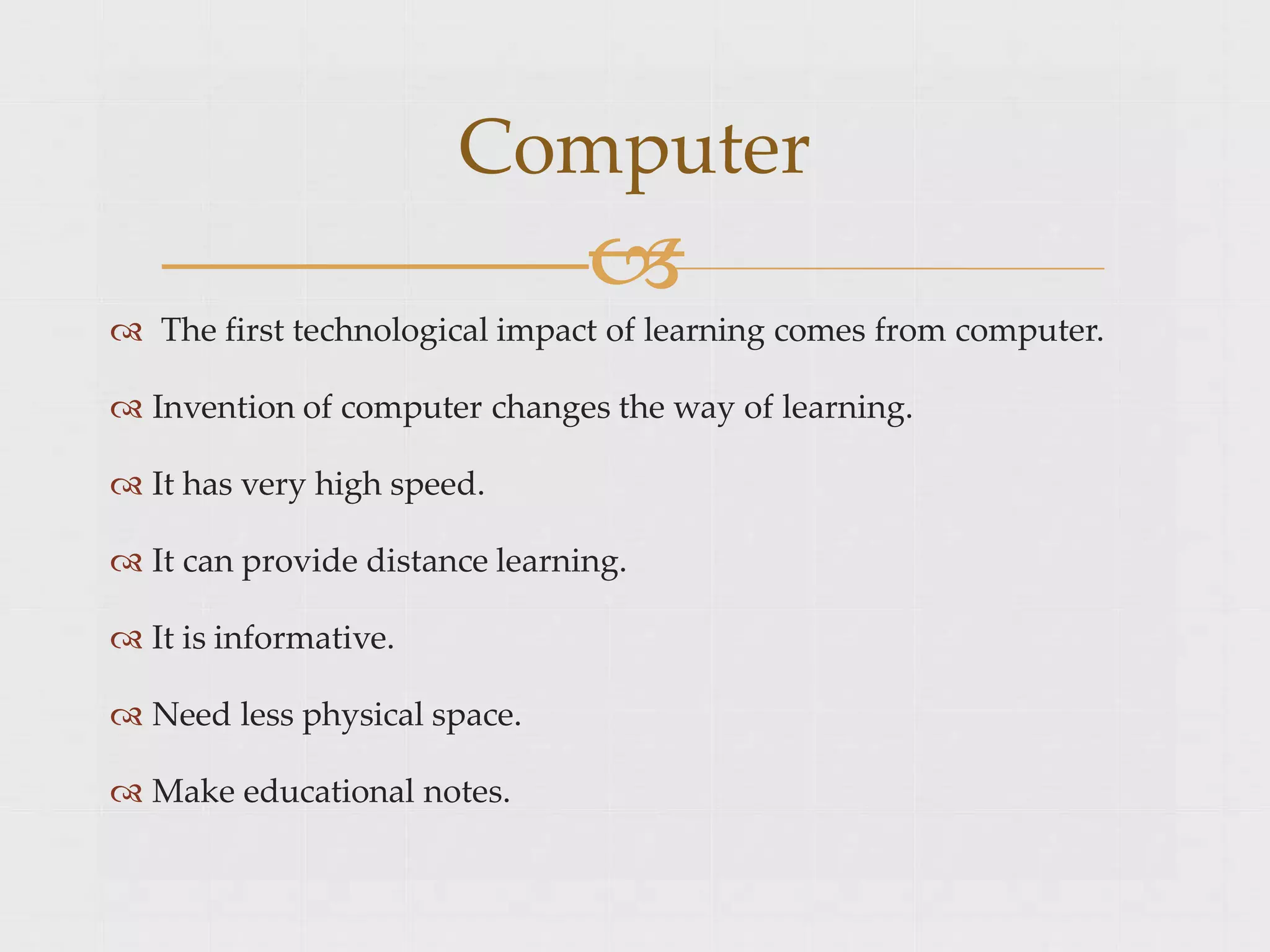
Computer

 The first technological impact of learning comes from computer.
 Invention of computer changes the way of learning.
 It has very high speed.
 It can provide distance learning.
 It is informative.
 Need less physical space.
 Make educational notes.
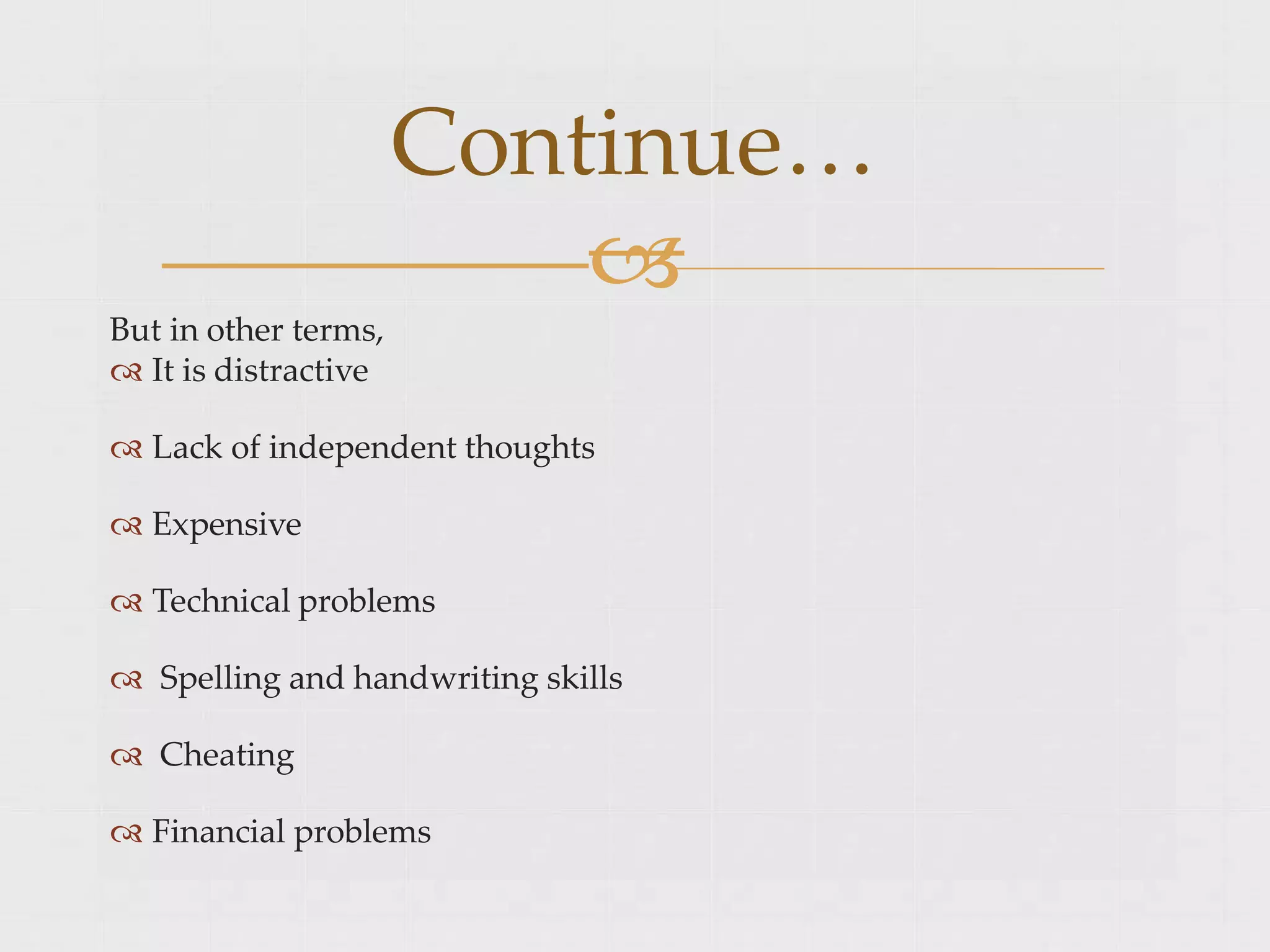
Continue…

But in other terms,
 It is distractive
 Lack of independent thoughts
 Expensive
 Technical problems
 Spelling and handwriting skills
 Cheating
 Financial problems

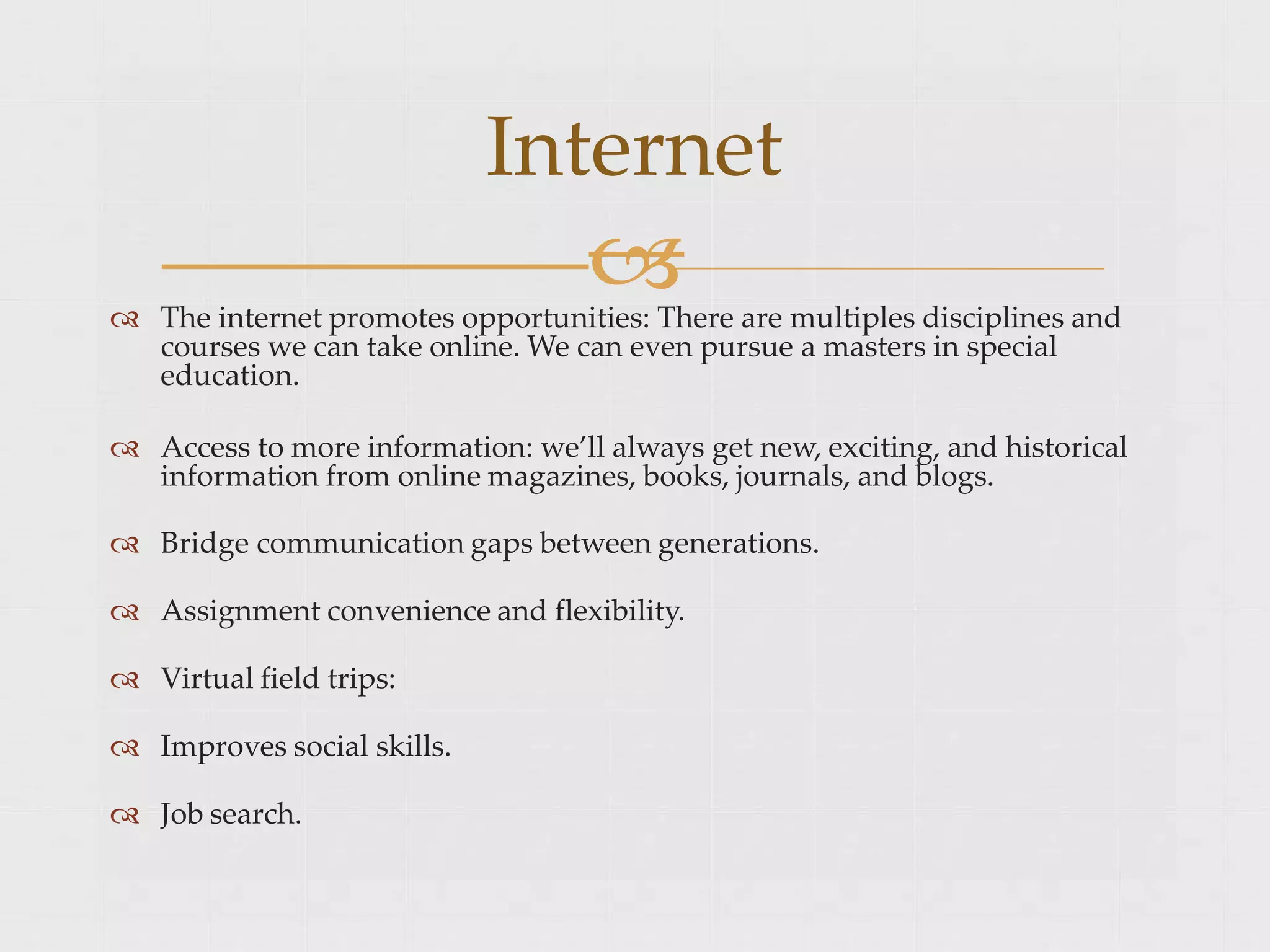
Internet
 The internet promotes opportunities: There are multiples disciplines and
courses we can take online. We can even pursue a masters in special
education.
 Access to more information: we’ll always get new, exciting, and historical
information from online magazines, books, journals, and blogs.
 Bridge communication gaps between generations.
 Assignment convenience and flexibility.
 Virtual field trips:
 Improves social skills.
 Job search.
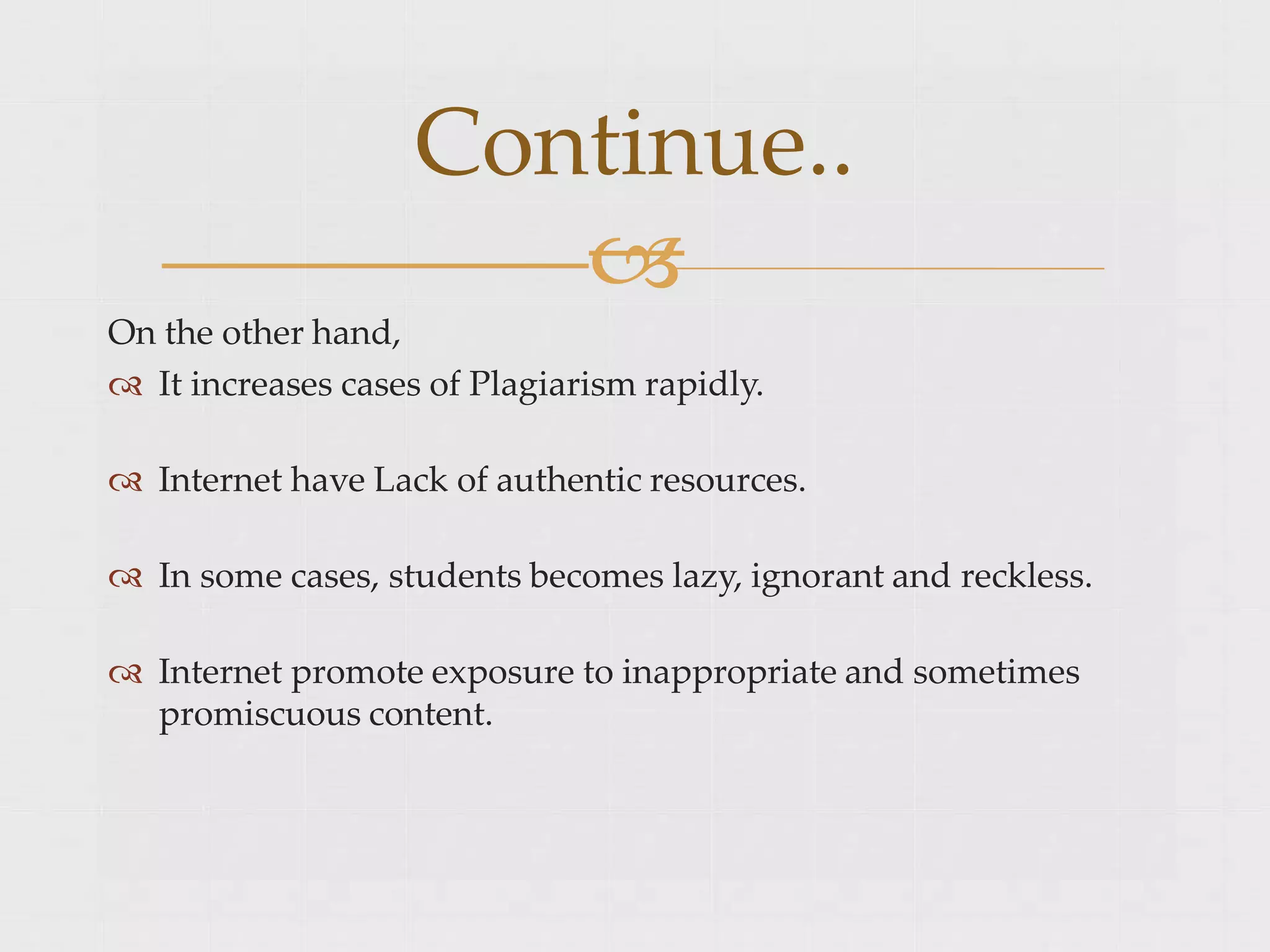
On the other hand,
 It increases cases of Plagiarism rapidly.
 Internet have Lack of authentic resources.
 In some cases, students becomes lazy, ignorant and reckless.
 Internet promote exposure to inappropriate and sometimes
promiscuous content.
Continue..

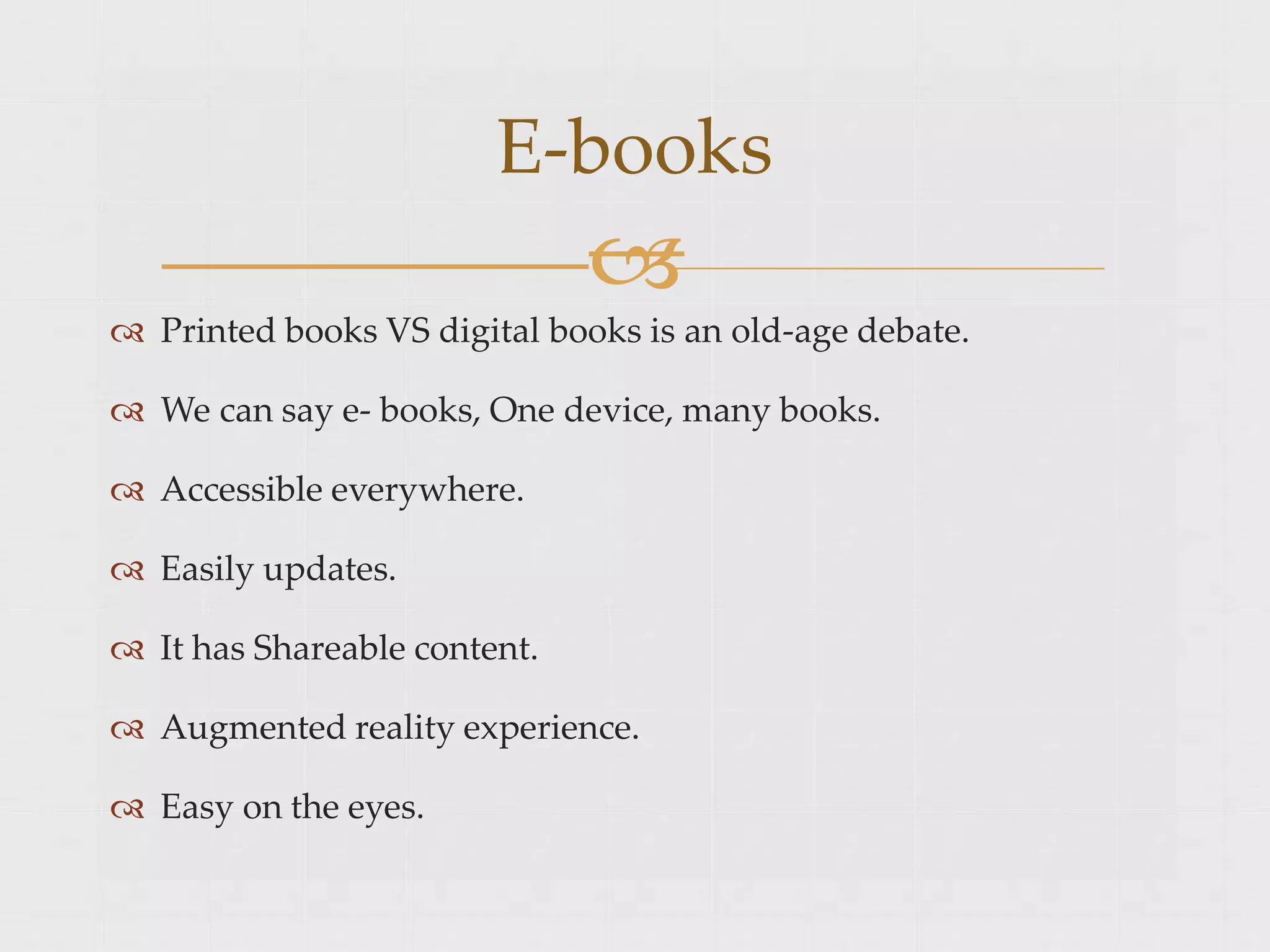
 Printed books VS digital books is an old-age debate.
 We can say e- books, One device, many books.
 Accessible everywhere.
 Easily updates.
 It has Shareable content.
 Augmented reality experience.
 Easy on the eyes.
E-books

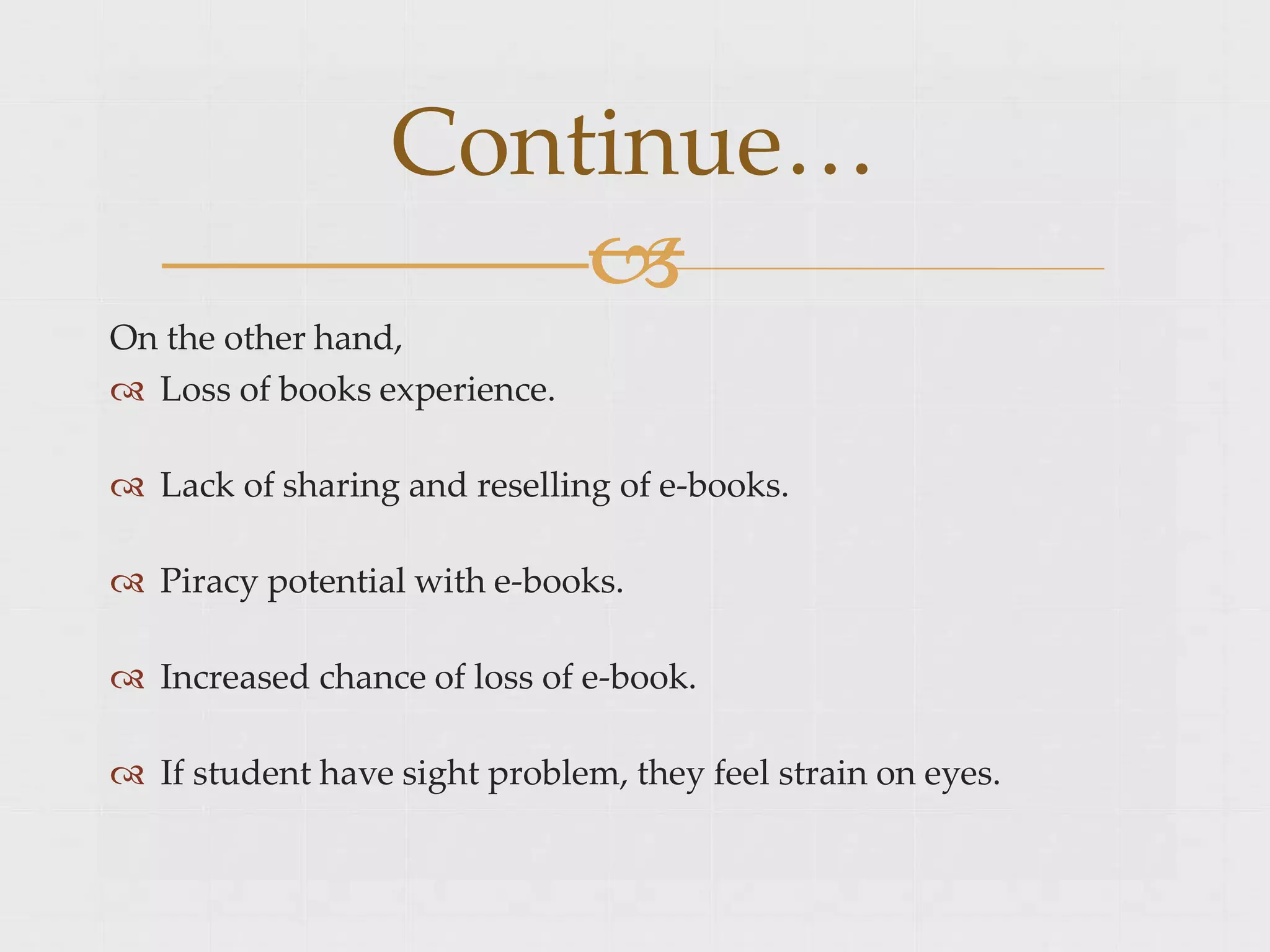
On the other hand,
 Loss of books experience.
 Lack of sharing and reselling of e-books.
 Piracy potential with e-books.
 Increased chance of loss of e-book.
 If student have sight problem, they feel strain on eyes.
Continue…


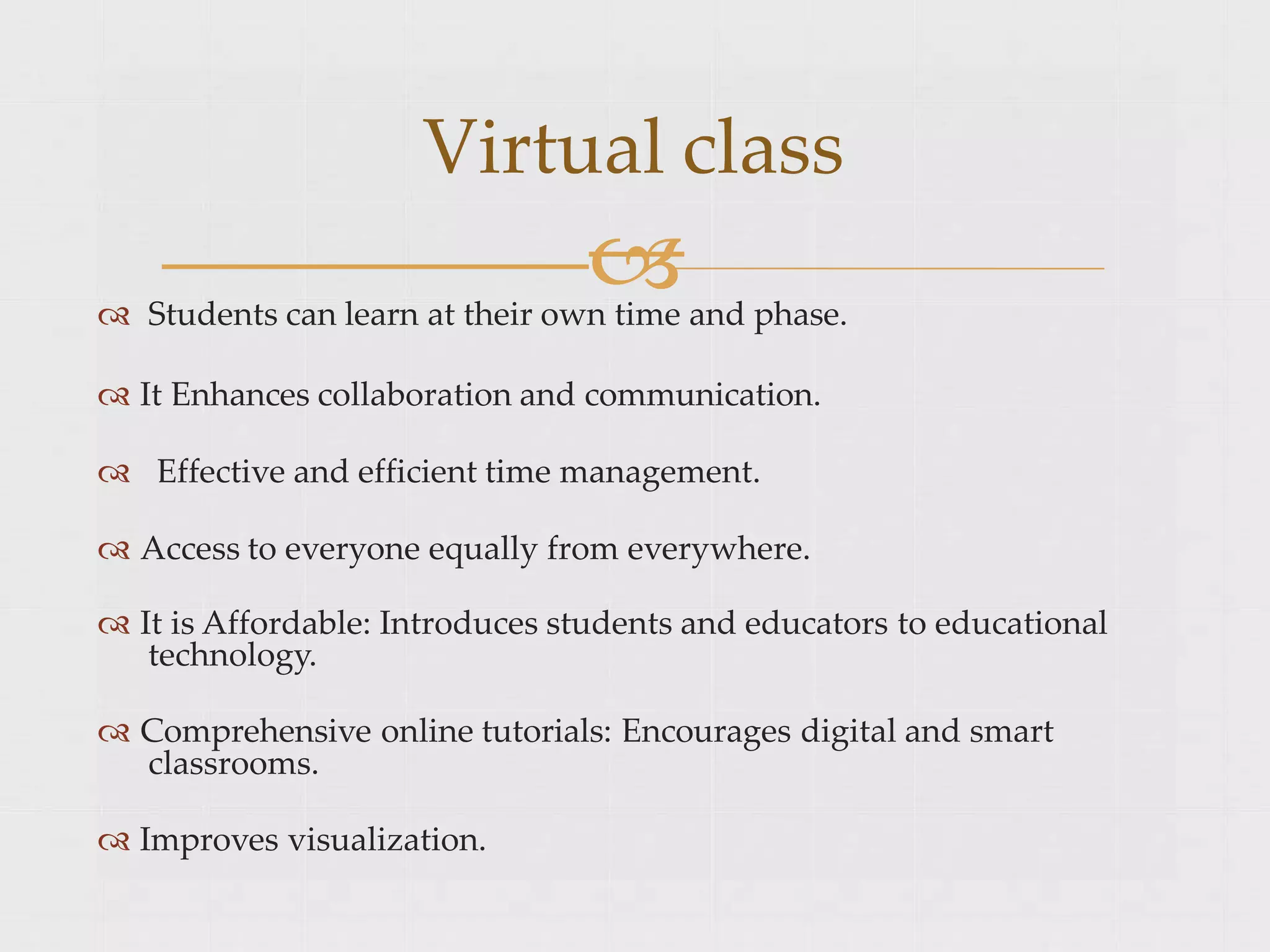
 Students can learn at their own time and phase.
 It Enhances collaboration and communication.
 Effective and efficient time management.
 Access to everyone equally from everywhere.
 It is Affordable: Introduces students and educators to educational
technology.
 Comprehensive online tutorials: Encourages digital and smart
classrooms.
 Improves visualization.
Virtual class

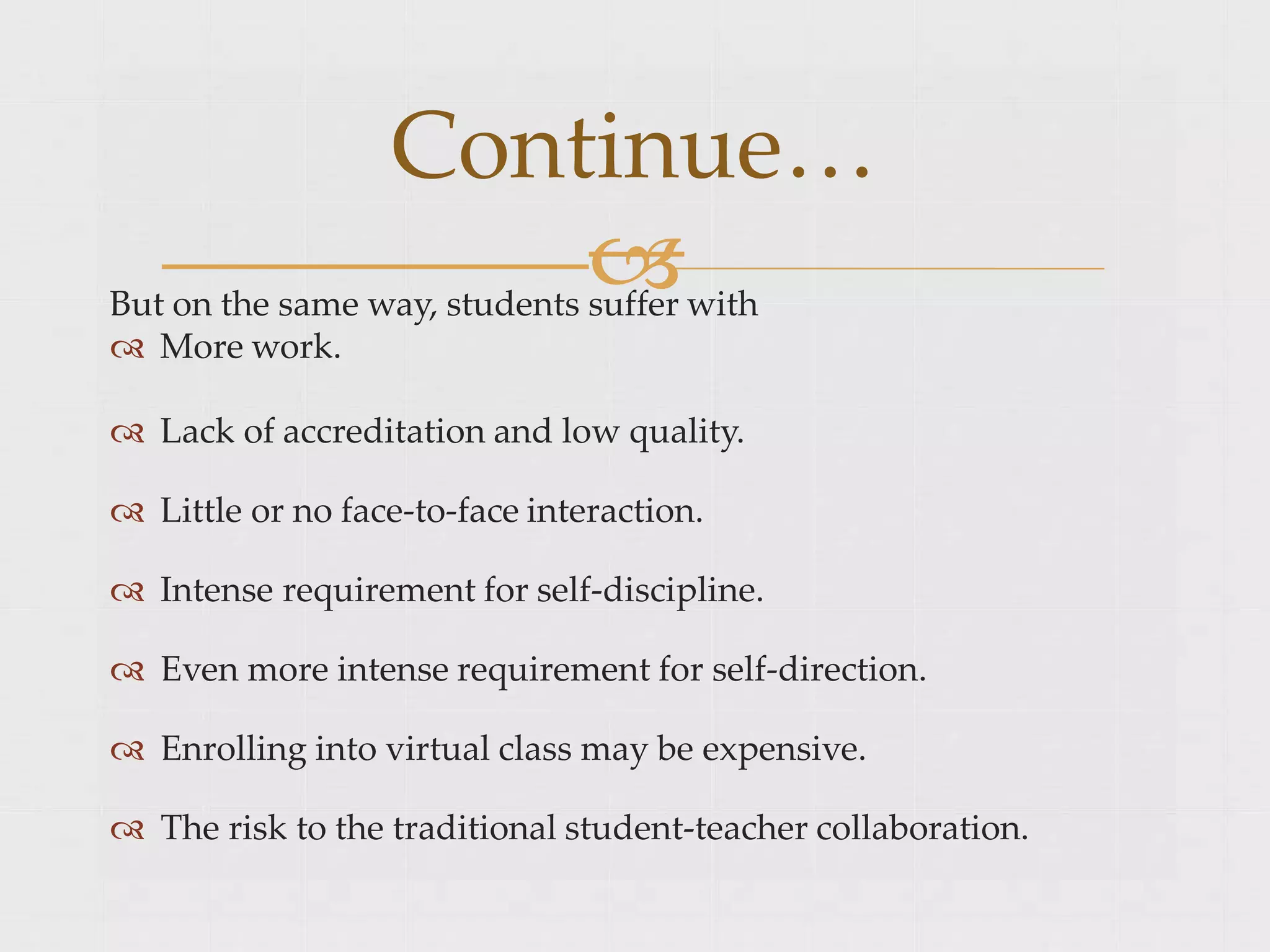
But on the same way, students suffer with
 More work.
 Lack of accreditation and low quality.
 Little or no face-to-face interaction.
 Intense requirement for self-discipline.
 Even more intense requirement for self-direction.
 Enrolling into virtual class may be expensive.
 The risk to the traditional student-teacher collaboration.
Continue…

 Audio books are available for blind students.
 It can be easily downloaded and can be shared.
 It is convenient for group teaching.
 It is economical and it can be used over and again.
 It captures attention.
 It can be used for drill and practice.
 It can be used for drawings and illustrations from the
textbooks.
Audio-books
Audio books lags here,
 Time consuming for teachers.
 Technical faults.
 Some animations will not be supported by all systems.
 Speakers create slide so they have something to present rather
than outlining, organising, and focusing on their message.
Continue..

 Improves engagement:
 Improves knowledge retention
 Encourages individual learning
 Encourages collaboration
 Students recognise and learn faster .
 Students can learn useful life skills through
technology.
Positive findings

 Immense expenditures.
 Insufficient methods of teaching.
 Transforming learners into inefficient learners.
 Waste of valuable time.
 Misguided by wrong information.
 Plagiarism increases.
Negative findings

 Extinct of good handwriting.
 Partial to the low-income group.
 Replacing books with e-books.
 Major challenges for teachers.
 Makes learners disconnected from the real world.
 A major drawback of losing assignment for students.
Continue..


Technology has a positive impact on education and at the same
time may also pose negative effects.
Whenever there is light, there is a shadow. Technology can
make us fly higher and higher in the sky but at the same time it
can even ruin our life with its negative features. Technology can
enhance our knowledge at the same time it can even lower our
grade in education.
Teachers and students should take advantage of this in the
good light and eliminate the drawbacks which are pulling back
many of students as well as schools from achieving excellence.
It is, thus, time for every country to introduce a more
technologically equipped education sector in the future.
Conclusion
Thank you

project 1 pp.pptx

  • 1.
    {Technology as aenabler of Learning: An exploratory study SUBMITTED TO : Sonica Rautela SUBMITTED BY: Sweta Anjali Tiwari - 21020621493
  • 2.
    Research Objective 1. Toexplore the factors affecting acceptance of technology in education 2. To identify the relationship among different technology variables Research methodology The research methodolgy used in my research paper was mostly the qualitative data that are collected by other authors who have written Thier research on the similar topics and have found the effect of technology on education and its advantages and disadvantages along with the future predictions that how technology will influence the education system.
  • 3.
      Introduction  EducationalTechnology  Technological devices used in Education  Impact of Technological devices in Education  Positive findings  Negative findings  Conclusion Content
  • 4.
     As weall know that, the era of 21st century is often regarded as an era of technology. Technology, today, plays a very important role in our life. It is seen as a basis of growth of an economy.  An economy which is poor in technology can never grow in today’s scenario. This is because technology makes our work much easier and less time consuming.  The impact of technology can be felt in every possible field one such field is EDUCATION. Introduction 
  • 5.
     The applicationof scientific laws and principles for the purpose of making life easy and comfortable is technology.  Educational technology is that science of strategies and techniques which leads us to the educational goals.  By using educational technology students learn, what they want to learn.  This is applicable through all stages of human knowledge. i.e. Preservation, transmission, advancement of knowledge.  Preservation of knowledge: printed book, tape-recorders, CDs, pen-drive,etc.  Transition of knowl. : teacher , T.V, internet, etc.  We said Advancement of knowledge, when knowledge reaches through machines. Educational Technology 
  • 7.
     Computer  Internet E-books  Virtual class  Audio-books Technological devices used in Education 
  • 8.
  • 9.
    Computer   The firsttechnological impact of learning comes from computer.  Invention of computer changes the way of learning.  It has very high speed.  It can provide distance learning.  It is informative.  Need less physical space.  Make educational notes.
  • 10.
    Continue…  But in otherterms,  It is distractive  Lack of independent thoughts  Expensive  Technical problems  Spelling and handwriting skills  Cheating  Financial problems
  • 11.
     Internet  The internetpromotes opportunities: There are multiples disciplines and courses we can take online. We can even pursue a masters in special education.  Access to more information: we’ll always get new, exciting, and historical information from online magazines, books, journals, and blogs.  Bridge communication gaps between generations.  Assignment convenience and flexibility.  Virtual field trips:  Improves social skills.  Job search.
  • 12.
    On the otherhand,  It increases cases of Plagiarism rapidly.  Internet have Lack of authentic resources.  In some cases, students becomes lazy, ignorant and reckless.  Internet promote exposure to inappropriate and sometimes promiscuous content. Continue.. 
  • 13.
     Printed booksVS digital books is an old-age debate.  We can say e- books, One device, many books.  Accessible everywhere.  Easily updates.  It has Shareable content.  Augmented reality experience.  Easy on the eyes. E-books 
  • 14.
    On the otherhand,  Loss of books experience.  Lack of sharing and reselling of e-books.  Piracy potential with e-books.  Increased chance of loss of e-book.  If student have sight problem, they feel strain on eyes. Continue… 
  • 15.
      Students canlearn at their own time and phase.  It Enhances collaboration and communication.  Effective and efficient time management.  Access to everyone equally from everywhere.  It is Affordable: Introduces students and educators to educational technology.  Comprehensive online tutorials: Encourages digital and smart classrooms.  Improves visualization. Virtual class
  • 16.
     But on thesame way, students suffer with  More work.  Lack of accreditation and low quality.  Little or no face-to-face interaction.  Intense requirement for self-discipline.  Even more intense requirement for self-direction.  Enrolling into virtual class may be expensive.  The risk to the traditional student-teacher collaboration. Continue…
  • 17.
      Audio booksare available for blind students.  It can be easily downloaded and can be shared.  It is convenient for group teaching.  It is economical and it can be used over and again.  It captures attention.  It can be used for drill and practice.  It can be used for drawings and illustrations from the textbooks. Audio-books
  • 18.
    Audio books lagshere,  Time consuming for teachers.  Technical faults.  Some animations will not be supported by all systems.  Speakers create slide so they have something to present rather than outlining, organising, and focusing on their message. Continue.. 
  • 19.
     Improves engagement: Improves knowledge retention  Encourages individual learning  Encourages collaboration  Students recognise and learn faster .  Students can learn useful life skills through technology. Positive findings 
  • 20.
     Immense expenditures. Insufficient methods of teaching.  Transforming learners into inefficient learners.  Waste of valuable time.  Misguided by wrong information.  Plagiarism increases. Negative findings 
  • 21.
     Extinct ofgood handwriting.  Partial to the low-income group.  Replacing books with e-books.  Major challenges for teachers.  Makes learners disconnected from the real world.  A major drawback of losing assignment for students. Continue.. 
  • 22.
     Technology has apositive impact on education and at the same time may also pose negative effects. Whenever there is light, there is a shadow. Technology can make us fly higher and higher in the sky but at the same time it can even ruin our life with its negative features. Technology can enhance our knowledge at the same time it can even lower our grade in education. Teachers and students should take advantage of this in the good light and eliminate the drawbacks which are pulling back many of students as well as schools from achieving excellence. It is, thus, time for every country to introduce a more technologically equipped education sector in the future. Conclusion
  • 23.