Technology for Plastic Mold Tooling - 
Direct Metal Dep sition
Abstract 
Abbreviations 
Table of Contents 
Plastic Injection Mold Tooling 
Moldflow Analysis 
Direct Metal Deposition (DMD) 
Evaluation of DMD Technology for Mold Productivity 
Comparative Analysis –Steel Mold vs. Copper Mold coated with 
H13 Steel by DMD 
Conclusion 
References 
Author Info 
3 
3 
4 
5 
6 
8 
9 
10 
11 
11 
© 2014, HCL Technologies. Reproduction Prohibited. This document is protected under Copyright by the Author, all rights reserved.
Abstract 
Technology for Plastic Mold Tooling - Direct Metal Deposition | 3 
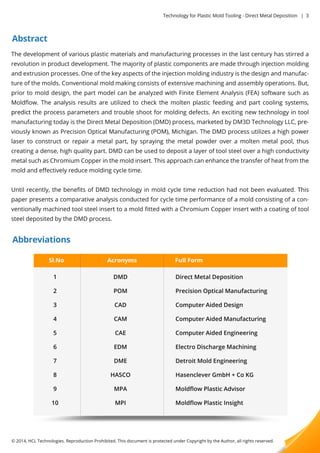
The development of various plastic materials and manufacturing processes in the last century has stirred a 
revolution in product development. The majority of plastic components are made through injection molding 
and extrusion processes. One of the key aspects of the injection molding industry is the design and manufac-ture 
of the molds. Conventional mold making consists of extensive machining and assembly operations. But, 
prior to mold design, the part model can be analyzed with Finite Element Analysis (FEA) software such as 
Moldflow. The analysis results are utilized to check the molten plastic feeding and part cooling systems, 
pprreeddiicctt the process parameters and trouble shoot for molding defects. An exciting new technology in tool 
manufacturing today is the Direct Metal Deposition (DMD) process, marketed by DM3D Technology LLC, pre-viously 
known as Precision Optical Manufacturing (POM), Michigan. The DMD process utilizes a high power 
laser to construct or repair a metal part, by spraying the metal powder over a molten metal pool, thus 
creating a dense, high quality part. DMD can be used to deposit a layer of tool steel over a high conductivity 
metal such as Chromium Copper in the mold insert. This approach can enhance the transfer of heat from the 
mold and effectively reduce molding cycle time. 
Until recently, the benefits of DMD technology in mold cycle time reduction had not been evaluated. This 
paper presents a comparative analysis conducted for cycle time performance of a mold consisting of a con-ventionally 
machined tool steel insert to a mold fitted with a Chromium Copper insert with a coating of tool 
steel deposited by the DMD process. 
Abbreviations 
Sl.No 
1 
2 
3 
4 
5 
6 
7 
8 
9 
10 
Acronyms Full Form 
DMD 
POM 
CAD 
CAM 
CAE 
EDM 
DDMMEE 
HASCO 
MPA 
MPI 
Direct Metal Deposition 
Precision Optical Manufacturing 
Computer Aided Design 
Computer Aided Manufacturing 
Computer Aided Engineering 
Electro Discharge Machining 
DDeettrrooiitt MMoolldd EEnnggiinneeeerriinngg 
Hasenclever GmbH + Co KG 
Moldflow Plastic Advisor 
Moldflow Plastic Insight 
© 2014, HCL Technologies. Reproduction Prohibited. This document is protected under Copyright by the Author, all rights reserved.
Plastic Injection Mold Tooling 
Technology for Plastic Mold Tooling - Direct Metal Deposition | 4 
Injection molding is a process in which plastic is melted and forced into a mold in a molding machine, and 
cooled to form a part. An injection mold is an assembly of steel plates consisting of mainly two halves with 
impressions or cavities of the part to be molded. The mold has two halves representing the inside surface 
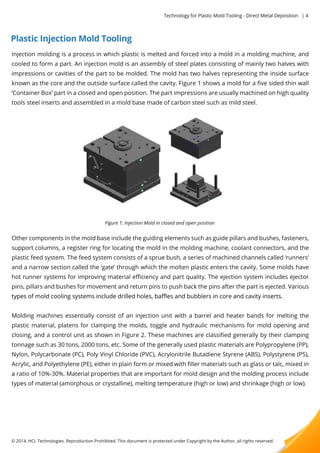
known as the core and the outside surface called the cavity. Figure 1 shows a mold for a five sided thin wall 
‘Container Box’ part in a closed and open position. The part impressions are usually machined on high quality 
tools steel inserts and assembled in a mold base made of carbon steel such as mild steel. 
Figure 1: Injection Mold in closed and open position 
Other components in the mold base include the guiding elements such as guide pillars and bushes, fasteners, 
support columns, a register ring for locating the mold in the molding machine, coolant connectors, and the 
plastic feed system. The feed system consists of a sprue bush, a series of machined channels called ‘runners’ 
and a narrow section called the ‘gate’ through which the molten plastic enters the cavity. Some molds have 
hot runner systems for improving material efficiency and part quality. The ejection system includes ejector 
pins, pillars and bushes for movement and return pins to push back the pins after the part is ejected. Various 
types of mold cooling systems include drilled holes, baffles and bubblers in core aanndd ccaavviittyy iinnsseerrttss.. 
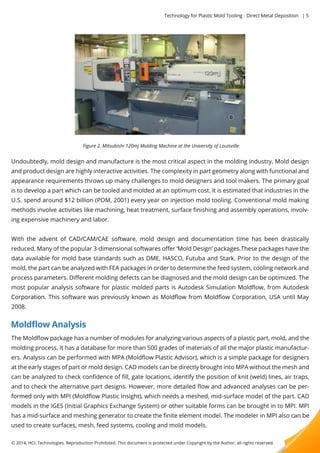
Molding machines essentially consist of an injection unit with a barrel and heater bands for melting the 
plastic material, platens for clamping the molds, toggle and hydraulic mechanisms for mold opening and 
closing, and a control unit as shown in Figure 2. These machines are classified generally by their clamping 
tonnage such as 30 tons, 2000 tons, etc. Some of the generally used plastic materials are Polypropylene (PP), 
Nylon, Polycarbonate (PC), Poly Vinyl Chloride (PVC), Acrylonitrile Butadiene Styrene (ABS), Polystyrene (PS), 
Acrylic, and Polyethylene (PE), either in plain form or mixed with filler materials such as glass or talc, mixed in 
aa ratio of 10%-30%. Material properties that are important for mold design and the molding process include 
types of material (amorphous or crystalline), melting temperature (high or low) and shrinkage (high or low). 
© 2014, HCL Technologies. Reproduction Prohibited. This document is protected under Copyright by the Author, all rights reserved.
Technology for Plastic Mold Tooling - Direct Metal Deposition | 5 
Figure 2. Mitsubishi 120mj Molding Machine at the University of Louisville 
Undoubtedly, mold design and manufacture is the most critical aspect in the molding industry. Mold design 
and product design are highly interactive activities. The complexity in part geometry along with functional and 
appearance requirements throws up many challenges to mold designers and tool makers. The primary goal 
is to develop a part which can be tooled and molded at an optimum cost. It is estimated that industries in the 
U.S. spend around $12 billion (POM, 2001) every year on injection mold tooling. Conventional mold making 
methods involve activities like machining, heat treatment, surface finishing and assembly operations, involv-ing 
expensive machinery and labor. 
WWiitthh the advent of CAD/CAM/CAE software, mold design and documentation time has been drastically 
reduced. Many of the popular 3-dimensional softwares offer ‘Mold Design’ packages.These packages have the 
data available for mold base standards such as DME, HASCO, Futuba and Stark. Prior to the design of the 
mold, the part can be analyzed with FEA packages in order to determine the feed system, cooling network and 
process parameters. Different molding defects can be diagnosed and the mold design can be optimized. The 
most popular analysis software for plastic molded parts is Autodesk Simulation Moldflow, from Autodesk 
CCoorrppoorraattiioonn.. This software was previously known as Moldflow from Moldflow Corporation, USA until May 
2008. 
Moldflow Analysis 
The Moldflow package has a number of modules for analyzing various aspects of a plastic part, mold, and the 
molding process. It has a database for more than 500 grades of materials of all the major plastic manufactur-ers. 
Analysis can be performed with MPA (Moldflow Plastic Advisor), which is a simple package for designers 
at the early stages of part or mold design. CAD models can be directly brought into MPA without the mesh and 
can be analyzed to check confidence of fill, gate locations, identify the position of knit (weld) lines, air traps, 
and to check the alternative part designs. However, more detailed flow and advanced analyses can be per-ffoorrmmeedd 
only with MPI (Moldflow Plastic Insight), which needs a meshed, mid-surface model of the part. CAD 
models in the IGES (Initial Graphics Exchange System) or other suitable forms can be brought in to MPI. MPI 
has a mid-surface and meshing generator to create the finite element model. The modeler in MPI also can be 
used to create surfaces, mesh, feed systems, cooling and mold models. 
© 2014, HCL Technologies. Reproduction Prohibited. This document is protected under Copyright by the Author, all rights reserved.
Technology for Plastic Mold Tooling - Direct Metal Deposition | 6 
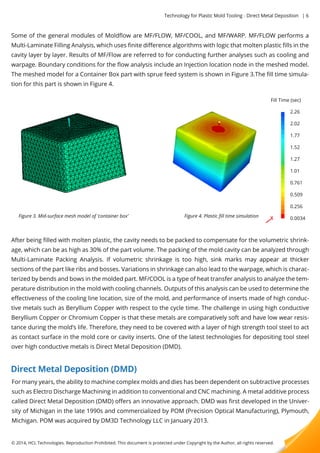
Some of the general modules of Moldflow are MF/FLOW, MF/COOL, and MF/WARP. MF/FLOW performs a 
Multi-Laminate Filling Analysis, which uses finite difference algorithms with logic that molten plastic fills in the 
cavity layer by layer. Results of MF/Flow are referred to for conducting further analyses such as cooling and 
warpage. Boundary conditions for the flow analysis include an Injection location node in the meshed model. 
The meshed model for a Container Box part with sprue feed system is shown in Figure 3.The fill time simula-tion 
for this part is shown in Figure 4. 
Figure 3. Mid-surface mesh model of ‘container box’ Figure 4. Plastic fill time simulation 
Fill Time (sec) 
After being filled with molten plastic, the cavity needs to be packed to compensate for the volumetric shrink-age, 
which can be as high as 30% of the part volume. The packing of the mold cavity can be analyzed through 
Multi-Laminate Packing Analysis. If volumetric shrinkage is too high, sink marks may appear at thicker 
sections of the part like ribs and bosses. Variations in shrinkage can also lead to the warpage, which is charac-terized 
by bends and bows in the molded part. MF/COOL is a type of heat transfer analysis to analyze the tem-perature 
distribution in the mold with cooling channels. Outputs of this analysis can be used to determine the 
effectiveness of the cooling line location, size of the mold, and performance of inserts made of high conduc-tive 
metals such as Beryllium Copper with respect to the cycle time. The challenge in using high conductive 
Beryllium Copper or Chromium Copper is that these metals are comparatively soft and have low wear resis-tance 
during the mold’s life. Therefore, they need to be covered with a layer of high strength tool steel to act 
as contact surface in the mold core or cavity inserts. One of the latest technologies for depositing tool steel 
over high conductive metals is Direct Metal Deposition (DMD). 
Direct Metal Deposition (DMD) 
For many years, the ability to machine complex molds and dies has been dependent on subtractive processes 
such as Electro Discharge Machining in addition to conventional and CNC machining. A metal additive process 
called Direct Metal Deposition (DMD) offers an innovative approach. DMD was first developed in the Univer-sity 
of Michigan in the late 1990s and commercialized by POM (Precision Optical Manufacturing), Plymouth, 
Michigan. POM was acquired by DM3D Technology LLC in January 2013. 
© 2014, HCL Technologies. Reproduction Prohibited. This document is protected under Copyright by the Author, all rights reserved. 
2.26 
2.02 
1.77 
1.52 
1.27 
1.01 
00..776611 
0.509 
0.256 
0.0034
Technology for Plastic Mold Tooling - Direct Metal Deposition | 7 
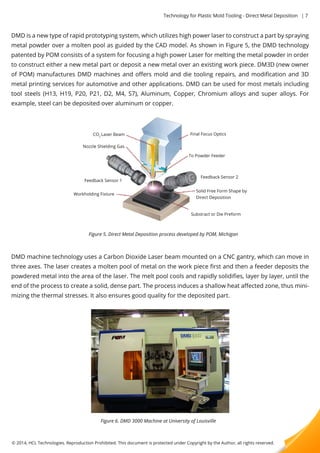
DMD is a new type of rapid prototyping system, which utilizes high power laser to construct a part by spraying 
metal powder over a molten pool as guided by the CAD model. As shown in Figure 5, the DMD technology 
patented by POM consists of a system for focusing a high power Laser for melting the metal powder in order 
to construct either a new metal part or deposit a new metal over an existing work piece. DM3D (new owner 
of POM) manufactures DMD machines and offers mold and die tooling repairs, and modification and 3D 
metal printing services for automotive and other applications. DMD can be used for most metals including 
ttooooll steels (H13, H19, P20, P21, D2, M4, S7), Aluminum, Copper, Chromium alloys and super alloys. For 
example, steel can be deposited over aluminum or copper. 
Final Focus Optics 
To Powder Feeder 
CO2 Laser Beam 
Nozzle Shielding Gas 
Feedback Sensor 1 
Workholding Fixture 
Feedback Sensor 2 
Solid Free Form Shape by 
Direct Deposition 
Substract or Die Preform 
Figure 5. Direct Metal Deposition process developed by POM, Michigan 
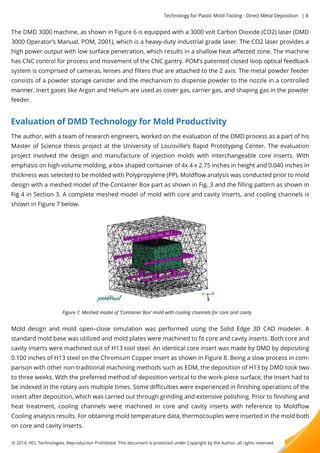
DMD machine technology uses a Carbon Dioxide Laser beam mounted on a CNC gantry, which can move in 
three axes. The laser creates a molten pool of metal on the work piece first and then a feeder deposits the 
powdered metal into the area of the laser. The melt pool cools and rapidly solidifies, layer by layer, until the 
end of the process to create a solid, dense part. The process induces a shallow heat affected zone, thus mini-mizing 
the thermal stresses. It also ensures good quality for the deposited part. 
Figure 6. DMD 3000 Machine at University of Louisville 
© 2014, HCL Technologies. Reproduction Prohibited. This document is protected under Copyright by the Author, all rights reserved.
Technology for Plastic Mold Tooling - Direct Metal Deposition | 8 
The DMD 3000 machine, as shown in Figure 6 is equipped with a 3000 volt Carbon Dioxide (CO2) laser (DMD 
3000 Operator’s Manual, POM, 2001), which is a heavy-duty industrial grade laser. The CO2 laser provides a 
high power output with low surface penetration, which results in a shallow heat affected zone. The machine 
has CNC control for process and movement of the CNC gantry. POM’s patented closed loop optical feedback 
system is comprised of cameras, lenses and filters that are attached to the Z axis. The metal powder feeder 
consists of a powder storage canister and the mechanism to dispense powder to the nozzle in a controlled 
mmaannnneerr.. Inert gases like Argon and Helium are used as cover gas, carrier gas, and shaping gas in the powder 
feeder. 
Evaluation of DMD Technology for Mold Productivity 
The author, with a team of research engineers, worked on the evaluation of the DMD process as a part of his 
Master of Science thesis project at the University of Louisville’s Rapid Prototyping Center. The evaluation 
project involved the design and manufacture of injection molds with interchangeable core inserts. With 
emphasis on high volume molding, a box shaped container of 4x 4 x 2.75 inches in height and 0.040 inches in 
thickness was selected to be molded with Polypropylene (PP). Moldflow analysis was conducted prior to mold 
design with a meshed model of the Container Box part as shown in Fig. 3 and the filling pattern as shown in 
FFiigg 4 in Section 3. A complete meshed model of mold with core and cavity inserts, and cooling channels is 
shown in Figure 7 below. 
Figure 7. Meshed model of ‘Container Box’ mold with cooling channels for core and cavity 
Mold design and mold open–close simulation was performed using the Solid Edge 3D CAD modeler. A 
standard mold base was utilized and mold plates were machined to fit core and cavity inserts. Both core and 
cavity inserts were machined out of H13 tool steel. An identical core insert was made by DMD by depositing 
0.100 inches of H13 steel on the Chromium Copper insert as shown in Figure 8. Being a slow process in com-parison 
with other non-traditional machining methods such as EDM, the deposition of H13 by DMD took two 
to three weeks. With the preferred method of deposition vertical to the work-piece surface, the insert had to 
bbee indexed in the rotary axis multiple times. Some difficulties were experienced in finishing operations of the 
insert after deposition, which was carried out through grinding and extensive polishing. Prior to finishing and 
heat treatment, cooling channels were machined in core and cavity inserts with reference to Moldflow 
Cooling analysis results. For obtaining mold temperature data, thermocouples were inserted in the mold both 
on core and cavity inserts. 
© 2014, HCL Technologies. Reproduction Prohibited. This document is protected under Copyright by the Author, all rights reserved.
Figure 8. Semi-finished Chromium Copper Insert coated 
with H13 tool steel by DMD 
Technology for Plastic Mold Tooling - Direct Metal Deposition | 9 
Figure 9. Container Box mold mounted in 
120mj Molding Machine 
Successive molding production runs were carried out for the mold with core inserts made of conventional 
machining and inserts made with the DMD process. Figure 9 shows the Container Box mold mounted in 
platens of the Mitsubishi 120mj machine during the molding runs. Molding cycle times for both types of 
inserts were recorded and the differences were observed. Mold core and cavity temperature were continu-ously 
monitored in both cases with digital thermocouples, and variations were recorded. The molded box 
parts were checked for warpage and other visible defects. 
Comparative Analysis –Steel Mold vs. Copper Mold coated with 
H13 Steel by DMD 
When the performance of the Steel mold (mold consisting of H13 steel insert) and the Copper mold (mold 
consisting of Chromium Copper Insert coated with H13 steel by DMD process) was analyzed with Moldflow, 
the following results were observed as mentioned in Table 1. The copper mold showed better performance 
in molded part temperature (lower temperature difference than steel mold), overall mold temperature 
(cooler than steel mold) as well as cooling effectiveness (higher heat dissipation by the coolant). 
Parameters 
Temperature difference in 
the molded part 
Mold Top Temperature 
Mold Bottom Temperature 
Coolant Temperature Rise 
DMD Copper Mold (° F) Difference (° F) 
Steel Mold (° F) 
26 
103 
97 
1 
-9.6 
-4.3 
-2.4 
0.7 
16.4 
98.7 
94.6 
1.7 
© 2014, HCL Technologies. Reproduction Prohibited. This document is protected under Copyright by the Author, all rights reserved.
Technology for Plastic Mold Tooling - Direct Metal Deposition | 10 
After collecting data from multiple molding runs with different settings for mold temperature, plastic melt 
temperature and packing pressure, the following observations were made from the data analysis for perfor-mance 
between the Steel mold and the Copper mold (with H13 steel coating by DMD). 
Maintaining the same dimensions and part quality, the achieved cycle time was 22 seconds for the 
Steel mold and 15 seconds for the Copper mold 
The cycle time saving of 7 seconds or approximately 32% will yield significant savings when such box 
parts are molded in the millions. 
With constant packing pressure, the Copper mold showed a 100% increase in cooling rate compared 
to the Steel mold. 
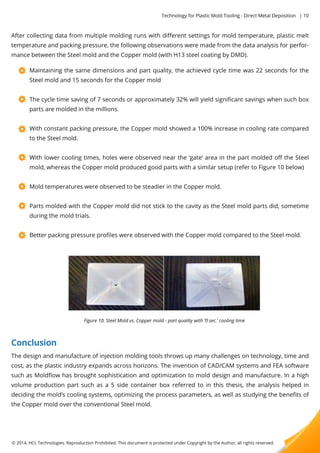
WWiitthh lower cooling times, holes were observed near the ‘gate’ area in the part molded off the Steel 
mold, whereas the Copper mold produced good parts with a similar setup (refer to Figure 10 below) 
Mold temperatures were observed to be steadier in the Copper mold. 
Parts molded with the Copper mold did not stick to the cavity as the Steel mold parts did, sometime 
during the mold trials. 
Better packing pressure profiles were observed with the Copper mold compared to the Steel mold. 
Figure 10. Steel Mold vs. Copper mold - part quality with ‘0 sec.’ cooling time 
Conclusion 
The design and manufacture of injection molding tools throws up many challenges on technology, time and 
cost, as the plastic industry expands across horizons. The invention of CAD/CAM systems and FEA software 
such as Moldflow has brought sophistication and optimization to mold design and manufacture. In a high 
volume production part such as a 5 side container box referred to in this thesis, the analysis helped in 
deciding the mold’s cooling systems, optimizing the process parameters, as well as studying the benefits of 
the Copper mold over the conventional Steel mold. 
© 2014, HCL Technologies. Reproduction Prohibited. This document is protected under Copyright by the Author, all rights reserved.
Technology for Plastic Mold Tooling - Direct Metal Deposition | 11 
The development of the DMD process is a milestone in mold manufacturing. The ability of this process to 
deposit tool steels over high conductivity metals and to construct the conformal cooling channels in the mold, 
can bring phenomenal reduction in molding cycle time. Cycle time optimization not only results in cost 
savings, but also ensures faster product delivery schedules. Employment of DMD processes for depositing 
H13 tool steel over the high conductivity chromium copper insert in this project was critical in obtaining a 
wear resistant molding surface. Significant saving of 32% in the cycle time achieved in the Copper mold 
ccooaatteedd wwiitthh HH1133 SStteeeell hhaass ccoonnfifirrmmeedd tthhee bbeenneefifittss ooff tthhiiss ccuuttttiinngg eeddggee tteecchhnnoollooggyy.. 
Reference 
1. Pundarik Bhat, Rammohan K. Ragade and Julius P. Wong, “DMD Process and Injection Molding Tool Development”, EDA 2002, 
Maui, Hawaii, August 2002 
2. Pundarik Bhat, “A Plastic Injection Molding Productivity Study”, Master of Science Thesis, University of Louisville, Louisville, KY 
2003 
3. Mold Design User’s Guide, I-DEAS 9.0 Mold Design Software, EDS (Electronic Data Systems)., 2001. 
4. DMD 3000 Operator’s Manual, POM (Precision Optical Machining), 2001. 
55.. wwwwww..PPOOMM..ccoomm,, ((wweebbssiittee ooff DDMM33DD TTeecchhnnoollooggyy LLLLCC)),, 22001133 
6. www.POM.net, (website of POM Group), 2003 
7. www.Moldflow.com (Website of Moldflow Corporation, USA), 2003. 
8. www.Autodesk.com (Website of Autodesk Corporation), 2013 
This whitepaper is published by HCL Engineering and R&D Services. 
The views and opinions in this article are for informational purposes only and should not be considered as a substitute for professional 
business advice. The use herein of any trademarks is not an assertion of ownership of such trademarks by HCL nor intended to imply 
any association between HCL and lawful owners of such trademarks. 
For more information about HCL Engineering and R&D Services, 
Please visit http://www.hcltech.com/engineering-rd-services 
Copyright@ HHCCLL TTeecchhnnoollooggiieess 
All rights reserved. 
Hello, I’m from HCL’s Engineering and R&D Services. We enable technology led organizations to go to market with innovative products 
and solutions. We patner with our customers in building world class products and creating associated solution delivery ecosystems 
to help bring market leadership. We develop engineering products, solutions and platforms across Aerospace and Defense, 
Automotive, Consumer Electronics, Software, Online, Industrial Manufacturing, Medical Devices, Networking and Telecom, Office 
Automation, Semiconductor and Servers & Storage for our customers. 
For more details contact: ers.info@hcl.com 
Follow us on twitter: http://twitter.com/hclers and 
Our blog http://www.hcltech.com/blogs/engineering-and-rd-services 
Visit our website: http://www.hcltech.com/engineering-rd-services 
Author Info 
Pundarik Bhat 
HCL Engineering and R&D Services

Technology for Plastic Mold Tooling - Direct Metal Deposition

  • 1.
    Technology for PlasticMold Tooling - Direct Metal Dep sition
  • 2.
    Abstract Abbreviations Tableof Contents Plastic Injection Mold Tooling Moldflow Analysis Direct Metal Deposition (DMD) Evaluation of DMD Technology for Mold Productivity Comparative Analysis –Steel Mold vs. Copper Mold coated with H13 Steel by DMD Conclusion References Author Info 3 3 4 5 6 8 9 10 11 11 © 2014, HCL Technologies. Reproduction Prohibited. This document is protected under Copyright by the Author, all rights reserved.
  • 3.
    Abstract Technology forPlastic Mold Tooling - Direct Metal Deposition | 3 The development of various plastic materials and manufacturing processes in the last century has stirred a revolution in product development. The majority of plastic components are made through injection molding and extrusion processes. One of the key aspects of the injection molding industry is the design and manufac-ture of the molds. Conventional mold making consists of extensive machining and assembly operations. But, prior to mold design, the part model can be analyzed with Finite Element Analysis (FEA) software such as Moldflow. The analysis results are utilized to check the molten plastic feeding and part cooling systems, pprreeddiicctt the process parameters and trouble shoot for molding defects. An exciting new technology in tool manufacturing today is the Direct Metal Deposition (DMD) process, marketed by DM3D Technology LLC, pre-viously known as Precision Optical Manufacturing (POM), Michigan. The DMD process utilizes a high power laser to construct or repair a metal part, by spraying the metal powder over a molten metal pool, thus creating a dense, high quality part. DMD can be used to deposit a layer of tool steel over a high conductivity metal such as Chromium Copper in the mold insert. This approach can enhance the transfer of heat from the mold and effectively reduce molding cycle time. Until recently, the benefits of DMD technology in mold cycle time reduction had not been evaluated. This paper presents a comparative analysis conducted for cycle time performance of a mold consisting of a con-ventionally machined tool steel insert to a mold fitted with a Chromium Copper insert with a coating of tool steel deposited by the DMD process. Abbreviations Sl.No 1 2 3 4 5 6 7 8 9 10 Acronyms Full Form DMD POM CAD CAM CAE EDM DDMMEE HASCO MPA MPI Direct Metal Deposition Precision Optical Manufacturing Computer Aided Design Computer Aided Manufacturing Computer Aided Engineering Electro Discharge Machining DDeettrrooiitt MMoolldd EEnnggiinneeeerriinngg Hasenclever GmbH + Co KG Moldflow Plastic Advisor Moldflow Plastic Insight © 2014, HCL Technologies. Reproduction Prohibited. This document is protected under Copyright by the Author, all rights reserved.
  • 4.
    Plastic Injection MoldTooling Technology for Plastic Mold Tooling - Direct Metal Deposition | 4 Injection molding is a process in which plastic is melted and forced into a mold in a molding machine, and cooled to form a part. An injection mold is an assembly of steel plates consisting of mainly two halves with impressions or cavities of the part to be molded. The mold has two halves representing the inside surface known as the core and the outside surface called the cavity. Figure 1 shows a mold for a five sided thin wall ‘Container Box’ part in a closed and open position. The part impressions are usually machined on high quality tools steel inserts and assembled in a mold base made of carbon steel such as mild steel. Figure 1: Injection Mold in closed and open position Other components in the mold base include the guiding elements such as guide pillars and bushes, fasteners, support columns, a register ring for locating the mold in the molding machine, coolant connectors, and the plastic feed system. The feed system consists of a sprue bush, a series of machined channels called ‘runners’ and a narrow section called the ‘gate’ through which the molten plastic enters the cavity. Some molds have hot runner systems for improving material efficiency and part quality. The ejection system includes ejector pins, pillars and bushes for movement and return pins to push back the pins after the part is ejected. Various types of mold cooling systems include drilled holes, baffles and bubblers in core aanndd ccaavviittyy iinnsseerrttss.. Molding machines essentially consist of an injection unit with a barrel and heater bands for melting the plastic material, platens for clamping the molds, toggle and hydraulic mechanisms for mold opening and closing, and a control unit as shown in Figure 2. These machines are classified generally by their clamping tonnage such as 30 tons, 2000 tons, etc. Some of the generally used plastic materials are Polypropylene (PP), Nylon, Polycarbonate (PC), Poly Vinyl Chloride (PVC), Acrylonitrile Butadiene Styrene (ABS), Polystyrene (PS), Acrylic, and Polyethylene (PE), either in plain form or mixed with filler materials such as glass or talc, mixed in aa ratio of 10%-30%. Material properties that are important for mold design and the molding process include types of material (amorphous or crystalline), melting temperature (high or low) and shrinkage (high or low). © 2014, HCL Technologies. Reproduction Prohibited. This document is protected under Copyright by the Author, all rights reserved.
  • 5.
    Technology for PlasticMold Tooling - Direct Metal Deposition | 5 Figure 2. Mitsubishi 120mj Molding Machine at the University of Louisville Undoubtedly, mold design and manufacture is the most critical aspect in the molding industry. Mold design and product design are highly interactive activities. The complexity in part geometry along with functional and appearance requirements throws up many challenges to mold designers and tool makers. The primary goal is to develop a part which can be tooled and molded at an optimum cost. It is estimated that industries in the U.S. spend around $12 billion (POM, 2001) every year on injection mold tooling. Conventional mold making methods involve activities like machining, heat treatment, surface finishing and assembly operations, involv-ing expensive machinery and labor. WWiitthh the advent of CAD/CAM/CAE software, mold design and documentation time has been drastically reduced. Many of the popular 3-dimensional softwares offer ‘Mold Design’ packages.These packages have the data available for mold base standards such as DME, HASCO, Futuba and Stark. Prior to the design of the mold, the part can be analyzed with FEA packages in order to determine the feed system, cooling network and process parameters. Different molding defects can be diagnosed and the mold design can be optimized. The most popular analysis software for plastic molded parts is Autodesk Simulation Moldflow, from Autodesk CCoorrppoorraattiioonn.. This software was previously known as Moldflow from Moldflow Corporation, USA until May 2008. Moldflow Analysis The Moldflow package has a number of modules for analyzing various aspects of a plastic part, mold, and the molding process. It has a database for more than 500 grades of materials of all the major plastic manufactur-ers. Analysis can be performed with MPA (Moldflow Plastic Advisor), which is a simple package for designers at the early stages of part or mold design. CAD models can be directly brought into MPA without the mesh and can be analyzed to check confidence of fill, gate locations, identify the position of knit (weld) lines, air traps, and to check the alternative part designs. However, more detailed flow and advanced analyses can be per-ffoorrmmeedd only with MPI (Moldflow Plastic Insight), which needs a meshed, mid-surface model of the part. CAD models in the IGES (Initial Graphics Exchange System) or other suitable forms can be brought in to MPI. MPI has a mid-surface and meshing generator to create the finite element model. The modeler in MPI also can be used to create surfaces, mesh, feed systems, cooling and mold models. © 2014, HCL Technologies. Reproduction Prohibited. This document is protected under Copyright by the Author, all rights reserved.
  • 6.
    Technology for PlasticMold Tooling - Direct Metal Deposition | 6 Some of the general modules of Moldflow are MF/FLOW, MF/COOL, and MF/WARP. MF/FLOW performs a Multi-Laminate Filling Analysis, which uses finite difference algorithms with logic that molten plastic fills in the cavity layer by layer. Results of MF/Flow are referred to for conducting further analyses such as cooling and warpage. Boundary conditions for the flow analysis include an Injection location node in the meshed model. The meshed model for a Container Box part with sprue feed system is shown in Figure 3.The fill time simula-tion for this part is shown in Figure 4. Figure 3. Mid-surface mesh model of ‘container box’ Figure 4. Plastic fill time simulation Fill Time (sec) After being filled with molten plastic, the cavity needs to be packed to compensate for the volumetric shrink-age, which can be as high as 30% of the part volume. The packing of the mold cavity can be analyzed through Multi-Laminate Packing Analysis. If volumetric shrinkage is too high, sink marks may appear at thicker sections of the part like ribs and bosses. Variations in shrinkage can also lead to the warpage, which is charac-terized by bends and bows in the molded part. MF/COOL is a type of heat transfer analysis to analyze the tem-perature distribution in the mold with cooling channels. Outputs of this analysis can be used to determine the effectiveness of the cooling line location, size of the mold, and performance of inserts made of high conduc-tive metals such as Beryllium Copper with respect to the cycle time. The challenge in using high conductive Beryllium Copper or Chromium Copper is that these metals are comparatively soft and have low wear resis-tance during the mold’s life. Therefore, they need to be covered with a layer of high strength tool steel to act as contact surface in the mold core or cavity inserts. One of the latest technologies for depositing tool steel over high conductive metals is Direct Metal Deposition (DMD). Direct Metal Deposition (DMD) For many years, the ability to machine complex molds and dies has been dependent on subtractive processes such as Electro Discharge Machining in addition to conventional and CNC machining. A metal additive process called Direct Metal Deposition (DMD) offers an innovative approach. DMD was first developed in the Univer-sity of Michigan in the late 1990s and commercialized by POM (Precision Optical Manufacturing), Plymouth, Michigan. POM was acquired by DM3D Technology LLC in January 2013. © 2014, HCL Technologies. Reproduction Prohibited. This document is protected under Copyright by the Author, all rights reserved. 2.26 2.02 1.77 1.52 1.27 1.01 00..776611 0.509 0.256 0.0034
  • 7.
    Technology for PlasticMold Tooling - Direct Metal Deposition | 7 DMD is a new type of rapid prototyping system, which utilizes high power laser to construct a part by spraying metal powder over a molten pool as guided by the CAD model. As shown in Figure 5, the DMD technology patented by POM consists of a system for focusing a high power Laser for melting the metal powder in order to construct either a new metal part or deposit a new metal over an existing work piece. DM3D (new owner of POM) manufactures DMD machines and offers mold and die tooling repairs, and modification and 3D metal printing services for automotive and other applications. DMD can be used for most metals including ttooooll steels (H13, H19, P20, P21, D2, M4, S7), Aluminum, Copper, Chromium alloys and super alloys. For example, steel can be deposited over aluminum or copper. Final Focus Optics To Powder Feeder CO2 Laser Beam Nozzle Shielding Gas Feedback Sensor 1 Workholding Fixture Feedback Sensor 2 Solid Free Form Shape by Direct Deposition Substract or Die Preform Figure 5. Direct Metal Deposition process developed by POM, Michigan DMD machine technology uses a Carbon Dioxide Laser beam mounted on a CNC gantry, which can move in three axes. The laser creates a molten pool of metal on the work piece first and then a feeder deposits the powdered metal into the area of the laser. The melt pool cools and rapidly solidifies, layer by layer, until the end of the process to create a solid, dense part. The process induces a shallow heat affected zone, thus mini-mizing the thermal stresses. It also ensures good quality for the deposited part. Figure 6. DMD 3000 Machine at University of Louisville © 2014, HCL Technologies. Reproduction Prohibited. This document is protected under Copyright by the Author, all rights reserved.
  • 8.
    Technology for PlasticMold Tooling - Direct Metal Deposition | 8 The DMD 3000 machine, as shown in Figure 6 is equipped with a 3000 volt Carbon Dioxide (CO2) laser (DMD 3000 Operator’s Manual, POM, 2001), which is a heavy-duty industrial grade laser. The CO2 laser provides a high power output with low surface penetration, which results in a shallow heat affected zone. The machine has CNC control for process and movement of the CNC gantry. POM’s patented closed loop optical feedback system is comprised of cameras, lenses and filters that are attached to the Z axis. The metal powder feeder consists of a powder storage canister and the mechanism to dispense powder to the nozzle in a controlled mmaannnneerr.. Inert gases like Argon and Helium are used as cover gas, carrier gas, and shaping gas in the powder feeder. Evaluation of DMD Technology for Mold Productivity The author, with a team of research engineers, worked on the evaluation of the DMD process as a part of his Master of Science thesis project at the University of Louisville’s Rapid Prototyping Center. The evaluation project involved the design and manufacture of injection molds with interchangeable core inserts. With emphasis on high volume molding, a box shaped container of 4x 4 x 2.75 inches in height and 0.040 inches in thickness was selected to be molded with Polypropylene (PP). Moldflow analysis was conducted prior to mold design with a meshed model of the Container Box part as shown in Fig. 3 and the filling pattern as shown in FFiigg 4 in Section 3. A complete meshed model of mold with core and cavity inserts, and cooling channels is shown in Figure 7 below. Figure 7. Meshed model of ‘Container Box’ mold with cooling channels for core and cavity Mold design and mold open–close simulation was performed using the Solid Edge 3D CAD modeler. A standard mold base was utilized and mold plates were machined to fit core and cavity inserts. Both core and cavity inserts were machined out of H13 tool steel. An identical core insert was made by DMD by depositing 0.100 inches of H13 steel on the Chromium Copper insert as shown in Figure 8. Being a slow process in com-parison with other non-traditional machining methods such as EDM, the deposition of H13 by DMD took two to three weeks. With the preferred method of deposition vertical to the work-piece surface, the insert had to bbee indexed in the rotary axis multiple times. Some difficulties were experienced in finishing operations of the insert after deposition, which was carried out through grinding and extensive polishing. Prior to finishing and heat treatment, cooling channels were machined in core and cavity inserts with reference to Moldflow Cooling analysis results. For obtaining mold temperature data, thermocouples were inserted in the mold both on core and cavity inserts. © 2014, HCL Technologies. Reproduction Prohibited. This document is protected under Copyright by the Author, all rights reserved.
  • 9.
    Figure 8. Semi-finishedChromium Copper Insert coated with H13 tool steel by DMD Technology for Plastic Mold Tooling - Direct Metal Deposition | 9 Figure 9. Container Box mold mounted in 120mj Molding Machine Successive molding production runs were carried out for the mold with core inserts made of conventional machining and inserts made with the DMD process. Figure 9 shows the Container Box mold mounted in platens of the Mitsubishi 120mj machine during the molding runs. Molding cycle times for both types of inserts were recorded and the differences were observed. Mold core and cavity temperature were continu-ously monitored in both cases with digital thermocouples, and variations were recorded. The molded box parts were checked for warpage and other visible defects. Comparative Analysis –Steel Mold vs. Copper Mold coated with H13 Steel by DMD When the performance of the Steel mold (mold consisting of H13 steel insert) and the Copper mold (mold consisting of Chromium Copper Insert coated with H13 steel by DMD process) was analyzed with Moldflow, the following results were observed as mentioned in Table 1. The copper mold showed better performance in molded part temperature (lower temperature difference than steel mold), overall mold temperature (cooler than steel mold) as well as cooling effectiveness (higher heat dissipation by the coolant). Parameters Temperature difference in the molded part Mold Top Temperature Mold Bottom Temperature Coolant Temperature Rise DMD Copper Mold (° F) Difference (° F) Steel Mold (° F) 26 103 97 1 -9.6 -4.3 -2.4 0.7 16.4 98.7 94.6 1.7 © 2014, HCL Technologies. Reproduction Prohibited. This document is protected under Copyright by the Author, all rights reserved.
  • 10.
    Technology for PlasticMold Tooling - Direct Metal Deposition | 10 After collecting data from multiple molding runs with different settings for mold temperature, plastic melt temperature and packing pressure, the following observations were made from the data analysis for perfor-mance between the Steel mold and the Copper mold (with H13 steel coating by DMD). Maintaining the same dimensions and part quality, the achieved cycle time was 22 seconds for the Steel mold and 15 seconds for the Copper mold The cycle time saving of 7 seconds or approximately 32% will yield significant savings when such box parts are molded in the millions. With constant packing pressure, the Copper mold showed a 100% increase in cooling rate compared to the Steel mold. WWiitthh lower cooling times, holes were observed near the ‘gate’ area in the part molded off the Steel mold, whereas the Copper mold produced good parts with a similar setup (refer to Figure 10 below) Mold temperatures were observed to be steadier in the Copper mold. Parts molded with the Copper mold did not stick to the cavity as the Steel mold parts did, sometime during the mold trials. Better packing pressure profiles were observed with the Copper mold compared to the Steel mold. Figure 10. Steel Mold vs. Copper mold - part quality with ‘0 sec.’ cooling time Conclusion The design and manufacture of injection molding tools throws up many challenges on technology, time and cost, as the plastic industry expands across horizons. The invention of CAD/CAM systems and FEA software such as Moldflow has brought sophistication and optimization to mold design and manufacture. In a high volume production part such as a 5 side container box referred to in this thesis, the analysis helped in deciding the mold’s cooling systems, optimizing the process parameters, as well as studying the benefits of the Copper mold over the conventional Steel mold. © 2014, HCL Technologies. Reproduction Prohibited. This document is protected under Copyright by the Author, all rights reserved.
  • 11.
    Technology for PlasticMold Tooling - Direct Metal Deposition | 11 The development of the DMD process is a milestone in mold manufacturing. The ability of this process to deposit tool steels over high conductivity metals and to construct the conformal cooling channels in the mold, can bring phenomenal reduction in molding cycle time. Cycle time optimization not only results in cost savings, but also ensures faster product delivery schedules. Employment of DMD processes for depositing H13 tool steel over the high conductivity chromium copper insert in this project was critical in obtaining a wear resistant molding surface. Significant saving of 32% in the cycle time achieved in the Copper mold ccooaatteedd wwiitthh HH1133 SStteeeell hhaass ccoonnfifirrmmeedd tthhee bbeenneefifittss ooff tthhiiss ccuuttttiinngg eeddggee tteecchhnnoollooggyy.. Reference 1. Pundarik Bhat, Rammohan K. Ragade and Julius P. Wong, “DMD Process and Injection Molding Tool Development”, EDA 2002, Maui, Hawaii, August 2002 2. Pundarik Bhat, “A Plastic Injection Molding Productivity Study”, Master of Science Thesis, University of Louisville, Louisville, KY 2003 3. Mold Design User’s Guide, I-DEAS 9.0 Mold Design Software, EDS (Electronic Data Systems)., 2001. 4. DMD 3000 Operator’s Manual, POM (Precision Optical Machining), 2001. 55.. wwwwww..PPOOMM..ccoomm,, ((wweebbssiittee ooff DDMM33DD TTeecchhnnoollooggyy LLLLCC)),, 22001133 6. www.POM.net, (website of POM Group), 2003 7. www.Moldflow.com (Website of Moldflow Corporation, USA), 2003. 8. www.Autodesk.com (Website of Autodesk Corporation), 2013 This whitepaper is published by HCL Engineering and R&D Services. The views and opinions in this article are for informational purposes only and should not be considered as a substitute for professional business advice. The use herein of any trademarks is not an assertion of ownership of such trademarks by HCL nor intended to imply any association between HCL and lawful owners of such trademarks. For more information about HCL Engineering and R&D Services, Please visit http://www.hcltech.com/engineering-rd-services Copyright@ HHCCLL TTeecchhnnoollooggiieess All rights reserved. Hello, I’m from HCL’s Engineering and R&D Services. We enable technology led organizations to go to market with innovative products and solutions. We patner with our customers in building world class products and creating associated solution delivery ecosystems to help bring market leadership. We develop engineering products, solutions and platforms across Aerospace and Defense, Automotive, Consumer Electronics, Software, Online, Industrial Manufacturing, Medical Devices, Networking and Telecom, Office Automation, Semiconductor and Servers & Storage for our customers. For more details contact: ers.info@hcl.com Follow us on twitter: http://twitter.com/hclers and Our blog http://www.hcltech.com/blogs/engineering-and-rd-services Visit our website: http://www.hcltech.com/engineering-rd-services Author Info Pundarik Bhat HCL Engineering and R&D Services