TECHNIQUES OF MANDIBULAR
ANESTHESIA
PRATHIBA . E[ FINAL YEAR ]
DPT OF OMFS
MANDIBULAR NERVE
• It is the branch of trigerminal nerve
• It is both motor as well as sensory
• Sensory located in semilunar or gasseriab ganglion
• Motor branch located in medulla oblongata and emerges out of foramen ovale
DEFINITION OF LOCAL ANESTHESIA
• Local anesthesia is define as reversible loss of sensation in a circumscribed area of
the body caused by depression of excitation in nerve endings or inhibition of the
conduction process in peripheral nerves
COMPOSITION OF LOCAL ANESTHESIA
Local
anesthetic
agent ;
Lignocaine
HCI 2%(20
mg/ml)
Reducing
agent;
Sodium
meta-
bisulphite
[0.5mg]
Vasoconstr
ictor;
Adrenaline
[0.012mg]
Isotonic
solution ;
Ringer’s
solution[6
mg]
Sodium
hydroxide
– to adjust
pH
VASOCONSTRICTORS OF L.A ;
- Decrease blood flow to the site of
injection – better visualization
- Reduced systemic toxicity
- More LA enters into nerve-
Increase duration of action
INFERIOR ALVEOLAR NERVE BLOCK
Other common name ;
Mandibular Nerve Block
Nerves anesthetized ;
Inferior alveolar nerve
Lingual nerve
Incisive nerve
Mental nerve
Area Anasthetized;
Body of mandible, Inferior portion of ramus,Mucous membrane and structures anterior to
mandibular 1st molar
• Indications ;Analgesia for surgical and operative dentistry on mandibular teeth and
supporting structures, Diagnostic and therapeutic purposes
• Approximating structures when needle is in position ;
The inferior dental nerve is blocked by the deposition of analgesic solution around it
just before it enters the mandibular foramen and when it is in the pterygomandibular space
This is bounded
Anteriorly; pterygomandibular raphe
Posteriorly; parotid gland
Laterally; Ascending ramus of the mandible
Medially; medial pterygoid muscle
Superiorly; 2 heads of lateral pterygoid
Inferiorly; Attachment of medial pterygoid
• ADVANTAGES;
Wide area of anesthesia
DISADVANTAGES;
Inadequate anesthesia
Intraoral landmarks
Lingual and lower lip anesthesia
Partial anesthesia bifid mandibular cannals
Technique
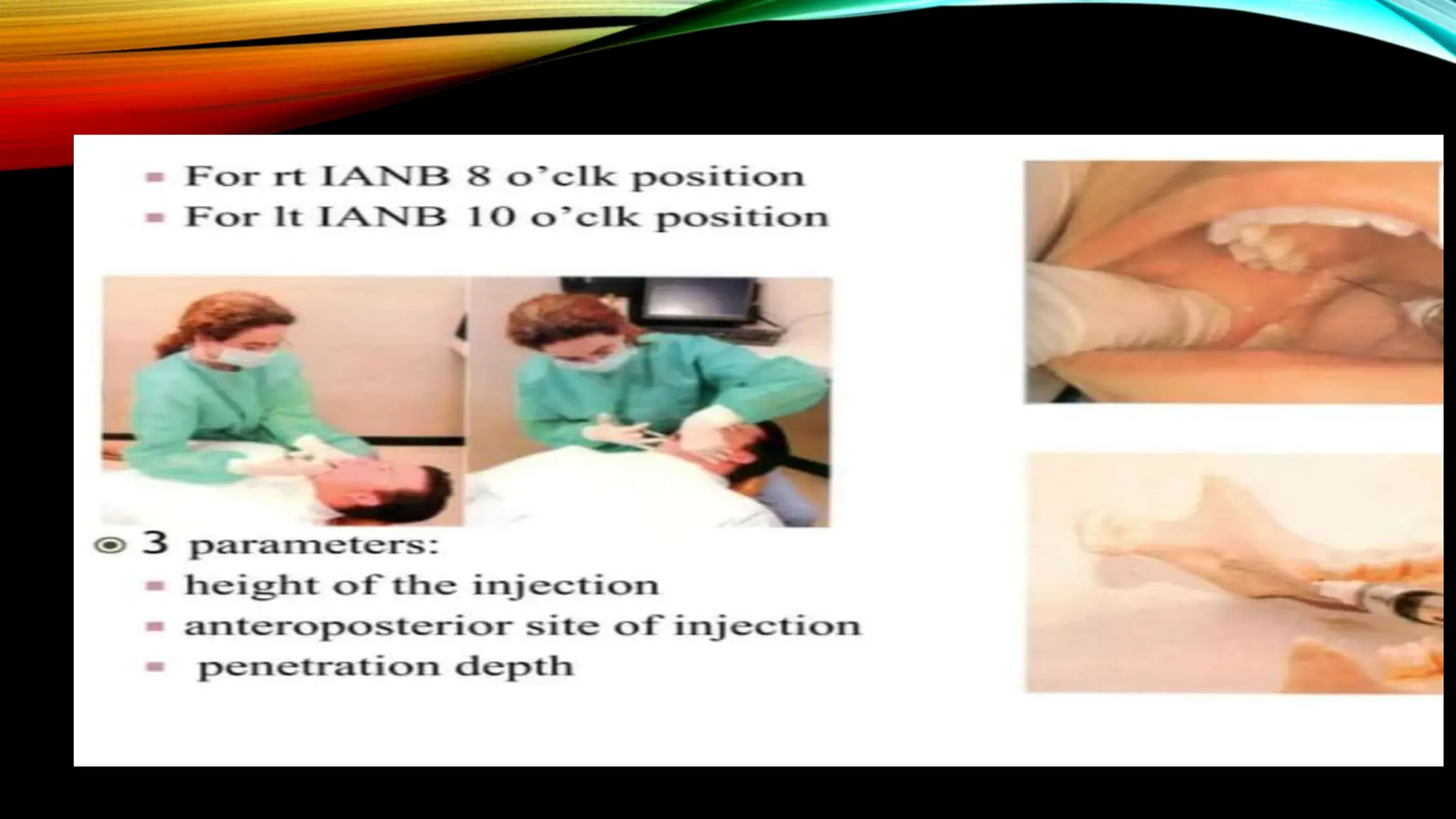
Mouth open ,body of mandible parallel to floor
Operator right side of patient
Thumb palpates mucobuccal fold
Thumb moves posteriorly to contact external oblique ridge on anterior border of
ramus
Greatest depth is identified Coronoid notch height of the mandibular sulcus
. Syringe parallel to the occusal plane Opposite side of the mouth bisecting finger
. Gently insert the needle , Needle withdrawn 1mm Solution deposit
COMPLICATION :
High injectionnumbness of the ear – when injected in auriculotemporal
nerve
High injection – Trismus injection into lateral pterygoid
High injection- Toxicity injection into pterygoid plexus of vein
High and deep injection – Paralysis injection into Substance of parotid
gland
HEMATOMA
Trancient facial paralysis - Injection into medial pterygoid
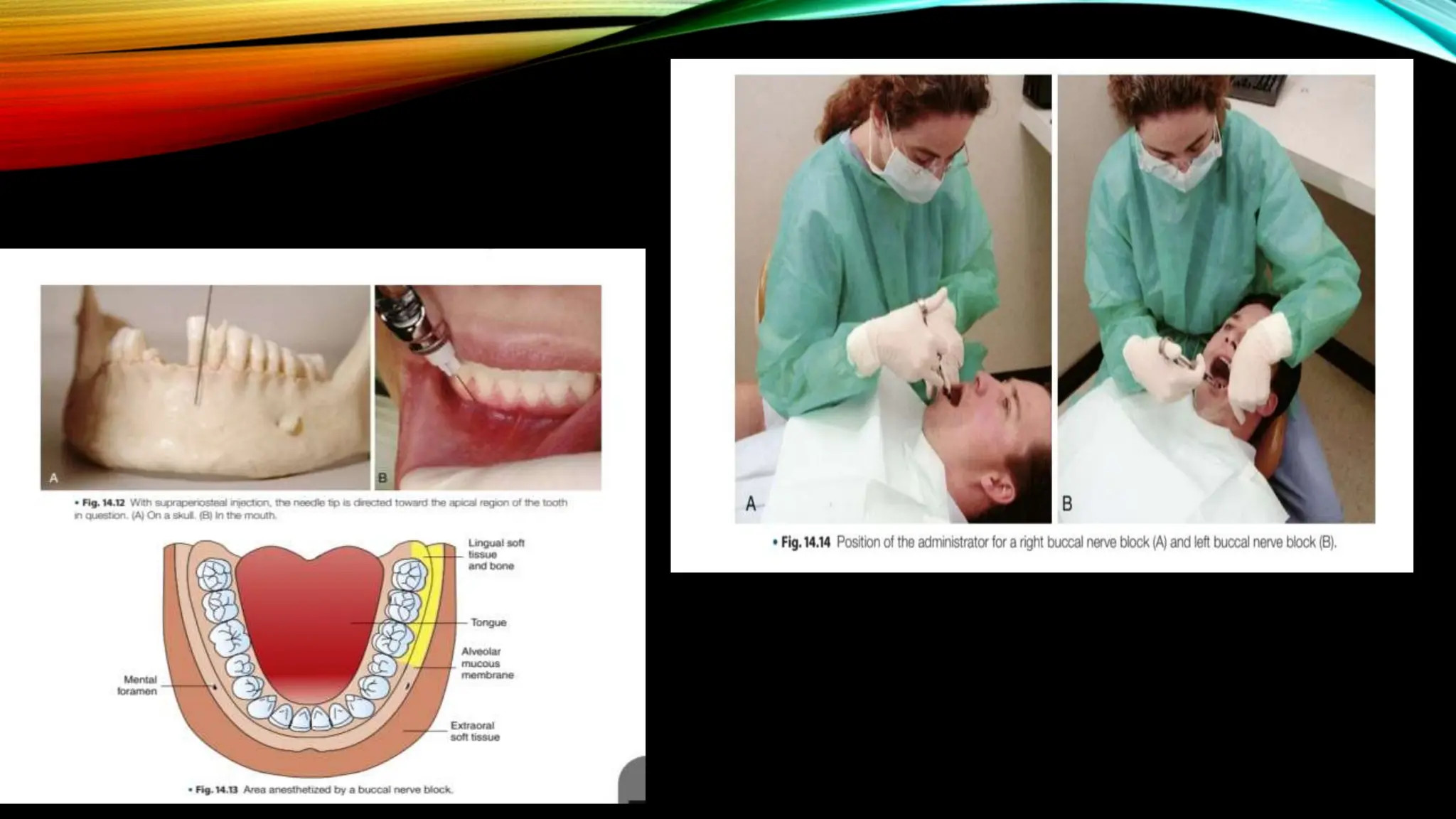
BUCCAL NERVE BLOCK
Nerve anesthetized
• Buccal nerve( a branch of the anterior division of V3)
Area anesthetized
Periosteum buccal to the mandibular molar teeth
Techniques
A 25- 27 gauge long needle is recommended this is most often used N
Because the buccal nerve block is usually administered immediately after an IANB.
Area of insertion
mucous membranes distal and buccal to the most distal molar tooth in the arch
Target area:
buccal nerve as it passes over the anterior border of the ramus
Landmarks
: mandibular molars muccobucal fold
Advantages
• Technically easy
Disadvantages
• Potential for pain if the needle contacts the periosteum during injection
Complications:
• Few of any consequences
• Hematoma ( bluish discoloration and tissue swelling at the injection site)
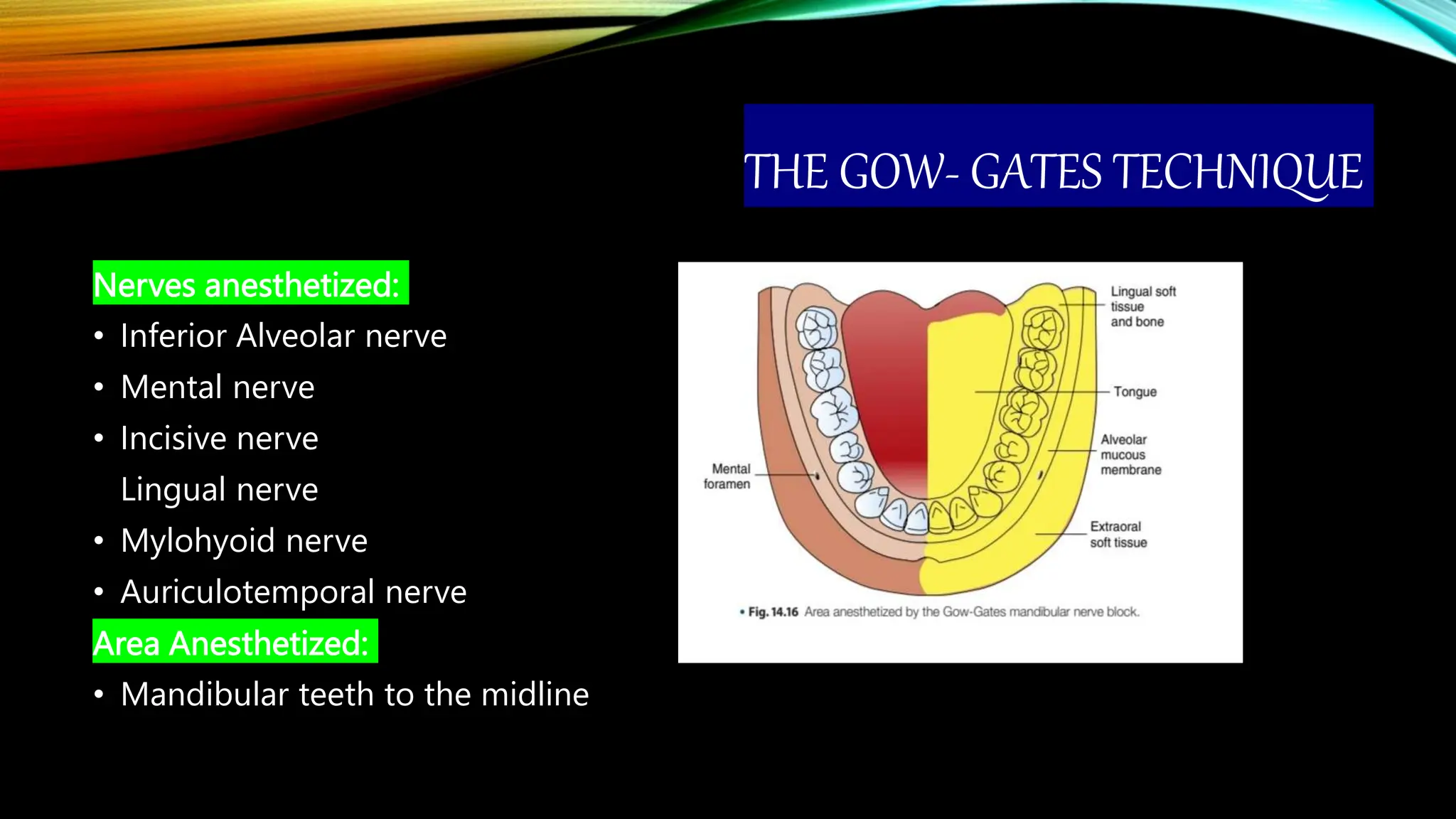
THE GOW- GATES TECHNIQUE
Nerves anesthetized:
• Inferior Alveolar nerve
• Mental nerve
• Incisive nerve
Lingual nerve
• Mylohyoid nerve
• Auriculotemporal nerve
Area Anesthetized:
• Mandibular teeth to the midline
• Buccal mucoperiosteum and mucous membranes on the side of injection
• Anterior two third of the tongue and floor of the oral cavity
• Lingual soft tissue and periosteum
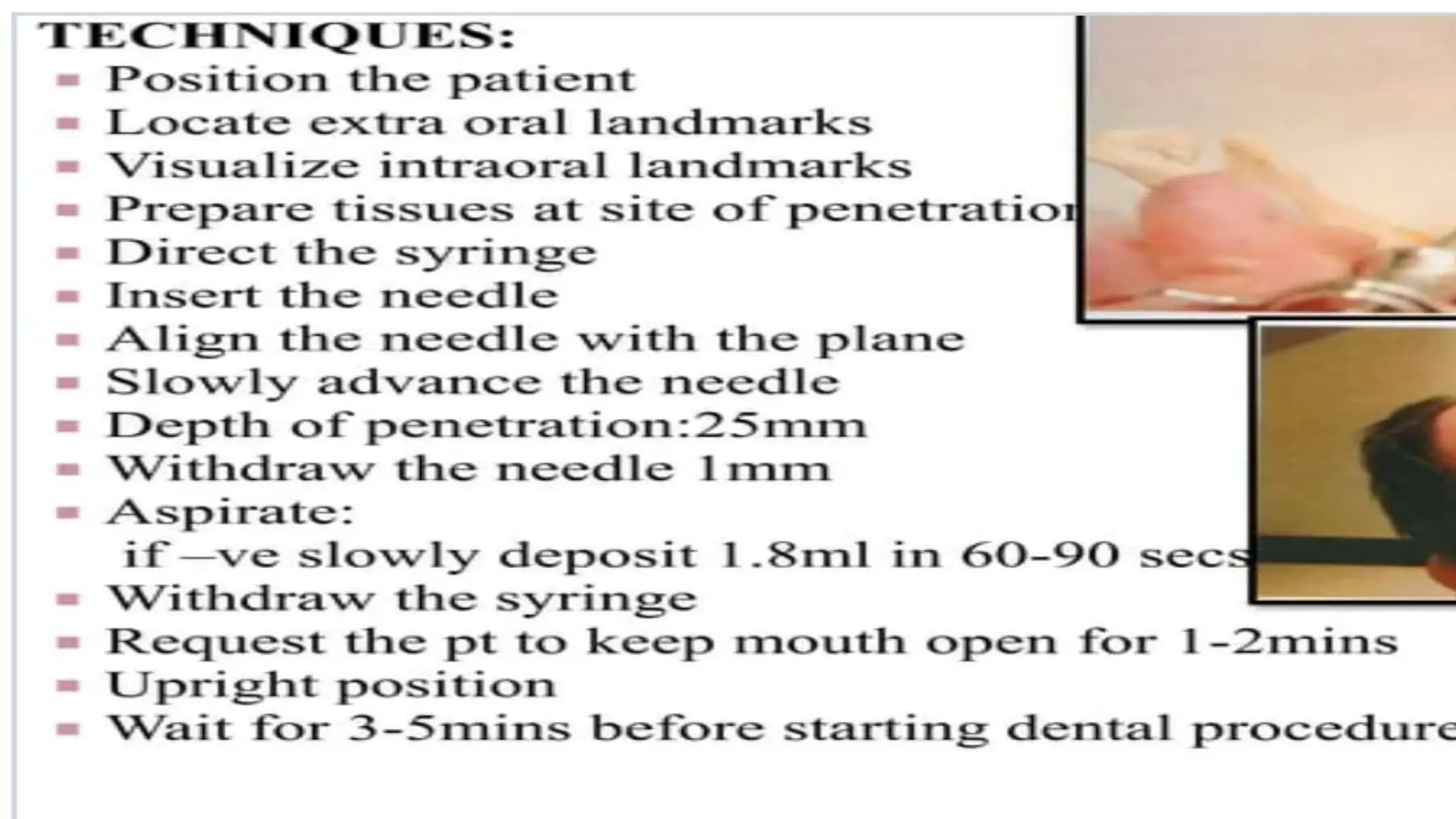
Techniques
• A 25or 27 gauge long needle recommended
• Area of insertion:Mucous membrane on the medial aspect of the mouth,just distal to the
maxillary second molar
• Target area: lateral side of the condylar neck, just below the insertion of the lateral
pterygoid muscle
Landmarks
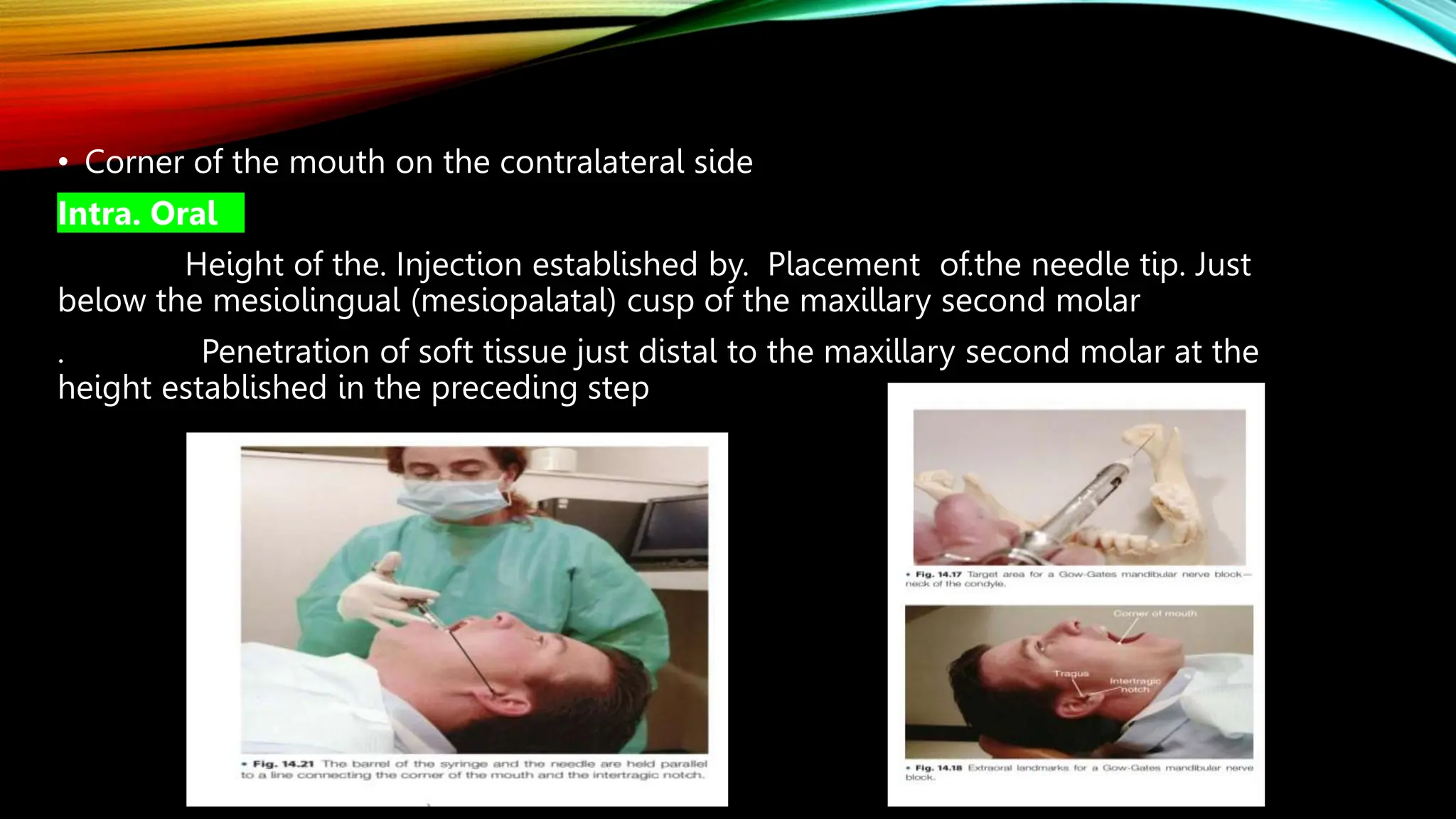
Extra oral :
• The intertagic notch
• External auditory meatus concealed by the tragus
• Corner of the mouth on the contralateral side
Intra. Oral
Height of the. Injection established by. Placement of.the needle tip. Just
below the mesiolingual (mesiopalatal) cusp of the maxillary second molar
. Penetration of soft tissue just distal to the maxillary second molar at the
height established in the preceding step
Advantages:
Relatively atraumatic
Patient need not be able to open the mouth
Fewer postoperative complications
Disadvantages:
Difficult to visualise the path of the needle and the depth of insertion
No bony contact –depth of penetration somewhat arbitrary
VAZIRANI – AKINOSI TECHNIQUE
• Its primary indication remains those situations in which limited mandibular opening
precludes the use of other mandibular injection techniques
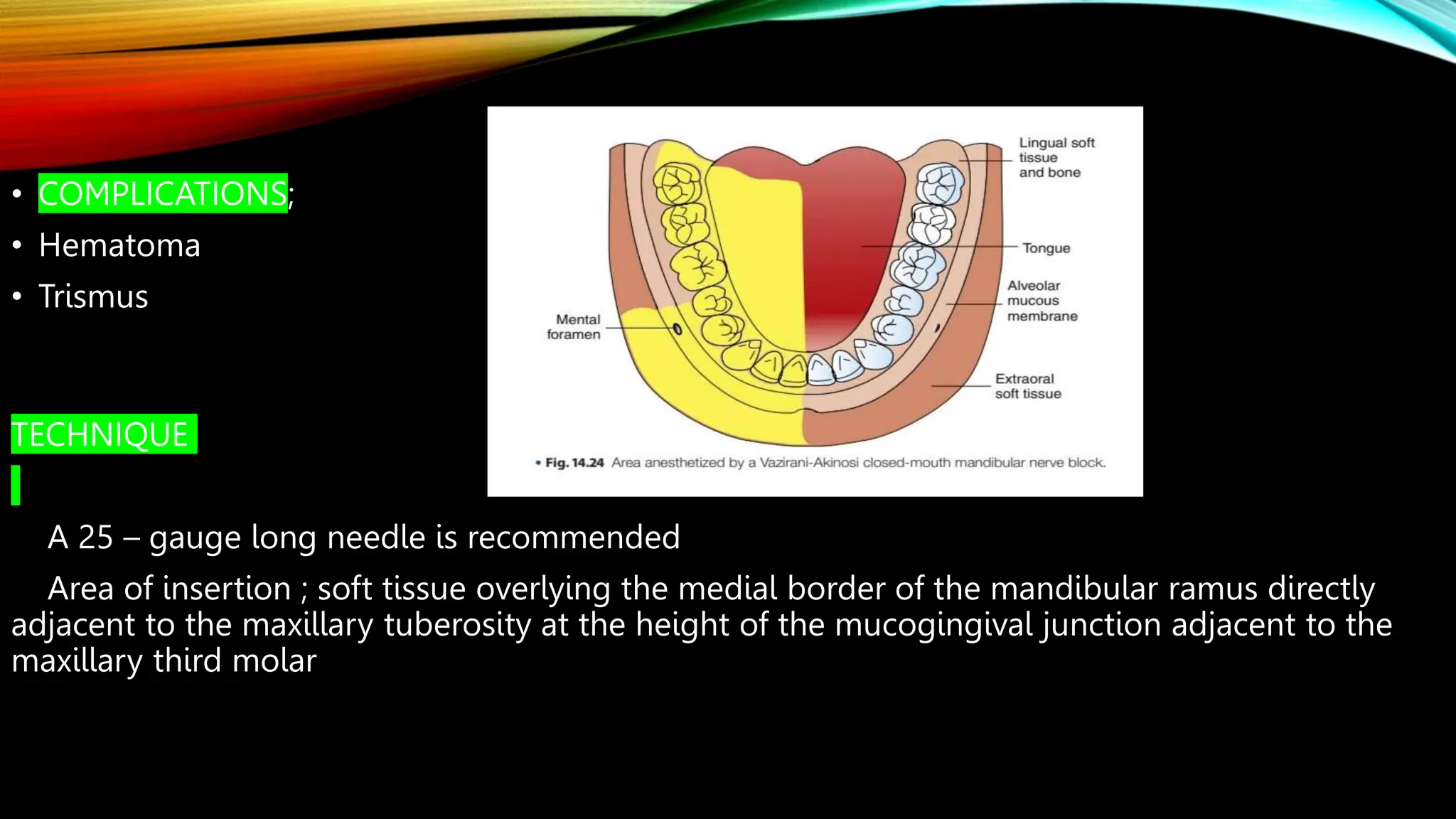
• Nerves anesthetized ; Inferior alveolar nerve and its subdivision ,mental and
nerves and long buccal nerves
• Areas anesthetized; All the mandibular hard and soft tissue to midline ,including
floor of mouth and anterior 2/3rd of tongue
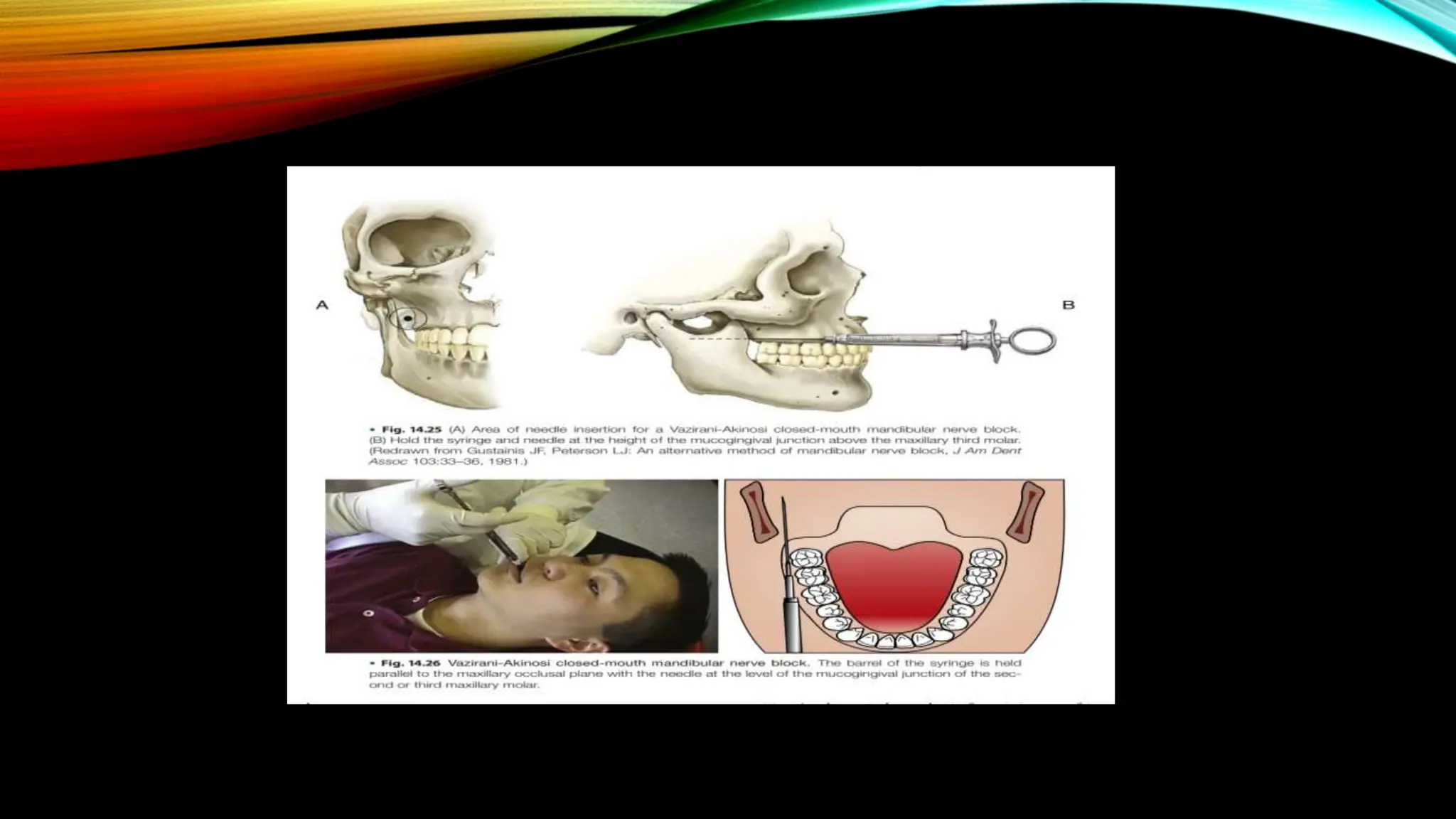
• Anatomical landmarks; occlusal plane of occluding teeth ; mucogingival junction of
maxillarymolar teeth ; anterior border of ramus
• COMPLICATIONS;
• Hematoma
• Trismus
TECHNIQUE
A 25 – gauge long needle is recommended
Area of insertion ; soft tissue overlying the medial border of the mandibular ramus directly
adjacent to the maxillary tuberosity at the height of the mucogingival junction adjacent to the
maxillary third molar
MENTAL NERVE BLOCK
• The mental nerve is a terminal branch of inferior alveolar nerve
Nerve anesthetized
• Mental nerve, terminal branch of the inferior alveolar nerve
Area anesthetized;
• Buccal mucous membrane anterior to the mental foramen to the midline skin of the
lower lip and chin
Technique
A 25 or 27 gauge short needle recommended
Area of insertion
• mucobuccal fold at or just anterior to the mental foramen
Target area;
mental nerve as it exits the mental foramen [ usually located between the apices of the
first and second premolars]
Landmarks ;
mandibular premolars and mucobuccal fold
Position of the patient ;
supine position is recommended
• Complications ;
• Hematoma
Paresthesia of lip and chin
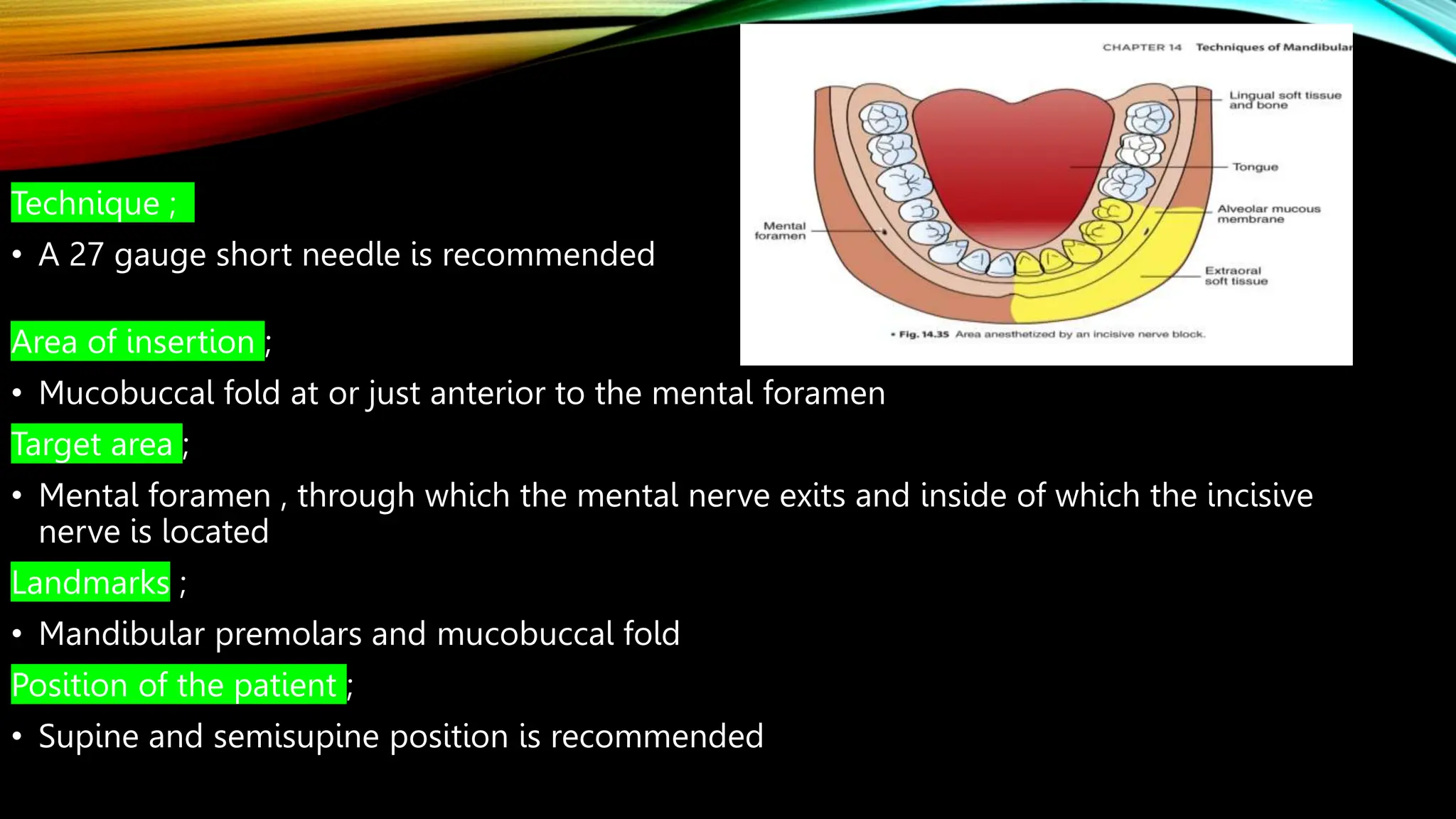
INCISIVE NERVE BLOCK
• It is a terminal branch of inferior alveolar nerve
Nerve anesthetized ;
• Mental and incisive nerve
Areas anesthetized ;
• Buccal mucous membrane anterior to the mental foramen ,usually from the second
premolar to the midline
• Lower lip and skin of the chin
• Pulpal nerve fibers to the premolars, canine and incisors
Technique ;
• A 27 gauge short needle is recommended
Area of insertion ;
• Mucobuccal fold at or just anterior to the mental foramen
Target area ;
• Mental foramen , through which the mental nerve exits and inside of which the incisive
nerve is located
Landmarks ;
• Mandibular premolars and mucobuccal fold
Position of the patient ;
• Supine and semisupine position is recommended
• Complications ;
• Hematoma
Paresthesia of lip and chin

Techniques of mandibular anesthesia.pptx

  • 1.
    TECHNIQUES OF MANDIBULAR ANESTHESIA PRATHIBA. E[ FINAL YEAR ] DPT OF OMFS
  • 2.
    MANDIBULAR NERVE • Itis the branch of trigerminal nerve • It is both motor as well as sensory • Sensory located in semilunar or gasseriab ganglion • Motor branch located in medulla oblongata and emerges out of foramen ovale
  • 4.
    DEFINITION OF LOCALANESTHESIA • Local anesthesia is define as reversible loss of sensation in a circumscribed area of the body caused by depression of excitation in nerve endings or inhibition of the conduction process in peripheral nerves
  • 5.
    COMPOSITION OF LOCALANESTHESIA Local anesthetic agent ; Lignocaine HCI 2%(20 mg/ml) Reducing agent; Sodium meta- bisulphite [0.5mg] Vasoconstr ictor; Adrenaline [0.012mg] Isotonic solution ; Ringer’s solution[6 mg] Sodium hydroxide – to adjust pH VASOCONSTRICTORS OF L.A ; - Decrease blood flow to the site of injection – better visualization - Reduced systemic toxicity - More LA enters into nerve- Increase duration of action
  • 6.
    INFERIOR ALVEOLAR NERVEBLOCK Other common name ; Mandibular Nerve Block Nerves anesthetized ; Inferior alveolar nerve Lingual nerve Incisive nerve Mental nerve Area Anasthetized; Body of mandible, Inferior portion of ramus,Mucous membrane and structures anterior to mandibular 1st molar
  • 7.
    • Indications ;Analgesiafor surgical and operative dentistry on mandibular teeth and supporting structures, Diagnostic and therapeutic purposes • Approximating structures when needle is in position ; The inferior dental nerve is blocked by the deposition of analgesic solution around it just before it enters the mandibular foramen and when it is in the pterygomandibular space This is bounded Anteriorly; pterygomandibular raphe Posteriorly; parotid gland Laterally; Ascending ramus of the mandible Medially; medial pterygoid muscle Superiorly; 2 heads of lateral pterygoid Inferiorly; Attachment of medial pterygoid
  • 8.
    • ADVANTAGES; Wide areaof anesthesia DISADVANTAGES; Inadequate anesthesia Intraoral landmarks Lingual and lower lip anesthesia Partial anesthesia bifid mandibular cannals
  • 10.
    Technique Mouth open ,bodyof mandible parallel to floor Operator right side of patient Thumb palpates mucobuccal fold Thumb moves posteriorly to contact external oblique ridge on anterior border of ramus Greatest depth is identified Coronoid notch height of the mandibular sulcus . Syringe parallel to the occusal plane Opposite side of the mouth bisecting finger . Gently insert the needle , Needle withdrawn 1mm Solution deposit
  • 11.
    COMPLICATION : High injectionnumbnessof the ear – when injected in auriculotemporal nerve High injection – Trismus injection into lateral pterygoid High injection- Toxicity injection into pterygoid plexus of vein High and deep injection – Paralysis injection into Substance of parotid gland HEMATOMA Trancient facial paralysis - Injection into medial pterygoid
  • 12.
    BUCCAL NERVE BLOCK Nerveanesthetized • Buccal nerve( a branch of the anterior division of V3) Area anesthetized Periosteum buccal to the mandibular molar teeth Techniques A 25- 27 gauge long needle is recommended this is most often used N Because the buccal nerve block is usually administered immediately after an IANB. Area of insertion mucous membranes distal and buccal to the most distal molar tooth in the arch Target area: buccal nerve as it passes over the anterior border of the ramus Landmarks : mandibular molars muccobucal fold
  • 14.
    Advantages • Technically easy Disadvantages •Potential for pain if the needle contacts the periosteum during injection Complications: • Few of any consequences • Hematoma ( bluish discoloration and tissue swelling at the injection site)
  • 15.
    THE GOW- GATESTECHNIQUE Nerves anesthetized: • Inferior Alveolar nerve • Mental nerve • Incisive nerve Lingual nerve • Mylohyoid nerve • Auriculotemporal nerve Area Anesthetized: • Mandibular teeth to the midline
  • 16.
    • Buccal mucoperiosteumand mucous membranes on the side of injection • Anterior two third of the tongue and floor of the oral cavity • Lingual soft tissue and periosteum Techniques • A 25or 27 gauge long needle recommended • Area of insertion:Mucous membrane on the medial aspect of the mouth,just distal to the maxillary second molar • Target area: lateral side of the condylar neck, just below the insertion of the lateral pterygoid muscle Landmarks Extra oral : • The intertagic notch • External auditory meatus concealed by the tragus
  • 17.
    • Corner ofthe mouth on the contralateral side Intra. Oral Height of the. Injection established by. Placement of.the needle tip. Just below the mesiolingual (mesiopalatal) cusp of the maxillary second molar . Penetration of soft tissue just distal to the maxillary second molar at the height established in the preceding step
  • 19.
    Advantages: Relatively atraumatic Patient neednot be able to open the mouth Fewer postoperative complications Disadvantages: Difficult to visualise the path of the needle and the depth of insertion No bony contact –depth of penetration somewhat arbitrary
  • 20.
    VAZIRANI – AKINOSITECHNIQUE • Its primary indication remains those situations in which limited mandibular opening precludes the use of other mandibular injection techniques • Nerves anesthetized ; Inferior alveolar nerve and its subdivision ,mental and nerves and long buccal nerves • Areas anesthetized; All the mandibular hard and soft tissue to midline ,including floor of mouth and anterior 2/3rd of tongue • Anatomical landmarks; occlusal plane of occluding teeth ; mucogingival junction of maxillarymolar teeth ; anterior border of ramus
  • 21.
    • COMPLICATIONS; • Hematoma •Trismus TECHNIQUE A 25 – gauge long needle is recommended Area of insertion ; soft tissue overlying the medial border of the mandibular ramus directly adjacent to the maxillary tuberosity at the height of the mucogingival junction adjacent to the maxillary third molar
  • 23.
    MENTAL NERVE BLOCK •The mental nerve is a terminal branch of inferior alveolar nerve Nerve anesthetized • Mental nerve, terminal branch of the inferior alveolar nerve Area anesthetized; • Buccal mucous membrane anterior to the mental foramen to the midline skin of the lower lip and chin
  • 24.
    Technique A 25 or27 gauge short needle recommended Area of insertion • mucobuccal fold at or just anterior to the mental foramen Target area; mental nerve as it exits the mental foramen [ usually located between the apices of the first and second premolars] Landmarks ; mandibular premolars and mucobuccal fold Position of the patient ; supine position is recommended
  • 25.
    • Complications ; •Hematoma Paresthesia of lip and chin
  • 26.
    INCISIVE NERVE BLOCK •It is a terminal branch of inferior alveolar nerve Nerve anesthetized ; • Mental and incisive nerve Areas anesthetized ; • Buccal mucous membrane anterior to the mental foramen ,usually from the second premolar to the midline • Lower lip and skin of the chin • Pulpal nerve fibers to the premolars, canine and incisors
  • 27.
    Technique ; • A27 gauge short needle is recommended Area of insertion ; • Mucobuccal fold at or just anterior to the mental foramen Target area ; • Mental foramen , through which the mental nerve exits and inside of which the incisive nerve is located Landmarks ; • Mandibular premolars and mucobuccal fold Position of the patient ; • Supine and semisupine position is recommended
  • 28.
    • Complications ; •Hematoma Paresthesia of lip and chin