Under the Guidance of
Dr. CS PILLAI
Assistant Professor
Dept of Computer Science
Department of Computer Science and Engineering
Technical Seminar
CRYPTOCURRENCY
SURAJ S(1AH18CS100)
CONTENTS
• ABSTRACT
• INTRODUCTION OF CRYPOCURENCY
• STEPS INVOLVED CRYPTOCURRENCY
• BLOCKCHAIN
• MINING
• CRYPTOCURRENCY IN INDIA
• ADVANTAGES OF CRYPTOCURRENCY
• DISADVANTAGES OF CRYPTOCURRENCY
• APPLICATION
• CONCLUSION
• REFERENCE
• Virtual Currencies and cryptocurrency is a new digital addition to the cyber world
as well as global financial system that has not yet been fully administered into the
legal structure of many nations across the globe.
• Cryptocurrencies are digital assets where cryptography is used to create and
distribute currency through peer-to-peer network.
• Cryptocurrency has now emerged as an important asset in financial and business
applications.
• They rely on a secure backbone technology called Blockchain Technology which
allows storing all the transactions made in a secure distributed ledger, a data
structure which is done by the process called mining.
ABSTRACT
INTRODUCTION TO CRYPTOCURRENCY
• Cryptocurrencies is divided into two parts cryptography and currency.
• Cryptography is associated with the process of converting ordinary plain text into
unintelligible text and vice-versa.
I. An encrypted message is ciphertext. The process of turning ciphertext back into
plaintext is decryption.
II. It is a is the science of protecting information by transforming it into a secure
format.
• Since the development of Bitcoin in 2009 by Satoshi Nakamoto, the first-ever
cryptocurrency, it has become an important component of the international financial
market after ten years of development.
• The cryptocurrency market has grown to a total market capitalization of 209 billion
USD
TYPES OF CRYPTOCURRENCY
HISTORY AND STEPS INVOLVED IN
CRYPTOCURRENCY
• It is method of storing and transmitting data in a particular form so that ony those
for whom it is intended can read and process it.
• The art and science of concealing the messages to introduce secrecy in
information security is recognized as cryptography.
BLOCKCHAIN
• Blockchain does not store any of its information in a central location. Instead,
the blockchain is copied and spread across a network of computers.
• Block structure - The Blockchain comprises a sequence of blocks, which stores the
information of all the transactions, similar to a public ledger.
• Proof of work : The algorithm is used to confirm the transaction and creates a new
block to the chain.
• For Bitcoin, this means that transactions are permanently recorded and viewable to
anyone.
MINING
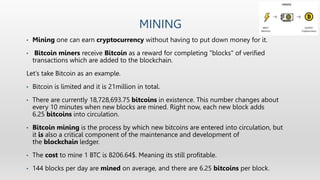
• Mining one can earn cryptocurrency without having to put down money for it.
• Bitcoin miners receive Bitcoin as a reward for completing "blocks" of verified
transactions which are added to the blockchain.
Let’s take Bitcoin as an example.
• Bitcoin is limited and it is 21million in total.
• There are currently 18,728,693.75 bitcoins in existence. This number changes about
every 10 minutes when new blocks are mined. Right now, each new block adds
6.25 bitcoins into circulation.
• Bitcoin mining is the process by which new bitcoins are entered into circulation, but
it is also a critical component of the maintenance and development of
the blockchain ledger.
• The cost to mine 1 BTC is 8206.64$. Meaning its still profitable.
• 144 blocks per day are mined on average, and there are 6.25 bitcoins per block.
CRYPTOCURRENCY IN INDIA
• What's the government stand on cryptos? The Ministry of Corporate Affairs (MCA) has
made it mandatory for companies to disclose crypto trading/investments during the
financial year.
• What's its legal status in India?
I. Cryptocurrencies are not illegal in India. Inter-Ministerial Committee (IMC) on
November 2, 2017, to study virtual currencies.
II. The government does not consider cryptocurrencies as legal tender.
• Is cryptocurrency taxable currently? Yes
• Were cryptocurrencies ever banned in India? The RBI, through a circular in April 2018
• However, the Supreme Court in March 2020 overturned RBI's circular, permitting banks to
handle cryptocurrency transactions from traders and exchanges.
ADVANTAGES OF CRYPTOCURRENCY
• Counterfeit ability.
• Protection from inflation.
• Self-governed and managed.
• Secure and private.
• Currency exchanges can be done easily.
• Decentralized.
• Cost-effective mode of transaction.
• A fast way to transfer funds.
DISADVANTAGES OF CRYPTOCURRENCY
• Transaction is irreversible.
• Regulations.
• High volatility and potential for large losses
• Can be used for illegal transactions
• Data losses can cause financial losses
• Decentralized but still operated by some organization.
• Some coins not available in other fiat currencies.
• Adverse Effects of mining on the environment.
• Susceptible to hacks
• No refund or cancellation policy
APPLICATIONS
• Military applications.
• Used by law Enforcement agencies.
• Cryptocurrency can be used to encourage ethical business practices.
• Cryptocurrencies are also environmentally friendly since they do not require any paper
to create notes for the currency.
• The cryptocurrency era has opened up new possibilities for game publishers and
developers. Some online games have already started transacting with cryptocurrency.
CONCLUSION
• Cryptocurrency seems to have moved past the early adoption phase that new
technologies experience
• The future of blockchain technology is about to take over the world just because
of solutions and not because of the availability of conventional technology offered.
• Some economic analysts predict a big change in crypto is forthcoming as
institutional money enters the market.
• It would further add credibility to blockchain and its uses as an alternative to
conventional currencies.
• People may buy Bitcoins as a safer mode of investment similar to Gold.
• Some nations like Iceland have even begun to start their own national
cryptocurrencies (Hofman, 2014)
REFERENCES
• https://www.geeksforgeeks.org
• https://www.investopedia.com/terms/b/blockchain.asp
• https://kite.zerodha.com/
• International Research Journal of Engineering and Technology (IRJET)
I. A Detailed Study on Cryptocurrency (April 2021)
II. Cryptocurrency, Security Issues and Upcoming Challenges to Legal Framework
in India(Jan 2020)
III. Data Security and Privacy in Bitcoin System: A Survey(July 2020)
IV. Security Of Cryptocurrency Using Hardware Wallet And QR Code(Jan 2019)
THANK YOU

technical seminar crypto ppt.pptx

  • 1.
    Under the Guidanceof Dr. CS PILLAI Assistant Professor Dept of Computer Science Department of Computer Science and Engineering Technical Seminar CRYPTOCURRENCY SURAJ S(1AH18CS100)
  • 2.
    CONTENTS • ABSTRACT • INTRODUCTIONOF CRYPOCURENCY • STEPS INVOLVED CRYPTOCURRENCY • BLOCKCHAIN • MINING • CRYPTOCURRENCY IN INDIA • ADVANTAGES OF CRYPTOCURRENCY • DISADVANTAGES OF CRYPTOCURRENCY • APPLICATION • CONCLUSION • REFERENCE
  • 3.
    • Virtual Currenciesand cryptocurrency is a new digital addition to the cyber world as well as global financial system that has not yet been fully administered into the legal structure of many nations across the globe. • Cryptocurrencies are digital assets where cryptography is used to create and distribute currency through peer-to-peer network. • Cryptocurrency has now emerged as an important asset in financial and business applications. • They rely on a secure backbone technology called Blockchain Technology which allows storing all the transactions made in a secure distributed ledger, a data structure which is done by the process called mining. ABSTRACT
  • 4.
    INTRODUCTION TO CRYPTOCURRENCY •Cryptocurrencies is divided into two parts cryptography and currency. • Cryptography is associated with the process of converting ordinary plain text into unintelligible text and vice-versa. I. An encrypted message is ciphertext. The process of turning ciphertext back into plaintext is decryption. II. It is a is the science of protecting information by transforming it into a secure format. • Since the development of Bitcoin in 2009 by Satoshi Nakamoto, the first-ever cryptocurrency, it has become an important component of the international financial market after ten years of development. • The cryptocurrency market has grown to a total market capitalization of 209 billion USD
  • 5.
  • 6.
    HISTORY AND STEPSINVOLVED IN CRYPTOCURRENCY • It is method of storing and transmitting data in a particular form so that ony those for whom it is intended can read and process it. • The art and science of concealing the messages to introduce secrecy in information security is recognized as cryptography.
  • 7.
    BLOCKCHAIN • Blockchain doesnot store any of its information in a central location. Instead, the blockchain is copied and spread across a network of computers. • Block structure - The Blockchain comprises a sequence of blocks, which stores the information of all the transactions, similar to a public ledger. • Proof of work : The algorithm is used to confirm the transaction and creates a new block to the chain. • For Bitcoin, this means that transactions are permanently recorded and viewable to anyone.
  • 8.
    MINING • Mining onecan earn cryptocurrency without having to put down money for it. • Bitcoin miners receive Bitcoin as a reward for completing "blocks" of verified transactions which are added to the blockchain. Let’s take Bitcoin as an example. • Bitcoin is limited and it is 21million in total. • There are currently 18,728,693.75 bitcoins in existence. This number changes about every 10 minutes when new blocks are mined. Right now, each new block adds 6.25 bitcoins into circulation. • Bitcoin mining is the process by which new bitcoins are entered into circulation, but it is also a critical component of the maintenance and development of the blockchain ledger. • The cost to mine 1 BTC is 8206.64$. Meaning its still profitable. • 144 blocks per day are mined on average, and there are 6.25 bitcoins per block.
  • 9.
    CRYPTOCURRENCY IN INDIA •What's the government stand on cryptos? The Ministry of Corporate Affairs (MCA) has made it mandatory for companies to disclose crypto trading/investments during the financial year. • What's its legal status in India? I. Cryptocurrencies are not illegal in India. Inter-Ministerial Committee (IMC) on November 2, 2017, to study virtual currencies. II. The government does not consider cryptocurrencies as legal tender. • Is cryptocurrency taxable currently? Yes • Were cryptocurrencies ever banned in India? The RBI, through a circular in April 2018 • However, the Supreme Court in March 2020 overturned RBI's circular, permitting banks to handle cryptocurrency transactions from traders and exchanges.
  • 10.
    ADVANTAGES OF CRYPTOCURRENCY •Counterfeit ability. • Protection from inflation. • Self-governed and managed. • Secure and private. • Currency exchanges can be done easily. • Decentralized. • Cost-effective mode of transaction. • A fast way to transfer funds.
  • 11.
    DISADVANTAGES OF CRYPTOCURRENCY •Transaction is irreversible. • Regulations. • High volatility and potential for large losses • Can be used for illegal transactions • Data losses can cause financial losses • Decentralized but still operated by some organization. • Some coins not available in other fiat currencies. • Adverse Effects of mining on the environment. • Susceptible to hacks • No refund or cancellation policy
  • 12.
    APPLICATIONS • Military applications. •Used by law Enforcement agencies. • Cryptocurrency can be used to encourage ethical business practices. • Cryptocurrencies are also environmentally friendly since they do not require any paper to create notes for the currency. • The cryptocurrency era has opened up new possibilities for game publishers and developers. Some online games have already started transacting with cryptocurrency.
  • 13.
    CONCLUSION • Cryptocurrency seemsto have moved past the early adoption phase that new technologies experience • The future of blockchain technology is about to take over the world just because of solutions and not because of the availability of conventional technology offered. • Some economic analysts predict a big change in crypto is forthcoming as institutional money enters the market. • It would further add credibility to blockchain and its uses as an alternative to conventional currencies. • People may buy Bitcoins as a safer mode of investment similar to Gold. • Some nations like Iceland have even begun to start their own national cryptocurrencies (Hofman, 2014)
  • 14.
    REFERENCES • https://www.geeksforgeeks.org • https://www.investopedia.com/terms/b/blockchain.asp •https://kite.zerodha.com/ • International Research Journal of Engineering and Technology (IRJET) I. A Detailed Study on Cryptocurrency (April 2021) II. Cryptocurrency, Security Issues and Upcoming Challenges to Legal Framework in India(Jan 2020) III. Data Security and Privacy in Bitcoin System: A Survey(July 2020) IV. Security Of Cryptocurrency Using Hardware Wallet And QR Code(Jan 2019)
  • 15.

Editor's Notes

  • #4 Insert a map of your country.
  • #5 Insert a picture of one of the geographic features of your country.
  • #7 Insert a picture illustrating a season in your country.
  • #8 Insert a picture of an animal and or plant found in your country.
  • #11 Insert a picture illustrating a custom or tradition here.
  • #12 Insert a picture of the head leader of your country.