TOPIC: CRYPTO
CURRENCY
Presented by: kevin Bishwas
INTRODUCTION TO CRYPTO
CURRENCY
Definition:
Cryptocurrency is a digital or virtual currency that
uses encryption algorithms to secure transactions
and function as a virtual accounting system.
CRYPTO CURRENCY
• Cryptocurrency is a form of digital money that is designed to be secure
and, in many cases, anonymous.
• It is a currency associated with the internet that uses cryptography, the
process of converting legible information into an almost uncrackable
code, to track purchases and transfers.
• The first cryptocurrency was bitcoin, which was created in 2009 and is
still the best known.
MEANING
MEANING OF CRYPTO
CURRENCY
• Today cryptocurrencies have become a global phenomenon known to
most people. While still somehow geeky and not understood by most
people, banks, governments and many companies are aware of its
importance.
• Digital currency
• Decentralized system
• First cryptocurrency
• No. Of cryptocurrencies
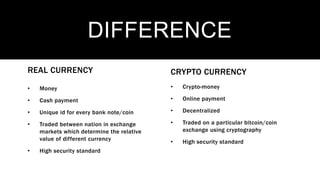
REAL CURRENCY
• Money
• Cash payment
• Unique id for every bank note/coin
• Traded between nation in exchange
markets which determine the relative
value of different currency
• High security standard
CRYPTO CURRENCY
• Crypto-money
• Online payment
• Decentralized
• Traded on a particular bitcoin/coin
exchange using cryptography
• High security standard
DIFFERENCE
WHY TO
USE
CRYPTO
CURREN
CY?
• Fast and cheap
• Easy to use
• Free to transfer and hold
• Decentralized control - Users are the only owners of
cryptocurrency
• Central government can't take it away and there are no
chargebacks
• Privacy and security- anonymous payments
• Due to no intermediary (such as bank or credit card
company) users
have freedom to transact
• Transparency is maintained through public ledger system
• Reduced "FRAUD" - eliminates cases of credit card frauds
HOW
CRYPTO
CURREN
CY
WORKS?
• A cryptocurrency runs on a blockchain, which is a
shared ledger or document duplicated several times
across a network of computers. The updated
document is distributed and made available to all
holders of the cryptocurrency.
• Every single transaction made and the ownership
of every single cryptocurrency in circulation is
recorded in the blockchain.
• The blockchain is run by miners, who use powerful
computers that tally the transactions. Their function
is to update each time a transaction is made and
also ensure the authenticity of information, thereby
ascertaining that each transaction is secure and is
processed properly and safely.
BITCOIN
• The Bitcoin protocol enables peer-to-peer (P2P) exchange in a
decentralized system that, unlike conventional currencies, is not
associated with any financial institution or government.
• Bitcoin-to-Bitcoin transactions are conducted through anonymous,
heavily encrypted hash codes across a peer-to-peer network.
• Each user's digital wallet maintains their Bitcoins. The wallet also
stores all addresses the user sends and receives Bitcoins from, along
with a private key known only to the user. The P2P network monitors
and verifies Bitcoin transfers.
THE 6 MOST IMPORTANT
CRYPTOCURRENCIES OTHER THAN
BITCOIN
• Litcoin (launched in year 2011)
• Ethereum (ETH-1aunched in 2015)
• Zcash (ZEC-launched in the latter part of 2016)
• Dash (Darkcoin-launched in January 2014)
• Ripple (XRP-re1eased in 2012)
• Monero (XMR-launched in 2014)
MINING
• Cryptocurrency mining includes two functions, namely: adding
transactions to the blockchain (securing and verifying) and also
releasing new currency . lndividual blocks added by miners should
contain a proof-of-work , or PoW .
• Mining needs a computer and a special program, which helps miners
compete with their peers in solving complicated mathematical
problems. This would need huge computer resources. In regular
intervals, miners would attempt to solve a block having the transaction
data using cryptographic hash functions.
CRYPTO CURRENCY MINING
LIMITS
• In practice, this means that miners are competing against each other to
calculate as many hashes as possible, in the hopes of getting to be the
first one to hit the correct one, form a block and get their
cryptocurrency payout.
• The difficulty of calculating the hashes also scales - every new block of
bitcoins becomes harder to mine. In theory, this ensures that the rate at
which new blocks are created remains steady. Many cryptocurrencies
also have a finite limit on the amount of units that can ever be
generated. For example, there will only ever be 21 million Bitcoins in
the world. After that, mining a new block will not generate any bitcoins
at all.
CRYPTO CURRENCY MINING
REQUIREMENTS
• While it used to be possible to mine your own cryptocurrencies using a
regular PC, for the most part that is no longer the case. As more people
start mining, the hardware necessary to mine effectively increases; from
a moderately-powerful processor, to a high-end GPU, to several GPUs
working together, to specialised chips designed specifically for mining.
• In order to successfully mine most modern cryptocurrencies, you'll need
to spend at least €1,000 on hardware, as well as footing the substantial
electricity bill that having it running 24/7 will generate. In fact, most
miners spend the vast majority of their mining income on covering the
costs of running their equipment.

what is crypto currency.pptx

  • 1.
  • 2.
    INTRODUCTION TO CRYPTO CURRENCY Definition: Cryptocurrencyis a digital or virtual currency that uses encryption algorithms to secure transactions and function as a virtual accounting system.
  • 3.
    CRYPTO CURRENCY • Cryptocurrencyis a form of digital money that is designed to be secure and, in many cases, anonymous. • It is a currency associated with the internet that uses cryptography, the process of converting legible information into an almost uncrackable code, to track purchases and transfers. • The first cryptocurrency was bitcoin, which was created in 2009 and is still the best known.
  • 4.
    MEANING MEANING OF CRYPTO CURRENCY •Today cryptocurrencies have become a global phenomenon known to most people. While still somehow geeky and not understood by most people, banks, governments and many companies are aware of its importance. • Digital currency • Decentralized system • First cryptocurrency • No. Of cryptocurrencies
  • 5.
    REAL CURRENCY • Money •Cash payment • Unique id for every bank note/coin • Traded between nation in exchange markets which determine the relative value of different currency • High security standard CRYPTO CURRENCY • Crypto-money • Online payment • Decentralized • Traded on a particular bitcoin/coin exchange using cryptography • High security standard DIFFERENCE
  • 6.
    WHY TO USE CRYPTO CURREN CY? • Fastand cheap • Easy to use • Free to transfer and hold • Decentralized control - Users are the only owners of cryptocurrency • Central government can't take it away and there are no chargebacks • Privacy and security- anonymous payments • Due to no intermediary (such as bank or credit card company) users have freedom to transact • Transparency is maintained through public ledger system • Reduced "FRAUD" - eliminates cases of credit card frauds
  • 7.
    HOW CRYPTO CURREN CY WORKS? • A cryptocurrencyruns on a blockchain, which is a shared ledger or document duplicated several times across a network of computers. The updated document is distributed and made available to all holders of the cryptocurrency. • Every single transaction made and the ownership of every single cryptocurrency in circulation is recorded in the blockchain. • The blockchain is run by miners, who use powerful computers that tally the transactions. Their function is to update each time a transaction is made and also ensure the authenticity of information, thereby ascertaining that each transaction is secure and is processed properly and safely.
  • 8.
    BITCOIN • The Bitcoinprotocol enables peer-to-peer (P2P) exchange in a decentralized system that, unlike conventional currencies, is not associated with any financial institution or government. • Bitcoin-to-Bitcoin transactions are conducted through anonymous, heavily encrypted hash codes across a peer-to-peer network. • Each user's digital wallet maintains their Bitcoins. The wallet also stores all addresses the user sends and receives Bitcoins from, along with a private key known only to the user. The P2P network monitors and verifies Bitcoin transfers.
  • 9.
    THE 6 MOSTIMPORTANT CRYPTOCURRENCIES OTHER THAN BITCOIN • Litcoin (launched in year 2011) • Ethereum (ETH-1aunched in 2015) • Zcash (ZEC-launched in the latter part of 2016) • Dash (Darkcoin-launched in January 2014) • Ripple (XRP-re1eased in 2012) • Monero (XMR-launched in 2014)
  • 10.
    MINING • Cryptocurrency miningincludes two functions, namely: adding transactions to the blockchain (securing and verifying) and also releasing new currency . lndividual blocks added by miners should contain a proof-of-work , or PoW . • Mining needs a computer and a special program, which helps miners compete with their peers in solving complicated mathematical problems. This would need huge computer resources. In regular intervals, miners would attempt to solve a block having the transaction data using cryptographic hash functions.
  • 11.
    CRYPTO CURRENCY MINING LIMITS •In practice, this means that miners are competing against each other to calculate as many hashes as possible, in the hopes of getting to be the first one to hit the correct one, form a block and get their cryptocurrency payout. • The difficulty of calculating the hashes also scales - every new block of bitcoins becomes harder to mine. In theory, this ensures that the rate at which new blocks are created remains steady. Many cryptocurrencies also have a finite limit on the amount of units that can ever be generated. For example, there will only ever be 21 million Bitcoins in the world. After that, mining a new block will not generate any bitcoins at all.
  • 12.
    CRYPTO CURRENCY MINING REQUIREMENTS •While it used to be possible to mine your own cryptocurrencies using a regular PC, for the most part that is no longer the case. As more people start mining, the hardware necessary to mine effectively increases; from a moderately-powerful processor, to a high-end GPU, to several GPUs working together, to specialised chips designed specifically for mining. • In order to successfully mine most modern cryptocurrencies, you'll need to spend at least €1,000 on hardware, as well as footing the substantial electricity bill that having it running 24/7 will generate. In fact, most miners spend the vast majority of their mining income on covering the costs of running their equipment.