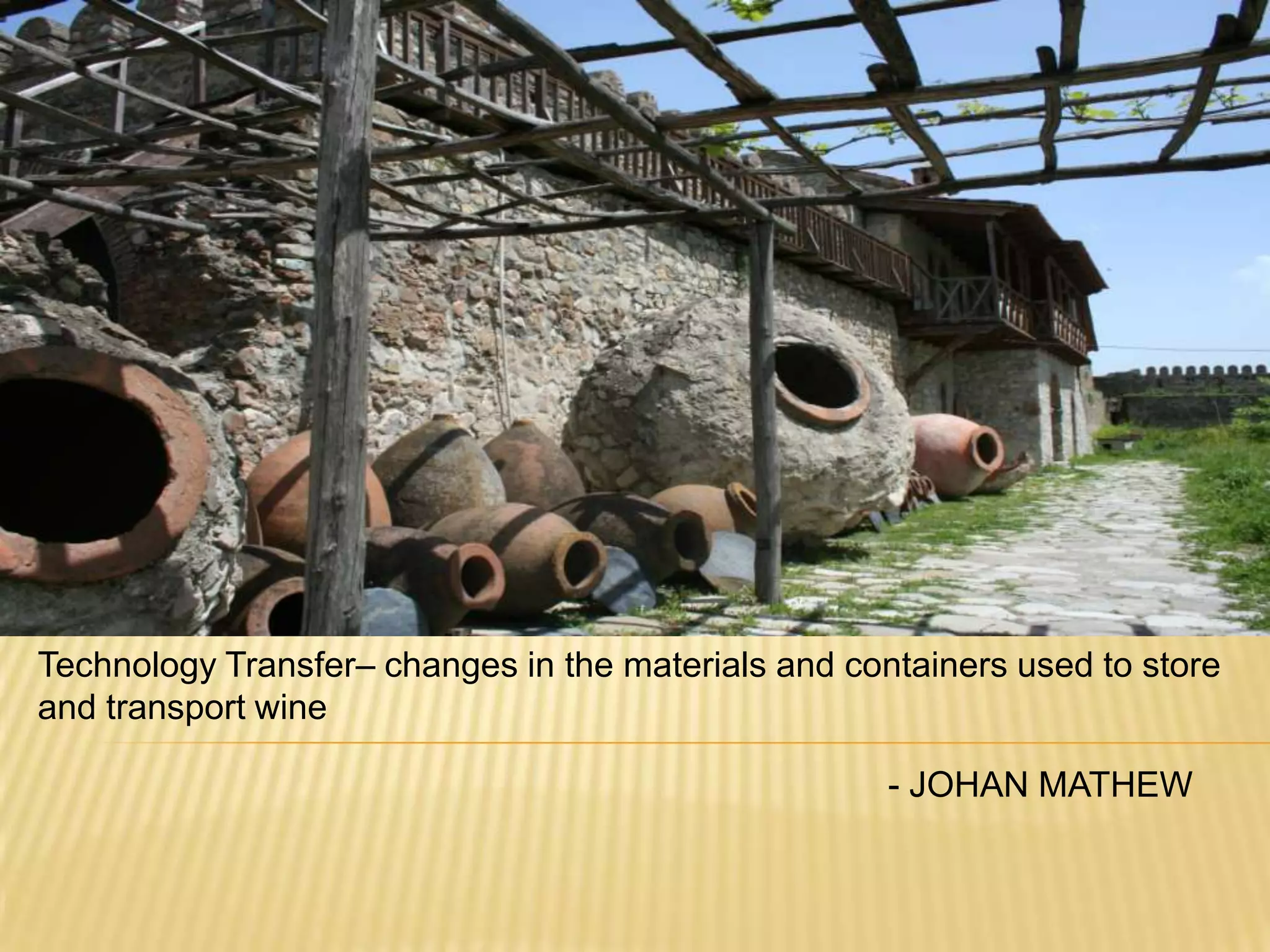
Technology Transfer– changes in the materials and containers used to store
and transport wine
- JOHAN MATHEW
History
• The earliest known vessel, that could have been
used for wine is the Qvevri, which is a clay jar,
said to date back to 6000 BC.
• 79 AD- First evidence of barrel. Romans stored
their wine in wooden containers held together
with loops.
• 1600’s- New glass making techniques started in
England.
• Monk takes giant step from using wooden plugs
to cork as a wine closure.
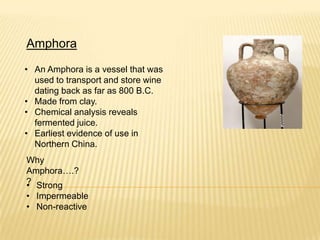
Amphora
• An Amphora is a vessel that was
used to transport and store wine
dating back as far as 800 B.C.
• Made from clay.
• Chemical analysis reveals
fermented juice.
• Earliest evidence of use in
Northern China.
Why
Amphora….?
?• Strong
• Impermeable
• Non-reactive
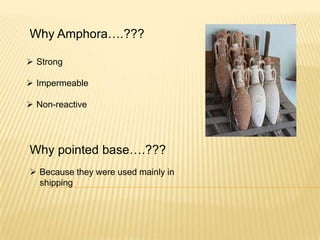
Why Amphora….???
 Strong
 Impermeable
 Non-reactive
Why pointed base….???
 Because they were used mainly in
shipping
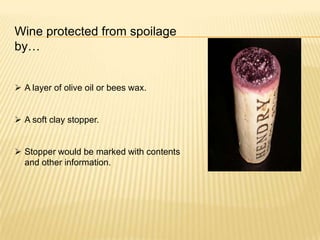
Wine protected from spoilage
by…
 A layer of olive oil or bees wax.
 A soft clay stopper.
 Stopper would be marked with contents
and other information.
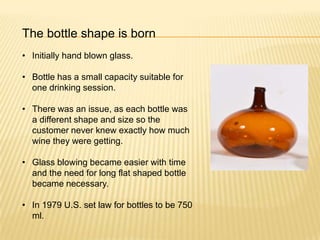
The bottle shape is born
• Initially hand blown glass.
• Bottle has a small capacity suitable for
one drinking session.
• There was an issue, as each bottle was
a different shape and size so the
customer never knew exactly how much
wine they were getting.
• Glass blowing became easier with time
and the need for long flat shaped bottle
became necessary.
• In 1979 U.S. set law for bottles to be 750
ml.
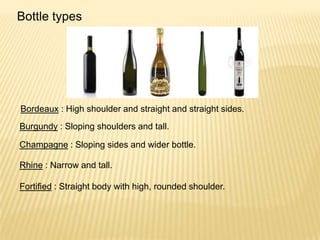
Bottle types
Bordeaux : High shoulder and straight and straight sides.
Burgundy : Sloping shoulders and tall.
Champagne : Sloping sides and wider bottle.
Rhine : Narrow and tall.
Fortified : Straight body with high, rounded shoulder.
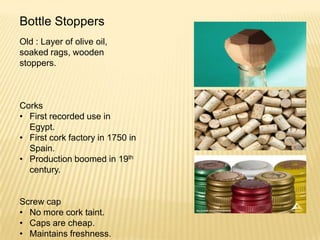
Bottle Stoppers
Old : Layer of olive oil,
soaked rags, wooden
stoppers.
Corks
• First recorded use in
Egypt.
• First cork factory in 1750 in
Spain.
• Production boomed in 19th
century.
Screw cap
• No more cork taint.
• Caps are cheap.
• Maintains freshness.
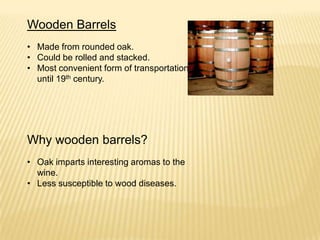
Wooden Barrels
• Made from rounded oak.
• Could be rolled and stacked.
• Most convenient form of transportation
until 19th century.
Why wooden barrels?
• Oak imparts interesting aromas to the
wine.
• Less susceptible to wood diseases.
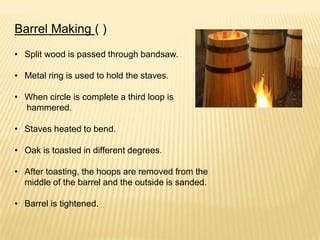
Barrel Making ( )
• Split wood is passed through bandsaw.
• Metal ring is used to hold the staves.
• When circle is complete a third loop is
hammered.
• Staves heated to bend.
• Oak is toasted in different degrees.
• After toasting, the hoops are removed from the
middle of the barrel and the outside is sanded.
• Barrel is tightened.
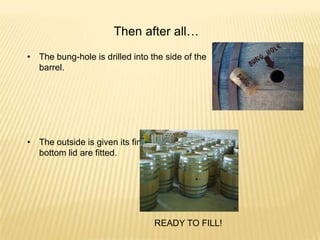
Then after all…
• The bung-hole is drilled into the side of the
barrel.
• The outside is given its final planning before the
bottom lid are fitted.
READY TO FILL!
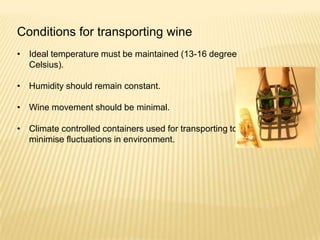
Conditions for transporting wine
• Ideal temperature must be maintained (13-16 degree
Celsius).
• Humidity should remain constant.
• Wine movement should be minimal.
• Climate controlled containers used for transporting to
minimise fluctuations in environment.
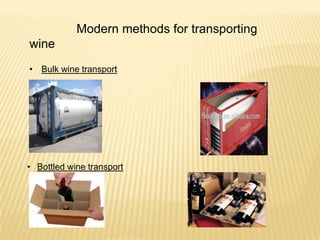
Modern methods for transporting
wine
• Bulk wine transport
ISO Tanks
Flexitanks
• Bottled wine transport
Bulk
• Limited lost space.
• Cost efficient.
• Oxidation occurs
through entire product.
Vs
.
Bottled
• Lower volume per
container.
• More costly.
• Oxidation can be
limited.
Future Storage Containers
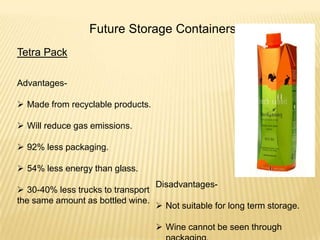
Tetra Pack
Advantages-
 Made from recyclable products.
 Will reduce gas emissions.
 92% less packaging.
 54% less energy than glass.
 30-40% less trucks to transport
the same amount as bottled wine.
Disadvantages-
 Not suitable for long term storage.
 Wine cannot be seen through
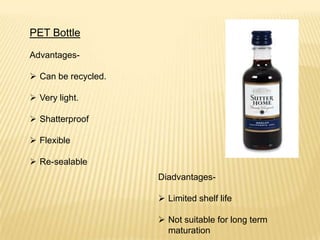
PET Bottle
Advantages-
 Can be recycled.
 Very light.
 Shatterproof
 Flexible
 Re-sealable
Diadvantages-
 Limited shelf life
 Not suitable for long term
maturation
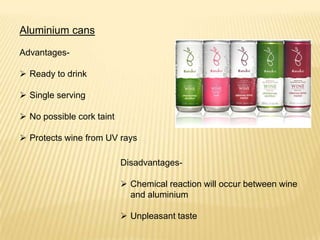
Aluminium cans
Advantages-
 Ready to drink
 Single serving
 No possible cork taint
 Protects wine from UV rays
Disadvantages-
 Chemical reaction will occur between wine
and aluminium
 Unpleasant taste
References and Resources
•Before The Wine Bottle Existed. April 2009. Retrieved 24 July, 2013,
from: http://salutwineco.wordpress.com/2009/04/27/historyof bottles/A
Short History of Wine Bottles.
•History of Glass Wine Bottles. (n.d). Retrieved 24 July,2013, from:
http://www.wineintro.com/history/glassware/general.html
•Pendleton, J. (2007). Wine History-When the Cork Met the Bottle.
Retrieved 24 July,2013, from:http://thewinehistorian.blogspot.co.nz/2007
/09/wine-history-when-cork-met-bottle.html.
•Wine in PET Bottles: Will Plastic Replace Glass?. (n.d). Retrieved 24 July
2013, from:http://www.wineanorak.com/wine_in_pet_bottles.html
•A History of Wine Storage. (n.d.). Retrieved 24 July, 2013, from:
http://www.spiralcellars.co.uk/news/a-history-of-wine-storage2/
•Brostrom, G. G., Brostrom, J. (2008). The Business of Wine: An Encyclope
Westport, Connecticut: Greenwood Publishing Group.
•Johnson, H. (1989). The Story of Wine. London: Mitchell Beazley Internation
•Intardonato, J. (2008). Fermenting Wine in Cement Tanks. Retrieved 25
July, 2013, from:http://www.winebusiness.com/wbm/?go=getArticle&datald
=55049
•Amphora. (2013). Retrieved 25 July, 2013, from:https://en.wikipedia.org/
•wiki/Amphora

Tech transfer

  • 1.
    Technology Transfer– changesin the materials and containers used to store and transport wine - JOHAN MATHEW
  • 2.
    History • The earliestknown vessel, that could have been used for wine is the Qvevri, which is a clay jar, said to date back to 6000 BC. • 79 AD- First evidence of barrel. Romans stored their wine in wooden containers held together with loops. • 1600’s- New glass making techniques started in England. • Monk takes giant step from using wooden plugs to cork as a wine closure.
  • 3.
    Amphora • An Amphorais a vessel that was used to transport and store wine dating back as far as 800 B.C. • Made from clay. • Chemical analysis reveals fermented juice. • Earliest evidence of use in Northern China. Why Amphora….? ?• Strong • Impermeable • Non-reactive
  • 4.
    Why Amphora….???  Strong Impermeable  Non-reactive Why pointed base….???  Because they were used mainly in shipping
  • 5.
    Wine protected fromspoilage by…  A layer of olive oil or bees wax.  A soft clay stopper.  Stopper would be marked with contents and other information.
  • 6.
    The bottle shapeis born • Initially hand blown glass. • Bottle has a small capacity suitable for one drinking session. • There was an issue, as each bottle was a different shape and size so the customer never knew exactly how much wine they were getting. • Glass blowing became easier with time and the need for long flat shaped bottle became necessary. • In 1979 U.S. set law for bottles to be 750 ml.
  • 7.
    Bottle types Bordeaux :High shoulder and straight and straight sides. Burgundy : Sloping shoulders and tall. Champagne : Sloping sides and wider bottle. Rhine : Narrow and tall. Fortified : Straight body with high, rounded shoulder.
  • 8.
    Bottle Stoppers Old :Layer of olive oil, soaked rags, wooden stoppers. Corks • First recorded use in Egypt. • First cork factory in 1750 in Spain. • Production boomed in 19th century. Screw cap • No more cork taint. • Caps are cheap. • Maintains freshness.
  • 9.
    Wooden Barrels • Madefrom rounded oak. • Could be rolled and stacked. • Most convenient form of transportation until 19th century. Why wooden barrels? • Oak imparts interesting aromas to the wine. • Less susceptible to wood diseases.
  • 10.
    Barrel Making () • Split wood is passed through bandsaw. • Metal ring is used to hold the staves. • When circle is complete a third loop is hammered. • Staves heated to bend. • Oak is toasted in different degrees. • After toasting, the hoops are removed from the middle of the barrel and the outside is sanded. • Barrel is tightened.
  • 11.
    Then after all… •The bung-hole is drilled into the side of the barrel. • The outside is given its final planning before the bottom lid are fitted. READY TO FILL!
  • 12.
    Conditions for transportingwine • Ideal temperature must be maintained (13-16 degree Celsius). • Humidity should remain constant. • Wine movement should be minimal. • Climate controlled containers used for transporting to minimise fluctuations in environment.
  • 13.
    Modern methods fortransporting wine • Bulk wine transport ISO Tanks Flexitanks • Bottled wine transport
  • 14.
    Bulk • Limited lostspace. • Cost efficient. • Oxidation occurs through entire product. Vs . Bottled • Lower volume per container. • More costly. • Oxidation can be limited.
  • 15.
    Future Storage Containers TetraPack Advantages-  Made from recyclable products.  Will reduce gas emissions.  92% less packaging.  54% less energy than glass.  30-40% less trucks to transport the same amount as bottled wine. Disadvantages-  Not suitable for long term storage.  Wine cannot be seen through
  • 16.
    PET Bottle Advantages-  Canbe recycled.  Very light.  Shatterproof  Flexible  Re-sealable Diadvantages-  Limited shelf life  Not suitable for long term maturation
  • 17.
    Aluminium cans Advantages-  Readyto drink  Single serving  No possible cork taint  Protects wine from UV rays Disadvantages-  Chemical reaction will occur between wine and aluminium  Unpleasant taste
  • 18.
    References and Resources •BeforeThe Wine Bottle Existed. April 2009. Retrieved 24 July, 2013, from: http://salutwineco.wordpress.com/2009/04/27/historyof bottles/A Short History of Wine Bottles. •History of Glass Wine Bottles. (n.d). Retrieved 24 July,2013, from: http://www.wineintro.com/history/glassware/general.html •Pendleton, J. (2007). Wine History-When the Cork Met the Bottle. Retrieved 24 July,2013, from:http://thewinehistorian.blogspot.co.nz/2007 /09/wine-history-when-cork-met-bottle.html. •Wine in PET Bottles: Will Plastic Replace Glass?. (n.d). Retrieved 24 July 2013, from:http://www.wineanorak.com/wine_in_pet_bottles.html •A History of Wine Storage. (n.d.). Retrieved 24 July, 2013, from: http://www.spiralcellars.co.uk/news/a-history-of-wine-storage2/
  • 19.
    •Brostrom, G. G.,Brostrom, J. (2008). The Business of Wine: An Encyclope Westport, Connecticut: Greenwood Publishing Group. •Johnson, H. (1989). The Story of Wine. London: Mitchell Beazley Internation •Intardonato, J. (2008). Fermenting Wine in Cement Tanks. Retrieved 25 July, 2013, from:http://www.winebusiness.com/wbm/?go=getArticle&datald =55049 •Amphora. (2013). Retrieved 25 July, 2013, from:https://en.wikipedia.org/ •wiki/Amphora

Editor's Notes

  • #5 Ships holds had piles of sand (or piles of grain) in them and the amphorae were packed into the sand. Many had slightly pointed bottoms for this reason.
  • #7 Protect the wine from spoilage by….A layer of olive oil or beeswax.
  • #14 Iso tanks- ullage must be left in tanks, wine must be stable before transportation to reduce risk of oxidation, 20000 L of wine per ISO tank.Flexitanks- bladders that line inside of containers, used once to reduce contamination, recyclable plastic, 24000L of wine per flexitank.Bottled- tightly with cardboard dividers or molded pulp as glass is fragile.
  • #16 Disadvantages- not suitable for long term storage, wine cannot be seen through packaging,