CONQUERING THE TEAS
Part 3:
Math Test
THE MATH TEST
 36 questions in 54 minutes: that’s 1 ½ minutes
per question.
 Each problem is stand alone.
 About 25% of the questions are arithmetic and
algebra problems.
 About 15%, although not true “word problems,”
are more than arithmetic, using tables or
graphs (mostly the coordinate system).
 About 60% are true “word problems”. So need
to practice word problems along with your
basic arithmetic and algebra skills.
 All questions are multiple choice.
 Preparation:
o Review basic math skills.
o Take practice tests.
MULTIPLE CHOICE STRATEGIES USUALLY
IRRELEVANT
 Because a math problem has a number answer
and so the choices are all numbers!
 So you have to do the problem, get the answer
and make the choice.
 Sometimes you can still use the procedure of
going through the choices one by one and
eliminating incorrect answers until you find the
correct one.
o This usually happens in a linear equation
problem:
 Find the y-intercept and eliminate those
that don’t have it.
 Then use slope to choose between the
remaining possibilities
o Very rarely a question might have word answers: One example
is “What is the result of dividing a positive integer X by a
positive number less than 1?” (two answers can be eliminated)
 A number greater than X
 A number less than X
 A negative number (may be eliminated: +/+ = +)
 An irrational number (eliminate: only a result of square
root)
BASIC MATH SKILLS NEEDED
 Operations with fractions
 Interchange between fractions,
decimals and percents (lots of
these)
 Operations with signed numbers
(integers)
 Find greatest common factor (GCF)
 Find least common multiple (LCM)
 Order of operations (PEMDAS)
 Arrange numbers from small to large (a list with positive numbers, negative
numbers, fractions and decimals, even square roots).
 Place value and rounding (for MOST problems: you pick the closest answer!)
 Some basic geometric formulas.
 A few basic conversion facts
o METRIC
o English
 Probably at least one scientific notation problem
BASIC ALGEBRA SKILLS NEEDED
 Change simple word statements into symbolic
expressions/equations.
 Evaluate an algebraic expression given value(s) to
substitute.
 Solve basic equations/inequalities.
o Combine like terms.
o Pull out GCF or distribute to remove parentheses
o Do the same thing to both sides to isolate the
variable:
 Add/subtract
 Multiply/divide
 Multiply fractional coefficients by reciprocal.
 Cross multiply in the case of a proportion.
 Be able to FOIL two binomials.
BASIC GRAPHING SKILLS NEEDED
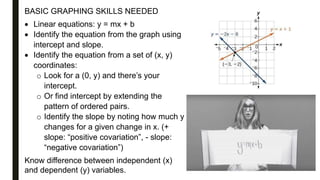
 Linear equations: y = mx + b
 Identify the equation from the graph using
intercept and slope.
 Identify the equation from a set of (x, y)
coordinates:
o Look for a (0, y) and there’s your
intercept.
o Or find intercept by extending the
pattern of ordered pairs.
o Identify the slope by noting how much y
changes for a given change in x. (+
slope: “positive covariation”, - slope:
“negative covariation”)
Know difference between independent (x)
and dependent (y) variables.
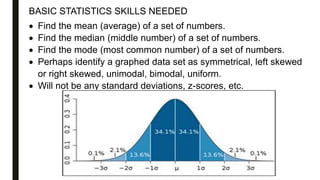
BASIC STATISTICS SKILLS NEEDED
 Find the mean (average) of a set of numbers.
 Find the median (middle number) of a set of numbers.
 Find the mode (most common number) of a set of numbers.
 Perhaps identify a graphed data set as symmetrical, left skewed
or right skewed, unimodal, bimodal, uniform.
 Will not be any standard deviations, z-scores, etc.
WORD PROBLEMS: BASICS
 What is a word problem?
o Most math problems give the “set-up”: you just
do the mechanics of evaluating (expressions) or
solving (equations).
o A word problem makes you:
 READ
 THINK
 Come up with the expression or equation
(the HARD part).
 Then of course do the straightforward
mechanics of evaluating or solving (the
EASY part).
 It doesn’t tell you what to do. Once you accept
responsibility of thinking it out for yourself:
AMAZING, IT IS POSSIBLE, THESE CAN BE
DONE!
HOW TO DO A WORD PROBLEM
 Read the problem.
 What is being asked for? (usually one or two answers).
o Assign an algebraic expression to each answer being asked for
using the given relationship between them (e.g. “a number” = “x” and “5
more than the number” = “x + 5”).
o Write an equation with those algebraic expressions in it
 Often it’s just add the expressions and set them equal to a value
actually given in the problem (think: how would anyone calculate that
given value? – the equation is that calculation).
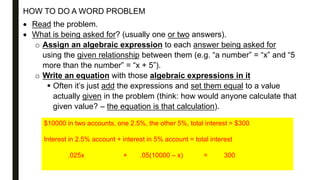
$10000 in two accounts, one 2.5%, the other 5%, total interest = $300
Interest in 2.5% account + interest in 5% account = total interest
.025x + .05(10000 – x) = 300
 Now solve the equation for
x: this is just mechanical,
like any problem that gives
you the set-up, only you
came up with this set-up!
o“x” = something and that
is one of the answers.
oIn the above example,
subtract that from 10,000
to get the other answer
(“10,000 - x”).
NOTE: SOME “WORD” PROBLEMS JUST REQUIRE SIMPLE ARITHMETIC
 No need to set up an equation.
o The unknown is already “by itself” and you are being given all the numbers
to calculate it!
 Imagine yourself in the problem:
o What would you naturally do in such a situation?
o Add? Subtract? Multiply? Divide?
o One step at a time!
 Cannot do it mechanically! You have to think and imagine what one would
naturally do in such a situation.
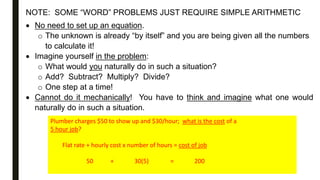
Plumber charges $50 to show up and $30/hour; what is the cost of a
5 hour job?
Flat rate + hourly cost x number of hours = cost of job
50 + 30(5) = 200
BASIC SET-UP SKILLS THATCAN BE
USED FOR WORD PROBLEMS
 Ratio and proportion (LOTS of these).
o Set up and solve a proportion
o Find the parts of a whole given a ratio
of parts and the total (MANY of
these).
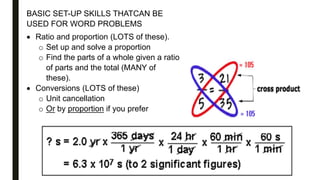
 Conversions (LOTS of these)
o Unit cancellation
o Or by proportion if you prefer
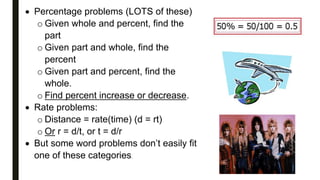
 Percentage problems (LOTS of these)
o Given whole and percent, find the
part
o Given part and whole, find the
percent
o Given part and percent, find the
whole.
o Find percent increase or decrease.
 Rate problems:
o Distance = rate(time) (d = rt)
o Or r = d/t, or t = d/r
 But some word problems don’t easily fit
one of these categories.
Our Services
Study Help
• Drop-In Study Help for all courses
• Study Groups
• Question Drop-Off
Student Tech Help
• Live Chat
• Scheduled Lab Consultations
• Ask-a-Lab Associate Email
• Get Tech Ready and Appy Hour Workshops
Learning Help
• Check out our collection of self-service resources that supplement classroom materials
Get In Touch!
www.wccnet.edu/LC (live chat assistance offered during regular hours)
(734) 973-3420
Email: LCLab@wccnet.edu

Teas prep conquering the teas part 3

  • 1.
  • 2.
    THE MATH TEST 36 questions in 54 minutes: that’s 1 ½ minutes per question.  Each problem is stand alone.  About 25% of the questions are arithmetic and algebra problems.  About 15%, although not true “word problems,” are more than arithmetic, using tables or graphs (mostly the coordinate system).  About 60% are true “word problems”. So need to practice word problems along with your basic arithmetic and algebra skills.  All questions are multiple choice.  Preparation: o Review basic math skills. o Take practice tests.
  • 3.
    MULTIPLE CHOICE STRATEGIESUSUALLY IRRELEVANT  Because a math problem has a number answer and so the choices are all numbers!  So you have to do the problem, get the answer and make the choice.  Sometimes you can still use the procedure of going through the choices one by one and eliminating incorrect answers until you find the correct one. o This usually happens in a linear equation problem:  Find the y-intercept and eliminate those that don’t have it.  Then use slope to choose between the remaining possibilities
  • 4.
    o Very rarelya question might have word answers: One example is “What is the result of dividing a positive integer X by a positive number less than 1?” (two answers can be eliminated)  A number greater than X  A number less than X  A negative number (may be eliminated: +/+ = +)  An irrational number (eliminate: only a result of square root)
  • 5.
    BASIC MATH SKILLSNEEDED  Operations with fractions  Interchange between fractions, decimals and percents (lots of these)  Operations with signed numbers (integers)  Find greatest common factor (GCF)  Find least common multiple (LCM)  Order of operations (PEMDAS)
  • 6.
     Arrange numbersfrom small to large (a list with positive numbers, negative numbers, fractions and decimals, even square roots).  Place value and rounding (for MOST problems: you pick the closest answer!)  Some basic geometric formulas.  A few basic conversion facts o METRIC o English  Probably at least one scientific notation problem
  • 7.
    BASIC ALGEBRA SKILLSNEEDED  Change simple word statements into symbolic expressions/equations.  Evaluate an algebraic expression given value(s) to substitute.  Solve basic equations/inequalities. o Combine like terms. o Pull out GCF or distribute to remove parentheses o Do the same thing to both sides to isolate the variable:  Add/subtract  Multiply/divide  Multiply fractional coefficients by reciprocal.  Cross multiply in the case of a proportion.  Be able to FOIL two binomials.
  • 8.
    BASIC GRAPHING SKILLSNEEDED  Linear equations: y = mx + b  Identify the equation from the graph using intercept and slope.  Identify the equation from a set of (x, y) coordinates: o Look for a (0, y) and there’s your intercept. o Or find intercept by extending the pattern of ordered pairs. o Identify the slope by noting how much y changes for a given change in x. (+ slope: “positive covariation”, - slope: “negative covariation”) Know difference between independent (x) and dependent (y) variables.
  • 9.
    BASIC STATISTICS SKILLSNEEDED  Find the mean (average) of a set of numbers.  Find the median (middle number) of a set of numbers.  Find the mode (most common number) of a set of numbers.  Perhaps identify a graphed data set as symmetrical, left skewed or right skewed, unimodal, bimodal, uniform.  Will not be any standard deviations, z-scores, etc.
  • 10.
    WORD PROBLEMS: BASICS What is a word problem? o Most math problems give the “set-up”: you just do the mechanics of evaluating (expressions) or solving (equations). o A word problem makes you:  READ  THINK  Come up with the expression or equation (the HARD part).  Then of course do the straightforward mechanics of evaluating or solving (the EASY part).  It doesn’t tell you what to do. Once you accept responsibility of thinking it out for yourself: AMAZING, IT IS POSSIBLE, THESE CAN BE DONE!
  • 11.
    HOW TO DOA WORD PROBLEM  Read the problem.  What is being asked for? (usually one or two answers). o Assign an algebraic expression to each answer being asked for using the given relationship between them (e.g. “a number” = “x” and “5 more than the number” = “x + 5”). o Write an equation with those algebraic expressions in it  Often it’s just add the expressions and set them equal to a value actually given in the problem (think: how would anyone calculate that given value? – the equation is that calculation). $10000 in two accounts, one 2.5%, the other 5%, total interest = $300 Interest in 2.5% account + interest in 5% account = total interest .025x + .05(10000 – x) = 300
  • 12.
     Now solvethe equation for x: this is just mechanical, like any problem that gives you the set-up, only you came up with this set-up! o“x” = something and that is one of the answers. oIn the above example, subtract that from 10,000 to get the other answer (“10,000 - x”).
  • 13.
    NOTE: SOME “WORD”PROBLEMS JUST REQUIRE SIMPLE ARITHMETIC  No need to set up an equation. o The unknown is already “by itself” and you are being given all the numbers to calculate it!  Imagine yourself in the problem: o What would you naturally do in such a situation? o Add? Subtract? Multiply? Divide? o One step at a time!  Cannot do it mechanically! You have to think and imagine what one would naturally do in such a situation. Plumber charges $50 to show up and $30/hour; what is the cost of a 5 hour job? Flat rate + hourly cost x number of hours = cost of job 50 + 30(5) = 200
  • 14.
    BASIC SET-UP SKILLSTHATCAN BE USED FOR WORD PROBLEMS  Ratio and proportion (LOTS of these). o Set up and solve a proportion o Find the parts of a whole given a ratio of parts and the total (MANY of these).  Conversions (LOTS of these) o Unit cancellation o Or by proportion if you prefer
  • 15.
     Percentage problems(LOTS of these) o Given whole and percent, find the part o Given part and whole, find the percent o Given part and percent, find the whole. o Find percent increase or decrease.  Rate problems: o Distance = rate(time) (d = rt) o Or r = d/t, or t = d/r  But some word problems don’t easily fit one of these categories.
  • 16.
    Our Services Study Help •Drop-In Study Help for all courses • Study Groups • Question Drop-Off Student Tech Help • Live Chat • Scheduled Lab Consultations • Ask-a-Lab Associate Email • Get Tech Ready and Appy Hour Workshops Learning Help • Check out our collection of self-service resources that supplement classroom materials Get In Touch! www.wccnet.edu/LC (live chat assistance offered during regular hours) (734) 973-3420 Email: LCLab@wccnet.edu