INSTRUCTION AND
LEARNING PROCESSES
Henry C. Balabal Jr.
Resource Speaker
INSTRUCTION AND
LEARNING PROCESSES
Interaction between the learners and teachers.
Learner-centered, participatory, and inclusive
instruction and learning processes involve the
larger community in providing and supporting
education.
INSTRUCTIONAL PLANNING
Planning of what and how will student learn, it
should also include both short term and long-
term goals.
WELL PLANNED INSTRUCTION
Maximizes academic learning time.
Actively engages learners in meaningful
activities; and Emphasizes proactive and positive
approach.
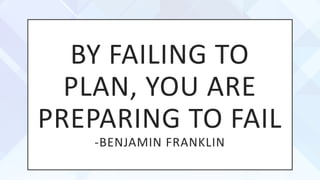
BY FAILING TO
PLAN, YOU ARE
PREPARING TO FAIL
-BENJAMIN FRANKLIN
REVISITING THE
DAILY LESSON LOG (DLL)
DepEd Order No. 42 s. 2016
Policy Guidelines on Daily Lesson Preparation for
the K to 12 Basic Education Program
DAILY LESSON LOG
DepEd Order No. 42 s. 2016
Policy Guidelines on Daily Lesson Preparation for
the K to 12 Basic Education Program
I. OBJECTIVES
The objectives states what the teachers intend to
teach and serve as guide for instruction and
assessment
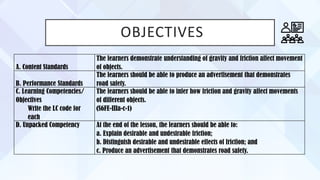
OBJECTIVES
A. Content Standards
The learners demonstrate understanding of gravity and friction affect movement
of objects.
B. Performance Standards
The learners should be able to produce an advertisement that demonstrates
road safety.
C. Learning Competencies/
Objectives
Write the LC code for
each
The learners should be able to infer how friction and gravity affect movements
of different objects.
(S6FE-IIIa-c-1)
D. Unpacked Competency At the end of the lesson, the learners should be able to:
a. Explain desirable and undesirable friction;
b. Distinguish desirable and undesirable effects of friction; and
c. Produce an advertisement that demonstrates road safety.
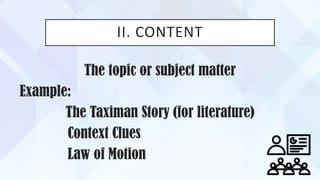
II. CONTENT
The topic or subject matter
Example:
The Taximan Story (for literature)
Context Clues
Law of Motion
III. LEARNING RESOURCES
References and other learning resources that the
teacher will use for the lesson.
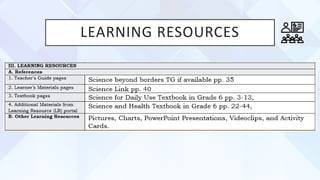
LEARNING RESOURCES
IV. PROCEDURES
This part of the DLL contain ten (10) parts
A. REVIEWING PREVIOUS
LESSON OR PRESENTING THE
NEW LESSON/S
LINK TO EXISTING KNOWLEDGE, USE
WARM-UP ACTIVITIES OR PROVIDE
A
“HOOK” TO GET STUDENTS
INTERESTED IN THE TOPIC
B. ESTABLISHING A PURPOSE
FOR THE LESSON
SET SMART GOALS FOR THE
LESSON
C. PRESENTING
EXAMPLES/INSTANCES OF THE
NEW LESSON
I DO (TEACHER)
EXPLICIT TEACHING AND
MODELLING OF
CONCEPT/SKILL
D. DISCUSSING NEW
CONCEPTS LEADS TO THE
FIRST FORMATIVE
ASSESSMENT
GUIDED/SHARED LEARNING
WE DO
(TEACHER AND STUDENTS)
E. DISCUSSING NEW
CONCEPTS LEADS TO THE
SECOND FORMATIVE
ASSESSMENT
OPPORTUNITIES FOR
PRACTICE
YOU DO (STUDENT)
F. DEVELOPING MASTERY
WHICH LEADS TO THE THIRD
FORMATIVE ASSESSMENT
INDEPENDENT PRACTICE
YOU DO (STUDENT)
G. FINDING PRACTICAL
APPLICATIONS OF CONCEPTS
AND SKILLS IN DAILY LIVING
VALUING
APPLICATION OF LESSON TO
REAL LIFE SITUATIONS
H. GENERALIZATION
CONCLUDE THE LESSON
I. EVALUATING LEARNING
J. ADDITIONAL ACTIVITIES
V. REMARKS
Re-teaching, lack of time, transfer of lesson to
the following day in cases of class suspension
VI. REFLECTIONS
Reflect and assess effectiveness
ELEMENTS OF EFFECTIVE
TEACHING
Identifying clear lesson and clear objectives
while carefully linking activities to them which is
essential for effectiveness.
ELEMENTS OF EFFECTIVE
TEACHING
Creating quality assignments, which is positively
associated with quality instruction and quality
student work.
ELEMENTS OF EFFECTIVE
TEACHING
Planning lessons that have clear goals, are
logically structured and progress through the
content step-by-step.
ELEMENTS OF EFFECTIVE
TEACHING
Planning the instructional strategies to be
deployed in the classroom and the timing of
these strategies.
ELEMENTS OF EFFECTIVE
TEACHING
Using advance organizers, graphic organizers,
and outlines to plan for effective instructional
delivery.
ELEMENTS OF EFFECTIVE
TEACHING
Considering students’ attention spans and
learning styles when designing lessons.
ELEMENTS OF EFFECTIVE
TEACHING
Systematically developing objectives, questions,
and activities that reflect higher level and lower
level cognitive skills as appropriate for the
content and the learners.
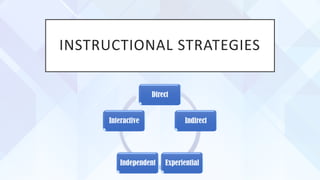
INSTRUCTIONAL STRATEGIES
Direct
Indirect
Experiential
Independent
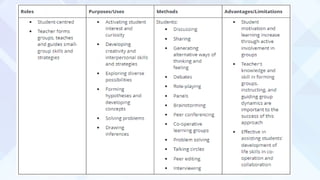
Interactive
INSTRUCTIONAL STRATEGIES
Direct
Instruction
INSTRUCTIONAL STRATEGIES
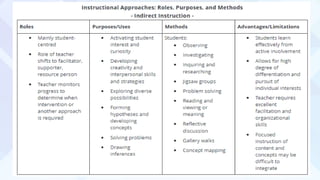
Indirect
Instruction
INSTRUCTIONAL STRATEGIES
Indirect
Instruction
INSTRUCTIONAL STRATEGIES
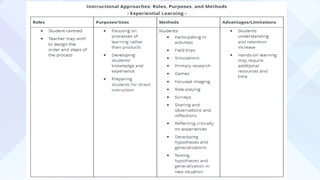
Experiential
Instruction
INSTRUCTIONAL STRATEGIES
Experiential
Instruction
INSTRUCTIONAL STRATEGIES
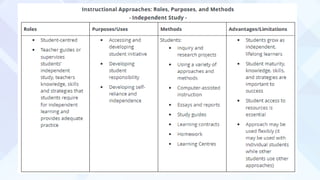
Independent
Study
INSTRUCTIONAL STRATEGIES
Interactive
Instruction
INSTRUCTIONAL METHODS
Post it
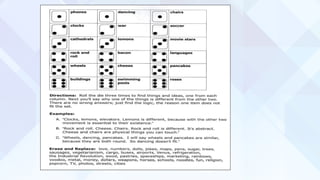
INSTRUCTIONAL METHODS
Dice games
INSTRUCTIONAL METHODS
Traffic Light
INSTRUCTIONAL METHODS
Mystery
Learners
INSTRUCTIONAL METHODS
Entry ticket
INSTRUCTIONAL METHODS
Didactic
questioning
INSTRUCTIONAL METHODS
Didactic
questioning
INSTRUCTIONAL METHODS
Concept
Formation
INSTRUCTIONAL METHODS
Simulation
INSTRUCTIONAL METHODS
Focused
Imaging
INSTRUCTIONAL METHODS
Assigned
question
INSTRUCTIONAL METHODS
Learning
Contracts
INSTRUCTIONAL METHODS
Circling
Questions
INSTRUCTIONAL METHODS
Information
Gap
INSTRUCTIONAL METHODS
Think-pair-
share
INSTRUCTIONAL METHODS
Vocabulary
building
INSTRUCTIONAL METHODS
Listen on
Your Feet
INSTRUCTIONAL METHODS
Act Out the
Story
INSTRUCTIONAL METHODS
Retell the
Story
INSTRUCTIONAL METHODS
Debates
INSTRUCTIONAL METHODS
Describe &
Draw
INSTRUCTIONAL METHODS
Improv
storytelling
INSTRUCTIONAL METHODS
Mad Lib
theater
INSTRUCTIONAL METHODS
Learning
Stations
INSTRUCTIONAL METHODS
Fact or Bluff
INSTRUCTIONAL METHODS
Guess that
pic
INSTRUCTIONAL METHODS
4 pics one
word
INSTRUCTIONAL METHODS
Bingo
INSTRUCTIONAL METHODS
Running
dictation
INSTRUCTIONAL METHODS
Charades
INSTRUCTIONAL METHODS
Pinoy Henyo
INSTRUCTIONAL METHODS
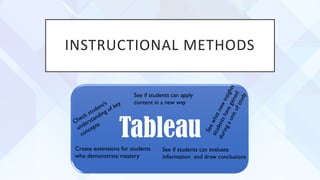
Tableau
See if students can apply
content in a new way
Create extensions for students
who demonstrate mastery
See if students can evaluate
information and draw conclusions
INSTRUCTIONAL METHODS
Paper Ball
INSTRUCTIONAL METHODS
Substitution
Table
INSTRUCTIONAL METHODS
Mystery Bag
INSTRUCTIONAL METHODS
Narrative Advance
Organizer
INSTRUCTIONAL SKILLS
Explaining
INSTRUCTIONAL SKILLS
Demonstrating
INSTRUCTIONAL SKILLS
Questioning
INSTRUCTIONAL SKILLS
Questioning
Technique
INSTRUCTIONAL SKILLS
Wait Time
INSTRUCTIONAL SKILLS
Levels of
Questions
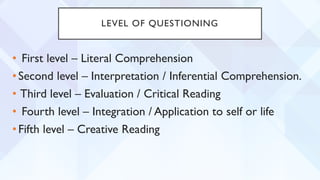
LEVEL OF QUESTIONING
• First level – Literal Comprehension
•Second level – Interpretation / Inferential Comprehension.
• Third level – Evaluation / Critical Reading
• Fourth level – Integration / Application to self or life
•Fifth level – Creative Reading
ATTENTION GRABBERS
Techniques intended to direct attention of
learners to the teacher.
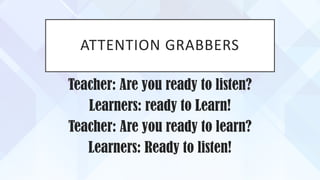
ATTENTION GRABBERS
Teacher: Are you ready to listen?
Learners: ready to Learn!
Teacher: Are you ready to learn?
Learners: Ready to listen!
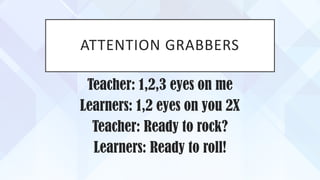
ATTENTION GRABBERS
Teacher: 1,2,3 eyes on me
Learners: 1,2 eyes on you 2X
Teacher: Ready to rock?
Learners: Ready to roll!
ATTENTION GRABBERS
Teacher: Macaroni and cheese, everybody?
Learners: Freeze
GROWTH-MINDSET FEEDBACK
growth-mindset-feedback-tool.pdf
Student_and_teacher_emotional_video(240p).mp4
Dahil_Kay_Ma'am(480p).mp4
_Oo,_guro_ako._Pero_hindi_Guro_LANG._(1080p).mp4

teaching strategies.pdf