Test Bank for Advanced Assessment Interpreting
Findings and Formulating Differential Diagnoses
by Goolsby download
http://testbankbell.com/product/test-bank-for-advanced-
assessment-interpreting-findings-and-formulating-differential-
diagnoses-by-goolsby/
Explore and download more test bank or solution manual
at testbankbell.com
We have selected some products that you may be interested in
Click the link to download now or visit testbankbell.com
for more options!.
Test bank Advanced Assessment: Interpreting Findings and
Formulating Differential Diagnoses 4th Edition Goolsby
http://testbankbell.com/product/test-bank-advanced-assessment-
interpreting-findings-and-formulating-differential-diagnoses-4th-
edition-goolsby/
Test Bank for Advanced Assessment : Interpreting Findings
and Formulating Differential Diagnoses 4th Edition Goolsby
http://testbankbell.com/product/test-bank-for-advanced-assessment-
interpreting-findings-and-formulating-differential-diagnoses-4th-
edition-goolsby/
Advanced Assessment Interpreting Findings and Formulating
Differential Diagnoses 3rd Edition Goolsby Grubbs Test
Bank
http://testbankbell.com/product/advanced-assessment-interpreting-
findings-and-formulating-differential-diagnoses-3rd-edition-goolsby-
grubbs-test-bank/
Social Psychology 9th Edition Kassin Test Bank
http://testbankbell.com/product/social-psychology-9th-edition-kassin-
test-bank/
Solutions Manual to accompany College Physics with
MasteringPhysics 9th edition 9780321749802
http://testbankbell.com/product/solutions-manual-to-accompany-college-
physics-with-masteringphysics-9th-edition-9780321749802/
Solution Manual for Chemistry 10th by Zumdahl
http://testbankbell.com/product/solution-manual-for-chemistry-10th-by-
zumdahl/
Test Bank for Human Resource Management 1st Edition by
Phillips
http://testbankbell.com/product/test-bank-for-human-resource-
management-1st-edition-by-phillips/
Test Bank For Drug Therapy in Nursing, Fourth edition:
Diane Aschenbrenner
http://testbankbell.com/product/test-bank-for-drug-therapy-in-nursing-
fourth-edition-diane-aschenbrenner/
Solution Manual for Organizational Behavior, 15th Edition
Stephen P. Robbins Timothy A. Judge
http://testbankbell.com/product/solution-manual-for-organizational-
behavior-15th-edition-stephen-p-robbins-timothy-a-judge/
Solution Manual for Financial Accounting 15th Edition by
Williams
http://testbankbell.com/product/solution-manual-for-financial-
accounting-15th-edition-by-williams/
Test Bank for Advanced Assessment Interpreting
Findings and Formulating Differential Diagnoses by
Goolsby
Full chapter at: https://testbankbell.com/product/test-bank-for-
advanced-assessment-interpreting-findings-and-formulating-
differential-diagnoses-by-goolsby/
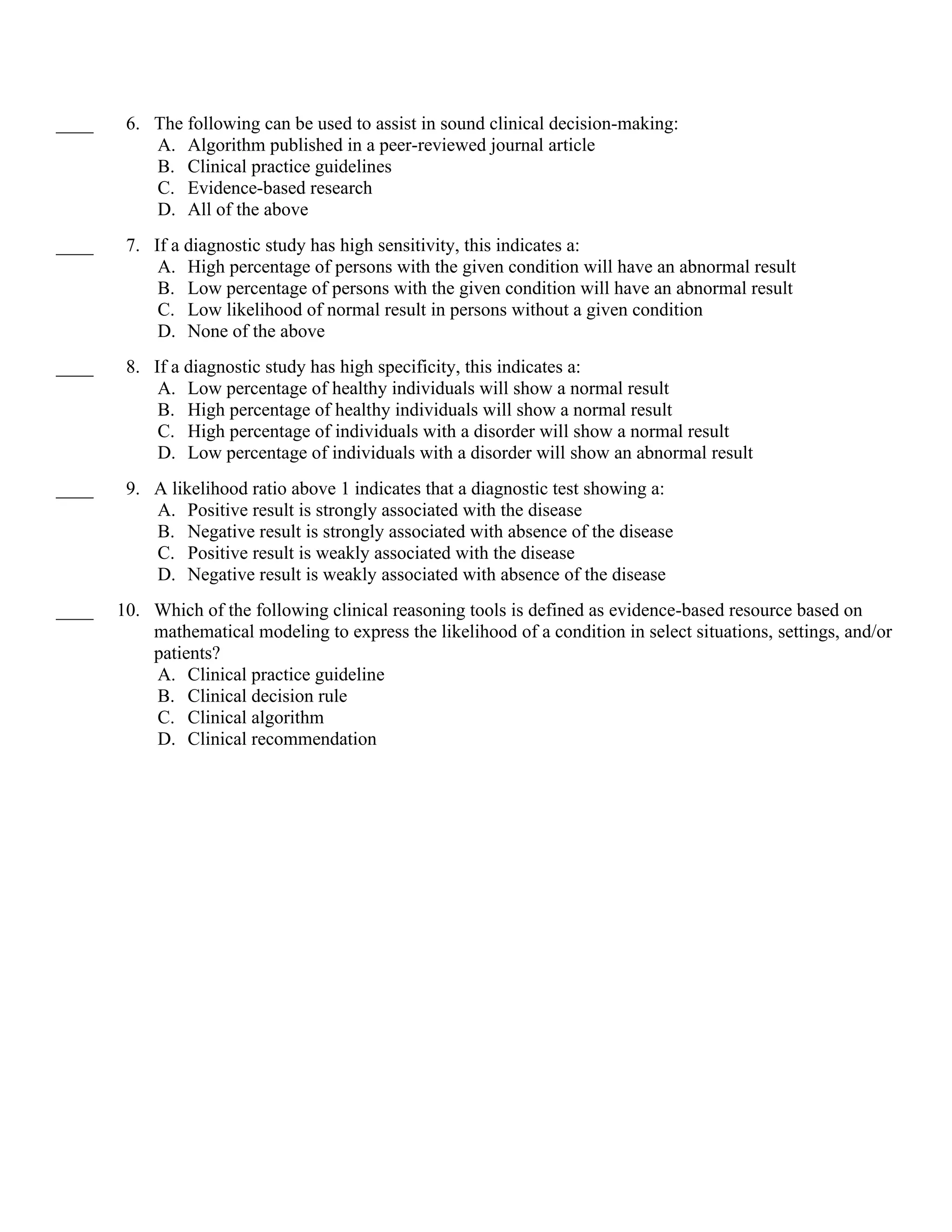
Chapter 1. Assessment and Clinical Decision-Making: Overview
Multiple Choice
Identify the choice that best completes the statement or answers the question.
____ 1. Which type of clinical decision-making is most reliable?
A. Intuitive
B. Analytical
C. Experiential
D. Augenblick
____ 2. Which of the following is false? To obtain adequate history, health-care providers must be:
A. Methodical and systematic
B. Attentive to the patient’s verbal and nonverbal language
C. Able to accurately interpret the patient’s responses
D. Adept at reading into the patient’s statements
____ 3. Essential parts of a health history include all of the following except:
A. Chief complaint
B. History of the present illness
C. Current vital signs
D. All of the above are essential history components
____ 4. Which of the following is false? While performing the physical examination, the examiner must be
able to:
A. Differentiate between normal and abnormal findings
B. Recall knowledge of a range of conditions and their associated signs and
symptoms
C. Recognize how certain conditions affect the response to other conditions
D. Foresee unpredictable findings
____ 5. The following is the least reliable source of information for diagnostic statistics:
A. Evidence-based investigations
B. Primary reports of research
C. Estimation based on a provider’s experience
D. Published meta-analyses
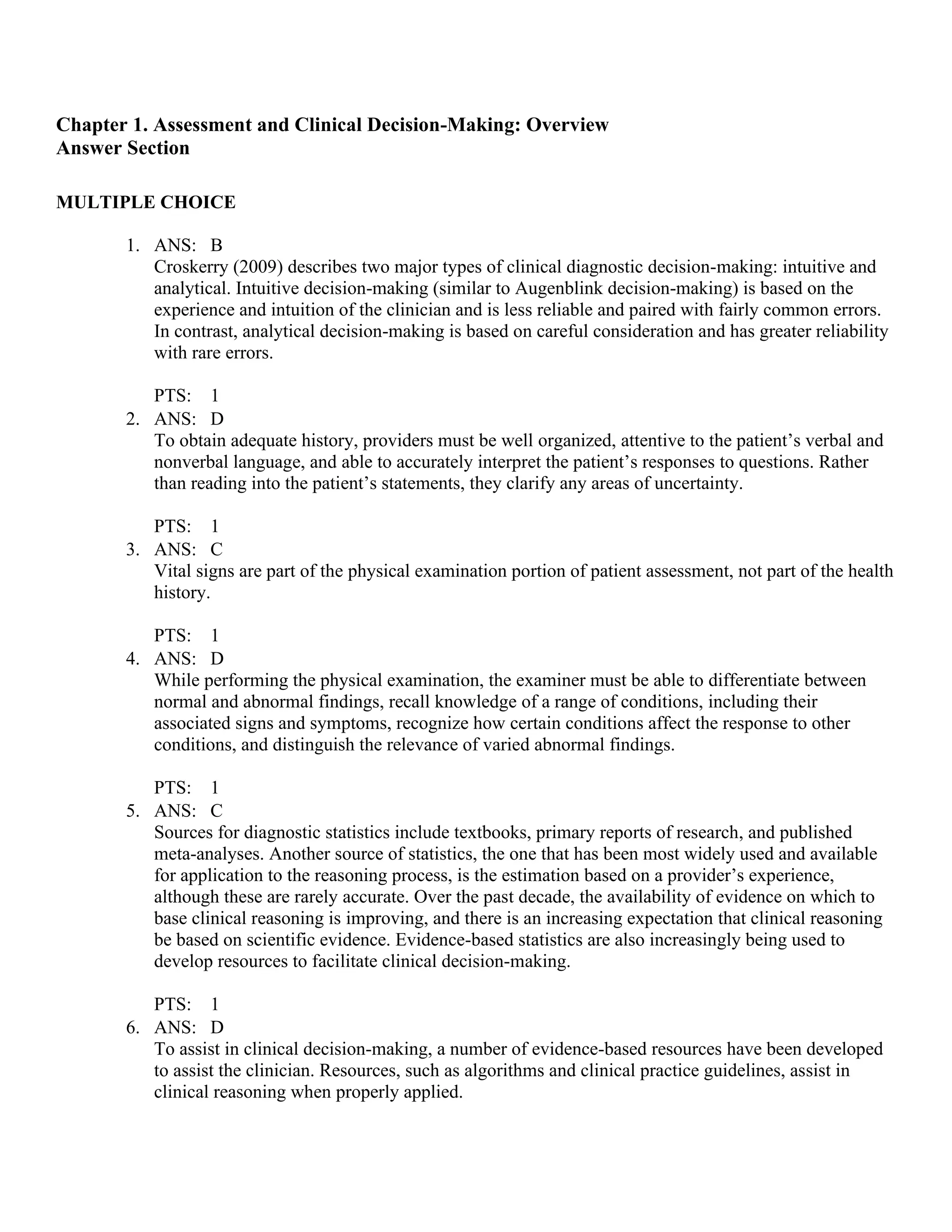
____ 6. The following can be used to assist in sound clinical decision-making:
A. Algorithm published in a peer-reviewed journal article
B. Clinical practice guidelines
C. Evidence-based research
D. All of the above
____ 7. If a diagnostic study has high sensitivity, this indicates a:
A. High percentage of persons with the given condition will have an abnormal result
B. Low percentage of persons with the given condition will have an abnormal result
C. Low likelihood of normal result in persons without a given condition
D. None of the above
____ 8. If a diagnostic study has high specificity, this indicates a:
A. Low percentage of healthy individuals will show a normal result
B. High percentage of healthy individuals will show a normal result
C. High percentage of individuals with a disorder will show a normal result
D. Low percentage of individuals with a disorder will show an abnormal result
____ 9. A likelihood ratio above 1 indicates that a diagnostic test showing a:
A. Positive result is strongly associated with the disease
B. Negative result is strongly associated with absence of the disease
C. Positive result is weakly associated with the disease
D. Negative result is weakly associated with absence of the disease
____ 10. Which of the following clinical reasoning tools is defined as evidence-based resource based on
mathematical modeling to express the likelihood of a condition in select situations, settings, and/or
patients?
A. Clinical practice guideline
B. Clinical decision rule
C. Clinical algorithm
D. Clinical recommendation
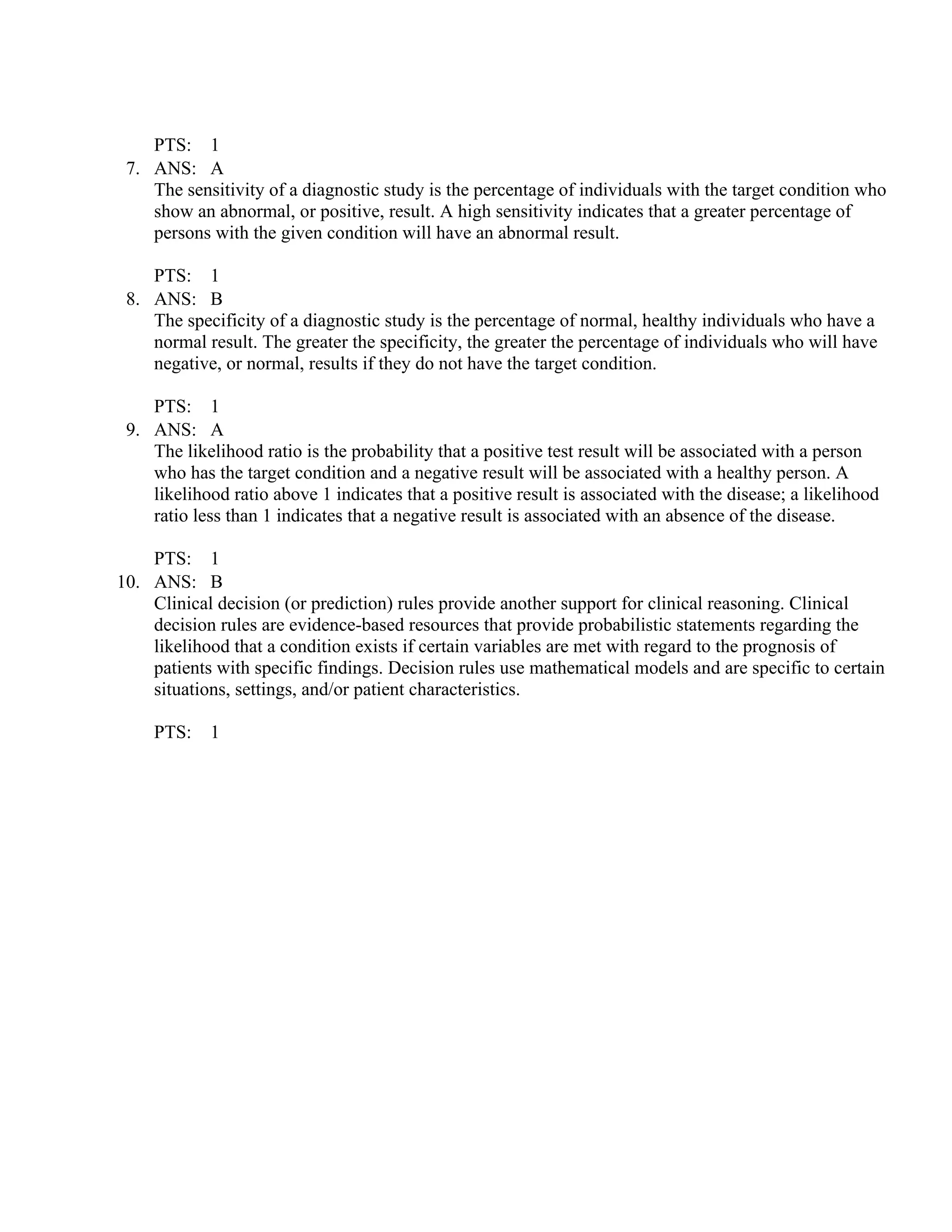
Chapter 1. Assessment and Clinical Decision-Making: Overview
Answer Section
MULTIPLE CHOICE
1. ANS: B
Croskerry (2009) describes two major types of clinical diagnostic decision-making: intuitive and
analytical. Intuitive decision-making (similar to Augenblink decision-making) is based on the
experience and intuition of the clinician and is less reliable and paired with fairly common errors.
In contrast, analytical decision-making is based on careful consideration and has greater reliability
with rare errors.
PTS: 1
2. ANS: D
To obtain adequate history, providers must be well organized, attentive to the patient’s verbal and
nonverbal language, and able to accurately interpret the patient’s responses to questions. Rather
than reading into the patient’s statements, they clarify any areas of uncertainty.
PTS: 1
3. ANS: C
Vital signs are part of the physical examination portion of patient assessment, not part of the health
history.
PTS: 1
4. ANS: D
While performing the physical examination, the examiner must be able to differentiate between
normal and abnormal findings, recall knowledge of a range of conditions, including their
associated signs and symptoms, recognize how certain conditions affect the response to other
conditions, and distinguish the relevance of varied abnormal findings.
PTS: 1
5. ANS: C
Sources for diagnostic statistics include textbooks, primary reports of research, and published
meta-analyses. Another source of statistics, the one that has been most widely used and available
for application to the reasoning process, is the estimation based on a provider’s experience,
although these are rarely accurate. Over the past decade, the availability of evidence on which to
base clinical reasoning is improving, and there is an increasing expectation that clinical reasoning
be based on scientific evidence. Evidence-based statistics are also increasingly being used to
develop resources to facilitate clinical decision-making.
PTS: 1
6. ANS: D
To assist in clinical decision-making, a number of evidence-based resources have been developed
to assist the clinician. Resources, such as algorithms and clinical practice guidelines, assist in
clinical reasoning when properly applied.
PTS: 1
7. ANS: A
The sensitivity of a diagnostic study is the percentage of individuals with the target condition who
show an abnormal, or positive, result. A high sensitivity indicates that a greater percentage of
persons with the given condition will have an abnormal result.
PTS: 1
8. ANS: B
The specificity of a diagnostic study is the percentage of normal, healthy individuals who have a
normal result. The greater the specificity, the greater the percentage of individuals who will have
negative, or normal, results if they do not have the target condition.
PTS: 1
9. ANS: A
The likelihood ratio is the probability that a positive test result will be associated with a person
who has the target condition and a negative result will be associated with a healthy person. A
likelihood ratio above 1 indicates that a positive result is associated with the disease; a likelihood
ratio less than 1 indicates that a negative result is associated with an absence of the disease.
PTS: 1
10. ANS: B
Clinical decision (or prediction) rules provide another support for clinical reasoning. Clinical
decision rules are evidence-based resources that provide probabilistic statements regarding the
likelihood that a condition exists if certain variables are met with regard to the prognosis of
patients with specific findings. Decision rules use mathematical models and are specific to certain
situations, settings, and/or patient characteristics.
PTS: 1
Exploring the Variety of Random
Documents with Different Content
“We asked to see the commandin’ officer, an’ when we found
him we reported to him as scouts belongin’ to Gen’ral Santa Anna’s
head-quarters, an’ that we had come with very important news for
Gen’ral Cortinas. What that news was we didn’t know ourselves; but
we knowed that we could get up a purty good story when the time
come.
“‘All right,’ said the Greaser cap’n. ‘I’m goin’ up to Gen’ral
Cortinas’ camp to-morrow, an’ you can ride right up with me.’
“We touched our hats to him an’ left the room. I hated mighty
bad to salute that dirty Greaser jest as I would my kurnel. I had
rather put a bullet in his yaller hide; but we war in for it, an’ we
knowed that the hull thing depended on our behavin’ ourselves
properly. As we passed out o’ the house we met the women, an’ I
begun to shake in my boots agin, ’cause I knowed them women had
sharp eyes, an’ I war afeered it war all up with us. But they didn’t
suspect nothin’, an’ I knowed that we war safe; ’cause if they
couldn’t see through the game we war playin’, nobody could.
“Wal, we went out into the yard an’ eat supper, an’ lay down
around the fire with them ar dirty Mexikins, an’ listened to their
insultin’ talk agin the Americans, an’, in course, jined in with ’em.
They thought me an’ ole Bill war lucky dogs in bein’ with a great
gen’ral like Santa Anna; but I couldn’t see what there war great in a
man who, with an army o’ fifty thousand men, would run from six
thousand. But we told ’em a good many things about the gen’ral
that I guess they never heered afore, an’ we hadn’t heered of ’em
neither; but they believed every thing we said war gospel truth, an’
we made our kalkerlations that in less nor a month the American
army would all be prisoners.
“The next mornin’ we made an ’arly start, an’ that arternoon
drew up in the Mexikin camp. It war a purty sight, I tell you—nothin’
to be seen but white tents as far as our eyes could reach. There
warn’t less nor a hundred thousand men in that ar camp, an’ I
begun to feel rather shaky when I thought of our small army at
Monterey. While me an’ Bill war lookin’ about, a spruce little Greaser
come up, an’ said that Gen’ral Cortinas war waitin’ to see us. We
found the rascal in a large tent, with a sentry afore the door, an’
when I sot eyes on him, my fingers ached to ketch him by the
throat. He looked jest as he did when me an’ him set out from
Monterey together, only he had on a blue uniform.
“‘Wal, boys,’ said he, smilin’ an’ motionin’ us to set down, ‘I
understand that you’re from Gen’ral Santa Anna, an’ have news for
me.’
“‘Yes, gen’ral,’ said ole Bill, takin’ off his slouch-hat, an’
scratchin’ his head as if thinkin’ what to say. ‘We’ve got news for
you. If you want to ketch Cap’n Morgan an’ his band o’ cutthroats,
I’ll tell you jest how you can do it.’
“‘How can it be done, my good feller,’ said the gen’ral, rubbin’
his hands. ‘I thought I should capture him the other night, but he
had too many men for me.’
“‘Wal,’ said ole Bill, ‘me an’ this feller here’—pintin’ to me—’war
in Monterey yesterday, an’ heered an order read to Cap’n Morgan to
march out o’ the city at midnight, an’ jine Cap’n Davis at Alamo.
Now, if you want to ketch him, all you have got to do is to take fifty
men, an’ wait for him in the mountains. He has got jest twenty-eight
men in his company.’
“‘I’ll do it,’ said the Greaser. ‘But I’ll take a hundred men, to
make sure of him. Which road is he going to take?’
“‘That’s what we can’t tell exactly,’ said ole Bill. ‘But me an’ this
feller thought that we would come an’ tell you, so that you could
have every thing ready, an’ then go back and find out all their plans.’
“‘Very well,’ said the Greaser; an’, arter writin’ somethin’ on a
piece o’ paper, he handed it to ole Bill, sayin’: ‘Here’s a pass for you
an’ your friend to go in an’ out o’ the lines whenever you please.
Now, you go back to Monterey, an’ find out all Cap’n Morgan’s plans,
an’ I’ll go out with a hundred men an’ ketch him.’
“This war exactly what me an’ Bill wanted. We were afeered at
first that he would send some one else instead o’ goin’ himself; but
now we knowed that we war all right; the gen’ral war ourn, an’ no
mistake.
“As soon as we got out o’ sight o’ the camp, we made good
time, an’ afore midnight we war in the kurnel’s head-quarters. As
soon as he heered our story, he sent for one o’ his officers, an’ told
him to march ’arly the next evenin’ with eighty men, an’ draw up an
ambush, in a deep gorge, through which ran the road that led to
Alamo. An’ he ordered Cap’n Morgan, who had reached Monterey
the day afore, to be ready to march through that gorge at midnight.
“Arter me an’ Bill had rested a little while, we set out on fresh
hosses, an’, in a few hours, were back in the Mexikin camp agin.
That arternoon we rid out, side by side, with Gen’ral Cortinas, an’
about ten o’clock in the evenin’ we reached the gorge. Every thing
war as silent as death; but I knowed that eighty Western rifles war
stowed away among the trees, on each side o’ the road, an’ behind
’em war sturdy hunters an’ trappers, achin’ to send a bullet in among
us.
“Arter the gen’ral had fixed his men to suit him, we drawed back
into the bushes, an’ waited for Cap’n Morgan to come up. Jest a little
afore midnight we heered a faint tramp, an’ in a few minits the
rangers swept down into the gorge. For a minit nothin’ war heered
but the noise o’ their hosses’ hoofs on the road. It war a fine sight to
see them brave men ridin’ right down into that ambush, knowin’, as
they did, that death war on each side o’ them. Nigher an’ nigher
they come; an’ the gen’ral war about to give the order to fire, when,
all to onct, a yell like an Injun’s burst from among the trees, an’ the
reports of eighty rifles echoed through the mountains. You never
seed a more astonished Greaser nor that Gen’ral Cortinas war about
that time.
“‘Carrajo,’ he yelled, ‘you have betrayed me.’
“‘Shouldn’t wonder if we had, you tarnal yaller-hided scoundrel,’
said ole Bill; an’ afore the Greaser could make a move, we had him
by the arms, an’ two six-shooters were lookin’ him in the face. His
cowardly men didn’t fire a shot, but throwed down their guns, an’
run in every direction. But our boys closed up about ’em, an’ out o’
them ar hundred men that come out to ketch Cap’n Morgan, not half
a dozen escaped. The only prisoner we tuk back to Monterey war
the gen’ral.”
After Dick had got through his tale, the hunters held a
consultation over the state of their larder. As their coffee, bread, and
other supplies were exhausted, and they did not like the idea of
living on venison and water, they concluded to break up camp. The
next morning they packed their baggage into the sled, and, taking a
last look at the place where they had spent so many happy hours,
set out for Uncle Joe’s cabin, which they reached a little before dark.
CHAPTER XVI.
The Lost Wagon-Train.
NCLE Joe met them at the door, and, while they were
relieving themselves of their overcoats and weapons,
asked innumerable questions about their sojourn in
the woods. Dick took the part of spokesman, and
described, in his rude, trapper’s style, the scenes
through which they had passed, dwelling with a good
deal of emphasis on the “keerlessness” displayed by
the Young Naturalist in attacking the moose, and in starting off alone
to fight the panther. The trapper tried hard to suppress the feelings
of pride which he really felt, and favored the young hunter with a
look that was intended to be severe, but which was, in fact, a
mingling of joy and satisfaction.
Frank bore the scolding which Uncle Joe administered with a
very good grace, for he knew that he deserved it.
“I’d like to take the youngster out on the prairy,” said Dick,
seating himself before the fire, and producing his never-failing pipe.
“I’ll bet that, arter he had follered me and Useless a year or two, he
wouldn’t be in no great hurry to pitch into every wild varmint he
come acrost.”
Frank made no reply, but taking the cubs from the pockets of
his overcoat, allowed them to run about the cabin—a proceeding
which the dogs, especially Brave, regarded with suspicion, and which
they could not be persuaded to permit, until they had received
several hearty kicks and cuffs from their masters.
“You can’t blame the critters,” said the trapper, puffing away at
his pipe. “It’s their natur’, an’ I sometimes think that them dogs have
a deal more sense than their human masters, an’”——
“Supper’s ready,” interrupted Bob, the cook and man-of-all-work,
and this announcement put an end to all further conversation on the
subject.
The boys were highly delighted to find themselves seated at a
well-filled table once more, and Uncle Joe’s good things rapidly
disappeared before their attacks. It made no difference to the
trapper, however. With him a few weeks “roughing it” in the woods
was, of course, no novelty. A log for a table, and a piece of clean
bark for a plate, answered his purpose as well as all the
improvements of civilization, which those who have been brought up
in the settlements regard as necessary to their very existence.
After supper, they drew their chairs in front of the fire, and
Uncle Joe and his brother solaced themselves with their pipes, while
Bob busied himself in clearing away the table and washing the
dishes.
“This Bill Lawson,” said the trapper, after taking a few puffs at
his pipe, to make sure that it was well lighted, “used to take it into
his head onct in awhile to act as guide for fellers as wanted to go to
Californy. He knowed every inch of the country from St. Joseph to
the mines, for he had been over the ground more’n you ever
traveled through these yere woods, an’ he was called as good a
guide as ever tuk charge of a wagon-train. In course, I allers went
with him on these trips, as a sort o’ pack-hoss an’ hunter, cause ole
Bill couldn’t think o’ goin’ anywhere without me; an’ I have often
thought that the reason why he made them trips as guide, was jest
to get a good look at the folks; it reminded him o’ the time when he
had parents, an’ brothers an’ sisters. He never laughed an’ joked
round the camp-fires, as he used to do when me and him war off
alone in the mountains. He hardly ever said a word to any body
besides me, an’ allers appeared to be sorrowful. This give him the
name of ‘Moody Bill,’ by which he was knowed all through the
country. Every trader on the prairy war acquainted with him, an’ he
allers tuk out a big train. I never knowed him to lose but one, an’ he
lost himself with it. The way it happened war this:
“One night, arter we had got about a week’s journey west of
Fort Laramie, we stopped in a little oak opening, where we made our
camp. It war right in the heart o’ the wust Injun country I ever see,
an’ near a place where me an’ ole Bill had often cached our furs an’
other fixins, an’ which we used as a kind o’ camp when we war in
that part o’ the country trappin’ beaver an’ fightin’ Injuns. It war a
cave in the side of a mountain, an’ the way we had it fixed nobody
besides ourselves couldn’t find it. We never went in or come out of it
until arter dark, ’cause the Comanches were a’most allers huntin’
’bout the mountains, an’ we didn’t want em to break up our
harborin’ place. We had made up our minds that, arter we had seed
our train safe through, we would come back to our ‘bar’s hole,’ as we
called it, an’ spend a month or so in fightin’ the Comanches an’
skrimmagin’ with the grizzlies in the mountains.
“Wal, as I war sayin’ we made our camp, an’ while I war
dressin’ a buck I had shot, ole Bill, as usual, leaned on his rifle, an’
watched the emigrants unpack their mules an’ wagons, an’ make
their preparations for the night. Arter supper he smoked a pipe, an’
then rolled himself up in his blanket an’ said——‘Dick, you know this
place, but you ain’t no trapper;’ an’, without sayin’ any more, he lay
down and went to sleep, leavin’ me to station the guards, an’ see
that every thing went on right durin’ the night.
“I knowed well enough what ole Bill meant when he said, ‘Dick,
you ain’t no trapper.’ He had seed Injun sign durin’ the day, an’ war
pokin’ fun at me, cause I hadn’t seed it too. I don’t know, to this
day, how it war that I had missed it, for I had kept a good look-out,
an’ I had allers thought that I war ’bout as good an Injun hunter as
any feller in them diggins, (allers exceptin’ ole Bill and Bob Kelly;)
but the way the ole man spoke tuk me down a peg or two, an’ made
me feel wusser nor you youngsters do when you get trounced at
school for missin’ your lessons.
“Wal, as soon as it come dark, I put out the guards, an’ then
shouldered my rifle, an’ started out to see if I could find any sign o’
them Injuns that ole Bill had diskivered. It war as purty a night as
you ever see. The moon shone out bright an’ clear, an’, savin’ the cry
of a whippoorwill, that come from a gully ’bout a quarter of a mile
from the camp, an’ the barkin’ o’ the prairy wolves, every thing war
as still as death. You youngsters would have laughed at the idea o’
goin’ out to hunt Injuns on such a night; but I knowed that there
must be somethin’ in the wind, for ole Bill never got fooled about
sich things. Here in the settlements he wouldn’t have knowed
enough to earn his salt; but out on the prairy he knowed all about
things.
“Wal, I walked all round the camp, an’ back to the place where I
had started from, an’ not a bit of Injun sign did I see. There war a
high hill jest on the other side of the gully, an’ I knowed that if there
war any Injuns about, an’ they should take it into their heads to
pounce down upon us, they would jest show themselves in that
direction; so I sot down on the prairy, outside o’ the wagons, which
war drawn up as a sort o’ breastwork round the camp, and begun to
listen. I didn’t hear nothin’, however, until a’most midnight, and then,
jest arter I had changed the guards, an’ was goin’ back to my place,
I heered somethin’ that made me prick up my ears. It war the
hootin’ of an owl, an’ it seemed to come from the hill.
“Now, you youngsters would’n’t have seed any thing strange in
that; but a man who has spent his life among wild Injuns and
varmints can tell the difference atween a sound when it comes from
an owl’s throat, and when it comes from a Comanche’s; an’ I to onct
made up my mind that it war a signal. Presently from the gully come
the song of a whippoorwill. It didn’t sound exactly like the notes I
had heered come from that same gully but a few minits afore, an’ I
knowed that it war another signal. When the whippoorwill had got
through, I heered the barkin’ of a prairy wolf further up the gully to
the right o’ the camp; an’ all to onct the wolves, which had been
barkin’ an’ quarrelin’ round the wagons, set up a howl, an’
scampered away out o’ sight. This would have been as good a sign
as I wanted that there war Injuns about, even if I hadn’t knowed it
afore; so I sot still on the ground to see what would be the next
move.
“In a few minits I heered a rustlin’ like in the grass a little to one
side of me. I listened, an’ could tell by the sound that there was
somebody in there, crawlin’ along on his hands an’ knees. Nearer an’
nearer it come, an’ when it got purty clost to me it stopped, an’ I
seed an’ Injun’s head come up over the top o’ the grass, an’ I could
see that the rascal war eyein’ me purty sharp. I sot mighty still,
noddin’ my head a leetle as if I war fallin’ asleep, keepin’ an’ eye on
the ole feller all the time to see that he didn’t come none of his
Injun tricks on me, and finally give a leetle snore, which seemed to
satisfy the painted heathen, for I heered his ‘ugh!’ as he crawled
along by me into camp.
“What made you do that?” interrupted Archie, excitedly. “Why
didn’t you muzzle him?”
“That the way you youngsters, what don’t know nothin’ about
fightin’ Injuns, would have done,” answered the trapper, with a
laugh, “an’ you would have had your har raised for your trouble. But,
you see, I knowed that he had friends not a great way off, an’ that
the fust motion I made to grab the rascal, I would have an arrer
slipped into me as easy as fallin’ off a log. But I didn’t like to have
the varlet behind me; so, as soon as I knowed that he had had time
to get into the camp, I commenced noddin’ agin, an’ finally fell back
on the ground, ker-chunk.
“I guess them Injuns that were layin’ round in the grass laughed
some when they see how quick I picked up my pins. I got up as
though I expected to see a hull tribe of Comanches clost on to me,
looked all round, an’, arter stretchin’ my arms as though I had
enjoyed a good sleep, I started along toward the place where one o’
the guards war standin’. I walked up clost to him, an’ whispered:
“‘Don’t act as though you thought that any thing was wrong,
but keep your eyes on the grass. There’s Injuns about.’
“The chap turned a leetle pale when he heered this; but
although he was as green as a punkin, as far as Injun fightin’ war
consarned, he seemed to have the real grit in him, for he nodded in
a way that showed that he understood what I meant. I then
dropped down on all-fours, an’ commenced crawlin’ into the camp to
find the Injun. The fires had burned low, an’ the moon had gone
down, but still there war light enough for me to see the rascal
crawlin’ along on the ground, an’ making toward one of the wagons.
When he reached it, he raised to his feet, an’, arter casting his eyes
about the camp, to make sure that no one seed him, he lifted up the
canvas an’ looked in. Now war my time. Droppin’ my rifle, I sprung
to my feet, an’ started for the varlet; but jest as I war goin’ to grab
him, one o’ the women in the wagon, who happened to be awake,
set up a screechin’. The Injun dropped like a flash o’ lightnin’, an’,
dodgin’ the grab I made at him, started for the other side o’ the
camp, jumpin’ over the fellers that were layin’ round as easy as if he
had wings. I war clost arter him, but the cuss run like a streak; an
finding that I war not likely to ketch him afore he got out into the
prairy, I jumped back for my rifle an’ tuk a flyin’ shot at him, jest as
he war divin’ under a wagon. I don’t very often throw away a chunk
o’ lead, an’, judgin’ by the way he yelled, I didn’t waste one that
time. He dropped like a log, but war on his feet agin in a minit, an’,
without waitin’ to ax no questions, set up the war-whoop. I tell you,
youngsters, the sound o’ that same war-whoop war no new thing to
me. I’ve heered it often—sometimes in the dead o’ night, when I
didn’t know that there war any danger about, an’ it has rung in my
ears when I’ve been runnin’ for my life, with a dozen o’ the yellin’
varlets clost to my heels; but I never before, nor since, felt my
courage give way as it did on that night. Scarcely a man in the hull
wagon-train, exceptin’ me an ole Bill, had ever drawed a bead on an
Injun, an’ I war a’most sartin that I should have a runnin’ fight with
the rascals afore mornin’.
“The whoop war answered from all round the camp, an’ the way
the bullets an’ arrers come into them ar wagons warn’t a funny thing
to look at. My shot had ’wakened a’most every one in[Pg camp, but
there warn’t much sleepin’ done arter the Injuns give that yell. Men,
women, an’ children poured out o’ the wagons, an’ run about, gettin’
in everybody’s way; an’ sich a muss as war kicked up in that ar camp
I never heered afore. There war about seventy men in the train, an’
they war all good marksmen, but there war scarcely a dozen that
thought o’ their rifles. They kept callin’ on me an’ ole Bill to save
’em, an’ never onct thought o’ pickin’ up their we’pons an’ fightin’ to
save themselves; an’, in spite of all we could do, them ar cowardly
sneaks would get behind the women an’ children for protection. It
war enough to frighten any one; an’ although that ar warn’t the fust
muss o’ the kind I had been in, I felt my ole ’coon-skin cap raise on
my head when I thought what a slaughter there would be when
them Comanches onct got inside o’ the camp. There war only a few
of us to fight ’em, an’ we did the best we could, sendin’ back their
yells, an’ bringin’ the death-screech from some unlucky rascal at
every shot. But the Injuns warn’t long in findin’ out how the land lay,
an’, risin’ round us like a cloud, they come pourin’ into camp.”
CHAPTER XVII.
The Struggle in the Cave.
E an ole Bill warn’t hired to run away, an’ we wouldn’t
need to have done it if them ar cowards had stood up
to the mark like men; but when I seed them Injuns
comin’, I knowed that the game war up—it warn’t no
use to fight longer. I jest ketched a glimpse of ole Bill
makin’ for his hoss, an’ I did the same, ’cause I
knowed that he would stay as long as there war any
chance o’ beatin’ back the Injuns.
“To jump on my hoss, an’ cut the lasso with which he war
picketed, warn’t the work of a minit, an’ then, clubbin’ my rifle, I laid
about me right an’ left, an’ my hoss, knowin’ as well as I did what
war the matter, carried me safely out o’ the camp.
“As I rode out on to the prairy, the Injuns started up on all sides
o’ me, but my hoss soon carried me out o’ their reach. As soon as I
thought I war safe, I hauled up to load my rifle, an’ wait for ole Bill.
I felt a leetle oneasy about him, ’cause, if the Comanches should
onct get a good sight at him, they would be sartin to know who he
war, an’ wouldn’t spare no pains to ketch him; an’ if they succeeded,
he couldn’t expect nothin’ but the stake.
“Wal, arter I had loaded up my rifle, an’ scraped some bullets, I
started back toward the camp, to see if I could find any thing o’ Bill;
an’ jest at that minit I heered a yell that made my blood run cold. By
the glare o’ the camp-fires, which the Comanches had started agin, I
seed the cause of the yell, for there war ole Bill on foot, an’ makin’
tracks for the gully, with a dozen yellin’ varlets clost at his heels. In
course I couldn’t help the old man any; an’, besides, I knowed that
they would take him alive at any risk, an’ that, if I kept out o’ the
scrape, I might have a chance to save him. Wal, jest at the edge o’
the gully he war ketched, an’ arter a hard tussle—for the ole man
warn’t one of them kind that gives up without a fight—he war bound
hand an’ foot, an’ carried back to the camp.
“In course the news spread among the Comanches like lightnin’,
an’ it had the effect o’ stoppin’ the slaughterin’ that war goin’ on, for
the Injuns all wanted to have a look at the man who had sent so
many o’ their best warriors to the happy huntin’-grounds.
“Finally, some o’ the varlets yelled out my name—the rest took it
up, an’ clouds of the warriors went scourin’ through the camp an’
over the prairy to find me; ’cause they knowed that whenever the
ole man war to be found, I warn’t a great way off. It begun to get
mighty onhealthy for me in them diggins, so I turned my hoss, an’
made tracks acrost the prairy. I rid some, now, I reckon, an’, in a
short time, war out o’ hearin’ o’ the yells o’ the savages.
“As soon as I thought I war safe, I camped down on the prairy,
an’, with my hoss for a sentinel, slept soundly until mornin’. I then
started for the camp, or, rather, the place where the camp had been,
for when I got there, I found nothin’ but its ruins. The Injuns had
burned every thing they did not want or could not carry away, an’
made off with their prisoners. Their trail war plain enough, an’ I to
onct commenced follerin’ it up, determined that I would either save
ole Bill or die with him; an’, on the fourth day, durin’ which time I
had lived on some parched corn I happened to have in the pockets
o’ my huntin’-shirt, an’ war in constant danger of being ketched by
stragglers, I seed the Injuns enter their camp. In course there war a
big rejoicin’ over the prisoners an’ plunder they had brought in, an’ it
war kept up until long arter dark.
“The camp, which numbered ’bout fifty lodges, war pitched in a
small prairy, surrounded on three sides by the woods. The nearest I
could get to it without bein’ diskivered war half a mile; an’ here I
tied my hoss in the edge o’ the woods, an’ lay down to sleep.
“’Arly the next mornin’ I war aroused by a yellin’ and the noise
o’ drums, an’ found the hull camp in motion. Near the middle o’ the
village war a small clear spot, where the prisoners war stationed.
They war not bound, but a single glance at a dozen armed warriors,
who stood at a little distance, showed that escape warn’t a thing to
be thought of. All except two o’ the prisoners sot on the ground,
with their heads on their hands, as if they wished to shut out all
sights an’ sounds o’ what war going on around ’em. The two who
were standin’ seemed to take matters more easy. They stood leanin’
against a post with their arms folded, an’ watched the motions o’ the
Injuns as though they war used to sich sights. One o’ these I picked
out as ole Bill, but, in course, I couldn’t tell sartin which one war
him, it war so far off.
“A little way from the prisoners were the principal chiefs o’ the
tribe, holdin’ a palaver regardin’ what should be done, an’ a little
further off stood the rest o’ the tribe—men, women, an’ children—
waitin’ the word to begin their horrid work.
“It war nigh noon afore the council broke up; then one o’ the
chiefs commenced shoutin’ some orders, an’ one o’ the prisoners
was led out o’ the camp by two Injuns, while the rest o’ the varlets
set up a yell, an’ armin’ themselves with whatever they could lay
their hands on, commenced formin’ themselves in two lines; the
prisoner, whoever he was, must run the gauntlet. While the savages
war fixin’ themselves, the white chap stood between the Injuns who
had led him out, watchin’ what war goin’ on, an’ I could easy tell
what he war thinkin’ of, ’cause I had been in sich scrapes myself. I
knowed that, as he looked through them long lines o’ screechin’
Injuns, an’ seed the tomahawks, clubs, knives, an’ whips, all ready
to give him a cut as he passed, he thought of every thing he had
done durin’ his life. But he warn’t given much time for thinkin’, for,
purty quick, the chief set up a yell to let the prisoner know that the
time had come. The chap didn’t hesitate a minit, but jumped from
the place where he war standin’, like a streak o’ lightnin’. I see him
disappear atween the lines, and made up my mind that that chap
war a goner, when, all to onct, out he come, all right, and made
toward the place where I war standin’. I guess them Injuns never
see any thing done quite so purty afore, an’ I knowed well enough
now who the fellow war, ’cause there warn’t but one man livin’ that
could come through them lines in that way, an’ that war Bill Lawson.
In course, the hull tribe, yellin’ an’ screechin’ like a pack o’ wolves,
war arter him in less nor the shake of a buck’s tail, and tomahawks,
bullets, an’ arrers whizzed by the prisoner in a mighty onpleasant
kind o’ way; but Bill kept jumpin’ from one side to the other in a way
that made him a mighty onhandy mark to shoot at, an’ the way he
did climb over that prairy was somethin’ for owls to look at. But, fast
as he run, I could see that there war one Injun gainin’ on him, an’ I
made up my mind that if the ole man could hold out long enough to
fetch him within pluggin’ distance o’ my shootin’-iron, I would put an
end to his jumpin’ for awhile. Nearer an’ nearer they come, the Injun
all the while gainin’ purty fast, an’ when they got within ’bout forty
rod o’ me, I could see that the varlet war gettin’ ready to throw his
tomahawk. I watched him until he raised his arm, an’ sent a bullet
plumb atween his eyes. The next minit the ole man jumped into the
bushes.
“There warn’t no time for talkin’ or sayin’ how de do?’ for the
rest o’ the Injuns war comin’ up, an’ we must put a good stretch o’
prairy atween us an’ them afore we war safe.
“‘Bill, says I, there’s my hoss. I’m younger nor you be, so jump
on him, and be off in a hurry; I’ll meet you at the ole bar’s hole,
Good-by.’
“I didn’t wait to give the ole man a chance to say a word, ’cause
I knowed that he didn’t like to take that hoss; but I made off
through the bushes. Ole Bill seed that I war gone, an’ jumpin’ on the
hoss, he rode out on the prairy in plain sight, to get the Comanches
to foller him, which some of ’em did; but the ole braves, who had
heered my shot, an’, in course, knowed that there war more’n one
feller ’bout, couldn’t be fooled easy, an’ thinkin’ they could ketch a
man on foot sooner nor a man on hossback, they kept on arter me.
But I war fresh for a long run—a week’s travelin’ acrost the prairy on
foot warn’t no new thing for me—an’ as I never see the Injun yet
that could beat me in a fair race, I felt safe, an’ knowed that I
should come out all right. I didn’t waste time in tryin’ to throw ’em
off my trail, but kept straight ahead at a steady pace, an’ whenever
an Injun come in sight, me an’ my rifle settled things with him in a
tarnal hurry. This made ’em kind o’ keerful, an’ afore sundown I war
out o’ hearin o’ their yells, an’ a greenhorn wouldn’t have thought
that there war an Injun in them woods. But I war too ole a coon to
believe that they had give up the chase, an’ it warn’t until the next
mornin’ that I camped to take a leetle sleep, an’ eat a squirrel I had
shot.
“Wal, I traveled for ’bout ten days, durin’ which time I didn’t see
a bit o’ Injun sign, an’ finally found myself gettin’ purty nigh the ole
bar’s hole. As soon as I come to the woods that run down from the
mountain, I tuk to a creek that run clost by the cave, an’ walked
along in the water, all the while keepin’ a good look-out for Injun
sign an’ for ole Bill. Arter I had gone ’bout a mile, I come to the
mouth o’ the cave. It war a hole jest large enough for a man to
squeeze himself through, an’ so covered up with bushes that a feller
might hunt a week without findin’ it. The cave itself war ’bout as
large as this yere cabin; an’ right acrost from the entrance war a
passage which led up to the top o’ the hill. Me an’ ole Bill had made
this ourselves, so that, in case our harborin’ place should be
diskivered, we would have a chance for escape.
“When I come to the cave it war purty dark; so, arter listenin’
awhile for signs of Injuns, if there war any around, I crawled along
into the hole, which war, in course, as dark as pitch, an’ commenced
fumblin’ around for a torch that I had left stuck into the wall o’ the
cave, all ready to be lighted. Arter searchin’ ’bout for a long time I
found it—not where I had left it, but lyin’ on the ground in the
middle o’ the cave. This seemed suspicious, an’ I begun to be afraid
that something war wrong. I hadn’t seed no Injun sign near the
cave, neither had I seed any thing of ole Bill, an’ I knowed that that
torch couldn’t get moved clear acrost that cave without somebody
had been foolin’ with it. I reckon my hand war none o’ the steadiest,
as I lifted the torch an’ commenced feelin’ in my possible-sack for
my flint an’ steel, thinkin’ that as soon as I could strike a light, I
would jest examine into things a leetle.
“Wal, I hadn’t made more ’n one blow at my flint, when the
cave echoed with the war-whoop, an’ the next minit I found myself
lyin’ flat on my back, with a big Comanche on top o’ me.
“When I first heered the yell, I thought the cave war full of
Injuns, an’ I’ll allow it made me feel a heap easier when I found that
the feller that clinched me war alone, for I knowed that if any one
Injun could master my scalp, he must be a tarnal sight smarter nor
any red-skin I had ever met; an’, without waitin’ to ask no questions,
I made a grab at the varmint, an’, by good luck, ketched the hand
that held his knife; an’ then commenced one o’ the liveliest little
fights I war ever in.
“The Injun war mighty strong, an’ as wiry as an eel, an’,
although I could keep him from usin’ his knife, I could not get him
off me, neither could I get my left arm free, which, in fallin’, he had
pinned to my side; but I kept thrashin’ about in a way that made it
mighty onhandy for him to hold me. But findin’ that I could do
nothin’ in that way, I all to onct let go the hand that held the knife,
an’ give him a clip ’side the head that would have knocked down a
buck. It kinder staggered his daylight some, I reckon’, for I made out
to get my arm free, an’, ketchin’ the varlet by the scalp-lock, I had
him on his back in a minit. He yelled an’ kicked wusser nor I I did
when he had me down, an’ slashed right an’ left with his scalpin’-
knife; but it didn’t take long to settle matters, an’ all fears that our
harborin’ place had been broke up war put at rest by the death o’
the Comanche.”
CHAPTER XVIII.
End of the Trapper and Black Mustang.
Y first job, arter I war sartin that the Comanche war
done for, war to light the torch an’ examine the cave.
First makin’ sure that thar war no more Injuns about,
I crawled along up the passage that led to the top o’
the hill, where I found that the log which covered the
hole had been moved, an’ I knowed in a minit that
that war the place where the Comanche had come in.
I didn’t care ’bout showin’ myself much, ’cause I didn’t know how
many more o’ the savages there might be about; so I pulled the log
over the hole agin’ an’ crawled back into the cave. I stuck my torch
in the ground, an’ arter movin’ the Comanche up in one corner out
of the way, I pulled over a pile of hemlock-boughs, that had many a
time served me an’ ole Bill for a bed, an’ found a kag o’ spruce beer,
an’ enough jerked meat to last a month. Me an’ Bill allers took good
keer to leave plenty o’ provender at the cave when we left, so that if
we should get hard pressed by the Injuns, or game should get
scarce, we would know where to go to find good livin’. As I hadn’t
had a good meal since we lost the train, I eat a heap o’ that jerked
meat, an’ then lay down to sleep, hopin’ that when I woke I should
find ole Bill with me. I warn’t much anxious about him, ’cause I
knowed he war on as good a hoss as ever tracked a prairy, an’ war
too ole in Injun fightin’ to be ketched easy; an’ I went to sleep,
sartin that he would turn up all right afore daylight.
“Wal, I slept like a top until ’arly the next mornin’, but didn’t see
nothin’ of ole Bill. Arter a breakfast on jerked meat an’ spruce beer, I
smoked a pipe, an’ crawled up the passage to the top o’ the hill,
pushed off the log, an’ settled down to listen. For two days, I kept
watch at that hole, listenin’ an’ peepin’, but there war no signs of ole
Bill. On the second arternoon, I heered the tramp of a hoss in the
creek, an’ a’most at the same minit a big Comanche poked his head
over the bushes not ten foot from where I war, an’ looked toward
the place where the sound come from. How the rascal got there
without seein’ me, I didn’t stop to think; but, risin’ to my feet, I
chucked my tomahawk at him, an’ there war one Injun less in them
woods. Nigher and nigher come the trampin’ o’ the hoss, an’ I war
sartin it war ole Bill; so when he got within yellin’ distance, I give the
gobble of a turkey, jest to let him know that there war danger
ahead. The ole man heered it, for the trampin’ o’ the hoss stopped,
an’, for a minit, the woods war as still as death; but all to onct I
heered the crack of a rifle, follered by the death-screech of a
Comanche, an’ then the clatter of hoofs an’ a loud laugh told me
that the ole man war retreatin’. I knowed there warn’t no use o’
watchin’ any more, so I pulled the log over the hole agin, crawled
back into the cave, an’ went to sleep. It war night when I woke, an’
takin’ my rifle, I crawled out into the gully an’ lay down in the shade
o’ the bushes. I lay there till near midnight without hearin’ any thing,
an’ had a’most made up my mind that ole Bill warn’t comin’, when
the low hootin’ of an owl come echoin’ down the gully. I answered it,
an’, in a few minits, up come Bill an’ crawled into the cave.
“‘Here I am,’ said he, ’an’ I had mighty hard work to get here,
too—the timmer’s chuck full o’ the outlyin’ varlets.’
“‘Where’s my hoss?’ I asked.
“‘He’s down in the bushes, all right side up with keer, an’ hid
away where the rascals will have to hunt a long time to find him.
He’s worth his weight in beaver-skins, that hoss is.
“Ole Bill eat his supper in silence; but, arter fillin’ his pipe, said:
“‘Dick, them ’ar Comanches have got my hoss, an’ I’m goin’
back arter it.’
“Now a feller would think that, arter what Bill had gone through,
he wouldn’t be in no hurry about goin’ back among the Injuns agin.
But sich scrapes warn’t no new thing to him; an’ when he said ‘Go,’
in course I warn’t goin’ to stay behind. So, arter takin’ another
smoke, the ole man tuk the knife and tomahawk o’ the Injun I had
killed in the cave, an’ led the way out into the gully. As he had said,
the timmer was full of Injuns, an’, as we crawled along on our hands
an’ knees, we could hear ’em talkin’ to each other all around us. But
we got past ’em all right, an’ as soon as we got out o’ the gully, the
ole man rose to his feet and said:
“‘That hoss knows that there’s somethin’ wrong; he hasn’t
moved an inch; he knows a’most as much as a human man, he
does;’ an’ pullin’ aside the branches of a thicket of scrub pines, I see
my hoss standin’ as quiet an’ still as could be, jest as Bill had left
him. He seemed mighty glad to see me agin, an’ rubbed his head
agin my shoulder, as I fastened on the saddle an’ jumped on his
back.
“It war a good two weeks’ work to get back to that camp, for
the prairy an’ woods war full o’ Comanches huntin’ around for Bill,
an’ sometimes we had to go miles round to get out o’ their way.
“When we reached the camp, we found it nearly deserted by
the braves; still, there war enough left to ketch me an’ ole Bill, if we
should be diskivered. Wal, we lay round in the woods until dark, but
not a glimp could we get o’ the ole man’s mustang. The critter might
be in the camp, but more ’n likely as not he war carryin’ a Comanche
on his back, an’ scourin’ the prairy in search o’ Bill.
“As soon as it war fairly dark, the ole man stuck out his hand,
and said:
“‘Dick, I’m goin’ now. Good-by.’
“I never before felt so bad at partin’ from him. Somehow I
knowed that somethin’ mighty onpleasant war goin’ to happen; but
it warn’t no use to try to keep him from goin’; so I bid him good-by,
an’ he commenced crawlin’ through the grass toward the camp. I
watched him as long as he war in sight, an’ then settled back agin a
tree, an’ waited to see what would turn up. For two hours I sot there
listenin’, an’ thinkin’ of all the fights me an’ ole Bill had been in, an’
wonderin’ when the time would come when we must part—not as
we had now, for a little while, but forever—when all to onct I heered
the barkin’ of a dog in the camp. In course the hull village war
aroused to onct, an’ a loud yell told me that ole Bill had been
diskivered. The yell was follered by the crack of a rifle, an’ the ole
man come gallopin’ out o’ the camp on his own hoss, shoutin’:
“‘Come on now, Dick, I’m even with the rascals. There’s one less
Comanche in the world.’
“The Injuns were clost on to Bill’s trail, an’ come pourin’ out o’
the camp on foot an’ on hossback; an’, seem’ one big feller far
ahead of the others, I hauled up for a minit, sent him from his
saddle, an’ then, jumpin’ on my hoss, started arter the ole man. In
course the yellin’ hounds war soon left behind, ’cause there warn’t
no hosses on them prairies that could hold a candle to ourn; an’ we
war beginnin’ to grow jolly over our good luck, when, the fust thing
we knowed, crack went a couple o’ rifles, an’ Bill throwed his arms
above his head an’ fell from his saddle.
“We had run chuck into a party o’ Comanches who had been out
huntin’ the ole man, an’ had give up the chase, an’ were ’turnin’ to
camp. The minit ole Bill fell I war by his side, an’, while I war liftin’
him from the ground, the rascals charged toward us with loud yells,
sartin that they had now got both of us in their power.
“‘Dick,’ said the ole man, a’most in a whisper, ‘I’ve sent a good
many o’ them screechin’ imps out o’ the world, an’ it’s my turn to go
now. They have finished me at last. You can’t help me—so save
yourself; but remember that every Comanche that crosses your trail
falls, to pay for this. Leave me.’
“‘Bill, me an’ you have been together too long for that. When I
leave you it’ll be arter this, said I, an’, liftin him in my arms, I got
him on my hoss, an’ started off agin. The way that little mustang got
over the ground carried us ahead of all except two o’ the
Comanches, who kept bangin’ away at us as fast as they could load
their rifles. If I hadn’t had ole Bill in my arms I would have put an
eend to their shootin’ an’ yellin’ in a tarnal hurry.
“It war no light load that hoss had to carry, an’ I knowed that
we must come to closer quarters soon, ’cause he couldn’t stand that
gait long. But he carried us five mile ’bout as quick as I ever
traveled, an’ then, all to onct, commenced to run slow. He war givin’
out fast. The yellin’ varlets kept comin’ nearer an’ nearer, an’ I had
only one chance for life, an’ a poor one at that. I would stick to the
hoss as long as he could step, an’ then try it on foot. So I turned
toward a strip o’ woods which lay ’bout a mile off, but he hadn’t
Welcome to our website – the perfect destination for book lovers and
knowledge seekers. We believe that every book holds a new world,
offering opportunities for learning, discovery, and personal growth.
That’s why we are dedicated to bringing you a diverse collection of
books, ranging from classic literature and specialized publications to
self-development guides and children's books.
More than just a book-buying platform, we strive to be a bridge
connecting you with timeless cultural and intellectual values. With an
elegant, user-friendly interface and a smart search system, you can
quickly find the books that best suit your interests. Additionally,
our special promotions and home delivery services help you save time
and fully enjoy the joy of reading.
Join us on a journey of knowledge exploration, passion nurturing, and
personal growth every day!
testbankbell.com

Test Bank for Advanced Assessment Interpreting Findings and Formulating Differential Diagnoses by Goolsby

  • 1.
    Test Bank forAdvanced Assessment Interpreting Findings and Formulating Differential Diagnoses by Goolsby download http://testbankbell.com/product/test-bank-for-advanced- assessment-interpreting-findings-and-formulating-differential- diagnoses-by-goolsby/ Explore and download more test bank or solution manual at testbankbell.com

  • 2.
    We have selectedsome products that you may be interested in Click the link to download now or visit testbankbell.com for more options!. Test bank Advanced Assessment: Interpreting Findings and Formulating Differential Diagnoses 4th Edition Goolsby http://testbankbell.com/product/test-bank-advanced-assessment- interpreting-findings-and-formulating-differential-diagnoses-4th- edition-goolsby/ Test Bank for Advanced Assessment : Interpreting Findings and Formulating Differential Diagnoses 4th Edition Goolsby http://testbankbell.com/product/test-bank-for-advanced-assessment- interpreting-findings-and-formulating-differential-diagnoses-4th- edition-goolsby/ Advanced Assessment Interpreting Findings and Formulating Differential Diagnoses 3rd Edition Goolsby Grubbs Test Bank http://testbankbell.com/product/advanced-assessment-interpreting- findings-and-formulating-differential-diagnoses-3rd-edition-goolsby- grubbs-test-bank/ Social Psychology 9th Edition Kassin Test Bank http://testbankbell.com/product/social-psychology-9th-edition-kassin- test-bank/
  • 3.
    Solutions Manual toaccompany College Physics with MasteringPhysics 9th edition 9780321749802 http://testbankbell.com/product/solutions-manual-to-accompany-college- physics-with-masteringphysics-9th-edition-9780321749802/ Solution Manual for Chemistry 10th by Zumdahl http://testbankbell.com/product/solution-manual-for-chemistry-10th-by- zumdahl/ Test Bank for Human Resource Management 1st Edition by Phillips http://testbankbell.com/product/test-bank-for-human-resource- management-1st-edition-by-phillips/ Test Bank For Drug Therapy in Nursing, Fourth edition: Diane Aschenbrenner http://testbankbell.com/product/test-bank-for-drug-therapy-in-nursing- fourth-edition-diane-aschenbrenner/ Solution Manual for Organizational Behavior, 15th Edition Stephen P. Robbins Timothy A. Judge http://testbankbell.com/product/solution-manual-for-organizational- behavior-15th-edition-stephen-p-robbins-timothy-a-judge/
  • 4.
    Solution Manual forFinancial Accounting 15th Edition by Williams http://testbankbell.com/product/solution-manual-for-financial- accounting-15th-edition-by-williams/
  • 5.
    Test Bank forAdvanced Assessment Interpreting Findings and Formulating Differential Diagnoses by Goolsby Full chapter at: https://testbankbell.com/product/test-bank-for- advanced-assessment-interpreting-findings-and-formulating- differential-diagnoses-by-goolsby/ Chapter 1. Assessment and Clinical Decision-Making: Overview Multiple Choice Identify the choice that best completes the statement or answers the question. ____ 1. Which type of clinical decision-making is most reliable? A. Intuitive B. Analytical C. Experiential D. Augenblick ____ 2. Which of the following is false? To obtain adequate history, health-care providers must be: A. Methodical and systematic B. Attentive to the patient’s verbal and nonverbal language C. Able to accurately interpret the patient’s responses D. Adept at reading into the patient’s statements ____ 3. Essential parts of a health history include all of the following except: A. Chief complaint B. History of the present illness C. Current vital signs D. All of the above are essential history components ____ 4. Which of the following is false? While performing the physical examination, the examiner must be able to: A. Differentiate between normal and abnormal findings B. Recall knowledge of a range of conditions and their associated signs and symptoms C. Recognize how certain conditions affect the response to other conditions D. Foresee unpredictable findings ____ 5. The following is the least reliable source of information for diagnostic statistics: A. Evidence-based investigations B. Primary reports of research C. Estimation based on a provider’s experience D. Published meta-analyses

  • 6.
    ____ 6. Thefollowing can be used to assist in sound clinical decision-making: A. Algorithm published in a peer-reviewed journal article B. Clinical practice guidelines C. Evidence-based research D. All of the above ____ 7. If a diagnostic study has high sensitivity, this indicates a: A. High percentage of persons with the given condition will have an abnormal result B. Low percentage of persons with the given condition will have an abnormal result C. Low likelihood of normal result in persons without a given condition D. None of the above ____ 8. If a diagnostic study has high specificity, this indicates a: A. Low percentage of healthy individuals will show a normal result B. High percentage of healthy individuals will show a normal result C. High percentage of individuals with a disorder will show a normal result D. Low percentage of individuals with a disorder will show an abnormal result ____ 9. A likelihood ratio above 1 indicates that a diagnostic test showing a: A. Positive result is strongly associated with the disease B. Negative result is strongly associated with absence of the disease C. Positive result is weakly associated with the disease D. Negative result is weakly associated with absence of the disease ____ 10. Which of the following clinical reasoning tools is defined as evidence-based resource based on mathematical modeling to express the likelihood of a condition in select situations, settings, and/or patients? A. Clinical practice guideline B. Clinical decision rule C. Clinical algorithm D. Clinical recommendation
  • 7.
    Chapter 1. Assessmentand Clinical Decision-Making: Overview Answer Section MULTIPLE CHOICE 1. ANS: B Croskerry (2009) describes two major types of clinical diagnostic decision-making: intuitive and analytical. Intuitive decision-making (similar to Augenblink decision-making) is based on the experience and intuition of the clinician and is less reliable and paired with fairly common errors. In contrast, analytical decision-making is based on careful consideration and has greater reliability with rare errors. PTS: 1 2. ANS: D To obtain adequate history, providers must be well organized, attentive to the patient’s verbal and nonverbal language, and able to accurately interpret the patient’s responses to questions. Rather than reading into the patient’s statements, they clarify any areas of uncertainty. PTS: 1 3. ANS: C Vital signs are part of the physical examination portion of patient assessment, not part of the health history. PTS: 1 4. ANS: D While performing the physical examination, the examiner must be able to differentiate between normal and abnormal findings, recall knowledge of a range of conditions, including their associated signs and symptoms, recognize how certain conditions affect the response to other conditions, and distinguish the relevance of varied abnormal findings. PTS: 1 5. ANS: C Sources for diagnostic statistics include textbooks, primary reports of research, and published meta-analyses. Another source of statistics, the one that has been most widely used and available for application to the reasoning process, is the estimation based on a provider’s experience, although these are rarely accurate. Over the past decade, the availability of evidence on which to base clinical reasoning is improving, and there is an increasing expectation that clinical reasoning be based on scientific evidence. Evidence-based statistics are also increasingly being used to develop resources to facilitate clinical decision-making. PTS: 1 6. ANS: D To assist in clinical decision-making, a number of evidence-based resources have been developed to assist the clinician. Resources, such as algorithms and clinical practice guidelines, assist in clinical reasoning when properly applied.
  • 8.
    PTS: 1 7. ANS:A The sensitivity of a diagnostic study is the percentage of individuals with the target condition who show an abnormal, or positive, result. A high sensitivity indicates that a greater percentage of persons with the given condition will have an abnormal result. PTS: 1 8. ANS: B The specificity of a diagnostic study is the percentage of normal, healthy individuals who have a normal result. The greater the specificity, the greater the percentage of individuals who will have negative, or normal, results if they do not have the target condition. PTS: 1 9. ANS: A The likelihood ratio is the probability that a positive test result will be associated with a person who has the target condition and a negative result will be associated with a healthy person. A likelihood ratio above 1 indicates that a positive result is associated with the disease; a likelihood ratio less than 1 indicates that a negative result is associated with an absence of the disease. PTS: 1 10. ANS: B Clinical decision (or prediction) rules provide another support for clinical reasoning. Clinical decision rules are evidence-based resources that provide probabilistic statements regarding the likelihood that a condition exists if certain variables are met with regard to the prognosis of patients with specific findings. Decision rules use mathematical models and are specific to certain situations, settings, and/or patient characteristics. PTS: 1
  • 9.
    Exploring the Varietyof Random Documents with Different Content
  • 10.
    “We asked tosee the commandin’ officer, an’ when we found him we reported to him as scouts belongin’ to Gen’ral Santa Anna’s head-quarters, an’ that we had come with very important news for Gen’ral Cortinas. What that news was we didn’t know ourselves; but we knowed that we could get up a purty good story when the time come. “‘All right,’ said the Greaser cap’n. ‘I’m goin’ up to Gen’ral Cortinas’ camp to-morrow, an’ you can ride right up with me.’ “We touched our hats to him an’ left the room. I hated mighty bad to salute that dirty Greaser jest as I would my kurnel. I had rather put a bullet in his yaller hide; but we war in for it, an’ we knowed that the hull thing depended on our behavin’ ourselves properly. As we passed out o’ the house we met the women, an’ I begun to shake in my boots agin, ’cause I knowed them women had sharp eyes, an’ I war afeered it war all up with us. But they didn’t suspect nothin’, an’ I knowed that we war safe; ’cause if they couldn’t see through the game we war playin’, nobody could. “Wal, we went out into the yard an’ eat supper, an’ lay down around the fire with them ar dirty Mexikins, an’ listened to their insultin’ talk agin the Americans, an’, in course, jined in with ’em. They thought me an’ ole Bill war lucky dogs in bein’ with a great gen’ral like Santa Anna; but I couldn’t see what there war great in a man who, with an army o’ fifty thousand men, would run from six thousand. But we told ’em a good many things about the gen’ral that I guess they never heered afore, an’ we hadn’t heered of ’em neither; but they believed every thing we said war gospel truth, an’ we made our kalkerlations that in less nor a month the American army would all be prisoners. “The next mornin’ we made an ’arly start, an’ that arternoon drew up in the Mexikin camp. It war a purty sight, I tell you—nothin’ to be seen but white tents as far as our eyes could reach. There warn’t less nor a hundred thousand men in that ar camp, an’ I begun to feel rather shaky when I thought of our small army at Monterey. While me an’ Bill war lookin’ about, a spruce little Greaser come up, an’ said that Gen’ral Cortinas war waitin’ to see us. We found the rascal in a large tent, with a sentry afore the door, an’
  • 11.
    when I soteyes on him, my fingers ached to ketch him by the throat. He looked jest as he did when me an’ him set out from Monterey together, only he had on a blue uniform. “‘Wal, boys,’ said he, smilin’ an’ motionin’ us to set down, ‘I understand that you’re from Gen’ral Santa Anna, an’ have news for me.’ “‘Yes, gen’ral,’ said ole Bill, takin’ off his slouch-hat, an’ scratchin’ his head as if thinkin’ what to say. ‘We’ve got news for you. If you want to ketch Cap’n Morgan an’ his band o’ cutthroats, I’ll tell you jest how you can do it.’ “‘How can it be done, my good feller,’ said the gen’ral, rubbin’ his hands. ‘I thought I should capture him the other night, but he had too many men for me.’ “‘Wal,’ said ole Bill, ‘me an’ this feller here’—pintin’ to me—’war in Monterey yesterday, an’ heered an order read to Cap’n Morgan to march out o’ the city at midnight, an’ jine Cap’n Davis at Alamo. Now, if you want to ketch him, all you have got to do is to take fifty men, an’ wait for him in the mountains. He has got jest twenty-eight men in his company.’ “‘I’ll do it,’ said the Greaser. ‘But I’ll take a hundred men, to make sure of him. Which road is he going to take?’ “‘That’s what we can’t tell exactly,’ said ole Bill. ‘But me an’ this feller thought that we would come an’ tell you, so that you could have every thing ready, an’ then go back and find out all their plans.’ “‘Very well,’ said the Greaser; an’, arter writin’ somethin’ on a piece o’ paper, he handed it to ole Bill, sayin’: ‘Here’s a pass for you an’ your friend to go in an’ out o’ the lines whenever you please. Now, you go back to Monterey, an’ find out all Cap’n Morgan’s plans, an’ I’ll go out with a hundred men an’ ketch him.’ “This war exactly what me an’ Bill wanted. We were afeered at first that he would send some one else instead o’ goin’ himself; but now we knowed that we war all right; the gen’ral war ourn, an’ no mistake. “As soon as we got out o’ sight o’ the camp, we made good time, an’ afore midnight we war in the kurnel’s head-quarters. As soon as he heered our story, he sent for one o’ his officers, an’ told
  • 12.
    him to march’arly the next evenin’ with eighty men, an’ draw up an ambush, in a deep gorge, through which ran the road that led to Alamo. An’ he ordered Cap’n Morgan, who had reached Monterey the day afore, to be ready to march through that gorge at midnight. “Arter me an’ Bill had rested a little while, we set out on fresh hosses, an’, in a few hours, were back in the Mexikin camp agin. That arternoon we rid out, side by side, with Gen’ral Cortinas, an’ about ten o’clock in the evenin’ we reached the gorge. Every thing war as silent as death; but I knowed that eighty Western rifles war stowed away among the trees, on each side o’ the road, an’ behind ’em war sturdy hunters an’ trappers, achin’ to send a bullet in among us. “Arter the gen’ral had fixed his men to suit him, we drawed back into the bushes, an’ waited for Cap’n Morgan to come up. Jest a little afore midnight we heered a faint tramp, an’ in a few minits the rangers swept down into the gorge. For a minit nothin’ war heered but the noise o’ their hosses’ hoofs on the road. It war a fine sight to see them brave men ridin’ right down into that ambush, knowin’, as they did, that death war on each side o’ them. Nigher an’ nigher they come; an’ the gen’ral war about to give the order to fire, when, all to onct, a yell like an Injun’s burst from among the trees, an’ the reports of eighty rifles echoed through the mountains. You never seed a more astonished Greaser nor that Gen’ral Cortinas war about that time. “‘Carrajo,’ he yelled, ‘you have betrayed me.’ “‘Shouldn’t wonder if we had, you tarnal yaller-hided scoundrel,’ said ole Bill; an’ afore the Greaser could make a move, we had him by the arms, an’ two six-shooters were lookin’ him in the face. His cowardly men didn’t fire a shot, but throwed down their guns, an’ run in every direction. But our boys closed up about ’em, an’ out o’ them ar hundred men that come out to ketch Cap’n Morgan, not half a dozen escaped. The only prisoner we tuk back to Monterey war the gen’ral.” After Dick had got through his tale, the hunters held a consultation over the state of their larder. As their coffee, bread, and other supplies were exhausted, and they did not like the idea of
  • 13.
    living on venisonand water, they concluded to break up camp. The next morning they packed their baggage into the sled, and, taking a last look at the place where they had spent so many happy hours, set out for Uncle Joe’s cabin, which they reached a little before dark.
  • 14.
    CHAPTER XVI. The LostWagon-Train. NCLE Joe met them at the door, and, while they were relieving themselves of their overcoats and weapons, asked innumerable questions about their sojourn in the woods. Dick took the part of spokesman, and described, in his rude, trapper’s style, the scenes through which they had passed, dwelling with a good deal of emphasis on the “keerlessness” displayed by the Young Naturalist in attacking the moose, and in starting off alone to fight the panther. The trapper tried hard to suppress the feelings of pride which he really felt, and favored the young hunter with a look that was intended to be severe, but which was, in fact, a mingling of joy and satisfaction. Frank bore the scolding which Uncle Joe administered with a very good grace, for he knew that he deserved it. “I’d like to take the youngster out on the prairy,” said Dick, seating himself before the fire, and producing his never-failing pipe. “I’ll bet that, arter he had follered me and Useless a year or two, he wouldn’t be in no great hurry to pitch into every wild varmint he come acrost.” Frank made no reply, but taking the cubs from the pockets of his overcoat, allowed them to run about the cabin—a proceeding which the dogs, especially Brave, regarded with suspicion, and which they could not be persuaded to permit, until they had received several hearty kicks and cuffs from their masters. “You can’t blame the critters,” said the trapper, puffing away at his pipe. “It’s their natur’, an’ I sometimes think that them dogs have a deal more sense than their human masters, an’”—— “Supper’s ready,” interrupted Bob, the cook and man-of-all-work, and this announcement put an end to all further conversation on the
  • 15.
    subject. The boys werehighly delighted to find themselves seated at a well-filled table once more, and Uncle Joe’s good things rapidly disappeared before their attacks. It made no difference to the trapper, however. With him a few weeks “roughing it” in the woods was, of course, no novelty. A log for a table, and a piece of clean bark for a plate, answered his purpose as well as all the improvements of civilization, which those who have been brought up in the settlements regard as necessary to their very existence. After supper, they drew their chairs in front of the fire, and Uncle Joe and his brother solaced themselves with their pipes, while Bob busied himself in clearing away the table and washing the dishes. “This Bill Lawson,” said the trapper, after taking a few puffs at his pipe, to make sure that it was well lighted, “used to take it into his head onct in awhile to act as guide for fellers as wanted to go to Californy. He knowed every inch of the country from St. Joseph to the mines, for he had been over the ground more’n you ever traveled through these yere woods, an’ he was called as good a guide as ever tuk charge of a wagon-train. In course, I allers went with him on these trips, as a sort o’ pack-hoss an’ hunter, cause ole Bill couldn’t think o’ goin’ anywhere without me; an’ I have often thought that the reason why he made them trips as guide, was jest to get a good look at the folks; it reminded him o’ the time when he had parents, an’ brothers an’ sisters. He never laughed an’ joked round the camp-fires, as he used to do when me and him war off alone in the mountains. He hardly ever said a word to any body besides me, an’ allers appeared to be sorrowful. This give him the name of ‘Moody Bill,’ by which he was knowed all through the country. Every trader on the prairy war acquainted with him, an’ he allers tuk out a big train. I never knowed him to lose but one, an’ he lost himself with it. The way it happened war this: “One night, arter we had got about a week’s journey west of Fort Laramie, we stopped in a little oak opening, where we made our camp. It war right in the heart o’ the wust Injun country I ever see, an’ near a place where me an’ ole Bill had often cached our furs an’
  • 16.
    other fixins, an’which we used as a kind o’ camp when we war in that part o’ the country trappin’ beaver an’ fightin’ Injuns. It war a cave in the side of a mountain, an’ the way we had it fixed nobody besides ourselves couldn’t find it. We never went in or come out of it until arter dark, ’cause the Comanches were a’most allers huntin’ ’bout the mountains, an’ we didn’t want em to break up our harborin’ place. We had made up our minds that, arter we had seed our train safe through, we would come back to our ‘bar’s hole,’ as we called it, an’ spend a month or so in fightin’ the Comanches an’ skrimmagin’ with the grizzlies in the mountains. “Wal, as I war sayin’ we made our camp, an’ while I war dressin’ a buck I had shot, ole Bill, as usual, leaned on his rifle, an’ watched the emigrants unpack their mules an’ wagons, an’ make their preparations for the night. Arter supper he smoked a pipe, an’ then rolled himself up in his blanket an’ said——‘Dick, you know this place, but you ain’t no trapper;’ an’, without sayin’ any more, he lay down and went to sleep, leavin’ me to station the guards, an’ see that every thing went on right durin’ the night. “I knowed well enough what ole Bill meant when he said, ‘Dick, you ain’t no trapper.’ He had seed Injun sign durin’ the day, an’ war pokin’ fun at me, cause I hadn’t seed it too. I don’t know, to this day, how it war that I had missed it, for I had kept a good look-out, an’ I had allers thought that I war ’bout as good an Injun hunter as any feller in them diggins, (allers exceptin’ ole Bill and Bob Kelly;) but the way the ole man spoke tuk me down a peg or two, an’ made me feel wusser nor you youngsters do when you get trounced at school for missin’ your lessons. “Wal, as soon as it come dark, I put out the guards, an’ then shouldered my rifle, an’ started out to see if I could find any sign o’ them Injuns that ole Bill had diskivered. It war as purty a night as you ever see. The moon shone out bright an’ clear, an’, savin’ the cry of a whippoorwill, that come from a gully ’bout a quarter of a mile from the camp, an’ the barkin’ o’ the prairy wolves, every thing war as still as death. You youngsters would have laughed at the idea o’ goin’ out to hunt Injuns on such a night; but I knowed that there must be somethin’ in the wind, for ole Bill never got fooled about
  • 17.
    sich things. Herein the settlements he wouldn’t have knowed enough to earn his salt; but out on the prairy he knowed all about things. “Wal, I walked all round the camp, an’ back to the place where I had started from, an’ not a bit of Injun sign did I see. There war a high hill jest on the other side of the gully, an’ I knowed that if there war any Injuns about, an’ they should take it into their heads to pounce down upon us, they would jest show themselves in that direction; so I sot down on the prairy, outside o’ the wagons, which war drawn up as a sort o’ breastwork round the camp, and begun to listen. I didn’t hear nothin’, however, until a’most midnight, and then, jest arter I had changed the guards, an’ was goin’ back to my place, I heered somethin’ that made me prick up my ears. It war the hootin’ of an owl, an’ it seemed to come from the hill. “Now, you youngsters would’n’t have seed any thing strange in that; but a man who has spent his life among wild Injuns and varmints can tell the difference atween a sound when it comes from an owl’s throat, and when it comes from a Comanche’s; an’ I to onct made up my mind that it war a signal. Presently from the gully come the song of a whippoorwill. It didn’t sound exactly like the notes I had heered come from that same gully but a few minits afore, an’ I knowed that it war another signal. When the whippoorwill had got through, I heered the barkin’ of a prairy wolf further up the gully to the right o’ the camp; an’ all to onct the wolves, which had been barkin’ an’ quarrelin’ round the wagons, set up a howl, an’ scampered away out o’ sight. This would have been as good a sign as I wanted that there war Injuns about, even if I hadn’t knowed it afore; so I sot still on the ground to see what would be the next move. “In a few minits I heered a rustlin’ like in the grass a little to one side of me. I listened, an’ could tell by the sound that there was somebody in there, crawlin’ along on his hands an’ knees. Nearer an’ nearer it come, an’ when it got purty clost to me it stopped, an’ I seed an’ Injun’s head come up over the top o’ the grass, an’ I could see that the rascal war eyein’ me purty sharp. I sot mighty still, noddin’ my head a leetle as if I war fallin’ asleep, keepin’ an’ eye on
  • 18.
    the ole fellerall the time to see that he didn’t come none of his Injun tricks on me, and finally give a leetle snore, which seemed to satisfy the painted heathen, for I heered his ‘ugh!’ as he crawled along by me into camp. “What made you do that?” interrupted Archie, excitedly. “Why didn’t you muzzle him?” “That the way you youngsters, what don’t know nothin’ about fightin’ Injuns, would have done,” answered the trapper, with a laugh, “an’ you would have had your har raised for your trouble. But, you see, I knowed that he had friends not a great way off, an’ that the fust motion I made to grab the rascal, I would have an arrer slipped into me as easy as fallin’ off a log. But I didn’t like to have the varlet behind me; so, as soon as I knowed that he had had time to get into the camp, I commenced noddin’ agin, an’ finally fell back on the ground, ker-chunk. “I guess them Injuns that were layin’ round in the grass laughed some when they see how quick I picked up my pins. I got up as though I expected to see a hull tribe of Comanches clost on to me, looked all round, an’, arter stretchin’ my arms as though I had enjoyed a good sleep, I started along toward the place where one o’ the guards war standin’. I walked up clost to him, an’ whispered: “‘Don’t act as though you thought that any thing was wrong, but keep your eyes on the grass. There’s Injuns about.’ “The chap turned a leetle pale when he heered this; but although he was as green as a punkin, as far as Injun fightin’ war consarned, he seemed to have the real grit in him, for he nodded in a way that showed that he understood what I meant. I then dropped down on all-fours, an’ commenced crawlin’ into the camp to find the Injun. The fires had burned low, an’ the moon had gone down, but still there war light enough for me to see the rascal crawlin’ along on the ground, an’ making toward one of the wagons. When he reached it, he raised to his feet, an’, arter casting his eyes about the camp, to make sure that no one seed him, he lifted up the canvas an’ looked in. Now war my time. Droppin’ my rifle, I sprung to my feet, an’ started for the varlet; but jest as I war goin’ to grab him, one o’ the women in the wagon, who happened to be awake,
  • 19.
    set up ascreechin’. The Injun dropped like a flash o’ lightnin’, an’, dodgin’ the grab I made at him, started for the other side o’ the camp, jumpin’ over the fellers that were layin’ round as easy as if he had wings. I war clost arter him, but the cuss run like a streak; an finding that I war not likely to ketch him afore he got out into the prairy, I jumped back for my rifle an’ tuk a flyin’ shot at him, jest as he war divin’ under a wagon. I don’t very often throw away a chunk o’ lead, an’, judgin’ by the way he yelled, I didn’t waste one that time. He dropped like a log, but war on his feet agin in a minit, an’, without waitin’ to ax no questions, set up the war-whoop. I tell you, youngsters, the sound o’ that same war-whoop war no new thing to me. I’ve heered it often—sometimes in the dead o’ night, when I didn’t know that there war any danger about, an’ it has rung in my ears when I’ve been runnin’ for my life, with a dozen o’ the yellin’ varlets clost to my heels; but I never before, nor since, felt my courage give way as it did on that night. Scarcely a man in the hull wagon-train, exceptin’ me an ole Bill, had ever drawed a bead on an Injun, an’ I war a’most sartin that I should have a runnin’ fight with the rascals afore mornin’. “The whoop war answered from all round the camp, an’ the way the bullets an’ arrers come into them ar wagons warn’t a funny thing to look at. My shot had ’wakened a’most every one in[Pg camp, but there warn’t much sleepin’ done arter the Injuns give that yell. Men, women, an’ children poured out o’ the wagons, an’ run about, gettin’ in everybody’s way; an’ sich a muss as war kicked up in that ar camp I never heered afore. There war about seventy men in the train, an’ they war all good marksmen, but there war scarcely a dozen that thought o’ their rifles. They kept callin’ on me an’ ole Bill to save ’em, an’ never onct thought o’ pickin’ up their we’pons an’ fightin’ to save themselves; an’, in spite of all we could do, them ar cowardly sneaks would get behind the women an’ children for protection. It war enough to frighten any one; an’ although that ar warn’t the fust muss o’ the kind I had been in, I felt my ole ’coon-skin cap raise on my head when I thought what a slaughter there would be when them Comanches onct got inside o’ the camp. There war only a few of us to fight ’em, an’ we did the best we could, sendin’ back their
  • 20.
    yells, an’ bringin’the death-screech from some unlucky rascal at every shot. But the Injuns warn’t long in findin’ out how the land lay, an’, risin’ round us like a cloud, they come pourin’ into camp.”
  • 21.
    CHAPTER XVII. The Strugglein the Cave. E an ole Bill warn’t hired to run away, an’ we wouldn’t need to have done it if them ar cowards had stood up to the mark like men; but when I seed them Injuns comin’, I knowed that the game war up—it warn’t no use to fight longer. I jest ketched a glimpse of ole Bill makin’ for his hoss, an’ I did the same, ’cause I knowed that he would stay as long as there war any chance o’ beatin’ back the Injuns. “To jump on my hoss, an’ cut the lasso with which he war picketed, warn’t the work of a minit, an’ then, clubbin’ my rifle, I laid about me right an’ left, an’ my hoss, knowin’ as well as I did what war the matter, carried me safely out o’ the camp. “As I rode out on to the prairy, the Injuns started up on all sides o’ me, but my hoss soon carried me out o’ their reach. As soon as I thought I war safe, I hauled up to load my rifle, an’ wait for ole Bill. I felt a leetle oneasy about him, ’cause, if the Comanches should onct get a good sight at him, they would be sartin to know who he war, an’ wouldn’t spare no pains to ketch him; an’ if they succeeded, he couldn’t expect nothin’ but the stake. “Wal, arter I had loaded up my rifle, an’ scraped some bullets, I started back toward the camp, to see if I could find any thing o’ Bill; an’ jest at that minit I heered a yell that made my blood run cold. By the glare o’ the camp-fires, which the Comanches had started agin, I seed the cause of the yell, for there war ole Bill on foot, an’ makin’ tracks for the gully, with a dozen yellin’ varlets clost at his heels. In course I couldn’t help the old man any; an’, besides, I knowed that they would take him alive at any risk, an’ that, if I kept out o’ the scrape, I might have a chance to save him. Wal, jest at the edge o’ the gully he war ketched, an’ arter a hard tussle—for the ole man
  • 22.
    warn’t one ofthem kind that gives up without a fight—he war bound hand an’ foot, an’ carried back to the camp. “In course the news spread among the Comanches like lightnin’, an’ it had the effect o’ stoppin’ the slaughterin’ that war goin’ on, for the Injuns all wanted to have a look at the man who had sent so many o’ their best warriors to the happy huntin’-grounds. “Finally, some o’ the varlets yelled out my name—the rest took it up, an’ clouds of the warriors went scourin’ through the camp an’ over the prairy to find me; ’cause they knowed that whenever the ole man war to be found, I warn’t a great way off. It begun to get mighty onhealthy for me in them diggins, so I turned my hoss, an’ made tracks acrost the prairy. I rid some, now, I reckon, an’, in a short time, war out o’ hearin’ o’ the yells o’ the savages. “As soon as I thought I war safe, I camped down on the prairy, an’, with my hoss for a sentinel, slept soundly until mornin’. I then started for the camp, or, rather, the place where the camp had been, for when I got there, I found nothin’ but its ruins. The Injuns had burned every thing they did not want or could not carry away, an’ made off with their prisoners. Their trail war plain enough, an’ I to onct commenced follerin’ it up, determined that I would either save ole Bill or die with him; an’, on the fourth day, durin’ which time I had lived on some parched corn I happened to have in the pockets o’ my huntin’-shirt, an’ war in constant danger of being ketched by stragglers, I seed the Injuns enter their camp. In course there war a big rejoicin’ over the prisoners an’ plunder they had brought in, an’ it war kept up until long arter dark. “The camp, which numbered ’bout fifty lodges, war pitched in a small prairy, surrounded on three sides by the woods. The nearest I could get to it without bein’ diskivered war half a mile; an’ here I tied my hoss in the edge o’ the woods, an’ lay down to sleep. “’Arly the next mornin’ I war aroused by a yellin’ and the noise o’ drums, an’ found the hull camp in motion. Near the middle o’ the village war a small clear spot, where the prisoners war stationed. They war not bound, but a single glance at a dozen armed warriors, who stood at a little distance, showed that escape warn’t a thing to be thought of. All except two o’ the prisoners sot on the ground,
  • 23.
    with their headson their hands, as if they wished to shut out all sights an’ sounds o’ what war going on around ’em. The two who were standin’ seemed to take matters more easy. They stood leanin’ against a post with their arms folded, an’ watched the motions o’ the Injuns as though they war used to sich sights. One o’ these I picked out as ole Bill, but, in course, I couldn’t tell sartin which one war him, it war so far off. “A little way from the prisoners were the principal chiefs o’ the tribe, holdin’ a palaver regardin’ what should be done, an’ a little further off stood the rest o’ the tribe—men, women, an’ children— waitin’ the word to begin their horrid work. “It war nigh noon afore the council broke up; then one o’ the chiefs commenced shoutin’ some orders, an’ one o’ the prisoners was led out o’ the camp by two Injuns, while the rest o’ the varlets set up a yell, an’ armin’ themselves with whatever they could lay their hands on, commenced formin’ themselves in two lines; the prisoner, whoever he was, must run the gauntlet. While the savages war fixin’ themselves, the white chap stood between the Injuns who had led him out, watchin’ what war goin’ on, an’ I could easy tell what he war thinkin’ of, ’cause I had been in sich scrapes myself. I knowed that, as he looked through them long lines o’ screechin’ Injuns, an’ seed the tomahawks, clubs, knives, an’ whips, all ready to give him a cut as he passed, he thought of every thing he had done durin’ his life. But he warn’t given much time for thinkin’, for, purty quick, the chief set up a yell to let the prisoner know that the time had come. The chap didn’t hesitate a minit, but jumped from the place where he war standin’, like a streak o’ lightnin’. I see him disappear atween the lines, and made up my mind that that chap war a goner, when, all to onct, out he come, all right, and made toward the place where I war standin’. I guess them Injuns never see any thing done quite so purty afore, an’ I knowed well enough now who the fellow war, ’cause there warn’t but one man livin’ that could come through them lines in that way, an’ that war Bill Lawson. In course, the hull tribe, yellin’ an’ screechin’ like a pack o’ wolves, war arter him in less nor the shake of a buck’s tail, and tomahawks, bullets, an’ arrers whizzed by the prisoner in a mighty onpleasant
  • 24.
    kind o’ way;but Bill kept jumpin’ from one side to the other in a way that made him a mighty onhandy mark to shoot at, an’ the way he did climb over that prairy was somethin’ for owls to look at. But, fast as he run, I could see that there war one Injun gainin’ on him, an’ I made up my mind that if the ole man could hold out long enough to fetch him within pluggin’ distance o’ my shootin’-iron, I would put an end to his jumpin’ for awhile. Nearer an’ nearer they come, the Injun all the while gainin’ purty fast, an’ when they got within ’bout forty rod o’ me, I could see that the varlet war gettin’ ready to throw his tomahawk. I watched him until he raised his arm, an’ sent a bullet plumb atween his eyes. The next minit the ole man jumped into the bushes. “There warn’t no time for talkin’ or sayin’ how de do?’ for the rest o’ the Injuns war comin’ up, an’ we must put a good stretch o’ prairy atween us an’ them afore we war safe. “‘Bill, says I, there’s my hoss. I’m younger nor you be, so jump on him, and be off in a hurry; I’ll meet you at the ole bar’s hole, Good-by.’ “I didn’t wait to give the ole man a chance to say a word, ’cause I knowed that he didn’t like to take that hoss; but I made off through the bushes. Ole Bill seed that I war gone, an’ jumpin’ on the hoss, he rode out on the prairy in plain sight, to get the Comanches to foller him, which some of ’em did; but the ole braves, who had heered my shot, an’, in course, knowed that there war more’n one feller ’bout, couldn’t be fooled easy, an’ thinkin’ they could ketch a man on foot sooner nor a man on hossback, they kept on arter me. But I war fresh for a long run—a week’s travelin’ acrost the prairy on foot warn’t no new thing for me—an’ as I never see the Injun yet that could beat me in a fair race, I felt safe, an’ knowed that I should come out all right. I didn’t waste time in tryin’ to throw ’em off my trail, but kept straight ahead at a steady pace, an’ whenever an Injun come in sight, me an’ my rifle settled things with him in a tarnal hurry. This made ’em kind o’ keerful, an’ afore sundown I war out o’ hearin o’ their yells, an’ a greenhorn wouldn’t have thought that there war an Injun in them woods. But I war too ole a coon to believe that they had give up the chase, an’ it warn’t until the next
  • 25.
    mornin’ that Icamped to take a leetle sleep, an’ eat a squirrel I had shot. “Wal, I traveled for ’bout ten days, durin’ which time I didn’t see a bit o’ Injun sign, an’ finally found myself gettin’ purty nigh the ole bar’s hole. As soon as I come to the woods that run down from the mountain, I tuk to a creek that run clost by the cave, an’ walked along in the water, all the while keepin’ a good look-out for Injun sign an’ for ole Bill. Arter I had gone ’bout a mile, I come to the mouth o’ the cave. It war a hole jest large enough for a man to squeeze himself through, an’ so covered up with bushes that a feller might hunt a week without findin’ it. The cave itself war ’bout as large as this yere cabin; an’ right acrost from the entrance war a passage which led up to the top o’ the hill. Me an’ ole Bill had made this ourselves, so that, in case our harborin’ place should be diskivered, we would have a chance for escape. “When I come to the cave it war purty dark; so, arter listenin’ awhile for signs of Injuns, if there war any around, I crawled along into the hole, which war, in course, as dark as pitch, an’ commenced fumblin’ around for a torch that I had left stuck into the wall o’ the cave, all ready to be lighted. Arter searchin’ ’bout for a long time I found it—not where I had left it, but lyin’ on the ground in the middle o’ the cave. This seemed suspicious, an’ I begun to be afraid that something war wrong. I hadn’t seed no Injun sign near the cave, neither had I seed any thing of ole Bill, an’ I knowed that that torch couldn’t get moved clear acrost that cave without somebody had been foolin’ with it. I reckon my hand war none o’ the steadiest, as I lifted the torch an’ commenced feelin’ in my possible-sack for my flint an’ steel, thinkin’ that as soon as I could strike a light, I would jest examine into things a leetle. “Wal, I hadn’t made more ’n one blow at my flint, when the cave echoed with the war-whoop, an’ the next minit I found myself lyin’ flat on my back, with a big Comanche on top o’ me. “When I first heered the yell, I thought the cave war full of Injuns, an’ I’ll allow it made me feel a heap easier when I found that the feller that clinched me war alone, for I knowed that if any one Injun could master my scalp, he must be a tarnal sight smarter nor
  • 26.
    any red-skin Ihad ever met; an’, without waitin’ to ask no questions, I made a grab at the varmint, an’, by good luck, ketched the hand that held his knife; an’ then commenced one o’ the liveliest little fights I war ever in. “The Injun war mighty strong, an’ as wiry as an eel, an’, although I could keep him from usin’ his knife, I could not get him off me, neither could I get my left arm free, which, in fallin’, he had pinned to my side; but I kept thrashin’ about in a way that made it mighty onhandy for him to hold me. But findin’ that I could do nothin’ in that way, I all to onct let go the hand that held the knife, an’ give him a clip ’side the head that would have knocked down a buck. It kinder staggered his daylight some, I reckon’, for I made out to get my arm free, an’, ketchin’ the varlet by the scalp-lock, I had him on his back in a minit. He yelled an’ kicked wusser nor I I did when he had me down, an’ slashed right an’ left with his scalpin’- knife; but it didn’t take long to settle matters, an’ all fears that our harborin’ place had been broke up war put at rest by the death o’ the Comanche.”
  • 27.
    CHAPTER XVIII. End ofthe Trapper and Black Mustang. Y first job, arter I war sartin that the Comanche war done for, war to light the torch an’ examine the cave. First makin’ sure that thar war no more Injuns about, I crawled along up the passage that led to the top o’ the hill, where I found that the log which covered the hole had been moved, an’ I knowed in a minit that that war the place where the Comanche had come in. I didn’t care ’bout showin’ myself much, ’cause I didn’t know how many more o’ the savages there might be about; so I pulled the log over the hole agin’ an’ crawled back into the cave. I stuck my torch in the ground, an’ arter movin’ the Comanche up in one corner out of the way, I pulled over a pile of hemlock-boughs, that had many a time served me an’ ole Bill for a bed, an’ found a kag o’ spruce beer, an’ enough jerked meat to last a month. Me an’ Bill allers took good keer to leave plenty o’ provender at the cave when we left, so that if we should get hard pressed by the Injuns, or game should get scarce, we would know where to go to find good livin’. As I hadn’t had a good meal since we lost the train, I eat a heap o’ that jerked meat, an’ then lay down to sleep, hopin’ that when I woke I should find ole Bill with me. I warn’t much anxious about him, ’cause I knowed he war on as good a hoss as ever tracked a prairy, an’ war too ole in Injun fightin’ to be ketched easy; an’ I went to sleep, sartin that he would turn up all right afore daylight. “Wal, I slept like a top until ’arly the next mornin’, but didn’t see nothin’ of ole Bill. Arter a breakfast on jerked meat an’ spruce beer, I smoked a pipe, an’ crawled up the passage to the top o’ the hill, pushed off the log, an’ settled down to listen. For two days, I kept watch at that hole, listenin’ an’ peepin’, but there war no signs of ole Bill. On the second arternoon, I heered the tramp of a hoss in the
  • 28.
    creek, an’ a’mostat the same minit a big Comanche poked his head over the bushes not ten foot from where I war, an’ looked toward the place where the sound come from. How the rascal got there without seein’ me, I didn’t stop to think; but, risin’ to my feet, I chucked my tomahawk at him, an’ there war one Injun less in them woods. Nigher and nigher come the trampin’ o’ the hoss, an’ I war sartin it war ole Bill; so when he got within yellin’ distance, I give the gobble of a turkey, jest to let him know that there war danger ahead. The ole man heered it, for the trampin’ o’ the hoss stopped, an’, for a minit, the woods war as still as death; but all to onct I heered the crack of a rifle, follered by the death-screech of a Comanche, an’ then the clatter of hoofs an’ a loud laugh told me that the ole man war retreatin’. I knowed there warn’t no use o’ watchin’ any more, so I pulled the log over the hole agin, crawled back into the cave, an’ went to sleep. It war night when I woke, an’ takin’ my rifle, I crawled out into the gully an’ lay down in the shade o’ the bushes. I lay there till near midnight without hearin’ any thing, an’ had a’most made up my mind that ole Bill warn’t comin’, when the low hootin’ of an owl come echoin’ down the gully. I answered it, an’, in a few minits, up come Bill an’ crawled into the cave. “‘Here I am,’ said he, ’an’ I had mighty hard work to get here, too—the timmer’s chuck full o’ the outlyin’ varlets.’ “‘Where’s my hoss?’ I asked. “‘He’s down in the bushes, all right side up with keer, an’ hid away where the rascals will have to hunt a long time to find him. He’s worth his weight in beaver-skins, that hoss is. “Ole Bill eat his supper in silence; but, arter fillin’ his pipe, said: “‘Dick, them ’ar Comanches have got my hoss, an’ I’m goin’ back arter it.’ “Now a feller would think that, arter what Bill had gone through, he wouldn’t be in no hurry about goin’ back among the Injuns agin. But sich scrapes warn’t no new thing to him; an’ when he said ‘Go,’ in course I warn’t goin’ to stay behind. So, arter takin’ another smoke, the ole man tuk the knife and tomahawk o’ the Injun I had killed in the cave, an’ led the way out into the gully. As he had said, the timmer was full of Injuns, an’, as we crawled along on our hands
  • 29.
    an’ knees, wecould hear ’em talkin’ to each other all around us. But we got past ’em all right, an’ as soon as we got out o’ the gully, the ole man rose to his feet and said: “‘That hoss knows that there’s somethin’ wrong; he hasn’t moved an inch; he knows a’most as much as a human man, he does;’ an’ pullin’ aside the branches of a thicket of scrub pines, I see my hoss standin’ as quiet an’ still as could be, jest as Bill had left him. He seemed mighty glad to see me agin, an’ rubbed his head agin my shoulder, as I fastened on the saddle an’ jumped on his back. “It war a good two weeks’ work to get back to that camp, for the prairy an’ woods war full o’ Comanches huntin’ around for Bill, an’ sometimes we had to go miles round to get out o’ their way. “When we reached the camp, we found it nearly deserted by the braves; still, there war enough left to ketch me an’ ole Bill, if we should be diskivered. Wal, we lay round in the woods until dark, but not a glimp could we get o’ the ole man’s mustang. The critter might be in the camp, but more ’n likely as not he war carryin’ a Comanche on his back, an’ scourin’ the prairy in search o’ Bill. “As soon as it war fairly dark, the ole man stuck out his hand, and said: “‘Dick, I’m goin’ now. Good-by.’ “I never before felt so bad at partin’ from him. Somehow I knowed that somethin’ mighty onpleasant war goin’ to happen; but it warn’t no use to try to keep him from goin’; so I bid him good-by, an’ he commenced crawlin’ through the grass toward the camp. I watched him as long as he war in sight, an’ then settled back agin a tree, an’ waited to see what would turn up. For two hours I sot there listenin’, an’ thinkin’ of all the fights me an’ ole Bill had been in, an’ wonderin’ when the time would come when we must part—not as we had now, for a little while, but forever—when all to onct I heered the barkin’ of a dog in the camp. In course the hull village war aroused to onct, an’ a loud yell told me that ole Bill had been diskivered. The yell was follered by the crack of a rifle, an’ the ole man come gallopin’ out o’ the camp on his own hoss, shoutin’:
  • 30.
    “‘Come on now,Dick, I’m even with the rascals. There’s one less Comanche in the world.’ “The Injuns were clost on to Bill’s trail, an’ come pourin’ out o’ the camp on foot an’ on hossback; an’, seem’ one big feller far ahead of the others, I hauled up for a minit, sent him from his saddle, an’ then, jumpin’ on my hoss, started arter the ole man. In course the yellin’ hounds war soon left behind, ’cause there warn’t no hosses on them prairies that could hold a candle to ourn; an’ we war beginnin’ to grow jolly over our good luck, when, the fust thing we knowed, crack went a couple o’ rifles, an’ Bill throwed his arms above his head an’ fell from his saddle. “We had run chuck into a party o’ Comanches who had been out huntin’ the ole man, an’ had give up the chase, an’ were ’turnin’ to camp. The minit ole Bill fell I war by his side, an’, while I war liftin’ him from the ground, the rascals charged toward us with loud yells, sartin that they had now got both of us in their power. “‘Dick,’ said the ole man, a’most in a whisper, ‘I’ve sent a good many o’ them screechin’ imps out o’ the world, an’ it’s my turn to go now. They have finished me at last. You can’t help me—so save yourself; but remember that every Comanche that crosses your trail falls, to pay for this. Leave me.’ “‘Bill, me an’ you have been together too long for that. When I leave you it’ll be arter this, said I, an’, liftin him in my arms, I got him on my hoss, an’ started off agin. The way that little mustang got over the ground carried us ahead of all except two o’ the Comanches, who kept bangin’ away at us as fast as they could load their rifles. If I hadn’t had ole Bill in my arms I would have put an eend to their shootin’ an’ yellin’ in a tarnal hurry. “It war no light load that hoss had to carry, an’ I knowed that we must come to closer quarters soon, ’cause he couldn’t stand that gait long. But he carried us five mile ’bout as quick as I ever traveled, an’ then, all to onct, commenced to run slow. He war givin’ out fast. The yellin’ varlets kept comin’ nearer an’ nearer, an’ I had only one chance for life, an’ a poor one at that. I would stick to the hoss as long as he could step, an’ then try it on foot. So I turned toward a strip o’ woods which lay ’bout a mile off, but he hadn’t
  • 31.
    Welcome to ourwebsite – the perfect destination for book lovers and knowledge seekers. We believe that every book holds a new world, offering opportunities for learning, discovery, and personal growth. That’s why we are dedicated to bringing you a diverse collection of books, ranging from classic literature and specialized publications to self-development guides and children's books. More than just a book-buying platform, we strive to be a bridge connecting you with timeless cultural and intellectual values. With an elegant, user-friendly interface and a smart search system, you can quickly find the books that best suit your interests. Additionally, our special promotions and home delivery services help you save time and fully enjoy the joy of reading. Join us on a journey of knowledge exploration, passion nurturing, and personal growth every day! testbankbell.com