Teaching   21st           century
           students
                           Dante Cuevas
                Adapted from the talk given at the
                Mextesol Morelos Regional
                Convention on September 9, 2012
                With speaker´s notes in white
– Is language a conscious or unconscious process?
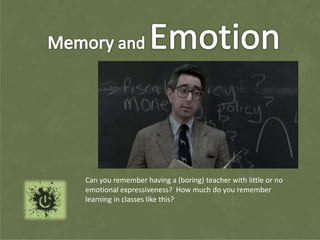
Can you remember having a (boring) teacher with little or no
emotional expressiveness? How much do you remember
learning in classes like this?
Give your
classes


      Without any form of emotion in
      the classroom our teachings are
      bound to fade into oblivion
You´re about to be given a sneak peek into my
upcoming book “Neuro-Emotional Learning”
which places emotion at the core of its
approach to learning.
EMOTIONAL
CONTEXT!
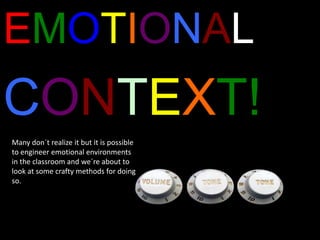
Many don´t realize it but it is possible
to engineer emotional environments
in the classroom and we´re about to
look at some crafty methods for doing
so.
“To be or not to be         that is the
   question”
This quote from Shakespeare
can be said in many tones of
emotion and as you vary
your emotional tone you vary
the responses elicited from
others. Every linguistic
exchange carries some form
of emotional undercurrent
that we often overlook.
For this reason it is important for us as teachers to be
aware of the emotional content embedded in the
communication we use to engage with students.
*particularly if there is little or no emotion present.
Practicing emotional awareness in the classroom will help
you to see that, indeed, there is a connection between
your emotional state and what you can achieve in the
classroom. Make emotional awareness a priority in your
class, significant gains can be made in 2-3 months.
Paying attention to our emotional state in the classroom is only
part of this “emotional engineering” process, we are now going
to look at other ways to engage students
Nowadays, our students are
accustomed to receiving
information in dynamic and
visually-rich ways, if we cannot
match this informational style in
the classroom we are sure to
disengage our students.
For this reason we are going to
look at some online tools that
help us do just that.
 *textbooks alone are not
enough!
Offline   Viewing
For those of you
without an internet
connection in the
classroom
offliberty.com is one
way in which you can
view multimedia
content offline.
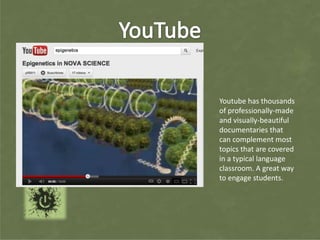
Youtube has thousands
of professionally-made
and visually-beautiful
documentaries that
can complement most
topics that are covered
in a typical language
classroom. A great way
to engage students.
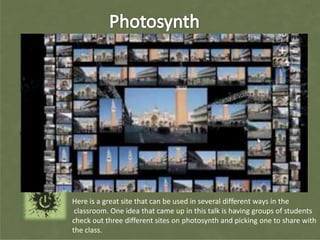
Here is a great site that can be used in several different ways in the
 classroom. One idea that came up in this talk is having groups of students
check out three different sites on photosynth and picking one to share with
the class.
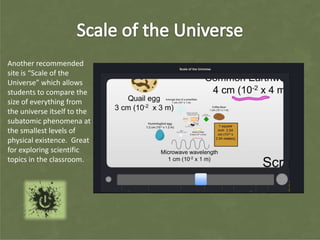
Another recommended
site is “Scale of the
Universe” which allows
students to compare the
size of everything from
the universe itself to the
subatomic phenomena at
the smallest levels of
physical existence. Great
for exploring scientific
topics in the classroom.
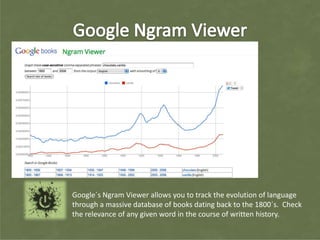
Google´s Ngram Viewer allows you to track the evolution of language
through a massive database of books dating back to the 1800´s. Check
the relevance of any given word in the course of written history.
This section comes directly from my
upcoming book “Neuro-Emotional
Learning” in which I cover the
importance of certain listening
techniques when engaging with our
students so that we may boost their
retention.
Whenever introducing new material in the classroom it is
important to connect it to our students´ life references or it
will not have any meaning for them and henceforth no
retention. Use their vocabulary and their ideas of the way the
world works to introduce new content.
No grounding, no meaning
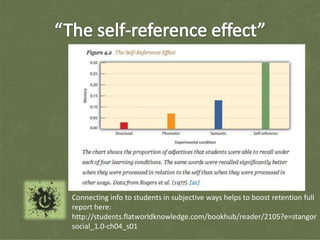
Connecting info to students in subjective ways helps to boost retention full
report here:
http://students.flatworldknowledge.com/bookhub/reader/2105?e=stangor
social_1.0-ch04_s01
1. No emotion, no retention
2. New internet tools are great for engaging
   students
3. Listen empathically and connect new content
   to students´ experiences and understandings.
Teaching 21st century students slideshare

Teaching 21st century students slideshare

  • 1.
    Teaching 21st century students Dante Cuevas Adapted from the talk given at the Mextesol Morelos Regional Convention on September 9, 2012 With speaker´s notes in white
  • 2.
    – Is languagea conscious or unconscious process?
  • 3.
    Can you rememberhaving a (boring) teacher with little or no emotional expressiveness? How much do you remember learning in classes like this?
  • 4.
    Give your classes Without any form of emotion in the classroom our teachings are bound to fade into oblivion
  • 5.
    You´re about tobe given a sneak peek into my upcoming book “Neuro-Emotional Learning” which places emotion at the core of its approach to learning.
  • 6.
    EMOTIONAL CONTEXT! Many don´t realizeit but it is possible to engineer emotional environments in the classroom and we´re about to look at some crafty methods for doing so.
  • 7.
    “To be ornot to be that is the question” This quote from Shakespeare can be said in many tones of emotion and as you vary your emotional tone you vary the responses elicited from others. Every linguistic exchange carries some form of emotional undercurrent that we often overlook.
  • 8.
    For this reasonit is important for us as teachers to be aware of the emotional content embedded in the communication we use to engage with students. *particularly if there is little or no emotion present. Practicing emotional awareness in the classroom will help you to see that, indeed, there is a connection between your emotional state and what you can achieve in the classroom. Make emotional awareness a priority in your class, significant gains can be made in 2-3 months.
  • 9.
    Paying attention toour emotional state in the classroom is only part of this “emotional engineering” process, we are now going to look at other ways to engage students
  • 10.
    Nowadays, our studentsare accustomed to receiving information in dynamic and visually-rich ways, if we cannot match this informational style in the classroom we are sure to disengage our students. For this reason we are going to look at some online tools that help us do just that. *textbooks alone are not enough!
  • 11.
    Offline Viewing For those of you without an internet connection in the classroom offliberty.com is one way in which you can view multimedia content offline.
  • 12.
    Youtube has thousands ofprofessionally-made and visually-beautiful documentaries that can complement most topics that are covered in a typical language classroom. A great way to engage students.
  • 13.
    Here is agreat site that can be used in several different ways in the classroom. One idea that came up in this talk is having groups of students check out three different sites on photosynth and picking one to share with the class.
  • 14.
    Another recommended site is“Scale of the Universe” which allows students to compare the size of everything from the universe itself to the subatomic phenomena at the smallest levels of physical existence. Great for exploring scientific topics in the classroom.
  • 15.
    Google´s Ngram Viewerallows you to track the evolution of language through a massive database of books dating back to the 1800´s. Check the relevance of any given word in the course of written history.
  • 16.
    This section comesdirectly from my upcoming book “Neuro-Emotional Learning” in which I cover the importance of certain listening techniques when engaging with our students so that we may boost their retention.
  • 17.
    Whenever introducing newmaterial in the classroom it is important to connect it to our students´ life references or it will not have any meaning for them and henceforth no retention. Use their vocabulary and their ideas of the way the world works to introduce new content. No grounding, no meaning
  • 18.
    Connecting info tostudents in subjective ways helps to boost retention full report here: http://students.flatworldknowledge.com/bookhub/reader/2105?e=stangor social_1.0-ch04_s01
  • 19.
    1. No emotion,no retention 2. New internet tools are great for engaging students 3. Listen empathically and connect new content to students´ experiences and understandings.