Why we needto evaluate best
practices in teaching and
learning?
5.
Reasons for Evaluation
1.Improved Student Outcomes
2. Teacher Professional Development
3. Accountability
4. Innovation and Adaptation
5. Resource Optimization
6. Credibility
6.
Best practices inteaching
and learning are essential
in achieving high-quality
education and improving
student outcomes.
7.
Overview of DepEd’sApproach
DepEd's approach to assessment and evaluation is guided by several key
principles, primarily outlined in DepEd Order No. 8, s. 2015 (Policy Guidelines on
Classroom Assessment for the K to 12 Basic Education Program). This order
shifted the focus from purely summative assessment to a more holistic and
formative approach.
DepEd utilizes assessment and evaluation data, along with other mechanisms, to
identify and promote best practices in teaching and learning. This involves
looking at various levels:
1. Classroom Level Evaluation
2. School-Based Level Evaluaion
3. System-Wide Evaluation
8.
1. Classroom Level(Teacher-Led Evaluation)
• Formative Assessment Analysis: Teachers regularly analyze the
results of their formative assessments to understand student learning
patterns, identify areas of difficulty, and adjust their teaching strategies
accordingly. Effective teachers use this data to differentiate instruction
and provide targeted support.
• Student Work Analysis: Examining student outputs (e.g., essays,
projects, performance tasks) provides insights into the effectiveness of
teaching approaches and the depth of student understanding.
9.
1. Classroom Level(Teacher-Led Evaluation)
• Reflection and Self-Assessment: Teachers are encouraged to
reflect on their teaching practices, identify strengths and weaknesses,
and seek ways to improve. Tools like professional development
portfolios and self-reflection journals can be used.
• Peer Observation and Feedback: Collaborative observation of
teaching practices among colleagues, followed by constructive
feedback, can help identify and share effective strategies. This is often
facilitated through Learning Action Cells (LACs), as mentioned in
DepEd Order No. 35, s. 2016.
10.
2. School Level(School-Based Evaluation)
• Analysis of Summative Assessment Data: Schools analyze the
results of summative assessments (e.g., quarterly exams,
standardized tests if applicable) to identify trends in student
achievement across different subjects and grade levels. This data can
inform school-wide improvement plans and highlight effective teaching
practices within specific areas.
11.
• Instructional Supervision:School leaders (principals,
assistant principals, department heads) conduct
classroom observations and provide feedback to
teachers. This process aims to ensure alignment with
curriculum standards and identify areas for professional
growth. Effective supervision focuses on supporting
teachers in implementing best practices.
13.
• Learning ActionCells (LACs): As highlighted in DepEd
Order No. 35, s. 2016, LACs serve as platforms for
teachers to collaboratively analyze student assessment
data, share successful teaching strategies, and
collectively problem-solve instructional challenges. This
peer-to-peer learning fosters the identification and
adoption of best practices.
14.
• School ImprovementPlan (SIP): Assessment data,
along with other school performance indicators, informs
the development and monitoring of the SIP. Schools
identify priority improvement areas related to teaching
and learning based on evaluation findings.
15.
3. System-Wide EvaluationApproaches
• Standardized Assessments: These assessment like NAT
(National Achievement Test) and PEPT (Philippine
Educational Placement Test) serve various purposes in
evaluating student learning outcomes, assessing the
level of proficiency in specific subjects, and providing a
standardized measure for comparing student
performance.
16.
• Program Evaluations:DepEd conducts evaluations of
specific programs and interventions to determine their
effectiveness in improving teaching and learning
outcomes. These evaluations often involve analyzing
student achievement data, teacher feedback, and
implementation processes.
17.
• Research Studies:DepEd engages in or supports
educational research to identify evidence-based
best practices in various aspects of teaching and
learning.
18.
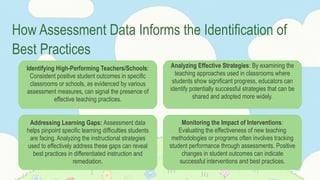
Monitoring the Impactof Interventions:
Evaluating the effectiveness of new teaching
methodologies or programs often involves tracking
student performance through assessments. Positive
changes in student outcomes can indicate
successful interventions and best practices.
Addressing Learning Gaps: Assessment data
helps pinpoint specific learning difficulties students
are facing. Analyzing the instructional strategies
used to effectively address these gaps can reveal
best practices in differentiated instruction and
remediation.
Identifying High-Performing Teachers/Schools:
Consistent positive student outcomes in specific
classrooms or schools, as evidenced by various
assessment measures, can signal the presence of
effective teaching practices.
How Assessment Data Informs the Identification of
Best Practices
Analyzing Effective Strategies: By examining the
teaching approaches used in classrooms where
students show significant progress, educators can
identify potentially successful strategies that can be
shared and adopted more widely.
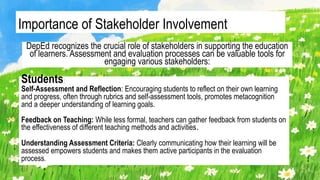
Importance of StakeholderInvolvement
DepEd recognizes the crucial role of stakeholders in supporting the education
of learners. Assessment and evaluation processes can be valuable tools for
engaging various stakeholders:
Students:
Self-Assessment and Reflection: Encouraging students to reflect on their own learning
and progress, often through rubrics and self-assessment tools, promotes metacognition
and a deeper understanding of learning goals.
Feedback on Teaching: While less formal, teachers can gather feedback from students on
the effectiveness of different teaching methods and activities.
Understanding Assessment Criteria: Clearly communicating how their learning will be
assessed empowers students and makes them active participants in the evaluation
process.
21.
Importance of StakeholderInvolvement
Parent/Guardians:
Involving Parents in Assessment Activities: In some cases, parents may be involved in
authentic assessment tasks (e.g., judging presentations, providing feedback on projects).
Seeking Parent Feedback on School Programs: Surveys and dialogues can gather parental
perspectives on the effectiveness of school programs and teaching practices.
Regular Communication of Progress: Providing timely and understandable reports on student
achievement through report cards, parent-teacher conferences, and other means keeps parents
informed about their child's learning.
.
22.
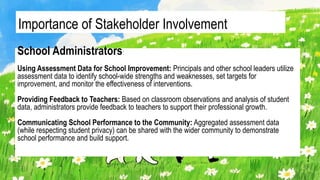
Importance of StakeholderInvolvement
School Administrators:
Using Assessment Data for School Improvement: Principals and other school leaders utilize
assessment data to identify school-wide strengths and weaknesses, set targets for
improvement, and monitor the effectiveness of interventions.
Providing Feedback to Teachers: Based on classroom observations and analysis of student
data, administrators provide feedback to teachers to support their professional growth.
Communicating School Performance to the Community: Aggregated assessment data
(while respecting student privacy) can be shared with the wider community to demonstrate
school performance and build support.
.
23.
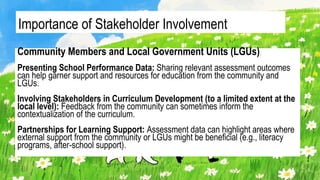
Importance of StakeholderInvolvement
Community Members and Local Government Units (LGUs):
Presenting School Performance Data: Sharing relevant assessment outcomes
can help garner support and resources for education from the community and
LGUs.
Involving Stakeholders in Curriculum Development (to a limited extent at the
local level): Feedback from the community can sometimes inform the
contextualization of the curriculum.
Partnerships for Learning Support: Assessment data can highlight areas where
external support from the community or LGUs might be beneficial (e.g., literacy
programs, after-school support).
24.
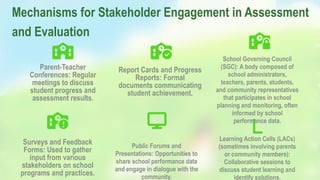
Learning Action Cells(LACs)
(sometimes involving parents
or community members):
Collaborative sessions to
discuss student learning and
identify solutions.
Parent-Teacher
Conferences: Regular
meetings to discuss
student progress and
assessment results.
Report Cards and Progress
Reports: Formal
documents communicating
student achievement.
School Governing Council
(SGC): A body composed of
school administrators,
teachers, parents, students,
and community representatives
that participates in school
planning and monitoring, often
informed by school
performance data.
Mechanisms for Stakeholder Engagement in Assessment
and Evaluation
Surveys and Feedback
Forms: Used to gather
input from various
stakeholders on school
programs and practices.
Public Forums and
Presentations: Opportunities to
share school performance data
and engage in dialogue with the
community.
25.
In summary, DepEd'sapproach to assessment and evaluation is multifaceted
and aims to be a driving force for improving teaching and learning.
By adhering to the principles outlined in DepEd orders, particularly DO No. 8,
s. 2015, and by strategically utilizing assessment data, schools can identify
and promote best practices in instruction and meaningfully engage
stakeholders in the shared goal of enhancing student outcomes.
Remember that the specific implementation of these principles and the
emphasis on different aspects may evolve with new DepEd policies and
priorities. Staying updated on the latest issuances is crucial for a
comprehensive understanding.
CONCLUSION
26.
DepEd uses differentways to assess and evaluate students to help improve
teaching and learning. Following the rules in DepEd Order No. 8, s. 2015,
schools can use test results and other data to find out what teaching
methods work best and involve parents, teachers, and others in helping
students do better.
Keep in mind that DepEd may change its guidelines over time, so it’s
important to stay updated with the latest policies.
CONCLUSION