CHANGE strategies:
PROBLEM SOLVING A (analyse problem) & B
(choose solution-solution analysis)
• A UNDERSTAND AND ACCEPT the problem
at hand (behaviour analysis techniques,
insight techniques)
• B generate, evaluate and implement
ALTERNATIVE SOLUTIONS (solution
analysis techniques & get commitment to act)
Before and during PROBLEM SOLVING:
orient the client
• orient client to DBT and to HER ROLE in
therapy
• Use list of TARGET BEHAVIOURS
• EXPLAIN problem-solving strategies
• REHEARSE with client exactly what she is to do
in trying to respond to the problem
PROBLEM SOLVING A (analyse problem)
•1 Define the behaviour: choose
focus, formulate, describe
•2 Chain Analyse target
behaviours
PROBLEM SOLVING A (analyse problem)
• 3 Formulate the problem: in terms of client’s
or therapist’s behaviour
• 4 Provide insight highlight, observe and
describe patterns, comment on implications of
behaviour, assess difficulties in
accepting/rejecting hypotheses
• 5 Be didactic provide information, reading,
family sessions
PROBLEM SOLVING A (analyse problem)
• 1 Define the behaviour:
•
• choose focus: Use the target hierarchy
• Describe: the problem specifically
• Validate: the client’s distress
Problem-solving
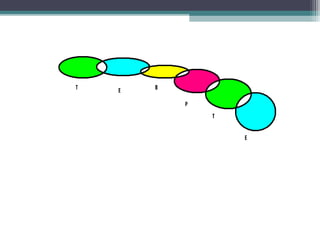
• 2 CHAIN ANALYSE TARGET BEHAVIOUR
• Choose specific instance
• Links: where to start? Filling in the links
• Where to stop?
• Analyse in-session behaviours
• Watch out for therapist and client avoidance!!
PROBLEM SOLVING A (analyse
problem)
• 3 Formulate what?
• Target behaviours and their precursors
• Observable events
• Current events
PROBLEM SOLVING A (analyse problem)
3 Formulate how?
1 Generate hypotheses about factors
controlling behaviour ABC
• Use theory to guide analysis
• Look for unbearable emotion as antecedent
• Look for negative reinforcement (escape)
PROBLEM SOLVING A (analyse problem)
• 4 provide insight: how?
• Highlight: patterns of behaviour
• Observe and describe: recurrent patterns
• Comment on implications
• assess difficulties in accepting/rejecting
hypotheses
PROBLEM SOLVING A (analyse problem)
• 4 provide insight: how?
• Be non-judgmental
• observe the effects of formulation and
react
• surround insight with validation
PROBLEM SOLVING A (analyse problem)
• 4 provide insight: how?
• Base explanations on bio-social theory, rules
governing client’s behaviour
• use DBT assumptions (client is trying her best
etc)
• Use non-pejorative language
PROBLEM SOLVING A (analyse problem)
• 5 be didactic
• Give reading, websites,videos, DVDs
• Give info to family/friends/carers
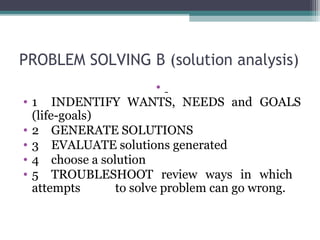
PROBLEM SOLVING B (solution analysis)
•
• 1 INDENTIFY WANTS, NEEDS and GOALS
(life-goals)
• 2 GENERATE SOLUTIONS
• 3 EVALUATE solutions generated
• 4 choose a solution
• 5 TROUBLESHOOT review ways in which
attempts to solve problem can go wrong.
PROBLEM SOLVING B (solution analysis)
• 2 GENERATE SOLUTIONS
• Brainstorm every possibility
• Suspend judgment
• Be irreverent if appropriate
PROBLEM SOLVING B (solution analysis)
• 3 EVALUATE solutions generated
• Pros & cons
• Give points
• Reject immoral/impractical
• Do not accept ‘I can’t’
PROBLEM SOLVING B (solution analysis)
• 4 choose a solution
• Select most effective remaining option
• Use mindfulness & commitment strategies to
address ‘I can’t’ and ‘I won’t’
• Obtain promise to implement solution
PROBLEM SOLVING B (solution analysis)
• TROUBLESHOOT potential pitfalls/obstacles
• Anticipate what might go wrong
• Make plans to cover these eventualities
• Obtain commitment to implement these plans
• Reinforce all desired behaviour in solution
analysis session
Consult group
• Use problem analysis and solution analysis in
consult group meetings

Teach 7 problem solving

  • 1.
    CHANGE strategies: PROBLEM SOLVINGA (analyse problem) & B (choose solution-solution analysis) • A UNDERSTAND AND ACCEPT the problem at hand (behaviour analysis techniques, insight techniques) • B generate, evaluate and implement ALTERNATIVE SOLUTIONS (solution analysis techniques & get commitment to act)
  • 2.
    Before and duringPROBLEM SOLVING: orient the client • orient client to DBT and to HER ROLE in therapy • Use list of TARGET BEHAVIOURS • EXPLAIN problem-solving strategies • REHEARSE with client exactly what she is to do in trying to respond to the problem
  • 3.
    PROBLEM SOLVING A(analyse problem) •1 Define the behaviour: choose focus, formulate, describe •2 Chain Analyse target behaviours
  • 4.
    PROBLEM SOLVING A(analyse problem) • 3 Formulate the problem: in terms of client’s or therapist’s behaviour • 4 Provide insight highlight, observe and describe patterns, comment on implications of behaviour, assess difficulties in accepting/rejecting hypotheses • 5 Be didactic provide information, reading, family sessions
  • 5.
    PROBLEM SOLVING A(analyse problem) • 1 Define the behaviour: • • choose focus: Use the target hierarchy • Describe: the problem specifically • Validate: the client’s distress
  • 6.
    Problem-solving • 2 CHAINANALYSE TARGET BEHAVIOUR • Choose specific instance • Links: where to start? Filling in the links • Where to stop? • Analyse in-session behaviours • Watch out for therapist and client avoidance!!
  • 8.
    PROBLEM SOLVING A(analyse problem) • 3 Formulate what? • Target behaviours and their precursors • Observable events • Current events
  • 9.
    PROBLEM SOLVING A(analyse problem) 3 Formulate how? 1 Generate hypotheses about factors controlling behaviour ABC • Use theory to guide analysis • Look for unbearable emotion as antecedent • Look for negative reinforcement (escape)
  • 10.
    PROBLEM SOLVING A(analyse problem) • 4 provide insight: how? • Highlight: patterns of behaviour • Observe and describe: recurrent patterns • Comment on implications • assess difficulties in accepting/rejecting hypotheses
  • 11.
    PROBLEM SOLVING A(analyse problem) • 4 provide insight: how? • Be non-judgmental • observe the effects of formulation and react • surround insight with validation
  • 12.
    PROBLEM SOLVING A(analyse problem) • 4 provide insight: how? • Base explanations on bio-social theory, rules governing client’s behaviour • use DBT assumptions (client is trying her best etc) • Use non-pejorative language
  • 13.
    PROBLEM SOLVING A(analyse problem) • 5 be didactic • Give reading, websites,videos, DVDs • Give info to family/friends/carers
  • 14.
    PROBLEM SOLVING B(solution analysis) • • 1 INDENTIFY WANTS, NEEDS and GOALS (life-goals) • 2 GENERATE SOLUTIONS • 3 EVALUATE solutions generated • 4 choose a solution • 5 TROUBLESHOOT review ways in which attempts to solve problem can go wrong.
  • 15.
    PROBLEM SOLVING B(solution analysis) • 2 GENERATE SOLUTIONS • Brainstorm every possibility • Suspend judgment • Be irreverent if appropriate
  • 16.
    PROBLEM SOLVING B(solution analysis) • 3 EVALUATE solutions generated • Pros & cons • Give points • Reject immoral/impractical • Do not accept ‘I can’t’
  • 17.
    PROBLEM SOLVING B(solution analysis) • 4 choose a solution • Select most effective remaining option • Use mindfulness & commitment strategies to address ‘I can’t’ and ‘I won’t’ • Obtain promise to implement solution
  • 18.
    PROBLEM SOLVING B(solution analysis) • TROUBLESHOOT potential pitfalls/obstacles • Anticipate what might go wrong • Make plans to cover these eventualities • Obtain commitment to implement these plans • Reinforce all desired behaviour in solution analysis session
  • 19.
    Consult group • Useproblem analysis and solution analysis in consult group meetings