JAPAN’S
CONTEMPORARY FOREIGN
AND ECONOMIC POLICIES
The Contemporary World
GEC- TCW
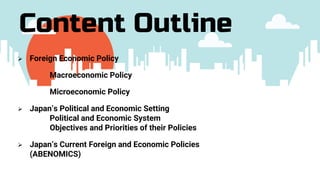
 Foreign Economic Policy
Macroeconomic Policy
Microeconomic Policy
 Japan’s Political and Economic Setting
Political and Economic System
Objectives and Priorities of their Policies
 Japan’s Current Foreign and Economic Policies
(ABENOMICS)
Content Outline
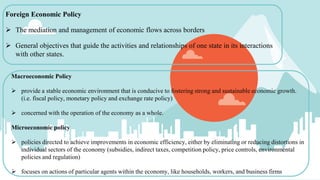
Foreign Economic Policy
 The mediation and management of economic flows across borders
 General objectives that guide the activities and relationships of one state in its interactions
with other states.
Macroeconomic Policy
 provide a stable economic environment that is conducive to fostering strong and sustainable economic growth.
(i.e. fiscal policy, monetary policy and exchange rate policy)
 concerned with the operation of the economy as a whole.
Microeconomic policy
 policies directed to achieve improvements in economic efficiency, either by eliminating or reducing distortions in
individual sectors of the economy (subsidies, indirect taxes, competition policy, price controls, environmental
policies and regulation)
 focuses on actions of particular agents within the economy, like households, workers, and business firms
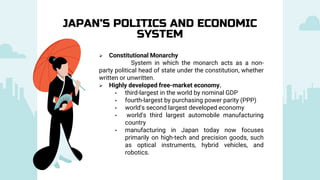
 Constitutional Monarchy
System in which the monarch acts as a non-
party political head of state under the constitution, whether
written or unwritten.
 Highly developed free-market economy.
• third-largest in the world by nominal GDP
• fourth-largest by purchasing power parity (PPP)
• world's second largest developed economy
• world's third largest automobile manufacturing
country
• manufacturing in Japan today now focuses
primarily on high-tech and precision goods, such
as optical instruments, hybrid vehicles, and
robotics.
JAPAN’S POLITICS AND ECONOMIC
SYSTEM
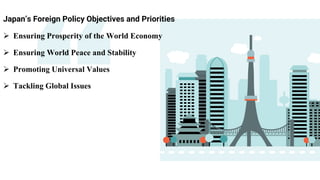
Japan’s Foreign Policy Objectives and Priorities
 Ensuring Prosperity of the World Economy
 Ensuring World Peace and Stability
 Promoting Universal Values
 Tackling Global Issues
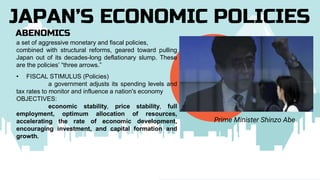
ABENOMICS
JAPAN’S ECONOMIC POLICIES
Prime Minister Shinzo Abe
a set of aggressive monetary and fiscal policies,
combined with structural reforms, geared toward pulling
Japan out of its decades-long deflationary slump. These
are the policies’ “three arrows.”
• FISCAL STIMULUS (Policies)
a government adjusts its spending levels and
tax rates to monitor and influence a nation's economy
OBJECTIVES:
economic stability, price stability, full
employment, optimum allocation of resources,
accelerating the rate of economic development,
encouraging investment, and capital formation and
growth.
JAPAN’S ECONOMIC POLICIES
LIMITATIONS:
 Size of fiscal measures,
 Fiscal policy as ineffective anti-cyclical measure,
 Administrative delay,
 Large scale underemployment,
 lack of coordination from the public,
 tax evasion,
 low tax base are the other limitations of fiscal policy.
Fiscal stimulus began in 2013 with economic recovery measures totaling 20.2 trillion yen ($210 billion), of
which 10.3 trillion ($116 billion) was direct government spending.
Abe’s hefty stimulus package, Japan’s second-largest ever, focused on building critical infrastructure
projects, such as bridges, tunnels, and earthquake-resistant roads. A separate 5.5 trillion yen
boost followed in April 2014, and after the December 2014 elections, Abe pushed through another
spending package, worth 3.5 trillion yen.
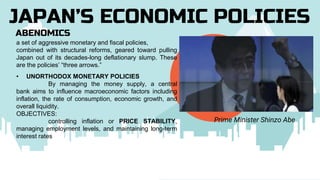
ABENOMICS
JAPAN’S ECONOMIC POLICIES
Prime Minister Shinzo Abe
a set of aggressive monetary and fiscal policies,
combined with structural reforms, geared toward pulling
Japan out of its decades-long deflationary slump. These
are the policies’ “three arrows.”
• UNORTHODOX MONETARY POLICIES
By managing the money supply, a central
bank aims to influence macroeconomic factors including
inflation, the rate of consumption, economic growth, and
overall liquidity.
OBJECTIVES:
controlling inflation or PRICE STABILITY,
managing employment levels, and maintaining long-term
interest rates
JAPAN’S ECONOMIC POLICIES
LIMITATIONS:
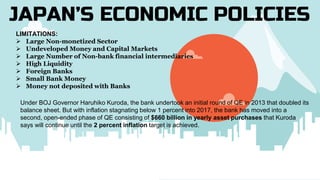
 Large Non-monetized Sector
 Undeveloped Money and Capital Markets
 Large Number of Non-bank financial intermediaries
 High Liquidity
 Foreign Banks
 Small Bank Money
 Money not deposited with Banks
Under BOJ Governor Haruhiko Kuroda, the bank undertook an initial round of QE in 2013 that doubled its
balance sheet. But with inflation stagnating below 1 percent into 2017, the bank has moved into a
second, open-ended phase of QE consisting of $660 billion in yearly asset purchases that Kuroda
says will continue until the 2 percent inflation target is achieved.
ABENOMICS
JAPAN’S ECONOMIC POLICIES
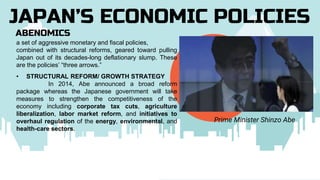
Prime Minister Shinzo Abe
a set of aggressive monetary and fiscal policies,
combined with structural reforms, geared toward pulling
Japan out of its decades-long deflationary slump. These
are the policies’ “three arrows.”
• STRUCTURAL REFORM/ GROWTH STRATEGY
In 2014, Abe announced a broad reform
package whereas the Japanese government will take
measures to strengthen the competitiveness of the
economy including corporate tax cuts, agriculture
liberalization, labor market reform, and initiatives to
overhaul regulation of the energy, environmental, and
health-care sectors.
JAPAN’S ECONOMIC POLICIES
LIMITATIONS:
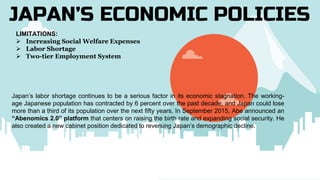
 Increasing Social Welfare Expenses
 Labor Shortage
 Two-tier Employment System
Japan’s labor shortage continues to be a serious factor in its economic stagnation. The working-
age Japanese population has contracted by 6 percent over the past decade, and Japan could lose
more than a third of its population over the next fifty years. In September 2015, Abe announced an
“Abenomics 2.0” platform that centers on raising the birth rate and expanding social security. He
also created a new cabinet position dedicated to reversing Japan’s demographic decline.

Tcw japan copy

  • 1.
    JAPAN’S CONTEMPORARY FOREIGN AND ECONOMICPOLICIES The Contemporary World GEC- TCW
  • 2.
     Foreign EconomicPolicy Macroeconomic Policy Microeconomic Policy  Japan’s Political and Economic Setting Political and Economic System Objectives and Priorities of their Policies  Japan’s Current Foreign and Economic Policies (ABENOMICS) Content Outline
  • 3.
    Foreign Economic Policy The mediation and management of economic flows across borders  General objectives that guide the activities and relationships of one state in its interactions with other states. Macroeconomic Policy  provide a stable economic environment that is conducive to fostering strong and sustainable economic growth. (i.e. fiscal policy, monetary policy and exchange rate policy)  concerned with the operation of the economy as a whole. Microeconomic policy  policies directed to achieve improvements in economic efficiency, either by eliminating or reducing distortions in individual sectors of the economy (subsidies, indirect taxes, competition policy, price controls, environmental policies and regulation)  focuses on actions of particular agents within the economy, like households, workers, and business firms
  • 4.
     Constitutional Monarchy Systemin which the monarch acts as a non- party political head of state under the constitution, whether written or unwritten.  Highly developed free-market economy. • third-largest in the world by nominal GDP • fourth-largest by purchasing power parity (PPP) • world's second largest developed economy • world's third largest automobile manufacturing country • manufacturing in Japan today now focuses primarily on high-tech and precision goods, such as optical instruments, hybrid vehicles, and robotics. JAPAN’S POLITICS AND ECONOMIC SYSTEM
  • 5.
    Japan’s Foreign PolicyObjectives and Priorities  Ensuring Prosperity of the World Economy  Ensuring World Peace and Stability  Promoting Universal Values  Tackling Global Issues
  • 6.
    ABENOMICS JAPAN’S ECONOMIC POLICIES PrimeMinister Shinzo Abe a set of aggressive monetary and fiscal policies, combined with structural reforms, geared toward pulling Japan out of its decades-long deflationary slump. These are the policies’ “three arrows.” • FISCAL STIMULUS (Policies) a government adjusts its spending levels and tax rates to monitor and influence a nation's economy OBJECTIVES: economic stability, price stability, full employment, optimum allocation of resources, accelerating the rate of economic development, encouraging investment, and capital formation and growth.
  • 7.
    JAPAN’S ECONOMIC POLICIES LIMITATIONS: Size of fiscal measures,  Fiscal policy as ineffective anti-cyclical measure,  Administrative delay,  Large scale underemployment,  lack of coordination from the public,  tax evasion,  low tax base are the other limitations of fiscal policy. Fiscal stimulus began in 2013 with economic recovery measures totaling 20.2 trillion yen ($210 billion), of which 10.3 trillion ($116 billion) was direct government spending. Abe’s hefty stimulus package, Japan’s second-largest ever, focused on building critical infrastructure projects, such as bridges, tunnels, and earthquake-resistant roads. A separate 5.5 trillion yen boost followed in April 2014, and after the December 2014 elections, Abe pushed through another spending package, worth 3.5 trillion yen.
  • 8.
    ABENOMICS JAPAN’S ECONOMIC POLICIES PrimeMinister Shinzo Abe a set of aggressive monetary and fiscal policies, combined with structural reforms, geared toward pulling Japan out of its decades-long deflationary slump. These are the policies’ “three arrows.” • UNORTHODOX MONETARY POLICIES By managing the money supply, a central bank aims to influence macroeconomic factors including inflation, the rate of consumption, economic growth, and overall liquidity. OBJECTIVES: controlling inflation or PRICE STABILITY, managing employment levels, and maintaining long-term interest rates
  • 9.
    JAPAN’S ECONOMIC POLICIES LIMITATIONS: Large Non-monetized Sector  Undeveloped Money and Capital Markets  Large Number of Non-bank financial intermediaries  High Liquidity  Foreign Banks  Small Bank Money  Money not deposited with Banks Under BOJ Governor Haruhiko Kuroda, the bank undertook an initial round of QE in 2013 that doubled its balance sheet. But with inflation stagnating below 1 percent into 2017, the bank has moved into a second, open-ended phase of QE consisting of $660 billion in yearly asset purchases that Kuroda says will continue until the 2 percent inflation target is achieved.
  • 10.
    ABENOMICS JAPAN’S ECONOMIC POLICIES PrimeMinister Shinzo Abe a set of aggressive monetary and fiscal policies, combined with structural reforms, geared toward pulling Japan out of its decades-long deflationary slump. These are the policies’ “three arrows.” • STRUCTURAL REFORM/ GROWTH STRATEGY In 2014, Abe announced a broad reform package whereas the Japanese government will take measures to strengthen the competitiveness of the economy including corporate tax cuts, agriculture liberalization, labor market reform, and initiatives to overhaul regulation of the energy, environmental, and health-care sectors.
  • 11.
    JAPAN’S ECONOMIC POLICIES LIMITATIONS: Increasing Social Welfare Expenses  Labor Shortage  Two-tier Employment System Japan’s labor shortage continues to be a serious factor in its economic stagnation. The working- age Japanese population has contracted by 6 percent over the past decade, and Japan could lose more than a third of its population over the next fifty years. In September 2015, Abe announced an “Abenomics 2.0” platform that centers on raising the birth rate and expanding social security. He also created a new cabinet position dedicated to reversing Japan’s demographic decline.