Oketec Co., Ltd
Eui Seon Jo
Parallel Session 1.1 : Performance of Outstanding Enterprise Participating in the Cluster Program
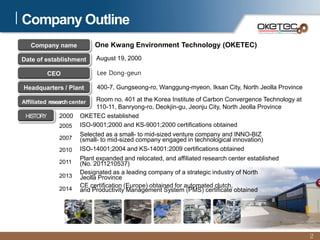
Company Outline
2
2000 OKETEC established
2005 ISO-9001;2000 and KS-9001;2000 certifications obtained
2007
Selected as a small- to mid-sized venture company and INNO-BIZ
(small- to mid-sized company engaged in technological innovation)
2010 ISO-14001;2004 and KS-14001:2009 certifications obtained
2011
Plant expanded and relocated, and affiliated research center established
(No. 2011210537)
2013
Designated as a leading company of a strategic industry of North
Jeolla Province
2014
CE certification (Europe) obtained for automated clutch,
and Productivity Management System (PMS) certificate obtained
One Kwang Environment Technology (OKETEC)
August 19, 2000
Lee Dong-geun
400-7, Gungseong-ro, Wanggung-myeon, Iksan City, North Jeolla Province
Room no. 401 at the Korea Institute of Carbon Convergence Technology at
110-11, Banryong-ro, Deokjin-gu, Jeonju City, North Jeolla Province
HISTORY
Affiliated researchcenter
Headquarters / Plant
CEO
Date of establishment
Company name
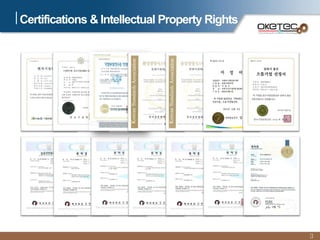
Certifications & Intellectual Property Rights
3
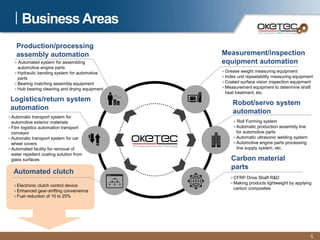
Business Areas
4
 Automated system for assembling
automotive engine parts
 Hydraulic bending system for automotive
parts
 Bearing matching assembly equipment
Hub bearing cleaning and drying equipment
Production/processing
assembly automation
Automatic transport system for
automotive exterior materials
Film logistics automation transport
conveyor
Automatic transport system for car
wheel covers
Automated facility for removal of
water repellent coating solution from
glass surfaces
Logistics/return system
automation
Electronic clutch control device
Enhanced gear-shifting convenience
Fuel reduction of 10 to 25%
Automated clutch
 Grease weight measuring equipment
 Index unit repeatability measuring equipment
 Coated surface vision inspection equipment
 Measurement equipment to determine shaft
heat treatment, etc.
Measurement/inspection
equipment automation
 Roll Forming system
Automatic production assembly line
for automotive parts
Automatic ultrasonic welding system
Automotive engine parts processing
line supply system, etc.
Robot/servo system
automation
CFRP Drive Shaft R&D
Making products lightweight by applying
carbon composites
Carbon material
parts
Factors that led to Project Participation
5
Corporate
growth
Credibility
OKETEC
CUSTOMER
KICOX
 Corporate support is provided by operating a mini
cluster by area
 R&D as well as non-R&D support
 Information is shared at seminars and technical
exchange conferences
 Advanced technologies are obtained by establishing
overseas market development teams
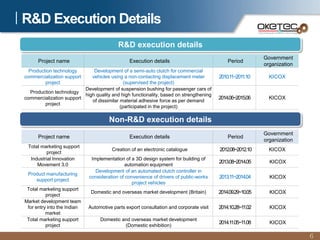
R&D Execution Details
6
Project name Execution details Period
Government
organization
Production technology
commercialization support
project
Development of a semi-auto clutch for commercial
vehicles using a non-contacting displacement meter
(supervised the project)
2010.11~2011.10 KICOX
Production technology
commercialization support
project
Development of suspension bushing for passenger cars of
high quality and high functionality, based on strengthening
of dissimilar material adhesive force as per demand
(participated in the project)
2014.06~2015.06 KICOX
Project name Execution details Period
Government
organization
Total marketing support
project
Creation of an electronic catalogue 2012.08~2012.10 KICOX
Industrial Innovation
Movement 3.0
Implementation of a 3D design system for building of
automation equipment
2013.08~2014.05 KICOX
Product manufacturing
support project
Development of an automated clutch controller in
consideration of convenience of drivers of public-works
project vehicles
2013.11~2014.04 KICOX
Total marketing support
project
Domestic and overseas market development (Britain) 2014.09.29~10.05 KICOX
Market development team
for entry into the Indian
market
Automotive parts export consultation and corporate visit 2014.10.28~11.02 KICOX
Total marketing support
project
Domestic and overseas market development
(Domestic exhibition)
2014.11.05~11.08 KICOX
R&D execution details
Non-R&D execution details
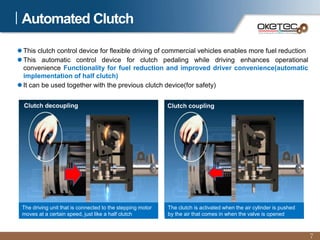
Automated Clutch
7
Clutch couplingClutch decoupling
 This clutch control device for flexible driving of commercial vehicles enables more fuel reduction
 This automatic control device for clutch pedaling while driving enhances operational
convenience Functionality for fuel reduction and improved driver convenience(automatic
implementation of half clutch)
 It can be used together with the previous clutch device(for safety)
The driving unit that is connected to the stepping motor
moves at a certain speed, just like a half clutch
The clutch is activated when the air cylinder is pushed
by the air that comes in when the valve is opened
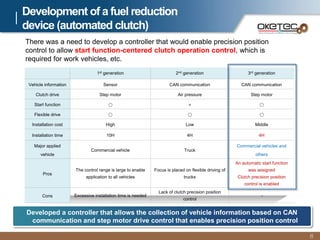
Development of a fuel reduction
device (automated clutch)
8
1st generation 2nd generation 3rd generation
Vehicle information Sensor CAN communication CAN communication
Clutch drive Step motor Air pressure Step motor
Start function ○ × ○
Flexible drive ○ ○ ○
Installation cost High Low Middle
Installation time 10H 4H 4H
Major applied
vehicle
Commercial vehicle Truck
Commercial vehicles and
others
Pros
The control range is large to enable
application to all vehicles
Focus is placed on flexible driving of
trucks
An automatic start function
was assigned
Clutch precision position
control is enabled
Cons Excessive installation time is needed
Lack of clutch precision position
control
-
There was a need to develop a controller that would enable precision position
control to allow start function-centered clutch operation control, which is
required for work vehicles, etc.
Developed a controller that allows the collection of vehicle information based on CAN
communication and step motor drive control that enables precision position control
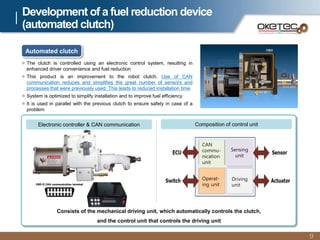
Electronic controller & CAN communication
Development of a fuel reduction device
(automated clutch)
9
 The clutch is controlled using an electronic control system, resulting in
enhanced driver convenience and fuel reduction
 This product is an improvement to the robot clutch. Use of CAN
communication reduces and simplifies the great number of sensors and
processes that were previously used. This leads to reduced installation time
 System is optimized to simplify installation and to improve fuel efficiency
 It is used in parallel with the previous clutch to ensure safety in case of a
problem
OBD-II CAN communication terminal
Consists of the mechanical driving unit, which automatically controls the clutch,
and the control unit that controls the driving unit
Automated clutch
Composition of control unit
CAN
commu-
nication
unit
Sensing
unit
Operat-
ing unit
Driving
unit
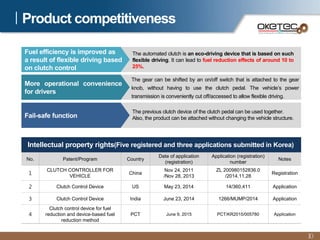
Product competitiveness
10
Intellectual property rights(Five registered and three applications submitted in Korea)
No. Patent/Program Country
Date of application
(registration)
Application (registration)
number
Notes
1
CLUTCH CONTROLLER FOR
VEHICLE
China
Nov 24, 2011
/Nov 28, 2013
ZL 200980152836.0
/2014.11.28
Registration
2 Clutch Control Device US May 23, 2014 14/360,411 Application
3 Clutch Control Device India June 23, 2014 1266/MUMP/2014 Application
4
Clutch control device for fuel
reduction and device-based fuel
reduction method
PCT June 9, 2015 PCT/KR2015/005780 Application
Fuel efficiency is improved as
a result of flexible driving based
on clutch control
The automated clutch is an eco-driving device that is based on such
flexible driving. It can lead to fuel reduction effects of around 10 to
25%.
More operational convenience
for drivers
The gear can be shifted by an on/off switch that is attached to the gear
knob, without having to use the clutch pedal. The vehicle’s power
transmission is conveniently cut off/accessed to allow flexible driving.
Fail-safe function
The previous clutch device of the clutch pedal can be used together.
Also, the product can be attached without changing the vehicle structure.
Background of commercialization
11
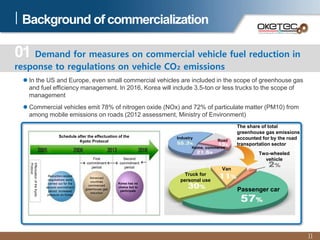
 In the US and Europe, even small commercial vehicles are included in the scope of greenhouse gas
and fuel efficiency management. In 2016, Korea will include 3.5-ton or less trucks to the scope of
management
 Commercial vehicles emit 78% of nitrogen oxide (NOx) and 72% of particulate matter (PM10) from
among mobile emissions on roads (2012 assessment, Ministry of Environment)
01 Demand for measures on commercial vehicle fuel reduction in
response to regulations on vehicle CO₂ emissions
Schedule after the effectuation of the
Kyoto Protocol
EffectuationoftheKyoto
Protocol
First
commitment
period
Second
commitment
period
Korea has no
choice but to
participate
Advanced
countries
commenced
greenhouse gas
reduction
Reduction-related
negotiations were
carried out for the
second commitment
period: Increased
pressure on Korea
Van
Two-wheeled
vehicle
Truck for
personal use
Passenger car
The share of total
greenhouse gas emissions
accounted for by the road
transportation sector
Industry
Home, commerce
Road
Background of commercialization
12
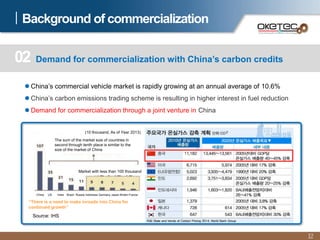
02 Demand for commercialization with China’s carbon credits
 China’s commercial vehicle market is rapidly growing at an annual average of 10.6%
 China’s carbon emissions trading scheme is resulting in higher interest in fuel reduction
 Demand for commercialization through a joint venture in China
(10 thousand, As of Year 2013)
The sum of the market size of countries in
second through tenth place is similar to the
size of the market of China
Market with less than 100 thousand
“There is a need to make inroads into China for
continued growth”
Source: IHS
China US India Brazil Russia Indonesia Germany Japan Britain France
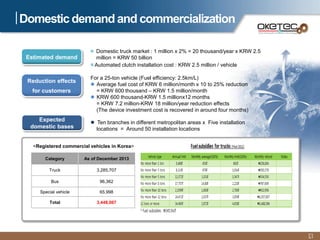
Reduction effects
for customers
<화물차유가보조금(2012년)>
For a 25-ton vehicle (Fuel efficiency: 2.5km/L)
 Average fuel cost of KRW 6 million/month x 10 to 25% reduction
= KRW 600 thousand – KRW 1.5 million/month
 KRW 600 thousand-KRW 1.5 millionx12 months
= KRW 7.2 million-KRW 18 million/year reduction effects
(The device investment cost is recovered in around four months)
Category As of December 2013
Truck 3,285,707
Bus 96,362
Special vehicle 65,998
Total 3,448,067
 Ten branches in different metropolitan areas x Five installation
locations = Around 50 installation locations
 Domestic truck market : 1 million x 2% = 20 thousand/year x KRW 2.5
million = KRW 50 billion
Automated clutch installation cost : KRW 2.5 million / vehicle
Domestic demand and commercialization
Estimated demand
Expected
domestic bases
<Registered commercial vehicles in Korea>
13
Conclusion
14
KICOX led OKETEC’s growth
 The different types of support provided by KICOX enabled efficient R&D,
including the identification of items and process improvements.
 Support was provided for R&D, which was needed for corporate growth, as
well as consulting, PR materials, production of pilot products, and market
development teams.
 An assessment was carried out on the company’s overall status and
improvements were made to address shortcomings based on consulting on
business and technology development.
 KICOX also made arrangements so that the company could receive support
from many support groups in North Jeolla Province and the academic sector.
Support provided by connecting the company to support
organizations in North Jeolla Province
 The company was provided with support for R&D programs from the Cheonbuk
Regional Small Medium Business Administration.
 Support was provided for production of pilot products, technology consulting, test
equipment, and technology training by KICOX, Jeonju National Defense Venture
Center, Jeonbuk Technopark, and Chonbuk National University TIC.
 Research personnel and technology support was provided by Chonbuk National
University, Jeonju University, Wonkwang University, and Korea Polytechnics.
Support from KICOX and professional consultants enabled the company to engage in
product development. Various support projects led to sales improvement and growth
OKETEC will grow further by engaging in close cooperation with KICOX and regional
support organizations. It will also strive to contribute to regional development.
Thank You

TCI 2015 OKETEC Co. Ltd

  • 1.
    Oketec Co., Ltd EuiSeon Jo Parallel Session 1.1 : Performance of Outstanding Enterprise Participating in the Cluster Program
  • 3.
    Company Outline 2 2000 OKETECestablished 2005 ISO-9001;2000 and KS-9001;2000 certifications obtained 2007 Selected as a small- to mid-sized venture company and INNO-BIZ (small- to mid-sized company engaged in technological innovation) 2010 ISO-14001;2004 and KS-14001:2009 certifications obtained 2011 Plant expanded and relocated, and affiliated research center established (No. 2011210537) 2013 Designated as a leading company of a strategic industry of North Jeolla Province 2014 CE certification (Europe) obtained for automated clutch, and Productivity Management System (PMS) certificate obtained One Kwang Environment Technology (OKETEC) August 19, 2000 Lee Dong-geun 400-7, Gungseong-ro, Wanggung-myeon, Iksan City, North Jeolla Province Room no. 401 at the Korea Institute of Carbon Convergence Technology at 110-11, Banryong-ro, Deokjin-gu, Jeonju City, North Jeolla Province HISTORY Affiliated researchcenter Headquarters / Plant CEO Date of establishment Company name
  • 4.
  • 5.
    Business Areas 4  Automatedsystem for assembling automotive engine parts  Hydraulic bending system for automotive parts  Bearing matching assembly equipment Hub bearing cleaning and drying equipment Production/processing assembly automation Automatic transport system for automotive exterior materials Film logistics automation transport conveyor Automatic transport system for car wheel covers Automated facility for removal of water repellent coating solution from glass surfaces Logistics/return system automation Electronic clutch control device Enhanced gear-shifting convenience Fuel reduction of 10 to 25% Automated clutch  Grease weight measuring equipment  Index unit repeatability measuring equipment  Coated surface vision inspection equipment  Measurement equipment to determine shaft heat treatment, etc. Measurement/inspection equipment automation  Roll Forming system Automatic production assembly line for automotive parts Automatic ultrasonic welding system Automotive engine parts processing line supply system, etc. Robot/servo system automation CFRP Drive Shaft R&D Making products lightweight by applying carbon composites Carbon material parts
  • 6.
    Factors that ledto Project Participation 5 Corporate growth Credibility OKETEC CUSTOMER KICOX  Corporate support is provided by operating a mini cluster by area  R&D as well as non-R&D support  Information is shared at seminars and technical exchange conferences  Advanced technologies are obtained by establishing overseas market development teams
  • 7.
    R&D Execution Details 6 Projectname Execution details Period Government organization Production technology commercialization support project Development of a semi-auto clutch for commercial vehicles using a non-contacting displacement meter (supervised the project) 2010.11~2011.10 KICOX Production technology commercialization support project Development of suspension bushing for passenger cars of high quality and high functionality, based on strengthening of dissimilar material adhesive force as per demand (participated in the project) 2014.06~2015.06 KICOX Project name Execution details Period Government organization Total marketing support project Creation of an electronic catalogue 2012.08~2012.10 KICOX Industrial Innovation Movement 3.0 Implementation of a 3D design system for building of automation equipment 2013.08~2014.05 KICOX Product manufacturing support project Development of an automated clutch controller in consideration of convenience of drivers of public-works project vehicles 2013.11~2014.04 KICOX Total marketing support project Domestic and overseas market development (Britain) 2014.09.29~10.05 KICOX Market development team for entry into the Indian market Automotive parts export consultation and corporate visit 2014.10.28~11.02 KICOX Total marketing support project Domestic and overseas market development (Domestic exhibition) 2014.11.05~11.08 KICOX R&D execution details Non-R&D execution details
  • 8.
    Automated Clutch 7 Clutch couplingClutchdecoupling  This clutch control device for flexible driving of commercial vehicles enables more fuel reduction  This automatic control device for clutch pedaling while driving enhances operational convenience Functionality for fuel reduction and improved driver convenience(automatic implementation of half clutch)  It can be used together with the previous clutch device(for safety) The driving unit that is connected to the stepping motor moves at a certain speed, just like a half clutch The clutch is activated when the air cylinder is pushed by the air that comes in when the valve is opened
  • 9.
    Development of afuel reduction device (automated clutch) 8 1st generation 2nd generation 3rd generation Vehicle information Sensor CAN communication CAN communication Clutch drive Step motor Air pressure Step motor Start function ○ × ○ Flexible drive ○ ○ ○ Installation cost High Low Middle Installation time 10H 4H 4H Major applied vehicle Commercial vehicle Truck Commercial vehicles and others Pros The control range is large to enable application to all vehicles Focus is placed on flexible driving of trucks An automatic start function was assigned Clutch precision position control is enabled Cons Excessive installation time is needed Lack of clutch precision position control - There was a need to develop a controller that would enable precision position control to allow start function-centered clutch operation control, which is required for work vehicles, etc. Developed a controller that allows the collection of vehicle information based on CAN communication and step motor drive control that enables precision position control
  • 10.
    Electronic controller &CAN communication Development of a fuel reduction device (automated clutch) 9  The clutch is controlled using an electronic control system, resulting in enhanced driver convenience and fuel reduction  This product is an improvement to the robot clutch. Use of CAN communication reduces and simplifies the great number of sensors and processes that were previously used. This leads to reduced installation time  System is optimized to simplify installation and to improve fuel efficiency  It is used in parallel with the previous clutch to ensure safety in case of a problem OBD-II CAN communication terminal Consists of the mechanical driving unit, which automatically controls the clutch, and the control unit that controls the driving unit Automated clutch Composition of control unit CAN commu- nication unit Sensing unit Operat- ing unit Driving unit
  • 11.
    Product competitiveness 10 Intellectual propertyrights(Five registered and three applications submitted in Korea) No. Patent/Program Country Date of application (registration) Application (registration) number Notes 1 CLUTCH CONTROLLER FOR VEHICLE China Nov 24, 2011 /Nov 28, 2013 ZL 200980152836.0 /2014.11.28 Registration 2 Clutch Control Device US May 23, 2014 14/360,411 Application 3 Clutch Control Device India June 23, 2014 1266/MUMP/2014 Application 4 Clutch control device for fuel reduction and device-based fuel reduction method PCT June 9, 2015 PCT/KR2015/005780 Application Fuel efficiency is improved as a result of flexible driving based on clutch control The automated clutch is an eco-driving device that is based on such flexible driving. It can lead to fuel reduction effects of around 10 to 25%. More operational convenience for drivers The gear can be shifted by an on/off switch that is attached to the gear knob, without having to use the clutch pedal. The vehicle’s power transmission is conveniently cut off/accessed to allow flexible driving. Fail-safe function The previous clutch device of the clutch pedal can be used together. Also, the product can be attached without changing the vehicle structure.
  • 12.
    Background of commercialization 11 In the US and Europe, even small commercial vehicles are included in the scope of greenhouse gas and fuel efficiency management. In 2016, Korea will include 3.5-ton or less trucks to the scope of management  Commercial vehicles emit 78% of nitrogen oxide (NOx) and 72% of particulate matter (PM10) from among mobile emissions on roads (2012 assessment, Ministry of Environment) 01 Demand for measures on commercial vehicle fuel reduction in response to regulations on vehicle CO₂ emissions Schedule after the effectuation of the Kyoto Protocol EffectuationoftheKyoto Protocol First commitment period Second commitment period Korea has no choice but to participate Advanced countries commenced greenhouse gas reduction Reduction-related negotiations were carried out for the second commitment period: Increased pressure on Korea Van Two-wheeled vehicle Truck for personal use Passenger car The share of total greenhouse gas emissions accounted for by the road transportation sector Industry Home, commerce Road
  • 13.
    Background of commercialization 12 02Demand for commercialization with China’s carbon credits  China’s commercial vehicle market is rapidly growing at an annual average of 10.6%  China’s carbon emissions trading scheme is resulting in higher interest in fuel reduction  Demand for commercialization through a joint venture in China (10 thousand, As of Year 2013) The sum of the market size of countries in second through tenth place is similar to the size of the market of China Market with less than 100 thousand “There is a need to make inroads into China for continued growth” Source: IHS China US India Brazil Russia Indonesia Germany Japan Britain France
  • 14.
    Reduction effects for customers <화물차유가보조금(2012년)> Fora 25-ton vehicle (Fuel efficiency: 2.5km/L)  Average fuel cost of KRW 6 million/month x 10 to 25% reduction = KRW 600 thousand – KRW 1.5 million/month  KRW 600 thousand-KRW 1.5 millionx12 months = KRW 7.2 million-KRW 18 million/year reduction effects (The device investment cost is recovered in around four months) Category As of December 2013 Truck 3,285,707 Bus 96,362 Special vehicle 65,998 Total 3,448,067  Ten branches in different metropolitan areas x Five installation locations = Around 50 installation locations  Domestic truck market : 1 million x 2% = 20 thousand/year x KRW 2.5 million = KRW 50 billion Automated clutch installation cost : KRW 2.5 million / vehicle Domestic demand and commercialization Estimated demand Expected domestic bases <Registered commercial vehicles in Korea> 13
  • 15.
    Conclusion 14 KICOX led OKETEC’sgrowth  The different types of support provided by KICOX enabled efficient R&D, including the identification of items and process improvements.  Support was provided for R&D, which was needed for corporate growth, as well as consulting, PR materials, production of pilot products, and market development teams.  An assessment was carried out on the company’s overall status and improvements were made to address shortcomings based on consulting on business and technology development.  KICOX also made arrangements so that the company could receive support from many support groups in North Jeolla Province and the academic sector. Support provided by connecting the company to support organizations in North Jeolla Province  The company was provided with support for R&D programs from the Cheonbuk Regional Small Medium Business Administration.  Support was provided for production of pilot products, technology consulting, test equipment, and technology training by KICOX, Jeonju National Defense Venture Center, Jeonbuk Technopark, and Chonbuk National University TIC.  Research personnel and technology support was provided by Chonbuk National University, Jeonju University, Wonkwang University, and Korea Polytechnics. Support from KICOX and professional consultants enabled the company to engage in product development. Various support projects led to sales improvement and growth
  • 16.
    OKETEC will growfurther by engaging in close cooperation with KICOX and regional support organizations. It will also strive to contribute to regional development. Thank You