MadisonVorbrich
May, 28, 2017
Table 0f
Contents
• Executive Summary
• Social Media Audit
– a. Social Media Assessment
– b. Traffic Sources Assessment
– c. Customer Demographics Assessment
– d. Competitor Assessment
• Social Media Objectives
• Online Brand Persona andVoice
• Strategies andTools
• Timing and Key Dates
• Social Media Roles and Responsibilities
• Social Media Policy
• Critical Response Plan
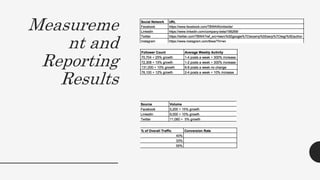
• Measurement and Reporting Results
Executive
Summary
• AtTBWAWorldwide our primary focus for 2017 is to
continue growing our online presence through social
media by engaging and interacting with more of our
followers as well as our current and past clients.
• To successfully do so we must drive traffic to our
website by sharing current ad campaigns involving our
cliental via social media, as well as creating thoughtful
and relevant posts that will engage more customers
and build upon current relationships.
• Strategies:
a) A plan to increase the volume of content we publish to
our social profiles.
b) Encourage conversations and discoverability of content.
Social
Media Audit
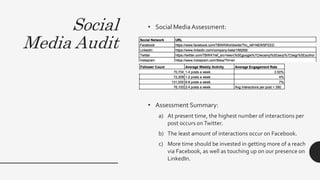
• Social Media Assessment:
• Assessment Summary:
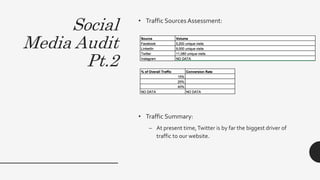
a) At present time, the highest number of interactions per
post occurs onTwitter.
b) The least amount of interactions occur on Facebook.
c) More time should be invested in getting more of a reach
via Facebook, as well as touching up on our presence on
LinkedIn.
Social
Media Audit
Pt.2
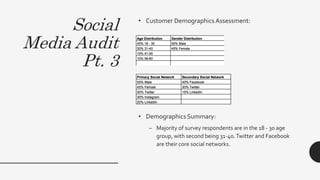
• Traffic Sources Assessment:
• Traffic Summary:
– At present time,Twitter is by far the biggest driver of
traffic to our website.
Social
Media Audit
Pt. 3
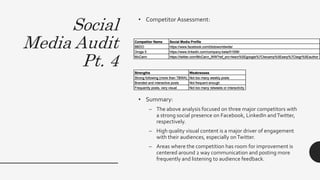
• Customer DemographicsAssessment:
• Demographics Summary:
– Majority of survey respondents are in the 18 - 30 age
group, with second being 31-40.Twitter and Facebook
are their core social networks.
Social
Media Audit
Pt. 4
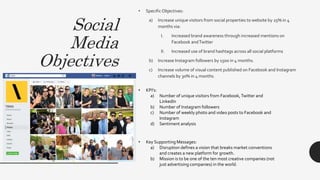
• Competitor Assessment:
• Summary:
– The above analysis focused on three major competitors with
a strong social presence on Facebook, LinkedIn andTwitter,
respectively.
– High quality visual content is a major driver of engagement
with their audiences, especially onTwitter.
– Areas where the competition has room for improvement is
centered around 2 way communication and posting more
frequently and listening to audience feedback.
Social
Media
Objectives
• SpecificObjectives:
a) Increase unique visitors from social properties to website by 25% in 4
months via:
I. Increased brand awareness through increased mentions on
Facebook andTwitter
II. Increased use of brand hashtags across all social platforms
b) Increase Instagram followers by 1500 in 4 months.
c) Increase volume of visual content published on Facebook and Instagram
channels by 30% in 4 months.
• KPI’s:
a) Number of unique visitors from Facebook,Twitter and
LinkedIn
b) Number of Instagram followers
c) Number of weekly photo and video posts to Facebook and
Instagram
d) Sentiment analysis
• Key Supporting Messages:
a) Disruption defines a vision that breaks market conventions
and creates a new platform for growth.
b) Mission is to be one of the ten most creative companies (not
just advertising companies) in the world.
Online
Brand
Persona
and Voice
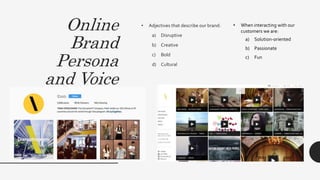
• Adjectives that describe our brand:
a) Disruptive
b) Creative
c) Bold
d) Cultural
• When interacting with our
customers we are:
a) Solution-oriented
b) Passionate
c) Fun
Strategies
and Tools
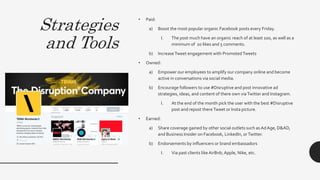
• Paid:
a) Boost the most popular organic Facebook posts every Friday.
I. The post much have an organic reach of at least 100, as well as a
minimum of 20 likes and 5 comments.
b) IncreaseTweet engagement with PromotedTweets
• Owned:
a) Empower our employees to amplify our company online and become
active in conversations via social media.
b) Encourage followers to use #Disruptive and post innovative ad
strategies, ideas, and content of there own viaTwitter and Instagram.
I. At the end of the month pick the user with the best #Disruptive
post and repost thereTweet or Insta picture.
• Earned:
a) Share coverage gained by other social outlets such asAdAge, D&AD,
and Business Insider on Facebook, LinkedIn, orTwitter.
b) Endorsements by influencers or brand embassadors
I. Via past clients like AirBnb,Apple, Nike, etc.
Strategies
and Tools
Pt. 2
• Tools:
a) ApprovedTools:
I. Hootsuite
II. Buffer
b) RejectedTools:
I. N/A
c) Existing Subscriptions/Licenses:
I. Adobe Creative Suite
II. Kapoost
III. Youtube
Timing and
Key Dates
• Holiday Dates:
a) Christmas
b) Valentine’s Day
• Internal Events/Dates:
a) Projeqt @ SXSW: March 9th – 12th
b) EffieAwards: May 17th
c) Cannes Lions International Festival of Creativity: June
17th – 24th
• LeadTimes:
a) Average time it takes to develop and execute a
campaign (successfully) could be anywhere from 1-3
months, depending on the client.
• Reporting Dates:
a) Reporting will occur once a quarter in February, May,
August and November. Precise datesTBA.
Social
Media Roles
and
Responsibili
ties
• Marketing Director:
a) Nancy Reyes
• Social Media Manager:
a) RohitThawani
• Social Media Coordinator:
a) Amie Miller
• Supporting Social MediaTeam Members:
a) Erica Hoholick
b) Jeremy Pagden
c) Joanne Lao
Social
Media
Policy
• As an employee and representative ofTBWA you are
expected to demonstrate best practices and a sense of
etiquette in your use of social by following some simple
guidelines:
a) Employees are allowed to associate themselves with the
company when posting but they must clearly brand their
online posts as personal and purely their own.The
company should not be held liable for any repercussions
the employees’ content may generate.
b) Content pertaining to sensitive company information
should not be shared to the outside online community.
Divulging information like the company’s design plans,
internal operations and legal matters are prohibited.
c) Proper copyright and reference laws should be observed
by employees when posting online.
Critical
Response
Plan
• Scenario 1 – InappropriateTweet:
a) WhenTweet is detected:
I. Take a screenshot
II. Delete Tweet
III. Alert RohitThawani (SM Manager) or Amie Miller (SM
Coordinator)
b) Rohit to sync with Amie to discuss impact and reach,
and evaluate further action.
c) Rohit to develop appropriate follow upTweet, Amie to
approve.
d) If media has picked up theTweet, Amie to manage all
direct contact.
e) Amie and Rohit to sync with employee responsible for
publishing theTweet to see if disciplinary action is
required.
Measureme
nt and
Reporting
Results

TBWA - Global Ad Agency

  • 1.
  • 2.
    Table 0f Contents • ExecutiveSummary • Social Media Audit – a. Social Media Assessment – b. Traffic Sources Assessment – c. Customer Demographics Assessment – d. Competitor Assessment • Social Media Objectives • Online Brand Persona andVoice • Strategies andTools • Timing and Key Dates • Social Media Roles and Responsibilities • Social Media Policy • Critical Response Plan • Measurement and Reporting Results
  • 3.
    Executive Summary • AtTBWAWorldwide ourprimary focus for 2017 is to continue growing our online presence through social media by engaging and interacting with more of our followers as well as our current and past clients. • To successfully do so we must drive traffic to our website by sharing current ad campaigns involving our cliental via social media, as well as creating thoughtful and relevant posts that will engage more customers and build upon current relationships. • Strategies: a) A plan to increase the volume of content we publish to our social profiles. b) Encourage conversations and discoverability of content.
  • 4.
    Social Media Audit • SocialMedia Assessment: • Assessment Summary: a) At present time, the highest number of interactions per post occurs onTwitter. b) The least amount of interactions occur on Facebook. c) More time should be invested in getting more of a reach via Facebook, as well as touching up on our presence on LinkedIn.
  • 5.
    Social Media Audit Pt.2 • TrafficSources Assessment: • Traffic Summary: – At present time,Twitter is by far the biggest driver of traffic to our website.
  • 6.
    Social Media Audit Pt. 3 •Customer DemographicsAssessment: • Demographics Summary: – Majority of survey respondents are in the 18 - 30 age group, with second being 31-40.Twitter and Facebook are their core social networks.
  • 7.
    Social Media Audit Pt. 4 •Competitor Assessment: • Summary: – The above analysis focused on three major competitors with a strong social presence on Facebook, LinkedIn andTwitter, respectively. – High quality visual content is a major driver of engagement with their audiences, especially onTwitter. – Areas where the competition has room for improvement is centered around 2 way communication and posting more frequently and listening to audience feedback.
  • 8.
    Social Media Objectives • SpecificObjectives: a) Increaseunique visitors from social properties to website by 25% in 4 months via: I. Increased brand awareness through increased mentions on Facebook andTwitter II. Increased use of brand hashtags across all social platforms b) Increase Instagram followers by 1500 in 4 months. c) Increase volume of visual content published on Facebook and Instagram channels by 30% in 4 months. • KPI’s: a) Number of unique visitors from Facebook,Twitter and LinkedIn b) Number of Instagram followers c) Number of weekly photo and video posts to Facebook and Instagram d) Sentiment analysis • Key Supporting Messages: a) Disruption defines a vision that breaks market conventions and creates a new platform for growth. b) Mission is to be one of the ten most creative companies (not just advertising companies) in the world.
  • 9.
    Online Brand Persona and Voice • Adjectivesthat describe our brand: a) Disruptive b) Creative c) Bold d) Cultural • When interacting with our customers we are: a) Solution-oriented b) Passionate c) Fun
  • 10.
    Strategies and Tools • Paid: a)Boost the most popular organic Facebook posts every Friday. I. The post much have an organic reach of at least 100, as well as a minimum of 20 likes and 5 comments. b) IncreaseTweet engagement with PromotedTweets • Owned: a) Empower our employees to amplify our company online and become active in conversations via social media. b) Encourage followers to use #Disruptive and post innovative ad strategies, ideas, and content of there own viaTwitter and Instagram. I. At the end of the month pick the user with the best #Disruptive post and repost thereTweet or Insta picture. • Earned: a) Share coverage gained by other social outlets such asAdAge, D&AD, and Business Insider on Facebook, LinkedIn, orTwitter. b) Endorsements by influencers or brand embassadors I. Via past clients like AirBnb,Apple, Nike, etc.
  • 11.
    Strategies and Tools Pt. 2 •Tools: a) ApprovedTools: I. Hootsuite II. Buffer b) RejectedTools: I. N/A c) Existing Subscriptions/Licenses: I. Adobe Creative Suite II. Kapoost III. Youtube
  • 12.
    Timing and Key Dates •Holiday Dates: a) Christmas b) Valentine’s Day • Internal Events/Dates: a) Projeqt @ SXSW: March 9th – 12th b) EffieAwards: May 17th c) Cannes Lions International Festival of Creativity: June 17th – 24th • LeadTimes: a) Average time it takes to develop and execute a campaign (successfully) could be anywhere from 1-3 months, depending on the client. • Reporting Dates: a) Reporting will occur once a quarter in February, May, August and November. Precise datesTBA.
  • 13.
    Social Media Roles and Responsibili ties • MarketingDirector: a) Nancy Reyes • Social Media Manager: a) RohitThawani • Social Media Coordinator: a) Amie Miller • Supporting Social MediaTeam Members: a) Erica Hoholick b) Jeremy Pagden c) Joanne Lao
  • 14.
    Social Media Policy • As anemployee and representative ofTBWA you are expected to demonstrate best practices and a sense of etiquette in your use of social by following some simple guidelines: a) Employees are allowed to associate themselves with the company when posting but they must clearly brand their online posts as personal and purely their own.The company should not be held liable for any repercussions the employees’ content may generate. b) Content pertaining to sensitive company information should not be shared to the outside online community. Divulging information like the company’s design plans, internal operations and legal matters are prohibited. c) Proper copyright and reference laws should be observed by employees when posting online.
  • 15.
    Critical Response Plan • Scenario 1– InappropriateTweet: a) WhenTweet is detected: I. Take a screenshot II. Delete Tweet III. Alert RohitThawani (SM Manager) or Amie Miller (SM Coordinator) b) Rohit to sync with Amie to discuss impact and reach, and evaluate further action. c) Rohit to develop appropriate follow upTweet, Amie to approve. d) If media has picked up theTweet, Amie to manage all direct contact. e) Amie and Rohit to sync with employee responsible for publishing theTweet to see if disciplinary action is required.
  • 16.