There is nouniversally correct way
categorize bugs. The taxonomy is not rigid.
A given bug can be put into one or another
category depending on its history and the
programmer's state of mind.
3.
The major categoriesare:
1.Requirements, Features and Functionality Bugs
2.Structural Bugs
3.Data Bugs
4. Coding Bugs
5.Interface, Integration and System Bugs
6. Test and Test Design Bugs.
4.
1.Requirements, Features and
FunctionalityBugs:
Various categories in Requirements, Features and
Functionality bugs include:
1.Requirements and Specifications Bugs
2. Feature Bugs
3. Feature Interaction Bugs
5.
1.1.Requirements and Specifications
Bugs:
Requirements and specifications developed from
them can be incomplete ambiguous, or self-
contradictory. They can be misunderstood or
impossible to understand.
The specifications that don't have flaws in them
may change while the design is in progress. The
features are added, modified and deleted.
6.
Requirements, especially, asexpressed in
specifications are a major source of expensive
bugs.
Very expensive to cover these Requirement
and specification bug.
These bugs are enter earliest in the system
and the leave last .
7.
1.2.Feature Bugs:
Specificationproblems usually create corresponding
feature problems.
A feature can be wrong, missing, or superfluous (serving
no useful purpose).
A missing feature or case is easier to detect and
correct.
A wrong feature could have deep design implications.
Removing the features might complicate the software,
consume more resources, and raise more bugs.
8.
1.3.Feature Interaction Bugs:
Features usually come in groups or related features.
The features of each group and the interaction of
features within the group are usually well tested.
Whenever the problem between the interaction of the
features that is called as feature Interaction Bugs.
The problem is unpredictable interactions between
feature groups or even between individual features.
9.
Specification and featurebug Remedies:
Most feature bugs are rooted in human to human communication
problems. One solution is to use high-level, formal specification
languages or systems.
Such languages and systems provide short term support but in the
long run, does not solve the problem.
Short term Support: Specification languages helps to define the
requirements clearly and precisely.
Long term Support: The language facilitates the development of
consistent test criteria, ensuring that testing is thorough and reliable.
The specification problem has been shifted to a higher level but not
eliminated.
10.
Testing Techniques forfunctional bugs
Most functional test techniques- that is those techniques
which are based on a behavioral description of software.
such as
transaction flow testing
syntax testing
domain testing
logic testing
state testing
These are useful in testing functional bugs.
11.
2.Structural bugs:
Various categoriesin Structural bugs include:
1.Control and Sequence Bugs
2.Logic bugs
3.Processing Bugs
4.Initialization Bugs
5.Data-Flow Bugs and Anomalies:
12.
2.1. Control andSequence Bugs
Control and sequence bugs include
paths left out
unreachable code
improper nesting of loops
loop-back or loop termination criteria incorrect
missing process steps
duplicated processing
unnecessary processing
GOTO's (not properly planned)
switches etc.
13.
Most ofthe control flow bugs are easily tested and
caught in unit testing.
Another reason for control flow bugs is that use of old
code especially ALP & COBOL code are dominated by
control flow bugs.
Control and sequence bugs at all levels are caught by
testing, especially structural testing, more specifically
path testing
14.
2.2.Logic Bugs:
Bugsin the logic
Evaluation of boolean expressions
Test cases(incorrect design)
Complicated operators
logic operators
If the bugs are parts of logical (i.e. boolean) processing not
related to control flow, they are characterized as
processing bugs.
If the bugs are parts of a logical expression (i.e. control-
flow statement) which is used to direct the control flow,
then they are categorized as control-flow bugs.
15.
2.3.Processing Bugs:
Processing bugsinclude arithmetic bugs, algebraic,
mathematical function evaluation, algorithm selection
and general processing.
Examples of Processing bugs include: Incorrect
conversion from one data representation to other,
ignoring overflow, improper use of greater-than-or-
equal etc
Although these bugs are frequent , they tend to be
caught in good unit testing
16.
2.4. Initialization Bugs:
Typical initialization bugs include: Forgetting to initialize the
variables before first use, assuming that they are initialized
elsewhere, initializing to the wrong format, representation or
type etc
Initialization bugs are common. Initialization bugs can be
improper and superfluous.
These bugs are generally less harmful but can affect
performance
17.
2.5.Data-Flow Bugs andAnomalies
Most initialization bugs are special case of data flow
anomalies.
A data flow anomaly occurs where there is a path along
which we expect to do something unreasonable with
data, such as using an uninitialized variable, attempting to
use a variable before it exists, modifying and then not
storing or using the result, or initializing twice without an
intermediate use.
18.
3.Data bugs:
Data bugsinclude all bugs that arise from the
specification of data objects(incorrect), their
formats, the number of such objects, and their
initial values.
Data Bugs are at least as common as bugs in code,
but they are often treated as if they did not exist at
all.
19.
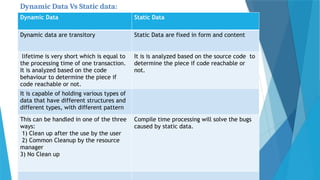
Dynamic Data VsStatic data:
Dynamic Data Static Data
Dynamic data are transitory Static Data are fixed in form and content
lifetime is very short which is equal to
the processing time of one transaction.
It is analyzed based on the code
behaviour to determine the piece if
code reachable or not.
It is is analyzed based on the source code to
determine the piece if code reachable or
not.
It is capable of holding various types of
data that have different structures and
different types, with different pattern
This can be handled in one of the three
ways:
1) Clean up after the use by the user
2) Common Cleanup by the resource
manager
3) No Clean up
Compile time processing will solve the bugs
caused by static data.
20.
4.Coding bugs:
Coding errorsof all kinds can create any of the other
kind of bugs.
If a program has many syntax errors, then we
should expect many logic and coding bugs.
The documentation bugs are also considered as
coding bugs which may mislead the maintenance
programmers.
21.
5.Interface, integration, andsystem bugs:
Various categories of bugs in Interface, Integration, and System Bugs are:
1. External Interfaces
2. Internal Interfaces
3. Hardware Architecture
4. Operating System Bugs:
5. software Architecture
6. Control and Sequence Bugs (Systems Level)
7. Resource Management Problems
8. Integration Bugs
9. System Bugs
22.
5.1. External Interfaces:
The external interfaces are the means used to communicate with
the world.
These include devices, actuators, sensors, input terminals, printers,
and communication lines.
All external interfaces, human or machine should employ a
protocol. The protocol may be wrong or incorrectly implemented.
Other external interface bugs are:
1. Timing/Sequence errors: Incorrect assumptions about external
signal timing or sequence.
2. Format misunderstandings: Misunderstanding external input or
output formats.
3. Insufficient input tolerance: Not handling bad or invalid input data
properly.
23.
5.2.Internal Interfaces:
Internalinterfaces are in principle not different from
external interfaces but they are more controlled.
A best example for internal interfaces is communicating
routines.
The external environment is fixed and the system must
adapt to it but the internal environment, which consists
of interfaces with other components, can be negotiated.
Internal interfaces have the same problem as external
interfaces.
24.
5.3. Hardware Architecture:
Bugs related to hardware architecture originate mostly from
misunderstanding how the hardware works.
Examples of hardware architecture bugs: address generation
error, i/o device operation / instruction error, waiting too long
for a response, incorrect interrupt handling etc.
The remedy for hardware architecture and interface problems
is :
1) Good Programming and Testing
2)Centralization of hardware interface: single point of
control and simplified communication.
25.
5.4.Operating System Bugs:
Programbugs related to the operating system are a
combination of hardware architecture and interface bugs
mostly caused by a misunderstanding of what it is the
operating system does.
Use operating system interface specialists, and use
explicit interface modules or macros for all operating
system calls.
This approach may not eliminate the bugs but at least will
localize them and make testing easier.
26.
5.5. Software Architecture:
Software architecture bugs are the kind that called - interactive.
Many of them depend on load, and their symptoms emerge
only when the system is stressed.
Sample for such bugs:
• Assumption that there will be no interrupts,
• Failure to block or un block interrupts,
• Assumption that memory and registers were initialized or
not initialized etc
Careful integration of modules and subjecting the final system to
a stress test are effective methods for these bugs
27.
5.6.Control and SequenceBugs (Systems
Level):
These bugs include:
1. Timing is ignored
2. Assuming events happen in a certain order
3. Working with incomplete data
4. Waiting for something that can't happen
5. Missing or incorrect process steps
The remedy for these bugs is highly structured
sequence control.
28.
5.7. Resource ManagementProblems:
Some resource management and usage bugs:
Required resource not obtained
Wrong resource used
Resource is already in use
Resource dead lock etc
Resource Management Remedies: A design remedy
that prevents bugs is always preferable to a test
method that discovers them.
The design remedy in resource management is to keep
the resource structure simple.
29.
5.8.Integration Bugs:
Integrationbugs are bugs having to do with the
integration of, and with the interfaces between, working
and tested components.
These bugs results from inconsistencies or
incompatibilities between components.
The communication methods include data structures, call
sequences, registers, semaphores, and communication
links and protocols results in integration bugs.
Integration bugs are relatively rare (9%)and they are
expensive to fix because.
30.
5.9.System Bugs:
Systembugs covering all kinds of bugs that cannot
be ascribed to a component or to their simple
interactions, but result from the totality of
interactions between many components such as
programs, data, hardware, and the operating
systems.
There can be no meaningful system testing until
there has been thorough component and
integration testing.
31.
TEST AND TESTDESIGN BUGS:
Testing: testers have no immunity to bugs. Tests
require complicated scenarios and databases.
They require code or the equivalent to execute and
consequently they can have bugs.
Test criteria: if the specification is correct, it is
correctly interpreted and implemented, and a
proper test has been designed;
32.
Remedies:The remediesof test bugs are:
1. Test Quality Assurance: Programmers have the right to ask how
quality in independent testing is monitored.
2. Test Execution Automation: The history of software bug removal and
prevention is indistinguishable from the history of programming
automation aids. Assemblers, loaders, compilers are developed to reduce
the incidence of programming and operation errors. Test execution bugs
are virtually eliminated by various test execution automation tools.
3. Test Debugging: The first remedy for test bugs is testing and debugging
the tests. Test debugging, when compared to program debugging, is
easier because tests, when properly designed are simpler than programs
and do not have to make concessions to efficiency.
4. Test Design Automation: Just as much of software development has
been automated, much test design can be and has been automated.