Tax Planning
Picking Up the Pieces
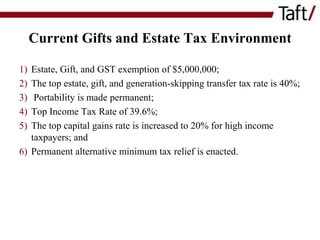
Current Gifts and Estate Tax Environment
1)
2)
3)
4)
5)

Estate, Gift, and GST exemption of $5,000,000;
The top estate, gift, and generation-skipping transfer tax rate is 40%;
Portability is made permanent;
Top Income Tax Rate of 39.6%;
The top capital gains rate is increased to 20% for high income
taxpayers; and
6) Permanent alternative minimum tax relief is enacted.
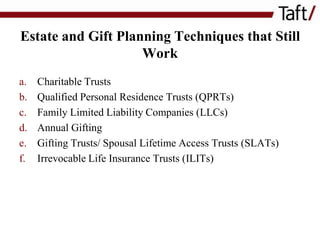
Estate and Gift Planning Techniques that Still
Work
a.
b.
c.
d.
e.
f.

Charitable Trusts
Qualified Personal Residence Trusts (QPRTs)
Family Limited Liability Companies (LLCs)
Annual Gifting
Gifting Trusts/ Spousal Lifetime Access Trusts (SLATs)
Irrevocable Life Insurance Trusts (ILITs)
What works – but may not work in the near future
a. Discounts
b. Perpetual Trusts
c. Grantor Retained Annuity Trusts (GRATs)
STATE OF THE ESTATE
PLANNING PROFESSION
Non-Tax Reasons Why Estate Planning is Still
Essential – “The Golden Age of Trusts was Long
Before there was an Estate Tax.”
Probate Avoidance
a.
b.
c.
d.

Delay
Public
Cost
Contests
Probate Avoidance
Funding the revocable living trust during life may be
necessary in order for the plan to satisfy the client’s
estate planning objectives and avoid probate.

Funding has traditionally been the responsibility of the
client, though expecting a client to fund his or her trust
may be unrealistic.
Probate Avoidance
• An asset typically becomes trust property when its
legal title is changed to reflect the transfer to the
trustees.
• Once transferred, the legal owner should be similar to
the following example.
• John Doe and Jane Doe, trustees, or their successors
in trust, under the John Doe living trust dated April
15, 1999, and any amendments thereto.
Trusts for Disability Planning
• The concern is with mental incapacity or physical infirmity so
severe as to preclude the maker from adequately managing his
or her financial affairs.
Trust for Disability Planning
Who will determine whether the definition has been
met?
1) Physicians;
2) Family members; or
3) A combination of physicians and family
members.
Trust for Disability Planning
What happens to the trust assets during
disability?
1) How will the assets be managed?
2) Will the Settlor’s obligations and debts be paid?
3) Will the Settlor’s business affairs continue as he
or she would have liked?
Trusts for Disability Planning
Common instructions include use trust assets for the Settlor’s needs:
a. Only;
b. First, and then, if there are sufficient assets, the spouse’s needs;
c. First, and then, if there are sufficient assets, the spouse’s needs,
then other beneficiaries’ needs, in that order.
d. First, the spouse’s needs and other beneficiaries’ needs, based
solely on needs; and
e. Beneficiaries needs, based solely on need.
Distributing assets to heirs at
appropriate times
Common Trust
a) State that children’s needs are more important than
equal distributors;
b) Explicitly allow the trustee to financially assist the
guardians;
c) Allow advancements to children for extraordinary
opportunities if trust assets are sufficient to provide
for the other children’s needs;
d) Reflect the Settlor’s decision as to when the
common trust will end.
Trust Distribution Options
1.
2.
3.
4.
5.
6.

Outright Distribution
Convenience Trust
Staggered Distributions
Protective Trust or Lifetime Trust
Discretionary Trust
Special Needs Trust
Other special circumstances
•
•
•
•

Spendthrift
Substance Abuse
Gambling
Sudden acquisition of wealth problems
Bloodline Trusts
• 50% of all marriages and 60% of second
marriages end in divorce
• A bloodline trust is designed to keep wealth in
the family, protecting your children and their
descendants.
Bloodline Trust
• Consider a bloodline trust when your child or his/her
spouse is:
a) A spendthrift and /or poor money manager.
b) Has difficulty holding a job.
c) Has an addiction such as alcoholism, drugs or
gambling.
d) Has children from a previous marriage.
Bloodline Trust
• Benefits of a Bloodline Trust
a) Trust assets can be used only for descendants – your
children’s or grandchildren’s health, education,
maintenance, or support.
b) Trust assets are never available to a son- or daughter-inlaw, either during the marriage or in a divorce.
c) Trust assets are protected from your child’s (or his/her
spouse’s) creditors.
d) The trust may terminate at your child’s death, and the
remaining principal can be paid to your child’s
descendants.
Tax Planning
A Credit-Shelter trust may still be a necessary planning
tool. An analysis of the client’s situation must be made
to determine if portability or a credit-shelter trust is the
best option.
Portability
• ATRA made permanent the portability of any unused
“applicable” exclusion amount for a surviving spouse of a
decedent if the decedent’s executor makes an election on a
timely filed estate tax return.
• The unused exclusion amount is referred to as the “deceased
spousal unused exclusion amount.” (“DSUE amount.”)
• The surviving spouse can use the DSUE amount either for
gifts during life or for estate tax purposes at death. An
individual can only use the DSUE amount from his or her “last
deceased spouse.”
Portability
a) Reasons for Using Portability:
1) A first marriage to a competent spouse or no children
existing by prior marriage of either spouse,
2) There are assets that would be difficult to administer in a
trust
3) Inequitable Wealth Allocation.
4) Qualified Retirement Plans.
5) As a post-mortem planning technique if no prior planning
is completed.
Reasons for Using Trusts Even With
Portability (and not rely on portability):
1)
2)

3)
4)
5)
6)
7)
8)

Growth in the assets are not excluded from the gross estate of the
surviving spouse,
The unused exclusion from a particular predeceased spouse will be lost if
the surviving spouse remarries and survives his or her next spouse.
There is no portability of the GST exemption,
There is no statute of limitations on the values used for portability
Trust can be funded with discounted and/or hard value assets,
Asset Protection
Professional management of assets can be required, and
No restrictions on the transfer of assets by the surviving spouse with
portability.
Portability
Possible Compromise:
A plan could be drafted to allow a surviving spouse to
disclaim an outright bequest with a provision that the
disclaimed assets pass to a bypass trust.
SLATs (Spousal Lifetime Access Trusts)
A client may wish to make gifts in a way that his/her
spouse can retain use of the assets if needed. A popular
way of using the increased gift exemption may be for a
client to make gifts to a “spousal lifetime access trust”
for the benefit of his/her spouse and children.
SLATS
• Beneficiaries
1) Spouse as a discretionary beneficiary. Children
as secondary beneficiaries.
2) Spouse could have a “5 or 5” annual withdrawal
power
3) Spouse could have limited power of appointment
exercisable at death or in life.
SLATS
• Trustees
1) Spouse can serve as trustee if distributions to the
spouse are limited to HEMS.
2) A “trust protector” can be given the discretion to
add the donor of the trust at some time in the
future.
SLATS
• Other Issues
a) Reciprocal Trust Issues
b) Drafting for Divorce or Spouse Predeceasing:
Include language providing a benefit only while
the donee spouse is living and married to the
grantor.
Gifting Trusts
1) Irrevocable Trusts established to pass wealth from
generation to generation without incurring transfer
taxes.
2) May be funded with annual gifts equal to annual
gifting exclusion.
3) In Ohio can elect to pot-out of the Rule Against
Perpetuities
4) GST exemption allocated to assets gifted to the trust
will make the trust corpus exempt ratio.
Life Insurance Trusts

1)
2)
3)
4)

Inheritance Equalization
Business Buy-Sell Agreements
Income replacement
Allow Settlor to control insurance proceeds
after death
5) Leverage annual gifting and GST exemption
Asset Protection Planning:
Ohio’s Legacy Trust
• ORC 5816.01 et seq.
• Ohio’s new legislation repeals the rule against self-settled
trusts.
• A domestic asset protection trust is a self-settled irrevocable
spendthrift trust. The settlor can be an income and principal
beneficiary of the trust. After the transfers to the trust pass the
statutory time period, the property held in the trust is protected
from the claims of future creditors.
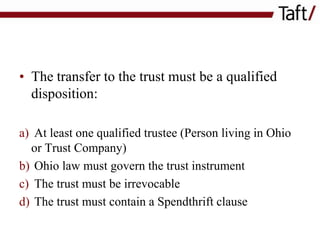
• The transfer to the trust must be a qualified
disposition:
a) At least one qualified trustee (Person living in Ohio
or Trust Company)
b) Ohio law must govern the trust instrument
c) The trust must be irrevocable
d) The trust must contain a Spendthrift clause
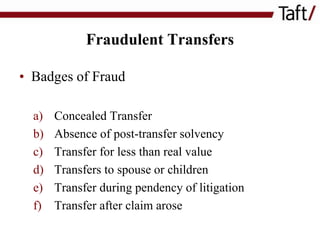
Fraudulent Transfers
• Badges of Fraud
a)
b)
c)
d)
e)
f)

Concealed Transfer
Absence of post-transfer solvency
Transfer for less than real value
Transfers to spouse or children
Transfer during pendency of litigation
Transfer after claim arose
How to Avoid Fraudulent Transfers
• Disclose the Transfer
• Retain Solvency
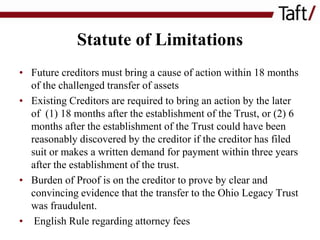
Statute of Limitations
• Future creditors must bring a cause of action within 18 months
of the challenged transfer of assets
• Existing Creditors are required to bring an action by the later
of (1) 18 months after the establishment of the Trust, or (2) 6
months after the establishment of the Trust could have been
reasonably discovered by the creditor if the creditor has filed
suit or makes a written demand for payment within three years
after the establishment of the trust.
• Burden of Proof is on the creditor to prove by clear and
convincing evidence that the transfer to the Ohio Legacy Trust
was fraudulent.
• English Rule regarding attorney fees
Exception Creditors
• In Ohio, the only exception creditors are a PreTransfer Spouse and claims for Child Support
Thank you
Missia H. Vaselaney, Esq.
Taft Stettinius & Hollister LLP
200 Public Square, Suite 3500
Cleveland, OH 44114
mvaselaney@taftlaw.com
216-706-3956

Tax planning "Picking up the pieces"

  • 1.
  • 2.
    Current Gifts andEstate Tax Environment 1) 2) 3) 4) 5) Estate, Gift, and GST exemption of $5,000,000; The top estate, gift, and generation-skipping transfer tax rate is 40%; Portability is made permanent; Top Income Tax Rate of 39.6%; The top capital gains rate is increased to 20% for high income taxpayers; and 6) Permanent alternative minimum tax relief is enacted.
  • 3.
    Estate and GiftPlanning Techniques that Still Work a. b. c. d. e. f. Charitable Trusts Qualified Personal Residence Trusts (QPRTs) Family Limited Liability Companies (LLCs) Annual Gifting Gifting Trusts/ Spousal Lifetime Access Trusts (SLATs) Irrevocable Life Insurance Trusts (ILITs)
  • 4.
    What works –but may not work in the near future a. Discounts b. Perpetual Trusts c. Grantor Retained Annuity Trusts (GRATs)
  • 5.
    STATE OF THEESTATE PLANNING PROFESSION Non-Tax Reasons Why Estate Planning is Still Essential – “The Golden Age of Trusts was Long Before there was an Estate Tax.”
  • 6.
  • 7.
    Probate Avoidance Funding therevocable living trust during life may be necessary in order for the plan to satisfy the client’s estate planning objectives and avoid probate. Funding has traditionally been the responsibility of the client, though expecting a client to fund his or her trust may be unrealistic.
  • 8.
    Probate Avoidance • Anasset typically becomes trust property when its legal title is changed to reflect the transfer to the trustees. • Once transferred, the legal owner should be similar to the following example. • John Doe and Jane Doe, trustees, or their successors in trust, under the John Doe living trust dated April 15, 1999, and any amendments thereto.
  • 9.
    Trusts for DisabilityPlanning • The concern is with mental incapacity or physical infirmity so severe as to preclude the maker from adequately managing his or her financial affairs.
  • 10.
    Trust for DisabilityPlanning Who will determine whether the definition has been met? 1) Physicians; 2) Family members; or 3) A combination of physicians and family members.
  • 11.
    Trust for DisabilityPlanning What happens to the trust assets during disability? 1) How will the assets be managed? 2) Will the Settlor’s obligations and debts be paid? 3) Will the Settlor’s business affairs continue as he or she would have liked?
  • 12.
    Trusts for DisabilityPlanning Common instructions include use trust assets for the Settlor’s needs: a. Only; b. First, and then, if there are sufficient assets, the spouse’s needs; c. First, and then, if there are sufficient assets, the spouse’s needs, then other beneficiaries’ needs, in that order. d. First, the spouse’s needs and other beneficiaries’ needs, based solely on needs; and e. Beneficiaries needs, based solely on need.
  • 13.
    Distributing assets toheirs at appropriate times
  • 14.
    Common Trust a) Statethat children’s needs are more important than equal distributors; b) Explicitly allow the trustee to financially assist the guardians; c) Allow advancements to children for extraordinary opportunities if trust assets are sufficient to provide for the other children’s needs; d) Reflect the Settlor’s decision as to when the common trust will end.
  • 15.
    Trust Distribution Options 1. 2. 3. 4. 5. 6. OutrightDistribution Convenience Trust Staggered Distributions Protective Trust or Lifetime Trust Discretionary Trust Special Needs Trust
  • 16.
    Other special circumstances • • • • Spendthrift SubstanceAbuse Gambling Sudden acquisition of wealth problems
  • 17.
    Bloodline Trusts • 50%of all marriages and 60% of second marriages end in divorce • A bloodline trust is designed to keep wealth in the family, protecting your children and their descendants.
  • 18.
    Bloodline Trust • Considera bloodline trust when your child or his/her spouse is: a) A spendthrift and /or poor money manager. b) Has difficulty holding a job. c) Has an addiction such as alcoholism, drugs or gambling. d) Has children from a previous marriage.
  • 19.
    Bloodline Trust • Benefitsof a Bloodline Trust a) Trust assets can be used only for descendants – your children’s or grandchildren’s health, education, maintenance, or support. b) Trust assets are never available to a son- or daughter-inlaw, either during the marriage or in a divorce. c) Trust assets are protected from your child’s (or his/her spouse’s) creditors. d) The trust may terminate at your child’s death, and the remaining principal can be paid to your child’s descendants.
  • 20.
    Tax Planning A Credit-Sheltertrust may still be a necessary planning tool. An analysis of the client’s situation must be made to determine if portability or a credit-shelter trust is the best option.
  • 21.
    Portability • ATRA madepermanent the portability of any unused “applicable” exclusion amount for a surviving spouse of a decedent if the decedent’s executor makes an election on a timely filed estate tax return. • The unused exclusion amount is referred to as the “deceased spousal unused exclusion amount.” (“DSUE amount.”) • The surviving spouse can use the DSUE amount either for gifts during life or for estate tax purposes at death. An individual can only use the DSUE amount from his or her “last deceased spouse.”
  • 22.
    Portability a) Reasons forUsing Portability: 1) A first marriage to a competent spouse or no children existing by prior marriage of either spouse, 2) There are assets that would be difficult to administer in a trust 3) Inequitable Wealth Allocation. 4) Qualified Retirement Plans. 5) As a post-mortem planning technique if no prior planning is completed.
  • 23.
    Reasons for UsingTrusts Even With Portability (and not rely on portability): 1) 2) 3) 4) 5) 6) 7) 8) Growth in the assets are not excluded from the gross estate of the surviving spouse, The unused exclusion from a particular predeceased spouse will be lost if the surviving spouse remarries and survives his or her next spouse. There is no portability of the GST exemption, There is no statute of limitations on the values used for portability Trust can be funded with discounted and/or hard value assets, Asset Protection Professional management of assets can be required, and No restrictions on the transfer of assets by the surviving spouse with portability.
  • 24.
    Portability Possible Compromise: A plancould be drafted to allow a surviving spouse to disclaim an outright bequest with a provision that the disclaimed assets pass to a bypass trust.
  • 25.
    SLATs (Spousal LifetimeAccess Trusts) A client may wish to make gifts in a way that his/her spouse can retain use of the assets if needed. A popular way of using the increased gift exemption may be for a client to make gifts to a “spousal lifetime access trust” for the benefit of his/her spouse and children.
  • 26.
    SLATS • Beneficiaries 1) Spouseas a discretionary beneficiary. Children as secondary beneficiaries. 2) Spouse could have a “5 or 5” annual withdrawal power 3) Spouse could have limited power of appointment exercisable at death or in life.
  • 27.
    SLATS • Trustees 1) Spousecan serve as trustee if distributions to the spouse are limited to HEMS. 2) A “trust protector” can be given the discretion to add the donor of the trust at some time in the future.
  • 28.
    SLATS • Other Issues a)Reciprocal Trust Issues b) Drafting for Divorce or Spouse Predeceasing: Include language providing a benefit only while the donee spouse is living and married to the grantor.
  • 29.
    Gifting Trusts 1) IrrevocableTrusts established to pass wealth from generation to generation without incurring transfer taxes. 2) May be funded with annual gifts equal to annual gifting exclusion. 3) In Ohio can elect to pot-out of the Rule Against Perpetuities 4) GST exemption allocated to assets gifted to the trust will make the trust corpus exempt ratio.
  • 30.
    Life Insurance Trusts 1) 2) 3) 4) InheritanceEqualization Business Buy-Sell Agreements Income replacement Allow Settlor to control insurance proceeds after death 5) Leverage annual gifting and GST exemption
  • 31.
    Asset Protection Planning: Ohio’sLegacy Trust • ORC 5816.01 et seq. • Ohio’s new legislation repeals the rule against self-settled trusts. • A domestic asset protection trust is a self-settled irrevocable spendthrift trust. The settlor can be an income and principal beneficiary of the trust. After the transfers to the trust pass the statutory time period, the property held in the trust is protected from the claims of future creditors.
  • 32.
    • The transferto the trust must be a qualified disposition: a) At least one qualified trustee (Person living in Ohio or Trust Company) b) Ohio law must govern the trust instrument c) The trust must be irrevocable d) The trust must contain a Spendthrift clause
  • 33.
    Fraudulent Transfers • Badgesof Fraud a) b) c) d) e) f) Concealed Transfer Absence of post-transfer solvency Transfer for less than real value Transfers to spouse or children Transfer during pendency of litigation Transfer after claim arose
  • 34.
    How to AvoidFraudulent Transfers • Disclose the Transfer • Retain Solvency
  • 35.
    Statute of Limitations •Future creditors must bring a cause of action within 18 months of the challenged transfer of assets • Existing Creditors are required to bring an action by the later of (1) 18 months after the establishment of the Trust, or (2) 6 months after the establishment of the Trust could have been reasonably discovered by the creditor if the creditor has filed suit or makes a written demand for payment within three years after the establishment of the trust. • Burden of Proof is on the creditor to prove by clear and convincing evidence that the transfer to the Ohio Legacy Trust was fraudulent. • English Rule regarding attorney fees
  • 36.
    Exception Creditors • InOhio, the only exception creditors are a PreTransfer Spouse and claims for Child Support
  • 37.
    Thank you Missia H.Vaselaney, Esq. Taft Stettinius & Hollister LLP 200 Public Square, Suite 3500 Cleveland, OH 44114 mvaselaney@taftlaw.com 216-706-3956