November 2015
Dan Borst
2015 Estate & Gift Tax Landscape
© 2015 Warner Norcross & Judd LLP. All rights reserved
• Federal Estate Tax = a tax on property transferred
from deceased persons to their heirs
• Levied only on the portion of an estate’s value that
exceeds the exemption level = $5.43 million in
2015 (potentially $10.86 million per married couple)
• Exemption reduced by lifetime gifts
• Assets passing to charity or US spouse exempted
2015 Estate & Gift Tax Landscape
© 2015 Warner Norcross & Judd LLP. All rights reserved
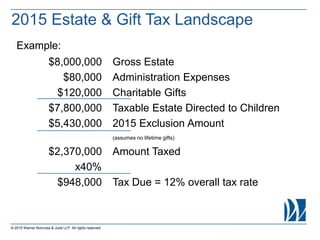
$8,000,000 Gross Estate
$80,000 Administration Expenses
$120,000 Charitable Gifts
$7,800,000 Taxable Estate Directed to Children
$5,430,000 2015 Exclusion Amount
(assumes no lifetime gifts)
$2,370,000 Amount Taxed
x40%
$948,000 Tax Due = 12% overall tax rate
Example:
2015 Estate & Gift Tax Landscape
© 2015 Warner Norcross & Judd LLP. All rights reserved
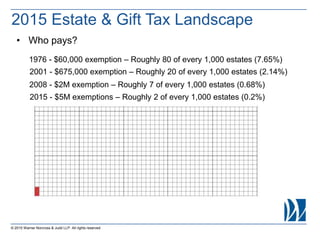
• Who pays?
2015 - $5M exemptions – Roughly 2 of every 1,000 estates (0.2%)
1976 - $60,000 exemption – Roughly 80 of every 1,000 estates (7.65%)
2001 - $675,000 exemption – Roughly 20 of every 1,000 estates (2.14%)
2008 - $2M exemption – Roughly 7 of every 1,000 estates (0.68%)
2015 Estate & Gift Tax Landscape
© 2015 Warner Norcross & Judd LLP. All rights reserved
• Average effective rate in 2013 = 16.6%
• The tax will generate about $246 billion over 2016 – 2025
• This is less than the 1% of Federal revenue over this
period but more than the federal government will spend on
the Food and Drug Administration, the Centers for Disease
Control & Prevention, and the Environmental Protection
Agency combined
2015 Estate & Gift Tax Landscape
© 2015 Warner Norcross & Judd LLP. All rights reserved
Long-term Care Planning
• 12.5% Americans now over 65
• 20% expected to be over 65 by 2030
Estate planning for the 99.8%
© 2015 Warner Norcross & Judd LLP. All rights reserved
Medicaid Eligibility
$2,000 of countable assets plus excluded assets:
One homestead and land
(up to $552,000 in equity)
One vehicleHousehold furniture & furnishings Prepaid funeral contract
Estate planning for the 99.8%
© 2015 Warner Norcross & Judd LLP. All rights reserved
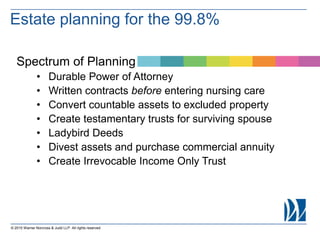
Spectrum of Planning
• Durable Power of Attorney
• Written contracts before entering nursing care
• Convert countable assets to excluded property
• Create testamentary trusts for surviving spouse
• Ladybird Deeds
• Divest assets and purchase commercial annuity
• Create Irrevocable Income Only Trust
Estate planning for the 99.8%
© 2015 Warner Norcross & Judd LLP. All rights reserved
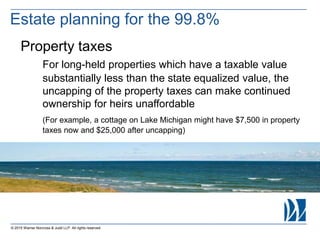
Property taxes
For long-held properties which have a taxable value
substantially less than the state equalized value, the
uncapping of the property taxes can make continued
ownership for heirs unaffordable
(For example, a cottage on Lake Michigan might have $7,500 in property
taxes now and $25,000 after uncapping)
Estate planning for the 99.8%
© 2015 Warner Norcross & Judd LLP. All rights reserved
Transferring residence/cottage to children
1. Leaving Residence in Parent’s Name Alone
2. Outright Conveyance to Children Now
3. Place Residence in joint name with Children
4. Convey to Parent’s Revocable Living Trust
5. Deed to Children Now but
Parent Retains Life Estate
6. Execute Ladybird Deed Conveying Property to Children at
Death if Parent Still Owns Property and Has Not Changed
Deed
© 2015 Warner Norcross & Judd LLP. All rights reserved
Portability (or Deceased Spousal Unused Exclusion Amount “DSUEA”)
• The ability of a surviving spouse to add the unused
amount of a deceased spouse’s estate and gift tax
exclusion amount to the surviving spouse’s estate and
gift tax exclusion amount. The combined amount is
available to shelter the surviving spouse’s lifetime and
testamentary transfers
Portability
• First applicable to decedents who died after December 31,
2010 and made “permanent” in 2012
• Does not apply to federal generation-skipping transfer tax
• Election is made on a timely filed estate tax return
(Treas. Regs. SS 20-2010-2T(a)(2) and (7)(i))
• A surviving spouse can use the DSUEAs of multiple
spouses through lifetime gifting but for testamentary
transfers, can only use the DSUEA of the “last deceased
spouse” who died while married to the surviving spouse
(Treas. Regs S 20-2011T(d)(5))
• Facilitates simple plans where 1 spouse distributes
property outright to the survivor
(through joint tenancy, beneficiary designations, outright gifts under Wills or Trusts)
© 2015 Warner Norcross & Judd LLP. All rights reserved
Portability
a. Simpler to Implement
• No more dividing assets between spouses under
traditional A/B planning
• No setting up new separate accounts
• Assets can remain jointly owned
b. Easier to Administer
• No need for surviving spouse to administer on-
going credit shelter and/or marital trust
c. More flexibility
• Surviving spouse has freedom to address changes
in circumstances and is not encumbered with
withdraw rights or power of appointment
© 2015 Warner Norcross & Judd LLP. All rights reserved
Portability: Advantages
© 2015 Warner Norcross & Judd LLP. All rights reserved
d. Second Basis Adjustment
• Step up in basis for assets owned by surviving spouse at
date of death
• Example: Peter dies in 2015 with an estate of $3 million.
$3 million funds a credit shelter trust for wife Nancy. His
DSUEA is $2.43 million ($5.43M - $3M = $2.43M) Peter’s
personal representative makes a portability election.
Nancy dies years later with an $8 million estate and
exclusion amount is $6 million. Credit shelter trust is $3.8
million. Nancy’s combined exemption is $8.43 million.
There is no estate tax but $800,000 of growth in credit
shelter does not receive second basis adjustment.
– Note that the benefit of this second basis adjustment can vary:
- is the asset likely to be sold or held?
- if sold, what will the resulting capital gain be to the new owner?
- the asset’s value may go down between the death of the first spouse
and second resulting in a step-down in basis
Portability: Advantages
© 2015 Warner Norcross & Judd LLP. All rights reserved
a. Previous second marriage
• Trusts for the benefit of the surviving spouse can
assure assets eventually go to children from a prior
marriage
b. Future second marriage
• A surviving spouse may remarry and direct assets to
new spouse or step-children.
• Also may forfeit DSUEA of first spouse if that goes
unused and surviving spouse survives new spouse
who uses his DSUEA for benefit of his children
leaving surviving spouse with a smaller
exclusion amount
Portability: Disadvantages
© 2015 Warner Norcross & Judd LLP. All rights reserved
c. Management
• Trusts provide management and control of property for
surviving spouse (or children). May have concerns about a
spouse’s diminishing capacity, susceptibility to undue
influence, problems with mental illness, or substance abuse
d. Asset Protection
• Assets left outright to surviving spouse exposes the assets of
the decedent spouse to the creditors of the surviving spouse.
• The best form of trust for creditor protection is a credit trust
with a spendthrift provision and/or discretionary distribution
standard where the surviving spouse does not serve as sole
trustee
Portability: Disadvantages
© 2015 Warner Norcross & Judd LLP. All rights reserved
e. Growth Potentially Exposed
• The surviving spouse’s own exclusion amount and
the DSUEA may not be enough to shelter assets
from estate tax because the DSUEA is not indexed
for inflation.
• Assets in a credit shelter trust including growth
remain outside of the surviving spouse’s gross
estate
Portability: Disadvantages
© 2015 Warner Norcross & Judd LLP. All rights reserved
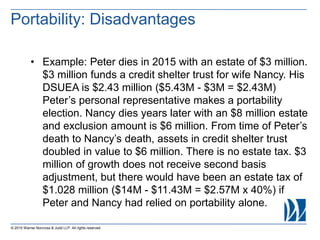
• Example: Peter dies in 2015 with an estate of $3 million.
$3 million funds a credit shelter trust for wife Nancy. His
DSUEA is $2.43 million ($5.43M - $3M = $2.43M)
Peter’s personal representative makes a portability
election. Nancy dies years later with an $8 million estate
and exclusion amount is $6 million. From time of Peter’s
death to Nancy’s death, assets in credit shelter trust
doubled in value to $6 million. There is no estate tax. $3
million of growth does not receive second basis
adjustment, but there would have been an estate tax of
$1.028 million ($14M - $11.43M = $2.57M x 40%) if
Peter and Nancy had relied on portability alone.
Portability: Disadvantages
© 2015 Warner Norcross & Judd LLP. All rights reserved
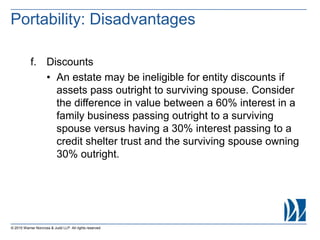
f. Discounts
• An estate may be ineligible for entity discounts if
assets pass outright to surviving spouse. Consider
the difference in value between a 60% interest in a
family business passing outright to a surviving
spouse versus having a 30% interest passing to a
credit shelter trust and the surviving spouse owning
30% outright.
Portability: Disadvantages
© 2015 Warner Norcross & Judd LLP. All rights reserved
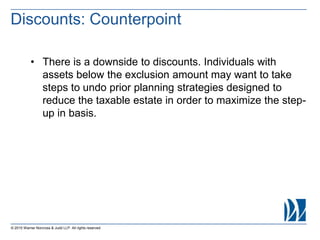
• There is a downside to discounts. Individuals with
assets below the exclusion amount may want to take
steps to undo prior planning strategies designed to
reduce the taxable estate in order to maximize the step-
up in basis.
Discounts: Counterpoint
© 2015 Warner Norcross & Judd LLP. All rights reserved
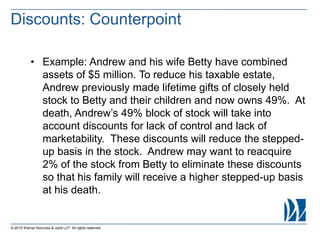
• Example: Andrew and his wife Betty have combined
assets of $5 million. To reduce his taxable estate,
Andrew previously made lifetime gifts of closely held
stock to Betty and their children and now owns 49%. At
death, Andrew’s 49% block of stock will take into
account discounts for lack of control and lack of
marketability. These discounts will reduce the stepped-
up basis in the stock. Andrew may want to reacquire
2% of the stock from Betty to eliminate these discounts
so that his family will receive a higher stepped-up basis
at his death.
Discounts: Counterpoint
© 2015 Warner Norcross & Judd LLP. All rights reserved
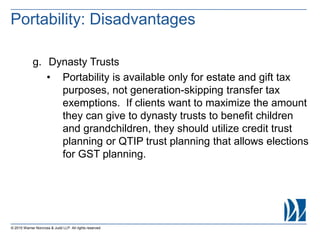
g. Dynasty Trusts
• Portability is available only for estate and gift tax
purposes, not generation-skipping transfer tax
exemptions. If clients want to maximize the amount
they can give to dynasty trusts to benefit children
and grandchildren, they should utilize credit trust
planning or QTIP trust planning that allows elections
for GST planning.
Portability: Disadvantages
© 2015 Warner Norcross & Judd LLP. All rights reserved
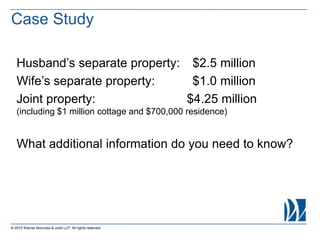
Case Study
Husband’s separate property: $2.5 million
Wife’s separate property: $1.0 million
Joint property: $4.25 million
(including $1 million cottage and $700,000 residence)
What additional information do you need to know?
© 2015 Warner Norcross & Judd LLP. All rights reserved
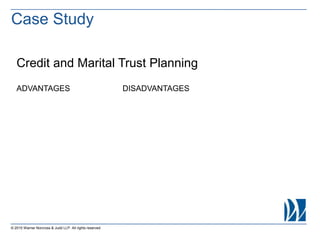
Case Study
Credit and Marital Trust Planning
ADVANTAGES DISADVANTAGES
© 2015 Warner Norcross & Judd LLP. All rights reserved
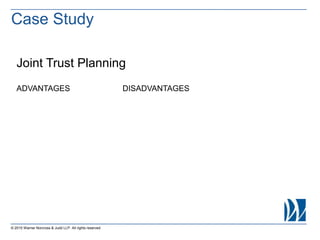
Case Study
Joint Trust Planning
ADVANTAGES DISADVANTAGES
© 2015 Warner Norcross & Judd LLP. All rights reserved
Case Study
Spouse’s Trust Planning
ADVANTAGES DISADVANTAGES
© 2015 Warner Norcross & Judd LLP. All rights reserved
• For clients who want asset protection and portability
planning, a spouse’s QTIP trust may be best. The
“all income” requirement of a QTIP trust is less
desirable (because at a minimum, the income
interest is susceptible to claims of creditors of
surviving spouse) than discretionary distributions
standard but does offer some credit protection and
will offer (likely) the second basis adjustment for
income tax purposes at the death of the surviving
spouse
• Revenue Procedure 2001 – 38 issue
Case Study

Dan Borst Power Point Presentation 2015 Tax Symposium

  • 1.
    November 2015 Dan Borst 2015Estate & Gift Tax Landscape
  • 2.
    © 2015 WarnerNorcross & Judd LLP. All rights reserved • Federal Estate Tax = a tax on property transferred from deceased persons to their heirs • Levied only on the portion of an estate’s value that exceeds the exemption level = $5.43 million in 2015 (potentially $10.86 million per married couple) • Exemption reduced by lifetime gifts • Assets passing to charity or US spouse exempted 2015 Estate & Gift Tax Landscape
  • 3.
    © 2015 WarnerNorcross & Judd LLP. All rights reserved $8,000,000 Gross Estate $80,000 Administration Expenses $120,000 Charitable Gifts $7,800,000 Taxable Estate Directed to Children $5,430,000 2015 Exclusion Amount (assumes no lifetime gifts) $2,370,000 Amount Taxed x40% $948,000 Tax Due = 12% overall tax rate Example: 2015 Estate & Gift Tax Landscape
  • 4.
    © 2015 WarnerNorcross & Judd LLP. All rights reserved • Who pays? 2015 - $5M exemptions – Roughly 2 of every 1,000 estates (0.2%) 1976 - $60,000 exemption – Roughly 80 of every 1,000 estates (7.65%) 2001 - $675,000 exemption – Roughly 20 of every 1,000 estates (2.14%) 2008 - $2M exemption – Roughly 7 of every 1,000 estates (0.68%) 2015 Estate & Gift Tax Landscape
  • 5.
    © 2015 WarnerNorcross & Judd LLP. All rights reserved • Average effective rate in 2013 = 16.6% • The tax will generate about $246 billion over 2016 – 2025 • This is less than the 1% of Federal revenue over this period but more than the federal government will spend on the Food and Drug Administration, the Centers for Disease Control & Prevention, and the Environmental Protection Agency combined 2015 Estate & Gift Tax Landscape
  • 6.
    © 2015 WarnerNorcross & Judd LLP. All rights reserved Long-term Care Planning • 12.5% Americans now over 65 • 20% expected to be over 65 by 2030 Estate planning for the 99.8%
  • 7.
    © 2015 WarnerNorcross & Judd LLP. All rights reserved Medicaid Eligibility $2,000 of countable assets plus excluded assets: One homestead and land (up to $552,000 in equity) One vehicleHousehold furniture & furnishings Prepaid funeral contract Estate planning for the 99.8%
  • 8.
    © 2015 WarnerNorcross & Judd LLP. All rights reserved Spectrum of Planning • Durable Power of Attorney • Written contracts before entering nursing care • Convert countable assets to excluded property • Create testamentary trusts for surviving spouse • Ladybird Deeds • Divest assets and purchase commercial annuity • Create Irrevocable Income Only Trust Estate planning for the 99.8%
  • 9.
    © 2015 WarnerNorcross & Judd LLP. All rights reserved Property taxes For long-held properties which have a taxable value substantially less than the state equalized value, the uncapping of the property taxes can make continued ownership for heirs unaffordable (For example, a cottage on Lake Michigan might have $7,500 in property taxes now and $25,000 after uncapping) Estate planning for the 99.8%
  • 10.
    © 2015 WarnerNorcross & Judd LLP. All rights reserved Transferring residence/cottage to children 1. Leaving Residence in Parent’s Name Alone 2. Outright Conveyance to Children Now 3. Place Residence in joint name with Children 4. Convey to Parent’s Revocable Living Trust 5. Deed to Children Now but Parent Retains Life Estate 6. Execute Ladybird Deed Conveying Property to Children at Death if Parent Still Owns Property and Has Not Changed Deed
  • 11.
    © 2015 WarnerNorcross & Judd LLP. All rights reserved Portability (or Deceased Spousal Unused Exclusion Amount “DSUEA”) • The ability of a surviving spouse to add the unused amount of a deceased spouse’s estate and gift tax exclusion amount to the surviving spouse’s estate and gift tax exclusion amount. The combined amount is available to shelter the surviving spouse’s lifetime and testamentary transfers Portability
  • 12.
    • First applicableto decedents who died after December 31, 2010 and made “permanent” in 2012 • Does not apply to federal generation-skipping transfer tax • Election is made on a timely filed estate tax return (Treas. Regs. SS 20-2010-2T(a)(2) and (7)(i)) • A surviving spouse can use the DSUEAs of multiple spouses through lifetime gifting but for testamentary transfers, can only use the DSUEA of the “last deceased spouse” who died while married to the surviving spouse (Treas. Regs S 20-2011T(d)(5)) • Facilitates simple plans where 1 spouse distributes property outright to the survivor (through joint tenancy, beneficiary designations, outright gifts under Wills or Trusts) © 2015 Warner Norcross & Judd LLP. All rights reserved Portability
  • 13.
    a. Simpler toImplement • No more dividing assets between spouses under traditional A/B planning • No setting up new separate accounts • Assets can remain jointly owned b. Easier to Administer • No need for surviving spouse to administer on- going credit shelter and/or marital trust c. More flexibility • Surviving spouse has freedom to address changes in circumstances and is not encumbered with withdraw rights or power of appointment © 2015 Warner Norcross & Judd LLP. All rights reserved Portability: Advantages
  • 14.
    © 2015 WarnerNorcross & Judd LLP. All rights reserved d. Second Basis Adjustment • Step up in basis for assets owned by surviving spouse at date of death • Example: Peter dies in 2015 with an estate of $3 million. $3 million funds a credit shelter trust for wife Nancy. His DSUEA is $2.43 million ($5.43M - $3M = $2.43M) Peter’s personal representative makes a portability election. Nancy dies years later with an $8 million estate and exclusion amount is $6 million. Credit shelter trust is $3.8 million. Nancy’s combined exemption is $8.43 million. There is no estate tax but $800,000 of growth in credit shelter does not receive second basis adjustment. – Note that the benefit of this second basis adjustment can vary: - is the asset likely to be sold or held? - if sold, what will the resulting capital gain be to the new owner? - the asset’s value may go down between the death of the first spouse and second resulting in a step-down in basis Portability: Advantages
  • 15.
    © 2015 WarnerNorcross & Judd LLP. All rights reserved a. Previous second marriage • Trusts for the benefit of the surviving spouse can assure assets eventually go to children from a prior marriage b. Future second marriage • A surviving spouse may remarry and direct assets to new spouse or step-children. • Also may forfeit DSUEA of first spouse if that goes unused and surviving spouse survives new spouse who uses his DSUEA for benefit of his children leaving surviving spouse with a smaller exclusion amount Portability: Disadvantages
  • 16.
    © 2015 WarnerNorcross & Judd LLP. All rights reserved c. Management • Trusts provide management and control of property for surviving spouse (or children). May have concerns about a spouse’s diminishing capacity, susceptibility to undue influence, problems with mental illness, or substance abuse d. Asset Protection • Assets left outright to surviving spouse exposes the assets of the decedent spouse to the creditors of the surviving spouse. • The best form of trust for creditor protection is a credit trust with a spendthrift provision and/or discretionary distribution standard where the surviving spouse does not serve as sole trustee Portability: Disadvantages
  • 17.
    © 2015 WarnerNorcross & Judd LLP. All rights reserved e. Growth Potentially Exposed • The surviving spouse’s own exclusion amount and the DSUEA may not be enough to shelter assets from estate tax because the DSUEA is not indexed for inflation. • Assets in a credit shelter trust including growth remain outside of the surviving spouse’s gross estate Portability: Disadvantages
  • 18.
    © 2015 WarnerNorcross & Judd LLP. All rights reserved • Example: Peter dies in 2015 with an estate of $3 million. $3 million funds a credit shelter trust for wife Nancy. His DSUEA is $2.43 million ($5.43M - $3M = $2.43M) Peter’s personal representative makes a portability election. Nancy dies years later with an $8 million estate and exclusion amount is $6 million. From time of Peter’s death to Nancy’s death, assets in credit shelter trust doubled in value to $6 million. There is no estate tax. $3 million of growth does not receive second basis adjustment, but there would have been an estate tax of $1.028 million ($14M - $11.43M = $2.57M x 40%) if Peter and Nancy had relied on portability alone. Portability: Disadvantages
  • 19.
    © 2015 WarnerNorcross & Judd LLP. All rights reserved f. Discounts • An estate may be ineligible for entity discounts if assets pass outright to surviving spouse. Consider the difference in value between a 60% interest in a family business passing outright to a surviving spouse versus having a 30% interest passing to a credit shelter trust and the surviving spouse owning 30% outright. Portability: Disadvantages
  • 20.
    © 2015 WarnerNorcross & Judd LLP. All rights reserved • There is a downside to discounts. Individuals with assets below the exclusion amount may want to take steps to undo prior planning strategies designed to reduce the taxable estate in order to maximize the step- up in basis. Discounts: Counterpoint
  • 21.
    © 2015 WarnerNorcross & Judd LLP. All rights reserved • Example: Andrew and his wife Betty have combined assets of $5 million. To reduce his taxable estate, Andrew previously made lifetime gifts of closely held stock to Betty and their children and now owns 49%. At death, Andrew’s 49% block of stock will take into account discounts for lack of control and lack of marketability. These discounts will reduce the stepped- up basis in the stock. Andrew may want to reacquire 2% of the stock from Betty to eliminate these discounts so that his family will receive a higher stepped-up basis at his death. Discounts: Counterpoint
  • 22.
    © 2015 WarnerNorcross & Judd LLP. All rights reserved g. Dynasty Trusts • Portability is available only for estate and gift tax purposes, not generation-skipping transfer tax exemptions. If clients want to maximize the amount they can give to dynasty trusts to benefit children and grandchildren, they should utilize credit trust planning or QTIP trust planning that allows elections for GST planning. Portability: Disadvantages
  • 23.
    © 2015 WarnerNorcross & Judd LLP. All rights reserved Case Study Husband’s separate property: $2.5 million Wife’s separate property: $1.0 million Joint property: $4.25 million (including $1 million cottage and $700,000 residence) What additional information do you need to know?
  • 24.
    © 2015 WarnerNorcross & Judd LLP. All rights reserved Case Study Credit and Marital Trust Planning ADVANTAGES DISADVANTAGES
  • 25.
    © 2015 WarnerNorcross & Judd LLP. All rights reserved Case Study Joint Trust Planning ADVANTAGES DISADVANTAGES
  • 26.
    © 2015 WarnerNorcross & Judd LLP. All rights reserved Case Study Spouse’s Trust Planning ADVANTAGES DISADVANTAGES
  • 27.
    © 2015 WarnerNorcross & Judd LLP. All rights reserved • For clients who want asset protection and portability planning, a spouse’s QTIP trust may be best. The “all income” requirement of a QTIP trust is less desirable (because at a minimum, the income interest is susceptible to claims of creditors of surviving spouse) than discretionary distributions standard but does offer some credit protection and will offer (likely) the second basis adjustment for income tax purposes at the death of the surviving spouse • Revenue Procedure 2001 – 38 issue Case Study