CORRECTION OF REFRACTIVE ERROR
SPECTACLE CORRECTION
Single vision lenses
Single vision lenses have one dioptric power throughout the entire lens.
They can be used to correct vision in either near or far viewing situations, which
is why single vision lenses form the basis of both distance glasses and reading
glasses.
Can also be used to correct astigmatic patients
Can be made photochromatic thus protecting the patient from the light.
Bifocal lenses
Bifocal lenses are used for people who are both nearsighted and
farsighted.
It is common for people who are over the age of 40 to begin to notice a
change in their vision and require the need for bifocals.
As we age, our eyes begin to have trouble focusing on objects at
different distances away.
Multifocal lenses
Multifocal lenses allow you to see at multiple distances, because they
have different sections for viewing close up, far away and everything in
between.
 Whether you're driving, using a computer, shopping or reading, you can
usually wear one pair of multifocal to accommodate most of your vision
needs.
Contact lenses
correction
MODERNTECHNOLOGY
IN REFRACTIVE ERROR
CORRECTION
Hybrid contact lenses
A hybrid lens is designed with a rigid gas permeable center and a soft skirt.
This provides the comfort of a soft lens with the clear vision of a gas permeable lens.
Good candidates for hybrid lenses include: Those with regular corneal astigmatism.
Smart glasses
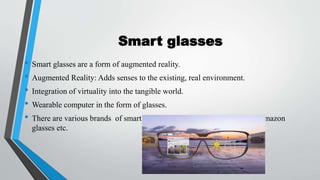
• Smart glasses are a form of augmented reality.
• Augmented Reality: Adds senses to the existing, real environment.
• Integration of virtuality into the tangible world.
• Wearable computer in the form of glasses.
• There are various brands of smart glasses e.g. google glasses, ray bun, amazon
glasses etc.
Smart glasses
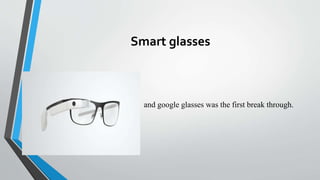
• First prototyped in late 2012 and google glasses was the first break through.
Functions of smart glasses
• Smart Glasses integrates a computer, cameras, and sensors in order
to deliver the augmented reality experience.
• Similar to the components of a smartphone: receiving calls, taking pictures,
sensors, GPS, speakers, video chart, Wi-Fi and Bluetooth services etc.
• Eye tracking helps to determine what the user is looking at
• Mini projectors help to cast virtual 3D objects into the real world.
Purpose for smart glasses
• Navigate the user on roads or indicate speeding
• Universal remote control with compatible devices through hand gestures
• Sighted companion for blind people by giving them information through
vibrations
• Students can view textbooks and virtual 3D worlds
• Can display performance measurement and comparison
smart contact lenses
• Contain different types of lenses depending on their purposes.
• Transition lenses: Contact lenses that darken automatically in sunlight to
reduce glare and enhance comfort.
• . The lenses feature a photochromic filter that continuously adjusts the amount
of light entering the eye.
• They automatically return to a regular tint in normal or dimly lit
environments.
Augmented reality lens
• A smart contact lens with a built-in visual display is designed to magnify images for
people with low vision. They also integrate human computer interface control.
• The patented lens, designed by a company called Mojo Vision, can project content
from a smartphone.
• Multiple lenses: are also used to restore vision in children and teens with myopia
(nearsightedness).
• These differ from existing OrthoK contact lenses, which reshape the cornea, by
redirecting how light hits the retina. Also, the new lens does not need to be worn
overnight.
Refractive surgery – LASIK surgery
• Lasik surgery: Laser – Assisted In Situ Keratomileusis
• It is a laser Tx applied to the cornea used to treat most cases of myopia,
hyperopia and astigmatism.
• Once the procedure is done the px can see as good as with glasses
• A bandage contact lens is inserted once the procedure is done as the cornea
self heal.
The end
Thank you

tawonga and tapiwa presentation goo.pptx

  • 1.
  • 2.
  • 3.
    Single vision lenses Singlevision lenses have one dioptric power throughout the entire lens. They can be used to correct vision in either near or far viewing situations, which is why single vision lenses form the basis of both distance glasses and reading glasses. Can also be used to correct astigmatic patients Can be made photochromatic thus protecting the patient from the light.
  • 4.
    Bifocal lenses Bifocal lensesare used for people who are both nearsighted and farsighted. It is common for people who are over the age of 40 to begin to notice a change in their vision and require the need for bifocals. As we age, our eyes begin to have trouble focusing on objects at different distances away.
  • 5.
    Multifocal lenses Multifocal lensesallow you to see at multiple distances, because they have different sections for viewing close up, far away and everything in between.  Whether you're driving, using a computer, shopping or reading, you can usually wear one pair of multifocal to accommodate most of your vision needs.
  • 6.
  • 11.
  • 12.
    Hybrid contact lenses Ahybrid lens is designed with a rigid gas permeable center and a soft skirt. This provides the comfort of a soft lens with the clear vision of a gas permeable lens. Good candidates for hybrid lenses include: Those with regular corneal astigmatism.
  • 13.
    Smart glasses • Smartglasses are a form of augmented reality. • Augmented Reality: Adds senses to the existing, real environment. • Integration of virtuality into the tangible world. • Wearable computer in the form of glasses. • There are various brands of smart glasses e.g. google glasses, ray bun, amazon glasses etc.
  • 14.
    Smart glasses • Firstprototyped in late 2012 and google glasses was the first break through.
  • 15.
    Functions of smartglasses • Smart Glasses integrates a computer, cameras, and sensors in order to deliver the augmented reality experience. • Similar to the components of a smartphone: receiving calls, taking pictures, sensors, GPS, speakers, video chart, Wi-Fi and Bluetooth services etc. • Eye tracking helps to determine what the user is looking at • Mini projectors help to cast virtual 3D objects into the real world.
  • 16.
    Purpose for smartglasses • Navigate the user on roads or indicate speeding • Universal remote control with compatible devices through hand gestures • Sighted companion for blind people by giving them information through vibrations • Students can view textbooks and virtual 3D worlds • Can display performance measurement and comparison
  • 17.
    smart contact lenses •Contain different types of lenses depending on their purposes. • Transition lenses: Contact lenses that darken automatically in sunlight to reduce glare and enhance comfort. • . The lenses feature a photochromic filter that continuously adjusts the amount of light entering the eye. • They automatically return to a regular tint in normal or dimly lit environments.
  • 18.
    Augmented reality lens •A smart contact lens with a built-in visual display is designed to magnify images for people with low vision. They also integrate human computer interface control. • The patented lens, designed by a company called Mojo Vision, can project content from a smartphone. • Multiple lenses: are also used to restore vision in children and teens with myopia (nearsightedness). • These differ from existing OrthoK contact lenses, which reshape the cornea, by redirecting how light hits the retina. Also, the new lens does not need to be worn overnight.
  • 19.
    Refractive surgery –LASIK surgery • Lasik surgery: Laser – Assisted In Situ Keratomileusis • It is a laser Tx applied to the cornea used to treat most cases of myopia, hyperopia and astigmatism. • Once the procedure is done the px can see as good as with glasses • A bandage contact lens is inserted once the procedure is done as the cornea self heal.
  • 20.