Prof. Stefan Doerr
Swansea University (UK)
The impact of climate change
on climate extreme events:
the case of wildfires
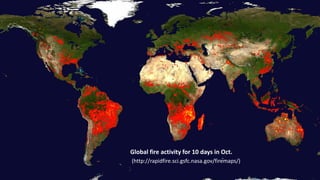
Global fire activity for 10 days in Oct.
(http://rapidfire.sci.gsfc.nasa.gov/firemaps/)
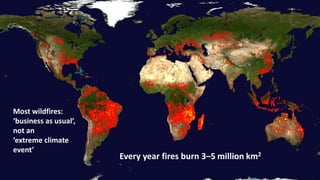
Most wildfires:
‘business as usual’,
not an
‘extreme climate
event’
Every year fires burn 3–5 million km2
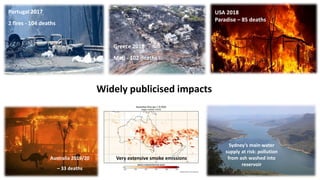
Portugal 2017
2 fires - 104 deaths
Australia 2019/20
– 33 deaths
Greece 2018
Widely publicised impacts
USA 2018
Paradise – 85 deaths
Greece 2018
Mati - 102 deaths
Very extensive smoke emissions
Sydney’s main water
supply at risk: pollution
from ash washed into
reservoir
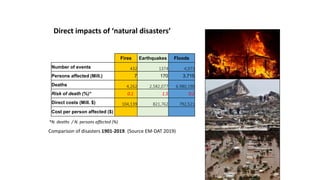
Fires Earthquakes Floods
Number of events 432 1374 4,973
Persons affected (Mill.) 7 170 3,715
Deaths 4,262 2,582,077 6,980,190
Risk of death (%)* 0.1 1.5 0.2
Direct costs (Mill. $) 104,139 821,762 792,521
Cost per person affected ($)
*N. deaths / N. persons affected (%)
Comparison of disasters 1901-2019. (Source EM-DAT 2019)
Direct impacts of ‘natural disasters’
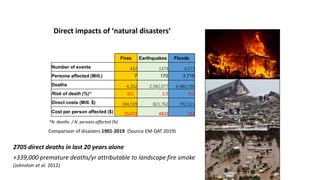
Fires Earthquakes Floods
Number of events 432 1374 4,973
Persons affected (Mill.) 7 170 3,715
Deaths 4,262 2,582,077 6,980,190
Risk of death (%)* 0.1 1.5 0.2
Direct costs (Mill. $) 104,139 821,762 792,521
Cost per person affected ($) 15,472 4833 213
*N. deaths / N. persons affected (%)
Comparison of disasters 1901-2019. (Source EM-DAT 2019)
Direct impacts of ‘natural disasters’
2705 direct deaths in last 20 years alone
+339,000 premature deaths/yr attributable to landscape fire smoke
(Johnston et al. 2012)
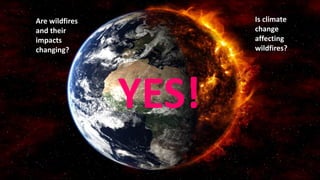
Are wildfires
and their
impacts
changing?
Is climate
change
affecting
wildfires?
YES!
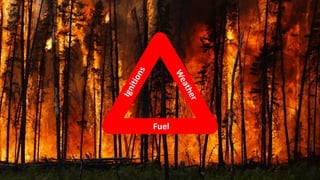
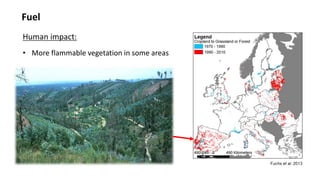
Fuel
Fuel
• More flammable vegetation in some areas
Human impact:
Fuel
Climate change:
• Vegetation more flammable with extended fire seasons
Fuel
Climate change:
• Vegetation more flammable with extended fire seasons
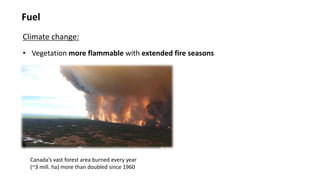
Canada’s vast forest area burned every year
(~3 mill. ha) more than doubled since 1960
Fuel
Climate change:
• Vegetation more flammable with extended fire seasons
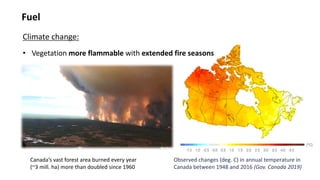
Observed changes (deg. C) in annual temperature in
Canada between 1948 and 2016 (Gov. Canada 2019)
Canada’s vast forest area burned every year
(~3 mill. ha) more than doubled since 1960
Ignitions
Human impact:
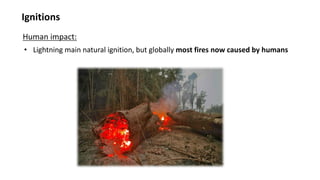
• Lightning main natural ignition, but globally most fires now caused by humans
Ignitions
Human impact:
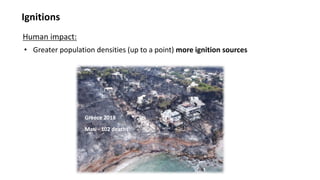
• Greater population densities (up to a point) more ignition sources
Greece 2018
Mati - 102 deaths
Ignitions
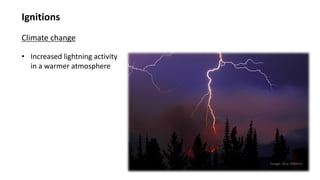
• Increased lightning activity
in a warmer atmosphere
Climate change
Image: Gov. Alberta
Ignitions
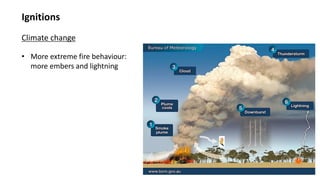
• More extreme fire behaviour:
more embers and lightning
Climate change
Weather
• has already led to an increase in the frequency and severity of fire weather
(e.g. western USA and Canada, southern Europe, Scandinavia, Amazonia)
• already contributed to more dangerous fire weather conditions for Australia
(includes an earlier start and later end to the fire season)
• These trends are expected to accelerate with climate warming
Human induced climate change:
https://sciencebrief.org/topics/climate-change-science/wildfires
Conclusions from a review of scientific literature on fire and climate (57 studies, Jan 2020)
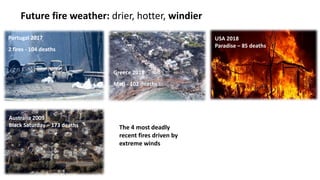
Future fire weather: drier, hotter, windier
Portugal 2017
2 fires - 104 deaths
USA 2018
Paradise – 85 deaths
Greece 2018
Mati - 102 deaths
Australia 2009
Black Saturday – 173 deaths
Canada 2016
Fort McMurray
- 60,000 evacuated
- $9 bill. losses
- winds not extreme
- no direct deaths
The 4 most deadly
recent fires driven by
extreme winds
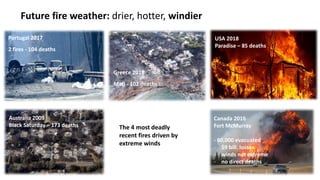
Future fire weather: drier, hotter, windier
Portugal 2017
2 fires - 104 deaths
USA 2018
Paradise – 85 deaths
Greece 2018
Mati - 102 deaths
Australia 2009
Black Saturday – 173 deaths The 4 most deadly
recent fires driven by
extreme winds
Canada 2016
Fort McMurray
- 60,000 evacuated
- $9 bill. losses
- winds not extreme
- no direct deaths
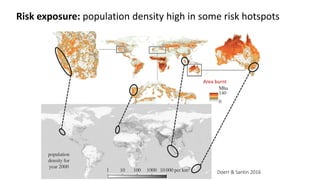
Area burnt
Doerr & Santin 2016
Risk exposure: population density high in some risk hotspots
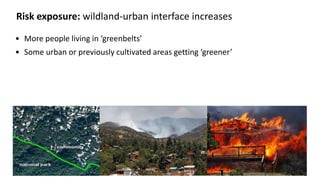
Risk exposure: wildland-urban interface increases
• More people living in ‘greenbelts’
• Some urban or previously cultivated areas getting ‘greener’
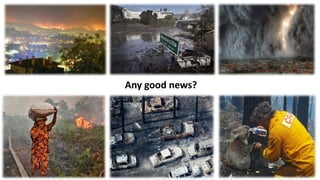
Any good news?
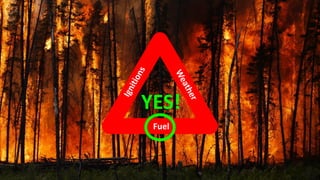
Fuel
YES!
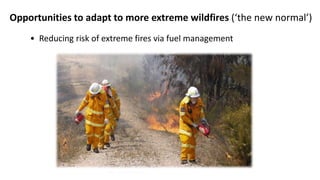
Opportunities to adapt to more extreme wildfires (‘the new normal’)
• Reducing risk of extreme fires via fuel management
ALLEN J. SCHABEN/GETTY IMAGES
Opportunities to adapt to more extreme wildfires (‘the new normal’)
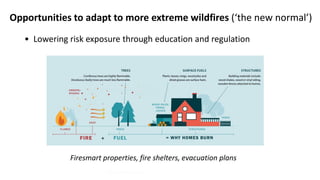
• Lowering risk exposure through education and regulation
ALLEN J. SCHABEN/GETTY IMAGES
Firesmart properties, fire shelters, evacuation plans
Current obstacles: cultural and legislative
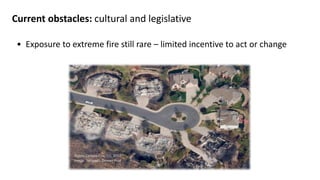
• Exposure to extreme fire still rare – limited incentive to act or change
Waldo Canyon Fire, CO, 2012;
Image: Sangosti, Denver Post
Current obstacles: cultural and legislative
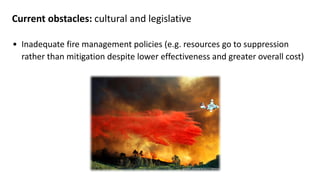
• Inadequate fire management policies (e.g. resources go to suppression
rather than mitigation despite lower effectiveness and greater overall cost)
ALLEN J. SCHABEN/GETTY IMAGES
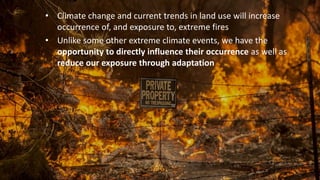
• Climate change and current trends in land use will increase
occurrence of, and exposure to, extreme fires
• Unlike some other extreme climate events, we have the
opportunity to directly influence their occurrence as well as
reduce our exposure through adaptation
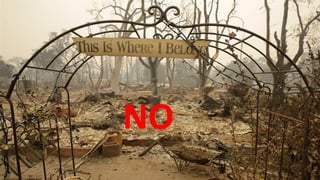
NO

First meeting of the OECD Task Force on Climate Change Adaptation presentation - Stefan Doerr

  • 1.
    Prof. Stefan Doerr SwanseaUniversity (UK) The impact of climate change on climate extreme events: the case of wildfires
  • 2.
    Global fire activityfor 10 days in Oct. (http://rapidfire.sci.gsfc.nasa.gov/firemaps/)
  • 3.
    Most wildfires: ‘business asusual’, not an ‘extreme climate event’ Every year fires burn 3–5 million km2
  • 4.
    Portugal 2017 2 fires- 104 deaths Australia 2019/20 – 33 deaths Greece 2018 Widely publicised impacts USA 2018 Paradise – 85 deaths Greece 2018 Mati - 102 deaths Very extensive smoke emissions Sydney’s main water supply at risk: pollution from ash washed into reservoir
  • 5.
    Fires Earthquakes Floods Numberof events 432 1374 4,973 Persons affected (Mill.) 7 170 3,715 Deaths 4,262 2,582,077 6,980,190 Risk of death (%)* 0.1 1.5 0.2 Direct costs (Mill. $) 104,139 821,762 792,521 Cost per person affected ($) *N. deaths / N. persons affected (%) Comparison of disasters 1901-2019. (Source EM-DAT 2019) Direct impacts of ‘natural disasters’
  • 6.
    Fires Earthquakes Floods Numberof events 432 1374 4,973 Persons affected (Mill.) 7 170 3,715 Deaths 4,262 2,582,077 6,980,190 Risk of death (%)* 0.1 1.5 0.2 Direct costs (Mill. $) 104,139 821,762 792,521 Cost per person affected ($) 15,472 4833 213 *N. deaths / N. persons affected (%) Comparison of disasters 1901-2019. (Source EM-DAT 2019) Direct impacts of ‘natural disasters’ 2705 direct deaths in last 20 years alone +339,000 premature deaths/yr attributable to landscape fire smoke (Johnston et al. 2012)
  • 7.
    Are wildfires and their impacts changing? Isclimate change affecting wildfires? YES!
  • 8.
  • 9.
    Fuel • More flammablevegetation in some areas Human impact:
  • 10.
    Fuel Climate change: • Vegetationmore flammable with extended fire seasons
  • 11.
    Fuel Climate change: • Vegetationmore flammable with extended fire seasons Canada’s vast forest area burned every year (~3 mill. ha) more than doubled since 1960
  • 12.
    Fuel Climate change: • Vegetationmore flammable with extended fire seasons Observed changes (deg. C) in annual temperature in Canada between 1948 and 2016 (Gov. Canada 2019) Canada’s vast forest area burned every year (~3 mill. ha) more than doubled since 1960
  • 13.
    Ignitions Human impact: • Lightningmain natural ignition, but globally most fires now caused by humans
  • 14.
    Ignitions Human impact: • Greaterpopulation densities (up to a point) more ignition sources Greece 2018 Mati - 102 deaths
  • 15.
    Ignitions • Increased lightningactivity in a warmer atmosphere Climate change Image: Gov. Alberta
  • 16.
    Ignitions • More extremefire behaviour: more embers and lightning Climate change
  • 17.
    Weather • has alreadyled to an increase in the frequency and severity of fire weather (e.g. western USA and Canada, southern Europe, Scandinavia, Amazonia) • already contributed to more dangerous fire weather conditions for Australia (includes an earlier start and later end to the fire season) • These trends are expected to accelerate with climate warming Human induced climate change: https://sciencebrief.org/topics/climate-change-science/wildfires Conclusions from a review of scientific literature on fire and climate (57 studies, Jan 2020)
  • 18.
    Future fire weather:drier, hotter, windier Portugal 2017 2 fires - 104 deaths USA 2018 Paradise – 85 deaths Greece 2018 Mati - 102 deaths Australia 2009 Black Saturday – 173 deaths Canada 2016 Fort McMurray - 60,000 evacuated - $9 bill. losses - winds not extreme - no direct deaths The 4 most deadly recent fires driven by extreme winds
  • 19.
    Future fire weather:drier, hotter, windier Portugal 2017 2 fires - 104 deaths USA 2018 Paradise – 85 deaths Greece 2018 Mati - 102 deaths Australia 2009 Black Saturday – 173 deaths The 4 most deadly recent fires driven by extreme winds Canada 2016 Fort McMurray - 60,000 evacuated - $9 bill. losses - winds not extreme - no direct deaths
  • 20.
    Area burnt Doerr &Santin 2016 Risk exposure: population density high in some risk hotspots
  • 21.
    Risk exposure: wildland-urbaninterface increases • More people living in ‘greenbelts’ • Some urban or previously cultivated areas getting ‘greener’
  • 22.
  • 23.
  • 24.
    Opportunities to adaptto more extreme wildfires (‘the new normal’) • Reducing risk of extreme fires via fuel management ALLEN J. SCHABEN/GETTY IMAGES
  • 25.
    Opportunities to adaptto more extreme wildfires (‘the new normal’) • Lowering risk exposure through education and regulation ALLEN J. SCHABEN/GETTY IMAGES Firesmart properties, fire shelters, evacuation plans
  • 26.
    Current obstacles: culturaland legislative • Exposure to extreme fire still rare – limited incentive to act or change Waldo Canyon Fire, CO, 2012; Image: Sangosti, Denver Post
  • 27.
    Current obstacles: culturaland legislative • Inadequate fire management policies (e.g. resources go to suppression rather than mitigation despite lower effectiveness and greater overall cost) ALLEN J. SCHABEN/GETTY IMAGES
  • 28.
    • Climate changeand current trends in land use will increase occurrence of, and exposure to, extreme fires • Unlike some other extreme climate events, we have the opportunity to directly influence their occurrence as well as reduce our exposure through adaptation
  • 29.