The Pearson English
Business Solutions*
Standard Test for
English Professionals
Plus (One Assessment)
Development and Validation
Business Solutions
Business Solutions  The Pearson English Business Solutions* Standard Test for English Professionals Plus (One Assessment)
2
The purpose of this paper is to describe the Pearson
English Business Solutions* Standard Test for English
Professionals Plus (One Assessment), an online, computer
adaptive test used by global professionals and
international organizations to assess Business English
proficiency.
First, the paper details the design, development and
administration of the test, including its four sections
(grammar, reading, listening and speaking), the model
of communicative competence on which it is based,
and how scores are reported and interpreted. Second,
the paper presents information on test reliability and
validity, including an empirical validation study, inter-
rater reliability, test-retest reliability, and Item Response
Theory analyses.
Lindsay Oishi
Ph.D. Associate Product Owner –
Progress and Measurement, Pearson English
Silvie Liao
Ph.D. ESL/EFL Learning Specialist Pearson English
April 2013
Business Solutions  The Pearson English Business Solutions* Standard Test for English Professionals Plus (One Assessment)
3
Contents
4 	 Introduction
5 	Test Description
Design
Administration
Number of Items
Format
Test Construct
12 	Content Design and Development
Item Development and Vocabulary Selection
Item Recording
14 	Score Reporting
Scores and Weights
Score Use
Score Interpretation
16 	Validation
Study Design
Reliability
Validity
20 	 Conclusion
21 	 About the Authors
21 	 About Pearson English Business Solutions*
22 	 References
Business Solutions  The Pearson English Business Solutions* Standard Test for English Professionals Plus (One Assessment)
4
Pearson English Business Solutions* One Assessment
is an online test designed to evaluate an individual’s
ability to understand and use English in global business
contexts. It is intended for adults and takes about an
hour to complete. The test can be taken at any time,
at any location, and requires a computer with a standard
Internet connection, audio output, and a microphone.
A combination of computer and human scoring
generates reliable, meaningful results that offer a valid
snapshot of an individual’s proficiency in Business
English.
Business English proficiency is how well a person
can comprehend and use English for common
business purposes, and includes many aspects of
general English language ability. Pearson English
Business Solutions* One Assessment tests a person’s
capacity to understand spoken and written English
on general and business topics, as well as his or her
ability to produce effective spoken English.
Corporations and other institutions can use test scores
to inform employment, training, and advancement
decisions, as well as measure the outcomes of English
language programs.
Introduction
Business Solutions  The Pearson English Business Solutions* Standard Test for English Professionals Plus (One Assessment)
5
Design
Pearson English Business Solutions* One Assessment
is a computer-based adaptive test that selects a total of
66 questions for each individual test-taker out of an item
bank that includes hundreds of questions. Individuals
answer multiple-choice questions across four sections:
Grammar, Listening, Reading and Speaking (the Speaking
section also includes other question types, as shown in
Table 1). In all sections except for the Speaking section,
there are 5 difficulty levels of questions, and test-takers
receive questions in pairs. All test-takers receive the first
pair of questions at Level 3 (Intermediate). If they answer
both questions correctly, the next pair of questions is at
Level 4. If they answer 1 question correctly, the next pair
of questions is at Level 3. If they miss both questions,
the next pair of questions is at Level 2. This process of
receiving easier or more difficult questions based on
previous answers continues until the final Speaking
section. The advantage of adaptive testing is that
test-takers receive questions that are appropriate for
their level.
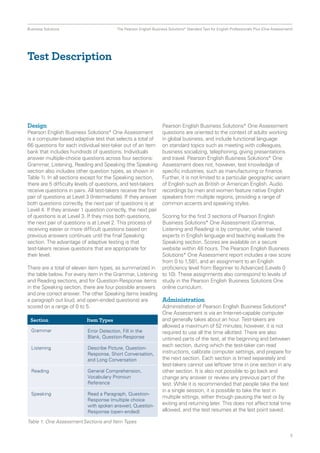
There are a total of eleven item types, as summarized in
the table below. For every item in the Grammar, Listening
and Reading sections, and for Question-Response items
in the Speaking section, there are four possible answers
and one correct answer. The other Speaking items (reading
a paragraph out loud, and open-ended questions) are
scored on a range of 0 to 5.
Pearson English Business Solutions* One Assessment
questions are oriented to the context of adults working
in global business, and include functional language
on standard topics such as meeting with colleagues,
business socializing, telephoning, giving presentations
and travel. Pearson English Business Solutions* One
Assessment does not, however, test knowledge of
specific industries, such as manufacturing or finance.
Further, it is not limited to a particular geographic variant
of English such as British or American English. Audio
recordings by men and women feature native English
speakers from multiple regions, providing a range of
common accents and speaking styles.
Scoring for the first 3 sections of Pearson English
Business Solutions* One Assessment (Grammar,
Listening and Reading) is by computer, while trained
experts in English language and teaching evaluate the
Speaking section. Scores are available on a secure
website within 48 hours. The Pearson English Business
Solutions* One Assessment report includes a raw score
from 0 to 1,581, and an assignment to an English
proficiency level from Beginner to Advanced (Levels 0
to 10). These assignments also correspond to levels of
study in the Pearson English Business Solutions One
online curriculum.
Administration
Administration of Pearson English Business Solutions*
One Assessment is via an Internet-capable computer
and generally takes about an hour. Test-takers are
allowed a maximum of 52 minutes; however, it is not
required to use all the time allotted. There are also
untimed parts of the test, at the beginning and between
each section, during which the test-taker can read
instructions, calibrate computer settings, and prepare for
the next section. Each section is timed separately and
test-takers cannot use leftover time in one section in any
other section. It is also not possible to go back and
change any answer or review any previous part of the
test. While it is recommended that people take the test
in a single session, it is possible to take the test in
multiple sittings, either through pausing the test or by
exiting and returning later. This does not affect total time
allowed, and the test resumes at the last point saved.
Test Description
Section Item Types
Grammar Error Detection, Fill in the
Blank, Question-Response
Listening Describe Picture, Question-
Response, Short Conversation,
and Long Conversation
Reading General Comprehension,
Vocabulary Pronoun
Reference
Speaking Read a Paragraph, Question-
Response (multiple choice
with spoken answer), Question-
Response (open-ended)
Table 1. One Assessment Sections and Item Types
Business Solutions  The Pearson English Business Solutions* Standard Test for English Professionals Plus (One Assessment)
6
Number of Items
The Pearson English Business Solutions* One
Assessment computerized assessment system presents
a total of 66 items in 4 separate sections
to each test-taker. Items are drawn from a large item
pool following an adaptive algorithm.
Format
This section provides a description of each test section
as well as examples and explanations of the types of
questions found in each. In all sections, questions are
presented one at a time, with an answer required before
the individual can move on to the next question. There
are equal numbers of each type of item within a section;
however, they can be presented at any time (i.e., items
of one type are not grouped together).
Part 1: Grammar
The Grammar section includes two types of items:
Error Detection and Fill in the Blank.
In an Error Detection question, the test-taker reads a
sentence that has 4 underlined components. Each
underlined component is a potential answer choice, and
the task is to select which answer is grammatically
incorrect. For Fill in the Blank questions, the test-taker
must choose the grammatically correct response out of
the four potential answers, which are typically similar
and represent common errors.
Section Items Presented Time Allowed
(minutes)
Grammar 26 15
Listening 16 15
Reading 16 15
Speaking 8 7
Total 66 52
Table 2. One Assessment Sections, Items and Time Allowed
Instructions:
Read the question. Find the mistake.
Click A, B, C or D to choose the answer.
After he received his second promotion, John was the
most happy employee in the company.
(A) After
(B) received
(C) most happy
(D) in
Instructions:
Read the question. Click A, B, C or D to choose the
answer that best completes the sentence.
A: Where was Elena this morning? She was supposed
to meet us in the conference room at 10:00AM.
B: She ___________ an important call regarding the
Heyns account.
(A)	must take
(B)	had to take
(C)	would take
(D)	should take
Example: Error Detection
Example: Fill in the Blank
Business Solutions  The Pearson English Business Solutions* Standard Test for English Professionals Plus (One Assessment)
7
Part 2 Listening
There are 4 item types in the Listening section: Picture,
Question-Response, Short Conversation, and Long
Conversation.
In the Picture questions, the test-taker sees a photograph
of a common social or business situation, and listens to
4 answer choices being read aloud. The answer choices
are not displayed as text, and the test-taker can only listen
to them twice.
In Question-Response items, test-takers listen to a
spoken question and select the written answer that is
the most appropriate response. The question is not
displayed as text and the test-taker can only listen to
it twice. There is a photo along with the question to
provide context, but it is not required to answer the
question correctly.
In Short and Long Conversation items, test-takers listen
to a conversation between 2 people and then answer a
written question about that conversation. The answer
choices are also presented as text. Short conversations
typically involve 1 sentence given by each person in
the dialogue. Long conversations typically involve more
than 1 sentence by each person in the dialogue. The
conversations are not presented as text and test-takers
can only listen to each item twice.
Example: Picture
Example: Question-Response
Example: Short Conversation
Instructions:
Look at the picture. Click PLAY and listen (You can listen
only twice). Click on A, B, C or D to select the best answer.
Answer choices (not displayed):
(A) The man is drinking coffee. (B) The women are shaking
hands. (C)The man and woman are meeting at a
restaurant. (D) The men are drinking wine.
PLAY
(A)
(B)
(C)
(D)
Instructions:
Listen to the question and select the most appropriate
response to that question.
PLAY
Question (not displayed):
“How often do you play golf?”
(A) Yes, let’s play next week.
(B)	 I play about twice a
week.
(C) I’ll probably golf today.
(D)	I play golf with my dad.
Instructions:
Listen to the conversation between the 2 people. Then,
answer the question about the conversation you heard.
What does the man offer to do?
(A) Ask the woman to call Ms.
Jones immediately
(B) Call Ms. Jones again the
next day
(C) Request that Ms. Jones
return the call later
(D)	 Invite the woman to call
Ms. Jones in the morning
PLAY
Business Solutions  The Pearson English Business Solutions* Standard Test for English Professionals Plus (One Assessment)
8
Part 3: Reading
The Reading section is comprised of General Compre­
hension, Vocabulary, and Pronoun Reference items in
approximately equal numbers. General Comprehension
questions test a reader’s ability to recognize explicit
information, make reasonable inferences from a text, and
use this knowledge to select a written answer with
appropriate semantic content in response to a written
question. Vocabulary items require the test-taker to
identify a synonymous word or phrase for a selected
word from the reading passage, as it is used in that
context. Finally, Pronoun Reference items ask the
test-taker to identify the noun that a pronoun such as
“it”, “he” or “they” refers to. In easier questions, this
noun is clearly stated in the passage; in harder questions,
the noun may have to be inferred from the text. As the
reading passages are short but complete texts, typically
a few hundred words long, there are 2 questions for
each passage.
Annual Sales Report
Dear Dymo Employees,
We had an excellent year at Dymo Industries. Total
sales were US$550 million. This is an impressive growth
of 10% compared to last year.
There are a few important reasons for the large increase
in sales. All the international divisions performed very
well. The new sales training helped many of us promote
our new line of toys. In addition, the creation of new
products opened more markets for us.
We continued last year to provide our customers
with improved products. We all know that product
enhancement can lead to larger market shares.
Therefore, we hope to continue increasing our sales
by creating better products in the coming year.
Congratulations on your great teamwork!
Jon Ngyuen
Instructions:
Read the document below. Then read the question.
Click A, B, C or D to select the best answer.
Which of the following is NOT a reason for
Dymo Industries’ increased sales?
(A)	A new sales team
(B)	New markets
(C)	Sales training
(D)	Performance in international divisions
Instructions:
Look at the word that is highlighted in yellow in the
reading passage. Choose the word or words that have
the same meaning as the highlighted word.
Look at the word “divisions” in the article. Which words
or phrases mean the same thing as “divisions” in this
article?
(A)	Disagreements within the company
(B)	Groups or teams within an organization
(C)	Sales methods
(D)	Individual employees
Instructions:
Instructions: Look at the pronoun that is highlighted
in yellow in the reading passage. Choose the word or
words that have the same meaning as the highlighted
pronoun. The word or words will come before the
highlighted pronoun. Some may even be in the previous
sentence.
Look at the word “this” in the article. What does the
word “this” refer to in the previous sentence?
(A)	Total sales
(B)	Dymo Industries
(C)	Last year
(D)	Division performance
Example: Reading Passage
Example: General Comprehension
Example: Vocabulary
Example: Pronoun Reference
Business Solutions  The Pearson English Business Solutions* Standard Test for English Professionals Plus (One Assessment)
9
Part 4: Speaking
In the speaking section, examinees read a written
paragraph out loud, answer 5 short questions (where
responses are provided in text), and respond to 2
open-ended questions. Test-takers are instructed to
speak naturally, using correct pronunciation, intonation,
stress and rhythm. Test-takers can only record their
answers once, and while recording, they cannot pause
the timer. There is an exception to this rule if the audio
recorded is too poor to produce a score-able response;
in that case, the test-taker is allowed to re-record his
or her response. If test-takers produce 2 recordings
without intelligible audio, the test takes them back to
the microphone calibration tool.
In Part A, test-takers read a short paragraph aloud.
Once they begin recording, they have 60 seconds total
to finish reading the paragraph aloud; however, they may
stop the recording at any point if they finish before 60
seconds are used. Part A has one question and is designed
to test pronunciation, including the ability to say all of the
sounds of English, stress the correct syllables, pause
appropriately, and use the correct intonation. This allows
scorers to evaluate the candidate’s ability to produce
intelligible and comprehen­sible speech. Intelligibility
refers to the production of sound patterns that are
recognizable as English. Comprehensibility refers to the
ability to speak so that people can understand the meaning.
Test-takers read paragraph aloud that has all of the
phonemes of English and a variety of sentence types.
In Part B, test-takers must listen to audio cues, choose
a written response that is appropriate in the context,
and speak it. They are evaluated on their ability to choose
the correct answer and to say it clearly. Part B has
5 questions and is designed to test communicative
competence. Communicative competence refers to
a speaker’s ability to apply linguistic, discourse, and
cultural knowledge to produce appropriate language in
a particular context.
Instructions:
Click RECORD and read the paragraph aloud. Click STOP
when you are finished.
Instructions:
Click PLAY and listen. You can only listen twice.
Click RECORD and then read the correct response aloud.
Click STOP when you are finished.
RECORD
RECORD
STOP
STOP
Our CEO announced a decision today
at the monthly company meeting.
The executives think that we should
expand our product line. We just need
to add a few luxury items to some
electronic goods. That should help us
increase our market share in Europe
and Asia. Future profits depend on
our dealing with this issue now. We
hope to increase sales by 10% in the
next year.
Audio Cue (not displayed): “We don’t
have time to discuss everything on
the agenda at today’s meeting.”
(A) The meeting started an hour ago.
(B) What’s the next point on the 	
agenda?
(C)That’s okay, we can continue
tomorrow.
(D) Well, what in particular concerns
you?
Example: Read Paragraph
Example: Select  Speak Response
PLAY
Business Solutions  The Pearson English Business Solutions* Standard Test for English Professionals Plus (One Assessment)
10
Part C has two open-ended questions and is designed to
test overall linguistic performance. Open-ended questions
allow evaluation of how well test-takers construct a
response to show evidence of their acquired knowledge.
The first question requires only a beginner to low inter­­
mediate level of English to answer adequately, while the
second question requires greater topic development and
linguistic complexity, and demonstrates high inter­mediate
to advanced ability when answered well. Test-takers are
given 75 seconds for the low-level response and 105
seconds for the high-level response, including preparation
time.
Level Question
Low What is your favorite hobby or
activity? Why?
High How does the Internet
affect your life? What are the
advantages and disadvantages
of the Internet?
Table 3. Examples of Open-ended Questions
Business Solutions  The Pearson English Business Solutions* Standard Test for English Professionals Plus (One Assessment)
11
Test Construct
Canale and Swain’s (1980) model of communicative
competence is one of the most influential frameworks
in language testing, and argues for the need to assess
grammatical, sociolinguistic, strategic and discourse
competence. In this model, simple declarative knowledge
of the language (e.g., being able to state the past tense
of a verb) is not sufficient evidence of ability to actually
use the language for real communicative purposes.
Figure 1 presents the theoretical framework of this
model. Tests of communicative competence not only
reflect the need for language to be used interactively
with other speakers of that language, but also incorporate
authentic contexts, situations, and topics. In this way,
tests based on this model aim to evaluate and an
individual’s overall ability to communicate successfully in
real-life situations.
As evident in the figure above, communicative
competence is a complex construct that involves more
than 1 language skill (such as reading or speaking per
se). To provide a strong evaluation of a candidate’s actual
communicative ability, a test must therefore address
multiple language skills. Figure 2 shows the language
skills assessed in Pearson English Business Solutions
One Assessment, and Figure 3 illustrates how each
section within the test addresses multiple facets of
communicative competence. As a comprehensive test,
Pearson English Business Solutions One Assessment is
designed to measure more than English language
knowledge or general linguistic skill. Instead, it specifically
targets the ability to effectively use English in global
business contexts.
– Vocabulary
– Syntax
– Morphology
– Phonology
– Sentence-
grammar
semantics
– Morphosyn-
tactic
– Syntactic
– Functional
– Morphosyn-
tactic
– Syntactic
– Functional
Grammatical Grammatical
Grammar
Grammar
Sociolinguistic Sociolinguistic
Listening
Listening
Strategic Strategic
Reading
Reading
Discourse Discourse
Speaking
Speaking
Communicative Competence Communicative Competence
Language skills
Sociocultural
rules of use (e.g.
appropriateness
of language use
in context)
– Comprehension
– Inferences
– Comprehension
– Inferences
Communication
strategies (e.g.
strategies used
for unfamiliar
topics or
grammar forms)
– Main Idea
– Detail
– Inferences
– Vocabulary
– Main Idea
– Detail
– Inferences
– Vocabulary
Cohesion and
coherence (e.g.
knowledge to
understand/
produce texts in
different genres
– Topic
development
– Grammar
control
– Fluency
– Pronunciation
– Communicative
effectiveness
– Topic
development
– Grammar
control
– Fluency
– Pronunciation
– Communicative
effectiveness
Figure 1. One Assessment Test Construct
Figure 2. Language Skills Assessed by One Assessment
Figure 3. Communicative Competence and Language Skills
Tested in One Assessment
Business Solutions  The Pearson English Business Solutions* Standard Test for English Professionals Plus (One Assessment)
12
The Pearson English Business Solutions* curriculum
and One Assessment were developed by a team of
experts with extensive training and experience teaching
English as a foreign language, creating curricula, and
writing coursework. Pearson English Business Solutions*
Corporation’s world-class Academic Advisory Board,
including four former presidents of International TESOL,
aided this team. Dr. David Nunan, the senior academic
advisor to Pearson English Business Solutions*, was
director and chair of applied linguistics at the University
of Hong Kong, and the president of International TESOL
in 1999-2000. He has published over 100 books and
articles in the areas of curriculum and materials develop­
ment, classroom-based research, and discourse analysis.
For more information, visit www.globalenglish.com/
company/about/advisors.
Item Development and Vocabulary Selection
As Pearson English Business Solutions* One Assessment
was designed to align with Pearson English Business
Solutions* levels, test items were created with reference
to content and learning objectives from the levels, which
are available by request or through the Pearson English
Business Solutions* website. The vocabulary used in
Pearson English Business Solutions* One Assessment
was also based on the Pearson English Business Solutions*
courses, and test-writers were given a comprehensive
list of 3,150 vocabulary words, as well as the syllabus for
each level.
For the grammar section, test writers were given the
test framework, which listed grammatical features
across different English proficiency levels, and were
advised to provide a balance across the three types of
grammar features: morpho-syntactic (e.g. articles “a/an/
the”), syntactic (e.g. use of a preposition), and functional
(e.g. tense marking in conditionals). For the listening
section, test writers were given a list of common
categories of expressions in business communication
(e.g. asking for and giving opinions). For the reading
section, test writers worked from a list of genres
common in the workplace, such as memos, forms,
charts and announcements.
Test items in the speaking section underwent a different
procedure to create the three distinct sub-sections. In
Part A (reading paragraphs), test writers were advised to
write paragraphs that met the following criteria:
– Length of 65 to 75 words
– Score between 75 and 85 on the Flesch Reading
Ease scale
– Paragraph subjects related to business
– Contain at least two instances of every phoneme
in English
– A variety of consonant clusters
(e.g. the “lpf” in the word helpful)
– Contain words with the phonemes /s/ and /z/
at the end (e.g. boss, was)
– Some variation in sentence intonation
(e.g., questions and statements)
Items in Part B and Part C were adapted from questions
in the Pearson English Business Solutions* curriculum.
After those speaking items were drafted, 30 non-native
speakers of English were recruited to take a pilot test.
Based on their responses, items that seemed inappropriate,
confusing or dependent on factors such as test-takers’
working experiences, regions or familiarity with certain
English dialects were either eliminated or revised.
Content Design and Development
Business Solutions  The Pearson English Business Solutions* Standard Test for English Professionals Plus (One Assessment)
13
Overall, the Pearson English Business Solutions* One
Assessment item bank was designed so that any
2 randomly selected test forms would have similar
test content and difficulty. The item bank has also
undergone 2 thorough reviews. Dr. Kathleen Bailey1
,
a recognized expert in English language testing,
analyzed the item pool, checking item difficulty, and
examining each item for its correspondence to the test
construct. Dr. Jean Turner2
of the Monterey Institute,
a recognized expert in English language testing, then
conducted a statistical analysis of each test item’s
discrimination (capacity to separate low-level
examinees from high-level examinees, based on their
overall pattern of responses). Items with appropriate
item discrimination were retained in the Pearson
English Business Solutions* One Assessment item
bank, while others were revised under Dr. Bailey’s
guidance. This effort reduced measurement error,
increased reliability, and enhanced construct validity.
Item Recording
16 professional voice talents (7 males and 9 females) were
hired to record listening items and speaking prompts. All
voice actors were native speakers with a range of common
American and British English accents. Recordings were
made in a professional recording studio in South San
Francisco, California. An ESL expert was on site to ensure
that the speed and pronunciation were clear, natural and
appropriate to the items at different levels of difficulty.
Business Solutions  The Pearson English Business Solutions* Standard Test for English Professionals Plus (One Assessment)
14
Scoring for the first 3 sections of Pearson English
Business Solutions* One Assessment (Grammar,
Listening and Reading) is computerized, and when the
audio files from the Speaking section have been scored
(within 48 hours and often sooner), the test-taker
receives an email with a link to a secure results web
page.
The Score Report includes:
– A raw score from 0 to 1,581
– The test-taker’s recommended English level at which to
begin studying (i.e., Level 3: High Beginner), and a
description of that level
– Performance (raw score) in each of the 4 sections:
Grammar, Listening, Reading, and Speaking
– A description of strengths and weaknesses by section
Scores and Weights
Pearson English Business Solutions* One Assessment
has a score range of 0 to 1,581, calculated by summing
the scores for each of the 4 sections. The maximum
possible scores vary by section: 403 in Grammar, 392 in
Listening, 395 in Reading and 391 in Speaking.
The raw score for each section is the sum of points
awarded for correct answers. Easier questions have
lower point values, and harder questions have higher
point values, with a range of 2.5 (easiest) to 27.5
(hardest) points awarded for a single correct answer.
Total score for the grammar section is divided by 1.625
in order to provide an equal weighting of grammar with
listening and reading sections (the grammar section has
26 questions, while the listening and reading sections
each have 16). It is possible for a user to be awarded
more points than the maximum section score. In this
case, the section score is set to the maximum.
The Speaking section is evaluated by trained, expert
human scorers with extensive experience in teaching
and assessing English as a foreign language. There are
3 parts to the Speaking section, with a different question
type in each.
Scoring for Part A of the Speaking section (reading a
paragraph aloud) is holistic and depends on 2 key factors:
intelligibility and comprehensibility. Scorers are instructed
to think about the extent to which pronunciation and fluency
problems reduce understanding of what the test-taker
said, and to gauge how much any accent interferes with
basic intelligibility. Each question is given a score of 0.0
to 5.0, with half-points allowed.
Part B of the Speaking section contains multiple choice
questions in increasing order of difficulty, and all
questions are scored as correct or incorrect.
Scoring for Part C of the Speaking section (2 open-
ended questions) is holistic, but the rubric includes
consideration for grammar and topical development
(how completely and well the response answers the
question), as well as pronunciation and fluency. Each of
these four sub-scores is given a score of 0 to 5, with
no half-points allowed.
Score Use
Pearson English Business Solutions* One Assessment
is a diagnostic tool that can be used in multiple ways.
First, it is a valid indicator of the most appropriate level
for an individual to begin studying Business English.
Second, organizations can use the test to estimate the
overall Business English proficiency of a potential or
current employee, and use this information to inform
hiring, training and advancement decisions. Third,
Pearson English Business Solutions* One Assessment
can be used to ascertain progress in Business English
after a significant and sustained period of study.
Scores on Pearson English Business Solutions* One
Assessment are valid and reliable indicators of Business
English proficiency when the test is taken in compliance
with recommended conditions. We strongly suggest
that test-takers complete the test to the best of their
ability, with no references, aides or outside help, in a
single session. An organization that wishes to enforce
these recommendations or require evidence of an
individual’s identity or independent performance should
set up a monitored, formal administration procedure or
use a respected third party administrator.
Score Reporting
Business Solutions  The Pearson English Business Solutions* Standard Test for English Professionals Plus (One Assessment)
15
Score Interpretation
Pearson English Business Solutions* One Assessment
raw scores are reported along with a Pearson English
Business Solutions* Business English Proficiency Level
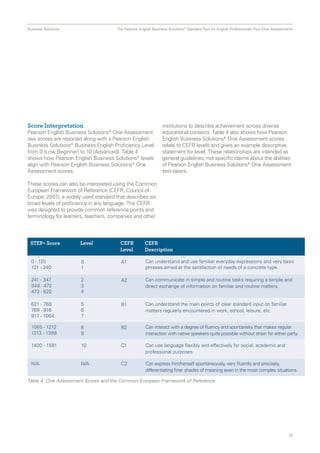
from 0 (Low Beginner) to 10 (Advanced). Table 4
shows how Pearson English Business Solutions* levels
align with Pearson English Business Solutions* One
Assessment scores.
These scores can also be interpreted using the Common
European Framework of Reference (CEFR, Council of
Europe, 2001), a widely used standard that describes six
broad levels of proficiency in any language. The CEFR
was designed to provide common reference points and
terminology for learners, teachers, companies and other
institutions to describe achievement across diverse
educational contexts. Table 4 also shows how Pearson
English Business Solutions* One Assessment scores
relate to CEFR levels and gives an example descriptive
statement for level. These relationships are intended as
general guidelines, not specific claims about the abilities
of Pearson English Business Solutions* One Assessment
test-takers.
STEP+ Score Level CEFR
Level
CEFR
Description
0 - 120
121 - 240
0
1
A1 Can understand and use familiar everyday expressions and very basic
phrases aimed at the satisfaction of needs of a concrete type.
241 - 347
348 - 472
473 - 620
2
3
4
A2 Can communicate in simple and routine tasks requiring a simple and
direct exchange of information on familiar and routine matters.
621 - 768
769 - 916
917 - 1064
5
6
7
B1 Can understand the main points of clear standard input on familiar
matters regularly encountered in work, school, leisure, etc.
1065 - 1212
1213 - 1399
8
9
B2 Can interact with a degree of fluency and spontaneity that makes regular
interaction with native speakers quite possible without strain for either party.
1400 - 1581 10 C1 Can use language flexibly and effectively for social, academic and
professional purposes.
N/A N/A C2 Can express him/herself spontaneously, very fluently and precisely,
differentiating finer shades of meaning even in the most complex situations.
Table 4. One Assessment Scores and the Common European Framework of Reference
Business Solutions  The Pearson English Business Solutions* Standard Test for English Professionals Plus (One Assessment)
16
As Pearson English Business Solutions* One Assessment
is continuously monitored, evaluated, and revised, validation
of the test is an ongoing process. The original test
development team was comprised of English language
teaching and assessment experts who drew on extensive
knowledge of the Common European Framework and
other standards to create items with appropriate content
and difficulty. In 2011, a respected external firm was
hired to perform a review of item performance and the
test overall; as a result, underper­forming items were
removed or revised in early 2012. In late 2012, the
speaking section of Pearson English Business Solutions*
One Assessment was revised significantly in order to
offer a more complete evaluation of speaking ability, with
more challenging questions and a more comprehensive
scoring process. To understand the consequences of the
changes to the test in early and late 2012, data from that
year was used to analyze test reliability and validity.
Study Design
Data on test reliability and validity was analyzed from
three samples:
– For overall test reliability and item analysis using the
Item Response Theory (IRT) model, test results were
used from a 3-week period in November and
December 2012 (N = 2,862).
– For test-retest reliability analysis, test results were
taken from May 2012 through March 2013 and
included those test-takers who took the test twice in
one day (N = 384).
– For the study on how test results related to other
constructs, participants (N = 62) were employed,
adult volunteers who took Pearson English Business
Solutions* One Assessment in October and November
of 2012. Participants completed a short survey with
demographic and other questions after they finished
the test. There were 16 men and 28 women in the
sample (18 did not state gender), with an average age
of 33 (range: 20-55 years). 9 native English speakers
were included in the validation study for comparison
purposes. Participants were from a variety of countries
in Europe, South America, and Asia, and had a range
of professions.
Reliability
Overall Test Reliability
As Pearson English Business Solutions* One Assessment
is a computer adaptive test with a large pool of potential
questions, it is not practical or useful to compute overall
test reliability metrics used in classical test theory (such
as Cronbach’s alpha). A modern alternative approach is
Item Response Theory (IRT), which considers the contri­
bution of each question to the overall test’s capacity to
give valid and reliable scores. IRT is “a diverse family of
[psychometric] models designed to represent the relation
between an individual’s item response and underlying
latent trait,” (Fraley, Waller and Brennan, 2000) that is
widely used in educational testing, and useful for modeling
communicative competence in English (a latent trait).
As IRT analysis is designed for tests that measure
a single latent variable, a factor analysis of principal
components (PCA) was first performed on the 4
Pearson English Business Solutions* One Assessment
subscores (Grammar, Listening, Reading, Speaking) to
ascertain unidimensionality across the test. As shown in
the screeplot presented in Figure 4, the analysis
indicated a single-factor solution, with the first factor
explaining 63% of the variance in subscores. A factor
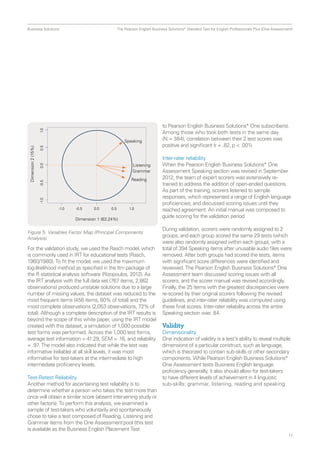
map of the variables showed that while all subscores
loaded positively on the first, primary factor, the
Speaking subscore also loaded positively on a second
factor (Figure 5).
Validation
2,000
Comp. 1 Comp. 2 Comp. 3 Comp. 4
4,0006,0008,00012,000
Variances
10,000
Figure 4. Screeplot of Principal Components using
One Assessment Section Scores
Business Solutions  The Pearson English Business Solutions* Standard Test for English Professionals Plus (One Assessment)
17
For the validation study, we used the Rasch model, which
is commonly used in IRT for educational tests (Rasch,
1960/1980). To fit the model, we used the maximum
log-likelihood method as specified in the ltm package of
the R statistical analysis software (Rizopoulos, 2012). As
the IRT analysis with the full data set (767 items, 2,862
observations) produced unstable solutions due to a large
number of missing values, the dataset was reduced to the
most frequent items (456 items, 60% of total) and the
most complete observations (2,053 observations, 72% of
total). Although a complete description of the IRT results is
beyond the scope of this white paper, using the IRT model
created with this dataset, a simulation of 1,000 possible
test forms was performed. Across the 1,000 test forms,
average test information = 41.29, SEM = .16, and reliability
= .97. The model also indicated that while the test was
informative (reliable) at all skill levels, it was most
informative for test-takers at the intermediate to high
intermediate proficiency levels.
Test-Retest Reliability
Another method for ascertaining test reliability is to
determine whether a person who takes the test more than
once will obtain a similar score (absent intervening study or
other factors). To perform this analysis, we examined a
sample of test-takers who voluntarily and spontaneously
chose to take a test composed of Reading, Listening and
Grammar items from the One Assessmentpool (this test
is available as the Business English Placement Test
to Pearson English Business Solutions* One subscribers).
Among those who took both tests in the same day
(N = 384), correlation between their 2 test scores was
positive and significant (r = .82, p  .001).
Inter-rater reliability
When the Pearson English Business Solutions* One
Assessment Speaking section was revised in September
2012, the team of expert scorers was extensively re-
trained to address the addition of open-ended questions.
As part of the training, scorers listened to sample
responses, which represented a range of English language
proficiencies, and discussed scoring issues until they
reached agreement. An initial manual was composed to
guide scoring for the validation period.
During validation, scorers were randomly assigned to 2
groups, and each group scored the same 29 tests (which
were also randomly assigned within each group), with a
total of 394 Speaking items after unusable audio files were
removed. After both groups had scored the tests, items
with significant score differences were identified and
reviewed. The Pearson English Business Solutions* One
Assessment team discussed scoring issues with all
scorers, and the scorer manual was revised accordingly.
Finally, the 25 items with the greatest discrepancies were
re-scored by their original scorers following the revised
guidelines, and inter-rater reliability was computed using
these final scores. Inter-rater reliability across the entire
Speaking section was .84.
Validity
Dimensionality
One indication of validity is a test’s ability to reveal multiple
dimensions of a particular construct, such as language,
which is theorized to contain sub-skills or other secondary
components. While Pearson English Business Solutions*
One Assessment tests Business English language
proficiency generally, it also should allow for test-takers
to have different levels of achievement in 4 linguistic
sub-skills: grammar, listening, reading and speaking.
Speaking
Listening
Grammar
Reading
Dimension 1 (63.24%)
-1.0
-1.0
-0.5
-0.5
0.0
0.0
0.5
0.5
1.0
1.0
Dimension2(15%)
Figure 5. Variables Factor Map (Principal Components
Analysis)
Business Solutions  The Pearson English Business Solutions* Standard Test for English Professionals Plus (One Assessment)
18
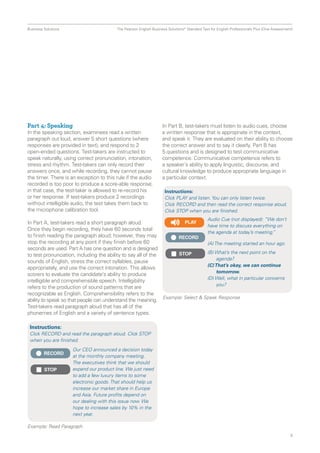
In Table 5, below, the correlations between sub-scores
on Pearson English Business Solutions* One Assessment
show that while each sub-score was positively and
significantly related to the other sub-scores, these relation­
ships were of moderate strength (Pearson’s r-values of .42
to .57). Higher r-values would suggest that Pearson English
Business Solutions* One Assessment sub-sections were
providing redundant information on highly similar constructs,
while lower r-values would indicate too much disparity in
sub-skills that are theoretically linked. It is also worth
noting that receptive skills (grammar, listening and reading)
are more strongly related to each other than they are to
productive skills (speaking), as would be expected in
standard models of language learning. Overall, the
moderate correlations demonstrated here support the
validity of Pearson English Business Solutions* One
Assessment as a Business English assessment with
the ability to discriminate between different secondary
language skills.
Although the number of native speakers in the validation
sample was small (n = 9), their performance on Pearson
English Business Solutions* One Assessment was high,
as expected. The average total Pearson English Business
Solutions* One Assessment score for native speakers was
1,414 (out of 1,581), with a standard deviation of 68 points.
For non-native speakers (n = 44), however, the average
was 1,012, with a much greater standard deviation of 300
points. These results, while preliminary, are evidence for
the construct validity of Pearson English Business
Solutions* One Assessment as a reflection of English
language ability. As we continue to work on validation,
more native speakers will be added to this sample.
Relationship to Self-Rating
As a further test of construct validity, we examined the
relationship between self-ratings and performance on
Pearson English Business Solutions* One Assessment.
While certainly imperfect, self-ratings are a reasonable way
to approximate the correspondence of a test with what it
measures, in domains where individuals can understand
their own proficiency and report it with some degree of
accuracy. Table 6 shows that among participants in the
validation sample who had both self-ratings and complete
Pearson English Business Solutions* One Assessment
scores (n = 44), there were moderate, positive correlations
between the 2 variables, both overall and for different
language skills (corresponding to sections within the test).
Listening Reading Speaking Total
Grammar .57 .57 .48 .84
Listening .53 .48 .81
Reading .42 .82
Speaking .70
STEP+ Section Correlation of Score
and Self Rating
Overall .53**
Grammar .38*
Listening .42*
Reading .45*
Speaking .65*
Table 5. Correlations for One Assessment Section and Total
Scores (N = 2,862)
Table 6. Correlation between One Assessment Section
Scores and Self-Ratings
* p  .01; ** p  .001
Business Solutions  The Pearson English Business Solutions* Standard Test for English Professionals Plus (One Assessment)
19
Relationship to Previous Study
The relationship of Pearson English Business Solutions*
One Assessment scores with previous English language
study was also examined as evidence of construct validity.
As language proficiency is a learned skill, the duration and
quality of previous study should have an impact on test
outcomes. We asked validation study participants to
report how much time they spent studying English in
various contexts, including primary, secondary, and
post-secondary education, as well as independently
through private instruction and self-study.
Table 7 shows that the self-reported average amount of
time (in years) spent studying English across all categories
was positively correlated with overall performance on
Pearson English Business Solutions* One Assessment,
Spearman’s r (36) = .46, p  .001. Time spent studying
English during post-secondary education, graduate school,
and private instruction were all significantly related to
Pearson English Business Solutions* One Assessment
scores, while English language study during primary and
secondary school, or through self-study (including via the
Internet) were not significantly related to Pearson English
Business Solutions* One Assessment scores.
Educational Context
(Years of English Study) N
Correlation with
STEP+ Score
Significantly Related to STEP+
Private Instruction 27 .48*
Lifetime Average
(All Instruction Types)
36 .46**
Post-secondary Education 36 .41*
Graduate Education 32 .39*
Not Significantly Related to STEP+
Internet-based Study
(not including GlobalEnglish* Edge) 28
.31
Primary Education 33 .28
Self-study 28 .20
Secondary Education 33 .15
Table 7. Previous Language Study Associated with STEP+ Scores
* p  .05; ** p  .01
Business Solutions  The Pearson English Business Solutions* Standard Test for English Professionals Plus (One Assessment)
20
In today’s global economy, Business English is
vital to organizational productivity. Companies and
institutions need to be able to assess Business
English as part of critical human capital decisions
such as recruiting the right person for the right job,
handling promotions and raises, ensuring personnel
skills development, and retaining employees.
Pearson English Business Solutions* robust, online
and adaptive assessment enables organizations to
evaluate and monitor the language skills of their
employees and job candidates with the end-goal
of increasing organizational communicative and
collaborative capacities.
When used as recommended, Pearson English
Business Solutions* One Assessment is an effective
diagnostic of Business English proficiency with
significant advantages over alternative assessments.
As an online test, it is always available and does
not require travel to a test center at a specific date
and time. Its breadth of question types allows for a
comprehensive picture of Business English capability,
yet because of its adaptive design, the test takes an
hour or less. Test-takers receive detailed feedback
on their performance, and Administrators can easily
access the score information and speech samples
that they need. Pearson English Business Solutions*
One Assessment is the best solution for companies
wanting fast, accurate, easy-to-implement evaluations
of Business English competence.
Conclusion
Business Solutions  The Pearson English Business Solutions* Standard Test for English Professionals Plus (One Assessment)
21
Pearson English Business Solutions* offers an innovative,
cloud-based suite of Business English solutions
specifically designed to produce immediate productivity
and performance gains enterprise-wide. In blending
the latest technology innovations with research on
how adults effectively acquire language, Pearson
English Business Solutions* provides a comprehensive
solution: formal and informal Business English learning,
instant on-the-job support for business tasks in English,
enterprise collaboration, mobile productivity, adaptive
Business English assessments, and the ability to
measure usage and proficiency improvements across
the company. Pearson English Business Solutions*
experts located throughout the world help companies
maximize the value of their investment through
custom analysis and recommendations, coordinated
program deployment, and ongoing support in 15
languages. Headquartered in Brisbane, California,
Pearson English Business Solutions* has partnered
with more than 500 of the world’s leading corporations
and enterprises, including BNP Paribas, Capgemini,
Deloitte, GlaxoSmithKline, Hilton, John Deere, Procter 
Gamble and Unisys. Pearson English Business Solutions*
is owned by Pearson, the world’s leading learning
company.
For more information visit www.english.com/business
Dr. Lindsay Oishi is the Associate Product Owner
for Progress and Measurement at Pearson English
Business Solutions* Corporation. She has a BA from
Georgetown University, an MA from Oxford University,
and a Ph.D. in Educational Psychology from Stanford
University. Dr. Oishi has worked on research, assess­
ment and evaluation in both academic settings, at
the Hasso Plattner Institute of Design and the Stanford
University Online High School, and in business
settings, at Hewlett-Packard and Adobe Systems.
She has written about online education and language
learning in publications for various organizations,
including the International Association for K-12 Online
Learning, the California Foreign Language Project,
and the American Educational Research Association.
Dr. Silvie Liao is the ESL/EFL Learning Specialist at
Pearson English Business Solutions Corporation.
She is an expert linguist, with an MA in TESOL from
Teachers College, Columbia University, and a Ph.D.
in Linguistics from the University of California,
Davis. Throughout her academic career, Dr. Liao has
published articles on second language acquisition,
sociolinguistics, language variation, and related topics.
She has over ten years of teaching experience with
students of all ages from diverse language and cultural
backgrounds.
About the Authors About Pearson English
Business Solutions*
1 
Dr. Kathleen Bailey is a professor of applied linguistics at the Monterey Institute of International Studies in Monterey, California. Director of the TESOL M.A.
program there for six years, she was also the Director of the Intensive English as a Second Language Program for 3 years. Dr. Bailey was the 1998-1999
president of TESOL. She has worked with language teachers in many countries and is the author or coauthor of numerous scholarly articles and books. Her
2 most recent books are Pursuing Professional Development: The Self as Source (co-authored with Andy Curtis and David Nunan, Heinle  Heinle, 2001)
and Practical English Language Teaching: Speaking (McGraw-Hill, 2004). Dr. Bailey earned her Ph.D. in applied linguistics from the University of California,
Los Angeles.
2 
Dr. Jean Turner is a professor of applied linguistics at the Monterey Institute of International Studies. She is a recognized expert in the field of English
language testing. She received her Ph.D. from the Graduate School of Language and Educational Linguistics, Monterey Institute of International Studies.
Business Solutions  White Paper — Improve Global Competitiveness by Solving the Hidden Business English Challenge
References
Canale, M. (1983). From communicative competence to communicative language pedagogy. In J. Richards
and R.W. Smith (Eds.), Language and Communication. New York: Longman.
Canale, M., Swain, M. (1980). Theoretical bases of communicative approaches to second language teaching
and testing. Applied Linguistics, 1, 1–47.
Council of Europe. (2001). Common European Framework of Reference for Languages: Learning, Teaching,
Assessment. Cambridge: Cambridge University Press. Council of Europe. (2009). Relating Language
Examinations to the Common European Framework of Reference for Languages: Learning, Teaching,
Assessment (CEFR): A Manual. Strasburg: Language Policy Division.
Hymes, D.H. (1966). Two types of linguistic relativity. In Bright, W. (Ed.), Sociolinguistics. The Hague: Mouton.
Fraley, R.C., Waller, N.G., and Brennan, K.A. (2000). An item response theory analysis of self-report measures
of adult attachment. Journal of Personality and Social Psychology, 78, 350–365.
Rasch, G. (1960/1980). Probabilistic models for some intelligence and attainment tests. Chicago: The University
of Chicago Press.
Rizopoulos, D. (2012). Latent Trait Models under IRT. Retrieved from http://rwiki.sciviews.org/doku.
php?id=packages:cran:ltm.
* Please be advised that GlobalEnglish has changed its name to Pearson English Business Solutions and the Edge service is now a part of the PEBS service, ‘One’.
All references to GlobalEnglish and Edge in this document should be viewed in light of this name change.
© 2014 Pearson English, a division of Pearson plc. All rights reserved.

STEP_Plus_Whitepaper

  • 1.
    The Pearson English BusinessSolutions* Standard Test for English Professionals Plus (One Assessment) Development and Validation Business Solutions
  • 2.
    Business Solutions The Pearson English Business Solutions* Standard Test for English Professionals Plus (One Assessment) 2 The purpose of this paper is to describe the Pearson English Business Solutions* Standard Test for English Professionals Plus (One Assessment), an online, computer adaptive test used by global professionals and international organizations to assess Business English proficiency. First, the paper details the design, development and administration of the test, including its four sections (grammar, reading, listening and speaking), the model of communicative competence on which it is based, and how scores are reported and interpreted. Second, the paper presents information on test reliability and validity, including an empirical validation study, inter- rater reliability, test-retest reliability, and Item Response Theory analyses. Lindsay Oishi Ph.D. Associate Product Owner – Progress and Measurement, Pearson English Silvie Liao Ph.D. ESL/EFL Learning Specialist Pearson English April 2013
  • 3.
    Business Solutions The Pearson English Business Solutions* Standard Test for English Professionals Plus (One Assessment) 3 Contents 4 Introduction 5 Test Description Design Administration Number of Items Format Test Construct 12 Content Design and Development Item Development and Vocabulary Selection Item Recording 14 Score Reporting Scores and Weights Score Use Score Interpretation 16 Validation Study Design Reliability Validity 20 Conclusion 21 About the Authors 21 About Pearson English Business Solutions* 22 References
  • 4.
    Business Solutions The Pearson English Business Solutions* Standard Test for English Professionals Plus (One Assessment) 4 Pearson English Business Solutions* One Assessment is an online test designed to evaluate an individual’s ability to understand and use English in global business contexts. It is intended for adults and takes about an hour to complete. The test can be taken at any time, at any location, and requires a computer with a standard Internet connection, audio output, and a microphone. A combination of computer and human scoring generates reliable, meaningful results that offer a valid snapshot of an individual’s proficiency in Business English. Business English proficiency is how well a person can comprehend and use English for common business purposes, and includes many aspects of general English language ability. Pearson English Business Solutions* One Assessment tests a person’s capacity to understand spoken and written English on general and business topics, as well as his or her ability to produce effective spoken English. Corporations and other institutions can use test scores to inform employment, training, and advancement decisions, as well as measure the outcomes of English language programs. Introduction
  • 5.
    Business Solutions The Pearson English Business Solutions* Standard Test for English Professionals Plus (One Assessment) 5 Design Pearson English Business Solutions* One Assessment is a computer-based adaptive test that selects a total of 66 questions for each individual test-taker out of an item bank that includes hundreds of questions. Individuals answer multiple-choice questions across four sections: Grammar, Listening, Reading and Speaking (the Speaking section also includes other question types, as shown in Table 1). In all sections except for the Speaking section, there are 5 difficulty levels of questions, and test-takers receive questions in pairs. All test-takers receive the first pair of questions at Level 3 (Intermediate). If they answer both questions correctly, the next pair of questions is at Level 4. If they answer 1 question correctly, the next pair of questions is at Level 3. If they miss both questions, the next pair of questions is at Level 2. This process of receiving easier or more difficult questions based on previous answers continues until the final Speaking section. The advantage of adaptive testing is that test-takers receive questions that are appropriate for their level. There are a total of eleven item types, as summarized in the table below. For every item in the Grammar, Listening and Reading sections, and for Question-Response items in the Speaking section, there are four possible answers and one correct answer. The other Speaking items (reading a paragraph out loud, and open-ended questions) are scored on a range of 0 to 5. Pearson English Business Solutions* One Assessment questions are oriented to the context of adults working in global business, and include functional language on standard topics such as meeting with colleagues, business socializing, telephoning, giving presentations and travel. Pearson English Business Solutions* One Assessment does not, however, test knowledge of specific industries, such as manufacturing or finance. Further, it is not limited to a particular geographic variant of English such as British or American English. Audio recordings by men and women feature native English speakers from multiple regions, providing a range of common accents and speaking styles. Scoring for the first 3 sections of Pearson English Business Solutions* One Assessment (Grammar, Listening and Reading) is by computer, while trained experts in English language and teaching evaluate the Speaking section. Scores are available on a secure website within 48 hours. The Pearson English Business Solutions* One Assessment report includes a raw score from 0 to 1,581, and an assignment to an English proficiency level from Beginner to Advanced (Levels 0 to 10). These assignments also correspond to levels of study in the Pearson English Business Solutions One online curriculum. Administration Administration of Pearson English Business Solutions* One Assessment is via an Internet-capable computer and generally takes about an hour. Test-takers are allowed a maximum of 52 minutes; however, it is not required to use all the time allotted. There are also untimed parts of the test, at the beginning and between each section, during which the test-taker can read instructions, calibrate computer settings, and prepare for the next section. Each section is timed separately and test-takers cannot use leftover time in one section in any other section. It is also not possible to go back and change any answer or review any previous part of the test. While it is recommended that people take the test in a single session, it is possible to take the test in multiple sittings, either through pausing the test or by exiting and returning later. This does not affect total time allowed, and the test resumes at the last point saved. Test Description Section Item Types Grammar Error Detection, Fill in the Blank, Question-Response Listening Describe Picture, Question- Response, Short Conversation, and Long Conversation Reading General Comprehension, Vocabulary Pronoun Reference Speaking Read a Paragraph, Question- Response (multiple choice with spoken answer), Question- Response (open-ended) Table 1. One Assessment Sections and Item Types
  • 6.
    Business Solutions The Pearson English Business Solutions* Standard Test for English Professionals Plus (One Assessment) 6 Number of Items The Pearson English Business Solutions* One Assessment computerized assessment system presents a total of 66 items in 4 separate sections to each test-taker. Items are drawn from a large item pool following an adaptive algorithm. Format This section provides a description of each test section as well as examples and explanations of the types of questions found in each. In all sections, questions are presented one at a time, with an answer required before the individual can move on to the next question. There are equal numbers of each type of item within a section; however, they can be presented at any time (i.e., items of one type are not grouped together). Part 1: Grammar The Grammar section includes two types of items: Error Detection and Fill in the Blank. In an Error Detection question, the test-taker reads a sentence that has 4 underlined components. Each underlined component is a potential answer choice, and the task is to select which answer is grammatically incorrect. For Fill in the Blank questions, the test-taker must choose the grammatically correct response out of the four potential answers, which are typically similar and represent common errors. Section Items Presented Time Allowed (minutes) Grammar 26 15 Listening 16 15 Reading 16 15 Speaking 8 7 Total 66 52 Table 2. One Assessment Sections, Items and Time Allowed Instructions: Read the question. Find the mistake. Click A, B, C or D to choose the answer. After he received his second promotion, John was the most happy employee in the company. (A) After (B) received (C) most happy (D) in Instructions: Read the question. Click A, B, C or D to choose the answer that best completes the sentence. A: Where was Elena this morning? She was supposed to meet us in the conference room at 10:00AM. B: She ___________ an important call regarding the Heyns account. (A) must take (B) had to take (C) would take (D) should take Example: Error Detection Example: Fill in the Blank
  • 7.
    Business Solutions The Pearson English Business Solutions* Standard Test for English Professionals Plus (One Assessment) 7 Part 2 Listening There are 4 item types in the Listening section: Picture, Question-Response, Short Conversation, and Long Conversation. In the Picture questions, the test-taker sees a photograph of a common social or business situation, and listens to 4 answer choices being read aloud. The answer choices are not displayed as text, and the test-taker can only listen to them twice. In Question-Response items, test-takers listen to a spoken question and select the written answer that is the most appropriate response. The question is not displayed as text and the test-taker can only listen to it twice. There is a photo along with the question to provide context, but it is not required to answer the question correctly. In Short and Long Conversation items, test-takers listen to a conversation between 2 people and then answer a written question about that conversation. The answer choices are also presented as text. Short conversations typically involve 1 sentence given by each person in the dialogue. Long conversations typically involve more than 1 sentence by each person in the dialogue. The conversations are not presented as text and test-takers can only listen to each item twice. Example: Picture Example: Question-Response Example: Short Conversation Instructions: Look at the picture. Click PLAY and listen (You can listen only twice). Click on A, B, C or D to select the best answer. Answer choices (not displayed): (A) The man is drinking coffee. (B) The women are shaking hands. (C)The man and woman are meeting at a restaurant. (D) The men are drinking wine. PLAY (A) (B) (C) (D) Instructions: Listen to the question and select the most appropriate response to that question. PLAY Question (not displayed): “How often do you play golf?” (A) Yes, let’s play next week. (B) I play about twice a week. (C) I’ll probably golf today. (D) I play golf with my dad. Instructions: Listen to the conversation between the 2 people. Then, answer the question about the conversation you heard. What does the man offer to do? (A) Ask the woman to call Ms. Jones immediately (B) Call Ms. Jones again the next day (C) Request that Ms. Jones return the call later (D) Invite the woman to call Ms. Jones in the morning PLAY
  • 8.
    Business Solutions The Pearson English Business Solutions* Standard Test for English Professionals Plus (One Assessment) 8 Part 3: Reading The Reading section is comprised of General Compre­ hension, Vocabulary, and Pronoun Reference items in approximately equal numbers. General Comprehension questions test a reader’s ability to recognize explicit information, make reasonable inferences from a text, and use this knowledge to select a written answer with appropriate semantic content in response to a written question. Vocabulary items require the test-taker to identify a synonymous word or phrase for a selected word from the reading passage, as it is used in that context. Finally, Pronoun Reference items ask the test-taker to identify the noun that a pronoun such as “it”, “he” or “they” refers to. In easier questions, this noun is clearly stated in the passage; in harder questions, the noun may have to be inferred from the text. As the reading passages are short but complete texts, typically a few hundred words long, there are 2 questions for each passage. Annual Sales Report Dear Dymo Employees, We had an excellent year at Dymo Industries. Total sales were US$550 million. This is an impressive growth of 10% compared to last year. There are a few important reasons for the large increase in sales. All the international divisions performed very well. The new sales training helped many of us promote our new line of toys. In addition, the creation of new products opened more markets for us. We continued last year to provide our customers with improved products. We all know that product enhancement can lead to larger market shares. Therefore, we hope to continue increasing our sales by creating better products in the coming year. Congratulations on your great teamwork! Jon Ngyuen Instructions: Read the document below. Then read the question. Click A, B, C or D to select the best answer. Which of the following is NOT a reason for Dymo Industries’ increased sales? (A) A new sales team (B) New markets (C) Sales training (D) Performance in international divisions Instructions: Look at the word that is highlighted in yellow in the reading passage. Choose the word or words that have the same meaning as the highlighted word. Look at the word “divisions” in the article. Which words or phrases mean the same thing as “divisions” in this article? (A) Disagreements within the company (B) Groups or teams within an organization (C) Sales methods (D) Individual employees Instructions: Instructions: Look at the pronoun that is highlighted in yellow in the reading passage. Choose the word or words that have the same meaning as the highlighted pronoun. The word or words will come before the highlighted pronoun. Some may even be in the previous sentence. Look at the word “this” in the article. What does the word “this” refer to in the previous sentence? (A) Total sales (B) Dymo Industries (C) Last year (D) Division performance Example: Reading Passage Example: General Comprehension Example: Vocabulary Example: Pronoun Reference
  • 9.
    Business Solutions The Pearson English Business Solutions* Standard Test for English Professionals Plus (One Assessment) 9 Part 4: Speaking In the speaking section, examinees read a written paragraph out loud, answer 5 short questions (where responses are provided in text), and respond to 2 open-ended questions. Test-takers are instructed to speak naturally, using correct pronunciation, intonation, stress and rhythm. Test-takers can only record their answers once, and while recording, they cannot pause the timer. There is an exception to this rule if the audio recorded is too poor to produce a score-able response; in that case, the test-taker is allowed to re-record his or her response. If test-takers produce 2 recordings without intelligible audio, the test takes them back to the microphone calibration tool. In Part A, test-takers read a short paragraph aloud. Once they begin recording, they have 60 seconds total to finish reading the paragraph aloud; however, they may stop the recording at any point if they finish before 60 seconds are used. Part A has one question and is designed to test pronunciation, including the ability to say all of the sounds of English, stress the correct syllables, pause appropriately, and use the correct intonation. This allows scorers to evaluate the candidate’s ability to produce intelligible and comprehen­sible speech. Intelligibility refers to the production of sound patterns that are recognizable as English. Comprehensibility refers to the ability to speak so that people can understand the meaning. Test-takers read paragraph aloud that has all of the phonemes of English and a variety of sentence types. In Part B, test-takers must listen to audio cues, choose a written response that is appropriate in the context, and speak it. They are evaluated on their ability to choose the correct answer and to say it clearly. Part B has 5 questions and is designed to test communicative competence. Communicative competence refers to a speaker’s ability to apply linguistic, discourse, and cultural knowledge to produce appropriate language in a particular context. Instructions: Click RECORD and read the paragraph aloud. Click STOP when you are finished. Instructions: Click PLAY and listen. You can only listen twice. Click RECORD and then read the correct response aloud. Click STOP when you are finished. RECORD RECORD STOP STOP Our CEO announced a decision today at the monthly company meeting. The executives think that we should expand our product line. We just need to add a few luxury items to some electronic goods. That should help us increase our market share in Europe and Asia. Future profits depend on our dealing with this issue now. We hope to increase sales by 10% in the next year. Audio Cue (not displayed): “We don’t have time to discuss everything on the agenda at today’s meeting.” (A) The meeting started an hour ago. (B) What’s the next point on the agenda? (C)That’s okay, we can continue tomorrow. (D) Well, what in particular concerns you? Example: Read Paragraph Example: Select Speak Response PLAY
  • 10.
    Business Solutions The Pearson English Business Solutions* Standard Test for English Professionals Plus (One Assessment) 10 Part C has two open-ended questions and is designed to test overall linguistic performance. Open-ended questions allow evaluation of how well test-takers construct a response to show evidence of their acquired knowledge. The first question requires only a beginner to low inter­­ mediate level of English to answer adequately, while the second question requires greater topic development and linguistic complexity, and demonstrates high inter­mediate to advanced ability when answered well. Test-takers are given 75 seconds for the low-level response and 105 seconds for the high-level response, including preparation time. Level Question Low What is your favorite hobby or activity? Why? High How does the Internet affect your life? What are the advantages and disadvantages of the Internet? Table 3. Examples of Open-ended Questions
  • 11.
    Business Solutions The Pearson English Business Solutions* Standard Test for English Professionals Plus (One Assessment) 11 Test Construct Canale and Swain’s (1980) model of communicative competence is one of the most influential frameworks in language testing, and argues for the need to assess grammatical, sociolinguistic, strategic and discourse competence. In this model, simple declarative knowledge of the language (e.g., being able to state the past tense of a verb) is not sufficient evidence of ability to actually use the language for real communicative purposes. Figure 1 presents the theoretical framework of this model. Tests of communicative competence not only reflect the need for language to be used interactively with other speakers of that language, but also incorporate authentic contexts, situations, and topics. In this way, tests based on this model aim to evaluate and an individual’s overall ability to communicate successfully in real-life situations. As evident in the figure above, communicative competence is a complex construct that involves more than 1 language skill (such as reading or speaking per se). To provide a strong evaluation of a candidate’s actual communicative ability, a test must therefore address multiple language skills. Figure 2 shows the language skills assessed in Pearson English Business Solutions One Assessment, and Figure 3 illustrates how each section within the test addresses multiple facets of communicative competence. As a comprehensive test, Pearson English Business Solutions One Assessment is designed to measure more than English language knowledge or general linguistic skill. Instead, it specifically targets the ability to effectively use English in global business contexts. – Vocabulary – Syntax – Morphology – Phonology – Sentence- grammar semantics – Morphosyn- tactic – Syntactic – Functional – Morphosyn- tactic – Syntactic – Functional Grammatical Grammatical Grammar Grammar Sociolinguistic Sociolinguistic Listening Listening Strategic Strategic Reading Reading Discourse Discourse Speaking Speaking Communicative Competence Communicative Competence Language skills Sociocultural rules of use (e.g. appropriateness of language use in context) – Comprehension – Inferences – Comprehension – Inferences Communication strategies (e.g. strategies used for unfamiliar topics or grammar forms) – Main Idea – Detail – Inferences – Vocabulary – Main Idea – Detail – Inferences – Vocabulary Cohesion and coherence (e.g. knowledge to understand/ produce texts in different genres – Topic development – Grammar control – Fluency – Pronunciation – Communicative effectiveness – Topic development – Grammar control – Fluency – Pronunciation – Communicative effectiveness Figure 1. One Assessment Test Construct Figure 2. Language Skills Assessed by One Assessment Figure 3. Communicative Competence and Language Skills Tested in One Assessment
  • 12.
    Business Solutions The Pearson English Business Solutions* Standard Test for English Professionals Plus (One Assessment) 12 The Pearson English Business Solutions* curriculum and One Assessment were developed by a team of experts with extensive training and experience teaching English as a foreign language, creating curricula, and writing coursework. Pearson English Business Solutions* Corporation’s world-class Academic Advisory Board, including four former presidents of International TESOL, aided this team. Dr. David Nunan, the senior academic advisor to Pearson English Business Solutions*, was director and chair of applied linguistics at the University of Hong Kong, and the president of International TESOL in 1999-2000. He has published over 100 books and articles in the areas of curriculum and materials develop­ ment, classroom-based research, and discourse analysis. For more information, visit www.globalenglish.com/ company/about/advisors. Item Development and Vocabulary Selection As Pearson English Business Solutions* One Assessment was designed to align with Pearson English Business Solutions* levels, test items were created with reference to content and learning objectives from the levels, which are available by request or through the Pearson English Business Solutions* website. The vocabulary used in Pearson English Business Solutions* One Assessment was also based on the Pearson English Business Solutions* courses, and test-writers were given a comprehensive list of 3,150 vocabulary words, as well as the syllabus for each level. For the grammar section, test writers were given the test framework, which listed grammatical features across different English proficiency levels, and were advised to provide a balance across the three types of grammar features: morpho-syntactic (e.g. articles “a/an/ the”), syntactic (e.g. use of a preposition), and functional (e.g. tense marking in conditionals). For the listening section, test writers were given a list of common categories of expressions in business communication (e.g. asking for and giving opinions). For the reading section, test writers worked from a list of genres common in the workplace, such as memos, forms, charts and announcements. Test items in the speaking section underwent a different procedure to create the three distinct sub-sections. In Part A (reading paragraphs), test writers were advised to write paragraphs that met the following criteria: – Length of 65 to 75 words – Score between 75 and 85 on the Flesch Reading Ease scale – Paragraph subjects related to business – Contain at least two instances of every phoneme in English – A variety of consonant clusters (e.g. the “lpf” in the word helpful) – Contain words with the phonemes /s/ and /z/ at the end (e.g. boss, was) – Some variation in sentence intonation (e.g., questions and statements) Items in Part B and Part C were adapted from questions in the Pearson English Business Solutions* curriculum. After those speaking items were drafted, 30 non-native speakers of English were recruited to take a pilot test. Based on their responses, items that seemed inappropriate, confusing or dependent on factors such as test-takers’ working experiences, regions or familiarity with certain English dialects were either eliminated or revised. Content Design and Development
  • 13.
    Business Solutions The Pearson English Business Solutions* Standard Test for English Professionals Plus (One Assessment) 13 Overall, the Pearson English Business Solutions* One Assessment item bank was designed so that any 2 randomly selected test forms would have similar test content and difficulty. The item bank has also undergone 2 thorough reviews. Dr. Kathleen Bailey1 , a recognized expert in English language testing, analyzed the item pool, checking item difficulty, and examining each item for its correspondence to the test construct. Dr. Jean Turner2 of the Monterey Institute, a recognized expert in English language testing, then conducted a statistical analysis of each test item’s discrimination (capacity to separate low-level examinees from high-level examinees, based on their overall pattern of responses). Items with appropriate item discrimination were retained in the Pearson English Business Solutions* One Assessment item bank, while others were revised under Dr. Bailey’s guidance. This effort reduced measurement error, increased reliability, and enhanced construct validity. Item Recording 16 professional voice talents (7 males and 9 females) were hired to record listening items and speaking prompts. All voice actors were native speakers with a range of common American and British English accents. Recordings were made in a professional recording studio in South San Francisco, California. An ESL expert was on site to ensure that the speed and pronunciation were clear, natural and appropriate to the items at different levels of difficulty.
  • 14.
    Business Solutions The Pearson English Business Solutions* Standard Test for English Professionals Plus (One Assessment) 14 Scoring for the first 3 sections of Pearson English Business Solutions* One Assessment (Grammar, Listening and Reading) is computerized, and when the audio files from the Speaking section have been scored (within 48 hours and often sooner), the test-taker receives an email with a link to a secure results web page. The Score Report includes: – A raw score from 0 to 1,581 – The test-taker’s recommended English level at which to begin studying (i.e., Level 3: High Beginner), and a description of that level – Performance (raw score) in each of the 4 sections: Grammar, Listening, Reading, and Speaking – A description of strengths and weaknesses by section Scores and Weights Pearson English Business Solutions* One Assessment has a score range of 0 to 1,581, calculated by summing the scores for each of the 4 sections. The maximum possible scores vary by section: 403 in Grammar, 392 in Listening, 395 in Reading and 391 in Speaking. The raw score for each section is the sum of points awarded for correct answers. Easier questions have lower point values, and harder questions have higher point values, with a range of 2.5 (easiest) to 27.5 (hardest) points awarded for a single correct answer. Total score for the grammar section is divided by 1.625 in order to provide an equal weighting of grammar with listening and reading sections (the grammar section has 26 questions, while the listening and reading sections each have 16). It is possible for a user to be awarded more points than the maximum section score. In this case, the section score is set to the maximum. The Speaking section is evaluated by trained, expert human scorers with extensive experience in teaching and assessing English as a foreign language. There are 3 parts to the Speaking section, with a different question type in each. Scoring for Part A of the Speaking section (reading a paragraph aloud) is holistic and depends on 2 key factors: intelligibility and comprehensibility. Scorers are instructed to think about the extent to which pronunciation and fluency problems reduce understanding of what the test-taker said, and to gauge how much any accent interferes with basic intelligibility. Each question is given a score of 0.0 to 5.0, with half-points allowed. Part B of the Speaking section contains multiple choice questions in increasing order of difficulty, and all questions are scored as correct or incorrect. Scoring for Part C of the Speaking section (2 open- ended questions) is holistic, but the rubric includes consideration for grammar and topical development (how completely and well the response answers the question), as well as pronunciation and fluency. Each of these four sub-scores is given a score of 0 to 5, with no half-points allowed. Score Use Pearson English Business Solutions* One Assessment is a diagnostic tool that can be used in multiple ways. First, it is a valid indicator of the most appropriate level for an individual to begin studying Business English. Second, organizations can use the test to estimate the overall Business English proficiency of a potential or current employee, and use this information to inform hiring, training and advancement decisions. Third, Pearson English Business Solutions* One Assessment can be used to ascertain progress in Business English after a significant and sustained period of study. Scores on Pearson English Business Solutions* One Assessment are valid and reliable indicators of Business English proficiency when the test is taken in compliance with recommended conditions. We strongly suggest that test-takers complete the test to the best of their ability, with no references, aides or outside help, in a single session. An organization that wishes to enforce these recommendations or require evidence of an individual’s identity or independent performance should set up a monitored, formal administration procedure or use a respected third party administrator. Score Reporting
  • 15.
    Business Solutions The Pearson English Business Solutions* Standard Test for English Professionals Plus (One Assessment) 15 Score Interpretation Pearson English Business Solutions* One Assessment raw scores are reported along with a Pearson English Business Solutions* Business English Proficiency Level from 0 (Low Beginner) to 10 (Advanced). Table 4 shows how Pearson English Business Solutions* levels align with Pearson English Business Solutions* One Assessment scores. These scores can also be interpreted using the Common European Framework of Reference (CEFR, Council of Europe, 2001), a widely used standard that describes six broad levels of proficiency in any language. The CEFR was designed to provide common reference points and terminology for learners, teachers, companies and other institutions to describe achievement across diverse educational contexts. Table 4 also shows how Pearson English Business Solutions* One Assessment scores relate to CEFR levels and gives an example descriptive statement for level. These relationships are intended as general guidelines, not specific claims about the abilities of Pearson English Business Solutions* One Assessment test-takers. STEP+ Score Level CEFR Level CEFR Description 0 - 120 121 - 240 0 1 A1 Can understand and use familiar everyday expressions and very basic phrases aimed at the satisfaction of needs of a concrete type. 241 - 347 348 - 472 473 - 620 2 3 4 A2 Can communicate in simple and routine tasks requiring a simple and direct exchange of information on familiar and routine matters. 621 - 768 769 - 916 917 - 1064 5 6 7 B1 Can understand the main points of clear standard input on familiar matters regularly encountered in work, school, leisure, etc. 1065 - 1212 1213 - 1399 8 9 B2 Can interact with a degree of fluency and spontaneity that makes regular interaction with native speakers quite possible without strain for either party. 1400 - 1581 10 C1 Can use language flexibly and effectively for social, academic and professional purposes. N/A N/A C2 Can express him/herself spontaneously, very fluently and precisely, differentiating finer shades of meaning even in the most complex situations. Table 4. One Assessment Scores and the Common European Framework of Reference
  • 16.
    Business Solutions The Pearson English Business Solutions* Standard Test for English Professionals Plus (One Assessment) 16 As Pearson English Business Solutions* One Assessment is continuously monitored, evaluated, and revised, validation of the test is an ongoing process. The original test development team was comprised of English language teaching and assessment experts who drew on extensive knowledge of the Common European Framework and other standards to create items with appropriate content and difficulty. In 2011, a respected external firm was hired to perform a review of item performance and the test overall; as a result, underper­forming items were removed or revised in early 2012. In late 2012, the speaking section of Pearson English Business Solutions* One Assessment was revised significantly in order to offer a more complete evaluation of speaking ability, with more challenging questions and a more comprehensive scoring process. To understand the consequences of the changes to the test in early and late 2012, data from that year was used to analyze test reliability and validity. Study Design Data on test reliability and validity was analyzed from three samples: – For overall test reliability and item analysis using the Item Response Theory (IRT) model, test results were used from a 3-week period in November and December 2012 (N = 2,862). – For test-retest reliability analysis, test results were taken from May 2012 through March 2013 and included those test-takers who took the test twice in one day (N = 384). – For the study on how test results related to other constructs, participants (N = 62) were employed, adult volunteers who took Pearson English Business Solutions* One Assessment in October and November of 2012. Participants completed a short survey with demographic and other questions after they finished the test. There were 16 men and 28 women in the sample (18 did not state gender), with an average age of 33 (range: 20-55 years). 9 native English speakers were included in the validation study for comparison purposes. Participants were from a variety of countries in Europe, South America, and Asia, and had a range of professions. Reliability Overall Test Reliability As Pearson English Business Solutions* One Assessment is a computer adaptive test with a large pool of potential questions, it is not practical or useful to compute overall test reliability metrics used in classical test theory (such as Cronbach’s alpha). A modern alternative approach is Item Response Theory (IRT), which considers the contri­ bution of each question to the overall test’s capacity to give valid and reliable scores. IRT is “a diverse family of [psychometric] models designed to represent the relation between an individual’s item response and underlying latent trait,” (Fraley, Waller and Brennan, 2000) that is widely used in educational testing, and useful for modeling communicative competence in English (a latent trait). As IRT analysis is designed for tests that measure a single latent variable, a factor analysis of principal components (PCA) was first performed on the 4 Pearson English Business Solutions* One Assessment subscores (Grammar, Listening, Reading, Speaking) to ascertain unidimensionality across the test. As shown in the screeplot presented in Figure 4, the analysis indicated a single-factor solution, with the first factor explaining 63% of the variance in subscores. A factor map of the variables showed that while all subscores loaded positively on the first, primary factor, the Speaking subscore also loaded positively on a second factor (Figure 5). Validation 2,000 Comp. 1 Comp. 2 Comp. 3 Comp. 4 4,0006,0008,00012,000 Variances 10,000 Figure 4. Screeplot of Principal Components using One Assessment Section Scores
  • 17.
    Business Solutions The Pearson English Business Solutions* Standard Test for English Professionals Plus (One Assessment) 17 For the validation study, we used the Rasch model, which is commonly used in IRT for educational tests (Rasch, 1960/1980). To fit the model, we used the maximum log-likelihood method as specified in the ltm package of the R statistical analysis software (Rizopoulos, 2012). As the IRT analysis with the full data set (767 items, 2,862 observations) produced unstable solutions due to a large number of missing values, the dataset was reduced to the most frequent items (456 items, 60% of total) and the most complete observations (2,053 observations, 72% of total). Although a complete description of the IRT results is beyond the scope of this white paper, using the IRT model created with this dataset, a simulation of 1,000 possible test forms was performed. Across the 1,000 test forms, average test information = 41.29, SEM = .16, and reliability = .97. The model also indicated that while the test was informative (reliable) at all skill levels, it was most informative for test-takers at the intermediate to high intermediate proficiency levels. Test-Retest Reliability Another method for ascertaining test reliability is to determine whether a person who takes the test more than once will obtain a similar score (absent intervening study or other factors). To perform this analysis, we examined a sample of test-takers who voluntarily and spontaneously chose to take a test composed of Reading, Listening and Grammar items from the One Assessmentpool (this test is available as the Business English Placement Test to Pearson English Business Solutions* One subscribers). Among those who took both tests in the same day (N = 384), correlation between their 2 test scores was positive and significant (r = .82, p .001). Inter-rater reliability When the Pearson English Business Solutions* One Assessment Speaking section was revised in September 2012, the team of expert scorers was extensively re- trained to address the addition of open-ended questions. As part of the training, scorers listened to sample responses, which represented a range of English language proficiencies, and discussed scoring issues until they reached agreement. An initial manual was composed to guide scoring for the validation period. During validation, scorers were randomly assigned to 2 groups, and each group scored the same 29 tests (which were also randomly assigned within each group), with a total of 394 Speaking items after unusable audio files were removed. After both groups had scored the tests, items with significant score differences were identified and reviewed. The Pearson English Business Solutions* One Assessment team discussed scoring issues with all scorers, and the scorer manual was revised accordingly. Finally, the 25 items with the greatest discrepancies were re-scored by their original scorers following the revised guidelines, and inter-rater reliability was computed using these final scores. Inter-rater reliability across the entire Speaking section was .84. Validity Dimensionality One indication of validity is a test’s ability to reveal multiple dimensions of a particular construct, such as language, which is theorized to contain sub-skills or other secondary components. While Pearson English Business Solutions* One Assessment tests Business English language proficiency generally, it also should allow for test-takers to have different levels of achievement in 4 linguistic sub-skills: grammar, listening, reading and speaking. Speaking Listening Grammar Reading Dimension 1 (63.24%) -1.0 -1.0 -0.5 -0.5 0.0 0.0 0.5 0.5 1.0 1.0 Dimension2(15%) Figure 5. Variables Factor Map (Principal Components Analysis)
  • 18.
    Business Solutions The Pearson English Business Solutions* Standard Test for English Professionals Plus (One Assessment) 18 In Table 5, below, the correlations between sub-scores on Pearson English Business Solutions* One Assessment show that while each sub-score was positively and significantly related to the other sub-scores, these relation­ ships were of moderate strength (Pearson’s r-values of .42 to .57). Higher r-values would suggest that Pearson English Business Solutions* One Assessment sub-sections were providing redundant information on highly similar constructs, while lower r-values would indicate too much disparity in sub-skills that are theoretically linked. It is also worth noting that receptive skills (grammar, listening and reading) are more strongly related to each other than they are to productive skills (speaking), as would be expected in standard models of language learning. Overall, the moderate correlations demonstrated here support the validity of Pearson English Business Solutions* One Assessment as a Business English assessment with the ability to discriminate between different secondary language skills. Although the number of native speakers in the validation sample was small (n = 9), their performance on Pearson English Business Solutions* One Assessment was high, as expected. The average total Pearson English Business Solutions* One Assessment score for native speakers was 1,414 (out of 1,581), with a standard deviation of 68 points. For non-native speakers (n = 44), however, the average was 1,012, with a much greater standard deviation of 300 points. These results, while preliminary, are evidence for the construct validity of Pearson English Business Solutions* One Assessment as a reflection of English language ability. As we continue to work on validation, more native speakers will be added to this sample. Relationship to Self-Rating As a further test of construct validity, we examined the relationship between self-ratings and performance on Pearson English Business Solutions* One Assessment. While certainly imperfect, self-ratings are a reasonable way to approximate the correspondence of a test with what it measures, in domains where individuals can understand their own proficiency and report it with some degree of accuracy. Table 6 shows that among participants in the validation sample who had both self-ratings and complete Pearson English Business Solutions* One Assessment scores (n = 44), there were moderate, positive correlations between the 2 variables, both overall and for different language skills (corresponding to sections within the test). Listening Reading Speaking Total Grammar .57 .57 .48 .84 Listening .53 .48 .81 Reading .42 .82 Speaking .70 STEP+ Section Correlation of Score and Self Rating Overall .53** Grammar .38* Listening .42* Reading .45* Speaking .65* Table 5. Correlations for One Assessment Section and Total Scores (N = 2,862) Table 6. Correlation between One Assessment Section Scores and Self-Ratings * p .01; ** p .001
  • 19.
    Business Solutions The Pearson English Business Solutions* Standard Test for English Professionals Plus (One Assessment) 19 Relationship to Previous Study The relationship of Pearson English Business Solutions* One Assessment scores with previous English language study was also examined as evidence of construct validity. As language proficiency is a learned skill, the duration and quality of previous study should have an impact on test outcomes. We asked validation study participants to report how much time they spent studying English in various contexts, including primary, secondary, and post-secondary education, as well as independently through private instruction and self-study. Table 7 shows that the self-reported average amount of time (in years) spent studying English across all categories was positively correlated with overall performance on Pearson English Business Solutions* One Assessment, Spearman’s r (36) = .46, p .001. Time spent studying English during post-secondary education, graduate school, and private instruction were all significantly related to Pearson English Business Solutions* One Assessment scores, while English language study during primary and secondary school, or through self-study (including via the Internet) were not significantly related to Pearson English Business Solutions* One Assessment scores. Educational Context (Years of English Study) N Correlation with STEP+ Score Significantly Related to STEP+ Private Instruction 27 .48* Lifetime Average (All Instruction Types) 36 .46** Post-secondary Education 36 .41* Graduate Education 32 .39* Not Significantly Related to STEP+ Internet-based Study (not including GlobalEnglish* Edge) 28 .31 Primary Education 33 .28 Self-study 28 .20 Secondary Education 33 .15 Table 7. Previous Language Study Associated with STEP+ Scores * p .05; ** p .01
  • 20.
    Business Solutions The Pearson English Business Solutions* Standard Test for English Professionals Plus (One Assessment) 20 In today’s global economy, Business English is vital to organizational productivity. Companies and institutions need to be able to assess Business English as part of critical human capital decisions such as recruiting the right person for the right job, handling promotions and raises, ensuring personnel skills development, and retaining employees. Pearson English Business Solutions* robust, online and adaptive assessment enables organizations to evaluate and monitor the language skills of their employees and job candidates with the end-goal of increasing organizational communicative and collaborative capacities. When used as recommended, Pearson English Business Solutions* One Assessment is an effective diagnostic of Business English proficiency with significant advantages over alternative assessments. As an online test, it is always available and does not require travel to a test center at a specific date and time. Its breadth of question types allows for a comprehensive picture of Business English capability, yet because of its adaptive design, the test takes an hour or less. Test-takers receive detailed feedback on their performance, and Administrators can easily access the score information and speech samples that they need. Pearson English Business Solutions* One Assessment is the best solution for companies wanting fast, accurate, easy-to-implement evaluations of Business English competence. Conclusion
  • 21.
    Business Solutions The Pearson English Business Solutions* Standard Test for English Professionals Plus (One Assessment) 21 Pearson English Business Solutions* offers an innovative, cloud-based suite of Business English solutions specifically designed to produce immediate productivity and performance gains enterprise-wide. In blending the latest technology innovations with research on how adults effectively acquire language, Pearson English Business Solutions* provides a comprehensive solution: formal and informal Business English learning, instant on-the-job support for business tasks in English, enterprise collaboration, mobile productivity, adaptive Business English assessments, and the ability to measure usage and proficiency improvements across the company. Pearson English Business Solutions* experts located throughout the world help companies maximize the value of their investment through custom analysis and recommendations, coordinated program deployment, and ongoing support in 15 languages. Headquartered in Brisbane, California, Pearson English Business Solutions* has partnered with more than 500 of the world’s leading corporations and enterprises, including BNP Paribas, Capgemini, Deloitte, GlaxoSmithKline, Hilton, John Deere, Procter Gamble and Unisys. Pearson English Business Solutions* is owned by Pearson, the world’s leading learning company. For more information visit www.english.com/business Dr. Lindsay Oishi is the Associate Product Owner for Progress and Measurement at Pearson English Business Solutions* Corporation. She has a BA from Georgetown University, an MA from Oxford University, and a Ph.D. in Educational Psychology from Stanford University. Dr. Oishi has worked on research, assess­ ment and evaluation in both academic settings, at the Hasso Plattner Institute of Design and the Stanford University Online High School, and in business settings, at Hewlett-Packard and Adobe Systems. She has written about online education and language learning in publications for various organizations, including the International Association for K-12 Online Learning, the California Foreign Language Project, and the American Educational Research Association. Dr. Silvie Liao is the ESL/EFL Learning Specialist at Pearson English Business Solutions Corporation. She is an expert linguist, with an MA in TESOL from Teachers College, Columbia University, and a Ph.D. in Linguistics from the University of California, Davis. Throughout her academic career, Dr. Liao has published articles on second language acquisition, sociolinguistics, language variation, and related topics. She has over ten years of teaching experience with students of all ages from diverse language and cultural backgrounds. About the Authors About Pearson English Business Solutions* 1  Dr. Kathleen Bailey is a professor of applied linguistics at the Monterey Institute of International Studies in Monterey, California. Director of the TESOL M.A. program there for six years, she was also the Director of the Intensive English as a Second Language Program for 3 years. Dr. Bailey was the 1998-1999 president of TESOL. She has worked with language teachers in many countries and is the author or coauthor of numerous scholarly articles and books. Her 2 most recent books are Pursuing Professional Development: The Self as Source (co-authored with Andy Curtis and David Nunan, Heinle Heinle, 2001) and Practical English Language Teaching: Speaking (McGraw-Hill, 2004). Dr. Bailey earned her Ph.D. in applied linguistics from the University of California, Los Angeles. 2  Dr. Jean Turner is a professor of applied linguistics at the Monterey Institute of International Studies. She is a recognized expert in the field of English language testing. She received her Ph.D. from the Graduate School of Language and Educational Linguistics, Monterey Institute of International Studies.
  • 22.
    Business Solutions White Paper — Improve Global Competitiveness by Solving the Hidden Business English Challenge References Canale, M. (1983). From communicative competence to communicative language pedagogy. In J. Richards and R.W. Smith (Eds.), Language and Communication. New York: Longman. Canale, M., Swain, M. (1980). Theoretical bases of communicative approaches to second language teaching and testing. Applied Linguistics, 1, 1–47. Council of Europe. (2001). Common European Framework of Reference for Languages: Learning, Teaching, Assessment. Cambridge: Cambridge University Press. Council of Europe. (2009). Relating Language Examinations to the Common European Framework of Reference for Languages: Learning, Teaching, Assessment (CEFR): A Manual. Strasburg: Language Policy Division. Hymes, D.H. (1966). Two types of linguistic relativity. In Bright, W. (Ed.), Sociolinguistics. The Hague: Mouton. Fraley, R.C., Waller, N.G., and Brennan, K.A. (2000). An item response theory analysis of self-report measures of adult attachment. Journal of Personality and Social Psychology, 78, 350–365. Rasch, G. (1960/1980). Probabilistic models for some intelligence and attainment tests. Chicago: The University of Chicago Press. Rizopoulos, D. (2012). Latent Trait Models under IRT. Retrieved from http://rwiki.sciviews.org/doku. php?id=packages:cran:ltm. * Please be advised that GlobalEnglish has changed its name to Pearson English Business Solutions and the Edge service is now a part of the PEBS service, ‘One’. All references to GlobalEnglish and Edge in this document should be viewed in light of this name change. © 2014 Pearson English, a division of Pearson plc. All rights reserved.