INTRODUCTION
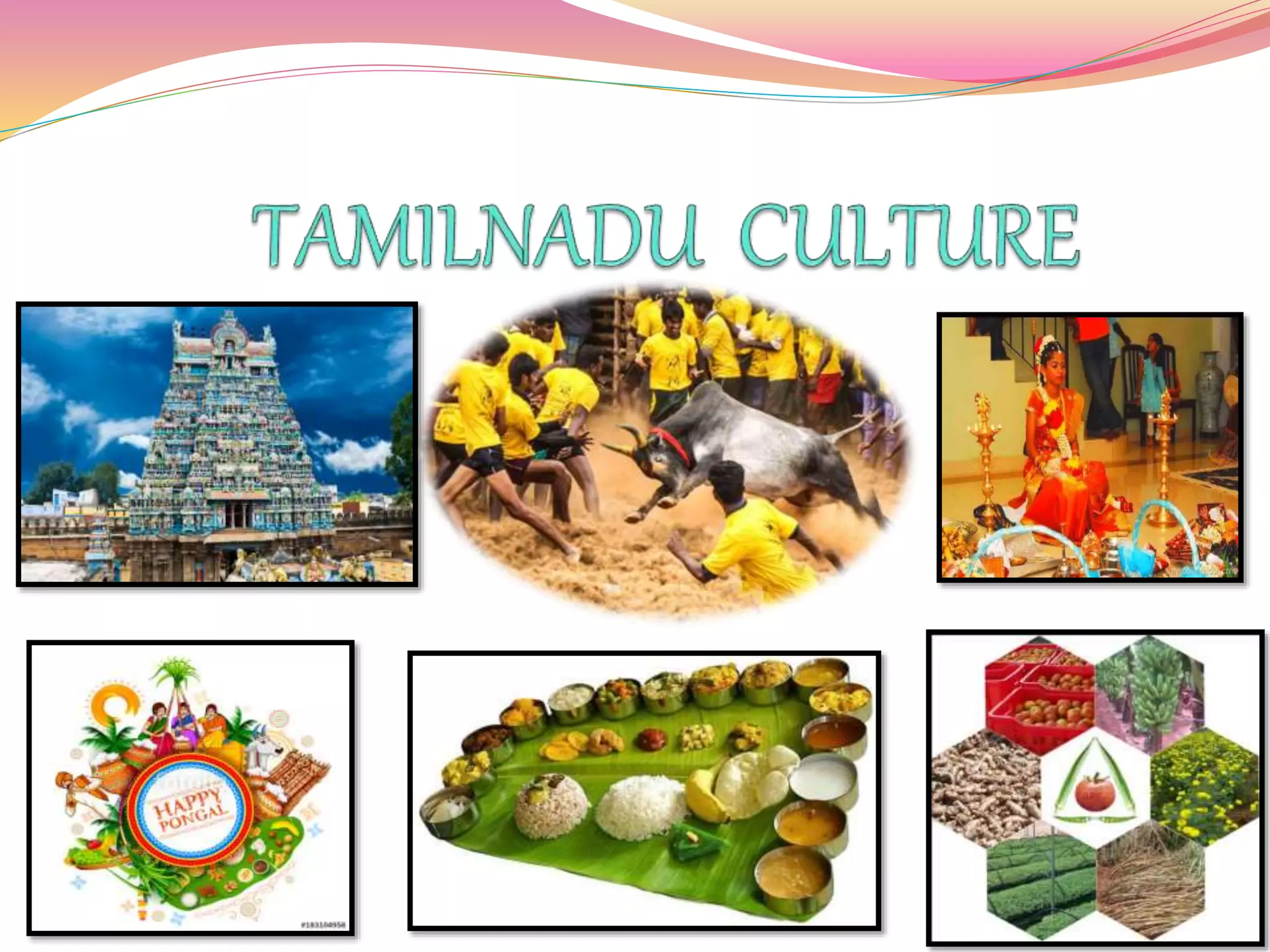
 Tamil Nadu is an enchanting and ancient land in the
extreme south of peninsular India. Tamil Nadu is the
eleventh largest state in India.
Tamil is the official language and it is the worlds first
language.
Tamil culture is still followed by many peoples the
culture like cuisine, temple, dress, games, festivals, etc.
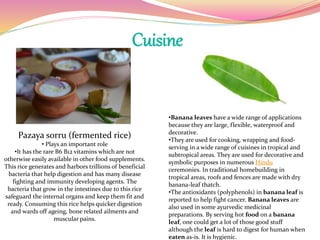
Cuisine
Pazaya sorru (fermented rice)
• Plays an important role
•It has the rare B6 B12 vitamins which are not
otherwise easily available in other food supplements.
This rice generates and harbors trillions of beneficial
bacteria that help digestion and has many disease
fighting and immunity developing agents. The
bacteria that grow in the intestines due to this rice
safeguard the internal organs and keep them fit and
ready. Consuming this rice helps quicker digestion
and wards off ageing, bone related ailments and
muscular pains.
•Banana leaves have a wide range of applications
because they are large, flexible, waterproof and
decorative.
•They are used for cooking, wrapping and food-
serving in a wide range of cuisines in tropical and
subtropical areas. They are used for decorative and
symbolic purposes in numerous Hindu
ceremonies. In traditional homebuilding in
tropical areas, roofs and fences are made with dry
banana-leaf thatch.
•The antioxidants (polyphenols) in banana leaf is
reported to help fight cancer. Banana leaves are
also used in some ayurvedic medicinal
preparations. By serving hot food on a banana
leaf, one could get a lot of those good stuff
although the leaf is hard to digest for human when
eaten as-is. It is hygienic.
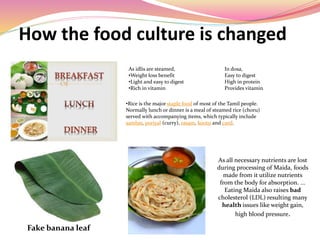
How the food culture is changed
As idlis are steamed, In dosa,
•Weight loss benefit Easy to digest
•Light and easy to digest High in protein
•Rich in vitamin Provides vitamin
•Rice is the major staple food of most of the Tamil people.
Normally lunch or dinner is a meal of steamed rice (choru)
served with accompanying items, which typically include
sambar, poriyal (curry), rasam, kootu and curd.
Fake banana leaf
As all necessary nutrients are lost
during processing of Maida, foods
made from it utilize nutrients
from the body for absorption. ...
Eating Maida also raises bad
cholesterol (LDL) resulting many
health issues like weight gain,
high blood pressure.
Temple
In the Indian state of Tamil Nadu, known as the Land of Temples. Nearly 33,000
ancient temples, many at least 800 to 1400 years old, are found scattered all over the
state. As per Tamilnadu Hindu Endowments Board, there are 38615 Temples. Most of
the largest hindu Temples reside here.[1] Studded with complex architecture, variety of
sculptures, and rich inscriptions, the temples remain the very essence of the culture
and heritage of Tamil land, with historical records dating back to at least 3,000 years.
The changes in temple culture
 Not praying to god but just came to gossip or by
parents compulsion
 Taking selfies or picture
 2 to 5 mins spending time with god because of our
busy schedule
 Not believing god
 No mariages has been celebrated in temple as all wants
to have their function in their own desired way like
halls, beaches, etc.
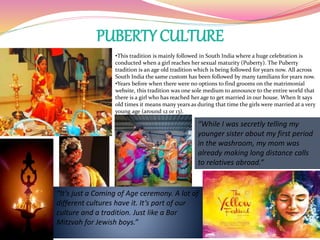
PUBERTY CULTURE
•This tradition is mainly followed in South India where a huge celebration is
conducted when a girl reaches her sexual maturity (Puberty). The Puberty
tradition is an age old tradition which is being followed for years now. All across
South India the same custom has been followed by many tamilians for years now.
•Years before when there were no options to find grooms on the matrimonial
website, this tradition was one sole medium to announce to the entire world that
there is a girl who has reached her age to get married in our house. When It says
old times it means many years as during that time the girls were married at a very
young age (around 12 or 13).
“It’s just a Coming of Age ceremony. A lot of
different cultures have it. It’s part of our
culture and a tradition. Just like a Bar
Mitzvah for Jewish boys.”
“While I was secretly telling my
younger sister about my first period
in the washroom, my mom was
already making long distance calls
to relatives abroad.”
Changes in puberty culture
 Nowadays parents don’t want their daughter first
period to tell everyone as their living a nuclear life.
 It may also be girls wish to their parents not tell about
her first period.
 Don’t believe in rituals.
 Highly educated.
PONGAL (Festival)
•The day preceding Pongal is called Bhogi.
•Discard old belongings and celebrate new
possessions.
•Light a bonfire in order to burn the discards.
Houses are cleaned, painted and decorated.
• The horns of oxen and buffaloes are painted.
• Here farmers keep medicinal herb corner of
each fields.
•The origins of the Thai Pongal festival
may date to more than 1000 years ago.
•Puthiyeedu is believed to represent the first
harvest of the year.
• Tamil people refer to Pongal as "Tamizhar
Thirunaal,“
• During the festival, milk is cooked in a
vessel. When it starts to bubble and
overflows out of the vessel, freshly harvested
rice grains are added to the pot. At the same
time other participants blow a conch called
the sanggu and shout "Pongalo Pongal
Tamilians decorate their homes with banana
and mango leaves and embellish the floor with
decorative patterns drawn using rice flour.[5]
kolams/rangolis are drawn on doorsteps.
HAPPY PONGAL
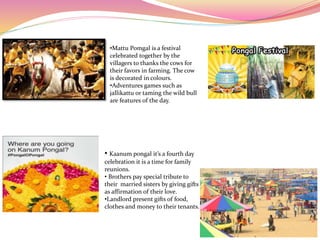
• Kaanum pongal it’s a fourth day
celebration it is a time for family
reunions.
• Brothers pay special tribute to
their married sisters by giving gifts
as affirmation of their love.
•Landlord present gifts of food,
clothes and money to their tenants.
•Mattu Pomgal is a festival
celebrated together by the
villagers to thanks the cows for
their favors in farming. The cow
is decorated in colours.
•Adventures games such as
jallikattu or taming the wild bull
are features of the day.
Changes in pongal culture
 Nowadays people don’t celebrate as they have been
migrated to city life and forgotten their culture
 Don’t want to attach with their families as they are
living a nuclear life.
 Busy with their own life.
 In pongal fest people nowadays don’t put rangoli
rather than they sticks stickers of rangoli.
JALLIKATTU CULTURE
 Jallikattu (or sallikkattu), also known as ta and
manju virattu[2], is a traditional spectacle in which a
Bos indicus bull, such as the Pulikulam or Kangayam
breeds. 3rd day mattu pongal.
 Puja to this bull with alangaram and released first into
the area , is released into a crowd of people, and
multiple human participants attempt to grab the large
hump on the bull's back with both arms and hang on to
it while the bull attempts to escape.
 The player reverse it as a divine and never attempts to
embrace it.
VAADI VAASAL
The picture speaks a lot, look at the Visnava symbo and
temple in walls
AGRICULTURE
During the Sangam age, 500 BCE – 300 CE, agriculture was the main vocation of the
Tamils.[1] It was considered a necessity for life, and hence was treated as the foremost
among all occupations. The farmers or the Ulavar were placed right at the top of the
social classification. As they were the producers of food grains, they lived with self-
respect. Agriculture during the early stages of Sangam period was primitive,[1] but it
progressively got more efficient with improvements in irrigation, ploughing,
manuring, storage and distribution. The ancient Tamils were aware of the different
varieties of soil, the kinds of crops that can be grown on them and the various
irrigation schemes suitable for a given region.
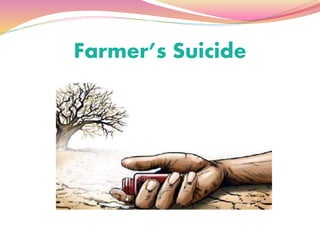
Farmer’s Suicide
Thank you
Presented by
Preksha
Aishwarya
Ankitha
Aakansha
Gayathri
Jenifer

Tamilnadu culture

  • 2.
    INTRODUCTION  Tamil Naduis an enchanting and ancient land in the extreme south of peninsular India. Tamil Nadu is the eleventh largest state in India. Tamil is the official language and it is the worlds first language. Tamil culture is still followed by many peoples the culture like cuisine, temple, dress, games, festivals, etc.
  • 3.
    Cuisine Pazaya sorru (fermentedrice) • Plays an important role •It has the rare B6 B12 vitamins which are not otherwise easily available in other food supplements. This rice generates and harbors trillions of beneficial bacteria that help digestion and has many disease fighting and immunity developing agents. The bacteria that grow in the intestines due to this rice safeguard the internal organs and keep them fit and ready. Consuming this rice helps quicker digestion and wards off ageing, bone related ailments and muscular pains. •Banana leaves have a wide range of applications because they are large, flexible, waterproof and decorative. •They are used for cooking, wrapping and food- serving in a wide range of cuisines in tropical and subtropical areas. They are used for decorative and symbolic purposes in numerous Hindu ceremonies. In traditional homebuilding in tropical areas, roofs and fences are made with dry banana-leaf thatch. •The antioxidants (polyphenols) in banana leaf is reported to help fight cancer. Banana leaves are also used in some ayurvedic medicinal preparations. By serving hot food on a banana leaf, one could get a lot of those good stuff although the leaf is hard to digest for human when eaten as-is. It is hygienic.
  • 4.
    How the foodculture is changed As idlis are steamed, In dosa, •Weight loss benefit Easy to digest •Light and easy to digest High in protein •Rich in vitamin Provides vitamin •Rice is the major staple food of most of the Tamil people. Normally lunch or dinner is a meal of steamed rice (choru) served with accompanying items, which typically include sambar, poriyal (curry), rasam, kootu and curd. Fake banana leaf As all necessary nutrients are lost during processing of Maida, foods made from it utilize nutrients from the body for absorption. ... Eating Maida also raises bad cholesterol (LDL) resulting many health issues like weight gain, high blood pressure.
  • 5.
    Temple In the Indianstate of Tamil Nadu, known as the Land of Temples. Nearly 33,000 ancient temples, many at least 800 to 1400 years old, are found scattered all over the state. As per Tamilnadu Hindu Endowments Board, there are 38615 Temples. Most of the largest hindu Temples reside here.[1] Studded with complex architecture, variety of sculptures, and rich inscriptions, the temples remain the very essence of the culture and heritage of Tamil land, with historical records dating back to at least 3,000 years.
  • 6.
    The changes intemple culture  Not praying to god but just came to gossip or by parents compulsion  Taking selfies or picture  2 to 5 mins spending time with god because of our busy schedule  Not believing god  No mariages has been celebrated in temple as all wants to have their function in their own desired way like halls, beaches, etc.
  • 7.
    PUBERTY CULTURE •This traditionis mainly followed in South India where a huge celebration is conducted when a girl reaches her sexual maturity (Puberty). The Puberty tradition is an age old tradition which is being followed for years now. All across South India the same custom has been followed by many tamilians for years now. •Years before when there were no options to find grooms on the matrimonial website, this tradition was one sole medium to announce to the entire world that there is a girl who has reached her age to get married in our house. When It says old times it means many years as during that time the girls were married at a very young age (around 12 or 13). “It’s just a Coming of Age ceremony. A lot of different cultures have it. It’s part of our culture and a tradition. Just like a Bar Mitzvah for Jewish boys.” “While I was secretly telling my younger sister about my first period in the washroom, my mom was already making long distance calls to relatives abroad.”
  • 8.
    Changes in pubertyculture  Nowadays parents don’t want their daughter first period to tell everyone as their living a nuclear life.  It may also be girls wish to their parents not tell about her first period.  Don’t believe in rituals.  Highly educated.
  • 9.
    PONGAL (Festival) •The daypreceding Pongal is called Bhogi. •Discard old belongings and celebrate new possessions. •Light a bonfire in order to burn the discards. Houses are cleaned, painted and decorated. • The horns of oxen and buffaloes are painted. • Here farmers keep medicinal herb corner of each fields. •The origins of the Thai Pongal festival may date to more than 1000 years ago. •Puthiyeedu is believed to represent the first harvest of the year. • Tamil people refer to Pongal as "Tamizhar Thirunaal,“ • During the festival, milk is cooked in a vessel. When it starts to bubble and overflows out of the vessel, freshly harvested rice grains are added to the pot. At the same time other participants blow a conch called the sanggu and shout "Pongalo Pongal Tamilians decorate their homes with banana and mango leaves and embellish the floor with decorative patterns drawn using rice flour.[5] kolams/rangolis are drawn on doorsteps. HAPPY PONGAL
  • 10.
    • Kaanum pongalit’s a fourth day celebration it is a time for family reunions. • Brothers pay special tribute to their married sisters by giving gifts as affirmation of their love. •Landlord present gifts of food, clothes and money to their tenants. •Mattu Pomgal is a festival celebrated together by the villagers to thanks the cows for their favors in farming. The cow is decorated in colours. •Adventures games such as jallikattu or taming the wild bull are features of the day.
  • 11.
    Changes in pongalculture  Nowadays people don’t celebrate as they have been migrated to city life and forgotten their culture  Don’t want to attach with their families as they are living a nuclear life.  Busy with their own life.  In pongal fest people nowadays don’t put rangoli rather than they sticks stickers of rangoli.
  • 12.
    JALLIKATTU CULTURE  Jallikattu(or sallikkattu), also known as ta and manju virattu[2], is a traditional spectacle in which a Bos indicus bull, such as the Pulikulam or Kangayam breeds. 3rd day mattu pongal.  Puja to this bull with alangaram and released first into the area , is released into a crowd of people, and multiple human participants attempt to grab the large hump on the bull's back with both arms and hang on to it while the bull attempts to escape.  The player reverse it as a divine and never attempts to embrace it. VAADI VAASAL The picture speaks a lot, look at the Visnava symbo and temple in walls
  • 13.
    AGRICULTURE During the Sangamage, 500 BCE – 300 CE, agriculture was the main vocation of the Tamils.[1] It was considered a necessity for life, and hence was treated as the foremost among all occupations. The farmers or the Ulavar were placed right at the top of the social classification. As they were the producers of food grains, they lived with self- respect. Agriculture during the early stages of Sangam period was primitive,[1] but it progressively got more efficient with improvements in irrigation, ploughing, manuring, storage and distribution. The ancient Tamils were aware of the different varieties of soil, the kinds of crops that can be grown on them and the various irrigation schemes suitable for a given region.
  • 14.
  • 15.