INDIAN CULTURE

BY – MANSVINI MISRA
IX - B
IN THIS LAND OF FREEDOM, I CAN
HAVE MY OWN RELIGION, MY OWN
GOD AND MY OWN FAITH.
SECULARISM IN INDIA – MY GOD
"I do not expect India of my dreams
to develop one religion, i.e., to be
wholly Hindu or wholly Christian or
wholly Mussalman, but I want it to
be wholly tolerant, with its religions
working side by side with one
another.'' So said Mahatma Gandhi.
TASTE OF INDIA
DIFFERENT TYPES OF FOOD IN
INDIA
Many cultures and customs converge in India,
including food traditions. The subcontinent can
be divided into roughly four culinary regions---north, east, south and west. These cooking
regions are grouped by geography, climate and
cultural influences. While most Indian food is
identified by the use of somewhat exotic spices,
the subtleties and variations of regional
favorites, as well as traditional ingredients used
in the major cooking regions, produce ethnically
diverse and delicious cuisine throughout the
country.
FOOD – IN THE VEINS OF REGIONS
NORTH

EAST

SOUTH

WEST
FOOD – NORTH INDIAN TASTE
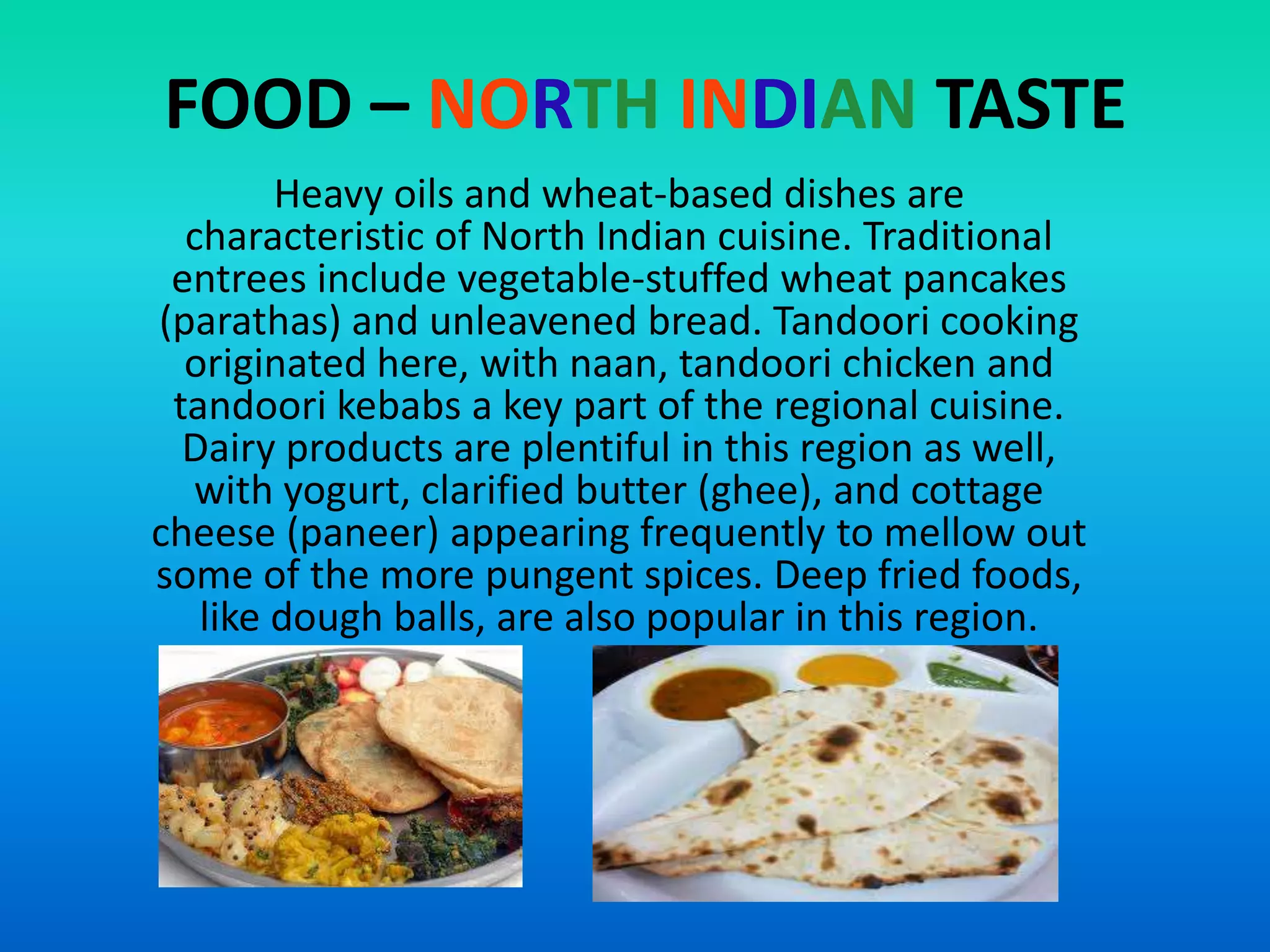
Heavy oils and wheat-based dishes are
characteristic of North Indian cuisine. Traditional
entrees include vegetable-stuffed wheat pancakes
(parathas) and unleavened bread. Tandoori cooking
originated here, with naan, tandoori chicken and
tandoori kebabs a key part of the regional cuisine.
Dairy products are plentiful in this region as well,
with yogurt, clarified butter (ghee), and cottage
cheese (paneer) appearing frequently to mellow out
some of the more pungent spices. Deep fried foods,
like dough balls, are also popular in this region.
FOOD – EAST INDIAN FOOD
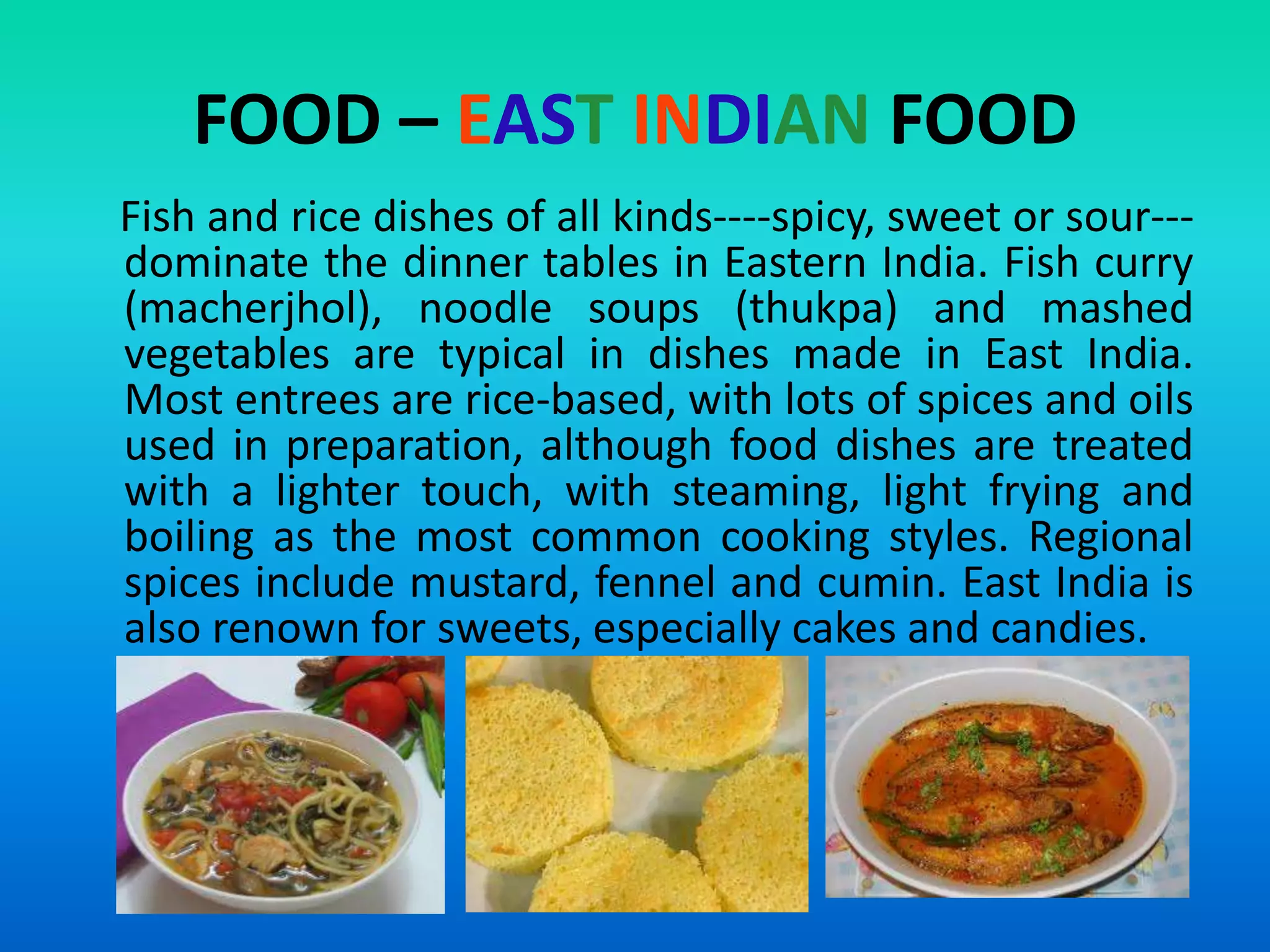
Fish and rice dishes of all kinds----spicy, sweet or sour--dominate the dinner tables in Eastern India. Fish curry
(macherjhol), noodle soups (thukpa) and mashed
vegetables are typical in dishes made in East India.
Most entrees are rice-based, with lots of spices and oils
used in preparation, although food dishes are treated
with a lighter touch, with steaming, light frying and
boiling as the most common cooking styles. Regional
spices include mustard, fennel and cumin. East India is
also renown for sweets, especially cakes and candies.
FOOD – SOUTH INDIAN FOOD
More tropical flavors dominate the cuisine of Southern
India, such as coconut, bananas and jackfruit. Stuffed
rice and lentil crepes (dosas) and fermented rice cakes
(idli) are other South Indian delicacies. Strong spices
dominate South Indian food, and favorites include
cinnamon, clover, cardamom and pepper. Seafood,
particularly fish and prawns, often stars as the main
dish. Most South Indian food is less greasy than other
areas, as dishes are primarily steamed or lightly fried.
Rice dominates in the kitchen, just as it does in the
east.
FOOD – WEST INDIAN FOOD
Fewer meat dishes are prominent in Western Indian cuisine,
as the area's inhabitants are heavily vegetarian. Stir-fried
and curried vegetable dishes are plentiful, as are sweet and
sour sauces that are served over rice. Most meat dishes
feature seafood, as Western India enjoys an extensive
coastline. Lobster, crab, fish and prawns all feature
prominently in Western Indian dishes. Peanuts, cashews
and sesame seeds are frequent garnishes to main courses.
Steamed cakes (khaman dhokla) and flat bread (rotli) are
eaten as sides.
FESTIVALS OF INDIA
BAKR – ID
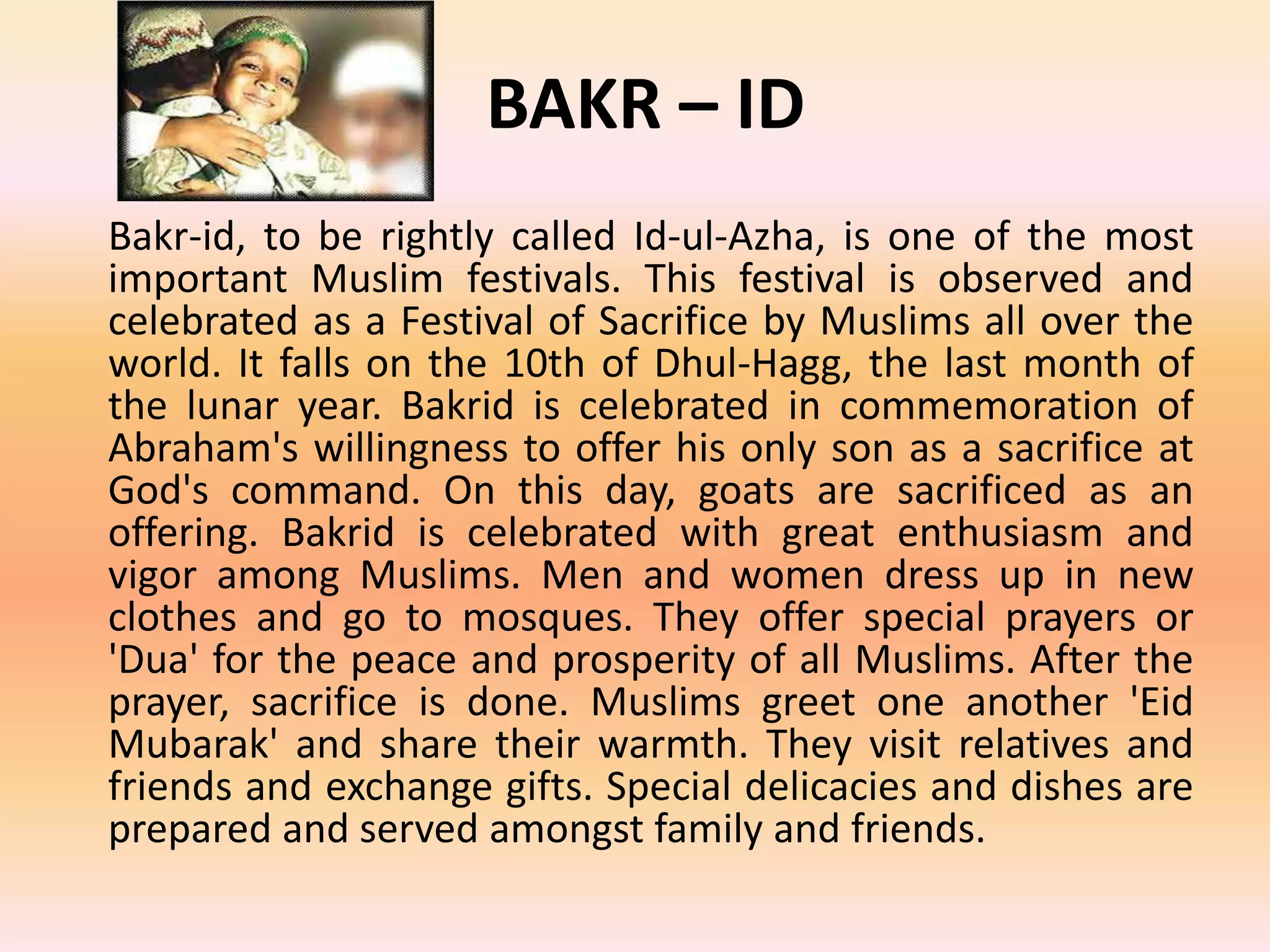
Bakr-id, to be rightly called Id-ul-Azha, is one of the most
important Muslim festivals. This festival is observed and
celebrated as a Festival of Sacrifice by Muslims all over the
world. It falls on the 10th of Dhul-Hagg, the last month of
the lunar year. Bakrid is celebrated in commemoration of
Abraham's willingness to offer his only son as a sacrifice at
God's command. On this day, goats are sacrificed as an
offering. Bakrid is celebrated with great enthusiasm and
vigor among Muslims. Men and women dress up in new
clothes and go to mosques. They offer special prayers or
'Dua' for the peace and prosperity of all Muslims. After the
prayer, sacrifice is done. Muslims greet one another 'Eid
Mubarak' and share their warmth. They visit relatives and
friends and exchange gifts. Special delicacies and dishes are
prepared and served amongst family and friends.
BUDDHA JAYANTI
Buddhism might not be as old as other religions, but is definitely the
most popular. This is because of its teachings that have transformed
the thinking and living of many. Many argue that Buddhism is not
even a religion, but a set of teachings that an enlightened prince
called Siddhartha gave. Buddha Jayanti celebrates the birth,
enlightenment and salvation of this prince. It was his simplicity and
love for others that captured the faith of everyone's life that he,
and later his teachings, touched. In today's time, when man's faith
on mysticism is in question, he bends his faith towards that of a
human teaching. Although many believe that Buddha was a God,
some believe he was an avatar of Vishnu (the supreme God in
Hinduism). God or not, Lord Buddha is kept in the same pedestal by
his followers.
CHRISTMAS
Christmas is believed to be a western festival. There have been age
long debates on whether or not India had Christianity as a religion
before the European invasion. Whichever be the case, it seems
easier to believe that Europeans brought Christianity to the country.
However, even if it did exist before they came, surely the customs
must not have been similar as that of the Europeans. Today what
we see, especially in urban India, is without doubt an adaptation of
the western celebration; in an Indianized way. But wherever it came
from, it brings us a time of sheer happiness and togetherness.
Celebrated on the 25th day of the month of December every year,
Christmas is celebrated with much pomp and show. It marks the
birth of Jesus Christ, savior of mankind. Every family, Christian or
non-Christian, revel in the merriment and indulge in activities to
enjoy the Yuletide.
DUSSEHRA
Giant effigies of Ravana, Meghnada, and Kumbhakarna being built
days before indicate the arrival of one of the most significant and
highly revered festivals of India - Dussehra, preceded by the nineday Navratri. The sights of these huge and full effigies pass on the
message of preparing for the festivities that highlight this
auspicious festival. Dussehra, the celebration of victory over evil, is
a devout festival of the Hindus, marked on the tenth day of the
bright half of the month of Ashwin, as per the Hindu calendar, at
the end of the nine days of Navratri. Also referred to as Vijaya
Dashmi, Dasara, or Dashain, this holy occasion brings together
families and friends to indulge in the worship and devotion of
Goddess Durga and her nine forms, apart from celebrating the
triumph of Lord Rama over the demon king, Ravana. Though this
blissful occasion is observed across the country, larger-than-life
celebrations are held in Delhi and Varanasi, the most popular places
to witness them.
DEEPAVALI
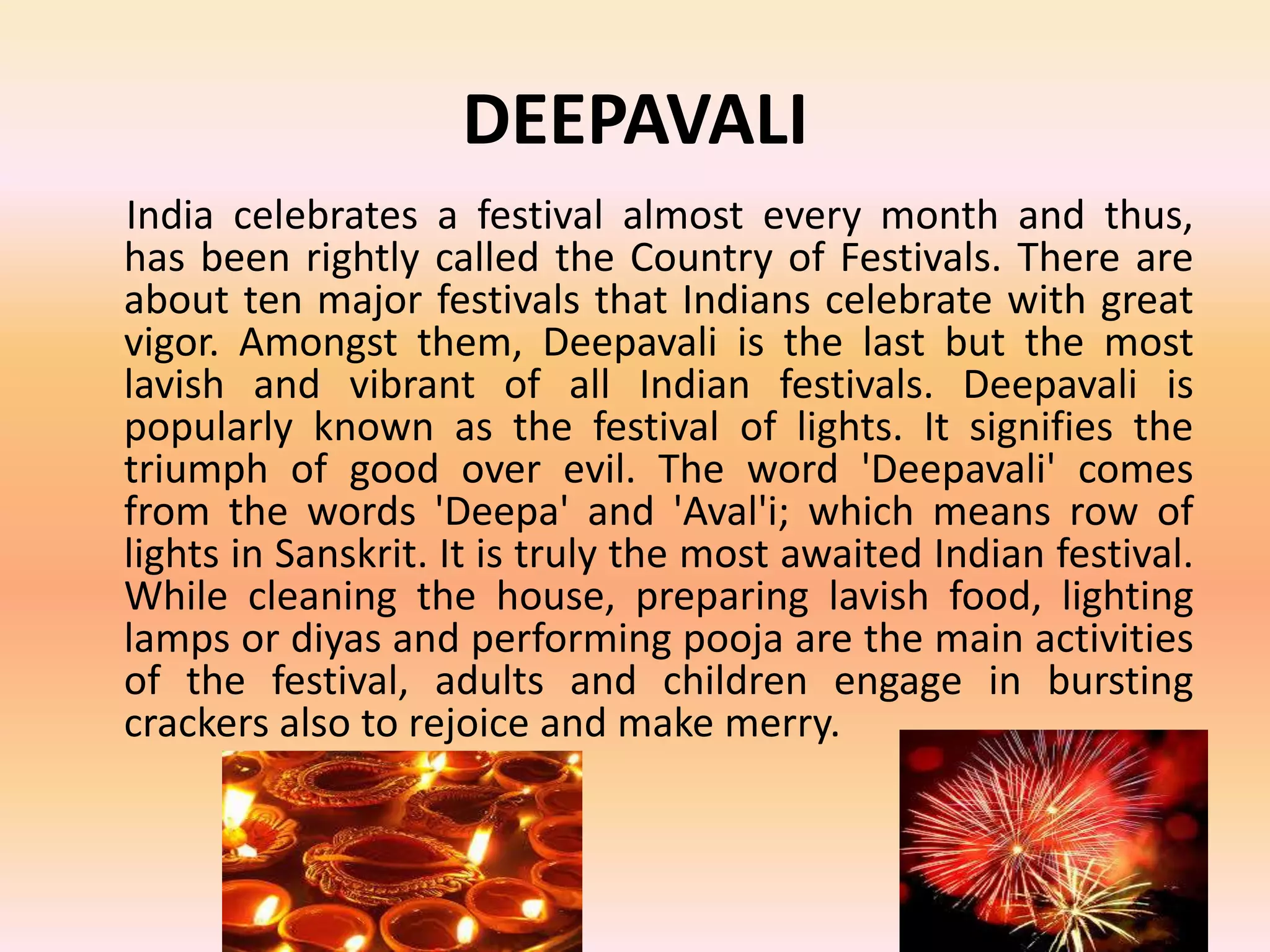
India celebrates a festival almost every month and thus,
has been rightly called the Country of Festivals. There are
about ten major festivals that Indians celebrate with great
vigor. Amongst them, Deepavali is the last but the most
lavish and vibrant of all Indian festivals. Deepavali is
popularly known as the festival of lights. It signifies the
triumph of good over evil. The word 'Deepavali' comes
from the words 'Deepa' and 'Aval'i; which means row of
lights in Sanskrit. It is truly the most awaited Indian festival.
While cleaning the house, preparing lavish food, lighting
lamps or diyas and performing pooja are the main activities
of the festival, adults and children engage in bursting
crackers also to rejoice and make merry.
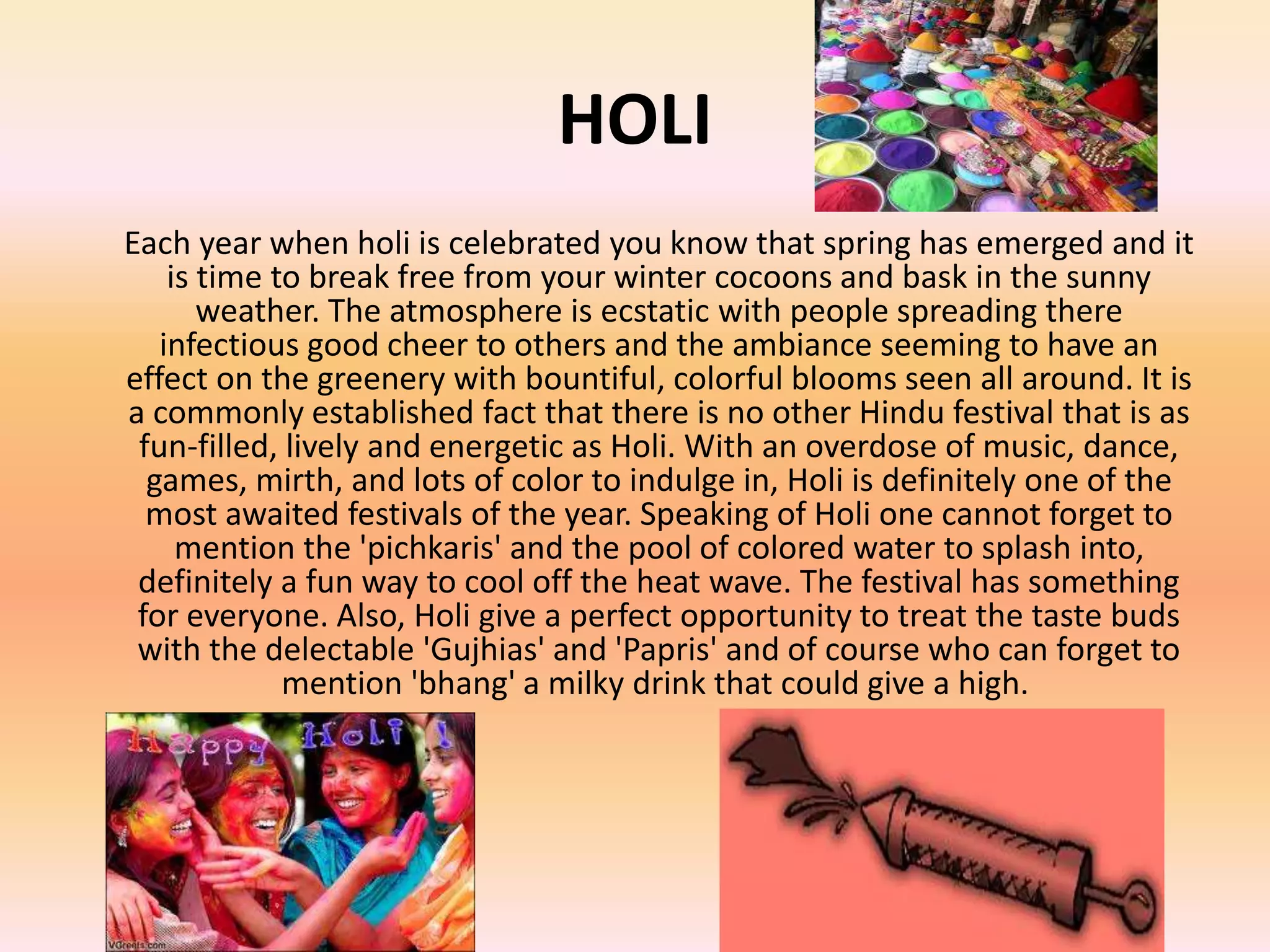
HOLI
Each year when holi is celebrated you know that spring has emerged and it
is time to break free from your winter cocoons and bask in the sunny
weather. The atmosphere is ecstatic with people spreading there
infectious good cheer to others and the ambiance seeming to have an
effect on the greenery with bountiful, colorful blooms seen all around. It is
a commonly established fact that there is no other Hindu festival that is as
fun-filled, lively and energetic as Holi. With an overdose of music, dance,
games, mirth, and lots of color to indulge in, Holi is definitely one of the
most awaited festivals of the year. Speaking of Holi one cannot forget to
mention the 'pichkaris' and the pool of colored water to splash into,
definitely a fun way to cool off the heat wave. The festival has something
for everyone. Also, Holi give a perfect opportunity to treat the taste buds
with the delectable 'Gujhias' and 'Papris' and of course who can forget to
mention 'bhang' a milky drink that could give a high.
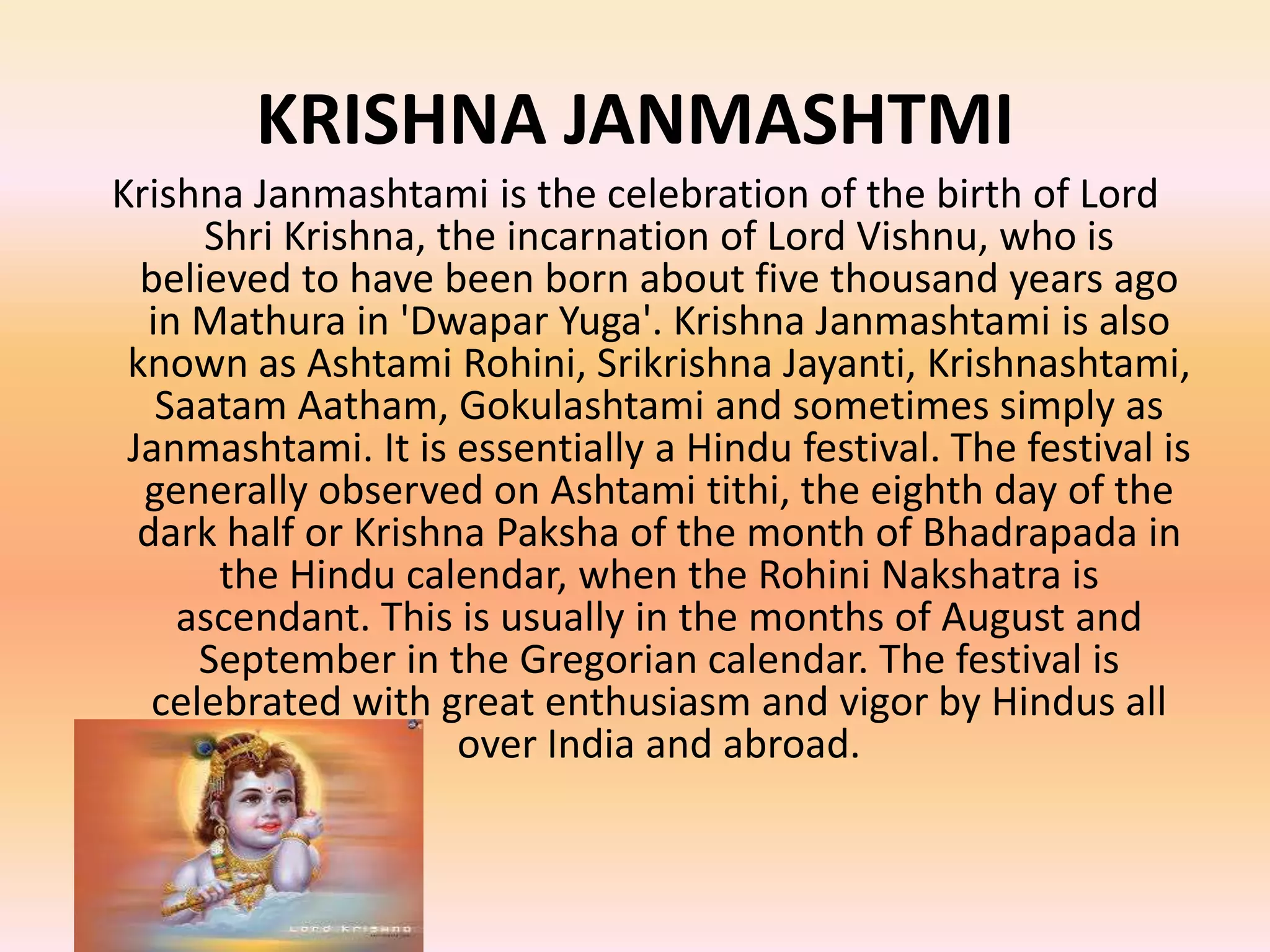
KRISHNA JANMASHTMI
Krishna Janmashtami is the celebration of the birth of Lord
Shri Krishna, the incarnation of Lord Vishnu, who is
believed to have been born about five thousand years ago
in Mathura in 'Dwapar Yuga'. Krishna Janmashtami is also
known as Ashtami Rohini, Srikrishna Jayanti, Krishnashtami,
Saatam Aatham, Gokulashtami and sometimes simply as
Janmashtami. It is essentially a Hindu festival. The festival is
generally observed on Ashtami tithi, the eighth day of the
dark half or Krishna Paksha of the month of Bhadrapada in
the Hindu calendar, when the Rohini Nakshatra is
ascendant. This is usually in the months of August and
September in the Gregorian calendar. The festival is
celebrated with great enthusiasm and vigor by Hindus all
over India and abroad.
RAKSHA BANDHAN
Raksha Bandhan is the festival meant to tighten the
knot of relation between a brother and a sister. It is
celebrated on the full moon day in the month of
Shravan (month according to Hindi calendar) which
comes in the month of August. Raksha Bandhan is also
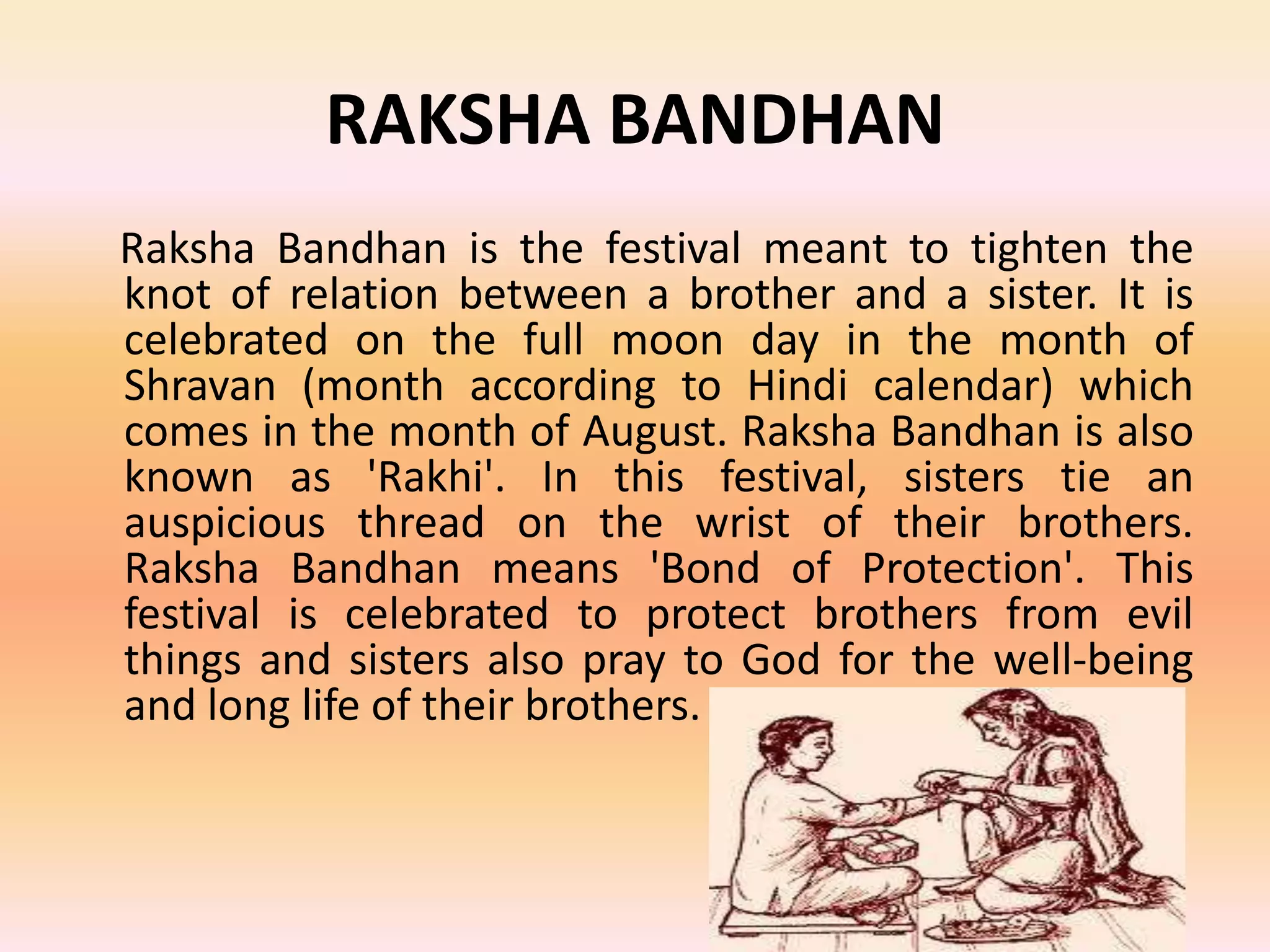
known as 'Rakhi'. In this festival, sisters tie an
auspicious thread on the wrist of their brothers.
Raksha Bandhan means 'Bond of Protection'. This
festival is celebrated to protect brothers from evil
things and sisters also pray to God for the well-being
and long life of their brothers.
KARVA CHAUTH
Karva Chauth is a festival that every Indian woman looks
forward to. A typical Indian woman is described to be so
devoted to her husband that all her prayers channel to his
safety and well-being. Although today India is a developing
country and has moved way forward into modernity, the
devotion of Indian women to their husband has not
wavered. Karva Chauth is the day that symbolizes this love
and devotion of an Indian woman towards her husband. On
this day she fasts the entire day without even a sip of water,
until the moon appears which is when her husband feeds
her the first morsel of food. She does this as a prayer to her
husband's protection and long life. Even some unmarried
women or girls keep this fast in prayer of a good husband.
MUSIC OF INDIA
• Indian classical music is categorized under two
genres. These are Hindustani and Carnatic.
Broadly speaking, Carnatic music developed in
the south of the country, while Hindustani is
indigenous to the north.
• Hindustani music is based on the raga system. A
raga is a melodic scale, consisting of notes from
the basic seven known as sa, re, ga, ma pa, dha,
and ni. Apart from sa and pa which are constant,
the other notes may be in major or minor tone,
and this gives rise to innumerable combinations.
Ten basic scales or “thaats” are recognized, and
other ragas are considered to have evolved from
these. A raga must contain a minimum of five
notes.
MUSICAL INTRUMENTS
DANCES OF INDIA
Dance is a form of communication that brings out the inner most
feelings and at the same time helps express what a civilization is all
about. Indian Dances are all about connection of the mind with the
soul. A dancer has to lead a very disciplined life. All the traditional
dances still follow the rules set by Bharata Muni in his 'Natya
Shastra'.
The Indian Dance is one of the most well established arts and has
been developing for nearly two thousand years!! The dances
originated in the temples, where dancing was used to illustrate and
depict various Hindu mythologies. The dances were performed by
'Devadasi's' or ladies who dedicated their life to the service of god. It
is believed that the gods and goddesses not only appreciate dance
but are great dancers as well! Over time, dances were used not only
to express devotion to god, but also to portray one's emotion and
state of mind.
Indian culture

Indian culture

  • 1.
    INDIAN CULTURE BY –MANSVINI MISRA IX - B
  • 2.
    IN THIS LANDOF FREEDOM, I CAN HAVE MY OWN RELIGION, MY OWN GOD AND MY OWN FAITH.
  • 3.
    SECULARISM IN INDIA– MY GOD "I do not expect India of my dreams to develop one religion, i.e., to be wholly Hindu or wholly Christian or wholly Mussalman, but I want it to be wholly tolerant, with its religions working side by side with one another.'' So said Mahatma Gandhi.
  • 4.
  • 5.
    DIFFERENT TYPES OFFOOD IN INDIA Many cultures and customs converge in India, including food traditions. The subcontinent can be divided into roughly four culinary regions---north, east, south and west. These cooking regions are grouped by geography, climate and cultural influences. While most Indian food is identified by the use of somewhat exotic spices, the subtleties and variations of regional favorites, as well as traditional ingredients used in the major cooking regions, produce ethnically diverse and delicious cuisine throughout the country.
  • 6.
    FOOD – INTHE VEINS OF REGIONS NORTH EAST SOUTH WEST
  • 7.
    FOOD – NORTHINDIAN TASTE Heavy oils and wheat-based dishes are characteristic of North Indian cuisine. Traditional entrees include vegetable-stuffed wheat pancakes (parathas) and unleavened bread. Tandoori cooking originated here, with naan, tandoori chicken and tandoori kebabs a key part of the regional cuisine. Dairy products are plentiful in this region as well, with yogurt, clarified butter (ghee), and cottage cheese (paneer) appearing frequently to mellow out some of the more pungent spices. Deep fried foods, like dough balls, are also popular in this region.
  • 8.
    FOOD – EASTINDIAN FOOD Fish and rice dishes of all kinds----spicy, sweet or sour--dominate the dinner tables in Eastern India. Fish curry (macherjhol), noodle soups (thukpa) and mashed vegetables are typical in dishes made in East India. Most entrees are rice-based, with lots of spices and oils used in preparation, although food dishes are treated with a lighter touch, with steaming, light frying and boiling as the most common cooking styles. Regional spices include mustard, fennel and cumin. East India is also renown for sweets, especially cakes and candies.
  • 9.
    FOOD – SOUTHINDIAN FOOD More tropical flavors dominate the cuisine of Southern India, such as coconut, bananas and jackfruit. Stuffed rice and lentil crepes (dosas) and fermented rice cakes (idli) are other South Indian delicacies. Strong spices dominate South Indian food, and favorites include cinnamon, clover, cardamom and pepper. Seafood, particularly fish and prawns, often stars as the main dish. Most South Indian food is less greasy than other areas, as dishes are primarily steamed or lightly fried. Rice dominates in the kitchen, just as it does in the east.
  • 10.
    FOOD – WESTINDIAN FOOD Fewer meat dishes are prominent in Western Indian cuisine, as the area's inhabitants are heavily vegetarian. Stir-fried and curried vegetable dishes are plentiful, as are sweet and sour sauces that are served over rice. Most meat dishes feature seafood, as Western India enjoys an extensive coastline. Lobster, crab, fish and prawns all feature prominently in Western Indian dishes. Peanuts, cashews and sesame seeds are frequent garnishes to main courses. Steamed cakes (khaman dhokla) and flat bread (rotli) are eaten as sides.
  • 11.
  • 12.
    BAKR – ID Bakr-id,to be rightly called Id-ul-Azha, is one of the most important Muslim festivals. This festival is observed and celebrated as a Festival of Sacrifice by Muslims all over the world. It falls on the 10th of Dhul-Hagg, the last month of the lunar year. Bakrid is celebrated in commemoration of Abraham's willingness to offer his only son as a sacrifice at God's command. On this day, goats are sacrificed as an offering. Bakrid is celebrated with great enthusiasm and vigor among Muslims. Men and women dress up in new clothes and go to mosques. They offer special prayers or 'Dua' for the peace and prosperity of all Muslims. After the prayer, sacrifice is done. Muslims greet one another 'Eid Mubarak' and share their warmth. They visit relatives and friends and exchange gifts. Special delicacies and dishes are prepared and served amongst family and friends.
  • 13.
    BUDDHA JAYANTI Buddhism mightnot be as old as other religions, but is definitely the most popular. This is because of its teachings that have transformed the thinking and living of many. Many argue that Buddhism is not even a religion, but a set of teachings that an enlightened prince called Siddhartha gave. Buddha Jayanti celebrates the birth, enlightenment and salvation of this prince. It was his simplicity and love for others that captured the faith of everyone's life that he, and later his teachings, touched. In today's time, when man's faith on mysticism is in question, he bends his faith towards that of a human teaching. Although many believe that Buddha was a God, some believe he was an avatar of Vishnu (the supreme God in Hinduism). God or not, Lord Buddha is kept in the same pedestal by his followers.
  • 14.
    CHRISTMAS Christmas is believedto be a western festival. There have been age long debates on whether or not India had Christianity as a religion before the European invasion. Whichever be the case, it seems easier to believe that Europeans brought Christianity to the country. However, even if it did exist before they came, surely the customs must not have been similar as that of the Europeans. Today what we see, especially in urban India, is without doubt an adaptation of the western celebration; in an Indianized way. But wherever it came from, it brings us a time of sheer happiness and togetherness. Celebrated on the 25th day of the month of December every year, Christmas is celebrated with much pomp and show. It marks the birth of Jesus Christ, savior of mankind. Every family, Christian or non-Christian, revel in the merriment and indulge in activities to enjoy the Yuletide.
  • 15.
    DUSSEHRA Giant effigies ofRavana, Meghnada, and Kumbhakarna being built days before indicate the arrival of one of the most significant and highly revered festivals of India - Dussehra, preceded by the nineday Navratri. The sights of these huge and full effigies pass on the message of preparing for the festivities that highlight this auspicious festival. Dussehra, the celebration of victory over evil, is a devout festival of the Hindus, marked on the tenth day of the bright half of the month of Ashwin, as per the Hindu calendar, at the end of the nine days of Navratri. Also referred to as Vijaya Dashmi, Dasara, or Dashain, this holy occasion brings together families and friends to indulge in the worship and devotion of Goddess Durga and her nine forms, apart from celebrating the triumph of Lord Rama over the demon king, Ravana. Though this blissful occasion is observed across the country, larger-than-life celebrations are held in Delhi and Varanasi, the most popular places to witness them.
  • 16.
    DEEPAVALI India celebrates afestival almost every month and thus, has been rightly called the Country of Festivals. There are about ten major festivals that Indians celebrate with great vigor. Amongst them, Deepavali is the last but the most lavish and vibrant of all Indian festivals. Deepavali is popularly known as the festival of lights. It signifies the triumph of good over evil. The word 'Deepavali' comes from the words 'Deepa' and 'Aval'i; which means row of lights in Sanskrit. It is truly the most awaited Indian festival. While cleaning the house, preparing lavish food, lighting lamps or diyas and performing pooja are the main activities of the festival, adults and children engage in bursting crackers also to rejoice and make merry.
  • 17.
    HOLI Each year whenholi is celebrated you know that spring has emerged and it is time to break free from your winter cocoons and bask in the sunny weather. The atmosphere is ecstatic with people spreading there infectious good cheer to others and the ambiance seeming to have an effect on the greenery with bountiful, colorful blooms seen all around. It is a commonly established fact that there is no other Hindu festival that is as fun-filled, lively and energetic as Holi. With an overdose of music, dance, games, mirth, and lots of color to indulge in, Holi is definitely one of the most awaited festivals of the year. Speaking of Holi one cannot forget to mention the 'pichkaris' and the pool of colored water to splash into, definitely a fun way to cool off the heat wave. The festival has something for everyone. Also, Holi give a perfect opportunity to treat the taste buds with the delectable 'Gujhias' and 'Papris' and of course who can forget to mention 'bhang' a milky drink that could give a high.
  • 18.
    KRISHNA JANMASHTMI Krishna Janmashtamiis the celebration of the birth of Lord Shri Krishna, the incarnation of Lord Vishnu, who is believed to have been born about five thousand years ago in Mathura in 'Dwapar Yuga'. Krishna Janmashtami is also known as Ashtami Rohini, Srikrishna Jayanti, Krishnashtami, Saatam Aatham, Gokulashtami and sometimes simply as Janmashtami. It is essentially a Hindu festival. The festival is generally observed on Ashtami tithi, the eighth day of the dark half or Krishna Paksha of the month of Bhadrapada in the Hindu calendar, when the Rohini Nakshatra is ascendant. This is usually in the months of August and September in the Gregorian calendar. The festival is celebrated with great enthusiasm and vigor by Hindus all over India and abroad.
  • 19.
    RAKSHA BANDHAN Raksha Bandhanis the festival meant to tighten the knot of relation between a brother and a sister. It is celebrated on the full moon day in the month of Shravan (month according to Hindi calendar) which comes in the month of August. Raksha Bandhan is also known as 'Rakhi'. In this festival, sisters tie an auspicious thread on the wrist of their brothers. Raksha Bandhan means 'Bond of Protection'. This festival is celebrated to protect brothers from evil things and sisters also pray to God for the well-being and long life of their brothers.
  • 20.
    KARVA CHAUTH Karva Chauthis a festival that every Indian woman looks forward to. A typical Indian woman is described to be so devoted to her husband that all her prayers channel to his safety and well-being. Although today India is a developing country and has moved way forward into modernity, the devotion of Indian women to their husband has not wavered. Karva Chauth is the day that symbolizes this love and devotion of an Indian woman towards her husband. On this day she fasts the entire day without even a sip of water, until the moon appears which is when her husband feeds her the first morsel of food. She does this as a prayer to her husband's protection and long life. Even some unmarried women or girls keep this fast in prayer of a good husband.
  • 21.
    MUSIC OF INDIA •Indian classical music is categorized under two genres. These are Hindustani and Carnatic. Broadly speaking, Carnatic music developed in the south of the country, while Hindustani is indigenous to the north. • Hindustani music is based on the raga system. A raga is a melodic scale, consisting of notes from the basic seven known as sa, re, ga, ma pa, dha, and ni. Apart from sa and pa which are constant, the other notes may be in major or minor tone, and this gives rise to innumerable combinations. Ten basic scales or “thaats” are recognized, and other ragas are considered to have evolved from these. A raga must contain a minimum of five notes.
  • 22.
  • 23.
    DANCES OF INDIA Danceis a form of communication that brings out the inner most feelings and at the same time helps express what a civilization is all about. Indian Dances are all about connection of the mind with the soul. A dancer has to lead a very disciplined life. All the traditional dances still follow the rules set by Bharata Muni in his 'Natya Shastra'. The Indian Dance is one of the most well established arts and has been developing for nearly two thousand years!! The dances originated in the temples, where dancing was used to illustrate and depict various Hindu mythologies. The dances were performed by 'Devadasi's' or ladies who dedicated their life to the service of god. It is believed that the gods and goddesses not only appreciate dance but are great dancers as well! Over time, dances were used not only to express devotion to god, but also to portray one's emotion and state of mind.