Talking to Users

       Presentation to
       ESUG Smalltalk
       Conference 2002


       Andy Berry
       www.tof.co.uk
What This Presentation Is About…

                    Who are your ‘Users’?
                    Finding out what’s
                     important
                    Learning their Language
                    Documentation
                    Changes during
                     Development
                    Training your Users
                    Support Issues
But First, A Confession…

What triggered this presentation were two
projects that went wrong.

Previously, I’d done several very successful
projects, so they made me want to
understand:

                   Why?
Is Extreme Programming the
Answer?

There may be those who feel:

      “Of course it is!”

Others who feel:

      “It’s an expensive fad”

BUT, you should at least consider whether elements of
XP can be used in your corporate culture.
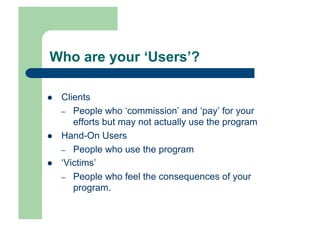
Who are your ‘Users’?

    Clients
     –  People who ‘commission’ and ‘pay’ for your
        efforts but may not actually use the program
    Hand-On Users
     –  People who use the program
    ‘Victims’
     –  People who feel the consequences of your
        program.
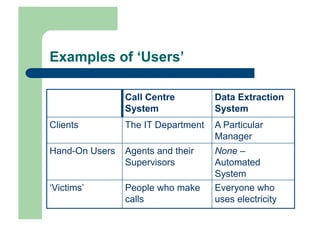
Examples of ‘Users’

                Call Centre         Data Extraction
                System              System
Clients         The IT Department   A Particular
                                    Manager
Hand-On Users   Agents and their    None –
                Supervisors         Automated
                                    System
‘Victims’       People who make     Everyone who
                calls               uses electricity
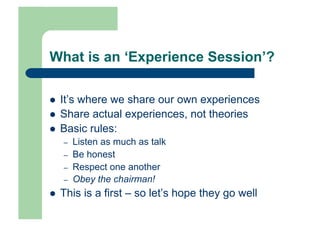
What is an ‘Experience Session’?

    It’s where we share our own experiences
    Share actual experiences, not theories
    Basic rules:
     –    Listen as much as talk
     –    Be honest
     –    Respect one another
     –    Obey the chairman!
    This is a first – so let’s hope they go well
Our 1st Experience Session


 Do you agree that the division of users into
 Clients, Hands-On and ‘Victim’ is:

   •  Correct?
   •  Helpful?

 If not, what can we do to improve on it?
Finding Out What’s Important

Another confession…

The projects went wrong because I didn’t find out
what was important to each group of users.

You must:

   •  Find out what is important to each group
   •  Reconcile differences
But, How?


    Involve All Users at All Stages
    Put some Structure into their Involvement
    Document Everything

An aside: Do you need to consider “Needs”
  Versus “Desires” ?
First And Foremost…


             Learn the Language
             of your Users

             But how???
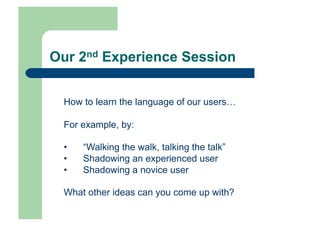
Our 2nd Experience Session


 How to learn the language of our users…

 For example, by:

 •    “Walking the walk, talking the talk”
 •    Shadowing an experienced user
 •    Shadowing a novice user

 What other ideas can you come up with?
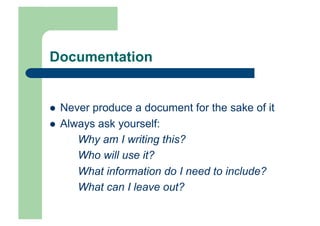
Documentation


    Never produce a document for the sake of it
    Always ask yourself:
        Why am I writing this?
        Who will use it?
        What information do I need to include?
        What can I leave out?
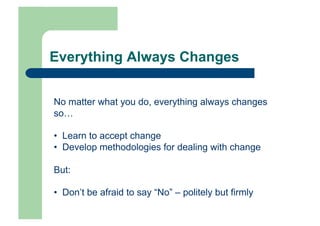
Everything Always Changes


No matter what you do, everything always changes
so…

•  Learn to accept change
•  Develop methodologies for dealing with change

But:

•  Don’t be afraid to say “No” – politely but firmly
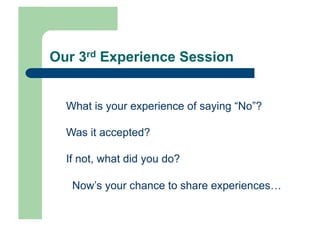
Our 3rd Experience Session


  What is your experience of saying “No”?

  Was it accepted?

  If not, what did you do?

   Now’s your chance to share experiences…
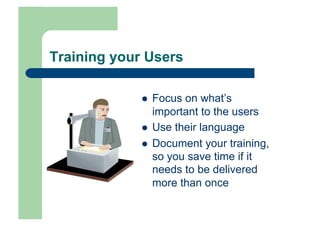
Training your Users

                 Focus on what’s
                  important to the users
                 Use their language
                 Document your training,
                  so you save time if it
                  needs to be delivered
                  more than once
Supporting your Users


    Design and document a “Support Process”
    The process should include:
      –  Bug Reporting with Priority
      –  A “Suggestion Box”
      –  Periodic “User-led Reviews”
Our 4th (and Final!) Experience
Session


Do you agree that we need to design a
support process as an integral part of every
project?

What’s missing from the list of issues just
given?
Thanks for Listening


    You’ll find this presentation at:
        www.tof.co.uk/talking
  Any    comments to:
        talking@tof.co.uk
  We   hope it made you think about your
     users and their needs

Talking to Users

  • 1.
    Talking to Users Presentation to ESUG Smalltalk Conference 2002 Andy Berry www.tof.co.uk
  • 2.
    What This PresentationIs About…   Who are your ‘Users’?   Finding out what’s important   Learning their Language   Documentation   Changes during Development   Training your Users   Support Issues
  • 3.
    But First, AConfession… What triggered this presentation were two projects that went wrong. Previously, I’d done several very successful projects, so they made me want to understand: Why?
  • 4.
    Is Extreme Programmingthe Answer? There may be those who feel: “Of course it is!” Others who feel: “It’s an expensive fad” BUT, you should at least consider whether elements of XP can be used in your corporate culture.
  • 5.
    Who are your‘Users’?   Clients –  People who ‘commission’ and ‘pay’ for your efforts but may not actually use the program   Hand-On Users –  People who use the program   ‘Victims’ –  People who feel the consequences of your program.
  • 6.
    Examples of ‘Users’ Call Centre Data Extraction System System Clients The IT Department A Particular Manager Hand-On Users Agents and their None – Supervisors Automated System ‘Victims’ People who make Everyone who calls uses electricity
  • 7.
    What is an‘Experience Session’?   It’s where we share our own experiences   Share actual experiences, not theories   Basic rules: –  Listen as much as talk –  Be honest –  Respect one another –  Obey the chairman!   This is a first – so let’s hope they go well
  • 8.
    Our 1st ExperienceSession Do you agree that the division of users into Clients, Hands-On and ‘Victim’ is: •  Correct? •  Helpful? If not, what can we do to improve on it?
  • 9.
    Finding Out What’sImportant Another confession… The projects went wrong because I didn’t find out what was important to each group of users. You must: •  Find out what is important to each group •  Reconcile differences
  • 10.
    But, How?   Involve All Users at All Stages   Put some Structure into their Involvement   Document Everything An aside: Do you need to consider “Needs” Versus “Desires” ?
  • 11.
    First And Foremost… Learn the Language of your Users But how???
  • 12.
    Our 2nd ExperienceSession How to learn the language of our users… For example, by: •  “Walking the walk, talking the talk” •  Shadowing an experienced user •  Shadowing a novice user What other ideas can you come up with?
  • 13.
    Documentation   Never produce a document for the sake of it   Always ask yourself: Why am I writing this? Who will use it? What information do I need to include? What can I leave out?
  • 14.
    Everything Always Changes Nomatter what you do, everything always changes so… •  Learn to accept change •  Develop methodologies for dealing with change But: •  Don’t be afraid to say “No” – politely but firmly
  • 15.
    Our 3rd ExperienceSession What is your experience of saying “No”? Was it accepted? If not, what did you do? Now’s your chance to share experiences…
  • 16.
    Training your Users   Focus on what’s important to the users   Use their language   Document your training, so you save time if it needs to be delivered more than once
  • 17.
    Supporting your Users   Design and document a “Support Process”   The process should include: –  Bug Reporting with Priority –  A “Suggestion Box” –  Periodic “User-led Reviews”
  • 18.
    Our 4th (andFinal!) Experience Session Do you agree that we need to design a support process as an integral part of every project? What’s missing from the list of issues just given?
  • 19.
    Thanks for Listening   You’ll find this presentation at: www.tof.co.uk/talking   Any comments to: talking@tof.co.uk   We hope it made you think about your users and their needs