TALISMA UL
Safety Data Sheet
according to Regulation (EC) No. 1907/2006 (REACH) with its amendment Regulation (EU) 2015/830
Date of issue: 7/3/2009 Revision date: 3/3/2016 Supersedes: 12/16/2015 Version: 8.7
3/3/2016 EN (English) 1/9
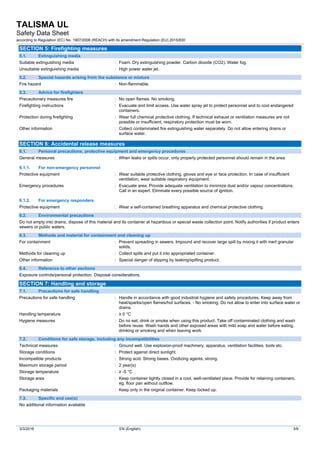
SECTION 1: Identification of the substance/mixture and of the company/undertaking
1.1. Product identifier
Product form : Mixture
Trade name : TALISMA UL
Product code : CA701021
Synonyms : Cypermethrin 20 g/L + Piperonyl Butoxyde 57 g/L ULV
1.2. Relevant identified uses of the substance or mixture and uses advised against
1.2.1. Relevant identified uses
Main use category : Professional use
Industrial/Professional use spec : Pesticide
Agriculture
Use of the substance/mixture : Insecticide
1.2.2. Uses advised against
No additional information available
1.3. Details of the supplier of the safety data sheet
Arysta LifeScience Benelux
Rue de Renory 26/1
B-4102 Ougrée - Belgium
T +32 (0)4 385 97 11 - F +32 (0)4 385 97 49
sdsin@arysta.com - http://www.arystalifescience.com
1.4. Emergency telephone number
Emergency number : Europe/Rest of the world (English): +44(0)1235 239670
112 (European Emergency Number)
USA: +1 215 207 0061 or 001866 928 0789
Australia: +61 2801 44558
People's Republic of China: + 86 10 5100 3039
New Zealand: +64 9929 1483
Country Organisation/Company Address Emergency number Comment
WHO http://www.who.int/gho/phe/chemical_saf
ety/poisons_centres/en/index.html
Cyprus Poison center 1401
Greece Poisons Information Centre
Children's Hospital "Aglaia. Kyriakou"
11527 Athens +30 210 779 3777
SECTION 2: Hazards identification
2.1. Classification of the substance or mixture
Classification according to Regulation (EC) No. 1272/2008 [CLP]Mixture/Substance: SDS EU 2015: According to Regulation (EU) 2015/830
(REACH Annex II)
Hazardous to the aquatic
environment — Acute
Hazard, Category 1
H400 Calculation method
Hazardous to the aquatic
environment — Chronic
Hazard, Category 1
H410 Calculation method
Full text of H statements : see section 16
Adverse physicochemical, human health and environmental effects
No additional information available
TALISMA UL
Safety Data Sheet
according to Regulation (EC) No. 1907/2006 (REACH) with its amendment Regulation (EU) 2015/830
3/3/2016 EN (English) 2/9
2.2. Label elements
Labelling according to Regulation (EC) No. 1272/2008 [CLP] Extra labelling to displayExtra classification(s) to display
Hazard pictograms (CLP) :
GHS09
CLP Signal word : Warning
Hazard statements (CLP) : H410 - Very toxic to aquatic life with long lasting effects
Precautionary statements (CLP) : P405 - Store locked up
P102 - Keep out of reach of children
P270 - Do not eat, drink or smoke when using this product
P273 - Avoid release to the environment
P391 - Collect spillage
EUH-statements : EUH401 - To avoid risks to human health and the environment, comply with the instructions for
use
Extra phrases : SP 1 Do not contaminate water with the product or its container (Do not clean application
equipment near surface water/Avoid contamination via drains from farmyards and roads)
2.3. Other hazards
No additional information available
SECTION 3: Composition/information on ingredients
3.1. Substance
Not applicable
3.2. Mixture
Name Product identifier % Classification according to
Regulation (EC) No.
1272/2008 [CLP]
Piperonyl butoxide (CAS No) 51-03-6
(EC no) 200-076-7
(REACH-no) 01-2119537431-46
5.7 - 7 Aquatic Acute 1, H400
Aquatic Chronic 1, H410
cypermethrin cis/trans +/- 40/60 (CAS No) 52315-07-8
(EC no) 257-842-9
(EC index no) 607-421-00-4
2 - 2.5 Acute Tox. 4 (Oral), H302
Acute Tox. 4 (Inhalation:dust,mist),
H332
STOT SE 3, H335
Aquatic Acute 1, H400 (M=1000)
Aquatic Chronic 1, H410 (M=1000)
Full text of H-statements: see section 16
SECTION 4: First aid measures
4.1. Description of first aid measures
First-aid measures general : If medical advice is needed, have product container or label at hand.
First-aid measures after inhalation : IF INHALED: Remove victim to fresh air and keep at rest in a position comfortable for
breathing. In case of breathing difficulties administer oxygen. In case of irregular breathing or
respiratory arrest provide artificial respiration. In all cases of doubt, or when symptoms persist,
seek medical advice.
First-aid measures after skin contact : After contact with skin, take off immediately all contaminated clothing, and wash immediately
with plenty of water and soap. If skin irritation occurs: Get medical advice/attention.
First-aid measures after eye contact : Rinse immediately carefully and thoroughly with eye-bath or water. Remove contact lenses, if
present and easy to do. Continue rinsing. If eye irritation persists: Get medical advice/attention.
First-aid measures after ingestion : If swallowed, rinse mouth with water (only if the person is conscious). Do not induce vomiting.
Immediately get medical attention.
4.2. Most important symptoms and effects, both acute and delayed
No additional information available
4.3. Indication of any immediate medical attention and special treatment needed
Treat symptomatically.
TALISMA UL
Safety Data Sheet
according to Regulation (EC) No. 1907/2006 (REACH) with its amendment Regulation (EU) 2015/830
3/3/2016 EN (English) 3/9
SECTION 5: Firefighting measures
5.1. Extinguishing media
Suitable extinguishing media : Foam. Dry extinguishing powder. Carbon dioxide (CO2). Water fog.
Unsuitable extinguishing media : High power water jet.
5.2. Special hazards arising from the substance or mixture
Fire hazard : Non-flammable.
5.3. Advice for firefighters
Precautionary measures fire : No open flames. No smoking.
Firefighting instructions : Evacuate and limit access. Use water spray jet to protect personnel and to cool endangered
containers.
Protection during firefighting : Wear full chemical protective clothing. If technical exhaust or ventilation measures are not
possible or insufficient, respiratory protection must be worn.
Other information : Collect contaminated fire extinguishing water separately. Do not allow entering drains or
surface water.
SECTION 6: Accidental release measures
6.1. Personal precautions, protective equipment and emergency procedures
General measures : When leaks or spills occur, only properly protected personnel should remain in the area.
6.1.1. For non-emergency personnel
Protective equipment : Wear suitable protective clothing, gloves and eye or face protection. In case of insufficient
ventilation, wear suitable respiratory equipment.
Emergency procedures : Evacuate area. Provide adequate ventilation to minimize dust and/or vapour concentrations.
Call in an expert. Eliminate every possible source of ignition.
6.1.2. For emergency responders
Protective equipment : Wear a self-contained breathing apparatus and chemical protective clothing.
6.2. Environmental precautions
Do not empty into drains, dispose of this material and its container at hazardous or special waste collection point. Notify authorities if product enters
sewers or public waters.
6.3. Methods and material for containment and cleaning up
For containment : Prevent spreading in sewers. Impound and recover large spill by mixing it with inert granular
solids.
Methods for cleaning up : Collect spills and put it into appropriated container.
Other information : Special danger of slipping by leaking/spilling product.
6.4. Reference to other sections
Exposure controls/personal protection. Disposal considerations.
SECTION 7: Handling and storage
7.1. Precautions for safe handling
Precautions for safe handling : Handle in accordance with good industrial hygiene and safety procedures. Keep away from
heat/sparks/open flames/hot surfaces. - No smoking. Do not allow to enter into surface water or
drains.
Handling temperature : ≥ 0 °C
Hygiene measures : Do no eat, drink or smoke when using this product. Take off contaminated clothing and wash
before reuse. Wash hands and other exposed areas with mild soap and water before eating,
drinking or smoking and when leaving work.
7.2. Conditions for safe storage, including any incompatibilities
Technical measures : Ground well. Use explosion-proof machinery, apparatus, ventilation facilities, tools etc.
Storage conditions : Protect against direct sunlight.
Incompatible products : Strong acid. Strong bases. Oxidizing agents, strong.
Maximum storage period : 2 year(s)
Storage temperature : ≥ -5 °C
Storage area : Keep container tightly closed in a cool, well-ventilated place. Provide for retaining containers,
eg. floor pan without outflow.
Packaging materials : Keep only in the original container. Keep locked up.
7.3. Specific end use(s)
No additional information available
TALISMA UL
Safety Data Sheet
according to Regulation (EC) No. 1907/2006 (REACH) with its amendment Regulation (EU) 2015/830
3/3/2016 EN (English) 4/9
SECTION 8: Exposure controls/personal protection
8.1. Control parameters
No additional information available
8.2. Exposure controls
Personal protective equipment : Gloves. Gas mask. Safety glasses.
Hand protection : Wear suitable gloves resistant to chemical penetration. NBR (Nitrile rubber). For special
purposes, it is recommended to check the resistance to chemicals of the protective gloves
mentioned above together with the supplier of these gloves
Eye protection : Face shield. Chemical goggles or safety glasses
Skin and body protection : Skin protection appropriate to the conditions of use should be provided
Respiratory protection : If technical exhaust or ventilation measures are not possible or insufficient, respiratory
protection must be worn
Environmental exposure controls : Notify authorities if product enters sewers or public waters.
Other information : Emergency eye wash fountains and safety showers should be available in the immediate
vicinity of any potential exposure.
SECTION 9: Physical and chemical properties
9.1. Information on basic physical and chemical properties
Physical state : Liquid
Appearance : clear.
Colour : yellow.
Odour : characteristic.
Odour threshold : No data available
pH : No data available
Relative evaporation rate (butylacetate=1) : No data available
Melting point : No data available
Freezing point : < 0 °C
Boiling point : No data available
Flash point : > 79 °C (CIPAC MT 12.2)
Auto-ignition temperature : 252 °C (EEC A.15)
Decomposition temperature : No data available
Flammability (solid, gas) : No data available
Vapour pressure : No data available
Relative vapour density at 20 °C : No data available
Relative density : 0.8933
Density : 0.8933 g/ml (20°C ; CIPCA MT 3.2.1)
Solubility : No data available
Log Pow : No data available
Viscosity, kinematic : 7.6816 cSt (20°C ; ASTM D445-53T)
Viscosity, dynamic : No data available
Explosive properties : not explosive.
Oxidising properties : not oxidizing.
Explosive limits : No data available
9.2. Other information
No additional information available
SECTION 10: Stability and reactivity
10.1. Reactivity
When exposed to heat, may decompose liberating hazardous gases.
TALISMA UL
Safety Data Sheet
according to Regulation (EC) No. 1907/2006 (REACH) with its amendment Regulation (EU) 2015/830
3/3/2016 EN (English) 5/9
10.2. Chemical stability
Stable under normal conditions.
10.3. Possibility of hazardous reactions
None under normal conditions. Refer to section 10.1 on Reactivity.
10.4. Conditions to avoid
Protect against direct sunlight. Keep away from heat/sparks/open flames/hot surfaces. - No smoking.
10.5. Incompatible materials
Strong acid. Strong bases. Strong oxidizing agents.
10.6. Hazardous decomposition products
When heated to decomposition, emits dangerous fumes. Carbon dioxide (CO2). Carbon monoxide. Nitrogen oxides (NOx).
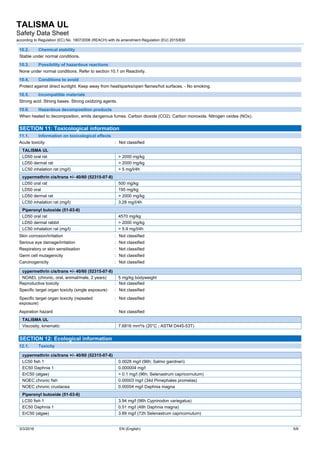
SECTION 11: Toxicological information
11.1. Information on toxicological effects
Acute toxicity : Not classified
TALISMA UL
LD50 oral rat > 2000 mg/kg
LD50 dermal rat > 2000 mg/kg
LC50 inhalation rat (mg/l) > 5 mg/l/4h
cypermethrin cis/trans +/- 40/60 (52315-07-8)
LD50 oral rat 500 mg/kg
LD50 oral 195 mg/kg
LD50 dermal rat > 2000 mg/kg
LC50 inhalation rat (mg/l) 3.28 mg/l/4h
Piperonyl butoxide (51-03-6)
LD50 oral rat 4570 mg/kg
LD50 dermal rabbit > 2000 mg/kg
LC50 inhalation rat (mg/l) > 5.9 mg/l/4h
Skin corrosion/irritation : Not classified
Serious eye damage/irritation : Not classified
Respiratory or skin sensitisation : Not classified
Germ cell mutagenicity : Not classified
Carcinogenicity : Not classified
cypermethrin cis/trans +/- 40/60 (52315-07-8)
NOAEL (chronic, oral, animal/male, 2 years) 5 mg/kg bodyweight
Reproductive toxicity : Not classified
Specific target organ toxicity (single exposure) : Not classified
Specific target organ toxicity (repeated
exposure)
: Not classified
Aspiration hazard : Not classified
TALISMA UL
Viscosity, kinematic 7.6816 mm²/s (20°C ; ASTM D445-53T)
SECTION 12: Ecological information
12.1. Toxicity
cypermethrin cis/trans +/- 40/60 (52315-07-8)
LC50 fish 1 0.0028 mg/l (96h; Salmo gairdneri)
EC50 Daphnia 1 0.000004 mg/l
ErC50 (algae) > 0.1 mg/l (96h; Selenastrum capricornutum)
NOEC chronic fish 0.00003 mg/l (34d Pimephales promelas)
NOEC chronic crustacea 0.00004 mg/l Daphnia magna
Piperonyl butoxide (51-03-6)
LC50 fish 1 3.94 mg/l (96h Cyprinodon variegatus)
EC50 Daphnia 1 0.51 mg/l (48h Daphnia magna)
ErC50 (algae) 3.89 mg/l (72h Selenastrum capricornutum)
TALISMA UL
Safety Data Sheet
according to Regulation (EC) No. 1907/2006 (REACH) with its amendment Regulation (EU) 2015/830
3/3/2016 EN (English) 6/9
12.2. Persistence and degradability
cypermethrin cis/trans +/- 40/60 (52315-07-8)
Persistence and degradability Not readily biodegradable.
Piperonyl butoxide (51-03-6)
Persistence and degradability Not readily biodegradable.
12.3. Bioaccumulative potential
cypermethrin cis/trans +/- 40/60 (52315-07-8)
BCF fish 1 1204 mg/l (Salmo gairdneri)
Log Pow 5.3 - 5.6 (25°C)
Piperonyl butoxide (51-03-6)
Log Pow 4.8
12.4. Mobility in soil
TALISMA UL
Surface tension 31.2 mN/m (25°C ; EEC A.5)
Piperonyl butoxide (51-03-6)
Ecology - soil Low mobility (soil).
12.5. Results of PBT and vPvB assessment
No additional information available
12.6. Other adverse effects
No additional information available
SECTION 13: Disposal considerations
13.1. Waste treatment methods
Regional legislation (waste) : Disposal must be done according to official regulations.
Waste treatment methods : Dispose of this material and its container to hazardous or special waste collection point.
Additional information : Do not contaminate water with the product or its container (Do not clean application equipment
near surface water/Avoid contamination via drains from farmyards and roads). Notify authorities
if product enters sewers or public waters.
SECTION 14: Transport information
In accordance with ADR / RID / IMDG / IATA / ADN
ADR IMDG IATA ADN RID
14.1. UN number
3082 3082 3082 3082 3082
14.2. UN proper shipping name
ENVIRONMENTALLY
HAZARDOUS
SUBSTANCE, LIQUID,
N.O.S. (Cypermethrin,
PBO)
ENVIRONMENTALLY
HAZARDOUS
SUBSTANCE, LIQUID,
N.O.S. (Cypermethrin,
PBO)
Environmentally
hazardous substance,
liquid, n.o.s.
(Cypermethrin, PBO)
ENVIRONMENTALLY
HAZARDOUS
SUBSTANCE, LIQUID,
N.O.S. (Cypermethrin,
PBO)
ENVIRONMENTALLY
HAZARDOUS
SUBSTANCE, LIQUID,
N.O.S. (Cypermethrin,
PBO)
Transport document description
UN 3082
ENVIRONMENTALLY
HAZARDOUS
SUBSTANCE, LIQUID,
N.O.S. (Cypermethrin,
PBO), 9, III, (E)
UN 3082
ENVIRONMENTALLY
HAZARDOUS
SUBSTANCE, LIQUID,
N.O.S. (Cypermethrin,
PBO), 9, III, MARINE
POLLUTANT/ENVIRONM
ENTALLY HAZARDOUS
UN 3082 Environmentally
hazardous substance,
liquid, n.o.s.
(Cypermethrin, PBO), 9,
III, ENVIRONMENTALLY
HAZARDOUS
UN 3082
ENVIRONMENTALLY
HAZARDOUS
SUBSTANCE, LIQUID,
N.O.S. (Cypermethrin,
PBO), 9, III,
ENVIRONMENTALLY
HAZARDOUS
UN 3082
ENVIRONMENTALLY
HAZARDOUS
SUBSTANCE, LIQUID,
N.O.S. (Cypermethrin,
PBO), 9, III,
ENVIRONMENTALLY
HAZARDOUS
14.3. Transport hazard class(es)
9 9 9 9 9
14.4. Packing group
III III III III III
14.5. Environmental hazards
Dangerous for the
environment : Yes
Dangerous for the
environment : Yes
Dangerous for the
environment : Yes
Dangerous for the
environment : Yes
Dangerous for the
environment : Yes
TALISMA UL
Safety Data Sheet
according to Regulation (EC) No. 1907/2006 (REACH) with its amendment Regulation (EU) 2015/830
3/3/2016 EN (English) 7/9
ADR IMDG IATA ADN RID
Marine pollutant : Yes
No supplementary information available
14.6. Special precautions for user
- Overland transport
Classification code (ADR) : M6
Special provisions (ADR) : 274, 335, 601
Limited quantities (ADR) : 5l
Excepted quantities (ADR) : E1
Packing instructions (ADR) : P001, IBC03, LP01, R001
Special packing provisions (ADR) : PP1
Mixed packing provisions (ADR) : MP19
Portable tank and bulk container instructions
(ADR)
: T4
Portable tank and bulk container special
provisions (ADR)
: TP1, TP29
Tank code (ADR) : LGBV
Vehicle for tank carriage : AT
Transport category (ADR) : 3
Special provisions for carriage - Packages
(ADR)
: V12
Special provisions for carriage - Loading,
unloading and handling (ADR)
: CV13
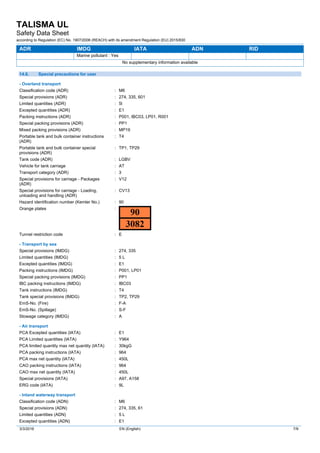
Hazard identification number (Kemler No.) : 90
Orange plates :
Tunnel restriction code : E
- Transport by sea
Special provisions (IMDG) : 274, 335
Limited quantities (IMDG) : 5 L
Excepted quantities (IMDG) : E1
Packing instructions (IMDG) : P001, LP01
Special packing provisions (IMDG) : PP1
IBC packing instructions (IMDG) : IBC03
Tank instructions (IMDG) : T4
Tank special provisions (IMDG) : TP2, TP29
EmS-No. (Fire) : F-A
EmS-No. (Spillage) : S-F
Stowage category (IMDG) : A
- Air transport
PCA Excepted quantities (IATA) : E1
PCA Limited quantities (IATA) : Y964
PCA limited quantity max net quantity (IATA) : 30kgG
PCA packing instructions (IATA) : 964
PCA max net quantity (IATA) : 450L
CAO packing instructions (IATA) : 964
CAO max net quantity (IATA) : 450L
Special provisions (IATA) : A97, A158
ERG code (IATA) : 9L
- Inland waterway transport
Classification code (ADN) : M6
Special provisions (ADN) : 274, 335, 61
Limited quantities (ADN) : 5 L
Excepted quantities (ADN) : E1
TALISMA UL
Safety Data Sheet
according to Regulation (EC) No. 1907/2006 (REACH) with its amendment Regulation (EU) 2015/830
3/3/2016 EN (English) 8/9
Carriage permitted (ADN) : T
Equipment required (ADN) : PP
Number of blue cones/lights (ADN) : 0
- Rail transport
Classification code (RID) : M6
Special provisions (RID) : 274, 335, 601
Limited quantities (RID) : 5L
Excepted quantities (RID) : E1
Packing instructions (RID) : P001, IBC03, LP01, R001
Special packing provisions (RID) : PP1
Mixed packing provisions (RID) : MP19
Portable tank and bulk container instructions
(RID)
: T4
Portable tank and bulk container special
provisions (RID)
: TP1, TP29
Tank codes for RID tanks (RID) : LGBV
Transport category (RID) : 3
Special provisions for carriage – Packages
(RID)
: W12
Special provisions for carriage - Loading,
unloading and handling (RID)
: CW13, CW31
Colis express (express parcels) (RID) : CE8
Hazard identification number (RID) : 90
14.7. Transport in bulk according to Annex II of MARPOL 73/78 and the IBC Code
Not applicable
SECTION 15: Regulatory information
15.1. Safety, health and environmental regulations/legislation specific for the substance or mixture
15.1.1. EU-Regulations
The following restrictions are applicable according to Annex XVII of the REACH Regulation (EC) No 1907/2006:
3. Liquid substances or mixtures which are regarded as dangerous in
accordance with Directive 1999/45/EC or are fulfilling the criteria for any
of the following hazard classes or categories set out in Annex I to
Regulation (EC) No 1272/2008
TALISMA UL
Contains no substance on the REACH candidate list
Contains no REACH Annex XIV substances
15.1.2. National regulations
No additional information available
15.2. Chemical safety assessment
No additional information available
SECTION 16: Other information
Indication of changes:
Revision date Modified
Supersedes Modified
UN-No. (ADN) Added
Class (ADN) Added
Packing group (IMDG) Removed
Packing group (IATA) Removed
2.1 Classification according
to Regulation (EC) No.
1272/2008 [CLP]
Modified
2.2 Hazard statements
(CLP)
Modified
2.2 EUH-statements Added
9.2 Minimum ignition
energy
Added
TALISMA UL
Safety Data Sheet
according to Regulation (EC) No. 1907/2006 (REACH) with its amendment Regulation (EU) 2015/830
3/3/2016 EN (English) 9/9
14.2 Proper Shipping Name
(ADR)
Modified
14.6 LQ Removed
14.6 Instruction "passenger"
- Limited quantities
(ICAO)
Removed
14.6 Instruction "passenger"
(ICAO)
Removed
14.6 Instruction "cargo"
(ICAO)
Removed
Full text of H- and EUH-statements:
Acute Tox. 4 (Inhalation:dust,mist) Acute toxicity (inhalation:dust,mist) Category 4
Acute Tox. 4 (Oral) Acute toxicity (oral), Category 4
Aquatic Acute 1 Hazardous to the aquatic environment — Acute Hazard, Category 1
Aquatic Chronic 1 Hazardous to the aquatic environment — Chronic Hazard, Category 1
STOT SE 3 Specific target organ toxicity — Single exposure, Category 3, Respiratory tract irritation
H302 Harmful if swallowed
H332 Harmful if inhaled
H335 May cause respiratory irritation
H400 Very toxic to aquatic life
H410 Very toxic to aquatic life with long lasting effects
EUH401 To avoid risks to human health and the environment, comply with the instructions for use
Classification and procedure used to derive the classification for mixtures according to Regulation (EC) 1272/2008 [CLP]:
Aquatic Acute 1 H400 Calculation method
Aquatic Chronic 1 H410 Calculation method
SDS EU (REACH Annex II)
This information is based on our current knowledge and is intended to describe the product for the purposes of health, safety and environmental requirements only. It should not therefore be
construed as guaranteeing any specific property of the product

Talisma ul msds

  • 1.
    TALISMA UL Safety DataSheet according to Regulation (EC) No. 1907/2006 (REACH) with its amendment Regulation (EU) 2015/830 Date of issue: 7/3/2009 Revision date: 3/3/2016 Supersedes: 12/16/2015 Version: 8.7 3/3/2016 EN (English) 1/9 SECTION 1: Identification of the substance/mixture and of the company/undertaking 1.1. Product identifier Product form : Mixture Trade name : TALISMA UL Product code : CA701021 Synonyms : Cypermethrin 20 g/L + Piperonyl Butoxyde 57 g/L ULV 1.2. Relevant identified uses of the substance or mixture and uses advised against 1.2.1. Relevant identified uses Main use category : Professional use Industrial/Professional use spec : Pesticide Agriculture Use of the substance/mixture : Insecticide 1.2.2. Uses advised against No additional information available 1.3. Details of the supplier of the safety data sheet Arysta LifeScience Benelux Rue de Renory 26/1 B-4102 Ougrée - Belgium T +32 (0)4 385 97 11 - F +32 (0)4 385 97 49 sdsin@arysta.com - http://www.arystalifescience.com 1.4. Emergency telephone number Emergency number : Europe/Rest of the world (English): +44(0)1235 239670 112 (European Emergency Number) USA: +1 215 207 0061 or 001866 928 0789 Australia: +61 2801 44558 People's Republic of China: + 86 10 5100 3039 New Zealand: +64 9929 1483 Country Organisation/Company Address Emergency number Comment WHO http://www.who.int/gho/phe/chemical_saf ety/poisons_centres/en/index.html Cyprus Poison center 1401 Greece Poisons Information Centre Children's Hospital "Aglaia. Kyriakou" 11527 Athens +30 210 779 3777 SECTION 2: Hazards identification 2.1. Classification of the substance or mixture Classification according to Regulation (EC) No. 1272/2008 [CLP]Mixture/Substance: SDS EU 2015: According to Regulation (EU) 2015/830 (REACH Annex II) Hazardous to the aquatic environment — Acute Hazard, Category 1 H400 Calculation method Hazardous to the aquatic environment — Chronic Hazard, Category 1 H410 Calculation method Full text of H statements : see section 16 Adverse physicochemical, human health and environmental effects No additional information available
  • 2.
    TALISMA UL Safety DataSheet according to Regulation (EC) No. 1907/2006 (REACH) with its amendment Regulation (EU) 2015/830 3/3/2016 EN (English) 2/9 2.2. Label elements Labelling according to Regulation (EC) No. 1272/2008 [CLP] Extra labelling to displayExtra classification(s) to display Hazard pictograms (CLP) : GHS09 CLP Signal word : Warning Hazard statements (CLP) : H410 - Very toxic to aquatic life with long lasting effects Precautionary statements (CLP) : P405 - Store locked up P102 - Keep out of reach of children P270 - Do not eat, drink or smoke when using this product P273 - Avoid release to the environment P391 - Collect spillage EUH-statements : EUH401 - To avoid risks to human health and the environment, comply with the instructions for use Extra phrases : SP 1 Do not contaminate water with the product or its container (Do not clean application equipment near surface water/Avoid contamination via drains from farmyards and roads) 2.3. Other hazards No additional information available SECTION 3: Composition/information on ingredients 3.1. Substance Not applicable 3.2. Mixture Name Product identifier % Classification according to Regulation (EC) No. 1272/2008 [CLP] Piperonyl butoxide (CAS No) 51-03-6 (EC no) 200-076-7 (REACH-no) 01-2119537431-46 5.7 - 7 Aquatic Acute 1, H400 Aquatic Chronic 1, H410 cypermethrin cis/trans +/- 40/60 (CAS No) 52315-07-8 (EC no) 257-842-9 (EC index no) 607-421-00-4 2 - 2.5 Acute Tox. 4 (Oral), H302 Acute Tox. 4 (Inhalation:dust,mist), H332 STOT SE 3, H335 Aquatic Acute 1, H400 (M=1000) Aquatic Chronic 1, H410 (M=1000) Full text of H-statements: see section 16 SECTION 4: First aid measures 4.1. Description of first aid measures First-aid measures general : If medical advice is needed, have product container or label at hand. First-aid measures after inhalation : IF INHALED: Remove victim to fresh air and keep at rest in a position comfortable for breathing. In case of breathing difficulties administer oxygen. In case of irregular breathing or respiratory arrest provide artificial respiration. In all cases of doubt, or when symptoms persist, seek medical advice. First-aid measures after skin contact : After contact with skin, take off immediately all contaminated clothing, and wash immediately with plenty of water and soap. If skin irritation occurs: Get medical advice/attention. First-aid measures after eye contact : Rinse immediately carefully and thoroughly with eye-bath or water. Remove contact lenses, if present and easy to do. Continue rinsing. If eye irritation persists: Get medical advice/attention. First-aid measures after ingestion : If swallowed, rinse mouth with water (only if the person is conscious). Do not induce vomiting. Immediately get medical attention. 4.2. Most important symptoms and effects, both acute and delayed No additional information available 4.3. Indication of any immediate medical attention and special treatment needed Treat symptomatically.
  • 3.
    TALISMA UL Safety DataSheet according to Regulation (EC) No. 1907/2006 (REACH) with its amendment Regulation (EU) 2015/830 3/3/2016 EN (English) 3/9 SECTION 5: Firefighting measures 5.1. Extinguishing media Suitable extinguishing media : Foam. Dry extinguishing powder. Carbon dioxide (CO2). Water fog. Unsuitable extinguishing media : High power water jet. 5.2. Special hazards arising from the substance or mixture Fire hazard : Non-flammable. 5.3. Advice for firefighters Precautionary measures fire : No open flames. No smoking. Firefighting instructions : Evacuate and limit access. Use water spray jet to protect personnel and to cool endangered containers. Protection during firefighting : Wear full chemical protective clothing. If technical exhaust or ventilation measures are not possible or insufficient, respiratory protection must be worn. Other information : Collect contaminated fire extinguishing water separately. Do not allow entering drains or surface water. SECTION 6: Accidental release measures 6.1. Personal precautions, protective equipment and emergency procedures General measures : When leaks or spills occur, only properly protected personnel should remain in the area. 6.1.1. For non-emergency personnel Protective equipment : Wear suitable protective clothing, gloves and eye or face protection. In case of insufficient ventilation, wear suitable respiratory equipment. Emergency procedures : Evacuate area. Provide adequate ventilation to minimize dust and/or vapour concentrations. Call in an expert. Eliminate every possible source of ignition. 6.1.2. For emergency responders Protective equipment : Wear a self-contained breathing apparatus and chemical protective clothing. 6.2. Environmental precautions Do not empty into drains, dispose of this material and its container at hazardous or special waste collection point. Notify authorities if product enters sewers or public waters. 6.3. Methods and material for containment and cleaning up For containment : Prevent spreading in sewers. Impound and recover large spill by mixing it with inert granular solids. Methods for cleaning up : Collect spills and put it into appropriated container. Other information : Special danger of slipping by leaking/spilling product. 6.4. Reference to other sections Exposure controls/personal protection. Disposal considerations. SECTION 7: Handling and storage 7.1. Precautions for safe handling Precautions for safe handling : Handle in accordance with good industrial hygiene and safety procedures. Keep away from heat/sparks/open flames/hot surfaces. - No smoking. Do not allow to enter into surface water or drains. Handling temperature : ≥ 0 °C Hygiene measures : Do no eat, drink or smoke when using this product. Take off contaminated clothing and wash before reuse. Wash hands and other exposed areas with mild soap and water before eating, drinking or smoking and when leaving work. 7.2. Conditions for safe storage, including any incompatibilities Technical measures : Ground well. Use explosion-proof machinery, apparatus, ventilation facilities, tools etc. Storage conditions : Protect against direct sunlight. Incompatible products : Strong acid. Strong bases. Oxidizing agents, strong. Maximum storage period : 2 year(s) Storage temperature : ≥ -5 °C Storage area : Keep container tightly closed in a cool, well-ventilated place. Provide for retaining containers, eg. floor pan without outflow. Packaging materials : Keep only in the original container. Keep locked up. 7.3. Specific end use(s) No additional information available
  • 4.
    TALISMA UL Safety DataSheet according to Regulation (EC) No. 1907/2006 (REACH) with its amendment Regulation (EU) 2015/830 3/3/2016 EN (English) 4/9 SECTION 8: Exposure controls/personal protection 8.1. Control parameters No additional information available 8.2. Exposure controls Personal protective equipment : Gloves. Gas mask. Safety glasses. Hand protection : Wear suitable gloves resistant to chemical penetration. NBR (Nitrile rubber). For special purposes, it is recommended to check the resistance to chemicals of the protective gloves mentioned above together with the supplier of these gloves Eye protection : Face shield. Chemical goggles or safety glasses Skin and body protection : Skin protection appropriate to the conditions of use should be provided Respiratory protection : If technical exhaust or ventilation measures are not possible or insufficient, respiratory protection must be worn Environmental exposure controls : Notify authorities if product enters sewers or public waters. Other information : Emergency eye wash fountains and safety showers should be available in the immediate vicinity of any potential exposure. SECTION 9: Physical and chemical properties 9.1. Information on basic physical and chemical properties Physical state : Liquid Appearance : clear. Colour : yellow. Odour : characteristic. Odour threshold : No data available pH : No data available Relative evaporation rate (butylacetate=1) : No data available Melting point : No data available Freezing point : < 0 °C Boiling point : No data available Flash point : > 79 °C (CIPAC MT 12.2) Auto-ignition temperature : 252 °C (EEC A.15) Decomposition temperature : No data available Flammability (solid, gas) : No data available Vapour pressure : No data available Relative vapour density at 20 °C : No data available Relative density : 0.8933 Density : 0.8933 g/ml (20°C ; CIPCA MT 3.2.1) Solubility : No data available Log Pow : No data available Viscosity, kinematic : 7.6816 cSt (20°C ; ASTM D445-53T) Viscosity, dynamic : No data available Explosive properties : not explosive. Oxidising properties : not oxidizing. Explosive limits : No data available 9.2. Other information No additional information available SECTION 10: Stability and reactivity 10.1. Reactivity When exposed to heat, may decompose liberating hazardous gases.
  • 5.
    TALISMA UL Safety DataSheet according to Regulation (EC) No. 1907/2006 (REACH) with its amendment Regulation (EU) 2015/830 3/3/2016 EN (English) 5/9 10.2. Chemical stability Stable under normal conditions. 10.3. Possibility of hazardous reactions None under normal conditions. Refer to section 10.1 on Reactivity. 10.4. Conditions to avoid Protect against direct sunlight. Keep away from heat/sparks/open flames/hot surfaces. - No smoking. 10.5. Incompatible materials Strong acid. Strong bases. Strong oxidizing agents. 10.6. Hazardous decomposition products When heated to decomposition, emits dangerous fumes. Carbon dioxide (CO2). Carbon monoxide. Nitrogen oxides (NOx). SECTION 11: Toxicological information 11.1. Information on toxicological effects Acute toxicity : Not classified TALISMA UL LD50 oral rat > 2000 mg/kg LD50 dermal rat > 2000 mg/kg LC50 inhalation rat (mg/l) > 5 mg/l/4h cypermethrin cis/trans +/- 40/60 (52315-07-8) LD50 oral rat 500 mg/kg LD50 oral 195 mg/kg LD50 dermal rat > 2000 mg/kg LC50 inhalation rat (mg/l) 3.28 mg/l/4h Piperonyl butoxide (51-03-6) LD50 oral rat 4570 mg/kg LD50 dermal rabbit > 2000 mg/kg LC50 inhalation rat (mg/l) > 5.9 mg/l/4h Skin corrosion/irritation : Not classified Serious eye damage/irritation : Not classified Respiratory or skin sensitisation : Not classified Germ cell mutagenicity : Not classified Carcinogenicity : Not classified cypermethrin cis/trans +/- 40/60 (52315-07-8) NOAEL (chronic, oral, animal/male, 2 years) 5 mg/kg bodyweight Reproductive toxicity : Not classified Specific target organ toxicity (single exposure) : Not classified Specific target organ toxicity (repeated exposure) : Not classified Aspiration hazard : Not classified TALISMA UL Viscosity, kinematic 7.6816 mm²/s (20°C ; ASTM D445-53T) SECTION 12: Ecological information 12.1. Toxicity cypermethrin cis/trans +/- 40/60 (52315-07-8) LC50 fish 1 0.0028 mg/l (96h; Salmo gairdneri) EC50 Daphnia 1 0.000004 mg/l ErC50 (algae) > 0.1 mg/l (96h; Selenastrum capricornutum) NOEC chronic fish 0.00003 mg/l (34d Pimephales promelas) NOEC chronic crustacea 0.00004 mg/l Daphnia magna Piperonyl butoxide (51-03-6) LC50 fish 1 3.94 mg/l (96h Cyprinodon variegatus) EC50 Daphnia 1 0.51 mg/l (48h Daphnia magna) ErC50 (algae) 3.89 mg/l (72h Selenastrum capricornutum)
  • 6.
    TALISMA UL Safety DataSheet according to Regulation (EC) No. 1907/2006 (REACH) with its amendment Regulation (EU) 2015/830 3/3/2016 EN (English) 6/9 12.2. Persistence and degradability cypermethrin cis/trans +/- 40/60 (52315-07-8) Persistence and degradability Not readily biodegradable. Piperonyl butoxide (51-03-6) Persistence and degradability Not readily biodegradable. 12.3. Bioaccumulative potential cypermethrin cis/trans +/- 40/60 (52315-07-8) BCF fish 1 1204 mg/l (Salmo gairdneri) Log Pow 5.3 - 5.6 (25°C) Piperonyl butoxide (51-03-6) Log Pow 4.8 12.4. Mobility in soil TALISMA UL Surface tension 31.2 mN/m (25°C ; EEC A.5) Piperonyl butoxide (51-03-6) Ecology - soil Low mobility (soil). 12.5. Results of PBT and vPvB assessment No additional information available 12.6. Other adverse effects No additional information available SECTION 13: Disposal considerations 13.1. Waste treatment methods Regional legislation (waste) : Disposal must be done according to official regulations. Waste treatment methods : Dispose of this material and its container to hazardous or special waste collection point. Additional information : Do not contaminate water with the product or its container (Do not clean application equipment near surface water/Avoid contamination via drains from farmyards and roads). Notify authorities if product enters sewers or public waters. SECTION 14: Transport information In accordance with ADR / RID / IMDG / IATA / ADN ADR IMDG IATA ADN RID 14.1. UN number 3082 3082 3082 3082 3082 14.2. UN proper shipping name ENVIRONMENTALLY HAZARDOUS SUBSTANCE, LIQUID, N.O.S. (Cypermethrin, PBO) ENVIRONMENTALLY HAZARDOUS SUBSTANCE, LIQUID, N.O.S. (Cypermethrin, PBO) Environmentally hazardous substance, liquid, n.o.s. (Cypermethrin, PBO) ENVIRONMENTALLY HAZARDOUS SUBSTANCE, LIQUID, N.O.S. (Cypermethrin, PBO) ENVIRONMENTALLY HAZARDOUS SUBSTANCE, LIQUID, N.O.S. (Cypermethrin, PBO) Transport document description UN 3082 ENVIRONMENTALLY HAZARDOUS SUBSTANCE, LIQUID, N.O.S. (Cypermethrin, PBO), 9, III, (E) UN 3082 ENVIRONMENTALLY HAZARDOUS SUBSTANCE, LIQUID, N.O.S. (Cypermethrin, PBO), 9, III, MARINE POLLUTANT/ENVIRONM ENTALLY HAZARDOUS UN 3082 Environmentally hazardous substance, liquid, n.o.s. (Cypermethrin, PBO), 9, III, ENVIRONMENTALLY HAZARDOUS UN 3082 ENVIRONMENTALLY HAZARDOUS SUBSTANCE, LIQUID, N.O.S. (Cypermethrin, PBO), 9, III, ENVIRONMENTALLY HAZARDOUS UN 3082 ENVIRONMENTALLY HAZARDOUS SUBSTANCE, LIQUID, N.O.S. (Cypermethrin, PBO), 9, III, ENVIRONMENTALLY HAZARDOUS 14.3. Transport hazard class(es) 9 9 9 9 9 14.4. Packing group III III III III III 14.5. Environmental hazards Dangerous for the environment : Yes Dangerous for the environment : Yes Dangerous for the environment : Yes Dangerous for the environment : Yes Dangerous for the environment : Yes
  • 7.
    TALISMA UL Safety DataSheet according to Regulation (EC) No. 1907/2006 (REACH) with its amendment Regulation (EU) 2015/830 3/3/2016 EN (English) 7/9 ADR IMDG IATA ADN RID Marine pollutant : Yes No supplementary information available 14.6. Special precautions for user - Overland transport Classification code (ADR) : M6 Special provisions (ADR) : 274, 335, 601 Limited quantities (ADR) : 5l Excepted quantities (ADR) : E1 Packing instructions (ADR) : P001, IBC03, LP01, R001 Special packing provisions (ADR) : PP1 Mixed packing provisions (ADR) : MP19 Portable tank and bulk container instructions (ADR) : T4 Portable tank and bulk container special provisions (ADR) : TP1, TP29 Tank code (ADR) : LGBV Vehicle for tank carriage : AT Transport category (ADR) : 3 Special provisions for carriage - Packages (ADR) : V12 Special provisions for carriage - Loading, unloading and handling (ADR) : CV13 Hazard identification number (Kemler No.) : 90 Orange plates : Tunnel restriction code : E - Transport by sea Special provisions (IMDG) : 274, 335 Limited quantities (IMDG) : 5 L Excepted quantities (IMDG) : E1 Packing instructions (IMDG) : P001, LP01 Special packing provisions (IMDG) : PP1 IBC packing instructions (IMDG) : IBC03 Tank instructions (IMDG) : T4 Tank special provisions (IMDG) : TP2, TP29 EmS-No. (Fire) : F-A EmS-No. (Spillage) : S-F Stowage category (IMDG) : A - Air transport PCA Excepted quantities (IATA) : E1 PCA Limited quantities (IATA) : Y964 PCA limited quantity max net quantity (IATA) : 30kgG PCA packing instructions (IATA) : 964 PCA max net quantity (IATA) : 450L CAO packing instructions (IATA) : 964 CAO max net quantity (IATA) : 450L Special provisions (IATA) : A97, A158 ERG code (IATA) : 9L - Inland waterway transport Classification code (ADN) : M6 Special provisions (ADN) : 274, 335, 61 Limited quantities (ADN) : 5 L Excepted quantities (ADN) : E1
  • 8.
    TALISMA UL Safety DataSheet according to Regulation (EC) No. 1907/2006 (REACH) with its amendment Regulation (EU) 2015/830 3/3/2016 EN (English) 8/9 Carriage permitted (ADN) : T Equipment required (ADN) : PP Number of blue cones/lights (ADN) : 0 - Rail transport Classification code (RID) : M6 Special provisions (RID) : 274, 335, 601 Limited quantities (RID) : 5L Excepted quantities (RID) : E1 Packing instructions (RID) : P001, IBC03, LP01, R001 Special packing provisions (RID) : PP1 Mixed packing provisions (RID) : MP19 Portable tank and bulk container instructions (RID) : T4 Portable tank and bulk container special provisions (RID) : TP1, TP29 Tank codes for RID tanks (RID) : LGBV Transport category (RID) : 3 Special provisions for carriage – Packages (RID) : W12 Special provisions for carriage - Loading, unloading and handling (RID) : CW13, CW31 Colis express (express parcels) (RID) : CE8 Hazard identification number (RID) : 90 14.7. Transport in bulk according to Annex II of MARPOL 73/78 and the IBC Code Not applicable SECTION 15: Regulatory information 15.1. Safety, health and environmental regulations/legislation specific for the substance or mixture 15.1.1. EU-Regulations The following restrictions are applicable according to Annex XVII of the REACH Regulation (EC) No 1907/2006: 3. Liquid substances or mixtures which are regarded as dangerous in accordance with Directive 1999/45/EC or are fulfilling the criteria for any of the following hazard classes or categories set out in Annex I to Regulation (EC) No 1272/2008 TALISMA UL Contains no substance on the REACH candidate list Contains no REACH Annex XIV substances 15.1.2. National regulations No additional information available 15.2. Chemical safety assessment No additional information available SECTION 16: Other information Indication of changes: Revision date Modified Supersedes Modified UN-No. (ADN) Added Class (ADN) Added Packing group (IMDG) Removed Packing group (IATA) Removed 2.1 Classification according to Regulation (EC) No. 1272/2008 [CLP] Modified 2.2 Hazard statements (CLP) Modified 2.2 EUH-statements Added 9.2 Minimum ignition energy Added
  • 9.
    TALISMA UL Safety DataSheet according to Regulation (EC) No. 1907/2006 (REACH) with its amendment Regulation (EU) 2015/830 3/3/2016 EN (English) 9/9 14.2 Proper Shipping Name (ADR) Modified 14.6 LQ Removed 14.6 Instruction "passenger" - Limited quantities (ICAO) Removed 14.6 Instruction "passenger" (ICAO) Removed 14.6 Instruction "cargo" (ICAO) Removed Full text of H- and EUH-statements: Acute Tox. 4 (Inhalation:dust,mist) Acute toxicity (inhalation:dust,mist) Category 4 Acute Tox. 4 (Oral) Acute toxicity (oral), Category 4 Aquatic Acute 1 Hazardous to the aquatic environment — Acute Hazard, Category 1 Aquatic Chronic 1 Hazardous to the aquatic environment — Chronic Hazard, Category 1 STOT SE 3 Specific target organ toxicity — Single exposure, Category 3, Respiratory tract irritation H302 Harmful if swallowed H332 Harmful if inhaled H335 May cause respiratory irritation H400 Very toxic to aquatic life H410 Very toxic to aquatic life with long lasting effects EUH401 To avoid risks to human health and the environment, comply with the instructions for use Classification and procedure used to derive the classification for mixtures according to Regulation (EC) 1272/2008 [CLP]: Aquatic Acute 1 H400 Calculation method Aquatic Chronic 1 H410 Calculation method SDS EU (REACH Annex II) This information is based on our current knowledge and is intended to describe the product for the purposes of health, safety and environmental requirements only. It should not therefore be construed as guaranteeing any specific property of the product