TAIWAN(FORMOSA)
ISLAND-BASTION OF NATIONALIST CHINA
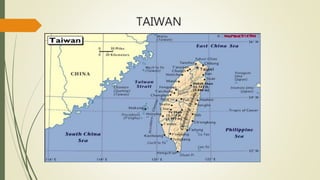
TAIWAN
TAIWAN
 Capital: Taipei
 Population: 23,519,518
 Area: 35,981 square kilometers
 Government: Unitary semi-presidential constitutional republic
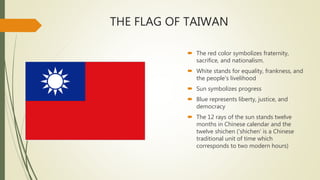
THE FLAG OF TAIWAN
 The red color symbolizes fraternity,
sacrifice, and nationalism.
 White stands for equality, frankness, and
the people's livelihood
 Sun symbolizes progress
 Blue represents liberty, justice, and
democracy
 The 12 rays of the sun stands twelve
months in Chinese calendar and the
twelve shichen ('shichen' is a Chinese
traditional unit of time which
corresponds to two modern hours)
EVENTS
 1544 -Portuguese sailors passing Taiwan record in the ship's log the name Ilha Formosa (Beautiful
Island).
 1582-Portuguese shipwreck survivors battle malaria and aborigines for ten weeks before returning to
Macau on a raft.
 1592 -Japan unsuccessfully seeks sovereignty over Taiwan (Takayamakoku 高山国 in Japanese, lit. high
mountain country)
 1604 -Dutch envoy Wijbrand van Waerwijck and his army are ordered to occupy the Pescadores in
order to open trade with China. However Ming Dynasty general Shen You-rong demanded their
withdrawal.
 1609 -Tokugawa Shogunate of Japan sends feudal lord Arima Harunobu (有馬晴信) on an exploratory
mission to Taiwan.
 1616-Nagasaki official Murayama Tōan (村山等安) leads troops on an unsuccessful invasion of Taiwan.
 1622 -Dutch envoy Cornelis Reijerszoon occupies the Pescadores in an attempt to persuade China to
open trade. The Ming court rejects his proposal.
 1624 -Ming China opens trade with the Dutch. The Dutch establish a trading base for commerce with
Japan and coastal China. Dutch official Maarten Sonk takes up his new post at Tayuan (present-day
Anping District, Tainan City) beginning the Dutch administration of Taiwan.
 Dutch begin construction of Fort Zeelandia which is completed ten years later.
EVENTS
 1626 -Spain sends an expedition to Santissima Trinidad (Keelung) and build Fort San Salvador due to
the Dutch threat to Chinese and Japanese trade to the Spanish Philippines.
 1628-Spanish establish a settlement at Tamsui and build Fort Santo Domingo in an attempt to attract
Chinese merchants.
 1642 -With the Dutch in southern Taiwan and the Spanish in northern Taiwan, confrontation
between the two adversaries were inevitable and eventually the Dutch drive the Spanish out of
Taiwan, becoming the sole ruling power on Taiwan.
 1653 -Taiwan becomes the second most profitable trading port in Asia, due to its ideal central
location between Japan, China and southeast Asia.
 1662 -Koxinga lays siege to Fort Zeelandia with the Dutch surrendering nine months later.
 1683 -Kingdom of Tungning are defeated by the Qing Empire, which has a1722 Zhu Yigui
rebellion suppressed.
 1732 - Qing forces under the administration of the Yongzheng Emperor suppress Dajiaxi (大甲西)
aboriginal rebellion.[2]
 1787–1788 -Lin Shuangwen rebellion (林爽文事件) suppressed after nine months of constant
battlingssumed full control over mainland China.
EVENTS
 1644-Manchus of the northeastern China defeated the Ming dynasty and established the Qing dynasty.
 1661-Taiwan was liberated from the Dutch by the Chinese admiral named Koxinga (Cheng-Cheng Kung)
 1683 -The Manchus of China seized the island and held it until 1895.
 1885 Taiwan became a regular province of China.
 Taiwan passed to Japan after the first Sino-Japanese war.
 1945-After World War II, Taiwan was restored to China. 1949
 The Nationalists under President Chiang Kai-shek, having lost the war against the communist on the
mainland, fled to Taiwan.
 1953-The United States helped Chiang to prevent mainland invasion by stationing a fleet in the strait of
Formosa.
 1954-Chiang Kai-shek was reelected president of Republic of China.
.
 1945-Japan (then including Taiwan) is defeated in World War II, signs Japanese Instrument of Surrender (September). United States directs
Japanese forces to surrender to ROC as per General Order No. 1 (August).
 Chen Yi of the Kuomintang is appointed as Chief Executive of Taiwan as the Republic of China proclaims October 25 as Retrocession Day.
 1947 -February 28 Incident; "White Terror" begins.
 US consulate in Taipei proposed "status of Taiwan is undetermined" and "Taiwan Under UN trustee" program in March; proposal was rejected
by the United States State Department.
 Chen Yi recalled and Taiwan Provincial Government established.
 1948-National Assembly of the Republic of China passes Temporary Provisions Effective During the Period of Communist Rebellion.
 Universal Declaration of Human Rights adopted by the United Nations General Assembly. P. C. Chang is among its authors.
 1949-The New Taiwan dollar is issued, exchanged at 1:40,000 old Taiwan dollars.
 Kuomintang army defeated in the Chinese Civil War, flees in exile to Taiwan with 2 million refugees.
 The capital of the Republic of China (ROC) relocated from Nanjing to Taipei on December 10, 1949.
 Martial law and the White Terror period. (to 1987)
 1950In late June, President Truman proclaims: "The determination of the future status of Formosa must await the restoration of security in the
Pacific, a peace settlement with Japan, or consideration by the United Nations."[citation needed]
 1951-Treaty of San Francisco officially signed by 49 nations; Japan officially renounced claims to Taiwan, but without designating a recipient.
 1952 -Treaty of San Francisco comes into force. Japan renounces all right, title, and claim to Taiwan, but no "receiving country" is designated.
However, Japan and the Republic of China then sign Sino-Japanese Peace Treaty (Treaty of Taipei).
 1953
 President Chiang began a land reform program which turned the island into one of the best
agricultural economies in the world.
 Mid-1960’s
 More than U.S.$4 billion had flowed into Taiwan’s economy. It’s foreign trade boomed. Import
doubled and export tripled.
 1971 -The seat for "China" at the United Nations Security Council is assumed by the People's
Republic of China, in place of the ROC.
 United Nations General Assembly Resolution 2758
 1972 -The United States establishes diplomatic ties with the People's Republic of China, and
acknowledges the One China Policy in the Shanghai Communique.
 1975 -President Chiang Kai-shek dies. Yen Chia-kan assumes the presidency until May 20, 1978.
 1978 -Chiang Ching-kuo elected President.
 1979 -The United States passes the Taiwan Relations Act, which affirms US commitment to defend
Taiwan militarily and to treat Taiwan as a state for most purposes of U.S. law.
 Early 1970’s -Taiwan’s international situation changed radically.
 197Taiwan lost it’s membership to UN.
 1973- US President Nixon visited Peking and established partial democratic relations with
Communist Chinese government.
 1979-US broke off diplomatic ties with Taiwan.
 1980 US-Taiwan defense treaty of 1954 lapsed.
CULTURE IN TAIWAN
 Cell phones are very popular in Taiwan. Mobile penetration rate stands at just over
100%. Because of their high use, phones in Taiwan have many functions and are
becoming cheaper.
 Internet cafes are very popular with teenagers. They often sell food. Many gamers eat
while using the internet. Many parents and teachers are concerned
 English teaching is a big business in Taiwan, with Taiwan, as part of its project to
reinvigorate the Taiwan Miracle, aiming to become a trilingual country—fluent in
Mandarin, Taiwanese, and English.
 Taiwan, like its neighbors in East Asia, is well known for its buxiban, often translated as
cram school, and literally meaning "make-up class" or "catch-up class" or to learn more
advanced classes with the amount of time youth spend in the internet cafes.
CULTURE IN TAIWAN
 Harmony / Group Relations They treat people with respect and dignity regardless of their
personal feelings. In order to maintain a sense of harmony, they will act with decorum at all
times and not do anything to cause someone else public embarrassment.
 The Concept of Face / Mien-tzu The concept of face is extremely important to the Taiwanese.
Face is difficult to translate into words but essential reflects a person's reputation, dignity, and
prestige. Face can be lost, saved or given to another person. Giving Face Face can be given to
people by complimenting them, showing them respect, or doing anything that increases their
self-esteem.
 Losing Face You can cause someone to loose face by causing someone embarrassment, and/or
tarnishing their image and reputation.
 Saving Face In the event that you cause someone to lose face, or someone is embarrassed by
circumstances that arise, the best recourse is to appropriate blame for problems that arise.
CULTURE IN TAIWAN
 "Guanxi" – Connections/Relationships Most Taiwanese business is conducted
among friends, friends of friends, and family. Such connections, or "guanxi"
(pronounced gwan-she) are developed with people at your own level or of a higher
status in both business and social situations.
 Dining Etiquette The Taiwanese prefer to entertain in public places rather than in
their home, especially when entertaining foreigners. If you are invited to a
Taiwanese home, it will happen once you have developed a relationship and should
be considered a great honour.
CULTURE IN TAIWAN
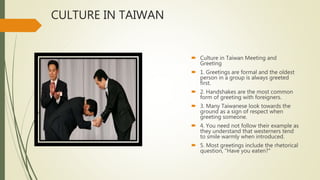
 Culture in Taiwan Meeting and
Greeting
 1. Greetings are formal and the oldest
person in a group is always greeted
first.
 2. Handshakes are the most common
form of greeting with foreigners.
 3. Many Taiwanese look towards the
ground as a sign of respect when
greeting someone.
 4. You need not follow their example as
they understand that westerners tend
to smile warmly when introduced.
 5. Most greetings include the rhetorical
question, "Have you eaten?"
CULTURE IN TAIWAN
 6. The Chinese traditionally have 3 names. The
surname, or family name is first and is followed
by one or two personal names.
 7. Chinese women do not change their names
when they marry other Chinese, and the
children’s last name will generally follow that
of the father.
 8. Often their personal names have some
poetic or otherwise significant meaning, so
asking about the meaning is a good way to
break the ice.
 9. When you are first meeting a person,
address the person by their academic,
professional, or honorific title and their
surname.
 10. If those you are meeting want to move to a
first name basis, they will advise you which
name to use.
 11. Some Chinese adopt more western names
in business and may ask you to call them by
that name.
FAMOUS LANDMARK IN TAIWAN

Taiwan(formosa)

  • 1.
  • 2.
  • 3.
    TAIWAN  Capital: Taipei Population: 23,519,518  Area: 35,981 square kilometers  Government: Unitary semi-presidential constitutional republic
  • 4.
    THE FLAG OFTAIWAN  The red color symbolizes fraternity, sacrifice, and nationalism.  White stands for equality, frankness, and the people's livelihood  Sun symbolizes progress  Blue represents liberty, justice, and democracy  The 12 rays of the sun stands twelve months in Chinese calendar and the twelve shichen ('shichen' is a Chinese traditional unit of time which corresponds to two modern hours)
  • 5.
    EVENTS  1544 -Portuguesesailors passing Taiwan record in the ship's log the name Ilha Formosa (Beautiful Island).  1582-Portuguese shipwreck survivors battle malaria and aborigines for ten weeks before returning to Macau on a raft.  1592 -Japan unsuccessfully seeks sovereignty over Taiwan (Takayamakoku 高山国 in Japanese, lit. high mountain country)  1604 -Dutch envoy Wijbrand van Waerwijck and his army are ordered to occupy the Pescadores in order to open trade with China. However Ming Dynasty general Shen You-rong demanded their withdrawal.  1609 -Tokugawa Shogunate of Japan sends feudal lord Arima Harunobu (有馬晴信) on an exploratory mission to Taiwan.  1616-Nagasaki official Murayama Tōan (村山等安) leads troops on an unsuccessful invasion of Taiwan.  1622 -Dutch envoy Cornelis Reijerszoon occupies the Pescadores in an attempt to persuade China to open trade. The Ming court rejects his proposal.  1624 -Ming China opens trade with the Dutch. The Dutch establish a trading base for commerce with Japan and coastal China. Dutch official Maarten Sonk takes up his new post at Tayuan (present-day Anping District, Tainan City) beginning the Dutch administration of Taiwan.  Dutch begin construction of Fort Zeelandia which is completed ten years later.
  • 6.
    EVENTS  1626 -Spainsends an expedition to Santissima Trinidad (Keelung) and build Fort San Salvador due to the Dutch threat to Chinese and Japanese trade to the Spanish Philippines.  1628-Spanish establish a settlement at Tamsui and build Fort Santo Domingo in an attempt to attract Chinese merchants.  1642 -With the Dutch in southern Taiwan and the Spanish in northern Taiwan, confrontation between the two adversaries were inevitable and eventually the Dutch drive the Spanish out of Taiwan, becoming the sole ruling power on Taiwan.  1653 -Taiwan becomes the second most profitable trading port in Asia, due to its ideal central location between Japan, China and southeast Asia.  1662 -Koxinga lays siege to Fort Zeelandia with the Dutch surrendering nine months later.  1683 -Kingdom of Tungning are defeated by the Qing Empire, which has a1722 Zhu Yigui rebellion suppressed.  1732 - Qing forces under the administration of the Yongzheng Emperor suppress Dajiaxi (大甲西) aboriginal rebellion.[2]  1787–1788 -Lin Shuangwen rebellion (林爽文事件) suppressed after nine months of constant battlingssumed full control over mainland China.
  • 7.
    EVENTS  1644-Manchus ofthe northeastern China defeated the Ming dynasty and established the Qing dynasty.  1661-Taiwan was liberated from the Dutch by the Chinese admiral named Koxinga (Cheng-Cheng Kung)  1683 -The Manchus of China seized the island and held it until 1895.  1885 Taiwan became a regular province of China.  Taiwan passed to Japan after the first Sino-Japanese war.  1945-After World War II, Taiwan was restored to China. 1949  The Nationalists under President Chiang Kai-shek, having lost the war against the communist on the mainland, fled to Taiwan.  1953-The United States helped Chiang to prevent mainland invasion by stationing a fleet in the strait of Formosa.  1954-Chiang Kai-shek was reelected president of Republic of China. .
  • 8.
     1945-Japan (thenincluding Taiwan) is defeated in World War II, signs Japanese Instrument of Surrender (September). United States directs Japanese forces to surrender to ROC as per General Order No. 1 (August).  Chen Yi of the Kuomintang is appointed as Chief Executive of Taiwan as the Republic of China proclaims October 25 as Retrocession Day.  1947 -February 28 Incident; "White Terror" begins.  US consulate in Taipei proposed "status of Taiwan is undetermined" and "Taiwan Under UN trustee" program in March; proposal was rejected by the United States State Department.  Chen Yi recalled and Taiwan Provincial Government established.  1948-National Assembly of the Republic of China passes Temporary Provisions Effective During the Period of Communist Rebellion.  Universal Declaration of Human Rights adopted by the United Nations General Assembly. P. C. Chang is among its authors.  1949-The New Taiwan dollar is issued, exchanged at 1:40,000 old Taiwan dollars.  Kuomintang army defeated in the Chinese Civil War, flees in exile to Taiwan with 2 million refugees.  The capital of the Republic of China (ROC) relocated from Nanjing to Taipei on December 10, 1949.  Martial law and the White Terror period. (to 1987)  1950In late June, President Truman proclaims: "The determination of the future status of Formosa must await the restoration of security in the Pacific, a peace settlement with Japan, or consideration by the United Nations."[citation needed]  1951-Treaty of San Francisco officially signed by 49 nations; Japan officially renounced claims to Taiwan, but without designating a recipient.  1952 -Treaty of San Francisco comes into force. Japan renounces all right, title, and claim to Taiwan, but no "receiving country" is designated. However, Japan and the Republic of China then sign Sino-Japanese Peace Treaty (Treaty of Taipei).
  • 9.
     1953  PresidentChiang began a land reform program which turned the island into one of the best agricultural economies in the world.  Mid-1960’s  More than U.S.$4 billion had flowed into Taiwan’s economy. It’s foreign trade boomed. Import doubled and export tripled.  1971 -The seat for "China" at the United Nations Security Council is assumed by the People's Republic of China, in place of the ROC.  United Nations General Assembly Resolution 2758  1972 -The United States establishes diplomatic ties with the People's Republic of China, and acknowledges the One China Policy in the Shanghai Communique.  1975 -President Chiang Kai-shek dies. Yen Chia-kan assumes the presidency until May 20, 1978.  1978 -Chiang Ching-kuo elected President.  1979 -The United States passes the Taiwan Relations Act, which affirms US commitment to defend Taiwan militarily and to treat Taiwan as a state for most purposes of U.S. law.
  • 10.
     Early 1970’s-Taiwan’s international situation changed radically.  197Taiwan lost it’s membership to UN.  1973- US President Nixon visited Peking and established partial democratic relations with Communist Chinese government.  1979-US broke off diplomatic ties with Taiwan.  1980 US-Taiwan defense treaty of 1954 lapsed.
  • 11.
    CULTURE IN TAIWAN Cell phones are very popular in Taiwan. Mobile penetration rate stands at just over 100%. Because of their high use, phones in Taiwan have many functions and are becoming cheaper.  Internet cafes are very popular with teenagers. They often sell food. Many gamers eat while using the internet. Many parents and teachers are concerned  English teaching is a big business in Taiwan, with Taiwan, as part of its project to reinvigorate the Taiwan Miracle, aiming to become a trilingual country—fluent in Mandarin, Taiwanese, and English.  Taiwan, like its neighbors in East Asia, is well known for its buxiban, often translated as cram school, and literally meaning "make-up class" or "catch-up class" or to learn more advanced classes with the amount of time youth spend in the internet cafes.
  • 12.
    CULTURE IN TAIWAN Harmony / Group Relations They treat people with respect and dignity regardless of their personal feelings. In order to maintain a sense of harmony, they will act with decorum at all times and not do anything to cause someone else public embarrassment.  The Concept of Face / Mien-tzu The concept of face is extremely important to the Taiwanese. Face is difficult to translate into words but essential reflects a person's reputation, dignity, and prestige. Face can be lost, saved or given to another person. Giving Face Face can be given to people by complimenting them, showing them respect, or doing anything that increases their self-esteem.  Losing Face You can cause someone to loose face by causing someone embarrassment, and/or tarnishing their image and reputation.  Saving Face In the event that you cause someone to lose face, or someone is embarrassed by circumstances that arise, the best recourse is to appropriate blame for problems that arise.
  • 13.
    CULTURE IN TAIWAN "Guanxi" – Connections/Relationships Most Taiwanese business is conducted among friends, friends of friends, and family. Such connections, or "guanxi" (pronounced gwan-she) are developed with people at your own level or of a higher status in both business and social situations.  Dining Etiquette The Taiwanese prefer to entertain in public places rather than in their home, especially when entertaining foreigners. If you are invited to a Taiwanese home, it will happen once you have developed a relationship and should be considered a great honour.
  • 14.
    CULTURE IN TAIWAN Culture in Taiwan Meeting and Greeting  1. Greetings are formal and the oldest person in a group is always greeted first.  2. Handshakes are the most common form of greeting with foreigners.  3. Many Taiwanese look towards the ground as a sign of respect when greeting someone.  4. You need not follow their example as they understand that westerners tend to smile warmly when introduced.  5. Most greetings include the rhetorical question, "Have you eaten?"
  • 15.
    CULTURE IN TAIWAN 6. The Chinese traditionally have 3 names. The surname, or family name is first and is followed by one or two personal names.  7. Chinese women do not change their names when they marry other Chinese, and the children’s last name will generally follow that of the father.  8. Often their personal names have some poetic or otherwise significant meaning, so asking about the meaning is a good way to break the ice.  9. When you are first meeting a person, address the person by their academic, professional, or honorific title and their surname.  10. If those you are meeting want to move to a first name basis, they will advise you which name to use.  11. Some Chinese adopt more western names in business and may ask you to call them by that name.
  • 16.