www.gajananshirke.com
1
Thi-Chi
Contents
www.gajananshirke.com
2
 Introduction
 Philosophy
 Physiological Foundation
 History
 Main Styles of Tai chi
 Principles
 Benefits
 Indications
 Concept
 Forms of Tai Chi
Tai Chi
www.gajananshirke.com
3
Tension is who think you should be
Relaxation is who you are - Tai Chi
Introduction
www.gajananshirke.com
4
 Thi-chi is a form of exercises that recognizes the mind
body connection.
 The movements are graceful, the tempo is slow and
benefits are great.
 It is combination of movement, breathing and mental
concentration to purify the essential life energies and
transmit it through the eight body mind channels to
every cell of the body.
Philosophy
www.gajananshirke.com
5
Ying
Dark
Feminine
Soft
Deficiency
Passive
Contracting
Yang
Light
Masculine
Hard
Expanding
Positive
Active
Excess
www.gajananshirke.com
6
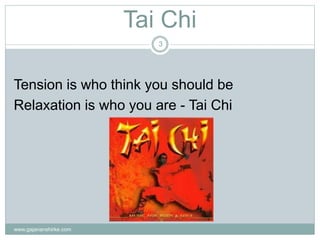
 Thi-chi essentials, a form of movement is yang-the white
portion.
 Meditation which involves quiet and rest, is yin-the black
segment.
 To perform tai chi exercise effectively requires inner
peacefulness and quiet while executing outwardly visible
movements.
 The movements of thi chi tends to increses yang side of
ying yang balance.
www.gajananshirke.com
7
 When the yang reaches its peak of energy and
vitality it generates to sit quietly- meditation-increses
yin side-cycle continues-when yin reaches peak-
yang increses-two opposite methods alternate-
obtains benefits of tai chi..
Physiological foundation
www.gajananshirke.com
8
 It is based on description of Chi or vital energy.
 The body is hypothetically composed of eight
energy channels and has 12 meridians that run
along the surface of the body.
 The eight energy channels include all parts of
trunk and extremities.
Eight Energy Channels
www.gajananshirke.com
9
1. Tu mo or channel of control---- runs along the spinal column from
the coccyx through the base of the skull and over the crown of the
head to the roof of the mouth.
2. Jen mo or channel of functions---goes through the center and front
of the body from the genital organs to the base of the mouth.
3. Tai mo or belt channel---circles the waist from the navel to the
small of the back.
4. Ch’ueng mo or thrusting channel---passes through the center of
the body between Tu mo and jen mo—extending from genitals to
the base of heart.
www.gajananshirke.com
10
5.Yang yu wei mo is positive arm channel beginning at the
navel, passing through the chest and going down the
posterior aspect of the arms to the middle finger.
6.Yin yu wei mo is negative arm channel extends of the arms
from the palms, ending in the chest.
7.Yang chiao mo is positive channel that goes down the sides of
the body and down the outer aspect of the lower extremity,
ending at the soles.
8.Yin chiao mo is negative channel starts from the soles and
extends upwards on the inside of the legs through the center
of the body to a point just below the eyebrows.
Overview of Histroy
www.gajananshirke.com
11
 The origin of tai chi can’t
be easily summarized. We
don’t know who founded tai
chi or in what year (or
century) that occurred.
Instead, there are three
major theories about the
origin of tai chi.
www.gajananshirke.com
12
Theory 1. Snake vs Crane.
Theory 2. A Mysterious
Stranger Brings Tai Chi
to the Chen Village.
Theory 3. A Seasoned
Chen Fighter Creates
Tai Chi.
www.gajananshirke.com
13
Tai Chi for National Health in China.
Although disdainful of the religious aspects of tai chi and
also wanting to suppress the potential threat posed by
skilled tai chi fighters, the Chinese government
nevertheless embraced the health benefits of tai chi.
The government even created and promoted simple
forms of tai chi. In 1956, the Chinese Sports Committee
created the Beijing short form, probably the most popular
form practiced today.
www.gajananshirke.com
14
 Tai chi is now the national exercise of China. With
support from the government, tai chi has since moved out
from the underground and into universities and
government-supported sports and martial arts programs
in China.
 Tai Chi Today - Currently, there are over 200 million
practitioners of tai chi throughout the world. From its
roots in China, its popularity has spread to become a
form of exercise appreciated around the globe for its
health, stress control, and self defense benefits.
Five main styles of Tai-Chi
www.gajananshirke.com
15
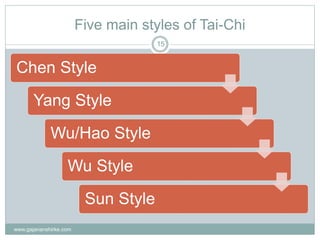
Chen Style
Yang Style
Wu/Hao Style
Wu Style
Sun Style
Yang style
www.gajananshirke.com
16
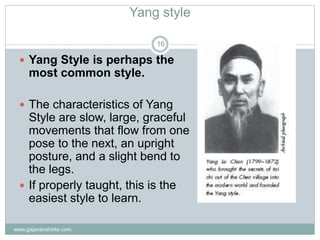
 Yang Style is perhaps the
most common style.
 The characteristics of Yang
Style are slow, large, graceful
movements that flow from one
pose to the next, an upright
posture, and a slight bend to
the legs.
 If properly taught, this is the
easiest style to learn.
Principle
www.gajananshirke.com
17
1. Slowing down
2. Take it easy
3. Thinking in curves
4. Be simple
5. Sink lower
6. Balance your movements
7. Stay balance
8. Move the whole package
9. Go with the flow
10. Stay rooted
www.gajananshirke.com
18
 Slowing down
This is the grand ultimate principle of T'ai Chi. The
stillness that comes with slowness is what T'ai Chi is
all about. You get all the benefits of T'ai Chi only
when you do it slowly.
 Take it easy
Forcing things is contrary to T'ai Chi principles.
Physical and mental stress make you tense and you
get all the movements wrong.
 Thinking in curves
Movement in T'ai Chi is always curved and circular,
never straight and linear. This allows one movement
to flow seamlessly to the next and promotes a better
flow of your chi (energy).
www.gajananshirke.com
19
 Be simple-
Simplicity is the essence of T'ai Chi. A mind, which is
filled with dogmas, assertions, quotes, is really an
uncreative mind. Live fully, live naturally. And be simple
to your core.
 Sink lower-
Relaxed and slightly bent knees firmly ground you,
letting energy flow from the earth into your body. This
also allows you to overpower your opponent by getting
beneath his or her energy centre.
Balance your movements-
Just as all things in the universe are reciprocal, T'ai Chi
is about balancing your moves- for example, forward
and back, weight-bearing and non-weight bearing and
reach and pull back. This is based on the ancient
Chinese philosophy of Yin and Yang, in which all things
are opposing yet complementary.
www.gajananshirke.com
20
 Stay balanced-
The importance of good balance cannot be over-
emphasised- be it T'ai Chi or real life. Both
physically and mentally, good balance is
essential to T'ai Chi.
 Move the whole package-
In the practice of T'ai Chi, all parts of the body
are linked together and every movement
involves the whole body. When one part of the
body moves, every part moves. When one part
is still, every part is still.
 Go with the flow-
In the practice of T'ai Chi, the movements are
performed slowly and softly, yet there is an
underlying strength; just as silk is both soft and
strong. Move and think as if you are on wheels,
with no jerky movements.
www.gajananshirke.com
21
Stay rooted
If there is no root, there is no fruit.
Always feel that you are firmly planted in the ground.
This applies not only to T'ai Chi, but to life.
www.gajananshirke.com 22
www.gajananshirke.com
23
1.  Muscle Strength
2. Enhance Flexibility
3.  Balance
4.  Energy Levels
5.  Concentration
6. Enhance Organ Function
7.  immunity against virus
infection
8.  tension headache
www.gajananshirke.com
24
9. Benefit patients with heart disease
10.  arthritis and back pain
11. Prevent depression
12.  sleep
13. Enhance the Functioning of the
Cardiovascular, Circulatory, Respiratory And
Nervous Systems
14. Contribute To A Feeling Of General Wellbeing
Indications
www.gajananshirke.com
25
 Rheumatoid Arthritis
 Osteoarthritis
 Low back ache
 Vertigo
 Hepatitis
 Fibromyalgia
 Nervous disorders
Ankylosing spondylitis
Anxiety
Depression
Hypertension
 Asthma
 Insomnia
 Multiple sclerosis
 Parkinson’s disease
• Chronic pain
Core Concept
www.gajananshirke.com
26
Breathing Alignment Energy
www.gajananshirke.com
27
 Breathing :
Diaphragmatic breathing
 Alignment:
a. Feet placed parallel, about shoulder-width
apart.
b. Knees slightly bent, but not beyond the toes.
c. Pelvis tilted slightly forward and upward.
d. Head lifted up as if supported by a string.
e. Shoulders, arms, wrists, and fingers relaxed.
f. Tip of tongue placed lightly on roof of mouth,
just behind front teeth.
 Energy
Physical settings for practicing
www.gajananshirke.com
28
 Time
 Venue
 Music
Progress to Tai Chi
www.gajananshirke.com
29
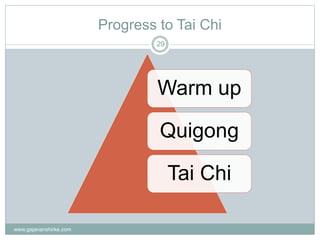
Warm up
Quigong
Tai Chi
Warm up
www.gajananshirke.com
30
Eye Crunches
Neck Bends
Shoulder Shrugs
Fingers
Wrists
Elbows and Shoulders
Shoulder Circles
Shoulder Stretches
Waist and Hips
Washing Machine
Waist Bends
Ankle Circles
Knee Bends
Qigong
www.gajananshirke.com
31
 Qigong is the little sister of Tai-Chi.
 Qigong is a series of movements that contains
many of the T’ai Chi principles and most of the
benefits of T’ai Chi practice.
 You can perform Qigong standing, sitting down,
even lying down.
www.gajananshirke.com
32
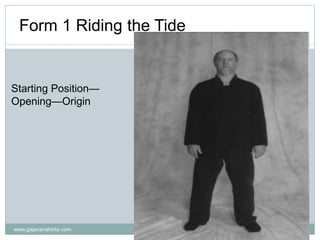
Form 1 Riding the Tide
Starting Position—
Opening—Origin
www.gajananshirke.com
33
Form 2
Opening the
Chest
(Gimme a Hug!)
www.gajananshirke.com 34
www.gajananshirke.com
35
Form 3
Painting the Rainbow
Steps:-
www.gajananshirke.com
36
Form 4
Parting the Clouds
www.gajananshirke.com
37
www.gajananshirke.com
38
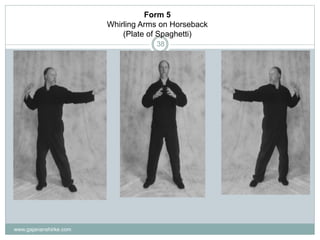
Form 5
Whirling Arms on Horseback
(Plate of Spaghetti)
www.gajananshirke.com
39
Form 6
Rowing on the Lake
www.gajananshirke.com
40
Form 7
Holding a Ball at Shoulder Level
(Scooping the Ice Cream)
www.gajananshirke.com
41
Form 8
Gazing at the Moon Over the Shoulder
www.gajananshirke.com
42
Form 9
Press Palms Across the Body
www.gajananshirke.com
43
Form 10
Wave Hands Like Clouds
(The Non-Attachment Exercise)
www.gajananshirke.com
44
www.gajananshirke.com
45
www.gajananshirke.com
46
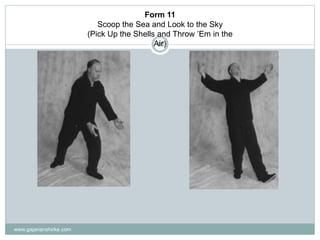
Form 11
Scoop the Sea and Look to the Sky
(Pick Up the Shells and Throw ’Em in the
Air)
www.gajananshirke.com
47
Form 12
Set the Waves Rolling (*Push the
Refrigerator)
www.gajananshirke.com
48
Form 13
Dove Spreads Wings
www.gajananshirke.com
49
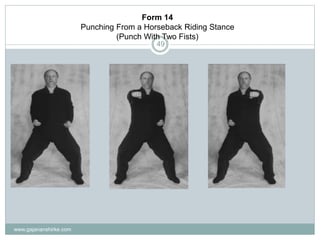
Form 14
Punching From a Horseback Riding Stance
(Punch With Two Fists)
www.gajananshirke.com
50
Form 15
Wild Goose in Flight
www.gajananshirke.com
51
Form 16
Turning the Windmill
www.gajananshirke.com
52
Form 17
Marching in Place While Bouncing the Ball
www.gajananshirke.com
53
Form 18
Press Palms and Calm Down (Closing)
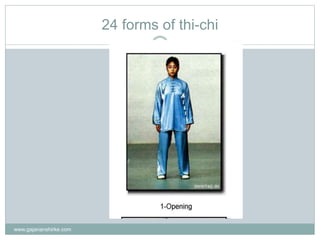
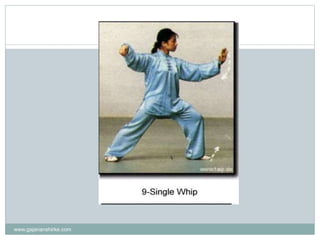
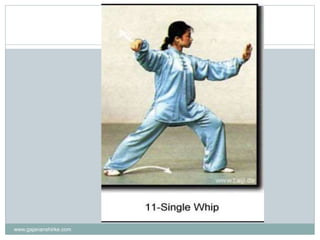
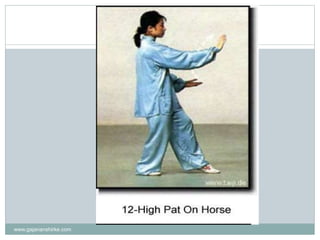
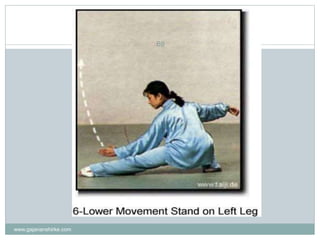
24 forms of thi-chi
www.gajananshirke.com
54
www.gajananshirke.com
55
www.gajananshirke.com
56
www.gajananshirke.com
57
www.gajananshirke.com
58
www.gajananshirke.com
59
www.gajananshirke.com
60
www.gajananshirke.com
61
www.gajananshirke.com
62
www.gajananshirke.com
63
www.gajananshirke.com
64
www.gajananshirke.com
65
www.gajananshirke.com
66
www.gajananshirke.com
67
www.gajananshirke.com
68
www.gajananshirke.com
69
www.gajananshirke.com
70
www.gajananshirke.com
71
www.gajananshirke.com
72
www.gajananshirke.com
73
www.gajananshirke.com
74
www.gajananshirke.com
75
www.gajananshirke.com
76
www.gajananshirke.com
77
www.gajananshirke.com
78THANK YOU

Tai chi philosophy