18.08.2008
Tahaarat
Ritual
Purification
Tahaarat
Contents and Hyperlinks
Introduction
Tahaarat
The Concept
Najis
The Concept
Ritual Purity
and Cleanliness
The Purifying agent :
Water
Major Ablution
Ghusl
Minor Ablution
Wuzu
Minor Ablution
Tayammum
Tahaarat
Other Applications Conclusion
Tahaarat
An Introduction
: Tahaarat :
Literally means
‘cleanliness
and
keeping free of states of impurity’
Tahaarat
An Introduction
 Purification particularly centered on the preparation for Salaat
 Tahaarat is rendered invalid by certain acts
 Ritual purification takes the form of ablution,
in a lesser and greater form
depending on necessitating circumstances
Tahaarat
The
Concept
Quran
Surah al Maida: 6
“O you who believe! When you rise up for prayer, wash you
faces, and your hands up to the elbows, and lightly rub your
heads and (wash) your feet up to the ankles. And if you are
unclean, purify yourselves”
Tahaarat
A unique aspect
 Islamic Prayers are unique in that physical purification is a
must
The Prophet saw
said:
"Allah does not accept Prayers without purification"
Hadith
Sahih Muslim
The Holy Prophet saw
has stated
“The key to paradise is Salaat,
and the key to salaat is Taharat”
Najis
The
Concept
Najis
The Concept
 In Islamic law, Najis (Arabic: ) are things or persons regarded
as ritually unclean
 There are two kinds of Najis
The essential Najis, which cannot be cleaned
and unessential Najis, which becomes
Najis by contact
Najis
The Concept
 Najis things bring a Muslim into a state of ritual
impurity (najaasat)
 Najaasat requires ritual purification or Tahaarat before
performing any religious duty
Najaasah
Impurity
 Najaasat (plural of najaasah) means impurities or defilements
 It is of two types :
 Haqeeqi : Visible impurities, eg urine; faeces; blood, or wine
 Hukmi : Invisible impurities
Najaasat
Types
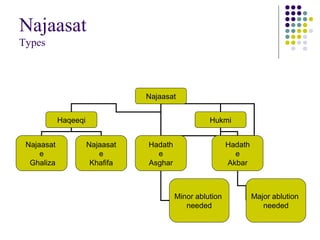
Najaasat
Haqeeqi Hukmi
Najaasat
e
Ghaliza
Najaasat
e
Khafifa
Hadath
e
Asghar
Hadath
e
Akbar
Minor ablution
needed
Major ablution
needed
Najaasat
Types
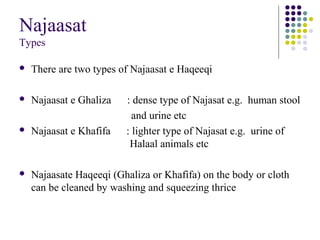
 There are two types of Najaasat e Haqeeqi
 Najaasat e Ghaliza : dense type of Najasat e.g. human stool
and urine etc
 Najaasat e Khafifa : lighter type of Najasat e.g. urine of
Halaal animals etc
 Najaasate Haqeeqi (Ghaliza or Khafifa) on the body or cloth
can be cleaned by washing and squeezing thrice
Najaasat
Some examples
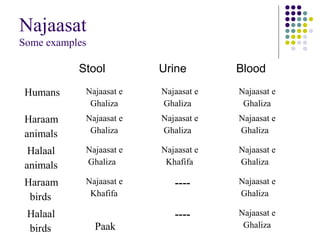
Stool Urine Blood
Humans Najaasat e
Ghaliza
Najaasat e
Ghaliza
Najaasat e
Ghaliza
Haraam
animals
Najaasat e
Ghaliza
Najaasat e
Ghaliza
Najaasat e
Ghaliza
Halaal
animals
Najaasat e
Ghaliza
Najaasat e
Khafifa
Najaasat e
Ghaliza
Haraam
birds
Najaasat e
Khafifa
---- Najaasat e
Ghaliza
Halaal
birds Paak
---- Najaasat e
Ghaliza
Hadath
The Concept
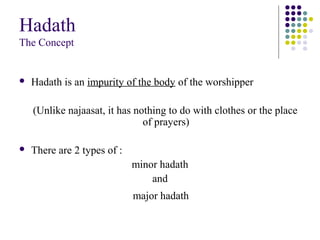
 Hadath is an impurity of the body of the worshipper
(Unlike najaasat, it has nothing to do with clothes or the place
of prayers)
 There are 2 types of :
minor hadath
and
major hadath
       
Minor Hadath
Hadath e Asghar
 State of ritual impurity which can be removed by minor
ablution (Wuzu)
Results from :
1. Sleeping
2. Flatus or urine
3. Unconsciousness because of fainting or being drunk
4. Touching the opposite sex between marriageable persons
5. Touching genitalia by the inside part of the palm
Minor Hadath
Hadath e Asghar
 On awakening one has Hadath
 On coming out from the toilet one has Hadath
 If a man touches his mother or sister or grandmother or aunt,
no Hadath occurs
Major Hadath
Hadath e Akbar
A state of major ritual impurity that requires
the greater ablution (ghusl) before one can
 pray,
 stay at the mosque,
 circumambulate the Kaaba,
 touch, carry, or recite the Quran .
Major Hadath
Hadath e Akbar
Actions that place one in the state of Hadath e Akbar
 Discharge of mani
 Sexual intercourse with or without ejaculation
(Both states called Janabat)
 Menstruation
 Post natal bleeding
Tahaarat
Ritual
Purity
&
Cleanliness
Tahaarat
Definition
 The term Tahaarat can be defined as
"freedom from najaasat
and from hadath."
Tahaarat
What is it ?
 Observing purity and cleanliness of the body, clothes and
surroundings as per Islamic prescription
Obligatory upon every Muslim
and a prerequisite of Salaat
 Purifying agent is water

Dry ablution possible, called Tayammum
Tahaarat
It’s categories
 Of 2 types :
- physical tahaarat
- spiritual or inner tahaarat
 Physical tahaarat achieved by using water to remove a
physical pollution
Tahaarat
It’s categories
Spiritual or inner taharah is achieved by :
 cultivating virtues (kindness, helpfulness)
 repentance
 freeing heart of vices (hatred, jealousy)
Hadith
Bukhari, Kitab ul Wuzu
The Holy Prophet saw
gave glad tidings that
"On the day of Resurrection, my followers will be called
"Ghurrul Muhajjaleen" the bright armed and bright faced,
from the traces of ablution on them. Therefore, whosoever can
increase the area of his radiance should try to do so by always
performing ablution before the prayers”
Tahaarat
It’s value
The Holy Prophet saw
has said :
'purification is half of faith.'
Inner purity (by salaat) is the real aim
but outer purity is a mandatory prerequisite
Tahaarat
It’s value
The Holy Prophet saw
has said :
'purification is half of faith.'
 Inner purity (by salaat) is the real aim
but outer purity is a mandatory prerequisite
 Ablution five times a day ensures constant physical purity
 A pure mind in a pure body is the watchword of Islam
Tahaarat
It’s importance
 Allah is clean and whosoever loves Him must be clean
(externally as well as internally)
Salaat is contact with Allah &
is unacceptable without cleanliness and purity
Hadith
Abu Dawood
The Holy Prophet saw
said
“The angels of mercy do not enter a house in which there is an
image, a dog or a person in a state of greater impurity
(Janabah)”
Tahaarat
An expectation
Muslims are expected
to be the cleanest
by performing ablutions
at least five times a day
Tahaarat
A ritual ablution
 Ritual ablution mandatory for
- salaat
- touching the Quran
- Haj/ umrah
- Azaan
 Ablution can be
- major or
- minor
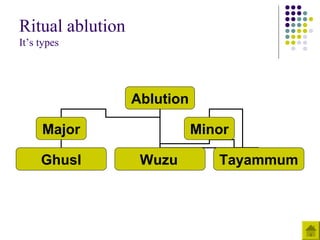
Ritual ablution
It’s types
Ablution
Major Minor
Ghusl Wuzu Tayammum
The Purifying agent
Water
Water
The purifying agent
Water used for ablution must be in its natural state
- free from colour
- odourless
- tasteless
- it must be unused
Water
Criteria of it’s purity
1. Used water is Mustamal water.
It is Taahir, but Wuzu or Ghusl not allowed with it
2. Water from which a drunk person, cat after eating a living
creature, dogs, pigs or carnivores have drunk is Najis
Water left by a cat (not after eating a mouse etc), cow or
buffalo or hen that eats anything Napaak, crow and other
haraam birds is Makrooh
Water
Criteria of it’s purity
3. Left over water of humans & Halaal animals is Taahir
4. Water becomes Najis if Najasat falls in it EXCEPT :

flowing water of river or sea

water stored in large quantity (reservoir or huge tanks)
Water
Criteria of it’s purity
5. Stored water covering 21 x 21 feet & deep enough so that a
person can take out water with his hands without baring the
ground, is large quantity of water
Death of animals/birds having flowing blood in water of a
small quantity will make it NAJIS
Water
Criteria of it’s purity
6. Big tanks and reservoirs becomes Najis when the taste,
colour or odour of the Najasat becomes apparent
7. Aquatic animals or insects not having flowing blood, e.g.
flies, ants etc do not make water Najis if they die in it
Taahir Water
 Wuzu and ghusl is allowed with :-
 1. Rain water
2. Well water
3. Spring, sea or river water
4. Water of melting snow or hail
5. Water of a big tank or pond
 Water left over after drinking by humans, Halaal animals and
Halaal birds
Major Ablution
Ghusl
Major Ablution
Ghusl
Ghusl mandatory after :
 Discharge of semen
 Intercourse (semen discharged or not)
 Completion of menses
 After childbirth or miscarriage
 Conversion to Islam
Ghusl
as per Sunnah
 Niyah for bathing
 First wash hands up to the wrists
 Wash privates
 Then clean any impure area and perform ablution, without
washing the feet. If having a bath on a stand (high area) you may
wash the feet
Ghusl
as per Sunnah
 Rub water (like applying oil) on the body to wet it
 Pour water thrice over right shoulder then over left
 Pour water over head thrice
 Then thrice over rest of body
Ghusl
as per Sunnah
 Wash feet after moving away from bathing area
 Do not face the Qiblah
 Do not recite any supplications
 Bathe in privacy
Ghusl
Some rules
 Performed standing or preferably seated
 Use sufficient water but do not waste
 Abstain from speaking during Ghusl
 Better not to read any Kalimah or Aayat while bathing
 Without Niyah there is no sawab but Ghusl valid
 Niyyah for ghusl :‘I am performing ghusl to become paak’
Ghusl
It’s Faraaiz
The 3 Farz acts in ghusl are :
1. Gargling : Water must reach the base of the throat
2. Inhaling water : up to the nose bone
3. Washing the entire body
(water flows over every part of the body, not leaving dry
any spot equal to the breadth of a hair)
Ghusl
Sunnahs
The 5 sunnahs in Ghusl are :
1. Washing hands upto the wrists
2. Washing private and unclean parts
3. Niyat of washing off Hukmi Najaasat
4. Wuzu before washing the body
5. Pouring water thrice over entire body
Ghusl
Certain Masaail
 Leave head dry if harmful. On recovery, washing the head is
Wajib
 Do not delay in wearing clothes after Ghusl
 Do not remove ointment from a wound during Ghusl.
Pour water over it if it is safe.
 Ghusl precludes need for wuzu
Ghusl
Certain Masaail
 Cutting nails & removing hair from armpits, pubic region
before ghusl
- Preferable weekly
- Sinful beyond 40 days
 Ghusl mandatory for Janabat (Hadath e Akbar)
 Ghusl also compulsory after Haiz & Nifaas
(Haiz: maximum period 10 days & Nifaas: bleeding after childbirth.
maximum period 40 days)
Cutting the nails
The ideal way
 Start at finger for Shahaadat
 Then cut nails of other 3 fingers (of right hand)
 Continue with small finger of left hand and complete the other
fingers and thumb in sequence
 Lastly, cut nail of the right thumb
(Start cutting toenails of the small toe of right foot and end at small toe of the
left foot)
Minor Ablution
Wuzu
Minor Ablution
Wuzu & Tayammum
 Minor ablution performed :
- with water, called wuzu
or
- sand or earth, called tayammum
 Wuzu cleanses in a permanent fashion (unless broken)
 Tayammum must be re-performed before each salaat
What is Wuzu
 Wuzu in the Shari'ah is :
 Use of Tahir water upon certain body parts
as Allah has prescribed and explained
Quran
Surah al Maidah : 6
 Quranic prescription for Wuzu
“O Ye who believe! When ye prepare for prayer, wash your
faces, and your hands (and arms) to the elbows; rub your
heads (with water); and (wash) your feet to the ankles. And if
you are unclean, purify yourselves”
Hadith
Sahih Muslim 1/160
 Ibn Umar ra
said :
“Indeed I heard Rasoolullah saw
say:
Allah does not accept Prayer without purification,
nor Sadaqah from illegally attained wealth.”
Hadith
Sahih Muslim 1/148
Rasoolullah saw
said
“When the Muslim servant makes wuzu and washes his face
then the sin of everything he looked at with his eye comes
away with the water, or with the last drop of the water, and
when he washes his hands then the sin of everything he
stretched out his hands to comes away with the water, or with
the last drop of the water. And when he washes his feet every
sin which his feet walked towards comes away with the water
or with the last drop of the water - so that he leaves clean
(clear/pure) from sins.”
Wuzu
It’s method
 Make Niyah
 Saying Bismillah wash hands up to the wrists
 Use Miswaak
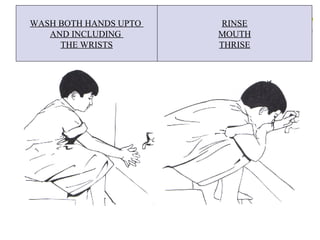
WASH BOTH HANDS UPTO
AND INCLUDING
THE WRISTS
RINSE
MOUTH
THRISE
Wuzu
It’s method
 Rinse mouth thrice
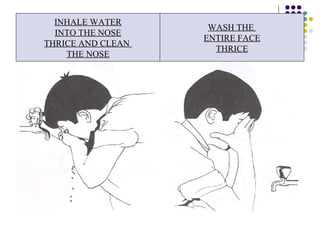
 Inhale water into nose thrice
(clean nose with little finger of left hand)
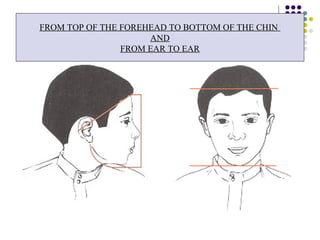
 Wash face thrice
(forehead to bottom of chin and from ear to ear)
 Run fingers through beard
INHALE WATER
INTO THE NOSE
THRICE AND CLEAN
THE NOSE
WASH THE
ENTIRE FACE
THRICE
FROM TOP OF THE FOREHEAD TO BOTTOM OF THE CHIN
AND
FROM EAR TO EAR
Wuzu
It’s method
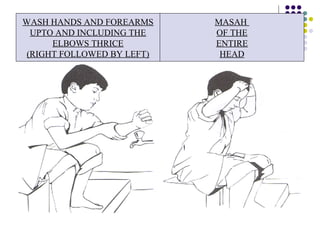
 Wash hands and forearm upto elbows thrice
(right first)
 Masah of entire head
WASH HANDS AND FOREARMS
UPTO AND INCLUDING THE
ELBOWS THRICE
(RIGHT FOLLOWED BY LEFT)
MASAH
OF THE
ENTIRE
HEAD
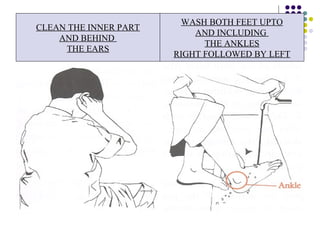
CLEAN THE INNER PART
AND BEHIND
THE EARS
WASH BOTH FEET UPTO
AND INCLUDING
THE ANKLES
RIGHT FOLLOWED BY LEFT
Wuzu
It’s method
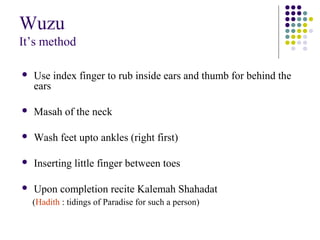
 Use index finger to rub inside ears and thumb for behind the
ears
 Masah of the neck
 Wash feet upto ankles (right first)
 Inserting little finger between toes
 Upon completion recite Kalemah Shahadat
(Hadith : tidings of Paradise for such a person)
Aspects of Wuzu
Miswaak
 Miswaak is that which the teeth is brushed with.
 It is also called the Siwaak (plural: Sook)
 Doing Miswaak is Mustahab
 Siwaak is usually got from Araak tree
Hence, a natural toothbrush
Aspects of Wuzu
Miswaak
 It is also a form of worship
 The Prophet saw
used siwaak :
- during every wuzu
- before reading the Quran
- before sleeping and on waking
- and whenever the breath changed
Hadith
Abu Dawood no. 37
 Abu Hurairah ra
narrates that
Rasoolullah saw
has said :
“If I did not fear to cause hardship to my Ummah,
I would have ordered them to use the siwaak with every wuzu”
Hadith
Sahih Bukhari
 Aaishah ra
narrates that
Rasoolullah saw
said
“The siwaak is a means of cleansing the mouth and
pleasing the Lord”
Aspects of Wuzu
Masah over socks
 If socks worn after Wuzu, then for 24 hours, Masah over them
is enough, if they have not been taken off
 In journey, one can do Masah over socks for 3 days
Wuzu
Four obligatory acts
 Washing face :
(top of forehead to bottom of chin & from ear to ear)
 Washing hands up to elbows
 Masah of one fourth of the head
 Washing feet
Wuzu
Sunnahs
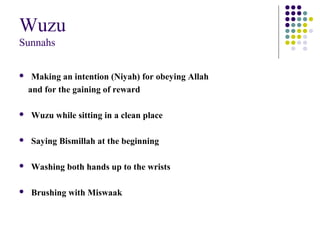
 Making an intention (Niyah) for obeying Allah
and for the gaining of reward
 Wuzu while sitting in a clean place
 Saying Bismillah at the beginning
 Washing both hands up to the wrists
 Brushing with Miswaak
Wuzu
Sunnahs
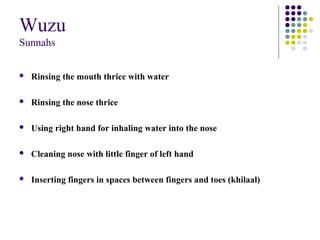
 Rinsing the mouth thrice with water
 Rinsing the nose thrice
 Using right hand for inhaling water into the nose
 Cleaning nose with little finger of left hand
 Inserting fingers in spaces between fingers and toes (khilaal)
Wuzu
Sunnahs
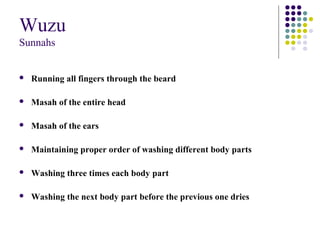
 Running all fingers through the beard
 Masah of the entire head
 Masah of the ears
 Maintaining proper order of washing different body parts
 Washing three times each body part
 Washing the next body part before the previous one dries
Wuzu
Important points
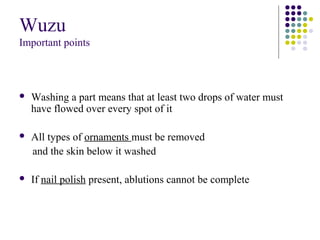
 Washing a part means that at least two drops of water must
have flowed over every spot of it
 All types of ornaments must be removed
and the skin below it washed
 If nail polish present, ablutions cannot be complete
Wuzu
It’s nullifiers
Nawaqid of Wuzu are :
 Passage of any waste matter from the body
 Vomiting mouthfuls
 Discharge of blood or pus
 Sleeping while taking support
 Flow of water from an infected eye
 Laughing out loud whilst in Prayer
 Loss of consciousness, or onset of insanity
Important point
 Bad odour :
Odour of cigarettes, raw onions, etc.
is offensive to both the Musallies and the Malaa'ikah.
After smoking wash mouth thoroughly before entering the
Masjid
Minor Ablution
Tayammum
What is Tayammum
 Literally means "aim or purpose"
 In Islamic law, it refers to :
"aiming for or seeking soil to wipe one's face and hands
with the intention of preparing oneself to pray, and so on"
Quran
On tayammum
 Surah al Nisaa, verse 43

Quran
Surah al Nisaa, verse 43
 The Qur'an says,
"And if you are ill, or on a journey, or one of you comes from
relieving himself, or you have touched women, and you do not
find water, then go to high clean soil and rub your face and
hands (therewith). Lo, Allah is Benign, Forgiving"
(al-Nisaa: 43)
Hadith
About tayammum
 The Prophet, upon whom be peace, said,
"All of the earth has been made for me and my nation a pure
place of prayer. Whenever a person from my nation wants to
pray, he has something with which to purify himself, that is,
the earth.“
(Related by Ahmad)
Hadith
Sahih al Bukhari
 Tayammum is viewed as a blessing from Allah to the Muslims
The Prophet saw
said :
"I have been given five things that were not given to anyone before
me: I have been made victorious due to fear for a distance of one
month's journey; the earth has been made a place of prayer for me--
wherever and whoever of my nation wants to pray, he may pray; and
the war booty has been made lawful for me, and this was not lawful
for anyone before me. I have been given permission to intercede. The
prophets used to be raised for their own people only, but I have been
raised for all of mankind"
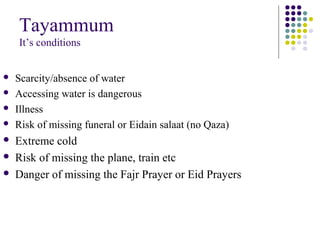
Tayammum
It’s conditions
 Scarcity/absence of water
 Accessing water is dangerous
 Illness
 Risk of missing funeral or Eidain salaat (no Qaza)
 Extreme cold
 Risk of missing the plane, train etc
 Danger of missing the Fajr Prayer or Eid Prayers
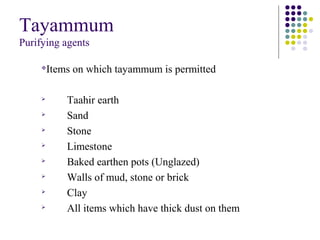
Tayammum
Purifying agents

Items on which tayammum is permitted

Taahir earth

Sand

Stone

Limestone

Baked earthen pots (Unglazed)

Walls of mud, stone or brick

Clay

All items which have thick dust on them
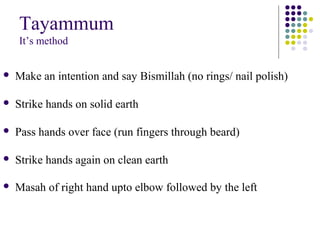
Tayammum
It’s method
 Make an intention and say Bismillah (no rings/ nail polish)
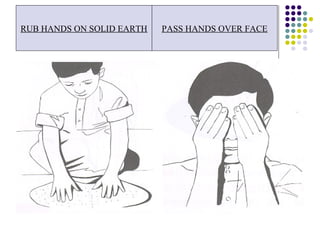
 Strike hands on solid earth
 Pass hands over face (run fingers through beard)
 Strike hands again on clean earth
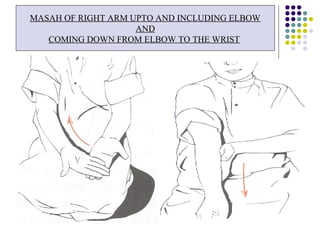
 Masah of right hand upto elbow followed by the left
RUB HANDS ON SOLID EARTH PASS HANDS OVER FACE
MASAH OF RIGHT ARM UPTO AND INCLUDING ELBOW
AND
COMING DOWN FROM ELBOW TO THE WRIST
Tayammum
Obligatory acts
Three acts are obligatory
 Intention (Niyah) whether Tayammum is for ablution or
for bath or both
 Passing palms over entire face
 Passing palms over both arms up to and including the
elbows
Tahaarat
Other
Applications
Purifying
Impure clothes
 Wash the clothes with soap
 Put them in a bucket
 Pour water until clothes submerged & bucket starts to
overflow
 The flowing water will render the clothes pure
Purifying
The ground
Impurities on the ground purified by pouring water over them
 Hadith about the Bedouin who urinated in the mosque.
.
The Prophet saw
said all that need be done for purification was
pouring of water over it
Said Abu Qulabah,
"The drying of the ground is its purification."
One who has no means of
Tahaarat
Whoever cannot get water or soil
may pray in whatever state he is in
and
he will not have to repeat his prayer later
Hadith
Muslim
 Based on what Muslim related from Hazrat Aishah (ra)
She had borrowed some jewelry from Asma and it broke (and
fell). The Messenger of Allah, upon whom be peace, sent
some people to search for it. The prayer time came and they
had to pray without ablution. When they came to the Prophet,
they complained to him and the verses of tayammum were
revealed. Usaid ibn Huzhair said, "May Allah give you good
recompense. Allah never reveals an order with respect to you
except that He removes by it some hardship and gives the
Muslims some benefit." The companions prayed while in a
state of impurity, but the Prophet did not admonish them nor
did he order them to repeat their prayers.
Says an-Nawawi, "That is the strongest statement of proof (on
this question)."
Tahaarat
Conclusion
Tahaarat
A part of Iman
 Purification is an inseparable part of faith
"Purification is half of faith"
Sahih al Jami al-Saghir
Hadith No.3957
Tahaarat
A part of Iman
 Tahaarat includes both
 moral purification
 where one is free from polytheism, hypocrisy and ill
manners
 physical purification
 means private and public cleanliness
Tahaarat
A part of Iman
 A desire for Tahaarat will encourage
physical
mental
spiritual
and social well being

Tahaarat

  • 1.
  • 2.
    Tahaarat Contents and Hyperlinks Introduction Tahaarat TheConcept Najis The Concept Ritual Purity and Cleanliness The Purifying agent : Water Major Ablution Ghusl Minor Ablution Wuzu Minor Ablution Tayammum Tahaarat Other Applications Conclusion
  • 3.
    Tahaarat An Introduction : Tahaarat: Literally means ‘cleanliness and keeping free of states of impurity’
  • 4.
    Tahaarat An Introduction  Purificationparticularly centered on the preparation for Salaat  Tahaarat is rendered invalid by certain acts  Ritual purification takes the form of ablution, in a lesser and greater form depending on necessitating circumstances
  • 5.
  • 6.
    Quran Surah al Maida:6 “O you who believe! When you rise up for prayer, wash you faces, and your hands up to the elbows, and lightly rub your heads and (wash) your feet up to the ankles. And if you are unclean, purify yourselves”
  • 7.
    Tahaarat A unique aspect Islamic Prayers are unique in that physical purification is a must The Prophet saw said: "Allah does not accept Prayers without purification"
  • 8.
    Hadith Sahih Muslim The HolyProphet saw has stated “The key to paradise is Salaat, and the key to salaat is Taharat”
  • 9.
  • 10.
    Najis The Concept  InIslamic law, Najis (Arabic: ) are things or persons regarded as ritually unclean  There are two kinds of Najis The essential Najis, which cannot be cleaned and unessential Najis, which becomes Najis by contact
  • 11.
    Najis The Concept  Najisthings bring a Muslim into a state of ritual impurity (najaasat)  Najaasat requires ritual purification or Tahaarat before performing any religious duty
  • 12.
    Najaasah Impurity  Najaasat (pluralof najaasah) means impurities or defilements  It is of two types :  Haqeeqi : Visible impurities, eg urine; faeces; blood, or wine  Hukmi : Invisible impurities
  • 13.
  • 14.
    Najaasat Types  There aretwo types of Najaasat e Haqeeqi  Najaasat e Ghaliza : dense type of Najasat e.g. human stool and urine etc  Najaasat e Khafifa : lighter type of Najasat e.g. urine of Halaal animals etc  Najaasate Haqeeqi (Ghaliza or Khafifa) on the body or cloth can be cleaned by washing and squeezing thrice
  • 15.
    Najaasat Some examples Stool UrineBlood Humans Najaasat e Ghaliza Najaasat e Ghaliza Najaasat e Ghaliza Haraam animals Najaasat e Ghaliza Najaasat e Ghaliza Najaasat e Ghaliza Halaal animals Najaasat e Ghaliza Najaasat e Khafifa Najaasat e Ghaliza Haraam birds Najaasat e Khafifa ---- Najaasat e Ghaliza Halaal birds Paak ---- Najaasat e Ghaliza
  • 16.
    Hadath The Concept  Hadathis an impurity of the body of the worshipper (Unlike najaasat, it has nothing to do with clothes or the place of prayers)  There are 2 types of : minor hadath and major hadath        
  • 17.
    Minor Hadath Hadath eAsghar  State of ritual impurity which can be removed by minor ablution (Wuzu) Results from : 1. Sleeping 2. Flatus or urine 3. Unconsciousness because of fainting or being drunk 4. Touching the opposite sex between marriageable persons 5. Touching genitalia by the inside part of the palm
  • 18.
    Minor Hadath Hadath eAsghar  On awakening one has Hadath  On coming out from the toilet one has Hadath  If a man touches his mother or sister or grandmother or aunt, no Hadath occurs
  • 19.
    Major Hadath Hadath eAkbar A state of major ritual impurity that requires the greater ablution (ghusl) before one can  pray,  stay at the mosque,  circumambulate the Kaaba,  touch, carry, or recite the Quran .
  • 20.
    Major Hadath Hadath eAkbar Actions that place one in the state of Hadath e Akbar  Discharge of mani  Sexual intercourse with or without ejaculation (Both states called Janabat)  Menstruation  Post natal bleeding
  • 21.
  • 22.
    Tahaarat Definition  The termTahaarat can be defined as "freedom from najaasat and from hadath."
  • 23.
    Tahaarat What is it?  Observing purity and cleanliness of the body, clothes and surroundings as per Islamic prescription Obligatory upon every Muslim and a prerequisite of Salaat  Purifying agent is water  Dry ablution possible, called Tayammum
  • 24.
    Tahaarat It’s categories  Of2 types : - physical tahaarat - spiritual or inner tahaarat  Physical tahaarat achieved by using water to remove a physical pollution
  • 25.
    Tahaarat It’s categories Spiritual orinner taharah is achieved by :  cultivating virtues (kindness, helpfulness)  repentance  freeing heart of vices (hatred, jealousy)
  • 26.
    Hadith Bukhari, Kitab ulWuzu The Holy Prophet saw gave glad tidings that "On the day of Resurrection, my followers will be called "Ghurrul Muhajjaleen" the bright armed and bright faced, from the traces of ablution on them. Therefore, whosoever can increase the area of his radiance should try to do so by always performing ablution before the prayers”
  • 27.
    Tahaarat It’s value The HolyProphet saw has said : 'purification is half of faith.' Inner purity (by salaat) is the real aim but outer purity is a mandatory prerequisite
  • 28.
    Tahaarat It’s value The HolyProphet saw has said : 'purification is half of faith.'  Inner purity (by salaat) is the real aim but outer purity is a mandatory prerequisite  Ablution five times a day ensures constant physical purity  A pure mind in a pure body is the watchword of Islam
  • 29.
    Tahaarat It’s importance  Allahis clean and whosoever loves Him must be clean (externally as well as internally) Salaat is contact with Allah & is unacceptable without cleanliness and purity
  • 30.
    Hadith Abu Dawood The HolyProphet saw said “The angels of mercy do not enter a house in which there is an image, a dog or a person in a state of greater impurity (Janabah)”
  • 31.
    Tahaarat An expectation Muslims areexpected to be the cleanest by performing ablutions at least five times a day
  • 32.
    Tahaarat A ritual ablution Ritual ablution mandatory for - salaat - touching the Quran - Haj/ umrah - Azaan  Ablution can be - major or - minor
  • 33.
  • 34.
  • 35.
    Water The purifying agent Waterused for ablution must be in its natural state - free from colour - odourless - tasteless - it must be unused
  • 36.
    Water Criteria of it’spurity 1. Used water is Mustamal water. It is Taahir, but Wuzu or Ghusl not allowed with it 2. Water from which a drunk person, cat after eating a living creature, dogs, pigs or carnivores have drunk is Najis Water left by a cat (not after eating a mouse etc), cow or buffalo or hen that eats anything Napaak, crow and other haraam birds is Makrooh
  • 37.
    Water Criteria of it’spurity 3. Left over water of humans & Halaal animals is Taahir 4. Water becomes Najis if Najasat falls in it EXCEPT :  flowing water of river or sea  water stored in large quantity (reservoir or huge tanks)
  • 38.
    Water Criteria of it’spurity 5. Stored water covering 21 x 21 feet & deep enough so that a person can take out water with his hands without baring the ground, is large quantity of water Death of animals/birds having flowing blood in water of a small quantity will make it NAJIS
  • 39.
    Water Criteria of it’spurity 6. Big tanks and reservoirs becomes Najis when the taste, colour or odour of the Najasat becomes apparent 7. Aquatic animals or insects not having flowing blood, e.g. flies, ants etc do not make water Najis if they die in it
  • 40.
    Taahir Water  Wuzuand ghusl is allowed with :-  1. Rain water 2. Well water 3. Spring, sea or river water 4. Water of melting snow or hail 5. Water of a big tank or pond  Water left over after drinking by humans, Halaal animals and Halaal birds
  • 41.
  • 42.
    Major Ablution Ghusl Ghusl mandatoryafter :  Discharge of semen  Intercourse (semen discharged or not)  Completion of menses  After childbirth or miscarriage  Conversion to Islam
  • 43.
    Ghusl as per Sunnah Niyah for bathing  First wash hands up to the wrists  Wash privates  Then clean any impure area and perform ablution, without washing the feet. If having a bath on a stand (high area) you may wash the feet
  • 44.
    Ghusl as per Sunnah Rub water (like applying oil) on the body to wet it  Pour water thrice over right shoulder then over left  Pour water over head thrice  Then thrice over rest of body
  • 45.
    Ghusl as per Sunnah Wash feet after moving away from bathing area  Do not face the Qiblah  Do not recite any supplications  Bathe in privacy
  • 46.
    Ghusl Some rules  Performedstanding or preferably seated  Use sufficient water but do not waste  Abstain from speaking during Ghusl  Better not to read any Kalimah or Aayat while bathing  Without Niyah there is no sawab but Ghusl valid  Niyyah for ghusl :‘I am performing ghusl to become paak’
  • 47.
    Ghusl It’s Faraaiz The 3Farz acts in ghusl are : 1. Gargling : Water must reach the base of the throat 2. Inhaling water : up to the nose bone 3. Washing the entire body (water flows over every part of the body, not leaving dry any spot equal to the breadth of a hair)
  • 48.
    Ghusl Sunnahs The 5 sunnahsin Ghusl are : 1. Washing hands upto the wrists 2. Washing private and unclean parts 3. Niyat of washing off Hukmi Najaasat 4. Wuzu before washing the body 5. Pouring water thrice over entire body
  • 49.
    Ghusl Certain Masaail  Leavehead dry if harmful. On recovery, washing the head is Wajib  Do not delay in wearing clothes after Ghusl  Do not remove ointment from a wound during Ghusl. Pour water over it if it is safe.  Ghusl precludes need for wuzu
  • 50.
    Ghusl Certain Masaail  Cuttingnails & removing hair from armpits, pubic region before ghusl - Preferable weekly - Sinful beyond 40 days  Ghusl mandatory for Janabat (Hadath e Akbar)  Ghusl also compulsory after Haiz & Nifaas (Haiz: maximum period 10 days & Nifaas: bleeding after childbirth. maximum period 40 days)
  • 51.
    Cutting the nails Theideal way  Start at finger for Shahaadat  Then cut nails of other 3 fingers (of right hand)  Continue with small finger of left hand and complete the other fingers and thumb in sequence  Lastly, cut nail of the right thumb (Start cutting toenails of the small toe of right foot and end at small toe of the left foot)
  • 52.
  • 53.
    Minor Ablution Wuzu &Tayammum  Minor ablution performed : - with water, called wuzu or - sand or earth, called tayammum  Wuzu cleanses in a permanent fashion (unless broken)  Tayammum must be re-performed before each salaat
  • 54.
    What is Wuzu Wuzu in the Shari'ah is :  Use of Tahir water upon certain body parts as Allah has prescribed and explained
  • 55.
    Quran Surah al Maidah: 6  Quranic prescription for Wuzu “O Ye who believe! When ye prepare for prayer, wash your faces, and your hands (and arms) to the elbows; rub your heads (with water); and (wash) your feet to the ankles. And if you are unclean, purify yourselves”
  • 56.
    Hadith Sahih Muslim 1/160 Ibn Umar ra said : “Indeed I heard Rasoolullah saw say: Allah does not accept Prayer without purification, nor Sadaqah from illegally attained wealth.”
  • 57.
    Hadith Sahih Muslim 1/148 Rasoolullahsaw said “When the Muslim servant makes wuzu and washes his face then the sin of everything he looked at with his eye comes away with the water, or with the last drop of the water, and when he washes his hands then the sin of everything he stretched out his hands to comes away with the water, or with the last drop of the water. And when he washes his feet every sin which his feet walked towards comes away with the water or with the last drop of the water - so that he leaves clean (clear/pure) from sins.”
  • 58.
    Wuzu It’s method  MakeNiyah  Saying Bismillah wash hands up to the wrists  Use Miswaak
  • 59.
    WASH BOTH HANDSUPTO AND INCLUDING THE WRISTS RINSE MOUTH THRISE
  • 60.
    Wuzu It’s method  Rinsemouth thrice  Inhale water into nose thrice (clean nose with little finger of left hand)  Wash face thrice (forehead to bottom of chin and from ear to ear)  Run fingers through beard
  • 61.
    INHALE WATER INTO THENOSE THRICE AND CLEAN THE NOSE WASH THE ENTIRE FACE THRICE
  • 62.
    FROM TOP OFTHE FOREHEAD TO BOTTOM OF THE CHIN AND FROM EAR TO EAR
  • 63.
    Wuzu It’s method  Washhands and forearm upto elbows thrice (right first)  Masah of entire head
  • 64.
    WASH HANDS ANDFOREARMS UPTO AND INCLUDING THE ELBOWS THRICE (RIGHT FOLLOWED BY LEFT) MASAH OF THE ENTIRE HEAD
  • 65.
    CLEAN THE INNERPART AND BEHIND THE EARS WASH BOTH FEET UPTO AND INCLUDING THE ANKLES RIGHT FOLLOWED BY LEFT
  • 66.
    Wuzu It’s method  Useindex finger to rub inside ears and thumb for behind the ears  Masah of the neck  Wash feet upto ankles (right first)  Inserting little finger between toes  Upon completion recite Kalemah Shahadat (Hadith : tidings of Paradise for such a person)
  • 67.
    Aspects of Wuzu Miswaak Miswaak is that which the teeth is brushed with.  It is also called the Siwaak (plural: Sook)  Doing Miswaak is Mustahab  Siwaak is usually got from Araak tree Hence, a natural toothbrush
  • 68.
    Aspects of Wuzu Miswaak It is also a form of worship  The Prophet saw used siwaak : - during every wuzu - before reading the Quran - before sleeping and on waking - and whenever the breath changed
  • 69.
    Hadith Abu Dawood no.37  Abu Hurairah ra narrates that Rasoolullah saw has said : “If I did not fear to cause hardship to my Ummah, I would have ordered them to use the siwaak with every wuzu”
  • 70.
    Hadith Sahih Bukhari  Aaishahra narrates that Rasoolullah saw said “The siwaak is a means of cleansing the mouth and pleasing the Lord”
  • 71.
    Aspects of Wuzu Masahover socks  If socks worn after Wuzu, then for 24 hours, Masah over them is enough, if they have not been taken off  In journey, one can do Masah over socks for 3 days
  • 72.
    Wuzu Four obligatory acts Washing face : (top of forehead to bottom of chin & from ear to ear)  Washing hands up to elbows  Masah of one fourth of the head  Washing feet
  • 73.
    Wuzu Sunnahs  Making anintention (Niyah) for obeying Allah and for the gaining of reward  Wuzu while sitting in a clean place  Saying Bismillah at the beginning  Washing both hands up to the wrists  Brushing with Miswaak
  • 74.
    Wuzu Sunnahs  Rinsing themouth thrice with water  Rinsing the nose thrice  Using right hand for inhaling water into the nose  Cleaning nose with little finger of left hand  Inserting fingers in spaces between fingers and toes (khilaal)
  • 75.
    Wuzu Sunnahs  Running allfingers through the beard  Masah of the entire head  Masah of the ears  Maintaining proper order of washing different body parts  Washing three times each body part  Washing the next body part before the previous one dries
  • 76.
    Wuzu Important points  Washinga part means that at least two drops of water must have flowed over every spot of it  All types of ornaments must be removed and the skin below it washed  If nail polish present, ablutions cannot be complete
  • 77.
    Wuzu It’s nullifiers Nawaqid ofWuzu are :  Passage of any waste matter from the body  Vomiting mouthfuls  Discharge of blood or pus  Sleeping while taking support  Flow of water from an infected eye  Laughing out loud whilst in Prayer  Loss of consciousness, or onset of insanity
  • 78.
    Important point  Badodour : Odour of cigarettes, raw onions, etc. is offensive to both the Musallies and the Malaa'ikah. After smoking wash mouth thoroughly before entering the Masjid
  • 79.
  • 80.
    What is Tayammum Literally means "aim or purpose"  In Islamic law, it refers to : "aiming for or seeking soil to wipe one's face and hands with the intention of preparing oneself to pray, and so on"
  • 81.
    Quran On tayammum  Surahal Nisaa, verse 43 
  • 82.
    Quran Surah al Nisaa,verse 43  The Qur'an says, "And if you are ill, or on a journey, or one of you comes from relieving himself, or you have touched women, and you do not find water, then go to high clean soil and rub your face and hands (therewith). Lo, Allah is Benign, Forgiving" (al-Nisaa: 43)
  • 83.
    Hadith About tayammum  TheProphet, upon whom be peace, said, "All of the earth has been made for me and my nation a pure place of prayer. Whenever a person from my nation wants to pray, he has something with which to purify himself, that is, the earth.“ (Related by Ahmad)
  • 84.
    Hadith Sahih al Bukhari Tayammum is viewed as a blessing from Allah to the Muslims The Prophet saw said : "I have been given five things that were not given to anyone before me: I have been made victorious due to fear for a distance of one month's journey; the earth has been made a place of prayer for me-- wherever and whoever of my nation wants to pray, he may pray; and the war booty has been made lawful for me, and this was not lawful for anyone before me. I have been given permission to intercede. The prophets used to be raised for their own people only, but I have been raised for all of mankind"
  • 85.
    Tayammum It’s conditions  Scarcity/absenceof water  Accessing water is dangerous  Illness  Risk of missing funeral or Eidain salaat (no Qaza)  Extreme cold  Risk of missing the plane, train etc  Danger of missing the Fajr Prayer or Eid Prayers
  • 86.
    Tayammum Purifying agents  Items onwhich tayammum is permitted  Taahir earth  Sand  Stone  Limestone  Baked earthen pots (Unglazed)  Walls of mud, stone or brick  Clay  All items which have thick dust on them
  • 87.
    Tayammum It’s method  Makean intention and say Bismillah (no rings/ nail polish)  Strike hands on solid earth  Pass hands over face (run fingers through beard)  Strike hands again on clean earth  Masah of right hand upto elbow followed by the left
  • 88.
    RUB HANDS ONSOLID EARTH PASS HANDS OVER FACE
  • 89.
    MASAH OF RIGHTARM UPTO AND INCLUDING ELBOW AND COMING DOWN FROM ELBOW TO THE WRIST
  • 90.
    Tayammum Obligatory acts Three actsare obligatory  Intention (Niyah) whether Tayammum is for ablution or for bath or both  Passing palms over entire face  Passing palms over both arms up to and including the elbows
  • 91.
  • 92.
    Purifying Impure clothes  Washthe clothes with soap  Put them in a bucket  Pour water until clothes submerged & bucket starts to overflow  The flowing water will render the clothes pure
  • 93.
    Purifying The ground Impurities onthe ground purified by pouring water over them  Hadith about the Bedouin who urinated in the mosque. . The Prophet saw said all that need be done for purification was pouring of water over it Said Abu Qulabah, "The drying of the ground is its purification."
  • 94.
    One who hasno means of Tahaarat Whoever cannot get water or soil may pray in whatever state he is in and he will not have to repeat his prayer later
  • 95.
    Hadith Muslim  Based onwhat Muslim related from Hazrat Aishah (ra) She had borrowed some jewelry from Asma and it broke (and fell). The Messenger of Allah, upon whom be peace, sent some people to search for it. The prayer time came and they had to pray without ablution. When they came to the Prophet, they complained to him and the verses of tayammum were revealed. Usaid ibn Huzhair said, "May Allah give you good recompense. Allah never reveals an order with respect to you except that He removes by it some hardship and gives the Muslims some benefit." The companions prayed while in a state of impurity, but the Prophet did not admonish them nor did he order them to repeat their prayers. Says an-Nawawi, "That is the strongest statement of proof (on this question)."
  • 96.
  • 97.
    Tahaarat A part ofIman  Purification is an inseparable part of faith "Purification is half of faith" Sahih al Jami al-Saghir Hadith No.3957
  • 98.
    Tahaarat A part ofIman  Tahaarat includes both  moral purification  where one is free from polytheism, hypocrisy and ill manners  physical purification  means private and public cleanliness
  • 99.
    Tahaarat A part ofIman  A desire for Tahaarat will encourage physical mental spiritual and social well being