Enhancing life-long learning, teaching and research through
information resources and services

08 November 2013

1
Talis Aspire Digitised Content
(TADC): from request to delivery
– Live and Kicking!
Dorothy Atherton, Services Manager - Resource Acquisitions and Supply

08 November 2013

2
Overview – Where are we
now and where are we
going?

• How did we get here?
– Review of transition from pilot to live
• Where are we now?
• Where are we going?
– Future Developments
– Measuring Value – what is the impact of TADC?
– How will we know when we’ve arrived?

08 November 2013

3
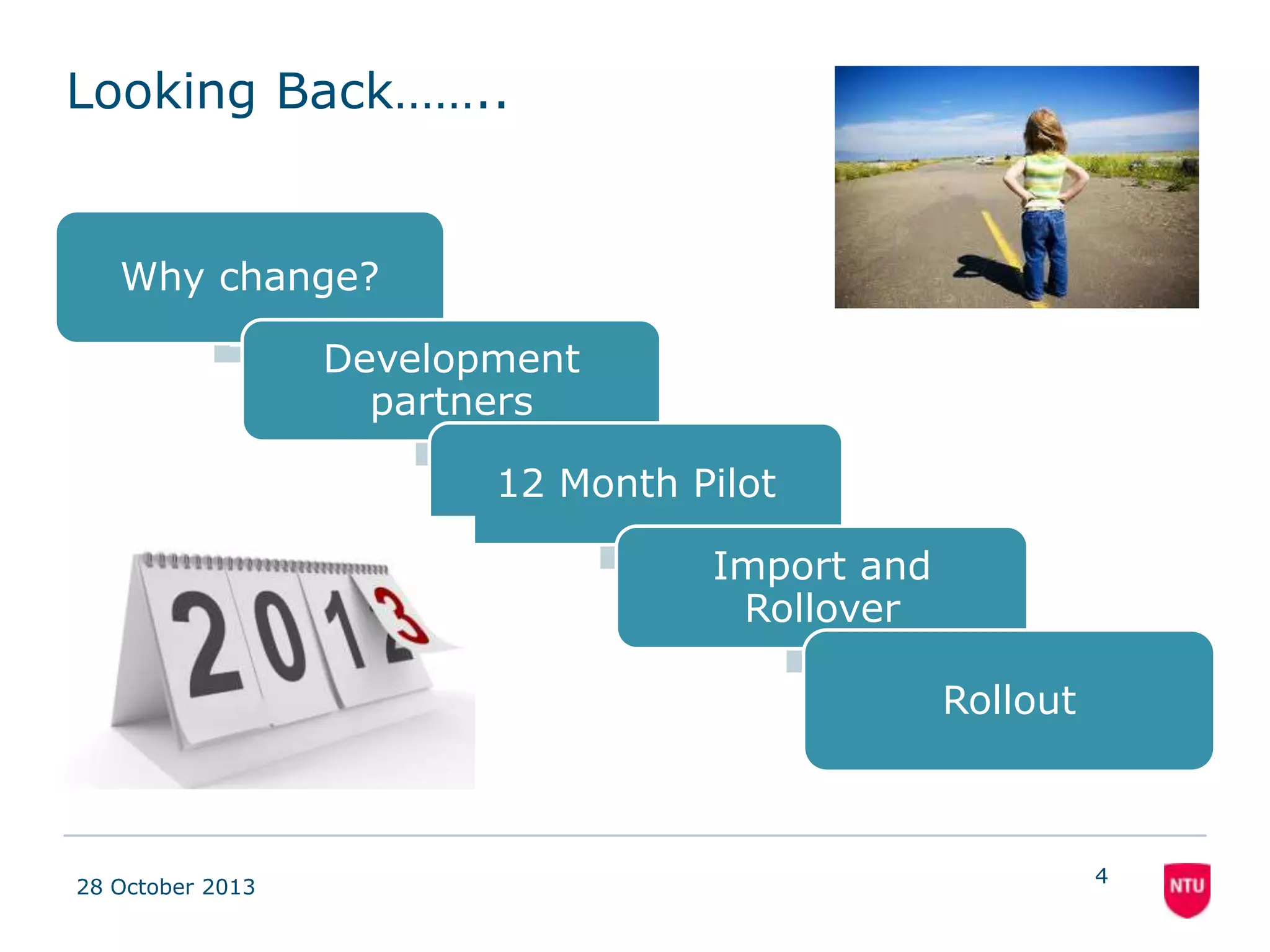
Looking Back……..

Why change?
12 Month Pilot
Development
partners
Import
Rollout

08 November 2013

4
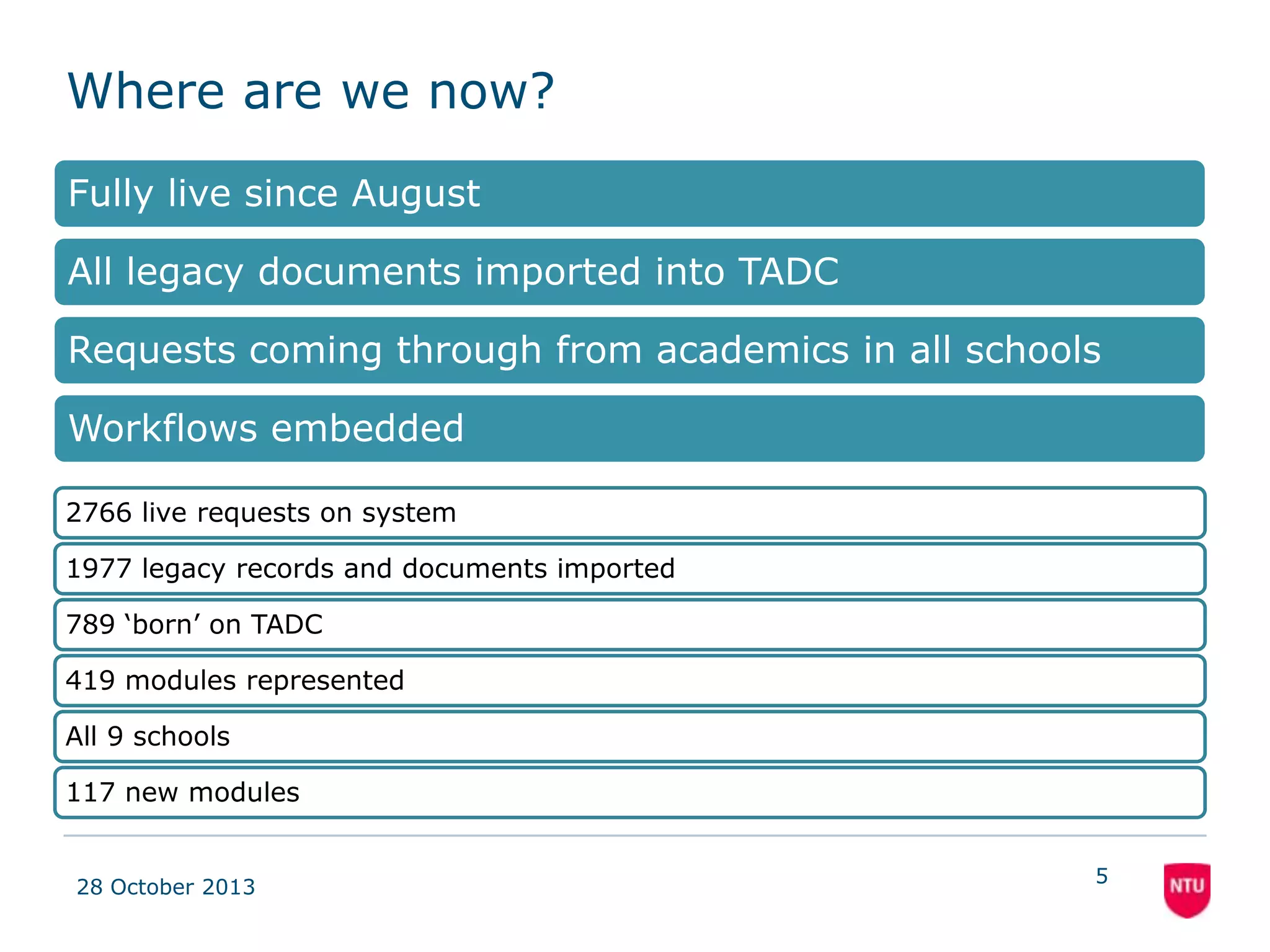
Where are we now?
Fully live since beginning of October
All legacy documents imported into TADC

Requests coming through from academics in all schools
Workflows embedded
2797active requests on system (99 in process, 2698 live)
1977 legacy records and documents imported
131 new requests since rollout
506 modules represented
All 9 schools

26 new modules since rollout
08 November 2013

5
2 questions for the
future:
How can the product be
improved even further?

How can we measure the
real value and impact of
TADC?

08 November 2013

6
From A to A*
•Rollover
•Reporting
•2 way communication with academic from
within TADC
• Better integration of TADC and TARL
• Facility to add manually to the request log

• Communication with the BL

08 November 2013

7
Measuring the value of
TADC
Financial
Compliance with CLA licence
Copyright awareness
User experience:
Academics

Students
Library Staff
08 November 2013

8
Financial
•Cost of software
•Staff time
– Time spent processing original request
– Time spent scanning and creating clean PDF
– Time spent attaching cover sheet and uploading

133 hours
No saving

– Time spent rolling over at year end

125 hours

– Time spent processing requests ultimately rejected
– Time spent corresponding with academics

50 hours
100 hours

– Time wasted in peaks on troughs of annual
digitisation cycle

08 November 2013

63 hours

475 hours

9
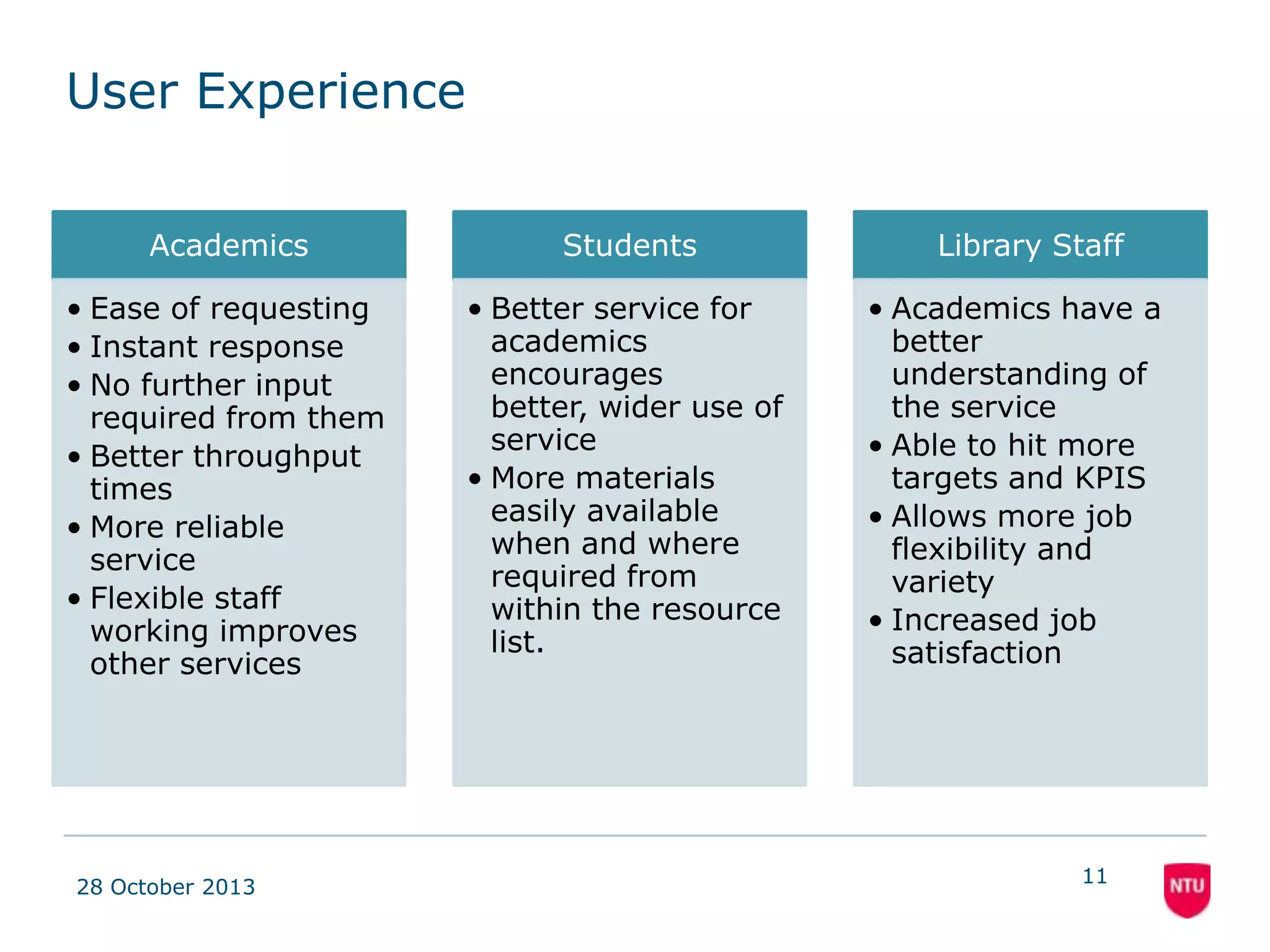
Compliance with Licence
– Concierge checks against authority sources and applies
rules consistently
– Less decision-making responsibility for staff
– Academics get instant feedback on compliance
– Library staff not the bad guys, and academic staff more
aware of issues
– TADC is context sensitive
– Structured decisions can be tracked and monitored
– Sentry controls access to documents stored in the vault
– Gives us more control over digitised content
– Greater automation of the rollover process
– Allows more efficient, timely completion
08 November 2013

10
This in turn leads to…….
• More flexible staff

• Measure through cross-over of staff
• Smoothing of peaks and troughs in service
• Measure through more consistent achievement of KPIs across all
services

• Greater job satisfaction
• Measure through absence rates, staff turnover, surveys PDCR etc
• Greater general awareness of copyright issues
• Measure through fall in number of rejected requests and requests
requiring supply of further information
• Fewer calls from the CLA!
08 November 2013

11
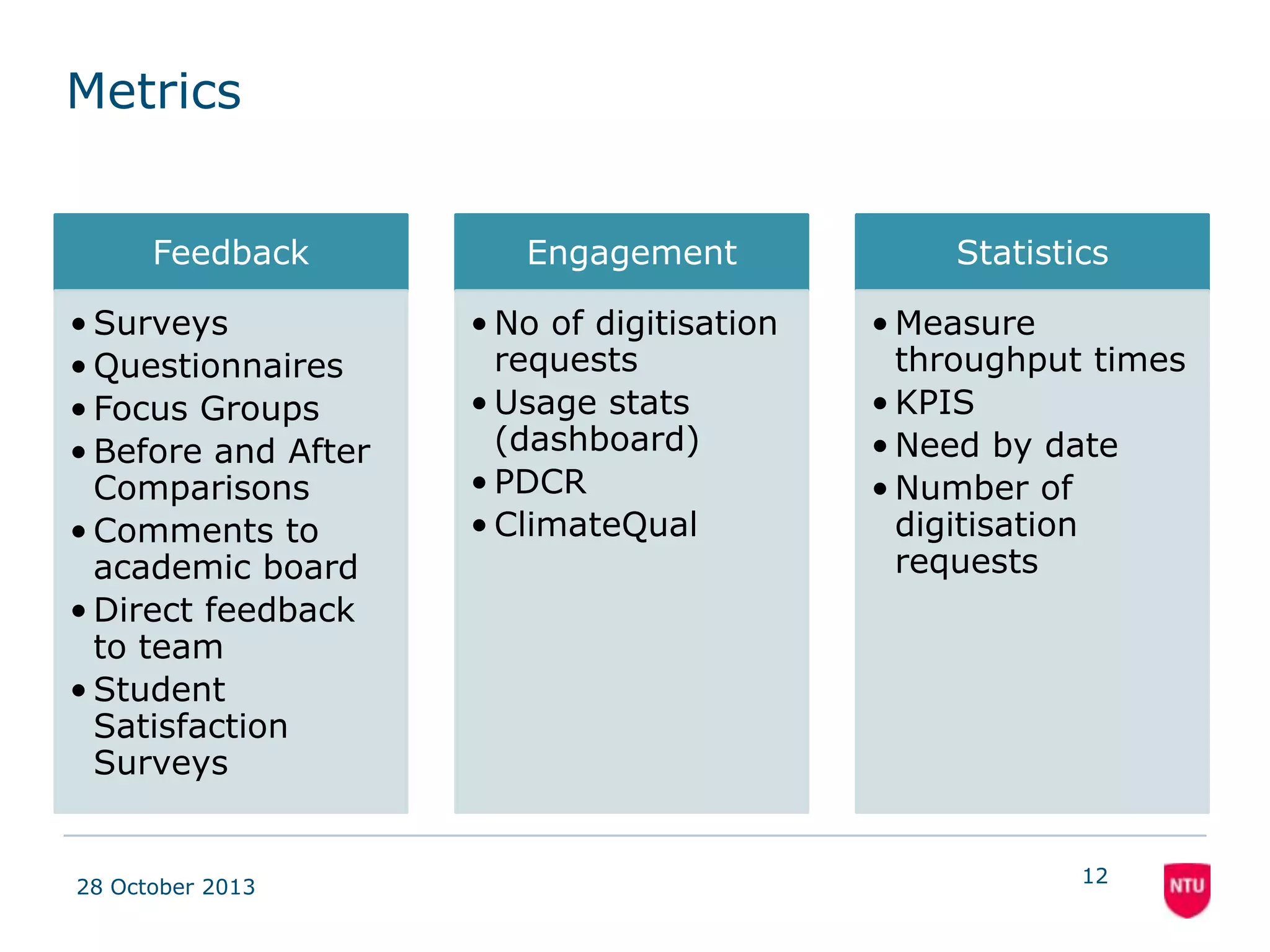
Academic Staff
•

Ease of requesting

•

Instant response

• More digitisation requests

− Regular stats

•
•

Better throughput times
More efficient reliable
service

•

Flexible working
improves other services

•

More awareness of
copyright issues
− Fewer rejected
requests
− More queries

No further input required
from them

•
•

Increased satisfaction
with the service
− Formal/Informal
feedback

08 November 2013

12
Students
• Better service for
academics encourages
better, wider use of
service
• More materials easily
available when and
where required from
within the resource list.
• All digitised materials
available from within
the resource list
08 November 2013

• Greater use of digitised
documents
− Usage Stats
• Increased satisfaction
with the service
− Formal/Informal
feedback
• Increased word of
mouth pressure on
academics to engage
with service
13
Simplicity
Clarity
Confidence
Transformative
Enabling

08 November 2013

14
Any Questions?

Want to know more about TADC?
dorothy.atherton@ntu.ac.uk

08 November 2013

15
No of Requests Between 01/10 and 22/10
140

120
100
80
60
40
20
0

08 November 2013

16

Assessing the Impact, Value and Future of Implementing Talis Aspire Digitised Content at Nottingham Trent University (Open Day, 24th Oct 2013)

  • 1.
    Enhancing life-long learning,teaching and research through information resources and services 08 November 2013 1
  • 2.
    Talis Aspire DigitisedContent (TADC): from request to delivery – Live and Kicking! Dorothy Atherton, Services Manager - Resource Acquisitions and Supply 08 November 2013 2
  • 3.
    Overview – Whereare we now and where are we going? • How did we get here? – Review of transition from pilot to live • Where are we now? • Where are we going? – Future Developments – Measuring Value – what is the impact of TADC? – How will we know when we’ve arrived? 08 November 2013 3
  • 4.
    Looking Back…….. Why change? 12Month Pilot Development partners Import Rollout 08 November 2013 4
  • 5.
    Where are wenow? Fully live since beginning of October All legacy documents imported into TADC Requests coming through from academics in all schools Workflows embedded 2797active requests on system (99 in process, 2698 live) 1977 legacy records and documents imported 131 new requests since rollout 506 modules represented All 9 schools 26 new modules since rollout 08 November 2013 5
  • 6.
    2 questions forthe future: How can the product be improved even further? How can we measure the real value and impact of TADC? 08 November 2013 6
  • 7.
    From A toA* •Rollover •Reporting •2 way communication with academic from within TADC • Better integration of TADC and TARL • Facility to add manually to the request log • Communication with the BL 08 November 2013 7
  • 8.
    Measuring the valueof TADC Financial Compliance with CLA licence Copyright awareness User experience: Academics Students Library Staff 08 November 2013 8
  • 9.
    Financial •Cost of software •Stafftime – Time spent processing original request – Time spent scanning and creating clean PDF – Time spent attaching cover sheet and uploading 133 hours No saving – Time spent rolling over at year end 125 hours – Time spent processing requests ultimately rejected – Time spent corresponding with academics 50 hours 100 hours – Time wasted in peaks on troughs of annual digitisation cycle 08 November 2013 63 hours 475 hours 9
  • 10.
    Compliance with Licence –Concierge checks against authority sources and applies rules consistently – Less decision-making responsibility for staff – Academics get instant feedback on compliance – Library staff not the bad guys, and academic staff more aware of issues – TADC is context sensitive – Structured decisions can be tracked and monitored – Sentry controls access to documents stored in the vault – Gives us more control over digitised content – Greater automation of the rollover process – Allows more efficient, timely completion 08 November 2013 10
  • 11.
    This in turnleads to……. • More flexible staff • Measure through cross-over of staff • Smoothing of peaks and troughs in service • Measure through more consistent achievement of KPIs across all services • Greater job satisfaction • Measure through absence rates, staff turnover, surveys PDCR etc • Greater general awareness of copyright issues • Measure through fall in number of rejected requests and requests requiring supply of further information • Fewer calls from the CLA! 08 November 2013 11
  • 12.
    Academic Staff • Ease ofrequesting • Instant response • More digitisation requests − Regular stats • • Better throughput times More efficient reliable service • Flexible working improves other services • More awareness of copyright issues − Fewer rejected requests − More queries No further input required from them • • Increased satisfaction with the service − Formal/Informal feedback 08 November 2013 12
  • 13.
    Students • Better servicefor academics encourages better, wider use of service • More materials easily available when and where required from within the resource list. • All digitised materials available from within the resource list 08 November 2013 • Greater use of digitised documents − Usage Stats • Increased satisfaction with the service − Formal/Informal feedback • Increased word of mouth pressure on academics to engage with service 13
  • 14.
  • 15.
    Any Questions? Want toknow more about TADC? dorothy.atherton@ntu.ac.uk 08 November 2013 15
  • 16.
    No of RequestsBetween 01/10 and 22/10 140 120 100 80 60 40 20 0 08 November 2013 16

Editor's Notes

  • #6 1 of 3 universities acting as Development PartnersPiloted for 12 monthsDuring August imported all legacy docs (more of this later!)Went fully live at the beginning of termImport didn’t go as smoothly as expected – that’s the lot of a development partner – we take the strain so that those who follow get an easier ride!Took the chance to tidy up our recordsRenamedAdded record to TARL if necessaryMade a note of anything that needed editing (eg notes directing student to NOW), source and/or chapterSent PDFs on a disc – an omen of things to follow?
  • #7 Stopped thinking about how and whether TADC will work for usStopped marvelling at how clever it isAll that is now given/provenIt’s obvious that TADC is an excellent product that is going to work very well for usWe have evidence that our pilot users all like it very muchThoughts have turned to 3 main areas:
  • #8 Plan to import to 2012/13 then test rolloverImport didn’t go as smoothly as expected – that’s the lot of a development partner – we take the strain so that those who follow get an easier ride!Took the chance to tidy up our recordsRenamedAdded record to TARL if necessaryMade a note of anything that needed editing (eg notes directing student to NOW), source and/or chapterSent PDFs on a disc – an omen of things to follow?Extracts all appeared on correct lists BUT:Where no extract details TADC did not recognise that is was a chapter, so everything rejected at rollover!Had to import directly to 2013 lists and forget rollover for imports (new licence meant we could get away with not checking for electronic copies, but will have to go back to check american publications before end of amnesty in Feb)However, did have about 350 requests from the pilot which were on the 2012/13 lists already – so we were able to test rollover (part of it at least)
  • #9 When the time came (May) to decide whether or not we were going to sign a contract and become paying customers for TADC.Despite the fact that I’d been banging on for a year or so about about how wonderful TADC was, this was by no means a given. No longer enough that we loved in the digitisation team, or even that our customers liked it. We had to be able to make a proper business case and make sure that the sums added up.We were looking mainly in 4 areas:Financial – at first glance, would seem that this should be purely objective and relatively easy to measureMaintaining compliance with the CLA always a worry, and feels quite risky. Any dig management system should help with this – how does TADC measure up?Linked to this is whether a system helps promote copyright awareness amongst the users. Any system which raised this amongst both the academic and student communities would surely be advantageous?Last but not least, would TADC improve the experience of uding the dig service for the three most important groups of stakeholders?Improving student experience is really what we are all about, and as eith all new systems we invest in, this would surely be the key driver when considering whether investment of time and money in implementing it is worthwhile.
  • #10 Finance the obvious area to start. Easily quantifiable. How much was it going to cost in terms of our previous way of working? Could it be considered more or less expensive? If the latter, would we gain in other, less tangible ways?The cost of the software was the obvious place to start. No surprise that TADC came out to be quite a bit more expensive than our previous digitisation management softwareBUT a large chunk of the cost of the digitisation service is in staff time. Began to think about metrics to represent this saving. *** Hard to say how much staff time we currently spend on the dig service. We currently have one part time (20 hours per week) member of staff who works only on digitisation. BUT Because of peaks and troughs, there are times when she has very little to do, and times when she is overwhelmed and needs help from other members of the RAST team. For example, she never does any of the rollover checking – this is all done elsewhere, and yet there is a period after Easter when she is generally looking for work. This makes it hard to say how much time is spent on digitisation. However – we decided to break down time required for the processing of an individual request, measuring timings on both systems. of before and after shows a saving of about 15 minutes per requests (time formerly spent rekeying, checking, searching for course/staff information, emailing about rejected requests etc)Rollover yet to be tested, but we would anticipate significant time savings. We estimated that current time spent checking approx 3000 live items, rescanning if necessary, corresponding with academics, rolling over documents is about 250 hours. Were we to save even half of this it would be significant. Then come things that are not so easy to measure, but which should be accounted for:We have not yet managed to come up with a final figure for the savings in staff time represented by TADC, but we can already see that these will be significantThese savings could not only be weighed against the cost of the licence in a very tangible way, but, as we sahll see will have an effect elsewheer when considering the value –added aspects of TADC
  • #11 Is it possible to measure whether TADC will bring more compliance with the licence, or to measure the value of this in terms of risk reduction?Proof of this particular pudding is in the eating, to a certain extent could only be measured by a avoiding getting into trouble wit the CLA in the futureI think it fair to say that there are various features in TADC which make the issue of compliance more objective by applying rules and automating checking against various authority sources. TADC is context sensitive which forces you to follow the rules, or give a reason why notThis in turnTakes a certain responsibility off the shoulders of the digitisation staff, and allows staff to be deployed more flexibly – less need for a dedicated, experienced member of staff to process requests – For us, mounting our documents in the VLE and the resultant lack of control was a constant worry, with TADC, the sentry takes care of access to the print and download buttons as well as confining access to the dates the module is runningWe also know that Talis have been working closely with the CLA as they go – so can be relatively relaxed that features of TADC will meet with CLA approv
  • #12 For us, this is very difficult to measure in terms of the benefits of TADC, as we have nothing to measure against. We have never sought any formal feedback about our digitisation service. We have only anecdotal evidence that staff and students used to love the service, and that they are dismayed that the quality of that service has diminished in the last couple of years.I believe that TADC can and will provide a better experience at all levels of the serviceFor academics, simpler requests and an increased But how can we actually measure this? Various means at our disposal:
  • #13 We can ask our users what they think and gather feedbackWe can look at how well they have engaged with the productWe can look at how the system has allowed us to improve the service we offer in terms of throughput time