Shaunna Mireau
The Lean Law Library
Law libraries are under pressure to be better,
faster, and cheaper. How can we achieve BFC
while maintaining high quality services to our
appreciative clients? This session will reveal how
using the lens of Lean Six Sigma to review law
library operations can build BFC opportunities
that will also delight law library customers and
stakeholders.
Lean Six Sigma is trending to become the ‘new’
solution to pressures on the legal market place.
Law librarians who can use Lean Six Sigma
concepts will be able to cross pollinate library
with management, increasing the relevance of
the library as integral to the organization as a
whole, not simply as a room or a team who are
important to legal researchers.
Why Better Faster and Cheaper?
2016-07-144
 Value
• Something tangible is created
• Correct the first time
• Client will pay for it
Lean Six Sigma
5
 Lean
• Eliminating waste
 Six Sigma
• Disciplined, data driven approach for
eliminating defects
 Process Improvement (PI)
Everything is a process
 Process is “a series of actions or
steps taken in order to achieve a
particular end”*
2016-07-146
*As a noun defined with a Google OneBox
Asking the Question
 PI is about understanding what we
do and why we do it
 “Can we do this better”
2016-07-147
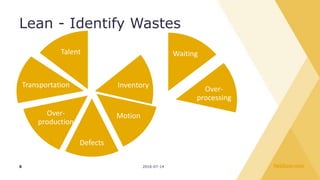
Lean - Identify Wastes
2016-07-148
Waiting
Over-
processing
Motion
Defects
Over-
production
Transportation
Talent
Inventory
2016-07-149
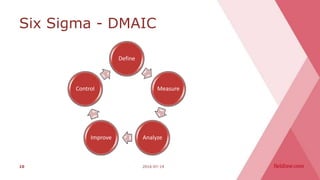
Six Sigma - DMAIC
Define
Measure
AnalyzeImprove
Control
2016-07-1410
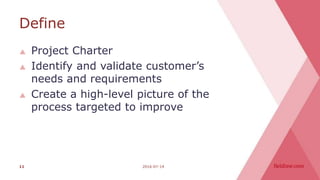
Define
 Project Charter
 Identify and validate customer’s
needs and requirements
 Create a high-level picture of the
process targeted to improve
2016-07-1411
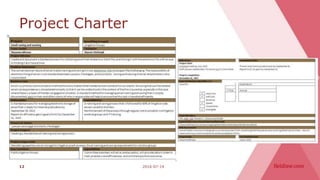
Project Charter
2016-07-1412
Project Charters
 What are we trying to achieve
 How do you build it?
• Cross functional team discussion
• Assignment by a Practice Group
• Dialog
• Ask lots of questions
 Think about who the customer of
the process is
2016-07-1413
Define
 Plan
• Know what you are trying to
accomplish, why, and who will be
affected
2016-07-1414
Measure
 Create a data collection plan
 Implement the plan, understand
the process in Sigma language
2016-07-1415
Measure
 Measurement methods
• Surveys (be careful how you ask)
• Data collection in accounting software
• Counting things
• Check sheets
2016-07-1416
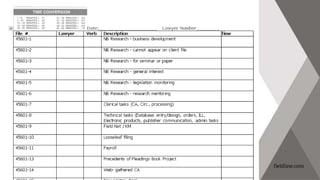
Check Sheet
2016-07-1417
Analyze
 Examine the data
 Watch the process
 Determine the root causes
2016-07-1418
Why is this happening?
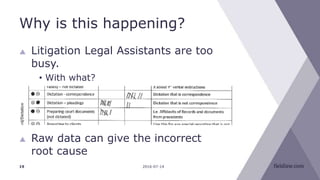
 Litigation Legal Assistants are too
busy.
• With what?
 Raw data can give the incorrect
root cause
2016-07-1419
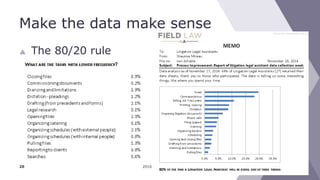
Make the data make sense
 The 80/20 rule
2016-07-1420
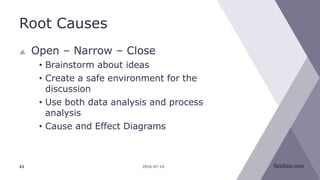
Root Causes
 Open – Narrow – Close
• Brainstorm about ideas
• Create a safe environment for the
discussion
• Use both data analysis and process
analysis
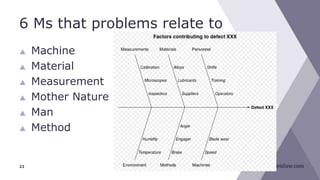
• Cause and Effect Diagrams
2016-07-1421
6 Ms that problems relate to
 Machine
 Material
 Measurement
 Mother Nature
 Man
 Method
2016-07-1422
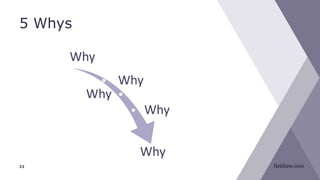
5 Whys
23
Why
Why
Why
Why
Why
Improve
 Generate solutions
 Select solutions
 Implement solutions
2016-07-1424
What If??
 Improve asks what if we did things
differently
• Tests and pilot groups with small teams
• Practice Groups trying different
methods
• Same output different process and
Measure
2016-07-1425
Example - Ordering Process
 Separate table in Access Database
for orders
 Titles on order not in the catalogue
for users
 What if we don’t keep an order
table?
2016-07-1426
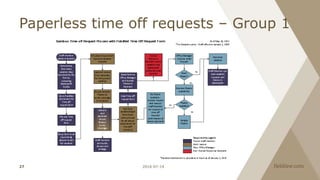
Paperless time off requests – Group 1
2016-07-1427
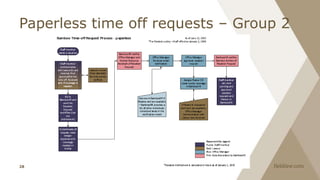
Paperless time off requests – Group 2
2016-07-1428
Improve
 Let the people doing the work tell
you where the problems are
 Let the people doing the work tell
you what the solutions are
2016-07-1429
Control
 Pick the right control method (how
are you going to test success)
 Document the response plan
2016-07-1430
Sustained Improvements with
Documentation
 Collect the story
 Share the story
 Understand the inputs were there
that impacted the decision (output)
 Embed the improvement (training)
 COMMUNICATION PLAN
2016-07-1431
Tools – Over share
 Action lists
 Progress reports
 Regular communication
 PLAN
2016-07-1432
Law librarians improving in the library
 Why are we doing things this way?
 Sacred cows
 Reporting requirements
2016-07-1433
Thanks!
smireau@fieldlaw.com P 780-423-7682 M 780-991-7682
2016-07-1434

E2853990.PPTX

  • 1.
  • 2.
    Law libraries areunder pressure to be better, faster, and cheaper. How can we achieve BFC while maintaining high quality services to our appreciative clients? This session will reveal how using the lens of Lean Six Sigma to review law library operations can build BFC opportunities that will also delight law library customers and stakeholders.
  • 3.
    Lean Six Sigmais trending to become the ‘new’ solution to pressures on the legal market place. Law librarians who can use Lean Six Sigma concepts will be able to cross pollinate library with management, increasing the relevance of the library as integral to the organization as a whole, not simply as a room or a team who are important to legal researchers.
  • 4.
    Why Better Fasterand Cheaper? 2016-07-144  Value • Something tangible is created • Correct the first time • Client will pay for it
  • 5.
    Lean Six Sigma 5 Lean • Eliminating waste  Six Sigma • Disciplined, data driven approach for eliminating defects  Process Improvement (PI)
  • 6.
    Everything is aprocess  Process is “a series of actions or steps taken in order to achieve a particular end”* 2016-07-146 *As a noun defined with a Google OneBox
  • 7.
    Asking the Question PI is about understanding what we do and why we do it  “Can we do this better” 2016-07-147
  • 8.
    Lean - IdentifyWastes 2016-07-148 Waiting Over- processing Motion Defects Over- production Transportation Talent Inventory
  • 9.
  • 10.
    Six Sigma -DMAIC Define Measure AnalyzeImprove Control 2016-07-1410
  • 11.
    Define  Project Charter Identify and validate customer’s needs and requirements  Create a high-level picture of the process targeted to improve 2016-07-1411
  • 12.
  • 13.
    Project Charters  Whatare we trying to achieve  How do you build it? • Cross functional team discussion • Assignment by a Practice Group • Dialog • Ask lots of questions  Think about who the customer of the process is 2016-07-1413
  • 14.
    Define  Plan • Knowwhat you are trying to accomplish, why, and who will be affected 2016-07-1414
  • 15.
    Measure  Create adata collection plan  Implement the plan, understand the process in Sigma language 2016-07-1415
  • 16.
    Measure  Measurement methods •Surveys (be careful how you ask) • Data collection in accounting software • Counting things • Check sheets 2016-07-1416
  • 17.
  • 18.
    Analyze  Examine thedata  Watch the process  Determine the root causes 2016-07-1418
  • 19.
    Why is thishappening?  Litigation Legal Assistants are too busy. • With what?  Raw data can give the incorrect root cause 2016-07-1419
  • 20.
    Make the datamake sense  The 80/20 rule 2016-07-1420
  • 21.
    Root Causes  Open– Narrow – Close • Brainstorm about ideas • Create a safe environment for the discussion • Use both data analysis and process analysis • Cause and Effect Diagrams 2016-07-1421
  • 22.
    6 Ms thatproblems relate to  Machine  Material  Measurement  Mother Nature  Man  Method 2016-07-1422
  • 23.
  • 24.
    Improve  Generate solutions Select solutions  Implement solutions 2016-07-1424
  • 25.
    What If??  Improveasks what if we did things differently • Tests and pilot groups with small teams • Practice Groups trying different methods • Same output different process and Measure 2016-07-1425
  • 26.
    Example - OrderingProcess  Separate table in Access Database for orders  Titles on order not in the catalogue for users  What if we don’t keep an order table? 2016-07-1426
  • 27.
    Paperless time offrequests – Group 1 2016-07-1427
  • 28.
    Paperless time offrequests – Group 2 2016-07-1428
  • 29.
    Improve  Let thepeople doing the work tell you where the problems are  Let the people doing the work tell you what the solutions are 2016-07-1429
  • 30.
    Control  Pick theright control method (how are you going to test success)  Document the response plan 2016-07-1430
  • 31.
    Sustained Improvements with Documentation Collect the story  Share the story  Understand the inputs were there that impacted the decision (output)  Embed the improvement (training)  COMMUNICATION PLAN 2016-07-1431
  • 32.
    Tools – Overshare  Action lists  Progress reports  Regular communication  PLAN 2016-07-1432
  • 33.
    Law librarians improvingin the library  Why are we doing things this way?  Sacred cows  Reporting requirements 2016-07-1433
  • 34.

Editor's Notes

  • #6 Eliminating waste and defects makes our Services Better – correct the first time Costs less time to produce them Faster and Cheaper